Who am I?
 Corneliu Balaban
 Mobile Engineering Manager @ Avira Romania
 Android aficionado with BI background
 Catching up on the “Kotlin for iOS” – Swift
 Passionate about BioMedical and AgriTech
What is this …
Kotlin?
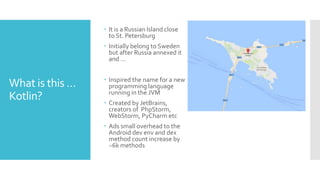
 It is a Russian Island close
to St. Petersburg
 Initially belong to Sweden
but after Russia annexed it
and …
 Inspired the name for a new
programming language
running in the JVM
 Created by JetBrains,
creators of PhpStorm,
WebStorm, PyCharm etc
 Ads small overhead to the
Android dev env and dex
method count increase by
~6k methods
What have we
been missing
inJava?
 No need for functional interfaces in order to implement own
higher functions and lambda’s
 Embedded lists iterators and mapping functions
 Class extensions (well… Swift has them)
 Strongly typed with inferred data types
 No elegant ways of avoiding NPE’s
Basic Kotlin
syntax
fun sayHello(name: String): Unit {
print("Hello ${name}!" + "Welcome to Bucharest Mobile Meetup");
}
OR
fun sayHello(name: String): Unit = print("Hello ${name}!" + "Welcome to Bucharest
Mobile Meetup");
OR
fun sayHello(name: String) = print("Hello ${name}!" + "Welcome to Bucharest
Mobile Meetup");
OOP concepts
Kotlin classes
 Inherit from Java’s equivalent of Object  Any
 By default are final
 Inheritance is enabled by prefixing the class with "open"
 Primary constructor is embedded in the class signature . It cannot
contain any code
 Secondary constructors are available. Need to delegate to primary
constructor
 init() methods come to the rescue
 Immutable variables are represented by the prefix "val" and can have
inferred data type
OOP concepts
Good ol' "bean"
 Easily accessible via "data classes"
 Makes a good separation of code if you want some objects that just
need to hold data
 Can make use of companion objects to hold “static” values
MoreOOP …
 Java developers love to be "static"
 Bad luck, there are no class level methods
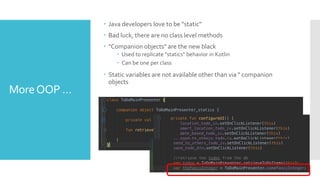
 "Companion objects" are the new black
 Used to replicate "statics" behavior in Kotlin
 Can be one per class
 Static variables are not available other than via " companion
objects
var, val … do I
need to know
them?
 Immutable objects/ variables are prefixed with "val"
 Can be initialized at declaration time. No data type needed as
inference works as a charm
 If they cannot be initialized at declaration time then data type is
mandatory
 Are there other kinds of immutable objects?
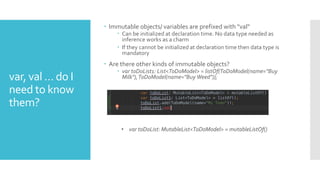
 var toDoList1: List<ToDoModel> = listOf(ToDoModel(name="Buy
Milk"),ToDoModel(name="Buy Weed"));
• var toDoList: MutableList<ToDoModel> = mutableListOf()
If val reffers to
immutable, do
I have project
level constants
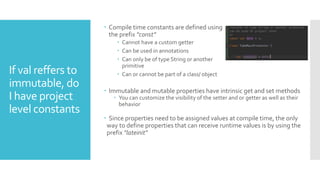
 Compile time constants are defined using
the prefix "const”
 Cannot have a custom getter
 Can be used in annotations
 Can only be of type String or another
primitive
 Can or cannot be part of a class/ object
 Immutable and mutable properties have intrinsic get and set methods
 You can customize the visibility of the setter and or getter as well as their
behavior
 Since properties need to be assigned values at compile time, the only
way to define properties that can receive runtime values is by using the
prefix "lateinit"
Optionals &
null safe
accessors
 Swift has them so why not Kotlin as well
 They are some weird implementation of Schroedingers cat
 Optional properties can contain a value or can be null
 Methods can return optionals as well
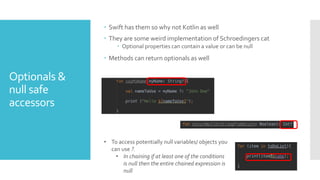
• To access potentially null variables/ objects you
can use ?.
• In chaining if at least one of the conditions
is null then the entire chained expression is
null
Loops,
operator
overloading
and string
interpolation
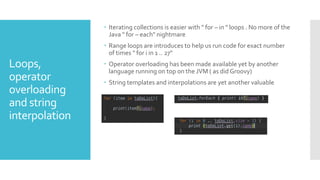
 Iterating collections is easier with " for – in " loops . No more of the
Java " for – each" nightmare
 Range loops are introduces to help us run code for exact number
of times " for i in 1 .. 27"
 Operator overloading has been made available yet by another
language running on top on the JVM ( as did Groovy)
 String templates and interpolations are yet another valuable
Lambdas and
higher order
functions
 Introduced in Java 8 but cumbersome to use.Why?
 Cumbersome to introduce as functional interfaces are needed
 Not backwards compatible
 Not really useful for Android developers as we are still stuck on Java
7
 Lambdas are natively supported by Kotlin
 Kotlin allows methods that can receive other functions as
parameters
 Also it allows the existence of functions outside classes which is
perfect for utils
Extensions
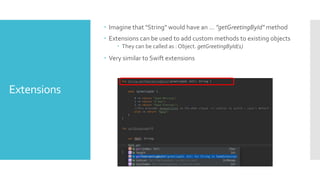
 Imagine that "String" would have an … ”getGreetingById" method
 Extensions can be used to add custom methods to existing objects
 They can be called as : Object. getGreetingById(1)
 Very similar to Swift extensions
Useful
resources
 Must try the "anko" library: https://github.com/Kotlin/anko
 Get dirty with Kotlin Koans here:
http://try.kotlinlang.org/#/Kotlin%20Koans/Introduction/Strings/T
ask.kt
 Try reading Antonio Leiva's Kotlin book:
https://leanpub.com/kotlin-for-android-developers
Oh, and one
more thing …
adding Kotlin
to your project
 Not going through all the steps ;)
 Check them here:
https://blog.jetbrains.com/kotlin/2013/08/working-with-kotlin-in-
android-studio/
Q &A

Kotlin presentation

  • 2.
    Who am I? Corneliu Balaban  Mobile Engineering Manager @ Avira Romania  Android aficionado with BI background  Catching up on the “Kotlin for iOS” – Swift  Passionate about BioMedical and AgriTech
  • 3.
    What is this… Kotlin?  It is a Russian Island close to St. Petersburg  Initially belong to Sweden but after Russia annexed it and …  Inspired the name for a new programming language running in the JVM  Created by JetBrains, creators of PhpStorm, WebStorm, PyCharm etc  Ads small overhead to the Android dev env and dex method count increase by ~6k methods
  • 4.
    What have we beenmissing inJava?  No need for functional interfaces in order to implement own higher functions and lambda’s  Embedded lists iterators and mapping functions  Class extensions (well… Swift has them)  Strongly typed with inferred data types  No elegant ways of avoiding NPE’s
  • 5.
    Basic Kotlin syntax fun sayHello(name:String): Unit { print("Hello ${name}!" + "Welcome to Bucharest Mobile Meetup"); } OR fun sayHello(name: String): Unit = print("Hello ${name}!" + "Welcome to Bucharest Mobile Meetup"); OR fun sayHello(name: String) = print("Hello ${name}!" + "Welcome to Bucharest Mobile Meetup");
  • 6.
    OOP concepts Kotlin classes Inherit from Java’s equivalent of Object  Any  By default are final  Inheritance is enabled by prefixing the class with "open"  Primary constructor is embedded in the class signature . It cannot contain any code  Secondary constructors are available. Need to delegate to primary constructor  init() methods come to the rescue  Immutable variables are represented by the prefix "val" and can have inferred data type
  • 7.
    OOP concepts Good ol'"bean"  Easily accessible via "data classes"  Makes a good separation of code if you want some objects that just need to hold data  Can make use of companion objects to hold “static” values
  • 8.
    MoreOOP …  Javadevelopers love to be "static"  Bad luck, there are no class level methods  "Companion objects" are the new black  Used to replicate "statics" behavior in Kotlin  Can be one per class  Static variables are not available other than via " companion objects
  • 9.
    var, val …do I need to know them?  Immutable objects/ variables are prefixed with "val"  Can be initialized at declaration time. No data type needed as inference works as a charm  If they cannot be initialized at declaration time then data type is mandatory  Are there other kinds of immutable objects?  var toDoList1: List<ToDoModel> = listOf(ToDoModel(name="Buy Milk"),ToDoModel(name="Buy Weed")); • var toDoList: MutableList<ToDoModel> = mutableListOf()
  • 10.
    If val reffersto immutable, do I have project level constants  Compile time constants are defined using the prefix "const”  Cannot have a custom getter  Can be used in annotations  Can only be of type String or another primitive  Can or cannot be part of a class/ object  Immutable and mutable properties have intrinsic get and set methods  You can customize the visibility of the setter and or getter as well as their behavior  Since properties need to be assigned values at compile time, the only way to define properties that can receive runtime values is by using the prefix "lateinit"
  • 11.
    Optionals & null safe accessors Swift has them so why not Kotlin as well  They are some weird implementation of Schroedingers cat  Optional properties can contain a value or can be null  Methods can return optionals as well • To access potentially null variables/ objects you can use ?. • In chaining if at least one of the conditions is null then the entire chained expression is null
  • 12.
    Loops, operator overloading and string interpolation  Iteratingcollections is easier with " for – in " loops . No more of the Java " for – each" nightmare  Range loops are introduces to help us run code for exact number of times " for i in 1 .. 27"  Operator overloading has been made available yet by another language running on top on the JVM ( as did Groovy)  String templates and interpolations are yet another valuable
  • 13.
    Lambdas and higher order functions Introduced in Java 8 but cumbersome to use.Why?  Cumbersome to introduce as functional interfaces are needed  Not backwards compatible  Not really useful for Android developers as we are still stuck on Java 7  Lambdas are natively supported by Kotlin  Kotlin allows methods that can receive other functions as parameters  Also it allows the existence of functions outside classes which is perfect for utils
  • 14.
    Extensions  Imagine that"String" would have an … ”getGreetingById" method  Extensions can be used to add custom methods to existing objects  They can be called as : Object. getGreetingById(1)  Very similar to Swift extensions
  • 15.
    Useful resources  Must trythe "anko" library: https://github.com/Kotlin/anko  Get dirty with Kotlin Koans here: http://try.kotlinlang.org/#/Kotlin%20Koans/Introduction/Strings/T ask.kt  Try reading Antonio Leiva's Kotlin book: https://leanpub.com/kotlin-for-android-developers
  • 16.
    Oh, and one morething … adding Kotlin to your project  Not going through all the steps ;)  Check them here: https://blog.jetbrains.com/kotlin/2013/08/working-with-kotlin-in- android-studio/
  • 17.