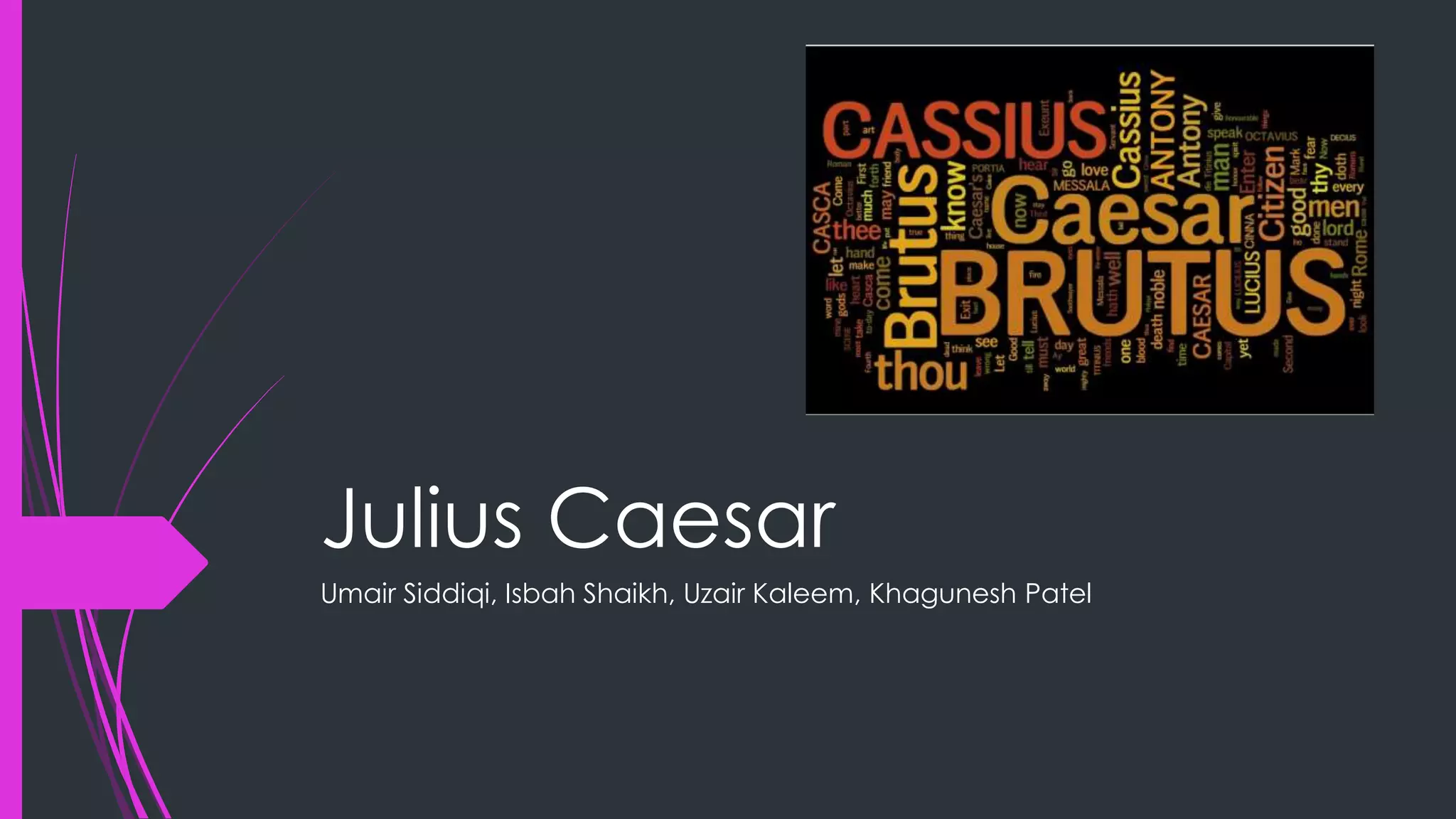
Julius Caesar 
Umair Siddiqi, Isbah Shaikh, Uzair Kaleem, Khagunesh Patel
Costume Designer 
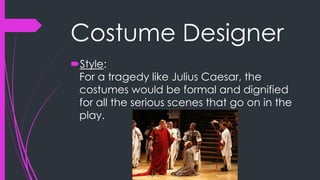
Style: 
For a tragedy like Julius Caesar, the 
costumes would be formal and dignified 
for all the serious scenes that go on in the 
play.
Costume Designer 
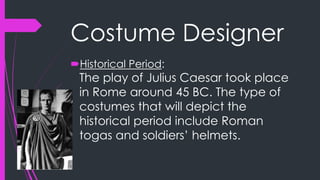
Historical Period: 
The play of Julius Caesar took place 
in Rome around 45 BC. The type of 
costumes that will depict the 
historical period include Roman 
togas and soldiers’ helmets.
Costume Designer 
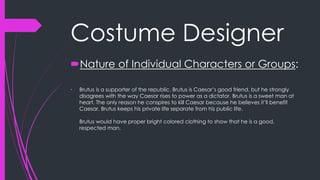
Nature of Individual Characters or Groups: 
• Brutus is a supporter of the republic. Brutus is Caesar’s good friend, but he strongly 
disagrees with the way Caesar rises to power as a dictator. Brutus is a sweet man at 
heart. The only reason he conspires to kill Caesar because he believes it’ll benefit 
Caesar. Brutus keeps his private life separate from his public life. 
Brutus would have proper bright colored clothing to show that he is a good, 
respected man.
Costume Designer 
Nature of Individual Characters or Groups: 
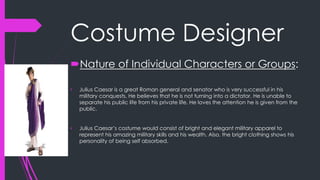
• Julius Caesar is a great Roman general and senator who is very successful in his 
military conquests. He believes that he is not turning into a dictator. He is unable to 
separate his public life from his private life. He loves the attention he is given from the 
public. 
• Julius Caesar’s costume would consist of bright and elegant military apparel to 
represent his amazing military skills and his wealth. Also, the bright clothing shows his 
personality of being self absorbed.
Costume Designer 
Nature of Individual Characters or Groups: 
• Conspirators: The two main men behind the murder of Caesar are Casca and 
Cassius. 
• Cassius is a talented general and longtime acquaintance of Caesar. He doesn’t like 
how Caesar is godlike now so he decided to kill Caesar. He is an impulsive and 
unscrupulous person. 
• Casca is a public figure who opposes Caesar. He believes that Caesar plays with the 
people into believing that he has no personal ambition. 
• The conspirators will have darker and more dull apparel to represent that they are 
the antagonists in this play.
Costume Designer 
Showing relationships and symbolic 
significance: 
 Julius Caesar and the conspirators will look more wealthy and have better 
looking apparel. This will distinguish the difference between the politicians 
and the commoners. 
 To show the relationship between the conspirators, the conspirators will 
have similar apparel that will match one another. 
 The symbolic looks will include Julius Caesar wearing bright colors signifying 
his greatness and the conspirators will wear dark apparel which will signify 
their dark motives and actions.
Costume Designer 
Meeting the needs of individual 
performers: 
 The performers will have light clothing. They will have light clothing 
because this will help the performers when the scenes with a lot of 
movements take place. It would make not as strenuous to do the 
actions.
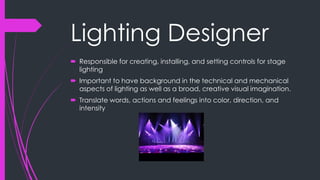
Lighting Designer 
 Responsible for creating, installing, and setting controls for stage 
lighting 
 Important to have background in the technical and mechanical 
aspects of lighting as well as a broad, creative visual imagination. 
 Translate words, actions and feelings into color, direction, and 
intensity
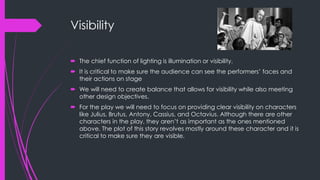
Visibility 
 The chief function of lighting is illumination or visibility. 
 It is critical to make sure the audience can see the performers’ faces and 
their actions on stage 
 We will need to create balance that allows for visibility while also meeting 
other design objectives. 
 For the play we will need to focus on providing clear visibility on characters 
like Julius, Brutus, Antony, Cassius, and Octavius. Although there are other 
characters in the play, they aren’t as important as the ones mentioned 
above. The plot of this story revolves mostly around these character and it is 
critical to make sure they are visible.
Shape and Form 
 Another goal of the lighting designer is to reveal objects as interesting as possible. 
 When you only have light from the top of the audience and from the front of the stage, the 
audience gets a flat uninteresting view. 
 The designer needs to make the play realistic by having lights and color from the side, top, and 
behind the actors. This will help enhance the actors and other visual elements. 
 Most of the play should contain lighting that reveals shape and form but there are three scenes in 
particular that should be focused on. 
 The first scene is where Julius is murdered. The lighting needs to be in a way that really signifies the 
importance of the murder but also the moment where Julius is stabbed. The audience needs to 
be able to see this part as accurately as possible. 
 The second scene that needs to be illuminated well is the part where the armies fight each other. 
Since this is part is also important, it also needs to look very realistic and clear to the audience. 
War isn’t something people experience everyday; we need to make it come alive. 
 The last scene that needs to stick out to the audience is when Brutus runs into his sword while 
Strato holds it. This part is crucial in the play because it shows that Brutus has had enough. He has 
seen Caesars ghost and knows they are about to lose the war. The audience needs to know of its 
importance.
Focus and Composition 
 In theater lighting, focus refers to the beams of light focused on one 
particular area. 
 Usually, the lighting will focus on a character or object and then leave the 
surrounding area either dim or completely black. This results in the 
audience focusing on that particular object/character. 
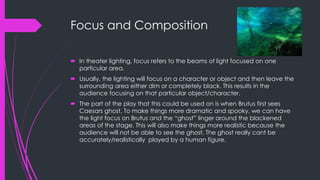
 The part of the play that this could be used on is when Brutus first sees 
Caesars ghost. To make things more dramatic and spooky, we can have 
the light focus on Brutus and the “ghost” linger around the blackened 
areas of the stage. This will also make things more realistic because the 
audience will not be able to see the ghost. The ghost really cant be 
accurately/realistically played by a human figure.
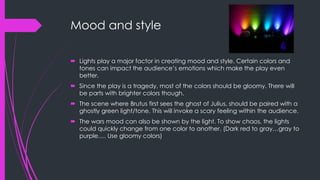
Mood and style 
 Lights play a major factor in creating mood and style. Certain colors and 
tones can impact the audience’s emotions which make the play even 
better. 
 Since the play is a tragedy, most of the colors should be gloomy. There will 
be parts with brighter colors though. 
 The scene where Brutus first sees the ghost of Julius, should be paired with a 
ghostly green light/tone. This will invoke a scary feeling within the audience. 
 The wars mood can also be shown by the light. To show chaos, the lights 
could quickly change from one color to another. (Dark red to gray…gray to 
purple…. Use gloomy colors)
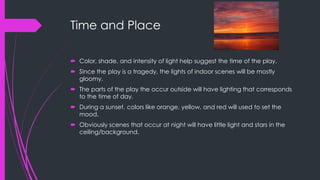
Time and Place 
 Color, shade, and intensity of light help suggest the time of the play. 
 Since the play is a tragedy, the lights of indoor scenes will be mostly 
gloomy. 
 The parts of the play the occur outside will have lighting that corresponds 
to the time of day. 
 During a sunset, colors like orange, yellow, and red will used to set the 
mood. 
 Obviously scenes that occur at night will have little light and stars in the 
ceiling/background.
Rhythm 
 It is important for light changes from scene to scene help establish the kind 
of rhythm and timing that the director needs for the audience to be drawn 
back into the action. 
 Abrupt, staccato changes with blackouts will unsettle and audience. 
 Slow fades and gradual cross fades allow for more thoughtful transitions. 
 Since the play has scenes that build off each other, we will have slow fade 
outs after each scene. This will give the audience time to think and also 
foreshadow future events.
Reinforcement of central image 
 The lighting must be consistent with the overall style and mood of 
the play. 
 Since this play has several locations where parts occur, it is 
important to make sure we have a smooth transition from our types 
of lighting. 
 When things are occurring outdoors, we will have natural colors that 
show the play is outside. When things are occurring inside, we will 
have things like candles and oil lamps.
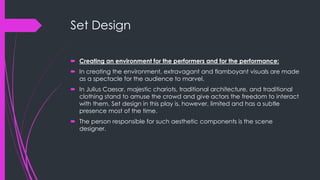
Set Design 
 Creating an environment for the performers and for the performance: 
 In creating the environment, extravagant and flamboyant visuals are made 
as a spectacle for the audience to marvel. 
 In Julius Caesar, majestic chariots, traditional architecture, and traditional 
clothing stand to amuse the crowd and give actors the freedom to interact 
with them. Set design in this play is, however, limited and has a subtle 
presence most of the time. 
 The person responsible for such aesthetic components is the scene 
designer.
Set Design 
 Helping set the mood and style of the production: 
 In the tragedy, Julius Caesar, the scenery is mostly straightforward. The set 
helps to convey the solemn theme when complemented with proper 
lighting. 
 Designers should establish the mood and style through architectural 
shapes, colors, fabrics, furniture, and other elements. 
 In the play, though only few are used, set pieces invoke a sense of 
seriousness.
Set Design 
 Helping distinguish realistic from non-realistic theatre 
 Realistic theatre calls for settings that are identical to their real life 
counterparts. 
 Nonrealistic theatre gives all creative freedom to the designer, and the use 
of important symbols. 
 In Julius Caesar, the realistic theatre design style supports the visual and 
thematic components of the play. It effectively conveyed the lifestyle and 
individual traits of each dynamic character.
Set Design 
 Establishing the locale and period in which the play takes place 
 The set should make evident the time period by displaying technologies or 
iconic items to that time. 
 Characters who also interact with set items can also give greater depth to 
their personality and intentions. 
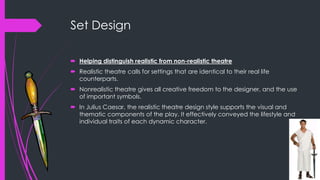
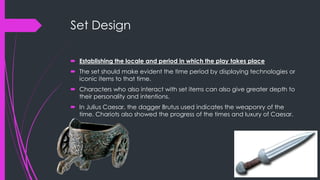
 In Julius Caesar, the dagger Brutus used indicates the weaponry of the 
time. Chariots also showed the progress of the times and luxury of Caesar.
Set Design 
 Evolving a design concept with the director and other designers 
 The design concept is a unifying idea carried out visually. 
 In depicting a time or place change in the play, the design concept is 
especially important. 
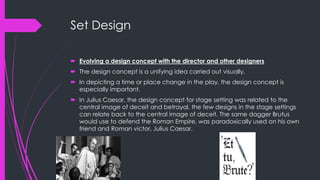
 In Julius Caesar, the design concept for stage setting was related to the 
central image of deceit and betrayal. the few designs in the stage settings 
can relate back to the central image of deceit. The same dagger Brutus 
would use to defend the Roman Empire, was paradoxically used on his own 
friend and Roman victor, Julius Caesar.
Set Design 
 Where appropriate, providing a central image or visual metaphor for the 
production. 
 The elements of design- lines, shapes, and colors add up to whole that is a 
motif through the play. It can also give greater weight to an underlying 
message. 
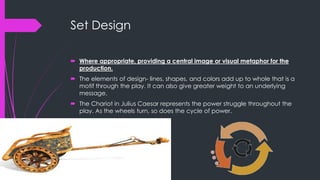
 The Chariot in Julius Caesar represents the power struggle throughout the 
play. As the wheels turn, so does the cycle of power.
Set Design 
 Ensuring that the scenery is coordinated with other production elements. 
 The directors concept is applied throughout the set designing/interaction 
process. Elements from the play remain consistent. 
 If the script and acting are realistic, the setting should not dominate the 
attention; if the script and acting are fictional, the setting should be 
extravagant and bold. 
 The settings in Julius Caesar seldom dominate the script and acting. It is 
consistent in sustaining a mood of seriousness.
Set Design 
 Solving practical design problems. 
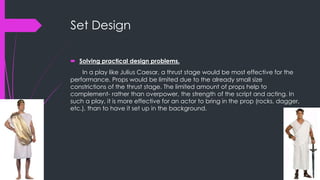
In a play like Julius Caesar, a thrust stage would be most effective for the 
performance. Props would be limited due to the already small size 
constrictions of the thrust stage. The limited amount of props help to 
complement- rather than overpower, the strength of the script and acting. In 
such a play, it is more effective for an actor to bring in the prop (rocks, dagger, 
etc.), than to have it set up in the background.
Director: 
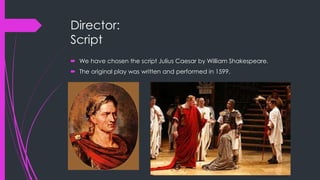
Script 
 We have chosen the script Julius Caesar by William Shakespeare. 
 The original play was written and performed in 1599.
Director: 
Casting 
 Julius Caesar – Johnny Depp 
 Brutus – Orlando Bloom 
 Antony – Leonardo Dicaprio 
 Cassius – Vin Diesel 
 Octavius – Will Arnett 
 Casca – Colin O’Donoghue 
 Calpurnia – Angelina Jolie 
 Portia – Kira Knightley 
 Flavius – Tom Hanks 
 Cicero – Brad Pitt 
 Lepidus – Robert Downey Jr. 
 Murellus – Christian Bale 
 Decius - Matt Damon
Director: 
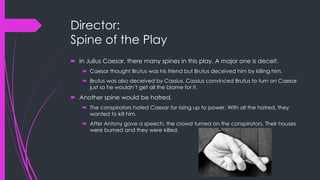
Spine of the Play 
 In Julius Caesar, there many spines in this play. A major one is deceit. 
 Caesar thought Brutus was his friend but Brutus deceived him by killing him. 
 Brutus was also deceived by Cassius. Cassius convinced Brutus to turn on Caesar 
just so he wouldn’t get all the blame for it. 
 Another spine would be hatred. 
 The conspirators hated Caesar for rising up to power. With all the hatred, they 
wanted to kill him. 
 After Antony gave a speech, the crowd turned on the conspirators. Their houses 
were burned and they were killed.
Director: 
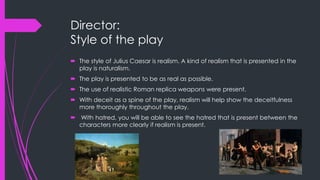
Style of the play 
 The style of Julius Caesar is realism. A kind of realism that is presented in the 
play is naturalism. 
 The play is presented to be as real as possible. 
 The use of realistic Roman replica weapons were present. 
 With deceit as a spine of the play, realism will help show the deceitfulness 
more thoroughly throughout the play. 
 With hatred, you will be able to see the hatred that is present between the 
characters more clearly if realism is present.
Director: 
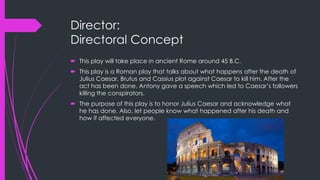
Directoral Concept 
 This play will take place in ancient Rome around 45 B.C. 
 This play is a Roman play that talks about what happens after the death of 
Julius Caesar. Brutus and Cassius plot against Caesar to kill him. After the 
act has been done, Antony gave a speech which led to Caesar’s followers 
killing the conspirators. 
 The purpose of this play is to honor Julius Caesar and acknowledge what 
he has done. Also, let people know what happened after his death and 
how if affected everyone.

Julius caesar

  • 1.
    Julius Caesar UmairSiddiqi, Isbah Shaikh, Uzair Kaleem, Khagunesh Patel
  • 2.
    Costume Designer Style: For a tragedy like Julius Caesar, the costumes would be formal and dignified for all the serious scenes that go on in the play.
  • 3.
    Costume Designer HistoricalPeriod: The play of Julius Caesar took place in Rome around 45 BC. The type of costumes that will depict the historical period include Roman togas and soldiers’ helmets.
  • 4.
    Costume Designer Natureof Individual Characters or Groups: • Brutus is a supporter of the republic. Brutus is Caesar’s good friend, but he strongly disagrees with the way Caesar rises to power as a dictator. Brutus is a sweet man at heart. The only reason he conspires to kill Caesar because he believes it’ll benefit Caesar. Brutus keeps his private life separate from his public life. Brutus would have proper bright colored clothing to show that he is a good, respected man.
  • 5.
    Costume Designer Natureof Individual Characters or Groups: • Julius Caesar is a great Roman general and senator who is very successful in his military conquests. He believes that he is not turning into a dictator. He is unable to separate his public life from his private life. He loves the attention he is given from the public. • Julius Caesar’s costume would consist of bright and elegant military apparel to represent his amazing military skills and his wealth. Also, the bright clothing shows his personality of being self absorbed.
  • 6.
    Costume Designer Natureof Individual Characters or Groups: • Conspirators: The two main men behind the murder of Caesar are Casca and Cassius. • Cassius is a talented general and longtime acquaintance of Caesar. He doesn’t like how Caesar is godlike now so he decided to kill Caesar. He is an impulsive and unscrupulous person. • Casca is a public figure who opposes Caesar. He believes that Caesar plays with the people into believing that he has no personal ambition. • The conspirators will have darker and more dull apparel to represent that they are the antagonists in this play.
  • 7.
    Costume Designer Showingrelationships and symbolic significance:  Julius Caesar and the conspirators will look more wealthy and have better looking apparel. This will distinguish the difference between the politicians and the commoners.  To show the relationship between the conspirators, the conspirators will have similar apparel that will match one another.  The symbolic looks will include Julius Caesar wearing bright colors signifying his greatness and the conspirators will wear dark apparel which will signify their dark motives and actions.
  • 8.
    Costume Designer Meetingthe needs of individual performers:  The performers will have light clothing. They will have light clothing because this will help the performers when the scenes with a lot of movements take place. It would make not as strenuous to do the actions.
  • 9.
    Lighting Designer Responsible for creating, installing, and setting controls for stage lighting  Important to have background in the technical and mechanical aspects of lighting as well as a broad, creative visual imagination.  Translate words, actions and feelings into color, direction, and intensity
  • 10.
    Visibility  Thechief function of lighting is illumination or visibility.  It is critical to make sure the audience can see the performers’ faces and their actions on stage  We will need to create balance that allows for visibility while also meeting other design objectives.  For the play we will need to focus on providing clear visibility on characters like Julius, Brutus, Antony, Cassius, and Octavius. Although there are other characters in the play, they aren’t as important as the ones mentioned above. The plot of this story revolves mostly around these character and it is critical to make sure they are visible.
  • 11.
    Shape and Form  Another goal of the lighting designer is to reveal objects as interesting as possible.  When you only have light from the top of the audience and from the front of the stage, the audience gets a flat uninteresting view.  The designer needs to make the play realistic by having lights and color from the side, top, and behind the actors. This will help enhance the actors and other visual elements.  Most of the play should contain lighting that reveals shape and form but there are three scenes in particular that should be focused on.  The first scene is where Julius is murdered. The lighting needs to be in a way that really signifies the importance of the murder but also the moment where Julius is stabbed. The audience needs to be able to see this part as accurately as possible.  The second scene that needs to be illuminated well is the part where the armies fight each other. Since this is part is also important, it also needs to look very realistic and clear to the audience. War isn’t something people experience everyday; we need to make it come alive.  The last scene that needs to stick out to the audience is when Brutus runs into his sword while Strato holds it. This part is crucial in the play because it shows that Brutus has had enough. He has seen Caesars ghost and knows they are about to lose the war. The audience needs to know of its importance.
  • 12.
    Focus and Composition  In theater lighting, focus refers to the beams of light focused on one particular area.  Usually, the lighting will focus on a character or object and then leave the surrounding area either dim or completely black. This results in the audience focusing on that particular object/character.  The part of the play that this could be used on is when Brutus first sees Caesars ghost. To make things more dramatic and spooky, we can have the light focus on Brutus and the “ghost” linger around the blackened areas of the stage. This will also make things more realistic because the audience will not be able to see the ghost. The ghost really cant be accurately/realistically played by a human figure.
  • 13.
    Mood and style  Lights play a major factor in creating mood and style. Certain colors and tones can impact the audience’s emotions which make the play even better.  Since the play is a tragedy, most of the colors should be gloomy. There will be parts with brighter colors though.  The scene where Brutus first sees the ghost of Julius, should be paired with a ghostly green light/tone. This will invoke a scary feeling within the audience.  The wars mood can also be shown by the light. To show chaos, the lights could quickly change from one color to another. (Dark red to gray…gray to purple…. Use gloomy colors)
  • 14.
    Time and Place  Color, shade, and intensity of light help suggest the time of the play.  Since the play is a tragedy, the lights of indoor scenes will be mostly gloomy.  The parts of the play the occur outside will have lighting that corresponds to the time of day.  During a sunset, colors like orange, yellow, and red will used to set the mood.  Obviously scenes that occur at night will have little light and stars in the ceiling/background.
  • 15.
    Rhythm  Itis important for light changes from scene to scene help establish the kind of rhythm and timing that the director needs for the audience to be drawn back into the action.  Abrupt, staccato changes with blackouts will unsettle and audience.  Slow fades and gradual cross fades allow for more thoughtful transitions.  Since the play has scenes that build off each other, we will have slow fade outs after each scene. This will give the audience time to think and also foreshadow future events.
  • 16.
    Reinforcement of centralimage  The lighting must be consistent with the overall style and mood of the play.  Since this play has several locations where parts occur, it is important to make sure we have a smooth transition from our types of lighting.  When things are occurring outdoors, we will have natural colors that show the play is outside. When things are occurring inside, we will have things like candles and oil lamps.
  • 17.
    Set Design Creating an environment for the performers and for the performance:  In creating the environment, extravagant and flamboyant visuals are made as a spectacle for the audience to marvel.  In Julius Caesar, majestic chariots, traditional architecture, and traditional clothing stand to amuse the crowd and give actors the freedom to interact with them. Set design in this play is, however, limited and has a subtle presence most of the time.  The person responsible for such aesthetic components is the scene designer.
  • 18.
    Set Design Helping set the mood and style of the production:  In the tragedy, Julius Caesar, the scenery is mostly straightforward. The set helps to convey the solemn theme when complemented with proper lighting.  Designers should establish the mood and style through architectural shapes, colors, fabrics, furniture, and other elements.  In the play, though only few are used, set pieces invoke a sense of seriousness.
  • 19.
    Set Design Helping distinguish realistic from non-realistic theatre  Realistic theatre calls for settings that are identical to their real life counterparts.  Nonrealistic theatre gives all creative freedom to the designer, and the use of important symbols.  In Julius Caesar, the realistic theatre design style supports the visual and thematic components of the play. It effectively conveyed the lifestyle and individual traits of each dynamic character.
  • 20.
    Set Design Establishing the locale and period in which the play takes place  The set should make evident the time period by displaying technologies or iconic items to that time.  Characters who also interact with set items can also give greater depth to their personality and intentions.  In Julius Caesar, the dagger Brutus used indicates the weaponry of the time. Chariots also showed the progress of the times and luxury of Caesar.
  • 21.
    Set Design Evolving a design concept with the director and other designers  The design concept is a unifying idea carried out visually.  In depicting a time or place change in the play, the design concept is especially important.  In Julius Caesar, the design concept for stage setting was related to the central image of deceit and betrayal. the few designs in the stage settings can relate back to the central image of deceit. The same dagger Brutus would use to defend the Roman Empire, was paradoxically used on his own friend and Roman victor, Julius Caesar.
  • 22.
    Set Design Where appropriate, providing a central image or visual metaphor for the production.  The elements of design- lines, shapes, and colors add up to whole that is a motif through the play. It can also give greater weight to an underlying message.  The Chariot in Julius Caesar represents the power struggle throughout the play. As the wheels turn, so does the cycle of power.
  • 23.
    Set Design Ensuring that the scenery is coordinated with other production elements.  The directors concept is applied throughout the set designing/interaction process. Elements from the play remain consistent.  If the script and acting are realistic, the setting should not dominate the attention; if the script and acting are fictional, the setting should be extravagant and bold.  The settings in Julius Caesar seldom dominate the script and acting. It is consistent in sustaining a mood of seriousness.
  • 24.
    Set Design Solving practical design problems. In a play like Julius Caesar, a thrust stage would be most effective for the performance. Props would be limited due to the already small size constrictions of the thrust stage. The limited amount of props help to complement- rather than overpower, the strength of the script and acting. In such a play, it is more effective for an actor to bring in the prop (rocks, dagger, etc.), than to have it set up in the background.
  • 25.
    Director: Script We have chosen the script Julius Caesar by William Shakespeare.  The original play was written and performed in 1599.
  • 26.
    Director: Casting Julius Caesar – Johnny Depp  Brutus – Orlando Bloom  Antony – Leonardo Dicaprio  Cassius – Vin Diesel  Octavius – Will Arnett  Casca – Colin O’Donoghue  Calpurnia – Angelina Jolie  Portia – Kira Knightley  Flavius – Tom Hanks  Cicero – Brad Pitt  Lepidus – Robert Downey Jr.  Murellus – Christian Bale  Decius - Matt Damon
  • 27.
    Director: Spine ofthe Play  In Julius Caesar, there many spines in this play. A major one is deceit.  Caesar thought Brutus was his friend but Brutus deceived him by killing him.  Brutus was also deceived by Cassius. Cassius convinced Brutus to turn on Caesar just so he wouldn’t get all the blame for it.  Another spine would be hatred.  The conspirators hated Caesar for rising up to power. With all the hatred, they wanted to kill him.  After Antony gave a speech, the crowd turned on the conspirators. Their houses were burned and they were killed.
  • 28.
    Director: Style ofthe play  The style of Julius Caesar is realism. A kind of realism that is presented in the play is naturalism.  The play is presented to be as real as possible.  The use of realistic Roman replica weapons were present.  With deceit as a spine of the play, realism will help show the deceitfulness more thoroughly throughout the play.  With hatred, you will be able to see the hatred that is present between the characters more clearly if realism is present.
  • 29.
    Director: Directoral Concept  This play will take place in ancient Rome around 45 B.C.  This play is a Roman play that talks about what happens after the death of Julius Caesar. Brutus and Cassius plot against Caesar to kill him. After the act has been done, Antony gave a speech which led to Caesar’s followers killing the conspirators.  The purpose of this play is to honor Julius Caesar and acknowledge what he has done. Also, let people know what happened after his death and how if affected everyone.