STAGE LAYOUT
DIRECTION
What are stage directions?
Stage directions are instructions in the script
of a play that tell actors how to enter, where
to stand, when to move, also information
about the lighting, scenery, props, and
sound effects.
Stage directions give vital information for
the action and relationships between
people, things and places inside the play
script. They also can be used to tell an
actor how to shape his or her
performance.
The stage directions are used to
describe:
a) The setting
b) How the character feels
c) How the character moves
​d) How the character speaks
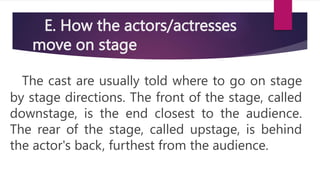
E. How the actors/actresses
move on stage
The cast are usually told where to go on stage
by stage directions. The front of the stage, called
downstage, is the end closest to the audience.
The rear of the stage, called upstage, is behind
the actor's back, furthest from the audience.
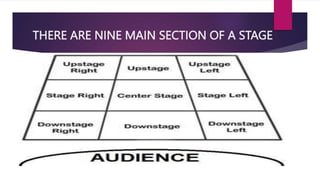
THERE ARE NINE MAIN SECTION OF A STAGE
They are often in abbreviated form. Here's
what they mean:
C: Center stage D: Downstage
U: Upstage R: Right
L: Left DR: Downstage right
DL: Downstage left UR: Upstage right
UL: Upstage left
The nine positions on a stage above are from the
performer's perspective on a proscenium stage.
These are important because they will guide the
performers as to where they go. Also, this will tell
you where to place the scenery, furniture and other
props.
 Upstage - this means away from the stage front. In the
proscenium stage, this usually serves as the entrance or
exit of the performers. It is where crosses or counter
crosses of the actors and actresses take place (see figure
 1). When a performer is on the upstage, she/he can be
seen as lesser important than the one on the downstage.
b. Center stage- the center of the playing area
c. Downstage- the area closest to the audience, when
a character is placed in this area, this leaves the
impression that he she is an important character.
Note: downstage and upstage cannot be used in
other types of stages but proscenium only.

STAGE LAYOUT DIRECTION.pptx

  • 1.
  • 2.
    What are stagedirections? Stage directions are instructions in the script of a play that tell actors how to enter, where to stand, when to move, also information about the lighting, scenery, props, and sound effects.
  • 3.
    Stage directions givevital information for the action and relationships between people, things and places inside the play script. They also can be used to tell an actor how to shape his or her performance.
  • 4.
    The stage directionsare used to describe: a) The setting b) How the character feels c) How the character moves ​d) How the character speaks
  • 5.
    E. How theactors/actresses move on stage The cast are usually told where to go on stage by stage directions. The front of the stage, called downstage, is the end closest to the audience. The rear of the stage, called upstage, is behind the actor's back, furthest from the audience.
  • 6.
    THERE ARE NINEMAIN SECTION OF A STAGE
  • 7.
    They are oftenin abbreviated form. Here's what they mean: C: Center stage D: Downstage U: Upstage R: Right L: Left DR: Downstage right DL: Downstage left UR: Upstage right UL: Upstage left
  • 8.
    The nine positionson a stage above are from the performer's perspective on a proscenium stage. These are important because they will guide the performers as to where they go. Also, this will tell you where to place the scenery, furniture and other props.
  • 9.
     Upstage -this means away from the stage front. In the proscenium stage, this usually serves as the entrance or exit of the performers. It is where crosses or counter crosses of the actors and actresses take place (see figure  1). When a performer is on the upstage, she/he can be seen as lesser important than the one on the downstage.
  • 10.
    b. Center stage-the center of the playing area c. Downstage- the area closest to the audience, when a character is placed in this area, this leaves the impression that he she is an important character. Note: downstage and upstage cannot be used in other types of stages but proscenium only.