PRESIDENT OF INDIA
• Head of the Union Executive is the President
•It also includes the PM & Councils of Ministers
•Real Executive Powers are vested in the councils of
minister
•Art. 53, The executive powers of the president are exercised
by him directly or through officers subordinate to him in
accordance with the constitution
ELECTION
• Elected by indirect election
• Electoral college in accordance with the system of
proportional representation by means of single transferable
vote
• Electoral college consists of:-
– The elected members of both Houses of Parliament
– The elected members of the state
• Indirect method is adopted because the size of the electorate
in India is too big
• Direct election of President would mean a tremendous loss
of time, money and energy
Procedures
• Art. 55, election of president shall be held in
accordance with the system of proportional
representation by means of single transferable
vote
• Secure absolute majority in the Presidential
election
• Envisages quota system
• The quota is 50%+1 of the votes
Procedures
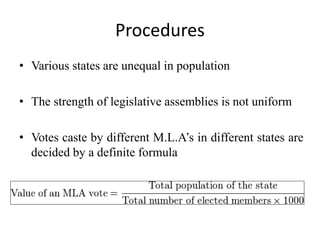
• Various states are unequal in population
• The strength of legislative assemblies is not uniform
• Votes caste by different M.L.A’s in different states are
decided by a definite formula
Procedures
• In this manner the total number of votes cast
by all M.L.A.’s are counted
• Those votes will be divided by the total
number of the elected M.P.’s of both the
Houses of Parliament and each M.P.
• Thus M.P. will have the number of votes as
decided by the following formula
Total votes casted by all M.L.A.’s
Total No. of elected M.P.’s
Procedures
1. First formula is used to give weight to the
population of each state
2. Second formula is used to bring a party
between the votes of all M.L.A.’s and those
of all M.P.’s.
Qualifications
• Citizen of India
• Completed 35 years of age
• Qualified for the election as a member of the
Lok Sabha
• Not hold any office of profit under the govt. of
India, state govt. of any local authority.
• Shall not be a member of either Hose of
People or House of legislature of any state
Term of Office
• 5 years from the date on which he enters upon
his office
• Eligible for re-election
• His office can be terminated in either of two
ways:-
– By resignation in writing under his hand addressed
to the Vice-President of India
– BY removal of violation of the constitution by the
process of impeachment
Powers of the president
• Art. 53, executive powers are vested in the
president
• Head of the executive power of union
• Not answerable to any court with exercise of
his powers
• Enjoy certain personal and legal immunities
• Armed with enormous power
Powers of The President
• Classified as follows:-
– Executive Powers
– Legislative Powers
– Financial Powers
– Judicial Powers
– Emergency Powers
– Miscellaneous Powers
Executive Powers
• Executive Powers are vested in President
• Exercise the powers directly or through his
subordinates
• Supreme command of Defence Forces
• Art.72, Power to grant pardons, reprieves,
respites or remission for punishment
• To remit or commute the sentences of any
person convicted of any offence
Executive Powers
• Appoint PM
• With the advice of PM make other
appointments, like Attorney General, Chief
Justice of SC and those of HC
• Members of UPSC, Election Commissioner,
Governor of State, Chief Commissioners of
Union Territories etc.
• Every appointment in central govt. is in the
name of President or under his authority
Executive Powers
• Represent the nation in the eyes of foreign
countries
• Sends and receives ambassadors and other
diplomatic agents from other countries
• War & peace are declared in his name
• Can issue directives to the state Governors in
certain executive matters
• Responsible for the administration of Union
Territories
Executive Powers
• Under certain conditions he can remove Chief
Justice of India, other judges of SC & HC
• Can remove chairman and members of the
Union & State Public Service Commission
Legislative Powers
• Cover a wide Field
• Integral part of the legislative process
• Assent to pass any money bill by parliament to
become law
• Summons, Prologue the both houses of
parliament
• Can dissolve Lok Sabha
• Select/nominate members in LS
Legislative Powers
• Certain bill needs prior assent to present before the
parliament
• He may withheld his assent or may return the bill to the
Houses for reconsideration on the lines suggested by him
• Formation of State, boundaries, alteration of area or names
of the existing state needs recommendation of the president
• Take over the administration of the state
• Exercise Veto on the advice of Union Cabinet
Financial Powers
• Every financial year, cause to laid before both
the house of parliament a statement of the
estimated receipts and expenditure of GOI
fro that year
• Can ask supplementary, additional, or excess
grants
• Money bill
• Enhancement or reduction of taxes
• Amendment or abolishment of any tax
Financial Powers
• Laid before the Parliament the Annual Financial
Statement, Report of Auditor General of India,
Relating to the Accounts of the GOI
• Recommendations made by the finance
commission, annual report of the Union Public
Service Commission
• Contingency Fund for unforeseen expenditure
• Expenditure must be approved by the Parliament
Judicial Power
• Enormous Judicial Power
– Grant Pardon
– Reprieves (cancel or postpone the punishment)
– Respite (a short period of rest or relief)
– Remission of punishment (the cancellation of a debt,
charge, or penalty.)
– Suspend, remit, commute (travel) the sentence of any
person convicted of any offence in all cases
– Where the punishment is by court- Martial and in all
cases the sentence is one of death
Judicial Power
• President is above law
• Not subject to the scrutiny of the any court
• Appoint Judges of SC & HC
• Art.143, he can ask SC any question of Law or
fact of public importance for its advisory
opinion
• Approval is necessary for the rules made by
SC for regulating practice and procedure of the
court
Emergency Powers
• Deal with unseen contingencies
• Part XVIII deal with emergency powers
• 3 kind of emergency
– Arising war or external aggression and internal
aggression
– Breakdown of constitutional machinery
– Financial emergency
National Emergency
• Emergency condition must laid before the house of
parliament
• Art.352, National Emergency, issue of proclamation of
emergency
• Remains valid for an indefinite period, unless president
revokes it
• 25th June 1975, hatred of internal threatened the very unity
and integrity of India
Constitutional Emergency
• Art. 356, Breakdown of constitution
• President take over the administration of the state
• President’s Rule of emergency
• Governor of state is not satisfied with situation arises, state
cannot be carried on in accordance with the provisions of
the constitution
• Approved by parliament within two months
• Remains in force for six months
• Can be extended for another six months
• Except High Court all the functions of state govt. are taken
over by the president
Financial Emergency
• Art.360, Situation arises that the financial stability in
INDIA or any part of it is threatened
• Remains valid for an indefinite period, unless president
revokes it
• Approved by the parliament, within two months
• Salary of any state govt. or union govt. servants may be
reduced
• Allocation of revenue between central and state may be
altered
• President may give direction to the state
Miscellaneous Powers
• Instruction to governor
• Refer any question of public importance for the opinion of
the SC
• Appoint Certain commissions:-
– Report on administration of scheduled areas and welfare
of schedule tribes & backward classes, Finance
commission
• Administration of tribal areas
• Powers and responsibilities as regards schedule castes and
tribes.
Councils of Minister
• President is constitutional Head
• Real executive of the Indian Union is Councils of Minister
• Actually Exercise the powers
• Art.74, Councils of ministers with PM
• PM as the head to aid the advise the President
• Responsible for the house of people
• Hold the office during the pleasure of the president
Formation
• Art.75, PM appointed by President
• Other ministers appointed by President on the advice of the
PM
• Free hand to appoint PM, but little opportunity of exercising
his personal choice in appointing PM
• Normally appoint the leader of the Majority Party in Lok
Sabha as the PM
• In case, if no party command clear majority, the President
may have some freedom of choice
• In 1996 – BJP- Atal Bihari Bajpayee & Deoganda (Leader
of United Front)
Formation
• PM is solely responsible for the formation of COM
• COM will be large or small is a matter in which PM decides
on administrative and political grounds.
• 3 categories of Ministers
– Cabinet
– Ministers of state
– Deputy Ministers
Difference Between COM & Cabinet
• Consist of top-ranking ministers, Decides mostly the policy
matters
• All cabinet members are ministers, all ministers are not
cabinet ministers
• Minister of state & deputy ministers do not attend the
cabinet meetings, unless specially invited
• No voice in formation of Govt. Policy, Parliamentary
Secretaries
Difference Between COM & Cabinet
• COM is a big body includes all categories of ministers,
Cabinet is smaller body consist of few members who are in
charge of separate departments.
• Cabinet is called as – “ A wheel within a wheel”
• Cabinet usually consist of 10 to 20 members
Functions
• COM and cabinet are the real executive head of
the govt.
• Take decisions in all administrative matters
• Collectively responsible to parliament
• A minister is free to give dissent while policy is in
the stage of discussion
• Cabinet occupies powerful position in parliament
Functions
• Union cabinet formulates the general policy of
country
• Shapes foreign relations
• Decide which taxes should be imposed, abolish,
reduced etc.
• How the national income should be spent
• Cabinet controls the budget, administrative
machinery of the country
Functions
• Coordinate the working of various departments of the govt.
such as:-
– Finance
– Home Defence
– Commerce
– Labour etc.
• To settle down the differences between the two department
• Conflicts are also resolved in the cabinet meetings
Committees of Cabinet
• The Size of committee is not uniform
• There are 10 standing committees
– Economic Committee: Directs and coordinated all
govt. activities in the economic field, regulate
working of national economy
– Heavy Industries Committee: Brings co-
ordination in all levels in the heavy industries in
the public sector
– Defence Committee: matters relating to the
defence of the country
Committees of Cabinet
– Foreign affairs committee: deals with all matters
related to foreign affairs
– Parliamentary & legal affairs Committee:
Watch progress, work of the govt., Scrutinizes bill
& attitude of the govt., take reviews all legislation
undertaken by various legislature
– The Rehabilitation Committee: Relief and
rehabilitation of displaced persons
Committees of Cabinet
– Information & Broadcasting Committee: Directs, co-
ordinates information activities (Govt., Press, Public),
formulate broadcasting polices
– The man-power committee: Consider the problem of man-
power in an integrated manner
– The scientific committee: advice the cabinet in formulation
and implementation of the policy with regard to scientific
affairs, co-ordinates scientific work by various ministers and
semi-govt. scientific institutions
– The appointment committee: all recommendations for
secretaries appointments of the rank of deputy secretaries
THE PM OF INDIA
• Real power rests with him and not the POI
• Art.74, - COM with PM at the head to aid &
advice President
• Exercise his functions
• Art.75, Appointment of PM
• Art.78, Duties & function of PM
THE PM OF INDIA
• Key stone of the cabinet
• Success of govt. depends upon the personality,
character and ability of PM
• Appointment:-
– Art.75, Appointed by POI
– Other ministers appointed with the advice of PM
– Art. 75 doest not say that the PM must necessarily
belong to Lok Sabha or Rajya Sabha
– POI can appoint a person as a PM, who is not a
member of legislature for a period of 6 month
THE PM OF INDIA
• Appointment:-
– Parliamentary govt. says that PM should a person
who commands majority votes in Lok Sabha
– Personal likes or dislike does not matters
– If no majority, President call upon the leader of
any party
Functions of PM
• Formation of the ministry
• Distribution of Portfolios
• Leader of Nation
• Advisor to the President
• Chief Coordinator
• Supervisory Functions
• Chairmanship Function
• Party Function
Formation of the Ministry
• Select the other ministers & present a list to
the president
• President has no other alternative but appoint
the ministers as recommended by PM
• PM is central to its life and death (Formation)
• Resignation of PM means Resignation of
whole ministry
Formation of the Ministry
• PM can change the portfolio
• Dismiss or ask for the resignation of his
colleagues
• Presides over the meetings of the cabinet
• Initiate discussion, determine the order of
discussion and sum it up.
• Efficiency of cabinet depends upon capacity of
PM
• Provide leadership in the cabinet
Distribution of Portfolios
• Distribute portfolios among the ministers
• Have a free hand in assigning various departments to
his colleagues
• Can create new ministers or merge those ministry
which previously separate
• Determine the size of cabinet and ministers to be
included in it
• Important members of the party do get the
important portfolios
Distribution of Portfolios
• Ministers are selected from all parts of the
country
• Can reshuffle the portfolios
• Can ask for the resignation of any minister
• Cannot ignore urban and rural interest
Leader of nation
• Spokesman of the governmental policies in
the parliament
• All important policy announcements are
made by him
• Leader of majority party
• General election in reality is the election of
PM
Advisor to the President
• Sole advisor to President
• Right to advise for dissolution of LS
• Only channel of communication between President and
cabinet
• Informs about all decision taken in the cabinet
• If president do not accept the advise, PM may resign
• PM enjoys the majority & confidence in Parliament,
then it is difficult for president to dismiss him
Chief Coordinator
• Coordinator of policies of various ministries
• Act as mediator when there is conflict between two
ministers
• Keeps an eye on the working of all departments of
GOI
• Ask for any file from any ministry for his perusal
• Vigilant regarding the working of the important
departments like Finance, Defence, Home, Foreign
Affairs etc.
Supervisory Functions
• Supervises the work of ministers
• Decisions should be actually carried out
• Supervise the work of each departments
• Difficult to control powerful colleague
• Special and keen interest in economic
planning of the country & foreign affairs
Chairmanship Function
• Chairman of the cabinet committees
• Head of the council of ministers
• Chairman of various standing committees of
the cabinet
• Fixes agenda of cabinet meetings
• Warn, advise, encourage them in discharging
their functions
Party Function
• Position of PM is linked with his party
• Numerically strong in parliament
• Control over his party
• Impose the decisions

President

  • 1.
    PRESIDENT OF INDIA •Head of the Union Executive is the President •It also includes the PM & Councils of Ministers •Real Executive Powers are vested in the councils of minister •Art. 53, The executive powers of the president are exercised by him directly or through officers subordinate to him in accordance with the constitution
  • 2.
    ELECTION • Elected byindirect election • Electoral college in accordance with the system of proportional representation by means of single transferable vote • Electoral college consists of:- – The elected members of both Houses of Parliament – The elected members of the state • Indirect method is adopted because the size of the electorate in India is too big • Direct election of President would mean a tremendous loss of time, money and energy
  • 3.
    Procedures • Art. 55,election of president shall be held in accordance with the system of proportional representation by means of single transferable vote • Secure absolute majority in the Presidential election • Envisages quota system • The quota is 50%+1 of the votes
  • 4.
    Procedures • Various statesare unequal in population • The strength of legislative assemblies is not uniform • Votes caste by different M.L.A’s in different states are decided by a definite formula
  • 5.
    Procedures • In thismanner the total number of votes cast by all M.L.A.’s are counted • Those votes will be divided by the total number of the elected M.P.’s of both the Houses of Parliament and each M.P. • Thus M.P. will have the number of votes as decided by the following formula Total votes casted by all M.L.A.’s Total No. of elected M.P.’s
  • 6.
    Procedures 1. First formulais used to give weight to the population of each state 2. Second formula is used to bring a party between the votes of all M.L.A.’s and those of all M.P.’s.
  • 7.
    Qualifications • Citizen ofIndia • Completed 35 years of age • Qualified for the election as a member of the Lok Sabha • Not hold any office of profit under the govt. of India, state govt. of any local authority. • Shall not be a member of either Hose of People or House of legislature of any state
  • 8.
    Term of Office •5 years from the date on which he enters upon his office • Eligible for re-election • His office can be terminated in either of two ways:- – By resignation in writing under his hand addressed to the Vice-President of India – BY removal of violation of the constitution by the process of impeachment
  • 9.
    Powers of thepresident • Art. 53, executive powers are vested in the president • Head of the executive power of union • Not answerable to any court with exercise of his powers • Enjoy certain personal and legal immunities • Armed with enormous power
  • 10.
    Powers of ThePresident • Classified as follows:- – Executive Powers – Legislative Powers – Financial Powers – Judicial Powers – Emergency Powers – Miscellaneous Powers
  • 11.
    Executive Powers • ExecutivePowers are vested in President • Exercise the powers directly or through his subordinates • Supreme command of Defence Forces • Art.72, Power to grant pardons, reprieves, respites or remission for punishment • To remit or commute the sentences of any person convicted of any offence
  • 12.
    Executive Powers • AppointPM • With the advice of PM make other appointments, like Attorney General, Chief Justice of SC and those of HC • Members of UPSC, Election Commissioner, Governor of State, Chief Commissioners of Union Territories etc. • Every appointment in central govt. is in the name of President or under his authority
  • 13.
    Executive Powers • Representthe nation in the eyes of foreign countries • Sends and receives ambassadors and other diplomatic agents from other countries • War & peace are declared in his name • Can issue directives to the state Governors in certain executive matters • Responsible for the administration of Union Territories
  • 14.
    Executive Powers • Undercertain conditions he can remove Chief Justice of India, other judges of SC & HC • Can remove chairman and members of the Union & State Public Service Commission
  • 15.
    Legislative Powers • Covera wide Field • Integral part of the legislative process • Assent to pass any money bill by parliament to become law • Summons, Prologue the both houses of parliament • Can dissolve Lok Sabha • Select/nominate members in LS
  • 16.
    Legislative Powers • Certainbill needs prior assent to present before the parliament • He may withheld his assent or may return the bill to the Houses for reconsideration on the lines suggested by him • Formation of State, boundaries, alteration of area or names of the existing state needs recommendation of the president • Take over the administration of the state • Exercise Veto on the advice of Union Cabinet
  • 17.
    Financial Powers • Everyfinancial year, cause to laid before both the house of parliament a statement of the estimated receipts and expenditure of GOI fro that year • Can ask supplementary, additional, or excess grants • Money bill • Enhancement or reduction of taxes • Amendment or abolishment of any tax
  • 18.
    Financial Powers • Laidbefore the Parliament the Annual Financial Statement, Report of Auditor General of India, Relating to the Accounts of the GOI • Recommendations made by the finance commission, annual report of the Union Public Service Commission • Contingency Fund for unforeseen expenditure • Expenditure must be approved by the Parliament
  • 19.
    Judicial Power • EnormousJudicial Power – Grant Pardon – Reprieves (cancel or postpone the punishment) – Respite (a short period of rest or relief) – Remission of punishment (the cancellation of a debt, charge, or penalty.) – Suspend, remit, commute (travel) the sentence of any person convicted of any offence in all cases – Where the punishment is by court- Martial and in all cases the sentence is one of death
  • 20.
    Judicial Power • Presidentis above law • Not subject to the scrutiny of the any court • Appoint Judges of SC & HC • Art.143, he can ask SC any question of Law or fact of public importance for its advisory opinion • Approval is necessary for the rules made by SC for regulating practice and procedure of the court
  • 21.
    Emergency Powers • Dealwith unseen contingencies • Part XVIII deal with emergency powers • 3 kind of emergency – Arising war or external aggression and internal aggression – Breakdown of constitutional machinery – Financial emergency
  • 22.
    National Emergency • Emergencycondition must laid before the house of parliament • Art.352, National Emergency, issue of proclamation of emergency • Remains valid for an indefinite period, unless president revokes it • 25th June 1975, hatred of internal threatened the very unity and integrity of India
  • 23.
    Constitutional Emergency • Art.356, Breakdown of constitution • President take over the administration of the state • President’s Rule of emergency • Governor of state is not satisfied with situation arises, state cannot be carried on in accordance with the provisions of the constitution • Approved by parliament within two months • Remains in force for six months • Can be extended for another six months • Except High Court all the functions of state govt. are taken over by the president
  • 24.
    Financial Emergency • Art.360,Situation arises that the financial stability in INDIA or any part of it is threatened • Remains valid for an indefinite period, unless president revokes it • Approved by the parliament, within two months • Salary of any state govt. or union govt. servants may be reduced • Allocation of revenue between central and state may be altered • President may give direction to the state
  • 25.
    Miscellaneous Powers • Instructionto governor • Refer any question of public importance for the opinion of the SC • Appoint Certain commissions:- – Report on administration of scheduled areas and welfare of schedule tribes & backward classes, Finance commission • Administration of tribal areas • Powers and responsibilities as regards schedule castes and tribes.
  • 26.
    Councils of Minister •President is constitutional Head • Real executive of the Indian Union is Councils of Minister • Actually Exercise the powers • Art.74, Councils of ministers with PM • PM as the head to aid the advise the President • Responsible for the house of people • Hold the office during the pleasure of the president
  • 27.
    Formation • Art.75, PMappointed by President • Other ministers appointed by President on the advice of the PM • Free hand to appoint PM, but little opportunity of exercising his personal choice in appointing PM • Normally appoint the leader of the Majority Party in Lok Sabha as the PM • In case, if no party command clear majority, the President may have some freedom of choice • In 1996 – BJP- Atal Bihari Bajpayee & Deoganda (Leader of United Front)
  • 28.
    Formation • PM issolely responsible for the formation of COM • COM will be large or small is a matter in which PM decides on administrative and political grounds. • 3 categories of Ministers – Cabinet – Ministers of state – Deputy Ministers
  • 29.
    Difference Between COM& Cabinet • Consist of top-ranking ministers, Decides mostly the policy matters • All cabinet members are ministers, all ministers are not cabinet ministers • Minister of state & deputy ministers do not attend the cabinet meetings, unless specially invited • No voice in formation of Govt. Policy, Parliamentary Secretaries
  • 30.
    Difference Between COM& Cabinet • COM is a big body includes all categories of ministers, Cabinet is smaller body consist of few members who are in charge of separate departments. • Cabinet is called as – “ A wheel within a wheel” • Cabinet usually consist of 10 to 20 members
  • 31.
    Functions • COM andcabinet are the real executive head of the govt. • Take decisions in all administrative matters • Collectively responsible to parliament • A minister is free to give dissent while policy is in the stage of discussion • Cabinet occupies powerful position in parliament
  • 32.
    Functions • Union cabinetformulates the general policy of country • Shapes foreign relations • Decide which taxes should be imposed, abolish, reduced etc. • How the national income should be spent • Cabinet controls the budget, administrative machinery of the country
  • 33.
    Functions • Coordinate theworking of various departments of the govt. such as:- – Finance – Home Defence – Commerce – Labour etc. • To settle down the differences between the two department • Conflicts are also resolved in the cabinet meetings
  • 34.
    Committees of Cabinet •The Size of committee is not uniform • There are 10 standing committees – Economic Committee: Directs and coordinated all govt. activities in the economic field, regulate working of national economy – Heavy Industries Committee: Brings co- ordination in all levels in the heavy industries in the public sector – Defence Committee: matters relating to the defence of the country
  • 35.
    Committees of Cabinet –Foreign affairs committee: deals with all matters related to foreign affairs – Parliamentary & legal affairs Committee: Watch progress, work of the govt., Scrutinizes bill & attitude of the govt., take reviews all legislation undertaken by various legislature – The Rehabilitation Committee: Relief and rehabilitation of displaced persons
  • 36.
    Committees of Cabinet –Information & Broadcasting Committee: Directs, co- ordinates information activities (Govt., Press, Public), formulate broadcasting polices – The man-power committee: Consider the problem of man- power in an integrated manner – The scientific committee: advice the cabinet in formulation and implementation of the policy with regard to scientific affairs, co-ordinates scientific work by various ministers and semi-govt. scientific institutions – The appointment committee: all recommendations for secretaries appointments of the rank of deputy secretaries
  • 37.
    THE PM OFINDIA • Real power rests with him and not the POI • Art.74, - COM with PM at the head to aid & advice President • Exercise his functions • Art.75, Appointment of PM • Art.78, Duties & function of PM
  • 38.
    THE PM OFINDIA • Key stone of the cabinet • Success of govt. depends upon the personality, character and ability of PM • Appointment:- – Art.75, Appointed by POI – Other ministers appointed with the advice of PM – Art. 75 doest not say that the PM must necessarily belong to Lok Sabha or Rajya Sabha – POI can appoint a person as a PM, who is not a member of legislature for a period of 6 month
  • 39.
    THE PM OFINDIA • Appointment:- – Parliamentary govt. says that PM should a person who commands majority votes in Lok Sabha – Personal likes or dislike does not matters – If no majority, President call upon the leader of any party
  • 40.
    Functions of PM •Formation of the ministry • Distribution of Portfolios • Leader of Nation • Advisor to the President • Chief Coordinator • Supervisory Functions • Chairmanship Function • Party Function
  • 41.
    Formation of theMinistry • Select the other ministers & present a list to the president • President has no other alternative but appoint the ministers as recommended by PM • PM is central to its life and death (Formation) • Resignation of PM means Resignation of whole ministry
  • 42.
    Formation of theMinistry • PM can change the portfolio • Dismiss or ask for the resignation of his colleagues • Presides over the meetings of the cabinet • Initiate discussion, determine the order of discussion and sum it up. • Efficiency of cabinet depends upon capacity of PM • Provide leadership in the cabinet
  • 43.
    Distribution of Portfolios •Distribute portfolios among the ministers • Have a free hand in assigning various departments to his colleagues • Can create new ministers or merge those ministry which previously separate • Determine the size of cabinet and ministers to be included in it • Important members of the party do get the important portfolios
  • 44.
    Distribution of Portfolios •Ministers are selected from all parts of the country • Can reshuffle the portfolios • Can ask for the resignation of any minister • Cannot ignore urban and rural interest
  • 45.
    Leader of nation •Spokesman of the governmental policies in the parliament • All important policy announcements are made by him • Leader of majority party • General election in reality is the election of PM
  • 46.
    Advisor to thePresident • Sole advisor to President • Right to advise for dissolution of LS • Only channel of communication between President and cabinet • Informs about all decision taken in the cabinet • If president do not accept the advise, PM may resign • PM enjoys the majority & confidence in Parliament, then it is difficult for president to dismiss him
  • 47.
    Chief Coordinator • Coordinatorof policies of various ministries • Act as mediator when there is conflict between two ministers • Keeps an eye on the working of all departments of GOI • Ask for any file from any ministry for his perusal • Vigilant regarding the working of the important departments like Finance, Defence, Home, Foreign Affairs etc.
  • 48.
    Supervisory Functions • Supervisesthe work of ministers • Decisions should be actually carried out • Supervise the work of each departments • Difficult to control powerful colleague • Special and keen interest in economic planning of the country & foreign affairs
  • 49.
    Chairmanship Function • Chairmanof the cabinet committees • Head of the council of ministers • Chairman of various standing committees of the cabinet • Fixes agenda of cabinet meetings • Warn, advise, encourage them in discharging their functions
  • 50.
    Party Function • Positionof PM is linked with his party • Numerically strong in parliament • Control over his party • Impose the decisions