K. Yamuna, C. Chandrasekhar / International Journal of Engineering Research and
Applications (IJERA) ISSN: 2248-9622 www.ijera.com
Vol. 3, Issue 4, Jul-Aug 2013, pp.1772-1777
1772 | P a g e
Design And Implementation Of Efficient Lifting Based Dwt
Architecture Using Wallace Tree Multiplier For Compression
K. Yamuna*, C. Chandrasekhar**
*(M. Tech (VLSI), SVCET, CHITTOOR, A.P., INDIA
** (HOD, Dept. of ECE, SVCET, CHITTOOR, A.P, INDIA
ABSTRACT
Demand for high speed and low power
architecture for DWT computation have led to
design of novel algorithms and architecture. In this
paper we design, model and implement a
hardware efficient, high speed and power efficient
DWT architecture based on modified lifting
scheme algorithm. The design is interfaced with
SIPO and PISO to reduce the number of I/O lines
on the FPGA. The design is implemented on
Spartan III device and is compared with lifting
scheme logic. The proposed design operates at
frequency of 520.738 MHz and consumes power
less than 0.103W. The pre-synthesis and post-
synthesis results are verified and suitable test
vectors are used in verifying the functionality of
the design. The design is suitable for real time data
processing.
Keywords - Lifting scheme, low power, high speed,
FPGA implementation
I. INTRODUCTION
Discrete wavelet transforms (DWT)
decomposes image into multiple sub bands of low
and high frequency components. Encoding of sub
band components leads to compression of image.
DWT along with encoding technique represents
image information with less number of bits achieving
image compression. Image compression finds
application in every discipline such as entertainment,
medical, defense, commercial and industrial domains.
The core of image compression unit is DWT. Other
image processing techniques such as image
enhancement, image restoration and image filtering
also requires DWT and Inverse DWT for
transformations. DWT-IDWT is one of the prominent
transformation techniques that are widely used in
signal processing and communication applications.
DWT-IDWT computes or transforms signal into
multiple resolution sub bands. DWT is
computationally very intensive and consumes power
due to large number of mathematical operations.
Latency and throughput are other major limitations of
DWT as there are multiple levels of hierarchy. DWT
has traditionally been implemented by convolution.
Digit serial or parallel representation of input data
further decides the architecture complexity. Such an
implementation demands a large number of
computations and a large storage that are not
desirable for either high-speed or low-power
applications. Recently, a lifting-based scheme that
often requires far fewer computations has been
proposed for the DWT. The main feature of the
lifting based DWT scheme is to break up the high
pass and low pass filters into a sequence of upper and
lower triangular matrices and convert the filter
implementation into banded matrix multiplications.
Since DWT requires intensive computations, several
architectural solutions using special purpose parallel
processor have been proposed, in order to meet the
real time requirement in many applications. The
solutions include parallel filter architecture, SIMD
linear array architecture, SIMD multigrain
architecture, 2-D block based architecture, and the
AWARE’s wavelet transform processor (WTP).
Several versions of lifting scheme architecture have
been compared and reported in literature. In terms of
hardware complexity, the folded architecture is the
simplest and the DSP-based architecture is the most
complex. All other architectures have comparable
hardware complexity and primarily differ in the
number of registers and multiplexor circuitry. The
control complexity of the architecture is very simple.
In contrast, the number of switches, multiplexors and
control signals used in the architectures of is quite
large. The control complexity of the remaining
architectures is moderate. In terms of timing
performance, the architectures are all pipelined,
with the architectures having the highest throughput
(1/Tm). The architecture has fewer cycles since it is
RPA based, but its clock period is higher. The
architecture in has the lowest computation delay.
DWT is recommended by JPEG2000 standards as it
supports features like progressive transmission,
higher compression and region of interest encoding
schemes. Convolution based DWT or FIR filter bank
based DWT architectures occupy large area as they
require more number of multipliers and adders, thus
making the computations complex and time
consuming. Mobile phones and other similar hand
held devices that support image//video applications
demand high speed and low power architectures with
reduced memory size for DWT processing. There are
several architectures discussed in literature to
perform lifting based approach for 2-D DWT is to
apply the 1-D DWT row-wise which produces L and
H sub bands and then process these sub-bands
column-wise to get LL, LH, HL and HH coefficients.
K. Yamuna, C. Chandrasekhar / International Journal of Engineering Research and
Applications (IJERA) ISSN: 2248-9622 www.ijera.com
Vol. 3, Issue 4, Jul-Aug 2013, pp.1772-1777
1773 | P a g e
Several architectures like direct mapped, folded, and
flipping for single level and multi-level DWT have
been proposed to implement 1-D lifting DWT. Much
architecture that implement the Two-Dimensional
separable Forward (2D-DWT) and Inverse DWT
(2D-IDWT) in order to be applied on 2D signals have
been presented in the past. These architectures are
consisting of filters for performing the 1D-DWT and
memory units for storing the results of the
transformation. Due to the fact that streaming
multimedia applications - in which the DWT is
present - are characterized by high throughput
requirements, this imposes the need for optimizing
the design of the filters in terms of speed. Moreover,
portable multimedia devices require low power
consumption for increasing the battery lifetime and
this can be achieved by minimizing the storage size
and number of memory accesses. Low power DWT
architectures based on pipelining and parallel
processing has been discussed, in their work low
power is achieved by modifying the architecture to
reduce number of computations the design was
implemented on FPGA. Many of the low power
techniques reported for DWT propose modifications
in the architecture level to reduce power dissipation.
Power reduction can be accomplished at various
levels of abstraction starting from architecture level
to circuit level. Power reduction at the sub system
level or at the circuit level can be accomplished when
ASIC design of DWT architecture is performed.
Many of the work reported in literature have
restricted to FPGA implementation. In this paper, in
order to demonstrate the dynamic power reduction
techniques at various levels of abstraction, DWT
architecture is considered as a test case for
illustration. ASIC design of DWT architecture
optimizing dynamic power reduction using 65nm
TSMC libraries is performed
II. WALLACE TREE MULTIPLIER
A Wallace tree is an efficient hardware
implementation of a digital circuit that multiplies two
integers. The benefit of the Wallace tree is that there
are only reduction layers, and each layer
has propagation delay. As making the partial
products is and the final addition is
, the multiplication is only ,
not much slower than addition (however, much more
expensive in the gate count). Naively adding partial
products with regular adders would require
time. From a complexity theoretic
perspective, the Wallace tree algorithm puts
multiplication in the class NC1.
These computations only consider gate delays and
don't deal with wire delays, which can also be very
substantial.
Fig.1.Wallace tree multiplier
The Wallace tree can be also represented by
a tree of 3/2 or 4/2 adders. It is sometimes combined
with Booth encoding.
III. LIFTING SCHEME
The Lifting Scheme is a well-known method
for constructing bi-orthogonal wavelets. The main
difference with the classical construction is that it
does not rely on the Fourier transform. The lifting
scheme is an efficient implementation of a wavelet
transform algorithm. It was primarily developed as a
method to improve wavelet transform, and then it
was extended to a generic method to create so-called
second-generation wavelets. Second-generation
wavelets are much more flexible and powerful than
the first generation wavelets. The lifting scheme is an
implementation of the filtering operations at each
level [6]. The figure 3 represents the classical and
lifting based implementations of DWT.
Fig.2.Lifting scheme
Lifting Scheme consists of three steps:
SPLIT, PREDICT and UPDATE, as shown in the
figure 2.
SPLIT: In this step, the data is divided into ODD
and EVEN elements.
PREDICT: The PREDICT step uses a function that
approximates the data set. The differences between
the approximation and the actual data, replace the
odd elements of the data set. The even elements are
left unchanged and become the input for the next step
in the transform. The PREDICT step, where the odd
K. Yamuna, C. Chandrasekhar / International Journal of Engineering Research and
Applications (IJERA) ISSN: 2248-9622 www.ijera.com
Vol. 3, Issue 4, Jul-Aug 2013, pp.1772-1777
1774 | P a g e
value is "predicted" from the even value is described
by the equation
Oddj+1, i = oddj, i – P (evenj, i)
UPDATE: The UPDATE step replaces the even
elements with an average. These results in a smoother
input for the next step of the wavelet transform. The
odd elements also represent an approximation of the
original data set, which allows filters to be
constructed. The UPDATE phase follows the
PREDICT phase. The original values of the odd
elements have been overwritten by the difference
between the odd element and its even "predictor". So
in calculating an average the UPDATE phase must
operate on the differences that are stored in the odd
elements:
Evenj+1, i = evenj, i + U (oddj+1, i)
The equations for the lifting based implementation of
the bi-orthogonal wavelet are:
Predict P1: di1 = α (x2i + x2i+2) +x2i+1 .. (1)
Update U1: ai1 = β (di1+di-11) + x2i ….. (2)
Predict P2: di2 = γ (ai1 + ai+1) +x2i+1 …..(3)
Update U2: ai2 = δ (di2+di-12) + ai1 .. (4)
Scale G1: ai = ζ ai2 …... ( 5)
Scale G1: di = di2/ζ …….. (6)
The figure 4 shows the lifting scheme
architecture to realize the equations shown above.
Fig.3.Lifting Scheme Architecture
The input data x is first split into even and
odd samples and each of the samples are taken
through predict and update stages as per the
architecture shown above. As the data moves from
first stage to the last stage, data switching occurs at
the input and output of every stage. Every stage
consists of multipliers and adders. For the given set
of Predict and Update stages, assuming the value of i
= 0, the equation can be finalized.
IV. MODIFIED LIFTING SCHEME
By re-arranging all the values and the
constant co-efficient, the final equation can be
derived.
ai= (3 * γ.β.δ.ζ + δ.ζ + β.ζ ) [ α ( x0 + x2) + x1 + α (
x0 + x-2) + x-1] + ζ.δ.β.γ [α(x2 + x4) + x3 + α( x-2 +
x-4) + x-3] + ζ.δ.γ ( x0 + x2 + x0 + x-2) + ζ * x0
…… (7)
di= 1/ζ [(2 * γ.β +1){ α ( x0 + x2) + x1} + γ.β { α (
x0 + x-2) + x-1 + α(x2 + x4) + x3} +γ( x0 + x2)]
…...(8)
Being a dedicated DWT core for JPEG
2000, the filter coefficients are fixed. The filter
coefficients are: α = 1.586134342, β =
0.05298011854, γ = 0.8829110762, δ
=0.4435068522, ζ = 1.149604398. By substituting the
above values in the modified equation, the coefficient
values obtained then are also decimals, by
multiplying them with constants they form integers
as: 1 * 32 = 57, 2 * 256 = 6, 3 * 64 = 30, 4 * 32 = 35,
5 * 256 = 12, 6 * 32 = 26, 7 * 32 = 50.
Thus the above integers are the values of the
underlined coefficients in above equations. From the
equations it is observed that there are common lifting
coefficients to compute ai and di coefficients and
there are input terms. The architecture realised by the
above equations considering the constant coefficients
is shown in the figure 4.
Figure 4 Modified Lifting Scheme Architecture for
DWT
Table 1 Estimation of Power, Delay and Area of sub
blocks
K. Yamuna, C. Chandrasekhar / International Journal of Engineering Research and
Applications (IJERA) ISSN: 2248-9622 www.ijera.com
Vol. 3, Issue 4, Jul-Aug 2013, pp.1772-1777
1775 | P a g e
V. HDL MODELING AND FPGA
IMPLEMENTATION
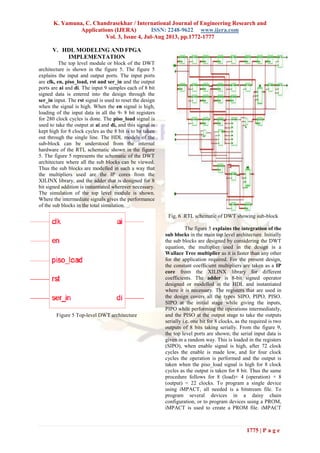
The top level module or block of the DWT
architecture is shown in the figure 5. The figure 5
explains the input and output ports. The input ports
are clk, en, piso_load, rst and ser_in and the output
ports are ai and di. The input 9 samples each of 8 bit
signed data is entered into the design through the
ser_in input. The rst signal is used to reset the design
when the signal is high. When the en signal is high,
loading of the input data in all the 9- 8 bit registers
for 280 clock cycles is done. The piso_load signal is
used to take the output at ai and di, and this signal is
kept high for 8 clock cycles as the 8 bit is to be taken
out through the single line. The HDL models of the
sub-block can be understood from the internal
hardware of the RTL schematic shown in the figure
5. The figure 5 represents the schematic of the DWT
architecture where all the sub blocks can be viewed.
Thus the sub blocks are modelled in such a way that
the multipliers used are the IP cores from the
XILINX library, and the adder that is designed for 8
bit signed addition is instantiated wherever necessary.
The simulation of the top level module is shown.
Where the intermediate signals gives the performance
of the sub blocks in the total simulation.
Figure 5 Top-level DWT architecture
Fig. 6 .RTL schematic of DWT showing sub-block
The figure 5 explains the integration of the
sub blocks in the main top level architecture. Initially
the sub blocks are designed by considering the DWT
equation, the multiplier used in the design is a
Wallace Tree multiplier as it is faster than any other
for the application required. For the present design,
the constant coefficient multipliers are taken as a IP
core from the XILINX library for different
coefficients. The adder is 8-bit signed operator
designed or modelled in the HDL and instantiated
where it is necessary. The registers that are used in
the design covers all the types SIPO, PIPO, PISO.
SIPO at the initial stage while giving the inputs,
PIPO while performing the operations intermediately,
and the PISO at the output stage to take the outputs
serially i.e. one bit for 8 clocks, as the required is two
outputs of 8 bits taking serially. From the figure 9,
the top level ports are shown; the serial input data is
given in a random way. This is loaded in the registers
(SIPO), when enable signal is high, after 72 clock
cycles the enable is made low, and for four clock
cycles the operation is performed and the output is
taken when the piso_load signal is high for 8 clock
cycles as the output is taken for 8 bit. Thus the same
procedure follows for 8 (load)+ 4 (operation) + 8
(output) = 22 clocks. To program a single device
using iMPACT, all needed is a bitstream file. To
program several devices in a daisy chain
configuration, or to program devices using a PROM,
iMPACT is used to create a PROM file. iMPACT
K. Yamuna, C. Chandrasekhar / International Journal of Engineering Research and
Applications (IJERA) ISSN: 2248-9622 www.ijera.com
Vol. 3, Issue 4, Jul-Aug 2013, pp.1772-1777
1776 | P a g e
accepts any number of bitstream and creates one or
more PROM files containing one or more daisy chain
configuration
Fig.7.simulation results for the DWT Architecture
TABLE 2 Synthesis results of modified lifting based
DWT
Parameters Lifting
based DWT
Modified
Lifting based
DWT with
low power
Area(sq.
mm)(LUT’s)
2179(7%) 835(3%)
Power(W) 0.103 0.103
Operating
frequency(max)
MHz
151.814 520.738
VI. CONCLUSION
In this work a modified lifting based DWT
architecture is proposed, designed, modeled and
verified. The design is modeled using HDL and is
implemented on FPGA. The interfaces required for
data processing are also designed and is used to
synchronize the data transfer operation. The HDL
models and simulation of the sub blocks have been
done to model the top-level design architecture. The
test-bench to verify the functionality and
performance of the sub modules and the top level
architecture have been done. Implemented the design
on FPGA and verified and debugged through the
Chip-Scope. The Pre and Post Synthesis have been
done and compared. The design can be further
optimized for video signal processing.
REFERENCES
[1] N. Jayant and P. Noll, Digital Coding of
Waveforms: Principles and Applications to
Speech and Video. Englewood Cliffs, NJ:
Prentice-Hall, 1984.
[2] C. Diou, L. Torres, and M. Robert, “A
wavelet core for video processing,”
presented at the IEEE Int. Conf. Image
Process., Sept. 2000.
[3] N. Jayant, J. Johnston, and R. Safranek,
“Signal compression based on models of
human perception,” Proc. IEEE, vol. 81, pp.
1385–1422, Oct. 1993.
[4] B. Zovko-Cihlar, S. Grgic, and D. Modric,
“Coding techniques in multimedia
communications,” in Proc. 2nd Int.
Workshop Image and Signal Processing,
IWISP’95, Budapest, Hungary, 1995, pp.
24–32.
[5] Digital Compression and Coding of
Continuous Tone Still Images, ISO/IEC IS
10918, 1991.
[6] I. Daubechies, Ten Lectures on Wavelets.
Philadelphia, PA: SIAM, 1992.
[7] S. Mallat, “A theory of multiresolutio
[8] n signal decomposition: The wavelet
representation,” IEEE Trans. Pattern Anal.
Machine Intell., vol. 11, pp. 674–693, July
1989.
[9] M. Nagabushanam, Cyril Prasanna Raj P, S.
Ramachandran, Design and Implementation
of Parallel and Pipelined Distributive
Arithmetic Based Discrete Wavelet
Transform IP Core, European Journal of
Scientific Research ISSN 1450-216X Vol.35
No.3 (2009), pp.378-392.
[10] M. Vishwanath, R. Owens, and M. J. Irwin,
“VLSI architectures for the discrete wavelet
transform,” IEEE Trans. Circuits Syst. II,
vol. 42, pp. 305–316, May 1995.
[11] J. S. Fridman and E. S. Manolakos,
“Discrete wavelet transform: Data
dependence analysis and synthesis of
distributed memory and control array.
K. Yamuna, C. Chandrasekhar / International Journal of Engineering Research and
Applications (IJERA) ISSN: 2248-9622 www.ijera.com
Vol. 3, Issue 4, Jul-Aug 2013, pp.1772-1777
1777 | P a g e
AUTHORS BIBILIOGRAPHY
1.
K.YAMUNA, student of M.Tech (VLSI Design),
sri venkateswara college of engineering
&Technology, Chittoor
Email.id:Yamuna.k712@gmail.com
2. Under the guidance of C.CHANDRA
SEKHAR,HOD &Professor, Dept.of ECE
Email.id:uma_sekhar2000@gmail.com

Ju3417721777

  • 1.
    K. Yamuna, C.Chandrasekhar / International Journal of Engineering Research and Applications (IJERA) ISSN: 2248-9622 www.ijera.com Vol. 3, Issue 4, Jul-Aug 2013, pp.1772-1777 1772 | P a g e Design And Implementation Of Efficient Lifting Based Dwt Architecture Using Wallace Tree Multiplier For Compression K. Yamuna*, C. Chandrasekhar** *(M. Tech (VLSI), SVCET, CHITTOOR, A.P., INDIA ** (HOD, Dept. of ECE, SVCET, CHITTOOR, A.P, INDIA ABSTRACT Demand for high speed and low power architecture for DWT computation have led to design of novel algorithms and architecture. In this paper we design, model and implement a hardware efficient, high speed and power efficient DWT architecture based on modified lifting scheme algorithm. The design is interfaced with SIPO and PISO to reduce the number of I/O lines on the FPGA. The design is implemented on Spartan III device and is compared with lifting scheme logic. The proposed design operates at frequency of 520.738 MHz and consumes power less than 0.103W. The pre-synthesis and post- synthesis results are verified and suitable test vectors are used in verifying the functionality of the design. The design is suitable for real time data processing. Keywords - Lifting scheme, low power, high speed, FPGA implementation I. INTRODUCTION Discrete wavelet transforms (DWT) decomposes image into multiple sub bands of low and high frequency components. Encoding of sub band components leads to compression of image. DWT along with encoding technique represents image information with less number of bits achieving image compression. Image compression finds application in every discipline such as entertainment, medical, defense, commercial and industrial domains. The core of image compression unit is DWT. Other image processing techniques such as image enhancement, image restoration and image filtering also requires DWT and Inverse DWT for transformations. DWT-IDWT is one of the prominent transformation techniques that are widely used in signal processing and communication applications. DWT-IDWT computes or transforms signal into multiple resolution sub bands. DWT is computationally very intensive and consumes power due to large number of mathematical operations. Latency and throughput are other major limitations of DWT as there are multiple levels of hierarchy. DWT has traditionally been implemented by convolution. Digit serial or parallel representation of input data further decides the architecture complexity. Such an implementation demands a large number of computations and a large storage that are not desirable for either high-speed or low-power applications. Recently, a lifting-based scheme that often requires far fewer computations has been proposed for the DWT. The main feature of the lifting based DWT scheme is to break up the high pass and low pass filters into a sequence of upper and lower triangular matrices and convert the filter implementation into banded matrix multiplications. Since DWT requires intensive computations, several architectural solutions using special purpose parallel processor have been proposed, in order to meet the real time requirement in many applications. The solutions include parallel filter architecture, SIMD linear array architecture, SIMD multigrain architecture, 2-D block based architecture, and the AWARE’s wavelet transform processor (WTP). Several versions of lifting scheme architecture have been compared and reported in literature. In terms of hardware complexity, the folded architecture is the simplest and the DSP-based architecture is the most complex. All other architectures have comparable hardware complexity and primarily differ in the number of registers and multiplexor circuitry. The control complexity of the architecture is very simple. In contrast, the number of switches, multiplexors and control signals used in the architectures of is quite large. The control complexity of the remaining architectures is moderate. In terms of timing performance, the architectures are all pipelined, with the architectures having the highest throughput (1/Tm). The architecture has fewer cycles since it is RPA based, but its clock period is higher. The architecture in has the lowest computation delay. DWT is recommended by JPEG2000 standards as it supports features like progressive transmission, higher compression and region of interest encoding schemes. Convolution based DWT or FIR filter bank based DWT architectures occupy large area as they require more number of multipliers and adders, thus making the computations complex and time consuming. Mobile phones and other similar hand held devices that support image//video applications demand high speed and low power architectures with reduced memory size for DWT processing. There are several architectures discussed in literature to perform lifting based approach for 2-D DWT is to apply the 1-D DWT row-wise which produces L and H sub bands and then process these sub-bands column-wise to get LL, LH, HL and HH coefficients.
  • 2.
    K. Yamuna, C.Chandrasekhar / International Journal of Engineering Research and Applications (IJERA) ISSN: 2248-9622 www.ijera.com Vol. 3, Issue 4, Jul-Aug 2013, pp.1772-1777 1773 | P a g e Several architectures like direct mapped, folded, and flipping for single level and multi-level DWT have been proposed to implement 1-D lifting DWT. Much architecture that implement the Two-Dimensional separable Forward (2D-DWT) and Inverse DWT (2D-IDWT) in order to be applied on 2D signals have been presented in the past. These architectures are consisting of filters for performing the 1D-DWT and memory units for storing the results of the transformation. Due to the fact that streaming multimedia applications - in which the DWT is present - are characterized by high throughput requirements, this imposes the need for optimizing the design of the filters in terms of speed. Moreover, portable multimedia devices require low power consumption for increasing the battery lifetime and this can be achieved by minimizing the storage size and number of memory accesses. Low power DWT architectures based on pipelining and parallel processing has been discussed, in their work low power is achieved by modifying the architecture to reduce number of computations the design was implemented on FPGA. Many of the low power techniques reported for DWT propose modifications in the architecture level to reduce power dissipation. Power reduction can be accomplished at various levels of abstraction starting from architecture level to circuit level. Power reduction at the sub system level or at the circuit level can be accomplished when ASIC design of DWT architecture is performed. Many of the work reported in literature have restricted to FPGA implementation. In this paper, in order to demonstrate the dynamic power reduction techniques at various levels of abstraction, DWT architecture is considered as a test case for illustration. ASIC design of DWT architecture optimizing dynamic power reduction using 65nm TSMC libraries is performed II. WALLACE TREE MULTIPLIER A Wallace tree is an efficient hardware implementation of a digital circuit that multiplies two integers. The benefit of the Wallace tree is that there are only reduction layers, and each layer has propagation delay. As making the partial products is and the final addition is , the multiplication is only , not much slower than addition (however, much more expensive in the gate count). Naively adding partial products with regular adders would require time. From a complexity theoretic perspective, the Wallace tree algorithm puts multiplication in the class NC1. These computations only consider gate delays and don't deal with wire delays, which can also be very substantial. Fig.1.Wallace tree multiplier The Wallace tree can be also represented by a tree of 3/2 or 4/2 adders. It is sometimes combined with Booth encoding. III. LIFTING SCHEME The Lifting Scheme is a well-known method for constructing bi-orthogonal wavelets. The main difference with the classical construction is that it does not rely on the Fourier transform. The lifting scheme is an efficient implementation of a wavelet transform algorithm. It was primarily developed as a method to improve wavelet transform, and then it was extended to a generic method to create so-called second-generation wavelets. Second-generation wavelets are much more flexible and powerful than the first generation wavelets. The lifting scheme is an implementation of the filtering operations at each level [6]. The figure 3 represents the classical and lifting based implementations of DWT. Fig.2.Lifting scheme Lifting Scheme consists of three steps: SPLIT, PREDICT and UPDATE, as shown in the figure 2. SPLIT: In this step, the data is divided into ODD and EVEN elements. PREDICT: The PREDICT step uses a function that approximates the data set. The differences between the approximation and the actual data, replace the odd elements of the data set. The even elements are left unchanged and become the input for the next step in the transform. The PREDICT step, where the odd
  • 3.
    K. Yamuna, C.Chandrasekhar / International Journal of Engineering Research and Applications (IJERA) ISSN: 2248-9622 www.ijera.com Vol. 3, Issue 4, Jul-Aug 2013, pp.1772-1777 1774 | P a g e value is "predicted" from the even value is described by the equation Oddj+1, i = oddj, i – P (evenj, i) UPDATE: The UPDATE step replaces the even elements with an average. These results in a smoother input for the next step of the wavelet transform. The odd elements also represent an approximation of the original data set, which allows filters to be constructed. The UPDATE phase follows the PREDICT phase. The original values of the odd elements have been overwritten by the difference between the odd element and its even "predictor". So in calculating an average the UPDATE phase must operate on the differences that are stored in the odd elements: Evenj+1, i = evenj, i + U (oddj+1, i) The equations for the lifting based implementation of the bi-orthogonal wavelet are: Predict P1: di1 = α (x2i + x2i+2) +x2i+1 .. (1) Update U1: ai1 = β (di1+di-11) + x2i ….. (2) Predict P2: di2 = γ (ai1 + ai+1) +x2i+1 …..(3) Update U2: ai2 = δ (di2+di-12) + ai1 .. (4) Scale G1: ai = ζ ai2 …... ( 5) Scale G1: di = di2/ζ …….. (6) The figure 4 shows the lifting scheme architecture to realize the equations shown above. Fig.3.Lifting Scheme Architecture The input data x is first split into even and odd samples and each of the samples are taken through predict and update stages as per the architecture shown above. As the data moves from first stage to the last stage, data switching occurs at the input and output of every stage. Every stage consists of multipliers and adders. For the given set of Predict and Update stages, assuming the value of i = 0, the equation can be finalized. IV. MODIFIED LIFTING SCHEME By re-arranging all the values and the constant co-efficient, the final equation can be derived. ai= (3 * γ.β.δ.ζ + δ.ζ + β.ζ ) [ α ( x0 + x2) + x1 + α ( x0 + x-2) + x-1] + ζ.δ.β.γ [α(x2 + x4) + x3 + α( x-2 + x-4) + x-3] + ζ.δ.γ ( x0 + x2 + x0 + x-2) + ζ * x0 …… (7) di= 1/ζ [(2 * γ.β +1){ α ( x0 + x2) + x1} + γ.β { α ( x0 + x-2) + x-1 + α(x2 + x4) + x3} +γ( x0 + x2)] …...(8) Being a dedicated DWT core for JPEG 2000, the filter coefficients are fixed. The filter coefficients are: α = 1.586134342, β = 0.05298011854, γ = 0.8829110762, δ =0.4435068522, ζ = 1.149604398. By substituting the above values in the modified equation, the coefficient values obtained then are also decimals, by multiplying them with constants they form integers as: 1 * 32 = 57, 2 * 256 = 6, 3 * 64 = 30, 4 * 32 = 35, 5 * 256 = 12, 6 * 32 = 26, 7 * 32 = 50. Thus the above integers are the values of the underlined coefficients in above equations. From the equations it is observed that there are common lifting coefficients to compute ai and di coefficients and there are input terms. The architecture realised by the above equations considering the constant coefficients is shown in the figure 4. Figure 4 Modified Lifting Scheme Architecture for DWT Table 1 Estimation of Power, Delay and Area of sub blocks
  • 4.
    K. Yamuna, C.Chandrasekhar / International Journal of Engineering Research and Applications (IJERA) ISSN: 2248-9622 www.ijera.com Vol. 3, Issue 4, Jul-Aug 2013, pp.1772-1777 1775 | P a g e V. HDL MODELING AND FPGA IMPLEMENTATION The top level module or block of the DWT architecture is shown in the figure 5. The figure 5 explains the input and output ports. The input ports are clk, en, piso_load, rst and ser_in and the output ports are ai and di. The input 9 samples each of 8 bit signed data is entered into the design through the ser_in input. The rst signal is used to reset the design when the signal is high. When the en signal is high, loading of the input data in all the 9- 8 bit registers for 280 clock cycles is done. The piso_load signal is used to take the output at ai and di, and this signal is kept high for 8 clock cycles as the 8 bit is to be taken out through the single line. The HDL models of the sub-block can be understood from the internal hardware of the RTL schematic shown in the figure 5. The figure 5 represents the schematic of the DWT architecture where all the sub blocks can be viewed. Thus the sub blocks are modelled in such a way that the multipliers used are the IP cores from the XILINX library, and the adder that is designed for 8 bit signed addition is instantiated wherever necessary. The simulation of the top level module is shown. Where the intermediate signals gives the performance of the sub blocks in the total simulation. Figure 5 Top-level DWT architecture Fig. 6 .RTL schematic of DWT showing sub-block The figure 5 explains the integration of the sub blocks in the main top level architecture. Initially the sub blocks are designed by considering the DWT equation, the multiplier used in the design is a Wallace Tree multiplier as it is faster than any other for the application required. For the present design, the constant coefficient multipliers are taken as a IP core from the XILINX library for different coefficients. The adder is 8-bit signed operator designed or modelled in the HDL and instantiated where it is necessary. The registers that are used in the design covers all the types SIPO, PIPO, PISO. SIPO at the initial stage while giving the inputs, PIPO while performing the operations intermediately, and the PISO at the output stage to take the outputs serially i.e. one bit for 8 clocks, as the required is two outputs of 8 bits taking serially. From the figure 9, the top level ports are shown; the serial input data is given in a random way. This is loaded in the registers (SIPO), when enable signal is high, after 72 clock cycles the enable is made low, and for four clock cycles the operation is performed and the output is taken when the piso_load signal is high for 8 clock cycles as the output is taken for 8 bit. Thus the same procedure follows for 8 (load)+ 4 (operation) + 8 (output) = 22 clocks. To program a single device using iMPACT, all needed is a bitstream file. To program several devices in a daisy chain configuration, or to program devices using a PROM, iMPACT is used to create a PROM file. iMPACT
  • 5.
    K. Yamuna, C.Chandrasekhar / International Journal of Engineering Research and Applications (IJERA) ISSN: 2248-9622 www.ijera.com Vol. 3, Issue 4, Jul-Aug 2013, pp.1772-1777 1776 | P a g e accepts any number of bitstream and creates one or more PROM files containing one or more daisy chain configuration Fig.7.simulation results for the DWT Architecture TABLE 2 Synthesis results of modified lifting based DWT Parameters Lifting based DWT Modified Lifting based DWT with low power Area(sq. mm)(LUT’s) 2179(7%) 835(3%) Power(W) 0.103 0.103 Operating frequency(max) MHz 151.814 520.738 VI. CONCLUSION In this work a modified lifting based DWT architecture is proposed, designed, modeled and verified. The design is modeled using HDL and is implemented on FPGA. The interfaces required for data processing are also designed and is used to synchronize the data transfer operation. The HDL models and simulation of the sub blocks have been done to model the top-level design architecture. The test-bench to verify the functionality and performance of the sub modules and the top level architecture have been done. Implemented the design on FPGA and verified and debugged through the Chip-Scope. The Pre and Post Synthesis have been done and compared. The design can be further optimized for video signal processing. REFERENCES [1] N. Jayant and P. Noll, Digital Coding of Waveforms: Principles and Applications to Speech and Video. Englewood Cliffs, NJ: Prentice-Hall, 1984. [2] C. Diou, L. Torres, and M. Robert, “A wavelet core for video processing,” presented at the IEEE Int. Conf. Image Process., Sept. 2000. [3] N. Jayant, J. Johnston, and R. Safranek, “Signal compression based on models of human perception,” Proc. IEEE, vol. 81, pp. 1385–1422, Oct. 1993. [4] B. Zovko-Cihlar, S. Grgic, and D. Modric, “Coding techniques in multimedia communications,” in Proc. 2nd Int. Workshop Image and Signal Processing, IWISP’95, Budapest, Hungary, 1995, pp. 24–32. [5] Digital Compression and Coding of Continuous Tone Still Images, ISO/IEC IS 10918, 1991. [6] I. Daubechies, Ten Lectures on Wavelets. Philadelphia, PA: SIAM, 1992. [7] S. Mallat, “A theory of multiresolutio [8] n signal decomposition: The wavelet representation,” IEEE Trans. Pattern Anal. Machine Intell., vol. 11, pp. 674–693, July 1989. [9] M. Nagabushanam, Cyril Prasanna Raj P, S. Ramachandran, Design and Implementation of Parallel and Pipelined Distributive Arithmetic Based Discrete Wavelet Transform IP Core, European Journal of Scientific Research ISSN 1450-216X Vol.35 No.3 (2009), pp.378-392. [10] M. Vishwanath, R. Owens, and M. J. Irwin, “VLSI architectures for the discrete wavelet transform,” IEEE Trans. Circuits Syst. II, vol. 42, pp. 305–316, May 1995. [11] J. S. Fridman and E. S. Manolakos, “Discrete wavelet transform: Data dependence analysis and synthesis of distributed memory and control array.
  • 6.
    K. Yamuna, C.Chandrasekhar / International Journal of Engineering Research and Applications (IJERA) ISSN: 2248-9622 www.ijera.com Vol. 3, Issue 4, Jul-Aug 2013, pp.1772-1777 1777 | P a g e AUTHORS BIBILIOGRAPHY 1. K.YAMUNA, student of M.Tech (VLSI Design), sri venkateswara college of engineering &Technology, Chittoor Email.id:Yamuna.k712@gmail.com 2. Under the guidance of C.CHANDRA SEKHAR,HOD &Professor, Dept.of ECE Email.id:uma_sekhar2000@gmail.com