Exploring HTML5 With
JavaServer Faces 2.0


Roger Kitain
Oracle Corporation
AGENDA

> HTML 5 Overview
  – What is HTML 5?
  – HTML 5 Features
> JSF 2.0 Component Model And HTML 5
  – Component Model Overview
  – Enhancing Components With HTML 5
> Demos


                                       2
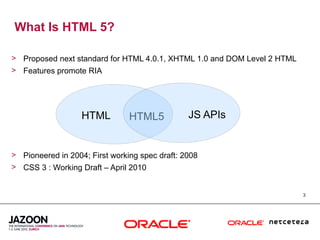
What Is HTML 5?

> Proposed next standard for HTML 4.0.1, XHTML 1.0 and DOM Level 2 HTML
> Features promote RIA


                   HTML         HTML5           JS APIs


> Pioneered in 2004; First working spec draft: 2008
> CSS 3 : Working Draft – April 2010


                                                                          3
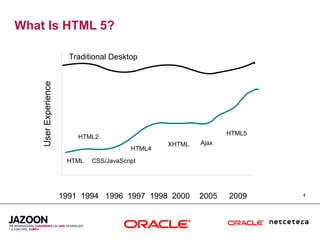
What Is HTML 5?

                        Traditional Desktop
    User Experience


                                                                 HTML5
                          HTML2
                                                  XHTML   Ajax
                                          HTML4
                       HTML   CSS/JavaScript


                      1991 1994 1996 1997 1998 2000       2005   2009    4
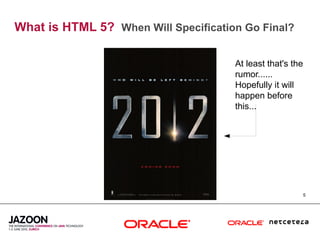
What is HTML 5? When Will Specification Go Final?

                                      At least that's the
                                      rumor......
                                      Hopefully it will
                                      happen before
                                      this...


                                                            5
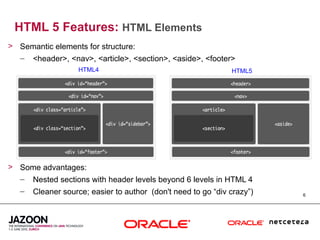
HTML 5 Features: HTML Elements
> Semantic elements for structure:
  – <header>, <nav>, <article>, <section>, <aside>, <footer>
                    HTML4                                      HTML5


> Some advantages:
  – Nested sections with header levels beyond 6 levels in HTML 4
   –   Cleaner source; easier to author (don't need to go “div crazy”)   6
HTML 5 Features : Html Elements/Attributes
> Other semantic elements:
  – <figure>, <dialog>, <meter>, <progress>...
   –   <progress> can be used with JavaScript to generate “real-time” progress bar
> Form elements / attributes:
  – <input name=”q” placeholder=”Search Here”>
   –   <input name=”q” autofocus>
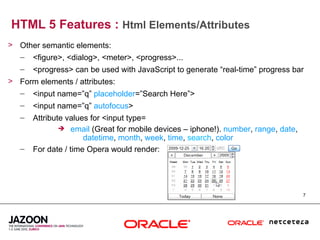
   –   Attribute values for <input type=
                email (Great for mobile devices – iphone!). number, range, date,
                      datetime, month, week, time, search, color
   –   For date / time Opera would render:


                                                                                    7
HTML 5 Features : Media Elements
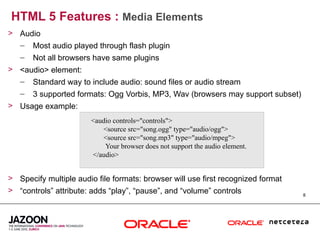
> Audio
  – Most audio played through flash plugin
   –   Not all browsers have same plugins
> <audio> element:
  – Standard way to include audio: sound files or audio stream
   –   3 supported formats: Ogg Vorbis, MP3, Wav (browsers may support subset)
> Usage example:
                       <audio controls="controls">
                          <source src="song.ogg" type="audio/ogg">
                          <source src="song.mp3" type="audio/mpeg">
                           Your browser does not support the audio element.
                       </audio>


> Specify multiple audio file formats: browser will use first recognized format
> “controls” attribute: adds “play”, “pause”, and “volume” controls               8
HTML 5 Features : Media Elements
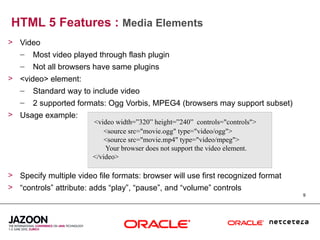
> Video
  – Most video played through flash plugin
   –   Not all browsers have same plugins
> <video> element:
  – Standard way to include video
   –   2 supported formats: Ogg Vorbis, MPEG4 (browsers may support subset)
> Usage example:
                        <video width=”320” height=”240” controls="controls">
                            <source src="movie.ogg" type="video/ogg">
                            <source src="movie.mp4" type="video/mpeg">
                            Your browser does not support the video element.
                        </video>

> Specify multiple video file formats: browser will use first recognized format
> “controls” attribute: adds “play”, “pause”, and “volume” controls
                                                                                  9
HTML 5 Features : Graphic Elements
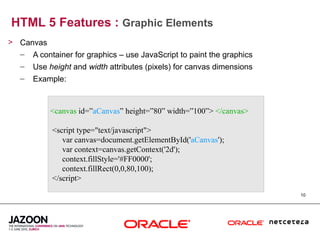
> Canvas
  – A container for graphics – use JavaScript to paint the graphics
   –   Use height and width attributes (pixels) for canvas dimensions
   –   Example:


           <canvas id=”aCanvas” height=”80” width=”100”> </canvas>

            <script type="text/javascript">
               var canvas=document.getElementById('aCanvas');
               var context=canvas.getContext('2d');
               context.fillStyle='#FF0000';
               context.fillRect(0,0,80,100);
            </script>
                                                                        10
HTML 5 Features : Graphic Elements: Canvas
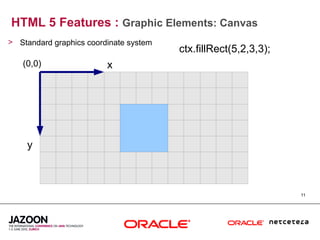
> Standard graphics coordinate system
                                        ctx.fillRect(5,2,3,3);
   (0,0)                 x


    y


                                                                 11
HTML 5 Features : Event Attributes
> Attach JavaScript to new event types:
  – Mouse events:
             ondrag, ondragend, ondragenter, ondragleave, ondragover,
                   ondragstart, ondrop, onmousewheel, onscroll
  – Window events:
             onafterprint, onbeforeprint, onbeforeonload, onerror,
                   onhaschanged, onmessage, onoffline, ononline, ...
  – Form events:
             onformhange, onforminput, oninput, oninvalid, …
  – Media events:
             Apply to media elements such as <audio>, <video>


                                                                         12
HTML 5 Features : JavaScript API
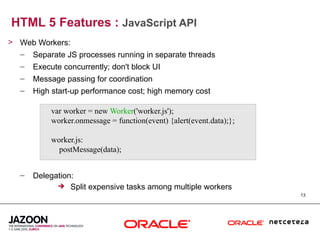
> Web Workers:
  – Separate JS processes running in separate threads
   –   Execute concurrently; don't block UI
   –   Message passing for coordination
   –   High start-up performance cost; high memory cost

            var worker = new Worker('worker.js');
            worker.onmessage = function(event) {alert(event.data);};

            worker.js:
              postMessage(data);


   –   Delegation:
              Split expensive tasks among multiple workers
                                                                       13
HTML 5 Features : JavaScript API
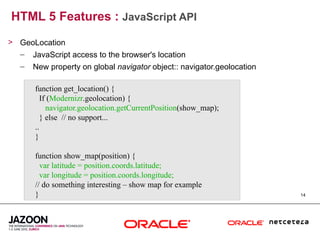
> GeoLocation
  – JavaScript access to the browser's location
   –   New property on global navigator object:: navigator.geolocation

       function get_location() {
          If (Modernizr.geolocation) {
            navigator.geolocation.getCurrentPosition(show_map);
          } else // no support...
       ..
       }

       function show_map(position) {
         var latitude = position.coords.latitude;
         var longitude = position.coords.longitude;
       // do something interesting – show map for example
       }                                                                 14
HTML 5 Features : JavaScript API
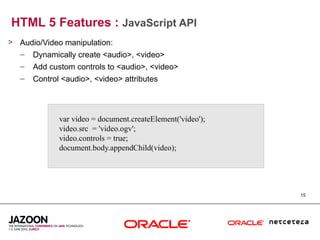
> Audio/Video manipulation:
  – Dynamically create <audio>, <video>
  –   Add custom controls to <audio>, <video>
  –   Control <audio>, <video> attributes


             var video = document.createElement('video');
             video.src = 'video.ogv';
             video.controls = true;
             document.body.appendChild(video);


                                                            15
HTML 5 Features : JavaScript API
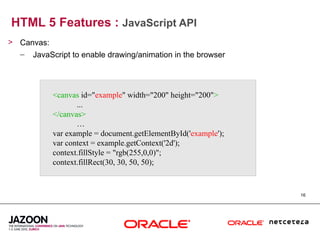
> Canvas:
  – JavaScript to enable drawing/animation in the browser


           <canvas id="example" width="200" height="200">
                  ...
           </canvas>
                  …
           var example = document.getElementById('example');
           var context = example.getContext('2d');
           context.fillStyle = "rgb(255,0,0)";
           context.fillRect(30, 30, 50, 50);


                                                               16
HTML 5 Features : JavaScript API
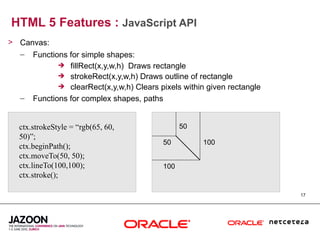
> Canvas:
  – Functions for simple shapes:
            fillRect(x,y,w,h) Draws rectangle
            strokeRect(x,y,w,h) Draws outline of rectangle
            clearRect(x,y,w,h) Clears pixels within given rectangle
  – Functions for complex shapes, paths


  ctx.strokeStyle = “rgb(65, 60,               50
  50)”;
                                         50         100
  ctx.beginPath();
  ctx.moveTo(50, 50);
  ctx.lineTo(100,100);                   100
  ctx.stroke();

                                                                       17
HTML 5 Features : JavaScript API
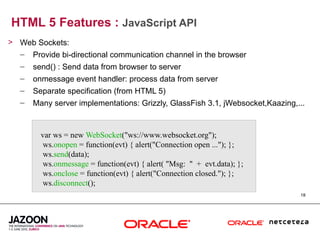
> Web Sockets:
  – Provide bi-directional communication channel in the browser
   –   send() : Send data from browser to server
   –   onmessage event handler: process data from server
   –   Separate specification (from HTML 5)
   –   Many server implementations: Grizzly, GlassFish 3.1, jWebsocket,Kaazing,...


         var ws = new WebSocket("ws://www.websocket.org");
          ws.onopen = function(evt) { alert("Connection open ..."); };
          ws.send(data);
          ws.onmessage = function(evt) { alert( "Msg: " + evt.data); };
          ws.onclose = function(evt) { alert("Connection closed."); };
          ws.disconnect();
                                                                                18
HTML 5 Features : What's Available .. And Where?
> http://html5test.com/
  – Will tell you what HTML5 features are available for the
     current browser.
  – http://weblogs.java.net/blog/rogerk/archive/2010/05/25/te
     sting-html5-feature-availability-browsers


                                                                19
JSF 2.0 Component Model


                          20
JSF 2.0 Component Model
> Facelets is the foundation
  – Optimized for JSF
   –   XHTML and tags
   –   Eliminates translation/compilation
   –   Templating
> Powerful tools:
  – Templating
   –   Composite Components


                                            21
JSF 2.0 Composite Components


                               22
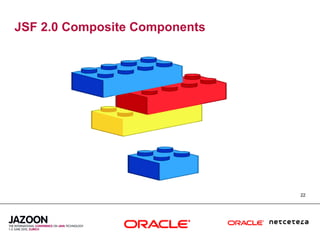
JSF 2.0 Composite Components
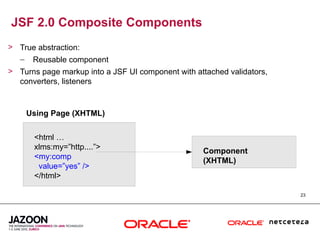
> True abstraction:
  – Reusable component
> Turns page markup into a JSF UI component with attached validators,
  converters, listeners


    Using Page (XHTML)


      <html …
      xlms:my=”http....”>
                                                   Component
      <my:comp
                                                   (XHTML)
       value=”yes” />
      </html>

                                                                        23
JSF 2.0 Composite Components
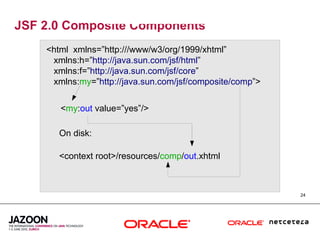
    <html xmlns=”http:///www/w3/org/1999/xhtml”
     xmlns:h=”http://java.sun.com/jsf/html”
     xmlns:f=”http://java.sun.com/jsf/core”
     xmlns:my=”http://java.sun.com/jsf/composite/comp”>


       <my:out value=”yes”/>

       On disk:

       <context root>/resources/comp/out.xhtml


                                                          24
JSF 2.0 Composite Components
What's Inside The Black Box?
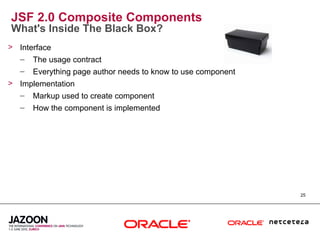
> Interface
  – The usage contract
  –   Everything page author needs to know to use component
> Implementation
  – Markup used to create component
  –   How the component is implemented


                                                              25
JSF 2.0 Composite Components
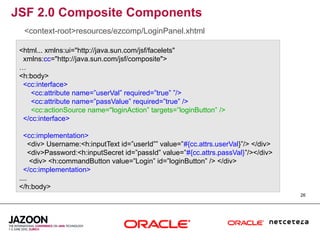
  <context-root>resources/ezcomp/LoginPanel.xhtml

 <html... xmlns:ui="http://java.sun.com/jsf/facelets"
  xmlns:cc="http://java.sun.com/jsf/composite">
 …
 <h:body>
  <cc:interface>
     <cc:attribute name=”userVal” required=”true” ”/>
     <cc:attribute name=”passValue” required=”true” />
     <cc:actionSource name="loginAction” targets=”loginButton” />
  </cc:interface>

   <cc:implementation>
      <div> Username:<h:inputText id=”userId”” value=”#{cc.attrs.userVal}”/> </div>
      <div>Password:<h:inputSecret id=”passId” value=”#{cc.attrs.passVal}”/></div>
      <div> <h:commandButton value=”Login” id=”loginButton” /> </div>
   </cc:implementation>
 ....
 </h:body>
                                                                                      26
JSF 2.0 Composite Components
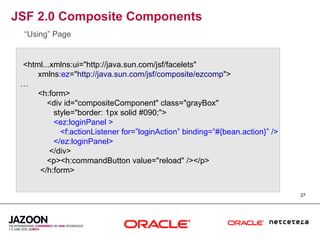
  “Using” Page


 <html...xmlns:ui="http://java.sun.com/jsf/facelets"
     xmlns:ez="http://java.sun.com/jsf/composite/ezcomp">
 …
     <h:form>
        <div id="compositeComponent" class="grayBox"
          style="border: 1px solid #090;">
          <ez:loginPanel >
            <f:actionListener for=”loginAction” binding=”#{bean.action}” />
          </ez:loginPanel>
         </div>
        <p><h:commandButton value="reload" /></p>
      </h:form>

                                                                              27
JSF 2.0 Composite Components With HTML 5


                                           28
Enhancing JSF 2.0 Components
With HTML 5
> JSF 2.0 specification introduced JavaScript to promote Ajax
> Composite components work well with JavaScript
> Composite components can leverage the HTML 5 JavaScript API


                                                                29
Enhancing JSF 2.0 Components
With HTML 5

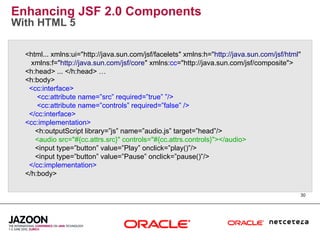
  <html... xmlns:ui="http://java.sun.com/jsf/facelets" xmlns:h="http://java.sun.com/jsf/html"
    xmlns:f="http://java.sun.com/jsf/core" xmlns:cc="http://java.sun.com/jsf/composite">
  <h:head> ... </h:head> …
  <h:body>
   <cc:interface>
      <cc:attribute name=”src” required=”true” ”/>
      <cc:attribute name=”controls” required=”false” />
   </cc:interface>
  <cc:implementation>
     <h:outputScript library=”js” name=”audio.js” target=”head”/>
     <audio src="#{cc.attrs.src}" controls="#{cc.attrs.controls}"></audio>
     <input type=”button” value=”Play” onclick=”play()”/>
     <input type=”button” value=”Pause” onclick=”pause()”/>
   </cc:implementation>
  </h:body>

                                                                                            30
Enhancing JSF 2.0 Components
With HTML 5

      audio.js:

      function play() {
         var audio = document.getElementsByTagName("audio")[0];
         audio.play();
         var display = document.getElementsByTagName("input")[0];
         display.value = audio.src;
      }

      function pause() {
         var audio = document.getElementsByTagName("audio")[0];
         audio.pause();
      }


                                                                    31
Enhancing JSF 2.0 Components
With HTML 5
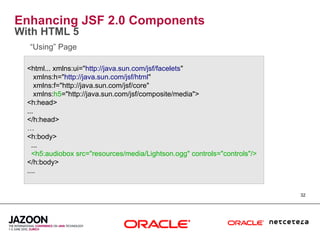
  “Using” Page

  <html... xmlns:ui="http://java.sun.com/jsf/facelets"
      xmlns:h="http://java.sun.com/jsf/html"
      xmlns:f="http://java.sun.com/jsf/core"
      xmlns:h5="http://java.sun.com/jsf/composite/media">
  <h:head>
  ...
  </h:head>
  …
  <h:body>
    ...
    <h5:audiobox src="resources/media/Lightson.ogg" controls="controls"/>
  </h:body>
  ....


                                                                            32
DEMOS
And let's look at some code...


                                 33
What's Next?

> With respect to JSF:
  – JSF 2.0 Rev A (Minor Maintenance Release)
   –   JSF 2.1 (Major Maintenance Release)
> We would like to hear from you!


                                                34
Summary

> HTML 5
  – Really about markup and JavaScript API
> HTML 5 Features
  – Promote Rich User Interfaces
   –   Graphics
   –   Media
   –   Multiprocessing
   –   Communication
> JSF 2.0 Components work well with JavaScript
  – Leverage HTML 5 JavaScript APIs
> Future Directions

                                                 35
Resources

> http://glassfish.dev.java.net
> http://javaserverfaces.dev.java.net
> http://dev.w3.org/html5/spec/Overview.html
> http://dev.w3.org/html5/websockets
> http://grizzly.dev.java.net


                                               36
Roger Kitain         http://twitter.com/rogerk09
Oracle Corporation   http://www.java.net/blogs/rogerk
                     roger.kitain@oracle.com

Jsf2 html5-jazoon

  • 1.
    Exploring HTML5 With JavaServerFaces 2.0 Roger Kitain Oracle Corporation
  • 2.
    AGENDA > HTML 5Overview – What is HTML 5? – HTML 5 Features > JSF 2.0 Component Model And HTML 5 – Component Model Overview – Enhancing Components With HTML 5 > Demos 2
  • 3.
    What Is HTML5? > Proposed next standard for HTML 4.0.1, XHTML 1.0 and DOM Level 2 HTML > Features promote RIA HTML HTML5 JS APIs > Pioneered in 2004; First working spec draft: 2008 > CSS 3 : Working Draft – April 2010 3
  • 4.
    What Is HTML5? Traditional Desktop User Experience HTML5 HTML2 XHTML Ajax HTML4 HTML CSS/JavaScript 1991 1994 1996 1997 1998 2000 2005 2009 4
  • 5.
    What is HTML5? When Will Specification Go Final? At least that's the rumor...... Hopefully it will happen before this... 5
  • 6.
    HTML 5 Features:HTML Elements > Semantic elements for structure: – <header>, <nav>, <article>, <section>, <aside>, <footer> HTML4 HTML5 > Some advantages: – Nested sections with header levels beyond 6 levels in HTML 4 – Cleaner source; easier to author (don't need to go “div crazy”) 6
  • 7.
    HTML 5 Features: Html Elements/Attributes > Other semantic elements: – <figure>, <dialog>, <meter>, <progress>... – <progress> can be used with JavaScript to generate “real-time” progress bar > Form elements / attributes: – <input name=”q” placeholder=”Search Here”> – <input name=”q” autofocus> – Attribute values for <input type=  email (Great for mobile devices – iphone!). number, range, date, datetime, month, week, time, search, color – For date / time Opera would render: 7
  • 8.
    HTML 5 Features: Media Elements > Audio – Most audio played through flash plugin – Not all browsers have same plugins > <audio> element: – Standard way to include audio: sound files or audio stream – 3 supported formats: Ogg Vorbis, MP3, Wav (browsers may support subset) > Usage example: <audio controls="controls"> <source src="song.ogg" type="audio/ogg"> <source src="song.mp3" type="audio/mpeg"> Your browser does not support the audio element. </audio> > Specify multiple audio file formats: browser will use first recognized format > “controls” attribute: adds “play”, “pause”, and “volume” controls 8
  • 9.
    HTML 5 Features: Media Elements > Video – Most video played through flash plugin – Not all browsers have same plugins > <video> element: – Standard way to include video – 2 supported formats: Ogg Vorbis, MPEG4 (browsers may support subset) > Usage example: <video width=”320” height=”240” controls="controls"> <source src="movie.ogg" type="video/ogg"> <source src="movie.mp4" type="video/mpeg"> Your browser does not support the video element. </video> > Specify multiple video file formats: browser will use first recognized format > “controls” attribute: adds “play”, “pause”, and “volume” controls 9
  • 10.
    HTML 5 Features: Graphic Elements > Canvas – A container for graphics – use JavaScript to paint the graphics – Use height and width attributes (pixels) for canvas dimensions – Example: <canvas id=”aCanvas” height=”80” width=”100”> </canvas> <script type="text/javascript"> var canvas=document.getElementById('aCanvas'); var context=canvas.getContext('2d'); context.fillStyle='#FF0000'; context.fillRect(0,0,80,100); </script> 10
  • 11.
    HTML 5 Features: Graphic Elements: Canvas > Standard graphics coordinate system ctx.fillRect(5,2,3,3); (0,0) x y 11
  • 12.
    HTML 5 Features: Event Attributes > Attach JavaScript to new event types: – Mouse events:  ondrag, ondragend, ondragenter, ondragleave, ondragover, ondragstart, ondrop, onmousewheel, onscroll – Window events:  onafterprint, onbeforeprint, onbeforeonload, onerror, onhaschanged, onmessage, onoffline, ononline, ... – Form events:  onformhange, onforminput, oninput, oninvalid, … – Media events:  Apply to media elements such as <audio>, <video> 12
  • 13.
    HTML 5 Features: JavaScript API > Web Workers: – Separate JS processes running in separate threads – Execute concurrently; don't block UI – Message passing for coordination – High start-up performance cost; high memory cost var worker = new Worker('worker.js'); worker.onmessage = function(event) {alert(event.data);}; worker.js: postMessage(data); – Delegation:  Split expensive tasks among multiple workers 13
  • 14.
    HTML 5 Features: JavaScript API > GeoLocation – JavaScript access to the browser's location – New property on global navigator object:: navigator.geolocation function get_location() { If (Modernizr.geolocation) { navigator.geolocation.getCurrentPosition(show_map); } else // no support... .. } function show_map(position) { var latitude = position.coords.latitude; var longitude = position.coords.longitude; // do something interesting – show map for example } 14
  • 15.
    HTML 5 Features: JavaScript API > Audio/Video manipulation: – Dynamically create <audio>, <video> – Add custom controls to <audio>, <video> – Control <audio>, <video> attributes var video = document.createElement('video'); video.src = 'video.ogv'; video.controls = true; document.body.appendChild(video); 15
  • 16.
    HTML 5 Features: JavaScript API > Canvas: – JavaScript to enable drawing/animation in the browser <canvas id="example" width="200" height="200"> ... </canvas> … var example = document.getElementById('example'); var context = example.getContext('2d'); context.fillStyle = "rgb(255,0,0)"; context.fillRect(30, 30, 50, 50); 16
  • 17.
    HTML 5 Features: JavaScript API > Canvas: – Functions for simple shapes:  fillRect(x,y,w,h) Draws rectangle  strokeRect(x,y,w,h) Draws outline of rectangle  clearRect(x,y,w,h) Clears pixels within given rectangle – Functions for complex shapes, paths ctx.strokeStyle = “rgb(65, 60, 50 50)”; 50 100 ctx.beginPath(); ctx.moveTo(50, 50); ctx.lineTo(100,100); 100 ctx.stroke(); 17
  • 18.
    HTML 5 Features: JavaScript API > Web Sockets: – Provide bi-directional communication channel in the browser – send() : Send data from browser to server – onmessage event handler: process data from server – Separate specification (from HTML 5) – Many server implementations: Grizzly, GlassFish 3.1, jWebsocket,Kaazing,... var ws = new WebSocket("ws://www.websocket.org"); ws.onopen = function(evt) { alert("Connection open ..."); }; ws.send(data); ws.onmessage = function(evt) { alert( "Msg: " + evt.data); }; ws.onclose = function(evt) { alert("Connection closed."); }; ws.disconnect(); 18
  • 19.
    HTML 5 Features: What's Available .. And Where? > http://html5test.com/ – Will tell you what HTML5 features are available for the current browser. – http://weblogs.java.net/blog/rogerk/archive/2010/05/25/te sting-html5-feature-availability-browsers 19
  • 20.
  • 21.
    JSF 2.0 ComponentModel > Facelets is the foundation – Optimized for JSF – XHTML and tags – Eliminates translation/compilation – Templating > Powerful tools: – Templating – Composite Components 21
  • 22.
    JSF 2.0 CompositeComponents 22
  • 23.
    JSF 2.0 CompositeComponents > True abstraction: – Reusable component > Turns page markup into a JSF UI component with attached validators, converters, listeners Using Page (XHTML) <html … xlms:my=”http....”> Component <my:comp (XHTML) value=”yes” /> </html> 23
  • 24.
    JSF 2.0 CompositeComponents <html xmlns=”http:///www/w3/org/1999/xhtml” xmlns:h=”http://java.sun.com/jsf/html” xmlns:f=”http://java.sun.com/jsf/core” xmlns:my=”http://java.sun.com/jsf/composite/comp”> <my:out value=”yes”/> On disk: <context root>/resources/comp/out.xhtml 24
  • 25.
    JSF 2.0 CompositeComponents What's Inside The Black Box? > Interface – The usage contract – Everything page author needs to know to use component > Implementation – Markup used to create component – How the component is implemented 25
  • 26.
    JSF 2.0 CompositeComponents <context-root>resources/ezcomp/LoginPanel.xhtml <html... xmlns:ui="http://java.sun.com/jsf/facelets" xmlns:cc="http://java.sun.com/jsf/composite"> … <h:body> <cc:interface> <cc:attribute name=”userVal” required=”true” ”/> <cc:attribute name=”passValue” required=”true” /> <cc:actionSource name="loginAction” targets=”loginButton” /> </cc:interface> <cc:implementation> <div> Username:<h:inputText id=”userId”” value=”#{cc.attrs.userVal}”/> </div> <div>Password:<h:inputSecret id=”passId” value=”#{cc.attrs.passVal}”/></div> <div> <h:commandButton value=”Login” id=”loginButton” /> </div> </cc:implementation> .... </h:body> 26
  • 27.
    JSF 2.0 CompositeComponents “Using” Page <html...xmlns:ui="http://java.sun.com/jsf/facelets" xmlns:ez="http://java.sun.com/jsf/composite/ezcomp"> … <h:form> <div id="compositeComponent" class="grayBox" style="border: 1px solid #090;"> <ez:loginPanel > <f:actionListener for=”loginAction” binding=”#{bean.action}” /> </ez:loginPanel> </div> <p><h:commandButton value="reload" /></p> </h:form> 27
  • 28.
    JSF 2.0 CompositeComponents With HTML 5 28
  • 29.
    Enhancing JSF 2.0Components With HTML 5 > JSF 2.0 specification introduced JavaScript to promote Ajax > Composite components work well with JavaScript > Composite components can leverage the HTML 5 JavaScript API 29
  • 30.
    Enhancing JSF 2.0Components With HTML 5 <html... xmlns:ui="http://java.sun.com/jsf/facelets" xmlns:h="http://java.sun.com/jsf/html" xmlns:f="http://java.sun.com/jsf/core" xmlns:cc="http://java.sun.com/jsf/composite"> <h:head> ... </h:head> … <h:body> <cc:interface> <cc:attribute name=”src” required=”true” ”/> <cc:attribute name=”controls” required=”false” /> </cc:interface> <cc:implementation> <h:outputScript library=”js” name=”audio.js” target=”head”/> <audio src="#{cc.attrs.src}" controls="#{cc.attrs.controls}"></audio> <input type=”button” value=”Play” onclick=”play()”/> <input type=”button” value=”Pause” onclick=”pause()”/> </cc:implementation> </h:body> 30
  • 31.
    Enhancing JSF 2.0Components With HTML 5 audio.js: function play() { var audio = document.getElementsByTagName("audio")[0]; audio.play(); var display = document.getElementsByTagName("input")[0]; display.value = audio.src; } function pause() { var audio = document.getElementsByTagName("audio")[0]; audio.pause(); } 31
  • 32.
    Enhancing JSF 2.0Components With HTML 5 “Using” Page <html... xmlns:ui="http://java.sun.com/jsf/facelets" xmlns:h="http://java.sun.com/jsf/html" xmlns:f="http://java.sun.com/jsf/core" xmlns:h5="http://java.sun.com/jsf/composite/media"> <h:head> ... </h:head> … <h:body> ... <h5:audiobox src="resources/media/Lightson.ogg" controls="controls"/> </h:body> .... 32
  • 33.
    DEMOS And let's lookat some code... 33
  • 34.
    What's Next? > Withrespect to JSF: – JSF 2.0 Rev A (Minor Maintenance Release) – JSF 2.1 (Major Maintenance Release) > We would like to hear from you! 34
  • 35.
    Summary > HTML 5 – Really about markup and JavaScript API > HTML 5 Features – Promote Rich User Interfaces – Graphics – Media – Multiprocessing – Communication > JSF 2.0 Components work well with JavaScript – Leverage HTML 5 JavaScript APIs > Future Directions 35
  • 36.
    Resources > http://glassfish.dev.java.net > http://javaserverfaces.dev.java.net >http://dev.w3.org/html5/spec/Overview.html > http://dev.w3.org/html5/websockets > http://grizzly.dev.java.net 36
  • 37.
    Roger Kitain http://twitter.com/rogerk09 Oracle Corporation http://www.java.net/blogs/rogerk roger.kitain@oracle.com