Brownbag
1
“Introduction to HTML 5”
Web Technologies Timeline
YEAR WEB TECHNOLOGY
1991 HTML
1994 HTML 2
1996 CSS1 + JAVA SCRIPT
1997 HTML 4
1998 CSS2
2000 XHTML 1
2002 TABLELESS WEB DESIGN
2005 AJAX
2009 HTML 5
2
HTML 4 vs HTML 5
3
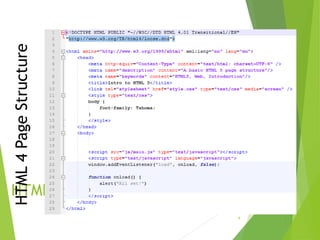
HTML 4 Structure
4
HTML4PageStructure
5
HTML5PageStructure
HTML 5 is Backward
Compatible
6
Content Model
 The content model is what defines how elements may
be.
7
Content Model
8
METADATA CONTENT
 Metadata content is content that sets up the
presentation or behavior of the rest of the content, or
that sets up the relationship of the document with other
documents, or that conveys other "out of band"
information.
 <base>, <command>, <link>, <eta>, <noscript>, <script>,
<style>, <title>
 Visit http://dev.w3.org/html5/spec-LC/content-
models.html#metadata-content-0 for more information
9
FLOW CONTENT
 Most elements that are used in the body of
documents and applications are categorized as flow
content.
 <a>, <article>, <section>, <span>
 Visit http://dev.w3.org/html5/spec-LC/content-
models.html#flow-content-0 for the complete list

10
SECTIONING CONTENT
 Sectioning content is content that defines the scope of
headings and footers.
 <article>, <aside>, <nav>, <section>
 Visit http://dev.w3.org/html5/spec-LC/content-
models.html#sectioning-content-0 for more information
11
HEADING CONTENT
 Heading content defines the header of a section
(whether explicitly marked up using sectioning content
elements, or implied by the heading content itself).
 <h1>, <h2>, <h3>, <h4>, <h5>, <h6>, <hgroup>
 Visit http://dev.w3.org/html5/spec-LC/content-
models.html#heading-content-0 for more information
12
PHRASING CONTENT
 Phrasing content is the text of the document, as well
as elements that mark up that text at the intra-
paragraph level. Runs of phrasing
content form paragraphs.
 <b>, <button>, <canvas>, <cite>, <code>, <em>, <embed>,
<i>, <iframe>, <img>, <input>, <script>, <select>,
 Visit http://dev.w3.org/html5/spec-LC/content-
models.html#phrasing-content-0 for the complete list
13
EMBEDDED CONTENT
 Embedded content is content that imports another
resource into the document, or content from another
vocabulary that is inserted into the document.
 <audio>, <canvas>, <embed>, <iframe>, <img>, <math>,
<object>, <svg>, <video>
 Visit http://dev.w3.org/html5/spec-LC/content-
models.html#embedded-content-0 for more information
14
INTERACTIVE CONTENT
 Interactive content is content that is specifically
intended for user interaction.
 <a>, <button>, <details>, <embed>, <iframe>, <keygen>,
<label>, <select>, <textarea>
 Visit http://dev.w3.org/html5/spec-LC/content-
models.html#interactive-content-0 for more information
15
A quick introduction to
HTML
16
A basic HTML document looks
like this:
<!DOCTYPE html>
<html>
<head>
<title>Sample Pages</title>
</head>
<body>
<h1>Sample page</h1>
<p>This is a <a href="demo.html">simple</a>
sample.</p>
<!-- this is a comment -->
<p>Example paragraph</p>
</body>
</html>
17
HTML Syntax
18
Here is an example document that
conforms to the HTML syntax:
<!doctype html>
<html>
<head>
<meta charset="UTF-8">
<title>Example document</title>
</head>
<body>
<p>Example paragraph</p>
</body>
</html>
19
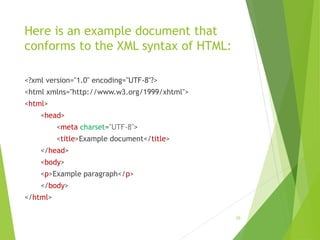
Here is an example document that
conforms to the XML syntax of HTML:
<?xml version="1.0" encoding="UTF-8"?>
<html xmlns="http://www.w3.org/1999/xhtml">
<html>
<head>
<meta charset="UTF-8">
<title>Example document</title>
</head>
<body>
<p>Example paragraph</p>
</body>
</html>
20
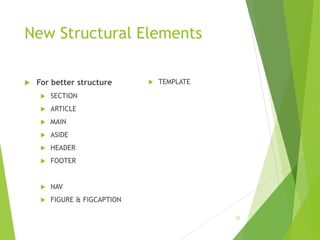
New Structural Elements
 For better structure
 SECTION
 ARTICLE
 MAIN
 ASIDE
 HEADER
 FOOTER
 NAV
 FIGURE & FIGCAPTION
 TEMPLATE
21
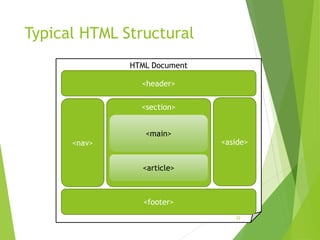
HTML Document
Typical HTML Structural
22
<header>
<footer>
<nav> <aside>
<section>
<main>
<article>
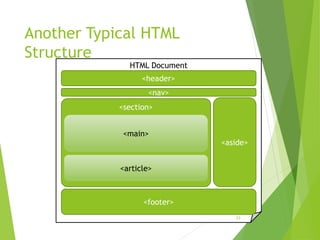
HTML Document
Another Typical HTML
Structure
23
<header>
<footer>
<nav>
<aside>
<section>
<main>
<article>
<header> element
 The header element represents the header of a section.
24
<nav> element
 Group of navigational links
 The nav element represents a section of a document
that links to other documents or to parts within the
document itself; that is, a section of navigation links.
25
<article> element
 The article element represents a section of content that
forms an independent part of a document or site; for
example, a magazine or newspaper article, or a blog
entry.
26
<section> element
 The section element represents a section of a
document, typically with a title or heading.
27
<main> element
 The main element represents the main content section
of the body of a document or application.
 The main content section consists of content that is
directly related to or expands upon the central topic of
a document or central functionality of an application.
28
<aside> element
 Tangential content
 The aside element represents content that is
tangentially related to the content that forms the main
textual flow of a document.
29
<footer> element
 he footer element represents the footer for the section
it applies to.
30
Sample Structure:
<!DOCTYPE html>
<html>
<head>
<title>Sample Page</title>
</head>
<body>
<header>…</header>
<nav>…</nav>
<section>
<main>…</main>
<article>…</article>
</section>
<aside>…</aside>
<footer>…</footer>
</body>
</html>
31
<figure> and <figcaption>
32
<figure> element
 The figure element represents a unit of content,
optionally with a caption, that is self-contained, that is
typically referenced as a single unit from the main flow
of the document, and that can be moved away from the
main flow of the document without affecting the
document’s meaning.
33
<figcaption> element
 The figcaption element represents a caption or legend
for a figure.
34
Sample Code:
<section>
<h1>ABCDE</h1>
<p>……</p>
<figure>
<img src=“01.jpg” />
<figurecaption>
Sample Figure Caption
</figurecaption>
</figure>
</section>
35
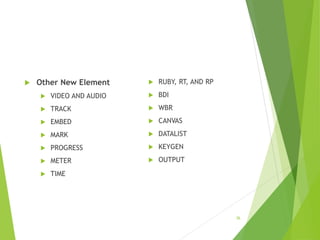
 Other New Element
 VIDEO AND AUDIO
 TRACK
 EMBED
 MARK
 PROGRESS
 METER
 TIME
 RUBY, RT, AND RP
 BDI
 WBR
 CANVAS
 DATALIST
 KEYGEN
 OUTPUT
36
<video> element
 The video element represents a video or movie.
 Some useful attributes:
 src (none empty URL, potentially surrounded by spaces)
 autoplay ("autoplay" or "" (empty string) or empty)
 controls ("controls" or "" (empty string) or empty)
 loop ("loop" or "" (empty string) or empty Instructs the UA
to seek back to the start of the video upon reaching the
end.)
 height (non-negative integer. The height of the video, in
CSS pixels.)
 width (non-negative integer. The width of the video, in
CSS pixels.)
37
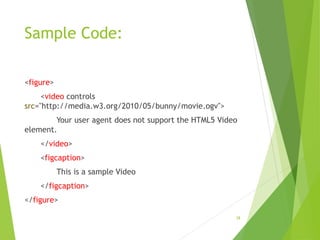
Sample Code:
<figure>
<video controls
src="http://media.w3.org/2010/05/bunny/movie.ogv">
Your user agent does not support the HTML5 Video
element.
</video>
<figcaption>
This is a sample Video
</figcaption>
</figure>
38
<audio> element
 An audio element represents an audio stream.
 Some useful attributes:
 src (URL potentially surrounded by spaces. The URL for the
audio stream.)
 autoplay ("autoplay" or "" (empty string) or empty.
Instructs the UA to automatically begin playback of the
audio stream as soon as it can do so without stopping.)
 controls ("controls" or "" (empty string) or empty. Instructs
the UA to expose a user interface for controlling playback
of the audio stream.)
 loop ("loop" or "" (empty string) or empty. Instructs the UA
to seek back to the start of the audio stream upon
reaching the end.)
39
Instructs the UA to expose a user interface for controlling playback of the audio stream.
Sample Code:
<figure>
<audio controls>
<source src="http://media.w3.org/2010/07/bunny/04-
Death_Becomes_Fur.mp4" type='audio/mp4'>
<source src="http://media.w3.org/2010/07/bunny/04-
Death_Becomes_Fur.oga" type='audio/ogg;
codecs=vorbis'>
<p>Your user agent does not support the HTML5 Audio
element.</p>
</audio>
<figcaption>
This is a sample audio
</figcaption>
40
<canvas> element
 Canvas for Dynamic Graphics
 The canvas element represents a resolution-dependent
bitmap canvas, which can be used for dynamically
rendering of images such as game graphics, graphs, or
other images.
 Some useful attributes:
 height (non-negative integer. The height of the canvas, in
CSS pixels.)
 width (non-negative integer. The width of the canvas, in
CSS pixels.)
41
Using Canvas
<canvas id="myCanvas" width="200"
height="100” style="border:1px solid
#c3c3c3;">
Your browser does not support the canvas element.
</canvas>
<script>
var canvas = document.getElementById("myCanvas");
var ctx = canvas.getContext("2d");
ctx.fillStyle = "#FF0000";
ctx.fillRect(0,0,150,75);
</script> 42
• The input element's type attribute now has
the following new values:
 tel
 search
 url
 email
 date
 time
 number
 range
 color
43
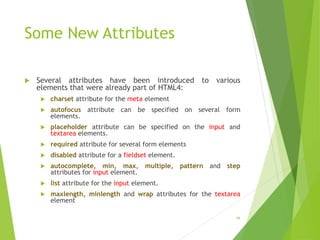
Some New Attributes
 Several attributes have been introduced to various
elements that were already part of HTML4:
 charset attribute for the meta element
 autofocus attribute can be specified on several form
elements.
 placeholder attribute can be specified on the input and
textarea elements.
 required attribute for several form elements
 disabled attribute for a fieldset element.
 autocomplete, min, max, multiple, pattern and step
attributes for input element.
 list attribute for the input element.
 maxlength, minlength and wrap attributes for the textarea
element
44
Obsolete Elements
45
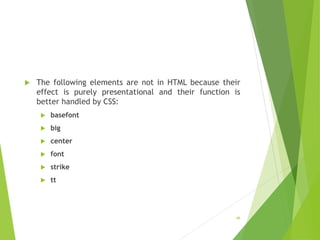
 The following elements are not in HTML because their
effect is purely presentational and their function is
better handled by CSS:
 basefont
 big
 center
 font
 strike
 tt
46
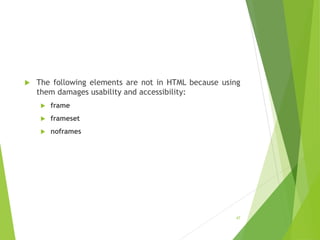
 The following elements are not in HTML because using
them damages usability and accessibility:
 frame
 frameset
 noframes
47
 The following elements are not included because they
have not been used often, created confusion, or their
function can be handled by other elements:
 acronym is not included because it has created a lot of
confusion. Web developers are to use abbr for
abbreviations.
 applet has been obsoleted in favor of object.
 isindex usage can be replaced by usage of form controls.
 dir has been obsoleted in favor of ul.
48
References:
 http://www.w3.org/TR/html5/
 http://www.w3.org/TR/html5-diff/
 http://dev.w3.org/html5/spec-LC/content-models.html
 http://www.w3.org/TR/html-markup/elements.html
 http://www.w3.org/wiki/HTML_structural_elements
49
Title Introduction to HTML 5
Version 1.0
By Ian Jasper Mangampo
50

Intro to html 5

  • 1.
  • 2.
    Web Technologies Timeline YEARWEB TECHNOLOGY 1991 HTML 1994 HTML 2 1996 CSS1 + JAVA SCRIPT 1997 HTML 4 1998 CSS2 2000 XHTML 1 2002 TABLELESS WEB DESIGN 2005 AJAX 2009 HTML 5 2
  • 3.
    HTML 4 vsHTML 5 3
  • 4.
  • 5.
  • 6.
    HTML 5 isBackward Compatible 6
  • 7.
    Content Model  Thecontent model is what defines how elements may be. 7
  • 8.
  • 9.
    METADATA CONTENT  Metadatacontent is content that sets up the presentation or behavior of the rest of the content, or that sets up the relationship of the document with other documents, or that conveys other "out of band" information.  <base>, <command>, <link>, <eta>, <noscript>, <script>, <style>, <title>  Visit http://dev.w3.org/html5/spec-LC/content- models.html#metadata-content-0 for more information 9
  • 10.
    FLOW CONTENT  Mostelements that are used in the body of documents and applications are categorized as flow content.  <a>, <article>, <section>, <span>  Visit http://dev.w3.org/html5/spec-LC/content- models.html#flow-content-0 for the complete list  10
  • 11.
    SECTIONING CONTENT  Sectioningcontent is content that defines the scope of headings and footers.  <article>, <aside>, <nav>, <section>  Visit http://dev.w3.org/html5/spec-LC/content- models.html#sectioning-content-0 for more information 11
  • 12.
    HEADING CONTENT  Headingcontent defines the header of a section (whether explicitly marked up using sectioning content elements, or implied by the heading content itself).  <h1>, <h2>, <h3>, <h4>, <h5>, <h6>, <hgroup>  Visit http://dev.w3.org/html5/spec-LC/content- models.html#heading-content-0 for more information 12
  • 13.
    PHRASING CONTENT  Phrasingcontent is the text of the document, as well as elements that mark up that text at the intra- paragraph level. Runs of phrasing content form paragraphs.  <b>, <button>, <canvas>, <cite>, <code>, <em>, <embed>, <i>, <iframe>, <img>, <input>, <script>, <select>,  Visit http://dev.w3.org/html5/spec-LC/content- models.html#phrasing-content-0 for the complete list 13
  • 14.
    EMBEDDED CONTENT  Embeddedcontent is content that imports another resource into the document, or content from another vocabulary that is inserted into the document.  <audio>, <canvas>, <embed>, <iframe>, <img>, <math>, <object>, <svg>, <video>  Visit http://dev.w3.org/html5/spec-LC/content- models.html#embedded-content-0 for more information 14
  • 15.
    INTERACTIVE CONTENT  Interactivecontent is content that is specifically intended for user interaction.  <a>, <button>, <details>, <embed>, <iframe>, <keygen>, <label>, <select>, <textarea>  Visit http://dev.w3.org/html5/spec-LC/content- models.html#interactive-content-0 for more information 15
  • 16.
  • 17.
    A basic HTMLdocument looks like this: <!DOCTYPE html> <html> <head> <title>Sample Pages</title> </head> <body> <h1>Sample page</h1> <p>This is a <a href="demo.html">simple</a> sample.</p> <!-- this is a comment --> <p>Example paragraph</p> </body> </html> 17
  • 18.
  • 19.
    Here is anexample document that conforms to the HTML syntax: <!doctype html> <html> <head> <meta charset="UTF-8"> <title>Example document</title> </head> <body> <p>Example paragraph</p> </body> </html> 19
  • 20.
    Here is anexample document that conforms to the XML syntax of HTML: <?xml version="1.0" encoding="UTF-8"?> <html xmlns="http://www.w3.org/1999/xhtml"> <html> <head> <meta charset="UTF-8"> <title>Example document</title> </head> <body> <p>Example paragraph</p> </body> </html> 20
  • 21.
    New Structural Elements For better structure  SECTION  ARTICLE  MAIN  ASIDE  HEADER  FOOTER  NAV  FIGURE & FIGCAPTION  TEMPLATE 21
  • 22.
    HTML Document Typical HTMLStructural 22 <header> <footer> <nav> <aside> <section> <main> <article>
  • 23.
    HTML Document Another TypicalHTML Structure 23 <header> <footer> <nav> <aside> <section> <main> <article>
  • 24.
    <header> element  Theheader element represents the header of a section. 24
  • 25.
    <nav> element  Groupof navigational links  The nav element represents a section of a document that links to other documents or to parts within the document itself; that is, a section of navigation links. 25
  • 26.
    <article> element  Thearticle element represents a section of content that forms an independent part of a document or site; for example, a magazine or newspaper article, or a blog entry. 26
  • 27.
    <section> element  Thesection element represents a section of a document, typically with a title or heading. 27
  • 28.
    <main> element  Themain element represents the main content section of the body of a document or application.  The main content section consists of content that is directly related to or expands upon the central topic of a document or central functionality of an application. 28
  • 29.
    <aside> element  Tangentialcontent  The aside element represents content that is tangentially related to the content that forms the main textual flow of a document. 29
  • 30.
    <footer> element  hefooter element represents the footer for the section it applies to. 30
  • 31.
    Sample Structure: <!DOCTYPE html> <html> <head> <title>SamplePage</title> </head> <body> <header>…</header> <nav>…</nav> <section> <main>…</main> <article>…</article> </section> <aside>…</aside> <footer>…</footer> </body> </html> 31
  • 32.
  • 33.
    <figure> element  Thefigure element represents a unit of content, optionally with a caption, that is self-contained, that is typically referenced as a single unit from the main flow of the document, and that can be moved away from the main flow of the document without affecting the document’s meaning. 33
  • 34.
    <figcaption> element  Thefigcaption element represents a caption or legend for a figure. 34
  • 35.
    Sample Code: <section> <h1>ABCDE</h1> <p>……</p> <figure> <img src=“01.jpg”/> <figurecaption> Sample Figure Caption </figurecaption> </figure> </section> 35
  • 36.
     Other NewElement  VIDEO AND AUDIO  TRACK  EMBED  MARK  PROGRESS  METER  TIME  RUBY, RT, AND RP  BDI  WBR  CANVAS  DATALIST  KEYGEN  OUTPUT 36
  • 37.
    <video> element  Thevideo element represents a video or movie.  Some useful attributes:  src (none empty URL, potentially surrounded by spaces)  autoplay ("autoplay" or "" (empty string) or empty)  controls ("controls" or "" (empty string) or empty)  loop ("loop" or "" (empty string) or empty Instructs the UA to seek back to the start of the video upon reaching the end.)  height (non-negative integer. The height of the video, in CSS pixels.)  width (non-negative integer. The width of the video, in CSS pixels.) 37
  • 38.
    Sample Code: <figure> <video controls src="http://media.w3.org/2010/05/bunny/movie.ogv"> Youruser agent does not support the HTML5 Video element. </video> <figcaption> This is a sample Video </figcaption> </figure> 38
  • 39.
    <audio> element  Anaudio element represents an audio stream.  Some useful attributes:  src (URL potentially surrounded by spaces. The URL for the audio stream.)  autoplay ("autoplay" or "" (empty string) or empty. Instructs the UA to automatically begin playback of the audio stream as soon as it can do so without stopping.)  controls ("controls" or "" (empty string) or empty. Instructs the UA to expose a user interface for controlling playback of the audio stream.)  loop ("loop" or "" (empty string) or empty. Instructs the UA to seek back to the start of the audio stream upon reaching the end.) 39 Instructs the UA to expose a user interface for controlling playback of the audio stream.
  • 40.
    Sample Code: <figure> <audio controls> <sourcesrc="http://media.w3.org/2010/07/bunny/04- Death_Becomes_Fur.mp4" type='audio/mp4'> <source src="http://media.w3.org/2010/07/bunny/04- Death_Becomes_Fur.oga" type='audio/ogg; codecs=vorbis'> <p>Your user agent does not support the HTML5 Audio element.</p> </audio> <figcaption> This is a sample audio </figcaption> 40
  • 41.
    <canvas> element  Canvasfor Dynamic Graphics  The canvas element represents a resolution-dependent bitmap canvas, which can be used for dynamically rendering of images such as game graphics, graphs, or other images.  Some useful attributes:  height (non-negative integer. The height of the canvas, in CSS pixels.)  width (non-negative integer. The width of the canvas, in CSS pixels.) 41
  • 42.
    Using Canvas <canvas id="myCanvas"width="200" height="100” style="border:1px solid #c3c3c3;"> Your browser does not support the canvas element. </canvas> <script> var canvas = document.getElementById("myCanvas"); var ctx = canvas.getContext("2d"); ctx.fillStyle = "#FF0000"; ctx.fillRect(0,0,150,75); </script> 42
  • 43.
    • The inputelement's type attribute now has the following new values:  tel  search  url  email  date  time  number  range  color 43
  • 44.
    Some New Attributes Several attributes have been introduced to various elements that were already part of HTML4:  charset attribute for the meta element  autofocus attribute can be specified on several form elements.  placeholder attribute can be specified on the input and textarea elements.  required attribute for several form elements  disabled attribute for a fieldset element.  autocomplete, min, max, multiple, pattern and step attributes for input element.  list attribute for the input element.  maxlength, minlength and wrap attributes for the textarea element 44
  • 45.
  • 46.
     The followingelements are not in HTML because their effect is purely presentational and their function is better handled by CSS:  basefont  big  center  font  strike  tt 46
  • 47.
     The followingelements are not in HTML because using them damages usability and accessibility:  frame  frameset  noframes 47
  • 48.
     The followingelements are not included because they have not been used often, created confusion, or their function can be handled by other elements:  acronym is not included because it has created a lot of confusion. Web developers are to use abbr for abbreviations.  applet has been obsoleted in favor of object.  isindex usage can be replaced by usage of form controls.  dir has been obsoleted in favor of ul. 48
  • 49.
    References:  http://www.w3.org/TR/html5/  http://www.w3.org/TR/html5-diff/ http://dev.w3.org/html5/spec-LC/content-models.html  http://www.w3.org/TR/html-markup/elements.html  http://www.w3.org/wiki/HTML_structural_elements 49
  • 50.
    Title Introduction toHTML 5 Version 1.0 By Ian Jasper Mangampo 50