My track at ICAAC 2015
(Sessions and Abstract Selection)
José Ramón Paño-Pardo
Division of Infectious Diseases
Hospital Clínico Universitario
Zaragoza, Spain
www.proantibioticos.comSeptember 29nd, 2015
Outline
• ICAAC 2015 Facts and Figures
• ICAAC Keynote and other “classical” sessions
• Most relevant sessions and abstracts by topic
- CPE
- Bloodstream infections
- Clinical infectious diseases (syndromes)
- Antimicrobial Stewardship
- New antimicrobials
- Clinical Microbiology
- PK/PD
(S-1350) The National Antimicrobial Prescribing Survey: enabling
greater regional and remote hospital participation
ICAAC 2015 Facts and Figures
Q: What did* ICAAC stand for?
A: Interscience Conference on
Antimicrobial Agents and Chemotherapy
*Last ICAAC, as we all know it
ICAAC was the main ASM* conference:
• ASM + 40.000 members: one the largest (if not the largest)
scientific societies
• Multidisciplinary: Microbiologist, Infectious Diseases specialists,
PharmD and pharmacologists, biologists….
• Attendees:
ICAAC 2015 Facts and Figures
*ASM: American Society for Microbiology
ICAAC was losing appeal as compared w/
its previously back-to-back competitors:
ECCMID y IDSA
• 2015 ≈ 5,000
• 2014 ≈ 6,000
• 2013: 5400 (126 españoles)
• Traditionally: +10,000
ICAAC 2015 Facts and Figures
• Medical Conference (especially ID) business model is
coming to an end
- Regulatory limitations to the relationship healthcare industry and
healthcare professionals…
- Antibiotics are not the most profitable drugs
- Information flows much much faster than some years ago
• but some are still trying to kill a goose that lays golden eggs
$250 early-bird rate
Pictures at conference forbidden (to enhance business)
- High registration price + Extras -6 hour-pre-ICAAC course: $375)
- Video scam: Slides/video library not included (as opposed to
ECCMID)
San Diego Convention Center
Friday, Sept 18th
(001) Infectious Diseases 101: For Fellows Age 18-88
• Four topics
• 2-hour (07:00-09:00) interactive session (Poll everywhere®)
Antimicrobial stewardship
Tropical Infectious Diseases
P. knowlesi
Strongyloidiasis
Myasis and other skin problems
Katayama fever
Preparedness (Ebola)
HIV
Friday, Sept 18th
(002) Keynote Session: Barbara Murray
The Enterococcus: A Tale of Survival and Success
of a Second Rate Pathogen
• Comprehensieve review on the controversial topics regarding
Enterococci (Epidemiology, pathogenicity and therapy)
(003)ICAAC Lecure: Keith Klugman
Pneumococcal Disease: Past, Present and Future
Friday, Sept 18th
(029) Literature Review
Emerging Viral Diseases (Robert Bonomo)
• 2-hour full-speed must session
Pediatric and Vaccines (Morven Edwards)
Multi-drug resistant microorganisms (DL Paterson)
HIV (Jean Michelle Molina)
Selected articles (See handout here)
Clinical Microbiology (Romney Humprhies)
Topics
Antimicrobial Stewardship #ABS
• #ABS seems to be on the rise: New category (S)
(074) The Most Efficient Interventions to Reduce Antimicrobial
Consumption in my Hospital (09/19 08:30-10:30)
• % patients on antibiotics (K. Thursky)
• De-escalation (L. Abbo)
• Duration (P. Tattevin)
• To Assess/Address Incorrect Use (A. Ghafur)
(132) Avoiding Common Pitfalls in Designing Healthcare
Epidemiology Studies (09/20 07:00-08:15): Meet the Experts
• D Morgan/J Jacobs
Question
Outcomes
Confounding
IRB
Antimicrobial Stewardship #ABS
• We need tools to better assess the impact of
interventions (and to enhance #ABS)
* Methodology to assess the quality of antimicrobial use
(S-1350) The National Antimicrobial Prescribing Survey: enabling
greater regional and remote hospital participation
(S-1355) The Appropriateness of Antimicrobial Prescribing in
Australian Hospitals
(Digression)
Antimicrobial Stewardship #ABS
• Need to merge efforts: #ABS should be comprehensive
(S-1339) Surviving Sepsis and Antibiotic Stewardship: Competing
Patient Safety Initiatives
Antimicrobial Stewardship #ABS
• ABSSSI -> High in the list of US priorities
(S-1329) #ABS Opportunities in Patients Hospitalized for Acute Bacterial Skin
and Skin Structure Infections (ABSSSIs)
(S-1331) A Retrospective Review of Emergency Department (ED) Antibiotic
Prescribing Patterns for Skin and Soft Tissue Infections
(S-1334) Multicenter Study of Antimicrobial Treatment in Admitted (ADM) vs
Not Admitted Patients with Acute Bacterial Skin And Skin Structure Infection
- Scores to better allocate patients (Outpatient/ED/Hospitalization)
- Opportunity to decrease antibiotic pressure
(S-428) Impact of Antimicrobial Stewardship Programme (ASP) on Outcomes in
Patients with Skin and Soft Tissue Infections (SSTIs) in a Tertiary Hospital
(S-925) Risk Assessment and Severity Analysis in Acute Bacterial Skin and Skin
Structure Infections (ABSSSIs)
Clinical Microbiology
• Blood, blood, blood!!!
(143) Rapid Identification of Pathogens in
Sepsis: From Blood To Bug
• Blood cultures: Best practice (Dr. Veinstein)
• Novel Identification Technology for Flagged
Positive Blood Cultures (Dr. Ozenci)
• Direct Detection of Microbes in Septic
Patients (vanden Bande)
• Economic and Stewardship Benefits of Rapid
Diagnostics of Sepsis (Dr. Riedel)
2h session (09/22 08:30)
(143) Rapid Identification of Pathogens in
Sepsis: From Blood To Bug
Dr Ozenci
Clinical Microbiology (+ #ABS)
(S-897) Antimicrobial Stewardship Combined with MALDI-TOF
and β-Lactam Test Performed on Gram-Negative Bacilli Blood
Culture is Effective for Sparing the Use of Carbapenems
+ BC -> 3h subculture -> MALDI + rapid-ESBL
(S-901) Fast Bacterial Identification by Mass Spectrometry in
Blood Culture Broths for Bacteriemic Patients Allows for Quick
Adaptation of Empirical Antibiotic Treatment
(D-224) The Spectrum of Unidentified Bacteria/Yeast by MALDI-
ToF MS in a Clinical Microbiology Laboratory
• 100/10.000 -> 23 genus/48 species
• Candida tropicalis (10), Escherichia coli (10), Klebsiella pneumoniae (9),
Pseudomonas aeruginosa (7), and Rothia mucilaginosa (7)
Clinical Microbiology
(S-905) Evaluation of Performances of Practices in French
Microbiology Laboratories: Discrepancies Between Laboratories
and Intensive Care Departments
(D-704) T2candida is More Sensitive and Rapid Than Blood
Culture for Detecting and Monitoring Invasive Candidiasis in
Proven Cases of Infection
T2CandidaPanel
(206) Microbiology Metrics Following Moving to an Offsite Core
Laboratory and Potential Effect on Patient Care
Bloodstream infections
Comparing Clinical Outcomes in Patients Treated With Cefazolin
Versus Nafcillin for Methicillin Susceptible Staphylococcus aureus
Bacteremia Secondary to High-Inoculum Infections
(C-1067) Epidemiology of Cefazolin-Inoculum Effect Positive
Methicillin-Susceptible Staphylococcus aureus Bacteremia in Korea: A
Nationwide Multicenter Study
• Cefazolin inocculum effect: around 20%
(A-458) Oxacillin Minimum Inhibitory Concentration and Flucloxacillin
Treatment Outcomes in Staphylococcus aureus Bacteremia
(B-521) Age-Related Gender Differences in Cytokine Response and
Outcomes of Patients with Staphylococcus aureus Bacteremia
(L-343) Impact of Socioeconomic Status on Host Immune Response
and Outcomes of Staphylococcus aureus Bacteremia
Bloodstream infections
Ertapenem vs Other Carbapenems for the Treatment of
Bloodstream Infections Due to Extended-spectrum β-
lactamase-producing Enterobacteriaceae: A Multinational Pre-
registered Cohort Study
• Multinational retrospective cohort (12 countries; 37 hospitals)
• Patients with monomicrobial BSI due to ESBL-E (2004-2012)
Therapy Clinical
cure/improvement
30-day mortality
Early empiric therapy
Ertapenem (32) vs other (163)
90.6% vs 75.4%
1.87 (0.24-20.08)
3.1% vs 23.3%
0.27 (0.02-4.03)
Targeted therapy
Ertapenem (205) vs other (504)
89.8% vs 82.6%
1.04(0.44-2.50)
9.3% vs 17.1%
0.93 (0.43-2.03)
“These results reinforce the idea that ertapenem should be considered an
alternative to other carbapenems for treating such infections”
Bloodstream infections
(C-178) Is Ertapenem as Efficacious as Other Carbapenems for
Infections Due to ESBL-producing Enterobacteriaceae in All
Subgroups of Patients?
• Sensitivity analyses using multivariate logistic regression, propensity
score and CART analyses were performed in different subpopulations
(30-d mortality)
• Sensitivity analysis favors other carbapenems in patients with septic
shock/severe sepsis (HR: 3.10; 95% CI: 0.86-11.20)
• In patients receiving ertapenem, renal failure was a protective factor
for 30-day mortality (mortality, 0 vs 27.8%;p=0.08)
• Caution is needed when using ertapenem in cases of severe sepsis/septic
shock in BSI due to ESBL-E
Conclusions
• The fact that renal failure have a protective effect for mortality in these
patients might be due to increased ertapenem exposure in this population
Carbapenemase-producing
Enterobacteriaceae
(35) Carbapenemases: Knocking on Hell’s Door
• Worldwide Spread of Carbapenemases: Update
2015 and Future Prospects (Dr. Pittout)
• Rapid Detection of Carbapenemase-Producers (Dr
Limbago)
• Antibiotic Stewardship to Help Limiting the Spread
of Carbapenemases
• Latest News in the Treatment of CPE (Dr Daikos)
Antibiotic Stewardship to
Help Limiting the Spread of
Carbapenemases
José Ramón Paño-Pardo
@joserrapa
Hospital Clínico Universitario
Zaragoza, Spain
New Antimicrobials
Bassetti M. Curr Opin Crit Care. 2015;21(5):402–11
New Antimicrobials: BLI
Bassetti M. Curr Opin Crit Care. 2015;21(5):402–11.
Drug In vitro activity Comments
Ceftazidime
+
Avibactam
(CAZ/AVI)
Ceftazidime Plus:
• ESBL
• AmpC
• KPC
• OXA-48
ICAAC 2015: (C-138)
• Non inferiority cUTI & cIAI
• FDA approved
• Available in Spain (Expanded access:
€12,000/course)
• Non active against MBL
Ceftaroline
+
Avibactam
Ceftriaxone Plus
• MRSA
• ESBL
• AmpC
• KPC
• OXA-48?
• Non active against non-fermenters (A.
baumannii and P. aeruginosa)
• Phase 2 trial vs doripenem (cUTI)
Aztreonam
+
Avibactam
Aztreonam Plus
• KPC
• Class D (OXA-48)
• Hydrolyzed by ESBL (class A) and AmpC
• Phase 1 trial (safety): completed
• Limited activity against MBL (class B carbapenemases):
Partial/transient solution
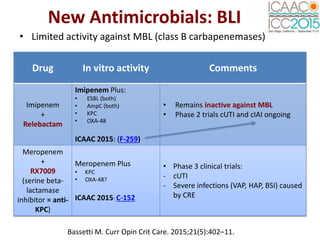
New Antimicrobials: BLI
Bassetti M. Curr Opin Crit Care. 2015;21(5):402–11.
Drug In vitro activity Comments
Imipenem
+
Relebactam
Imipenem Plus:
• ESBL (both)
• AmpC (both)
• KPC
• OXA-48
ICAAC 2015: (F-259)
• Remains inactive against MBL
• Phase 2 trials cUTI and cIAI ongoing
Meropenem
+
RX7009
(serine beta-
lactamase
inhibitor = anti-
KPC)
Meropenem Plus
• KPC
• OXA-48?
ICAAC 2015: C-152
• Phase 3 clinical trials:
- cUTI
- Severe infections (VAP, HAP, BSI) caused
by CRE
• Limited activity against MBL (class B carbapenemases)
New antimicrobials: new carbapenems
Bassetti M. Curr Opin Crit Care. 2015;21(5):402–11.
Drug
In vitro
activity
Comments
Razupenem
• ESBL
• MRSA
• VRE
• Less active against AmpC and
carbapenemases
• Phase 2 trials cUTI and cIAI ongoing
Tebipenem/
pivoxil
• novel oral carbapenem developed for the
treatment of upper respiratory tract
infections OMG!!!
Tomopenem
• Ceftazidime-R
P. aeruginosa
New antimicrobials: new cephalosporins
Bassetti M. Curr Opin Crit Care. 2015;21(5):402–11.
Drug In vitro activity Comments
Ceftolozane
/Tazobacta
m
Cefztazidime + side chain
• Enhanced
antipseudomonal actvity
(PBP mutations and efflux
pumps): x8 more active
than doripenem
• ESBL, AmpC, KPC?
• ICAAC2015: C-156b
• It is NOT active against class B
carbapenemases
• Phase 3: superior to levofloxacin
for cUTI and non-inferior to
meropenem for cIAI
• FDA-approved in Dec 2014
Ceftaroline
Ceftriaxone +:
• MRSA
• FDA and EMA approved
• Phase 3 trial: CAP
• BSI: (B-079)
• Pneumonia: (B-081)
Ceftobiprole
Ceftriaxone +:
• MRSA • EMA approved:
New antimicrobials: new quinolones
Bassetti M. Curr Opin Crit Care. 2015;21(5):402–11.
Drug In vitro activity Comments
Delafloxacin
• Enhanced activity against
E.coli and K. pneumoniae
• Low potential for resistance
selection (dual target)
Fenafloxacin
• Enhanced activity against
E.coli and K. pneumoniae
and P. aeruginosa
• FDA and EMA approved
• Phase 3 trial: CAP
New antimicrobials: new tetracyclines
Everacycline
• Enhanced activity as
compared with tigecycline
(same spectrum) (C-619, C-
563 )
• Phase 2 study (cIAI)
Clinical Infectious Diseases: PK/PD
112 Emerging Antimicrobial Combinations from the
Pharmacokinetics/Pharmacodynamics (PK/PD)
Laboratory
• Quantifying Antimicrobial Interactions (W Greco)
• Daptomycin, Glyco/lipo Peptides & Beta-Lactams against S. aureus
(M Rybak)
• Combinations for MDR Gram-Negative Pathogens (D. Wareham)
• Advances in Combination Therapy against Fungi (J Meletiadis)
Clinical Infectious Diseases: syndromes
(K-311) Clindamycin for the Management of Orthopedic
Devices Infections: A Retrospective Observational Study
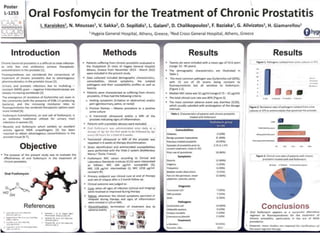
(L-1253) Oral Fosfomycin for the Treatment of Chronic
Prostatitis
ICAAC 2015 Selection

ICAAC 2015 Selection

  • 1.
    My track atICAAC 2015 (Sessions and Abstract Selection) José Ramón Paño-Pardo Division of Infectious Diseases Hospital Clínico Universitario Zaragoza, Spain www.proantibioticos.comSeptember 29nd, 2015
  • 3.
    Outline • ICAAC 2015Facts and Figures • ICAAC Keynote and other “classical” sessions • Most relevant sessions and abstracts by topic - CPE - Bloodstream infections - Clinical infectious diseases (syndromes) - Antimicrobial Stewardship - New antimicrobials - Clinical Microbiology - PK/PD
  • 5.
    (S-1350) The NationalAntimicrobial Prescribing Survey: enabling greater regional and remote hospital participation
  • 7.
    ICAAC 2015 Factsand Figures Q: What did* ICAAC stand for? A: Interscience Conference on Antimicrobial Agents and Chemotherapy *Last ICAAC, as we all know it
  • 8.
    ICAAC was themain ASM* conference: • ASM + 40.000 members: one the largest (if not the largest) scientific societies • Multidisciplinary: Microbiologist, Infectious Diseases specialists, PharmD and pharmacologists, biologists…. • Attendees: ICAAC 2015 Facts and Figures *ASM: American Society for Microbiology ICAAC was losing appeal as compared w/ its previously back-to-back competitors: ECCMID y IDSA • 2015 ≈ 5,000 • 2014 ≈ 6,000 • 2013: 5400 (126 españoles) • Traditionally: +10,000
  • 9.
    ICAAC 2015 Factsand Figures • Medical Conference (especially ID) business model is coming to an end - Regulatory limitations to the relationship healthcare industry and healthcare professionals… - Antibiotics are not the most profitable drugs - Information flows much much faster than some years ago • but some are still trying to kill a goose that lays golden eggs $250 early-bird rate Pictures at conference forbidden (to enhance business) - High registration price + Extras -6 hour-pre-ICAAC course: $375) - Video scam: Slides/video library not included (as opposed to ECCMID)
  • 11.
  • 12.
    Friday, Sept 18th (001)Infectious Diseases 101: For Fellows Age 18-88 • Four topics • 2-hour (07:00-09:00) interactive session (Poll everywhere®) Antimicrobial stewardship Tropical Infectious Diseases P. knowlesi Strongyloidiasis Myasis and other skin problems Katayama fever Preparedness (Ebola) HIV
  • 13.
    Friday, Sept 18th (002)Keynote Session: Barbara Murray The Enterococcus: A Tale of Survival and Success of a Second Rate Pathogen • Comprehensieve review on the controversial topics regarding Enterococci (Epidemiology, pathogenicity and therapy) (003)ICAAC Lecure: Keith Klugman Pneumococcal Disease: Past, Present and Future
  • 14.
    Friday, Sept 18th (029)Literature Review Emerging Viral Diseases (Robert Bonomo) • 2-hour full-speed must session Pediatric and Vaccines (Morven Edwards) Multi-drug resistant microorganisms (DL Paterson) HIV (Jean Michelle Molina) Selected articles (See handout here) Clinical Microbiology (Romney Humprhies)
  • 15.
  • 16.
    Antimicrobial Stewardship #ABS •#ABS seems to be on the rise: New category (S) (074) The Most Efficient Interventions to Reduce Antimicrobial Consumption in my Hospital (09/19 08:30-10:30) • % patients on antibiotics (K. Thursky) • De-escalation (L. Abbo) • Duration (P. Tattevin) • To Assess/Address Incorrect Use (A. Ghafur) (132) Avoiding Common Pitfalls in Designing Healthcare Epidemiology Studies (09/20 07:00-08:15): Meet the Experts • D Morgan/J Jacobs Question Outcomes Confounding IRB
  • 17.
    Antimicrobial Stewardship #ABS •We need tools to better assess the impact of interventions (and to enhance #ABS) * Methodology to assess the quality of antimicrobial use (S-1350) The National Antimicrobial Prescribing Survey: enabling greater regional and remote hospital participation (S-1355) The Appropriateness of Antimicrobial Prescribing in Australian Hospitals
  • 18.
  • 19.
    Antimicrobial Stewardship #ABS •Need to merge efforts: #ABS should be comprehensive (S-1339) Surviving Sepsis and Antibiotic Stewardship: Competing Patient Safety Initiatives
  • 20.
    Antimicrobial Stewardship #ABS •ABSSSI -> High in the list of US priorities (S-1329) #ABS Opportunities in Patients Hospitalized for Acute Bacterial Skin and Skin Structure Infections (ABSSSIs) (S-1331) A Retrospective Review of Emergency Department (ED) Antibiotic Prescribing Patterns for Skin and Soft Tissue Infections (S-1334) Multicenter Study of Antimicrobial Treatment in Admitted (ADM) vs Not Admitted Patients with Acute Bacterial Skin And Skin Structure Infection - Scores to better allocate patients (Outpatient/ED/Hospitalization) - Opportunity to decrease antibiotic pressure (S-428) Impact of Antimicrobial Stewardship Programme (ASP) on Outcomes in Patients with Skin and Soft Tissue Infections (SSTIs) in a Tertiary Hospital (S-925) Risk Assessment and Severity Analysis in Acute Bacterial Skin and Skin Structure Infections (ABSSSIs)
  • 21.
    Clinical Microbiology • Blood,blood, blood!!! (143) Rapid Identification of Pathogens in Sepsis: From Blood To Bug • Blood cultures: Best practice (Dr. Veinstein) • Novel Identification Technology for Flagged Positive Blood Cultures (Dr. Ozenci) • Direct Detection of Microbes in Septic Patients (vanden Bande) • Economic and Stewardship Benefits of Rapid Diagnostics of Sepsis (Dr. Riedel) 2h session (09/22 08:30)
  • 22.
    (143) Rapid Identificationof Pathogens in Sepsis: From Blood To Bug Dr Ozenci
  • 23.
    Clinical Microbiology (+#ABS) (S-897) Antimicrobial Stewardship Combined with MALDI-TOF and β-Lactam Test Performed on Gram-Negative Bacilli Blood Culture is Effective for Sparing the Use of Carbapenems + BC -> 3h subculture -> MALDI + rapid-ESBL (S-901) Fast Bacterial Identification by Mass Spectrometry in Blood Culture Broths for Bacteriemic Patients Allows for Quick Adaptation of Empirical Antibiotic Treatment (D-224) The Spectrum of Unidentified Bacteria/Yeast by MALDI- ToF MS in a Clinical Microbiology Laboratory • 100/10.000 -> 23 genus/48 species • Candida tropicalis (10), Escherichia coli (10), Klebsiella pneumoniae (9), Pseudomonas aeruginosa (7), and Rothia mucilaginosa (7)
  • 24.
    Clinical Microbiology (S-905) Evaluationof Performances of Practices in French Microbiology Laboratories: Discrepancies Between Laboratories and Intensive Care Departments (D-704) T2candida is More Sensitive and Rapid Than Blood Culture for Detecting and Monitoring Invasive Candidiasis in Proven Cases of Infection T2CandidaPanel (206) Microbiology Metrics Following Moving to an Offsite Core Laboratory and Potential Effect on Patient Care
  • 25.
    Bloodstream infections Comparing ClinicalOutcomes in Patients Treated With Cefazolin Versus Nafcillin for Methicillin Susceptible Staphylococcus aureus Bacteremia Secondary to High-Inoculum Infections (C-1067) Epidemiology of Cefazolin-Inoculum Effect Positive Methicillin-Susceptible Staphylococcus aureus Bacteremia in Korea: A Nationwide Multicenter Study • Cefazolin inocculum effect: around 20% (A-458) Oxacillin Minimum Inhibitory Concentration and Flucloxacillin Treatment Outcomes in Staphylococcus aureus Bacteremia (B-521) Age-Related Gender Differences in Cytokine Response and Outcomes of Patients with Staphylococcus aureus Bacteremia (L-343) Impact of Socioeconomic Status on Host Immune Response and Outcomes of Staphylococcus aureus Bacteremia
  • 26.
    Bloodstream infections Ertapenem vsOther Carbapenems for the Treatment of Bloodstream Infections Due to Extended-spectrum β- lactamase-producing Enterobacteriaceae: A Multinational Pre- registered Cohort Study • Multinational retrospective cohort (12 countries; 37 hospitals) • Patients with monomicrobial BSI due to ESBL-E (2004-2012) Therapy Clinical cure/improvement 30-day mortality Early empiric therapy Ertapenem (32) vs other (163) 90.6% vs 75.4% 1.87 (0.24-20.08) 3.1% vs 23.3% 0.27 (0.02-4.03) Targeted therapy Ertapenem (205) vs other (504) 89.8% vs 82.6% 1.04(0.44-2.50) 9.3% vs 17.1% 0.93 (0.43-2.03) “These results reinforce the idea that ertapenem should be considered an alternative to other carbapenems for treating such infections”
  • 27.
    Bloodstream infections (C-178) IsErtapenem as Efficacious as Other Carbapenems for Infections Due to ESBL-producing Enterobacteriaceae in All Subgroups of Patients? • Sensitivity analyses using multivariate logistic regression, propensity score and CART analyses were performed in different subpopulations (30-d mortality) • Sensitivity analysis favors other carbapenems in patients with septic shock/severe sepsis (HR: 3.10; 95% CI: 0.86-11.20) • In patients receiving ertapenem, renal failure was a protective factor for 30-day mortality (mortality, 0 vs 27.8%;p=0.08) • Caution is needed when using ertapenem in cases of severe sepsis/septic shock in BSI due to ESBL-E Conclusions • The fact that renal failure have a protective effect for mortality in these patients might be due to increased ertapenem exposure in this population
  • 28.
    Carbapenemase-producing Enterobacteriaceae (35) Carbapenemases: Knockingon Hell’s Door • Worldwide Spread of Carbapenemases: Update 2015 and Future Prospects (Dr. Pittout) • Rapid Detection of Carbapenemase-Producers (Dr Limbago) • Antibiotic Stewardship to Help Limiting the Spread of Carbapenemases • Latest News in the Treatment of CPE (Dr Daikos)
  • 29.
    Antibiotic Stewardship to HelpLimiting the Spread of Carbapenemases José Ramón Paño-Pardo @joserrapa Hospital Clínico Universitario Zaragoza, Spain
  • 30.
    New Antimicrobials Bassetti M.Curr Opin Crit Care. 2015;21(5):402–11
  • 31.
    New Antimicrobials: BLI BassettiM. Curr Opin Crit Care. 2015;21(5):402–11. Drug In vitro activity Comments Ceftazidime + Avibactam (CAZ/AVI) Ceftazidime Plus: • ESBL • AmpC • KPC • OXA-48 ICAAC 2015: (C-138) • Non inferiority cUTI & cIAI • FDA approved • Available in Spain (Expanded access: €12,000/course) • Non active against MBL Ceftaroline + Avibactam Ceftriaxone Plus • MRSA • ESBL • AmpC • KPC • OXA-48? • Non active against non-fermenters (A. baumannii and P. aeruginosa) • Phase 2 trial vs doripenem (cUTI) Aztreonam + Avibactam Aztreonam Plus • KPC • Class D (OXA-48) • Hydrolyzed by ESBL (class A) and AmpC • Phase 1 trial (safety): completed • Limited activity against MBL (class B carbapenemases): Partial/transient solution
  • 32.
    New Antimicrobials: BLI BassettiM. Curr Opin Crit Care. 2015;21(5):402–11. Drug In vitro activity Comments Imipenem + Relebactam Imipenem Plus: • ESBL (both) • AmpC (both) • KPC • OXA-48 ICAAC 2015: (F-259) • Remains inactive against MBL • Phase 2 trials cUTI and cIAI ongoing Meropenem + RX7009 (serine beta- lactamase inhibitor = anti- KPC) Meropenem Plus • KPC • OXA-48? ICAAC 2015: C-152 • Phase 3 clinical trials: - cUTI - Severe infections (VAP, HAP, BSI) caused by CRE • Limited activity against MBL (class B carbapenemases)
  • 33.
    New antimicrobials: newcarbapenems Bassetti M. Curr Opin Crit Care. 2015;21(5):402–11. Drug In vitro activity Comments Razupenem • ESBL • MRSA • VRE • Less active against AmpC and carbapenemases • Phase 2 trials cUTI and cIAI ongoing Tebipenem/ pivoxil • novel oral carbapenem developed for the treatment of upper respiratory tract infections OMG!!! Tomopenem • Ceftazidime-R P. aeruginosa
  • 34.
    New antimicrobials: newcephalosporins Bassetti M. Curr Opin Crit Care. 2015;21(5):402–11. Drug In vitro activity Comments Ceftolozane /Tazobacta m Cefztazidime + side chain • Enhanced antipseudomonal actvity (PBP mutations and efflux pumps): x8 more active than doripenem • ESBL, AmpC, KPC? • ICAAC2015: C-156b • It is NOT active against class B carbapenemases • Phase 3: superior to levofloxacin for cUTI and non-inferior to meropenem for cIAI • FDA-approved in Dec 2014 Ceftaroline Ceftriaxone +: • MRSA • FDA and EMA approved • Phase 3 trial: CAP • BSI: (B-079) • Pneumonia: (B-081) Ceftobiprole Ceftriaxone +: • MRSA • EMA approved:
  • 35.
    New antimicrobials: newquinolones Bassetti M. Curr Opin Crit Care. 2015;21(5):402–11. Drug In vitro activity Comments Delafloxacin • Enhanced activity against E.coli and K. pneumoniae • Low potential for resistance selection (dual target) Fenafloxacin • Enhanced activity against E.coli and K. pneumoniae and P. aeruginosa • FDA and EMA approved • Phase 3 trial: CAP New antimicrobials: new tetracyclines Everacycline • Enhanced activity as compared with tigecycline (same spectrum) (C-619, C- 563 ) • Phase 2 study (cIAI)
  • 36.
    Clinical Infectious Diseases:PK/PD 112 Emerging Antimicrobial Combinations from the Pharmacokinetics/Pharmacodynamics (PK/PD) Laboratory • Quantifying Antimicrobial Interactions (W Greco) • Daptomycin, Glyco/lipo Peptides & Beta-Lactams against S. aureus (M Rybak) • Combinations for MDR Gram-Negative Pathogens (D. Wareham) • Advances in Combination Therapy against Fungi (J Meletiadis)
  • 37.
    Clinical Infectious Diseases:syndromes (K-311) Clindamycin for the Management of Orthopedic Devices Infections: A Retrospective Observational Study (L-1253) Oral Fosfomycin for the Treatment of Chronic Prostatitis

Editor's Notes

  • #4 ICAAC Keynote and other specific sessions (MM): ID Fellows, Keynote session (la cuelgan el 15, poner el link), literature review y ID quizz (contar un poco de qué iban)
  • #6 ICAAC Keynote and other specific sessions (MM): ID Fellows, Keynote session (la cuelgan el 15, poner el link), literature review y ID quizz (contar un poco de qué iban)
  • #8 ICAAC Keynote and other specific sessions (MM): ID Fellows, Keynote session (la cuelgan el 15, poner el link), literature review y ID quizz (contar un poco de qué iban)
  • #19 Ejemplo del grado de discordancia entre expertos a la hora de evaluar prescripciones antibióticas, en este caso en UCI. Abstract: Background: There is universal awareness of the difficulties faced by doctors when prescribing antimicrobials. Methods: Over a six-month period patients hospitalized in the ICU and under treatment with antibiotics and/or antifungals were eligible to participate in the study. The data were assessed by two infectious diseases specialists. Once completed, all case forms were sent independently to both evaluators (TZSC and ARM) by e-mail. Based on the data received, the evaluator completed a form automatically generated on the e-mail and returned it to the original mailbox for further analysis. We assessed the level of agreement between infectious disease specialists and the physicians directly responsible for the decision to begin antimicrobial therapy, as well as to assess the appropriateness of the regimen prescribed. Results: Among the antimicrobial regimens prescribed to the 177 patients, 36 % were considered inappropriate by specialist #1 and 38 % were considered inappropriate by specialist #2. We found 78 % agreement by at least one of the infectious disease specialists with the prescribed antimicrobial regimen, and in 49 % of cases both specialists agreed with the prescribed regimen. Both disagreed with the prescribed regimen in 22 % of the cases and they disagreed between themselves in 29 % of the cases. Conclusion: This study highlights the difficulties in prescribing effective empirical antimicrobial therapy - they are of such magnitude that even two specialists in infectious diseases, well acquainted with our hospital’s resistance patterns and our patients’ profiles have considerable disagreement.
  • #30  ----- Notas de la reunión (18/09/15 01:39) ----- Good evening. First of all I would like to thank the organizing committee for the invitation. I am honoured to be here presenting this challenging topic.