Chapter 6:
Nonverbal Messages
Channels of Nonverbal
Communication
Body Communication
Facial Communication
Eye Communication
Touch Communication
Paralanguage and Silence
Spatial Messages
Artifactual Communication
Temporal Communication
Body Communication
Body Gestures:
1. Emblems
2. Illustrators
3. Affect Displays
4. Regulators
5. Adaptors
Body Appearance
Facial Communication
Facial Management Techniques:
1. Intensify
2. Deintensify
3. Neutralize
4. Mask
5. Simulate
Facial Feedback
1. Facial Feedback Hypothesis: Your facial expressions
influence your physiological arousal.
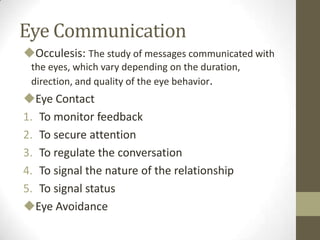
Eye Communication
Occulesis: The study of messages communicated with
the eyes, which vary depending on the duration,
direction, and quality of the eye behavior.
Eye Contact
1. To monitor feedback
2. To secure attention
3. To regulate the conversation
4. To signal the nature of the relationship
5. To signal status
Eye Avoidance
Touch Communication
Tactile Communication: Communication
by touch, also referred to as Haptics.
Meanings of Touch
Touch Avoidance
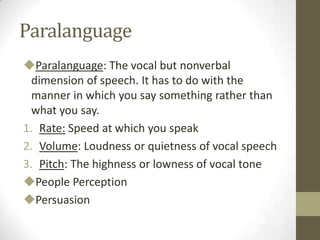
Paralanguage
Paralanguage: The vocal but nonverbal
dimension of speech. It has to do with the
manner in which you say something rather than
what you say.
1. Rate: Speed at which you speak
2. Volume: Loudness or quietness of vocal speech
3. Pitch: The highness or lowness of vocal tone
People Perception
Persuasion
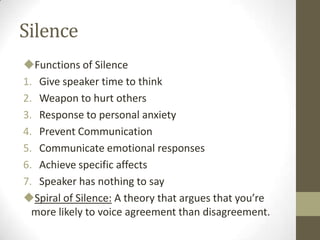
Silence
Functions of Silence
1. Give speaker time to think
2. Weapon to hurt others
3. Response to personal anxiety
4. Prevent Communication
5. Communicate emotional responses
6. Achieve specific affects
7. Speaker has nothing to say
Spiral of Silence: A theory that argues that you’re
more likely to voice agreement than disagreement.
Spatial Messages And
Territoriality
Proxemic Distances (4 types)
1. Intimate Distance: Ranging from the close
phase of actual touching to the far phase of 6-
18 inches.
2. Personal Distance: Ranges from 18 inches to
about 4 feet.
3. Social Distance: Ranges from 4 feet to 12 feet.
4. Public Distance: Ranges from12 feet to more
than 25 feet.
Territoriality
Primary or Home Territories: Areas that you call your
own.
Secondary Territories: Areas that don’t belong to you,
but that you have occupied.
Public Territories: Areas that are open to all people.
Withdrawal: you simply leave the scene
Turf Defense: you defend the territory against
encroachment
Insulation: Involves erecting barriers between yourself
and those who would encroach on your territory.
Linguistic Collusion: speaking in a way that intruders will
not understand either language or jargon.
Artifactual Communication
-Messages conveyed by objects that are made by
human hands.
Space Decoration
Color Communication
Clothing and Body Adornment
Scent
Olfactory Communication: Communicating by
smell.
Temporal Communication
Consists of the messages communicated by your time
orientation and treatment of time.
Chronemics- the study of the communicative function of time.
Psychological Time- Refers to a person’s emphasis on, or
orientation towards, the part, present or future.
Functions of Nonverbal
Communication
Forming and Managing Impressions
Forming and Defining Relationships
Structuring Conversation and Social
Interaction
Influencing and Deceiving
Expressing Emotions
Nonverbal Communication and
Culture
Culture and Gesture
Culture and Facial Expression
Culture and Eye Communication
Culture and Touch
Culture, Paralanguage, and Silence
Culture and Colors
Culture and Time (Formal / Informal)
Monochronism and Polychronism
YouTube Examples
Here are 2 videos from YouTube that will help explain
Nonverbal Communication
http://www.youtube.com/watch?v=VfDWQG47pAQ
http://www.youtube.com/watch?v=jl8xVhKZRHk&feature=py
v&ad=3807773923&kw=communication%20body%20languag
e&gclid=CNGVkvntz6gCFQ4g2godemlggg

Jonathan poche chapter 6

  • 1.
  • 2.
    Channels of Nonverbal Communication BodyCommunication Facial Communication Eye Communication Touch Communication Paralanguage and Silence Spatial Messages Artifactual Communication Temporal Communication
  • 3.
    Body Communication Body Gestures: 1.Emblems 2. Illustrators 3. Affect Displays 4. Regulators 5. Adaptors Body Appearance
  • 4.
    Facial Communication Facial ManagementTechniques: 1. Intensify 2. Deintensify 3. Neutralize 4. Mask 5. Simulate Facial Feedback 1. Facial Feedback Hypothesis: Your facial expressions influence your physiological arousal.
  • 5.
    Eye Communication Occulesis: Thestudy of messages communicated with the eyes, which vary depending on the duration, direction, and quality of the eye behavior. Eye Contact 1. To monitor feedback 2. To secure attention 3. To regulate the conversation 4. To signal the nature of the relationship 5. To signal status Eye Avoidance
  • 6.
    Touch Communication Tactile Communication:Communication by touch, also referred to as Haptics. Meanings of Touch Touch Avoidance
  • 7.
    Paralanguage Paralanguage: The vocalbut nonverbal dimension of speech. It has to do with the manner in which you say something rather than what you say. 1. Rate: Speed at which you speak 2. Volume: Loudness or quietness of vocal speech 3. Pitch: The highness or lowness of vocal tone People Perception Persuasion
  • 8.
    Silence Functions of Silence 1.Give speaker time to think 2. Weapon to hurt others 3. Response to personal anxiety 4. Prevent Communication 5. Communicate emotional responses 6. Achieve specific affects 7. Speaker has nothing to say Spiral of Silence: A theory that argues that you’re more likely to voice agreement than disagreement.
  • 9.
    Spatial Messages And Territoriality ProxemicDistances (4 types) 1. Intimate Distance: Ranging from the close phase of actual touching to the far phase of 6- 18 inches. 2. Personal Distance: Ranges from 18 inches to about 4 feet. 3. Social Distance: Ranges from 4 feet to 12 feet. 4. Public Distance: Ranges from12 feet to more than 25 feet.
  • 10.
    Territoriality Primary or HomeTerritories: Areas that you call your own. Secondary Territories: Areas that don’t belong to you, but that you have occupied. Public Territories: Areas that are open to all people. Withdrawal: you simply leave the scene Turf Defense: you defend the territory against encroachment Insulation: Involves erecting barriers between yourself and those who would encroach on your territory. Linguistic Collusion: speaking in a way that intruders will not understand either language or jargon.
  • 11.
    Artifactual Communication -Messages conveyedby objects that are made by human hands. Space Decoration Color Communication Clothing and Body Adornment Scent Olfactory Communication: Communicating by smell.
  • 12.
    Temporal Communication Consists ofthe messages communicated by your time orientation and treatment of time. Chronemics- the study of the communicative function of time. Psychological Time- Refers to a person’s emphasis on, or orientation towards, the part, present or future.
  • 13.
    Functions of Nonverbal Communication Formingand Managing Impressions Forming and Defining Relationships Structuring Conversation and Social Interaction Influencing and Deceiving Expressing Emotions
  • 14.
    Nonverbal Communication and Culture Cultureand Gesture Culture and Facial Expression Culture and Eye Communication Culture and Touch Culture, Paralanguage, and Silence Culture and Colors Culture and Time (Formal / Informal) Monochronism and Polychronism
  • 15.
    YouTube Examples Here are2 videos from YouTube that will help explain Nonverbal Communication http://www.youtube.com/watch?v=VfDWQG47pAQ http://www.youtube.com/watch?v=jl8xVhKZRHk&feature=py v&ad=3807773923&kw=communication%20body%20languag e&gclid=CNGVkvntz6gCFQ4g2godemlggg