Transaction Management
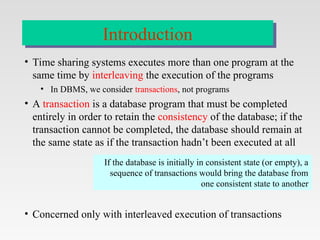
• Time sharing systems executes more than one program at the
same time by interleaving the execution of the programs
• In DBMS, we consider transactions, not programs
• A transaction is a database program that must be completed
entirely in order to retain the consistency of the database; if the
transaction cannot be completed, the database should remain at
the same state as if the transaction hadn’t been executed at all
• Concerned only with interleaved execution of transactions
Introduction
If the database is initially in consistent state (or empty), a
sequence of transactions would bring the database from
one consistent state to another
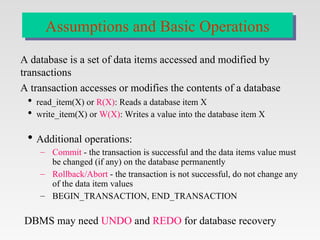
A database is a set of data items accessed and modified by
transactions
A transaction accesses or modifies the contents of a database
 read_item(X) or R(X): Reads a database item X
 write_item(X) or W(X): Writes a value into the database item X
 Additional operations:
– Commit - the transaction is successful and the data items value must
be changed (if any) on the database permanently
– Rollback/Abort - the transaction is not successful, do not change any
of the data item values
– BEGIN_TRANSACTION, END_TRANSACTION
DBMS may need UNDO and REDO for database recovery
Assumptions and Basic Operations
Transactions
Transactions
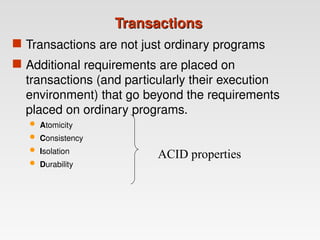
 Transactions are not just ordinary programs
 Additional requirements are placed on
transactions (and particularly their execution
environment) that go beyond the requirements
placed on ordinary programs.
 Atomicity
 Consistency
 Isolation
 Durability
ACID properties
ACID Properties
ACID Properties
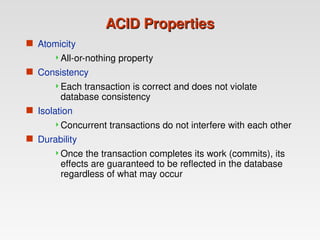
 Atomicity
All-or-nothing property
 Consistency
Each transaction is correct and does not violate
database consistency
 Isolation
Concurrent transactions do not interfere with each other
 Durability
Once the transaction completes its work (commits), its
effects are guaranteed to be reflected in the database
regardless of what may occur
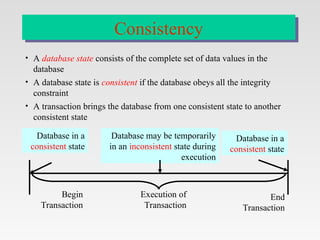
• A database state consists of the complete set of data values in the
database
• A database state is consistent if the database obeys all the integrity
constraint
• A transaction brings the database from one consistent state to another
consistent state
Database in a
consistent state
Database may be temporarily
in an inconsistent state during
execution
Database in a
consistent state
Begin
Transaction
Execution of
Transaction
End
Transaction
Consistency
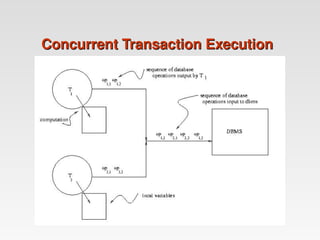
Concurrent Transaction Execution
Transaction Concept
Transaction Concept
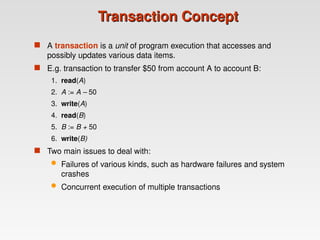
 A transaction is a unit of program execution that accesses and
possibly updates various data items.
 E.g. transaction to transfer $50 from account A to account B:
1. read(A)
2. A := A – 50
3. write(A)
4. read(B)
5. B := B + 50
6. write(B)
 Two main issues to deal with:
 Failures of various kinds, such as hardware failures and system
crashes
 Concurrent execution of multiple transactions
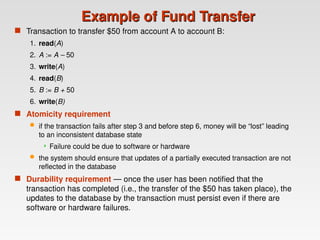
Example of Fund Transfer
 Transaction to transfer $50 from account A to account B:
1. read(A)
2. A := A – 50
3. write(A)
4. read(B)
5. B := B + 50
6. write(B)
 Atomicity requirement
 if the transaction fails after step 3 and before step 6, money will be “lost” leading
to an inconsistent database state
 Failure could be due to software or hardware
 the system should ensure that updates of a partially executed transaction are not
reflected in the database
 Durability requirement — once the user has been notified that the
transaction has completed (i.e., the transfer of the $50 has taken place), the
updates to the database by the transaction must persist even if there are
software or hardware failures.
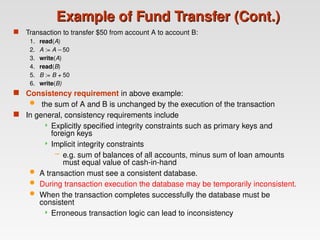
Example of Fund Transfer (Cont.)
 Transaction to transfer $50 from account A to account B:
1. read(A)
2. A := A – 50
3. write(A)
4. read(B)
5. B := B + 50
6. write(B)
 Consistency requirement in above example:
 the sum of A and B is unchanged by the execution of the transaction
 In general, consistency requirements include
 Explicitly specified integrity constraints such as primary keys and
foreign keys
 Implicit integrity constraints
– e.g. sum of balances of all accounts, minus sum of loan amounts
must equal value of cash-in-hand
 A transaction must see a consistent database.
 During transaction execution the database may be temporarily inconsistent.
 When the transaction completes successfully the database must be
consistent
 Erroneous transaction logic can lead to inconsistency
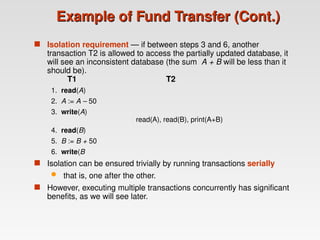
Example of Fund Transfer (Cont.)
 Isolation requirement — if between steps 3 and 6, another
transaction T2 is allowed to access the partially updated database, it
will see an inconsistent database (the sum A + B will be less than it
should be).
T1 T2
1. read(A)
2. A := A – 50
3. write(A)
read(A), read(B), print(A+B)
4. read(B)
5. B := B + 50
6. write(B
 Isolation can be ensured trivially by running transactions serially
 that is, one after the other.
 However, executing multiple transactions concurrently has significant
benefits, as we will see later.
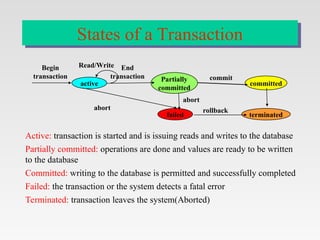
Active: transaction is started and is issuing reads and writes to the database
Partially committed: operations are done and values are ready to be written
to the database
Committed: writing to the database is permitted and successfully completed
Failed: the transaction or the system detects a fatal error
Terminated: transaction leaves the system(Aborted)
active
Partially
committed
terminated
failed
committed
Begin
transaction
End
transaction commit
abort
abort
Read/Write
States of a Transaction
rollback
Implementation of Atomicity and
Durability
Durability
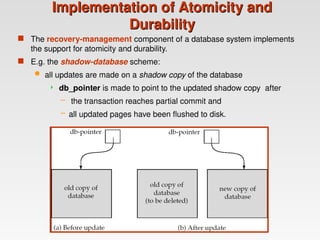
 The recovery-management component of a database system implements
the support for atomicity and durability.
 E.g. the shadow-database scheme:
 all updates are made on a shadow copy of the database
 db_pointer is made to point to the updated shadow copy after
– the transaction reaches partial commit and
– all updated pages have been flushed to disk.
Implementation of Atomicity and Durability
 db_pointer always points to the current consistent copy of the
database.
 In case transaction fails, old consistent copy pointed to by
db_pointer can be used, and the shadow copy can be deleted.
 The shadow-database scheme:
 Assumes that only one transaction is active at a time.
 Assumes disks do not fail
 Useful for text editors, but
extremely inefficient for large databases
– Variant called shadow paging reduces copying of data, but is
still not practical for large databases
 Does not handle concurrent transactions
Concurrent Executions
 Multiple transactions are allowed to run concurrently in
the system. Advantages are:
 increased processor and disk utilization, leading
to better transaction throughput
E.g. one transaction can be using the CPU while
another is reading from or writing to the disk
 reduced average response time for transactions:
short transactions need not wait behind long ones.
 Concurrency control schemes – mechanisms to
achieve isolation
 that is, to control the interaction among the
concurrent transactions in order to prevent them from
destroying the consistency of the database
Schedules
Schedules
 Schedule – a sequences of instructions that specify the
chronological order in which instructions of concurrent
transactions are executed
 a schedule for a set of transactions must consist of all
instructions of those transactions
 must preserve the order in which the instructions appear
in each individual transaction.
 A transaction that successfully completes its execution will
have a commit instructions as the last statement
 by default transaction assumed to execute commit
instruction as its last step
 A transaction that fails to successfully complete its execution
will have an abort instruction as the last statement
Schedule 1
Schedule 1
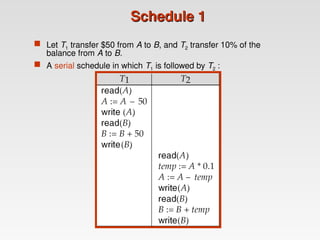
 Let T1 transfer $50 from A to B, and T2 transfer 10% of the
balance from A to B.
 A serial schedule in which T1 is followed by T2 :
Schedule 2
Schedule 2
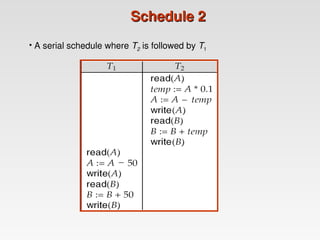
• A serial schedule where T2 is followed by T1
Schedule 3
Schedule 3
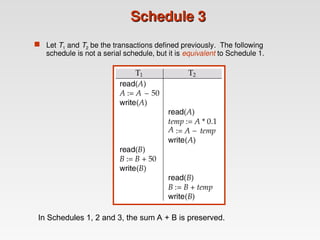
 Let T1 and T2 be the transactions defined previously. The following
schedule is not a serial schedule, but it is equivalent to Schedule 1.
In Schedules 1, 2 and 3, the sum A + B is preserved.
Schedule 4
Schedule 4
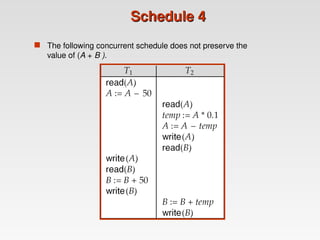
 The following concurrent schedule does not preserve the
value of (A + B ).
Serializability
Serializability
 Basic Assumption – Each transaction preserves database
consistency.
 Thus serial execution of a set of transactions preserves database
consistency.
 A (possibly concurrent) schedule is serializable if it is equivalent to a
serial schedule. Different forms of schedule equivalence give rise to
the notions of:
1. conflict serializability
2. view serializability
 Simplified view of transactions
 We ignore operations other than read and write instructions
 We assume that transactions may perform arbitrary computations
on data in local buffers in between reads and writes.
 Our simplified schedules consist of only read and write
instructions.
Serializable Schedules
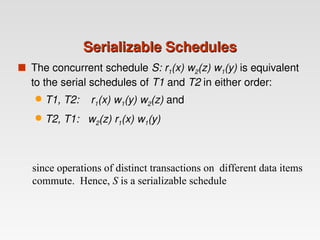
 The concurrent schedule S: r1(x) w2(z) w1(y) is equivalent
to the serial schedules of T1 and T2 in either order:
 T1, T2: r1(x) w1(y) w2(z) and
 T2, T1: w2(z) r1(x) w1(y)
since operations of distinct transactions on different data items
commute. Hence, S is a serializable schedule
Serializable Schedules
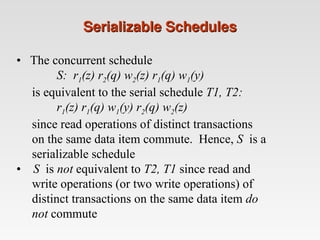
• The concurrent schedule
S: r1(z) r2(q) w2(z) r1(q) w1(y)
is equivalent to the serial schedule T1, T2:
r1(z) r1(q) w1(y) r2(q) w2(z)
since read operations of distinct transactions
on the same data item commute. Hence, S is a
serializable schedule
• S is not equivalent to T2, T1 since read and
write operations (or two write operations) of
distinct transactions on the same data item do
not commute
Conflicting Instructions
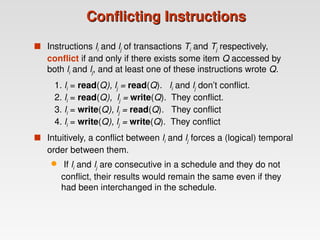
 Instructions li and lj of transactions Ti and Tj respectively,
conflict if and only if there exists some item Q accessed by
both li and lj, and at least one of these instructions wrote Q.
1. li = read(Q), lj = read(Q). li and lj don’t conflict.
2. li = read(Q), lj = write(Q). They conflict.
3. li = write(Q), lj = read(Q). They conflict
4. li = write(Q), lj = write(Q). They conflict
 Intuitively, a conflict between li and lj forces a (logical) temporal
order between them.
 If li and lj are consecutive in a schedule and they do not
conflict, their results would remain the same even if they
had been interchanged in the schedule.
Conflict Serializability
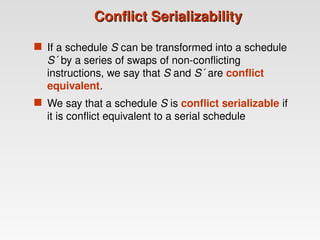
 If a schedule S can be transformed into a schedule
S´ by a series of swaps of non-conflicting
instructions, we say that S and S´ are conflict
equivalent.
 We say that a schedule S is conflict serializable if
it is conflict equivalent to a serial schedule
Conflict Serializability (Cont.)
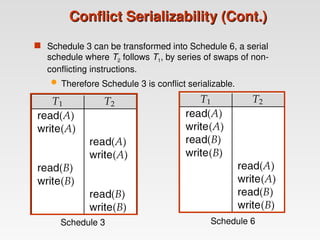
 Schedule 3 can be transformed into Schedule 6, a serial
schedule where T2 follows T1, by series of swaps of non-
conflicting instructions.
 Therefore Schedule 3 is conflict serializable.
Schedule 3 Schedule 6
Conflict Serializability (Cont.)
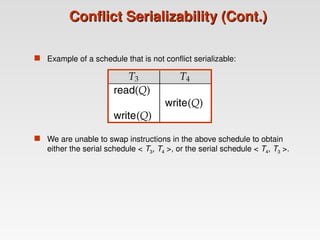
 Example of a schedule that is not conflict serializable:
 We are unable to swap instructions in the above schedule to obtain
either the serial schedule < T3, T4 >, or the serial schedule < T4, T3 >.
Serializability
Serializability
 Criterion for correctness of concurrency
 In other words, criterion for correctness of interleaved
schedules
 A schedule is correct, ie, serializable, if it is EQ. to
some serial schedule
 T1 then T2; result x
 T2 then T1; result y
 Both are considered correct!
Conflicting Instructions
 Two consecutive actions of different txs. Are said to
be in conflict in an interleaved schedule if:
 They involve the same DI
 Atleast one of them is a write
 Conflicting actions cannot be swapped
 Non-conflicting actions can be swapped
 Do you agree?
 Because swapping them does not change the state
of the DB
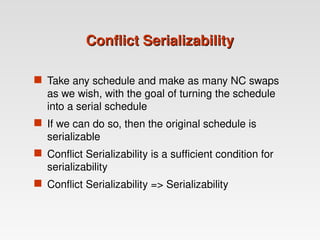
Conflict Serializability
 Take any schedule and make as many NC swaps
as we wish, with the goal of turning the schedule
into a serial schedule
 If we can do so, then the original schedule is
serializable
 Conflict Serializability is a sufficient condition for
serializability
 Conflict Serializability => Serializability
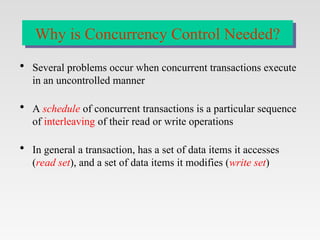
 Several problems occur when concurrent transactions execute
in an uncontrolled manner
 A schedule of concurrent transactions is a particular sequence
of interleaving of their read or write operations
 In general a transaction, has a set of data items it accesses
(read set), and a set of data items it modifies (write set)
Why is Concurrency Control Needed?
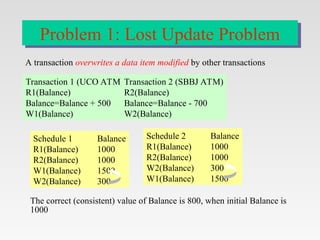
A transaction overwrites a data item modified by other transactions
The correct (consistent) value of Balance is 800, when initial Balance is
1000
Transaction 1 (UCO ATM)
R1(Balance)
Balance=Balance + 500
W1(Balance)
Transaction 2 (SBBJ ATM)
R2(Balance)
Balance=Balance - 700
W2(Balance)
Schedule 1 Balance
R1(Balance) 1000
R2(Balance) 1000
W1(Balance) 1500
W2(Balance) 300
Schedule 2 Balance
R1(Balance) 1000
R2(Balance) 1000
W2(Balance) 300
W1(Balance) 1500
Problem 1: Lost Update Problem
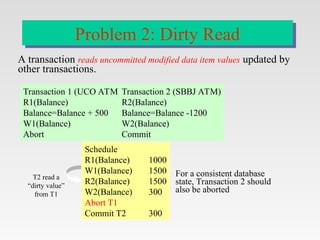
A transaction reads uncommitted modified data item values updated by
other transactions.
For a consistent database
state, Transaction 2 should
also be aborted
Transaction 1 (UCO ATM)
R1(Balance)
Balance=Balance + 500
W1(Balance)
Abort
Transaction 2 (SBBJ ATM)
R2(Balance)
Balance=Balance -1200
W2(Balance)
Commit
Schedule
R1(Balance) 1000
W1(Balance) 1500
R2(Balance) 1500
W2(Balance) 300
Abort T1
Commit T2 300
Problem 2: Dirty Read
T2 read a
“dirty value”
from T1
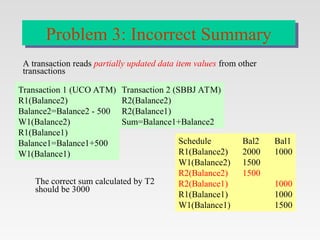
A transaction reads partially updated data item values from other
transactions
The correct sum calculated by T2
should be 3000
Transaction 1 (UCO ATM)
R1(Balance2)
Balance2=Balance2 - 500
W1(Balance2)
R1(Balance1)
Balance1=Balance1+500
W1(Balance1)
Transaction 2 (SBBJ ATM)
R2(Balance2)
R2(Balance1)
Sum=Balance1+Balance2
Schedule Bal2 Bal1
R1(Balance2) 2000 1000
W1(Balance2) 1500
R2(Balance2) 1500
R2(Balance1) 1000
R1(Balance1) 1000
W1(Balance1) 1500
Problem 3: Incorrect Summary
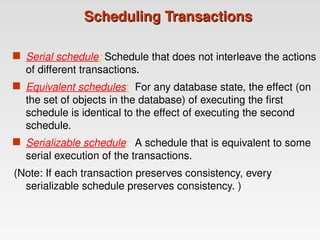
Scheduling Transactions
 Serial schedule: Schedule that does not interleave the actions
of different transactions.
 Equivalent schedules: For any database state, the effect (on
the set of objects in the database) of executing the first
schedule is identical to the effect of executing the second
schedule.
 Serializable schedule: A schedule that is equivalent to some
serial execution of the transactions.
(Note: If each transaction preserves consistency, every
serializable schedule preserves consistency. )
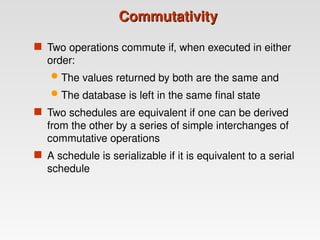
Commutativity
Commutativity
 Two operations commute if, when executed in either
order:
 The values returned by both are the same and
 The database is left in the same final state
 Two schedules are equivalent if one can be derived
from the other by a series of simple interchanges of
commutative operations
 A schedule is serializable if it is equivalent to a serial
schedule
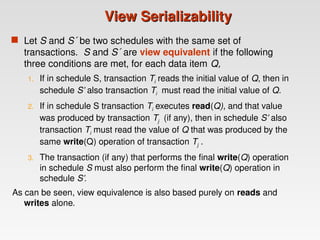
View Serializability
 Let S and S´ be two schedules with the same set of
transactions. S and S´ are view equivalent if the following
three conditions are met, for each data item Q,
1. If in schedule S, transaction Ti reads the initial value of Q, then in
schedule S’ also transaction Ti must read the initial value of Q.
2. If in schedule S transaction Ti executes read(Q), and that value
was produced by transaction Tj (if any), then in schedule S’ also
transaction Ti must read the value of Q that was produced by the
same write(Q) operation of transaction Tj .
3. The transaction (if any) that performs the final write(Q) operation
in schedule S must also perform the final write(Q) operation in
schedule S’.
As can be seen, view equivalence is also based purely on reads and
writes alone.
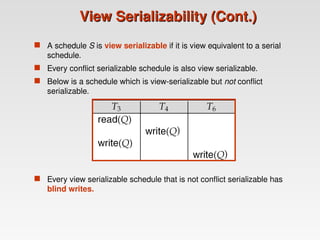
View Serializability (Cont.)
 A schedule S is view serializable if it is view equivalent to a serial
schedule.
 Every conflict serializable schedule is also view serializable.
 Below is a schedule which is view-serializable but not conflict
serializable.
 Every view serializable schedule that is not conflict serializable has
blind writes.
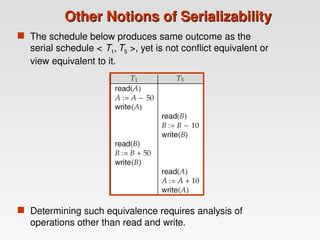
Other Notions of Serializability
 The schedule below produces same outcome as the
serial schedule < T1, T5 >, yet is not conflict equivalent or
view equivalent to it.
 Determining such equivalence requires analysis of
operations other than read and write.
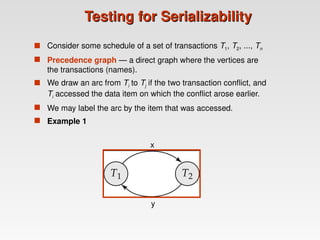
Testing for Serializability
 Consider some schedule of a set of transactions T1, T2, ..., Tn
 Precedence graph — a direct graph where the vertices are
the transactions (names).
 We draw an arc from Ti to Tj if the two transaction conflict, and
Ti accessed the data item on which the conflict arose earlier.
 We may label the arc by the item that was accessed.
 Example 1
x
y
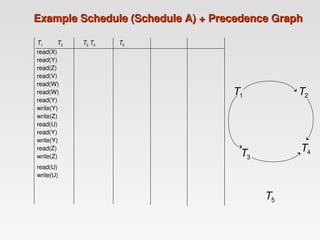
Example Schedule (Schedule A) + Precedence Graph
T1 T2 T3 T4 T5
read(X)
read(Y)
read(Z)
read(V)
read(W)
read(W)
read(Y)
write(Y)
write(Z)
read(U)
read(Y)
write(Y)
read(Z)
write(Z)
read(U)
write(U)
T3
T4
T1 T2
T5
Test for Conflict Serializability
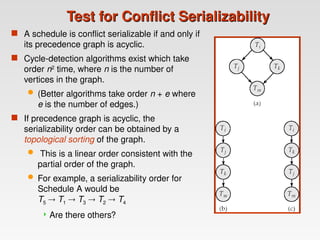
 A schedule is conflict serializable if and only if
its precedence graph is acyclic.
 Cycle-detection algorithms exist which take
order n2
time, where n is the number of
vertices in the graph.
 (Better algorithms take order n + e where
e is the number of edges.)
 If precedence graph is acyclic, the
serializability order can be obtained by a
topological sorting of the graph.
 This is a linear order consistent with the
partial order of the graph.
 For example, a serializability order for
Schedule A would be
T5  T1  T3  T2  T4
 Are there others?
Test for View Serializability
 The precedence graph test for conflict serializability cannot
be used directly to test for view serializability.
 Extension to test for view serializability has cost
exponential in the size of the precedence graph.
 The problem of checking if a schedule is view serializable
falls in the class of NP-complete problems.
 Thus existence of an efficient algorithm is extremely
unlikely.
 However practical algorithms that just check some
sufficient conditions for view serializability can still be
used.

Class-Transaction Management.ppt Database

  • 1.
  • 2.
    • Time sharingsystems executes more than one program at the same time by interleaving the execution of the programs • In DBMS, we consider transactions, not programs • A transaction is a database program that must be completed entirely in order to retain the consistency of the database; if the transaction cannot be completed, the database should remain at the same state as if the transaction hadn’t been executed at all • Concerned only with interleaved execution of transactions Introduction If the database is initially in consistent state (or empty), a sequence of transactions would bring the database from one consistent state to another
  • 3.
    A database isa set of data items accessed and modified by transactions A transaction accesses or modifies the contents of a database  read_item(X) or R(X): Reads a database item X  write_item(X) or W(X): Writes a value into the database item X  Additional operations: – Commit - the transaction is successful and the data items value must be changed (if any) on the database permanently – Rollback/Abort - the transaction is not successful, do not change any of the data item values – BEGIN_TRANSACTION, END_TRANSACTION DBMS may need UNDO and REDO for database recovery Assumptions and Basic Operations
  • 4.
    Transactions Transactions  Transactions arenot just ordinary programs  Additional requirements are placed on transactions (and particularly their execution environment) that go beyond the requirements placed on ordinary programs.  Atomicity  Consistency  Isolation  Durability ACID properties
  • 5.
    ACID Properties ACID Properties Atomicity All-or-nothing property  Consistency Each transaction is correct and does not violate database consistency  Isolation Concurrent transactions do not interfere with each other  Durability Once the transaction completes its work (commits), its effects are guaranteed to be reflected in the database regardless of what may occur
  • 6.
    • A databasestate consists of the complete set of data values in the database • A database state is consistent if the database obeys all the integrity constraint • A transaction brings the database from one consistent state to another consistent state Database in a consistent state Database may be temporarily in an inconsistent state during execution Database in a consistent state Begin Transaction Execution of Transaction End Transaction Consistency
  • 7.
  • 8.
    Transaction Concept Transaction Concept A transaction is a unit of program execution that accesses and possibly updates various data items.  E.g. transaction to transfer $50 from account A to account B: 1. read(A) 2. A := A – 50 3. write(A) 4. read(B) 5. B := B + 50 6. write(B)  Two main issues to deal with:  Failures of various kinds, such as hardware failures and system crashes  Concurrent execution of multiple transactions
  • 9.
    Example of FundTransfer Example of Fund Transfer  Transaction to transfer $50 from account A to account B: 1. read(A) 2. A := A – 50 3. write(A) 4. read(B) 5. B := B + 50 6. write(B)  Atomicity requirement  if the transaction fails after step 3 and before step 6, money will be “lost” leading to an inconsistent database state  Failure could be due to software or hardware  the system should ensure that updates of a partially executed transaction are not reflected in the database  Durability requirement — once the user has been notified that the transaction has completed (i.e., the transfer of the $50 has taken place), the updates to the database by the transaction must persist even if there are software or hardware failures.
  • 10.
    Example of FundTransfer (Cont.) Example of Fund Transfer (Cont.)  Transaction to transfer $50 from account A to account B: 1. read(A) 2. A := A – 50 3. write(A) 4. read(B) 5. B := B + 50 6. write(B)  Consistency requirement in above example:  the sum of A and B is unchanged by the execution of the transaction  In general, consistency requirements include  Explicitly specified integrity constraints such as primary keys and foreign keys  Implicit integrity constraints – e.g. sum of balances of all accounts, minus sum of loan amounts must equal value of cash-in-hand  A transaction must see a consistent database.  During transaction execution the database may be temporarily inconsistent.  When the transaction completes successfully the database must be consistent  Erroneous transaction logic can lead to inconsistency
  • 11.
    Example of FundTransfer (Cont.) Example of Fund Transfer (Cont.)  Isolation requirement — if between steps 3 and 6, another transaction T2 is allowed to access the partially updated database, it will see an inconsistent database (the sum A + B will be less than it should be). T1 T2 1. read(A) 2. A := A – 50 3. write(A) read(A), read(B), print(A+B) 4. read(B) 5. B := B + 50 6. write(B  Isolation can be ensured trivially by running transactions serially  that is, one after the other.  However, executing multiple transactions concurrently has significant benefits, as we will see later.
  • 12.
    Active: transaction isstarted and is issuing reads and writes to the database Partially committed: operations are done and values are ready to be written to the database Committed: writing to the database is permitted and successfully completed Failed: the transaction or the system detects a fatal error Terminated: transaction leaves the system(Aborted) active Partially committed terminated failed committed Begin transaction End transaction commit abort abort Read/Write States of a Transaction rollback
  • 13.
    Implementation of Atomicityand Implementation of Atomicity and Durability Durability  The recovery-management component of a database system implements the support for atomicity and durability.  E.g. the shadow-database scheme:  all updates are made on a shadow copy of the database  db_pointer is made to point to the updated shadow copy after – the transaction reaches partial commit and – all updated pages have been flushed to disk.
  • 14.
    Implementation of Atomicityand Durability Implementation of Atomicity and Durability  db_pointer always points to the current consistent copy of the database.  In case transaction fails, old consistent copy pointed to by db_pointer can be used, and the shadow copy can be deleted.  The shadow-database scheme:  Assumes that only one transaction is active at a time.  Assumes disks do not fail  Useful for text editors, but extremely inefficient for large databases – Variant called shadow paging reduces copying of data, but is still not practical for large databases  Does not handle concurrent transactions
  • 15.
    Concurrent Executions Concurrent Executions Multiple transactions are allowed to run concurrently in the system. Advantages are:  increased processor and disk utilization, leading to better transaction throughput E.g. one transaction can be using the CPU while another is reading from or writing to the disk  reduced average response time for transactions: short transactions need not wait behind long ones.  Concurrency control schemes – mechanisms to achieve isolation  that is, to control the interaction among the concurrent transactions in order to prevent them from destroying the consistency of the database
  • 16.
    Schedules Schedules  Schedule –a sequences of instructions that specify the chronological order in which instructions of concurrent transactions are executed  a schedule for a set of transactions must consist of all instructions of those transactions  must preserve the order in which the instructions appear in each individual transaction.  A transaction that successfully completes its execution will have a commit instructions as the last statement  by default transaction assumed to execute commit instruction as its last step  A transaction that fails to successfully complete its execution will have an abort instruction as the last statement
  • 17.
    Schedule 1 Schedule 1 Let T1 transfer $50 from A to B, and T2 transfer 10% of the balance from A to B.  A serial schedule in which T1 is followed by T2 :
  • 18.
    Schedule 2 Schedule 2 •A serial schedule where T2 is followed by T1
  • 19.
    Schedule 3 Schedule 3 Let T1 and T2 be the transactions defined previously. The following schedule is not a serial schedule, but it is equivalent to Schedule 1. In Schedules 1, 2 and 3, the sum A + B is preserved.
  • 20.
    Schedule 4 Schedule 4 The following concurrent schedule does not preserve the value of (A + B ).
  • 21.
    Serializability Serializability  Basic Assumption– Each transaction preserves database consistency.  Thus serial execution of a set of transactions preserves database consistency.  A (possibly concurrent) schedule is serializable if it is equivalent to a serial schedule. Different forms of schedule equivalence give rise to the notions of: 1. conflict serializability 2. view serializability  Simplified view of transactions  We ignore operations other than read and write instructions  We assume that transactions may perform arbitrary computations on data in local buffers in between reads and writes.  Our simplified schedules consist of only read and write instructions.
  • 22.
    Serializable Schedules Serializable Schedules The concurrent schedule S: r1(x) w2(z) w1(y) is equivalent to the serial schedules of T1 and T2 in either order:  T1, T2: r1(x) w1(y) w2(z) and  T2, T1: w2(z) r1(x) w1(y) since operations of distinct transactions on different data items commute. Hence, S is a serializable schedule
  • 23.
    Serializable Schedules Serializable Schedules •The concurrent schedule S: r1(z) r2(q) w2(z) r1(q) w1(y) is equivalent to the serial schedule T1, T2: r1(z) r1(q) w1(y) r2(q) w2(z) since read operations of distinct transactions on the same data item commute. Hence, S is a serializable schedule • S is not equivalent to T2, T1 since read and write operations (or two write operations) of distinct transactions on the same data item do not commute
  • 24.
    Conflicting Instructions Conflicting Instructions Instructions li and lj of transactions Ti and Tj respectively, conflict if and only if there exists some item Q accessed by both li and lj, and at least one of these instructions wrote Q. 1. li = read(Q), lj = read(Q). li and lj don’t conflict. 2. li = read(Q), lj = write(Q). They conflict. 3. li = write(Q), lj = read(Q). They conflict 4. li = write(Q), lj = write(Q). They conflict  Intuitively, a conflict between li and lj forces a (logical) temporal order between them.  If li and lj are consecutive in a schedule and they do not conflict, their results would remain the same even if they had been interchanged in the schedule.
  • 25.
    Conflict Serializability Conflict Serializability If a schedule S can be transformed into a schedule S´ by a series of swaps of non-conflicting instructions, we say that S and S´ are conflict equivalent.  We say that a schedule S is conflict serializable if it is conflict equivalent to a serial schedule
  • 26.
    Conflict Serializability (Cont.) ConflictSerializability (Cont.)  Schedule 3 can be transformed into Schedule 6, a serial schedule where T2 follows T1, by series of swaps of non- conflicting instructions.  Therefore Schedule 3 is conflict serializable. Schedule 3 Schedule 6
  • 27.
    Conflict Serializability (Cont.) ConflictSerializability (Cont.)  Example of a schedule that is not conflict serializable:  We are unable to swap instructions in the above schedule to obtain either the serial schedule < T3, T4 >, or the serial schedule < T4, T3 >.
  • 28.
    Serializability Serializability  Criterion forcorrectness of concurrency  In other words, criterion for correctness of interleaved schedules  A schedule is correct, ie, serializable, if it is EQ. to some serial schedule  T1 then T2; result x  T2 then T1; result y  Both are considered correct!
  • 29.
    Conflicting Instructions Conflicting Instructions Two consecutive actions of different txs. Are said to be in conflict in an interleaved schedule if:  They involve the same DI  Atleast one of them is a write  Conflicting actions cannot be swapped  Non-conflicting actions can be swapped  Do you agree?  Because swapping them does not change the state of the DB
  • 30.
    Conflict Serializability Conflict Serializability Take any schedule and make as many NC swaps as we wish, with the goal of turning the schedule into a serial schedule  If we can do so, then the original schedule is serializable  Conflict Serializability is a sufficient condition for serializability  Conflict Serializability => Serializability
  • 31.
     Several problemsoccur when concurrent transactions execute in an uncontrolled manner  A schedule of concurrent transactions is a particular sequence of interleaving of their read or write operations  In general a transaction, has a set of data items it accesses (read set), and a set of data items it modifies (write set) Why is Concurrency Control Needed?
  • 32.
    A transaction overwritesa data item modified by other transactions The correct (consistent) value of Balance is 800, when initial Balance is 1000 Transaction 1 (UCO ATM) R1(Balance) Balance=Balance + 500 W1(Balance) Transaction 2 (SBBJ ATM) R2(Balance) Balance=Balance - 700 W2(Balance) Schedule 1 Balance R1(Balance) 1000 R2(Balance) 1000 W1(Balance) 1500 W2(Balance) 300 Schedule 2 Balance R1(Balance) 1000 R2(Balance) 1000 W2(Balance) 300 W1(Balance) 1500 Problem 1: Lost Update Problem
  • 33.
    A transaction readsuncommitted modified data item values updated by other transactions. For a consistent database state, Transaction 2 should also be aborted Transaction 1 (UCO ATM) R1(Balance) Balance=Balance + 500 W1(Balance) Abort Transaction 2 (SBBJ ATM) R2(Balance) Balance=Balance -1200 W2(Balance) Commit Schedule R1(Balance) 1000 W1(Balance) 1500 R2(Balance) 1500 W2(Balance) 300 Abort T1 Commit T2 300 Problem 2: Dirty Read T2 read a “dirty value” from T1
  • 34.
    A transaction readspartially updated data item values from other transactions The correct sum calculated by T2 should be 3000 Transaction 1 (UCO ATM) R1(Balance2) Balance2=Balance2 - 500 W1(Balance2) R1(Balance1) Balance1=Balance1+500 W1(Balance1) Transaction 2 (SBBJ ATM) R2(Balance2) R2(Balance1) Sum=Balance1+Balance2 Schedule Bal2 Bal1 R1(Balance2) 2000 1000 W1(Balance2) 1500 R2(Balance2) 1500 R2(Balance1) 1000 R1(Balance1) 1000 W1(Balance1) 1500 Problem 3: Incorrect Summary
  • 35.
    Scheduling Transactions Scheduling Transactions Serial schedule: Schedule that does not interleave the actions of different transactions.  Equivalent schedules: For any database state, the effect (on the set of objects in the database) of executing the first schedule is identical to the effect of executing the second schedule.  Serializable schedule: A schedule that is equivalent to some serial execution of the transactions. (Note: If each transaction preserves consistency, every serializable schedule preserves consistency. )
  • 36.
    Commutativity Commutativity  Two operationscommute if, when executed in either order:  The values returned by both are the same and  The database is left in the same final state  Two schedules are equivalent if one can be derived from the other by a series of simple interchanges of commutative operations  A schedule is serializable if it is equivalent to a serial schedule
  • 37.
    View Serializability View Serializability Let S and S´ be two schedules with the same set of transactions. S and S´ are view equivalent if the following three conditions are met, for each data item Q, 1. If in schedule S, transaction Ti reads the initial value of Q, then in schedule S’ also transaction Ti must read the initial value of Q. 2. If in schedule S transaction Ti executes read(Q), and that value was produced by transaction Tj (if any), then in schedule S’ also transaction Ti must read the value of Q that was produced by the same write(Q) operation of transaction Tj . 3. The transaction (if any) that performs the final write(Q) operation in schedule S must also perform the final write(Q) operation in schedule S’. As can be seen, view equivalence is also based purely on reads and writes alone.
  • 38.
    View Serializability (Cont.) ViewSerializability (Cont.)  A schedule S is view serializable if it is view equivalent to a serial schedule.  Every conflict serializable schedule is also view serializable.  Below is a schedule which is view-serializable but not conflict serializable.  Every view serializable schedule that is not conflict serializable has blind writes.
  • 39.
    Other Notions ofSerializability Other Notions of Serializability  The schedule below produces same outcome as the serial schedule < T1, T5 >, yet is not conflict equivalent or view equivalent to it.  Determining such equivalence requires analysis of operations other than read and write.
  • 40.
    Testing for Serializability Testingfor Serializability  Consider some schedule of a set of transactions T1, T2, ..., Tn  Precedence graph — a direct graph where the vertices are the transactions (names).  We draw an arc from Ti to Tj if the two transaction conflict, and Ti accessed the data item on which the conflict arose earlier.  We may label the arc by the item that was accessed.  Example 1 x y
  • 41.
    Example Schedule (ScheduleA) + Precedence Graph Example Schedule (Schedule A) + Precedence Graph T1 T2 T3 T4 T5 read(X) read(Y) read(Z) read(V) read(W) read(W) read(Y) write(Y) write(Z) read(U) read(Y) write(Y) read(Z) write(Z) read(U) write(U) T3 T4 T1 T2 T5
  • 42.
    Test for ConflictSerializability Test for Conflict Serializability  A schedule is conflict serializable if and only if its precedence graph is acyclic.  Cycle-detection algorithms exist which take order n2 time, where n is the number of vertices in the graph.  (Better algorithms take order n + e where e is the number of edges.)  If precedence graph is acyclic, the serializability order can be obtained by a topological sorting of the graph.  This is a linear order consistent with the partial order of the graph.  For example, a serializability order for Schedule A would be T5  T1  T3  T2  T4  Are there others?
  • 43.
    Test for ViewSerializability Test for View Serializability  The precedence graph test for conflict serializability cannot be used directly to test for view serializability.  Extension to test for view serializability has cost exponential in the size of the precedence graph.  The problem of checking if a schedule is view serializable falls in the class of NP-complete problems.  Thus existence of an efficient algorithm is extremely unlikely.  However practical algorithms that just check some sufficient conditions for view serializability can still be used.