The High Scope Pre-K Curriculum: Will Your Child Benefit From It? Brandi Johnson Technical Communications English 1105 September 6, 2009
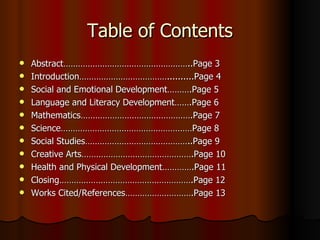
Table of Contents Abstract……………………………………………..Page 3 Introduction………………………………..........Page 4 Social and Emotional Development……….Page 5 Language and Literacy Development…….Page 6 Mathematics……………………………………….Page 7 Science………………………………………………Page 8 Social Studies……………………………………..Page 9 Creative Arts……………………………………….Page 10 Health and Physical Development………….Page 11 Closing……………………………………………….Page 12 Works Cited/References……………………….Page 13
Abstract The question is will your child benefit from a Pre-Kindergarten program and its High Scope curriculum?  The answer is yes.  There are seven domains that make up the Pre-Kindergarten curriculum.  The first domain is Personal and Social Development.  The second is Language and Literacy.  The third is Mathematics.  The fourth is Science.  The fifth is Social Studies.  The sixth is Creative Arts.  Finally, the seventh is Health and Physical Development.  I will explain each domain in detail and provide research on how your child will benefit from this program.  The sources that I will be providing you with information from are four different websites. 1) A paper written by members of the Albert Shanker Institute-“Preschool Curriculum: What’s In It for Children and Teachers” ; 2)Georgia’s Bright from the Start-Pre-K website; 3)Tennessee’s website about Pre-Kindergarten; 4)Mississippi’s Pre-K Curriculum website.  I will also provide details on my experience from teaching Pre-Kindergarten for six years.
Introduction A lot of parents question whether or not their child will benefit from a Pre-Kindergarten program.  Experts show that children who do attend Pre-Kindergarten tend to excel in academics from kindergarten on up through high school.  The High Scope Pre-Kindergarten curriculum focuses on five dimensions of school readiness.  The five dimensions include: Approaches to Learning; Language and Literacy/Communication; Social and Emotional Development; Physical Development/Health; Arts and Sciences.  The High Scope curriculum then breaks those five dimensions down into seven domains.  Those seven domains include: Personal and Social Development; Language and Literacy; Mathematics; Science; Social Studies; Creative Arts; and Health and Physical Development.  Within the seven domains the High Scope curriculum has broken the items down into content standards to help teachers plan, teach, and access the children.
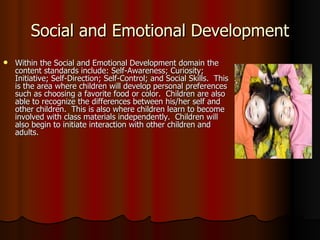
Social and Emotional Development Within the Social and Emotional Development domain the content standards include: Self-Awareness; Curiosity; Initiative; Self-Direction; Self-Control; and Social Skills.  This is the area where children will develop personal preferences such as choosing a favorite food or color.  Children are also able to recognize the differences between his/her self and other children.  This is also where children learn to become involved with class materials independently.  Children will also begin to initiate interaction with other children and adults.
Language and Literacy Development Next, there is the Language and Literacy domain.  This is a very important area for the children.  The content standards for this domain include: Listening; Phonological Awareness; Vocabulary Development; Expressive Language; Reading; and Writing.  In this area is where children learn to express their needs and wants with words.  Children also begin to use language to express ideas such as retelling a familiar story.  Children will also be able to demonstrate an awareness of print.  For example, they will begin to understand that you read a book from the front to the back and from the left to the right.  They will begin to recognize their names in print. Also, by the end of year, children will be able to match uppercase letters to lowercase letters.  A research summary presented by  The Albert Shanker Institute  states “The Pre-K years are an important time for children’s literacy growth.  Children who are engaged in meaningful, knowledge-building experiences with print gain the foundational skills for becoming skilled readers and writers.”  Children will enjoy listening and discussing storybooks.  Children will also develop skills in listening for the purpose of comprehension.
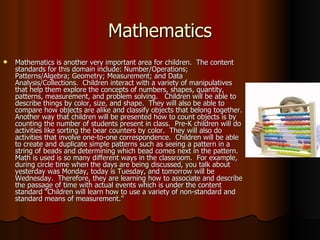
Mathematics Mathematics is another very important area for children.  The content standards for this domain include: Number/Operations; Patterns/Algebra; Geometry; Measurement; and Data Analysis/Collections.  Children interact with a variety of manipulatives that help them explore the concepts of numbers, shapes, quantity, patterns, measurement, and problem solving.  Children will be able to describe things by color, size, and shape.  They will also be able to compare how objects are alike and classify objects that belong together.  Another way that children will be presented how to count objects is by counting the number of students present in class.  Pre-K children will do activities like sorting the bear counters by color.  They will also do activities that involve one-to-one correspondence.  Children will be able to create and duplicate simple patterns such as seeing a pattern in a string of beads and determining which bead comes next in the pattern.  Math is used is so many different ways in the classroom.  For example, during circle time when the days are being discussed, you talk about yesterday was Monday, today is Tuesday, and tomorrow will be Wednesday.  Therefore, they are learning how to associate and describe the passage of time with actual events which is under the content standard “Children will learn how to use a variety of non-standard and standard means of measurement.”
Science Science is the next domain in the content standards.  There are three kinds of science that Pre-Kindergarten children learn about.  The first is related to Life Science.  By children taking care of animals and plants in the classroom they are being to recognize that there are basic requirements for all common life forms.  Children in Pre-Kindergarten learn about certain human body parts.  They also learn to recognize the difference between living organisms and non-living objects.  Most classrooms also have games where children can use picture cards to match animals and their offspring.  The next type of science that Pre-Kindergarten children learn is related to physical science.  A child can be playing in the block center and build a ramp for the cars and that will lead to a discussion on simple machines.  Another example is, the same child can be playing with cars in the block center with another child and make the comment “My race car goes faster than Robert’s truck.” That comment means that the child is recognizing different types/speeds of motion.  The last type of science that Pre-Kindergarten children learn about is earth science.  They learn about the seasons and the weather.  During circle time, the child who is the weather person is allowed to give their observation about what they weather is like and what they think the weather will be like throughout the day.  An example of an activity that can be done to explore the earth is for the children to collect rocks and classify them by size, color, shape, and texture.  This activity also leads back to the math domain .
Social Studies Next, we have the Social Studies domain.  In the classroom, children begin to discover how they are different and alike from other children.  They learn responsibilities such as being the line leader, the weather person, the lunch helper, etc.  They begin to become aware of people in their community such as police officers, dentists, postal workers, and firefighters.  They are able to dress up in dramatic play as the community helpers and play the role that they play in our community.  For example, Johnny might be in dramatic play dressed up as a firefighter and say “I’m here to put out the fire! Back up-it will be ok.”  Children will also be able to express beginning geographic thinking by doing activities like drawing a map of the classroom.  Pre-Kindergarten children also learn about the city and state that they live in.
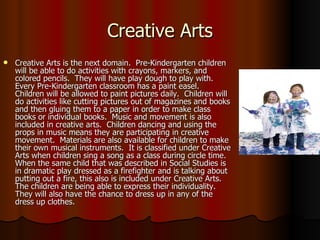
Creative Arts Creative Arts is the next domain.  Pre-Kindergarten children will be able to do activities with crayons, markers, and colored pencils.  They will have play dough to play with.  Every Pre-Kindergarten classroom has a paint easel.  Children will be allowed to paint pictures daily.  Children will do activities like cutting pictures out of magazines and books and then gluing them to a paper in order to make class books or individual books.  Music and movement is also included in creative arts.  Children dancing and using the props in music means they are participating in creative movement.  Materials are also available for children to make their own musical instruments.  It is classified under Creative Arts when children sing a song as a class during circle time.  When the same child that was described in Social Studies is in dramatic play dressed as a firefighter and is talking about putting out a fire, this also is included under Creative Arts.  The children are being able to express their individuality.  They will also have the chance to dress up in any of the dress up clothes.
Health and Physical Development The last domain that we have is Health and Physical Development.  Children do activities that promote fine and gross motor skills.  For example, working with puzzles, play dough, and blocks helps develop fine motor skills.  Working with pencils, crayons, and scissors also help develop fine motor skills.  Examples of gross motor skills are running, jumping, kicking a ball, and climbing the ladder to the slide.  Children will also be introduced to activities that relate to health and nutrition.  Most classes have a dentist come visit the class and talk about brushing their teeth.  Children are also taught to call 911 in case of an emergency.  Classes make a list of rules in order to keep them safe inside and outside.  During snack and lunch the teachers have discussions with the children about subjects such as food groups.  They will ask questions like “what food group would our milk go in?”  Activities are also done where they separate fruits from vegetables.
Closing I have taught Pre-Kindergarten for six years now.  I use everything that I have talked about in this paper.  I have seen for myself how the children benefit from the program and the curriculum.  It is amazing to see how children develop from the first time they walk through the door till the last day of school.  Then when you see the children the next year in kindergarten, you get to see how everything the children learned is helping them already.
Works Cited/Reference The Albert Shanker Institute . 2009. The The Albert Shanker Institute. 1 Sept. 2009  http:// www.shankerinstitute.org The HighScope Preschool Curriculum . 2009. Georgia Department of Early Care and Learning. 1 Sept. 2009  http:// decal.ga.gov/documents/attachments/HighScope.pdf Georiga Bright from the Start-Pre-K . Feb. 2007. Georgia Department of Early Care and Learning. 1 Sept. 2009  http://decal.ga.gov/documents/attachments/Content_Standards_Full.pdf Tennessee’s Voluntary Pre-Kindergarten Program . 2009. The Official Web Site of the State of Tennessee. 1 Sept. 2009  http:// tennessee.gov/governor/prek/activities/index.htm Mississippi Pre-Kindergarten Curriculum . 2001. Mississippi Department of Education. 1 Sept. 2009  http://www.mde.k12.ms.us/ACAD/ID/Curriculum/LAER/MsPreK.pdf

Johnson Presentation

  • 1.
    The High ScopePre-K Curriculum: Will Your Child Benefit From It? Brandi Johnson Technical Communications English 1105 September 6, 2009
  • 2.
    Table of ContentsAbstract……………………………………………..Page 3 Introduction………………………………..........Page 4 Social and Emotional Development……….Page 5 Language and Literacy Development…….Page 6 Mathematics……………………………………….Page 7 Science………………………………………………Page 8 Social Studies……………………………………..Page 9 Creative Arts……………………………………….Page 10 Health and Physical Development………….Page 11 Closing……………………………………………….Page 12 Works Cited/References……………………….Page 13
  • 3.
    Abstract The questionis will your child benefit from a Pre-Kindergarten program and its High Scope curriculum? The answer is yes. There are seven domains that make up the Pre-Kindergarten curriculum. The first domain is Personal and Social Development. The second is Language and Literacy. The third is Mathematics. The fourth is Science. The fifth is Social Studies. The sixth is Creative Arts. Finally, the seventh is Health and Physical Development. I will explain each domain in detail and provide research on how your child will benefit from this program. The sources that I will be providing you with information from are four different websites. 1) A paper written by members of the Albert Shanker Institute-“Preschool Curriculum: What’s In It for Children and Teachers” ; 2)Georgia’s Bright from the Start-Pre-K website; 3)Tennessee’s website about Pre-Kindergarten; 4)Mississippi’s Pre-K Curriculum website. I will also provide details on my experience from teaching Pre-Kindergarten for six years.
  • 4.
    Introduction A lotof parents question whether or not their child will benefit from a Pre-Kindergarten program. Experts show that children who do attend Pre-Kindergarten tend to excel in academics from kindergarten on up through high school. The High Scope Pre-Kindergarten curriculum focuses on five dimensions of school readiness. The five dimensions include: Approaches to Learning; Language and Literacy/Communication; Social and Emotional Development; Physical Development/Health; Arts and Sciences. The High Scope curriculum then breaks those five dimensions down into seven domains. Those seven domains include: Personal and Social Development; Language and Literacy; Mathematics; Science; Social Studies; Creative Arts; and Health and Physical Development. Within the seven domains the High Scope curriculum has broken the items down into content standards to help teachers plan, teach, and access the children.
  • 5.
    Social and EmotionalDevelopment Within the Social and Emotional Development domain the content standards include: Self-Awareness; Curiosity; Initiative; Self-Direction; Self-Control; and Social Skills. This is the area where children will develop personal preferences such as choosing a favorite food or color. Children are also able to recognize the differences between his/her self and other children. This is also where children learn to become involved with class materials independently. Children will also begin to initiate interaction with other children and adults.
  • 6.
    Language and LiteracyDevelopment Next, there is the Language and Literacy domain. This is a very important area for the children. The content standards for this domain include: Listening; Phonological Awareness; Vocabulary Development; Expressive Language; Reading; and Writing. In this area is where children learn to express their needs and wants with words. Children also begin to use language to express ideas such as retelling a familiar story. Children will also be able to demonstrate an awareness of print. For example, they will begin to understand that you read a book from the front to the back and from the left to the right. They will begin to recognize their names in print. Also, by the end of year, children will be able to match uppercase letters to lowercase letters. A research summary presented by The Albert Shanker Institute states “The Pre-K years are an important time for children’s literacy growth. Children who are engaged in meaningful, knowledge-building experiences with print gain the foundational skills for becoming skilled readers and writers.” Children will enjoy listening and discussing storybooks. Children will also develop skills in listening for the purpose of comprehension.
  • 7.
    Mathematics Mathematics isanother very important area for children. The content standards for this domain include: Number/Operations; Patterns/Algebra; Geometry; Measurement; and Data Analysis/Collections. Children interact with a variety of manipulatives that help them explore the concepts of numbers, shapes, quantity, patterns, measurement, and problem solving. Children will be able to describe things by color, size, and shape. They will also be able to compare how objects are alike and classify objects that belong together. Another way that children will be presented how to count objects is by counting the number of students present in class. Pre-K children will do activities like sorting the bear counters by color. They will also do activities that involve one-to-one correspondence. Children will be able to create and duplicate simple patterns such as seeing a pattern in a string of beads and determining which bead comes next in the pattern. Math is used is so many different ways in the classroom. For example, during circle time when the days are being discussed, you talk about yesterday was Monday, today is Tuesday, and tomorrow will be Wednesday. Therefore, they are learning how to associate and describe the passage of time with actual events which is under the content standard “Children will learn how to use a variety of non-standard and standard means of measurement.”
  • 8.
    Science Science isthe next domain in the content standards. There are three kinds of science that Pre-Kindergarten children learn about. The first is related to Life Science. By children taking care of animals and plants in the classroom they are being to recognize that there are basic requirements for all common life forms. Children in Pre-Kindergarten learn about certain human body parts. They also learn to recognize the difference between living organisms and non-living objects. Most classrooms also have games where children can use picture cards to match animals and their offspring. The next type of science that Pre-Kindergarten children learn is related to physical science. A child can be playing in the block center and build a ramp for the cars and that will lead to a discussion on simple machines. Another example is, the same child can be playing with cars in the block center with another child and make the comment “My race car goes faster than Robert’s truck.” That comment means that the child is recognizing different types/speeds of motion. The last type of science that Pre-Kindergarten children learn about is earth science. They learn about the seasons and the weather. During circle time, the child who is the weather person is allowed to give their observation about what they weather is like and what they think the weather will be like throughout the day. An example of an activity that can be done to explore the earth is for the children to collect rocks and classify them by size, color, shape, and texture. This activity also leads back to the math domain .
  • 9.
    Social Studies Next,we have the Social Studies domain. In the classroom, children begin to discover how they are different and alike from other children. They learn responsibilities such as being the line leader, the weather person, the lunch helper, etc. They begin to become aware of people in their community such as police officers, dentists, postal workers, and firefighters. They are able to dress up in dramatic play as the community helpers and play the role that they play in our community. For example, Johnny might be in dramatic play dressed up as a firefighter and say “I’m here to put out the fire! Back up-it will be ok.” Children will also be able to express beginning geographic thinking by doing activities like drawing a map of the classroom. Pre-Kindergarten children also learn about the city and state that they live in.
  • 10.
    Creative Arts CreativeArts is the next domain. Pre-Kindergarten children will be able to do activities with crayons, markers, and colored pencils. They will have play dough to play with. Every Pre-Kindergarten classroom has a paint easel. Children will be allowed to paint pictures daily. Children will do activities like cutting pictures out of magazines and books and then gluing them to a paper in order to make class books or individual books. Music and movement is also included in creative arts. Children dancing and using the props in music means they are participating in creative movement. Materials are also available for children to make their own musical instruments. It is classified under Creative Arts when children sing a song as a class during circle time. When the same child that was described in Social Studies is in dramatic play dressed as a firefighter and is talking about putting out a fire, this also is included under Creative Arts. The children are being able to express their individuality. They will also have the chance to dress up in any of the dress up clothes.
  • 11.
    Health and PhysicalDevelopment The last domain that we have is Health and Physical Development. Children do activities that promote fine and gross motor skills. For example, working with puzzles, play dough, and blocks helps develop fine motor skills. Working with pencils, crayons, and scissors also help develop fine motor skills. Examples of gross motor skills are running, jumping, kicking a ball, and climbing the ladder to the slide. Children will also be introduced to activities that relate to health and nutrition. Most classes have a dentist come visit the class and talk about brushing their teeth. Children are also taught to call 911 in case of an emergency. Classes make a list of rules in order to keep them safe inside and outside. During snack and lunch the teachers have discussions with the children about subjects such as food groups. They will ask questions like “what food group would our milk go in?” Activities are also done where they separate fruits from vegetables.
  • 12.
    Closing I havetaught Pre-Kindergarten for six years now. I use everything that I have talked about in this paper. I have seen for myself how the children benefit from the program and the curriculum. It is amazing to see how children develop from the first time they walk through the door till the last day of school. Then when you see the children the next year in kindergarten, you get to see how everything the children learned is helping them already.
  • 13.
    Works Cited/Reference TheAlbert Shanker Institute . 2009. The The Albert Shanker Institute. 1 Sept. 2009 http:// www.shankerinstitute.org The HighScope Preschool Curriculum . 2009. Georgia Department of Early Care and Learning. 1 Sept. 2009 http:// decal.ga.gov/documents/attachments/HighScope.pdf Georiga Bright from the Start-Pre-K . Feb. 2007. Georgia Department of Early Care and Learning. 1 Sept. 2009 http://decal.ga.gov/documents/attachments/Content_Standards_Full.pdf Tennessee’s Voluntary Pre-Kindergarten Program . 2009. The Official Web Site of the State of Tennessee. 1 Sept. 2009 http:// tennessee.gov/governor/prek/activities/index.htm Mississippi Pre-Kindergarten Curriculum . 2001. Mississippi Department of Education. 1 Sept. 2009 http://www.mde.k12.ms.us/ACAD/ID/Curriculum/LAER/MsPreK.pdf