Beginning Teaching Beginning Learning In Primary
Education 3rd Edition Janet Moyles download
https://ebookbell.com/product/beginning-teaching-beginning-
learning-in-primary-education-3rd-edition-janet-moyles-2270814
Explore and download more ebooks at ebookbell.com
Here are some recommended products that we believe you will be
interested in. You can click the link to download.
Marvelous Minilessons For Teaching Beginning Writing K3 Lori Jamison
Rog Rog
https://ebookbell.com/product/marvelous-minilessons-for-teaching-
beginning-writing-k3-lori-jamison-rog-rog-23395086
The Ultimate Teaching Manual A Route To Success For Beginning Teachers
Gererd Dixie
https://ebookbell.com/product/the-ultimate-teaching-manual-a-route-to-
success-for-beginning-teachers-gererd-dixie-50679394
The Ultimate Teaching Manual A Route To Success For Beginning Teachers
Pappsc Gererd Dixie
https://ebookbell.com/product/the-ultimate-teaching-manual-a-route-to-
success-for-beginning-teachers-pappsc-gererd-dixie-2413750
Teaching 101 Classroom Strategies For The Beginning Teacher Jeffrey
Glanz
https://ebookbell.com/product/teaching-101-classroom-strategies-for-
the-beginning-teacher-jeffrey-glanz-47087278
From Research To Teaching A Guide To Beginning Your Classroom Career
Michael Kibbe
https://ebookbell.com/product/from-research-to-teaching-a-guide-to-
beginning-your-classroom-career-michael-kibbe-47365168
The Beginning Teachers Field Guide Embarking On Your First Years
Selfcare And Teaching Tips For New Teachers Tina H Boogren
https://ebookbell.com/product/the-beginning-teachers-field-guide-
embarking-on-your-first-years-selfcare-and-teaching-tips-for-new-
teachers-tina-h-boogren-46393756
Best Practices For Teaching Beginnings And Endings In The Psychology
Major Research Cases And Recommendations 1st Edition Dana S Dunn
https://ebookbell.com/product/best-practices-for-teaching-beginnings-
and-endings-in-the-psychology-major-research-cases-and-
recommendations-1st-edition-dana-s-dunn-38411684
In The Beginning Is Desire Tracing Kalis Footprints In Indian
Literature Neela Bhattacharya Saxena
https://ebookbell.com/product/in-the-beginning-is-desire-tracing-
kalis-footprints-in-indian-literature-neela-bhattacharya-
saxena-35222152
Beginning Statistics 3rd Edition Warren Denley Atchley
https://ebookbell.com/product/beginning-statistics-3rd-edition-warren-
denley-atchley-46073210
Beginning Teaching:
Beginning Learning
Third Edition
Beginning Teaching:
Beginning Learning
Third Edition
Edited by
Janet Moyles
Open University Press
McGraw-Hill Education
McGraw-Hill House
Shoppenhangers Road
Maidenhead
Berkshire
England
SL6 2QL
email: enquiries@openup.co.uk
world wide web: www.openup.co.uk
and Two Penn Plaza, New York, NY 10121–2289, USA
First published 2007
Copyright # The Editor and Contributors, 2007
All rights reserved. Except for the quotation of short passages for the purposes of criticism and
review, no part of this publication may be reproduced, stored in a retrieval system, or
transmitted, in any form or by any means, electronic, mechanical, photocopying, recording or
otherwise, without the prior permission of the publisher or a licence from the Copyright
Licensing Agency Limited. Details of such licences (for reprographic reproduction) may be
obtained from the Copyright Licensing Agency Ltd of 90 Tottenham Court Road, London, W1T
4LP.
A catalogue record of this book is available from the British Library
ISBN 13: 978 0335 221 301 (pb) 978 0335 221 318 (hb)
ISBN 10: 0335 221 300 (pb) 0335 221 319 (hb)
Library of Congress Cataloguing-in-Publication Data
CIP data applied for
Typeset by YHT Ltd, London
Printed in Poland by OZGraf S.A.
www.polslzabook.pl
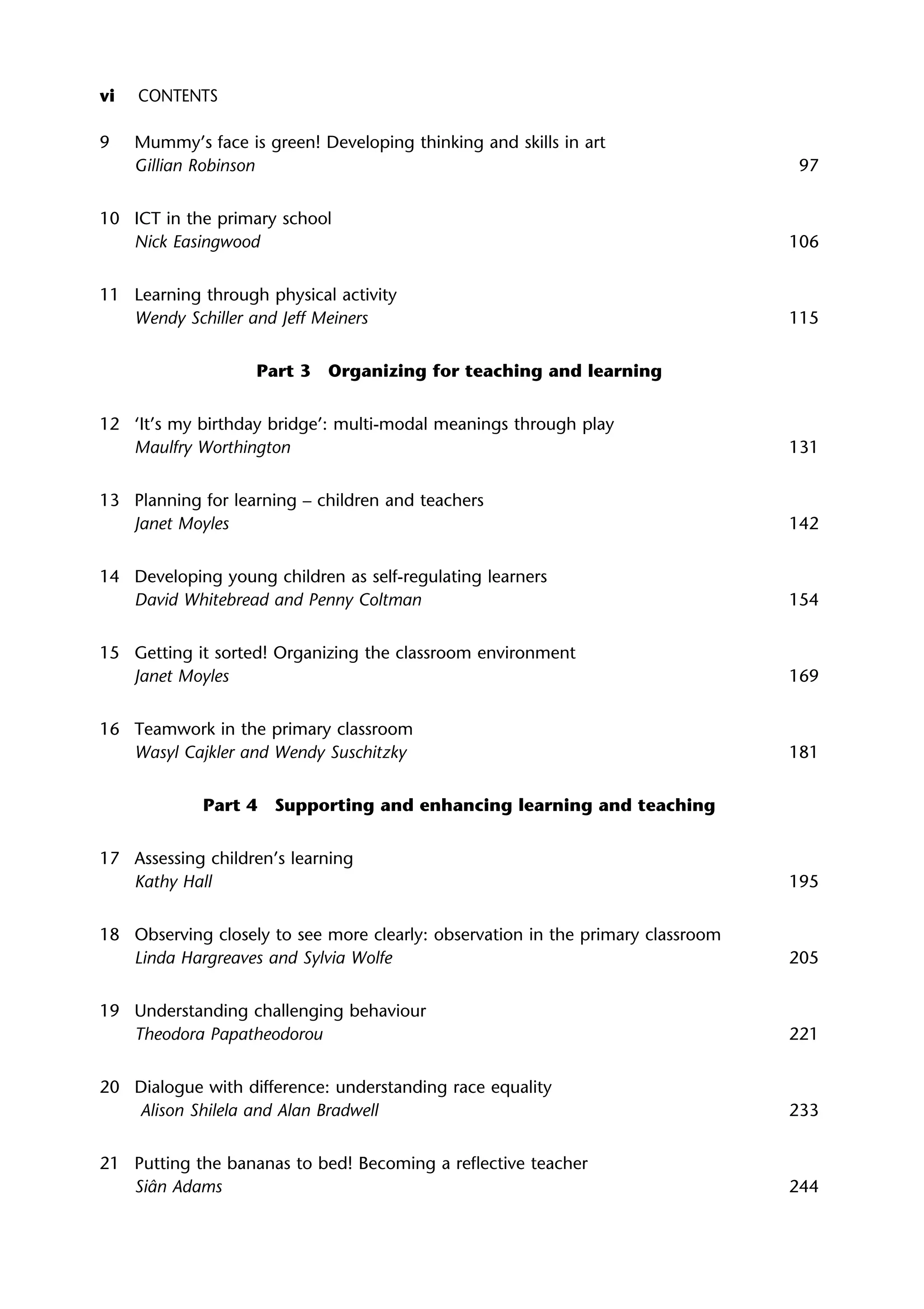
Contents
List of Figures and Tables ix
Notes on the editor and contributors xi
Acknowledgements xvii
Abbreviations xix
Introduction
Janet Moyles 1
Part 1 Early beginnings
1 Beginning at the beginning
Tricia David and Sacha Powell 13
2 Foundation Stage – expectations and vision
Nansi Ellis 24
3 Do we understand each other? Multi-disciplinary working in Children’s Centres
Karen McInnes 33
4 The first days at school
Hilary Fabian and Aline-Wendy Dunlop 43
5 The importance of partnerships with parents and carers
Deborah Albon 53
Part 2 Beginning to understand children’s thinking and learning
6 Inside the learning mind: primary children and their learning processes
Roger Merry and Jenny Rogers 65
7 Exploration, investigation and enquiry
Dan Davies and Alan Howe 74
8 Leaping oceans and crossing boundaries: how oral story can develop creative
and imaginative thinking in young children and their teachers
Jane Hislam and Rajinder Lall 86
9 Mummy’s face is green! Developing thinking and skills in art
Gillian Robinson 97
10 ICT in the primary school
Nick Easingwood 106
11 Learning through physical activity
Wendy Schiller and Jeff Meiners 115
Part 3 Organizing for teaching and learning
12 ‘It’s my birthday bridge’: multi-modal meanings through play
Maulfry Worthington 131
13 Planning for learning – children and teachers
Janet Moyles 142
14 Developing young children as self-regulating learners
David Whitebread and Penny Coltman 154
15 Getting it sorted! Organizing the classroom environment
Janet Moyles 169
16 Teamwork in the primary classroom
Wasyl Cajkler and Wendy Suschitzky 181
Part 4 Supporting and enhancing learning and teaching
17 Assessing children’s learning
Kathy Hall 195
18 Observing closely to see more clearly: observation in the primary classroom
Linda Hargreaves and Sylvia Wolfe 205
19 Understanding challenging behaviour
Theodora Papatheodorou 221
20 Dialogue with difference: understanding race equality
Alison Shilela and Alan Bradwell 233
21 Putting the bananas to bed! Becoming a reflective teacher
Siân Adams 244
vi CONTENTS
Conclusion
Janet Moyles, beginner teachers and tutors 254
Index 259
CONTENTS vii
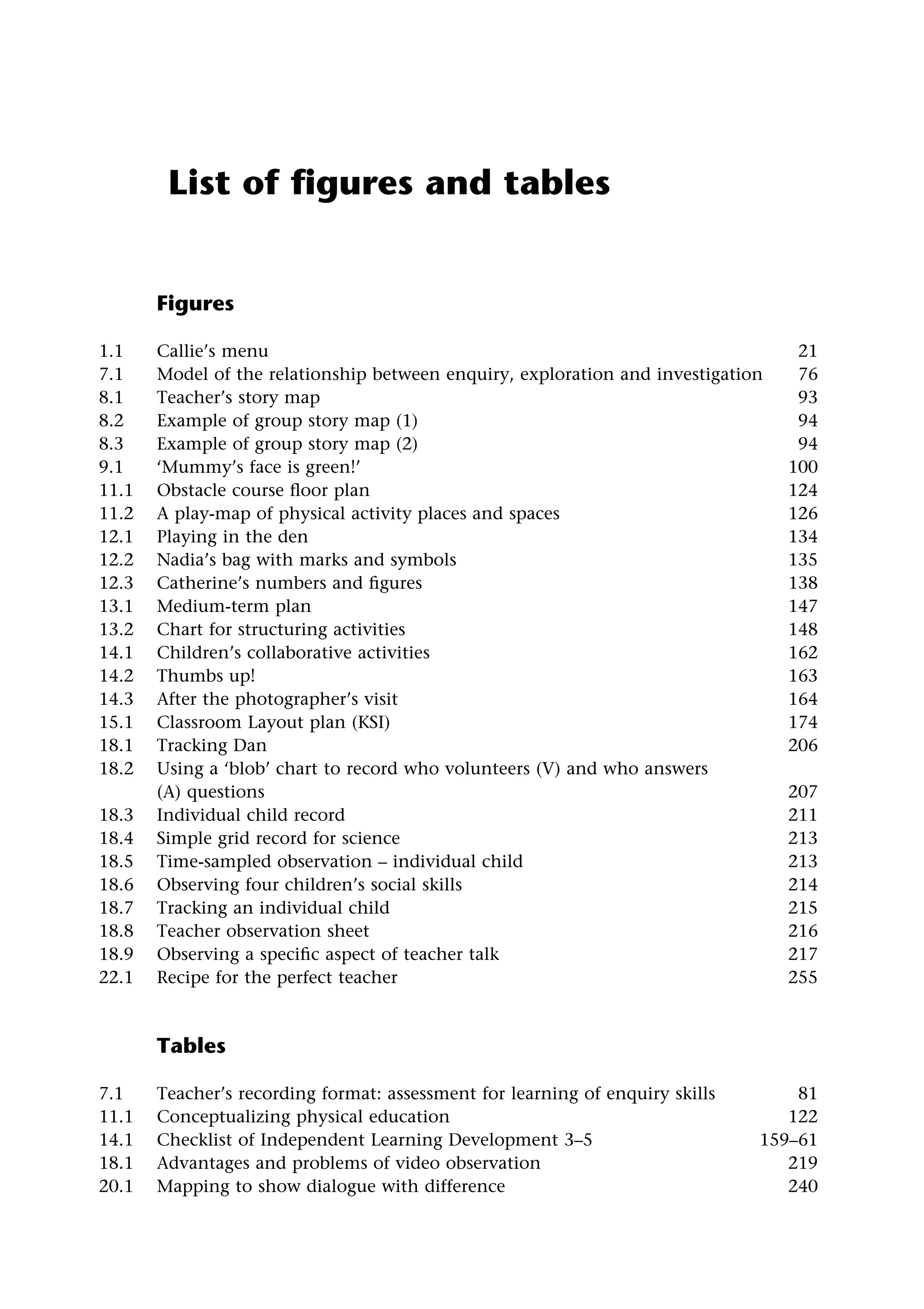
List of figures and tables
Figures
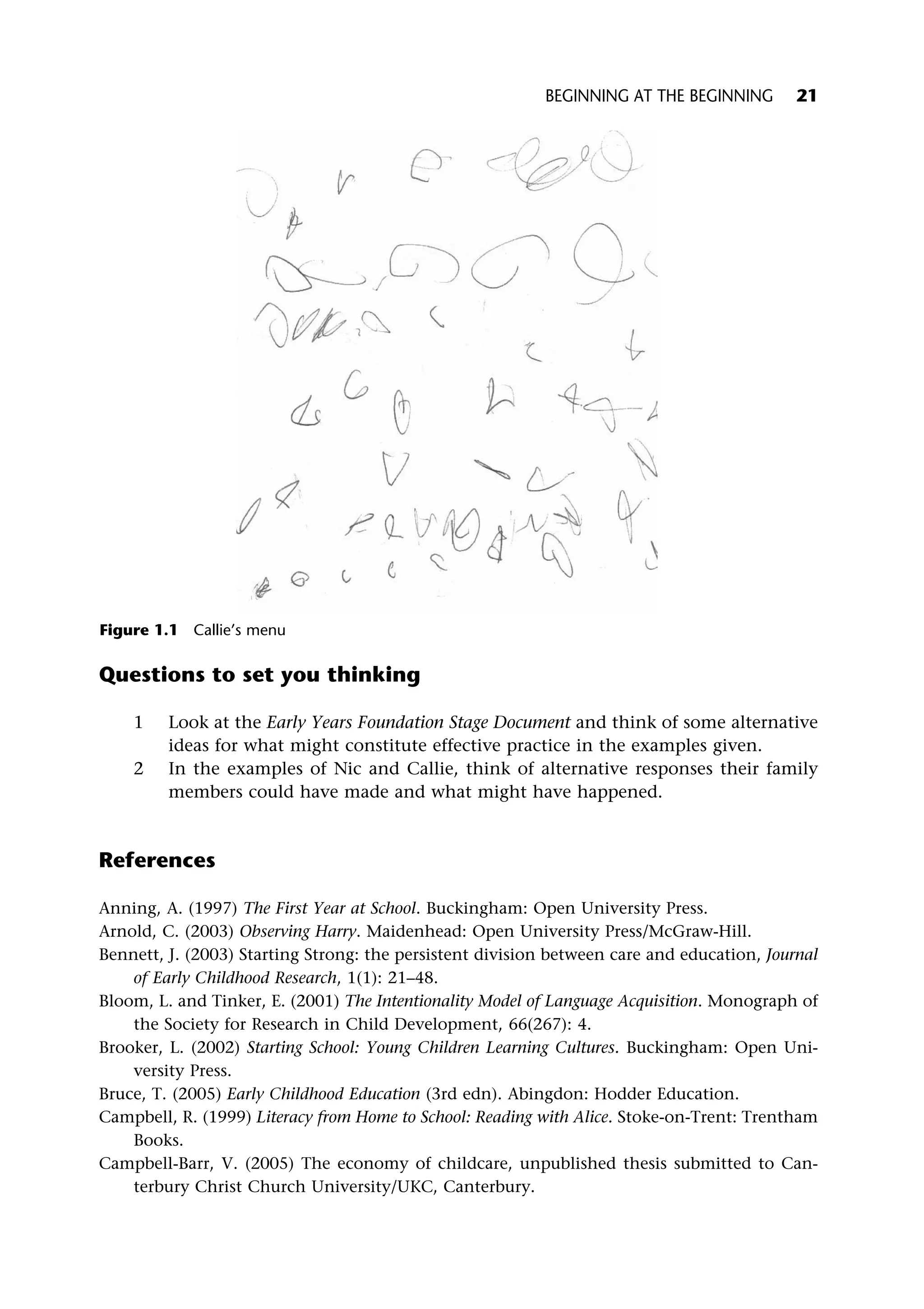
1.1 Callie’s menu 21
7.1 Model of the relationship between enquiry, exploration and investigation 76
8.1 Teacher’s story map 93
8.2 Example of group story map (1) 94
8.3 Example of group story map (2) 94
9.1 ‘Mummy’s face is green!’ 100
11.1 Obstacle course floor plan 124
11.2 A play-map of physical activity places and spaces 126
12.1 Playing in the den 134
12.2 Nadia’s bag with marks and symbols 135
12.3 Catherine’s numbers and figures 138
13.1 Medium-term plan 147
13.2 Chart for structuring activities 148
14.1 Children’s collaborative activities 162
14.2 Thumbs up! 163
14.3 After the photographer’s visit 164
15.1 Classroom Layout plan (KSI) 174
18.1 Tracking Dan 206
18.2 Using a ‘blob’ chart to record who volunteers (V) and who answers
(A) questions 207
18.3 Individual child record 211
18.4 Simple grid record for science 213
18.5 Time-sampled observation – individual child 213
18.6 Observing four children’s social skills 214
18.7 Tracking an individual child 215
18.8 Teacher observation sheet 216
18.9 Observing a specific aspect of teacher talk 217
22.1 Recipe for the perfect teacher 255
Tables
7.1 Teacher’s recording format: assessment for learning of enquiry skills 81
11.1 Conceptualizing physical education 122
14.1 Checklist of Independent Learning Development 3–5 159–61
18.1 Advantages and problems of video observation 219
20.1 Mapping to show dialogue with difference 240
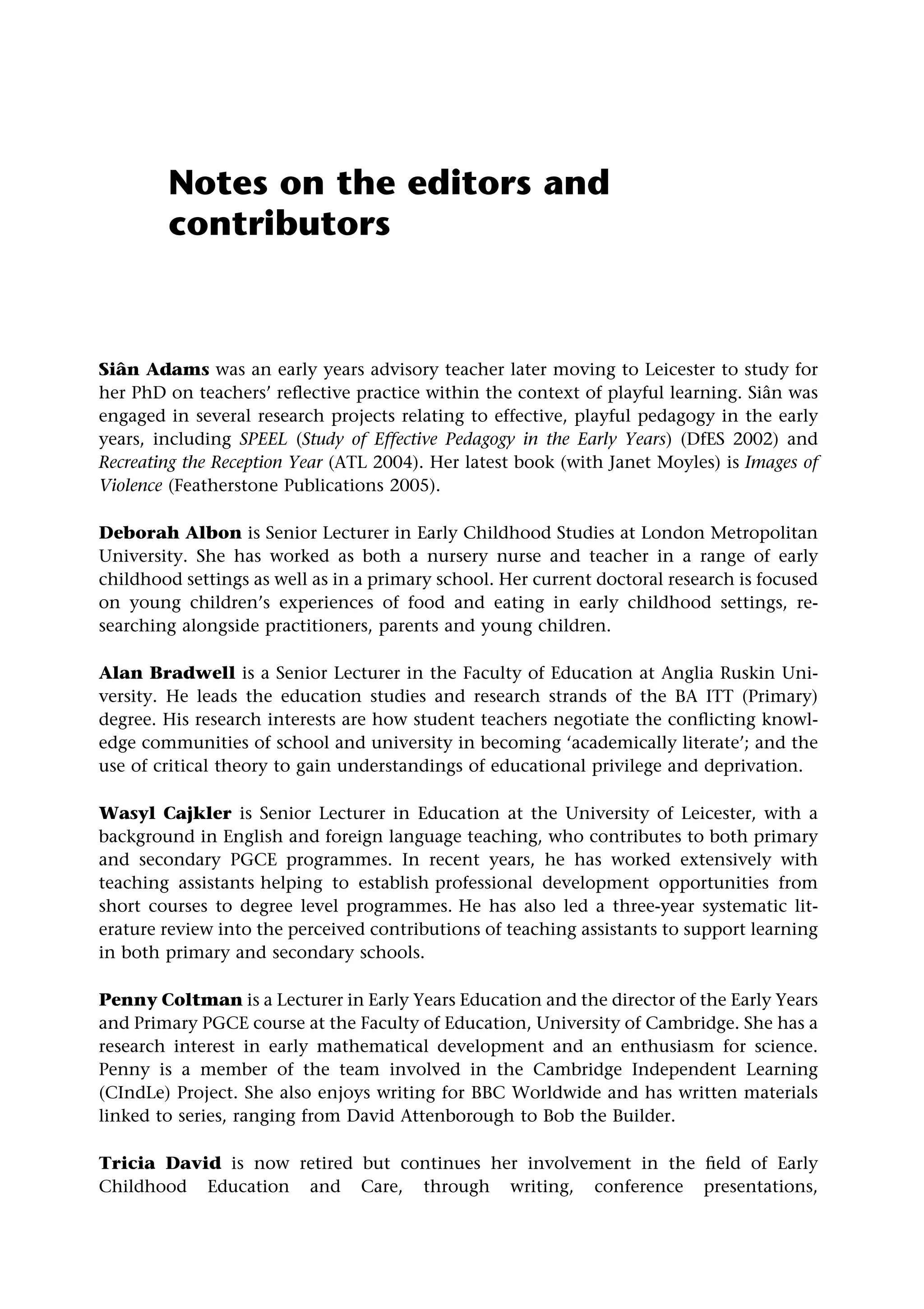
Notes on the editors and
contributors
Siân Adams was an early years advisory teacher later moving to Leicester to study for
her PhD on teachers’ reflective practice within the context of playful learning. Siân was
engaged in several research projects relating to effective, playful pedagogy in the early
years, including SPEEL (Study of Effective Pedagogy in the Early Years) (DfES 2002) and
Recreating the Reception Year (ATL 2004). Her latest book (with Janet Moyles) is Images of
Violence (Featherstone Publications 2005).
Deborah Albon is Senior Lecturer in Early Childhood Studies at London Metropolitan
University. She has worked as both a nursery nurse and teacher in a range of early
childhood settings as well as in a primary school. Her current doctoral research is focused
on young children’s experiences of food and eating in early childhood settings, re-
searching alongside practitioners, parents and young children.
Alan Bradwell is a Senior Lecturer in the Faculty of Education at Anglia Ruskin Uni-
versity. He leads the education studies and research strands of the BA ITT (Primary)
degree. His research interests are how student teachers negotiate the conflicting knowl-
edge communities of school and university in becoming ‘academically literate’; and the
use of critical theory to gain understandings of educational privilege and deprivation.
Wasyl Cajkler is Senior Lecturer in Education at the University of Leicester, with a
background in English and foreign language teaching, who contributes to both primary
and secondary PGCE programmes. In recent years, he has worked extensively with
teaching assistants helping to establish professional development opportunities from
short courses to degree level programmes. He has also led a three-year systematic lit-
erature review into the perceived contributions of teaching assistants to support learning
in both primary and secondary schools.
Penny Coltman is a Lecturer in Early Years Education and the director of the Early Years
and Primary PGCE course at the Faculty of Education, University of Cambridge. She has a
research interest in early mathematical development and an enthusiasm for science.
Penny is a member of the team involved in the Cambridge Independent Learning
(CIndLe) Project. She also enjoys writing for BBC Worldwide and has written materials
linked to series, ranging from David Attenborough to Bob the Builder.
Tricia David is now retired but continues her involvement in the field of Early
Childhood Education and Care, through writing, conference presentations,
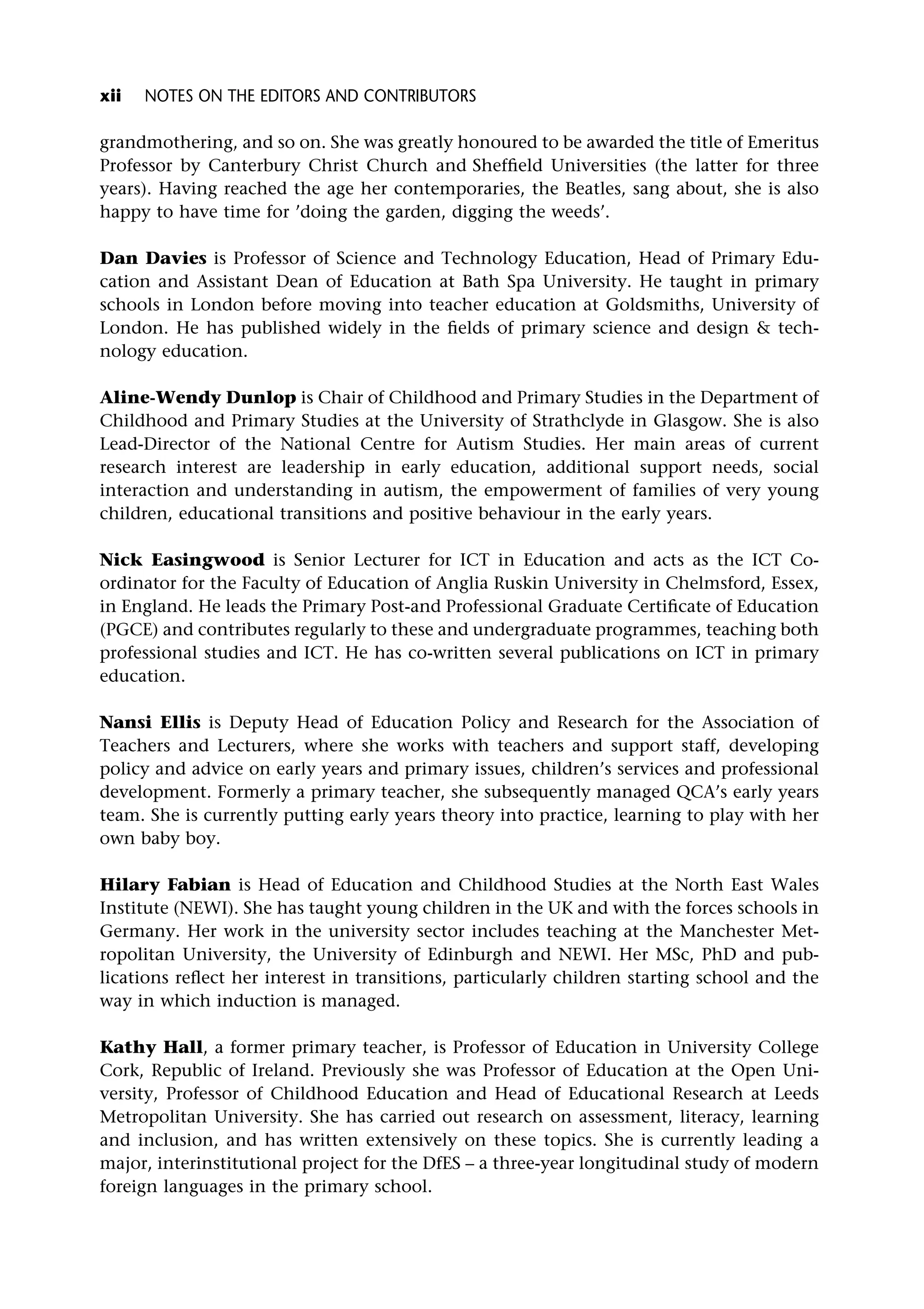
grandmothering, and so on. She was greatly honoured to be awarded the title of Emeritus
Professor by Canterbury Christ Church and Sheffield Universities (the latter for three
years). Having reached the age her contemporaries, the Beatles, sang about, she is also
happy to have time for ’doing the garden, digging the weeds’.
Dan Davies is Professor of Science and Technology Education, Head of Primary Edu-
cation and Assistant Dean of Education at Bath Spa University. He taught in primary
schools in London before moving into teacher education at Goldsmiths, University of
London. He has published widely in the fields of primary science and design & tech-
nology education.
Aline-Wendy Dunlop is Chair of Childhood and Primary Studies in the Department of
Childhood and Primary Studies at the University of Strathclyde in Glasgow. She is also
Lead-Director of the National Centre for Autism Studies. Her main areas of current
research interest are leadership in early education, additional support needs, social
interaction and understanding in autism, the empowerment of families of very young
children, educational transitions and positive behaviour in the early years.
Nick Easingwood is Senior Lecturer for ICT in Education and acts as the ICT Co-
ordinator for the Faculty of Education of Anglia Ruskin University in Chelmsford, Essex,
in England. He leads the Primary Post-and Professional Graduate Certificate of Education
(PGCE) and contributes regularly to these and undergraduate programmes, teaching both
professional studies and ICT. He has co-written several publications on ICT in primary
education.
Nansi Ellis is Deputy Head of Education Policy and Research for the Association of
Teachers and Lecturers, where she works with teachers and support staff, developing
policy and advice on early years and primary issues, children’s services and professional
development. Formerly a primary teacher, she subsequently managed QCA’s early years
team. She is currently putting early years theory into practice, learning to play with her
own baby boy.
Hilary Fabian is Head of Education and Childhood Studies at the North East Wales
Institute (NEWI). She has taught young children in the UK and with the forces schools in
Germany. Her work in the university sector includes teaching at the Manchester Met-
ropolitan University, the University of Edinburgh and NEWI. Her MSc, PhD and pub-
lications reflect her interest in transitions, particularly children starting school and the
way in which induction is managed.
Kathy Hall, a former primary teacher, is Professor of Education in University College
Cork, Republic of Ireland. Previously she was Professor of Education at the Open Uni-
versity, Professor of Childhood Education and Head of Educational Research at Leeds
Metropolitan University. She has carried out research on assessment, literacy, learning
and inclusion, and has written extensively on these topics. She is currently leading a
major, interinstitutional project for the DfES – a three-year longitudinal study of modern
foreign languages in the primary school.
xii NOTES ON THE EDITORS AND CONTRIBUTORS
Linda Hargreaves is Senior Lecturer in the Cambridge University Faculty of Education
teaching MEd/MPhil, educational research methods and psychology of education. A
former primary and early years teacher, she was an observer on the 1970s ORACLE project
and has used observation in subsequent research, most recently in the ESRC’s Teaching
and Learning research programme, ’Social Pedagogical Research in Groupwork’ (SPRinG)
project. She is currently Director of a national project on the status of teachers and the
teaching profession.
Jane Hislam is Programme Director of an undergraduate degree for teaching assistants
and lecturer in Primary English on the Primary PGCE course at the University of Leicester.
Her research and teaching interests are in the area of language and literacy, in particular
oral storytelling, children’s literature and the teaching of grammar to primary age pupils.
She is Director of a research project entitled ‘Song and Story with Under Five Year Olds’.
Alan Howe is Senior Lecturer in Primary Education and Primary Science Co-ordinator at
Bath Spa University. He taught in primary schools in London, Bristol and Bath before
moving into teacher education. He has published widely in the fields of primary science
and creativity in primary education. He is joint author of Science 5–11: A Guide for
Teachers, Teaching Science and Design & Technology in the Early Years, and Primary Design &
Technology for the Future, all published by David Fulton.
Rajinder Lall is Lecturer in Primary English on the Primary PGCE course at the Uni-
versity of Leicester and also works on an undergraduate degree for teaching assistants.
Her research and teaching interests are in the area of diversity and equality issues in
education and working with children who have English as an additional language. She
has extensively used oral storytelling in English and other languages in the classroom and
worked closely with many colleagues in schools. She is also a trustee for the Leicester
Complementary Schools Trust.
Karen McInnes is a Senior Researcher with Barnardo’s UK policy and research team.
Previously she was a Senior Lecturer in early years education at Bath Spa University
College and has worked with young children, both as a teacher and speech therapist.
Recent research projects have involved acting as a consultant researcher to a local Sure
Start programme and developing outcomes for local children’s centres. She has published
on various aspects of early years education.
Jeff Meiners is a Lecturer at the University of South Australia’s School of Education. He
has worked widely in movement, arts and dance education, teaching people of all ages, as
leader of a dance education team and has facilitated dance and movement projects across
Australia and in Papua New Guinea, England and Portugal. He was a 2002 and 2005
Australian Dance Award nominee for Services to Dance Education and is a member of the
Australia Council’s Dance Board.
Roger Merry taught for six years before joining the School of Education, University of
Leicester, where he is now a Senior Lecturer. He has worked extensively on the Primary
PGCE and doctorate programmes, and is currently in charge of the MA in Primary
NOTES ON THE EDITORS AND CONTRIBUTORS xiii
Education, with distance learning students from all over the world. His main interest is in
children’s learning, with publications including academic articles and books and ma-
terials for teachers and children.
Janet Moyles is Professor Emeritus at Anglia Ruskin University and an early years
consultant. She has worked as an early years teacher and head, and also run early years
initial and inservice training courses for teachers on play and learning and effective/
reflective pedagogy. She has directed several research projects including Jills of All Trades?
(ATL 1996), Teaching Fledglings to Fly (ATL 1997), Too Busy to Play? (Leicester 1997–2000),
SPEEL – Study of Pedagogical Effectiveness in Early Learning (DfES 2002) and Recreating the
Reception Year (ATL 2004).
Theodora Papatheodorou is Professor in Early Childhood Education and Research at
Anglia Ruskin University. She has long and diverse teaching and research experience in
the field of early childhood. Her work has been widely disseminated by publications and
presentations at international journals and conferences, respectively. She is the author of
the book Behaviour Problems in the Early Years (Routledge 2005).
Sacha Powell is Senior Research Fellow in the Department of Educational Research
at Canterbury Christ Church University. She works on a variety of research projects,
primarily in childhood and community studies. She has a particular interest in con-
structions of early childhood internationally, and regularly works with colleagues in the
People’s Republic of China. Her current research focus is on play policies and strategies
and their impact on opportunities for children’s and young people’s play and informal
recreation.
Gillian Robinson is Reader in Education, Director of Research Degrees and Lecturer in
Art and Design at Anglia Polytechnic University. Her book Sketch-books: Explore and Store
was published in 1995 and by Heinemann USA in 1996. Her continuing research interests
are focused on the value of sketchbooks and journals as a cross-curricular tool for de-
veloping creativity and thinking skills. She is also a practising painter, working mostly in
mixed media.
Jenny Rogers is an experienced early years teacher, psychologist and teacher-educator.
She developed the current Professional Course of the Primary PGCE at the University of
Leicester where she is Co-Director of the MA in Primary Education and supervises the
research of masters and doctoral students. She has published widely in the area of young
children’s learning, including mathematical development, and leads an international
research project on early learning and problem-solving.
Wendy Schiller has worked in Canada, South Africa, PNG and Australia with in-
digenous populations and taught at tertiary level in Canada and Australia. Wendy has
edited and authored 11 books, 25 book chapters and over 35 journal articles. She is
currently Professor and Director of Research at de Lissa Institute of Early Childhood and
Family Studies at the University of South Australia. Wendy was recently awarded an
Order of Australia Medal (OAM) for services to early childhood education.
xiv NOTES ON THE EDITORS AND CONTRIBUTORS
Alison Shilela is Associate Dean in the Faculty of Education at Anglia Ruskin Uni-
versity. She has taught in England, France, Zambia, Senegal and Germany in the primary,
secondary and post-compulsory sectors. She worked for the Cambridge Multicultural
Education Service and taught Namibian refugees in Zambia. Alison’s commitment to
teaching for social justice is now reflected in her research focused on engagement with
critical pedagogy through curriculum development in higher education from an inter-
national perspective.
Wendy Suschitzky is a part-time tutor working in initial teacher education at the
University of Leicester. She has worked in early years and community education. Her
main interests are mentoring, teacher education and diversity issues in young children’s
education.
David Whitebread is a Senior Lecturer in Psychology and Education in the Faculty of
Education, University of Cambridge, and a former director of the Early Years and Primary
PGCE course. His research interests are concerned with learning in young children, in-
cluding the role of play, thinking skills, and the development of self-regulation and
independent learning. His publications include The Psychology of Teaching and Learning in
the Primary School (RoutledgeFalmer 2000) and Teaching and Learning in the Early Years,
2nd edn (RoutledgeFalmer 2003).
Sylvia Wolfe is a tutor on the Primary PGCE course in the Faculty of Education, Uni-
versity of Cambridge, and an affiliate member of the Educational Dialogue Research Unit
at the Open University. Prior to studying for a PhD, she had extensive experience
working in an advisory service and as a class and language support teacher with a par-
ticular expertize in early years practice. Her research interests are in investigating class-
room communication, particularly the role of dialogue in effective teaching and
learning, and raising the achievement of bilingual pupils.
Maulfry Worthington is the co-author of Children’s Mathematics: Making Marks,
Making Meaning and is engaged in further research on children’s mathematical graphics
for her doctorate (Free University, Amsterdam). She has taught in the full 3–8 year age
range for 25 years. Maulfry has worked as a National Numeracy Consultant and lectured
on Primary and Early Years mathematics and Early Years pedagogy in Initial Teacher
Education. She is joint founder of the international Children’s Mathematics Network.
NOTES ON THE EDITORS AND CONTRIBUTORS xv
Acknowledgements
Many thanks and much appreciation should go to the students, tutors and others asso-
ciated with the range of institutions represented in this book who have contributed in
various ways to the production of this third edition. They have all worked hard to pro-
duce a worthwhile and exciting new volume which we all hope will ensure this book
continues to support the important task of educating our new early years and primary
teachers and the staff who work with them. This is no mean feat in the current age where
education is expected to be the panacea for many of society’s challenges and teachers are
under pressure to produce better and higher standards of learning and behaviour.
Further acknowledgements are given in individual chapters.
Abbreviations
We have tried to keep educational jargon to a minimum in the book but, inevitably, there
are certain acronyms or phrases given specific meaning in education.
ALS Additional Literacy Support
ATs Attainment Targets and tests within NC subjects
Citizenship Part of the NC related to children developing social and political
awareness
CWDC Children’s Workforce Development Council
DES Department for Education and Science, later to become the DfE
DfE Department for Education, the previous name for the DES
DfEE Department for Education and Employment, the government body in
charge of education prior to 2000
DfES Department for Education and Skills
EAL English as an Additional Language and EFL (English as a Foreign
Language)
Early years or
Early childhood
Education Applied usually to the education of birth–7/8-year-olds but increasingly
focused on birth–5-year-olds in the Foundation Stage
ECEC Early Childhood Education Centre
ERA Education Reform Act
EYFS Early Years Foundation Stage – guidance on curriculum for children
aged birth–5 years in all settings, e.g. nurseries, playgroups, reception
classes
HEI Higher Education Institution, e.g. university, college
ICT Information Communications Technology
ITE Initial Teacher Education (preferred by most academics to ITT)
ITT Initial Teacher Training
KS1 and KS2 The NC gives four age-related stages of education, with Key Stages 1 and
2 relating to primary children aged from 5–7 and 7–11 respectively
LEA Local Education Authority
NC National Curriculum
NQT Newly qualified teacher
OfSTED Office for Standards in Education, the body which governs school and
ITE/ITT course inspections
Parents/carers Anyone who has the legal guardianship of a child
PE Physical Education
Pedagogy The study of teaching and learning
PGCE Post-graduate Certificate in Education Professional Graduate Certificate
of Education
PPA Planning, Preparation and Assessment
Pupils Children in the context of school/ing
QCA Qualifications and Curriculum Authority
QTS Qualified Teaching Status
RE Religious Education
SATs Standard Attainment Tasks
SEN Special Educational Need(s)
STA Specialist Teaching Assistant
TAs Teacher Assistants (sometimes called Classroom Assistants or Learning
Support Assistants)
TDA Teacher Development Agency, which has charge of all ITT/ITE courses
TE Teaching experience (or TP, teaching practice or placement)
Year groups Those years which now constitute the years of schooling for primary
childen from age 5 to 11, e.g. Year 1 = 5–6-year-olds, Year 2 = 6–7-year-
olds, through to Year 6 = 10–11-year-olds. There is a designated Year R
for reception children (those who are approaching 5) now within the
EYFS.
xx ABBREVIATIONS
Introduction
Janet Moyles
Cameo 1
(From a student teacher’s journal about work with a Year 4 class) ‘The best
moment this half-term was when all the children together performed a dance/
drama about the water-cycle from beginning to end – five weeks’ work – and said
they really enjoyed it! I felt a great sense of achievement because, in the first
week’s dance session, they didn’t have a clue – and neither did I!’
Cameo 2
The student has spent nearly a week with a class of 5-year-olds on her first
teaching experience. In planning the final day, the teacher has suggested that
Julia might take the class for the Friday morning and ‘try out’ being a class
teacher. Plans have been made and Julia goes through in her mind just how
everything will go. The morning is spent on various activities and runs quite
smoothly, if rather noisily. The teacher, who has just entered the classroom,
reminds the student that the children will need some time to pack away the
equipment. Julia uses what she believes to be the teacher’s method of getting the
children to put everything away, saying clearly ‘Listen everybody . . . it’s time to
stop now. Put your things away and go and sit on the carpet.’ Pandemonium
reigns. The children appear to have gone berserk, rushing around the room,
colliding with each other and dropping things on the floor. Even worse, the
classroom looks like a herd of animals has passed through – and the teacher’s
standing there watching!
In the beginning . . .
Beginning teachers, whether students or those entering their first teaching posts, rightly
have high ideals about the kind of teachers they want to be and the kind of classroom
ethos they want to foster. Nearly always, as in the first cameo, they share a delight in
actually being with children and participating in the fun and enjoyment of new learning.
These are, however, only a very few aspects of the role of teacher, albeit arguably the best
bits! There are many skills and attributes needed, as will be evidenced through the
chapters of this book. Many of these will be acquired through the processes of initial
teacher education courses but since there are now a great multiplicity of standards for
students and newly qualified teachers, the time on courses for thinking more widely
about the professional aspects of teaching, as well as curriculum content, has become
somewhat limited.
The second cameo serves to emphasize that children and teaching can seemingly be
extremely unpredictable and that the balance of primary classroom life is sometimes
poised on a ruler edge (if not quite a knife edge). The student did everything ‘right’ yet
the outcome was disastrous for her confidence, at least in the short-term. What this
situation highlights is that it is not sufficient merely to emulate the actions and behav-
iours of another in order to learn to teach. How simple it would be if one could walk into
a classroom armed with subject knowledge, the desire to teach and a belief that what one
taught is what the children learn. The real world is far less predictable but infinitely more
varied, exciting and challenging!
Whereas we all might wish that someone could wave a magic wand and save us from
Julia’s encounter in Cameo 2, these experiences are all part of learning to be a teacher.
From the outset you need to be clear of one thing: no one can teach you how to teach any
more than anyone can teach you how to learn. Both happen in tandem – or at least they
should do – hence the title of this book Beginning Teaching: Beginning Learning. Learning to
teach is all about what we as teachers bring that develops our professional personalities in
harmony with our own personalities.
Every teacher is a mix of the personal and the professional and, whereas the pro-
fessional may take a few knocks in the beginning stages like Julia, keeping the personal
esteem intact is vital; I may be an awful teacher but that does not mean I am inevitably an
awful person!
In any profession, the learning curve between a state of being a ‘novice’ and that of
being an ‘expert’ (Casbergue and Allen 1997; Muijs and Reynolds 2005) is inevitably steep
because there are always so many new issues to deal with simultaneously. Even when a
certain level of expertise has been gained, new initiatives often challenge existing secu-
rities. Whatever apparently rigorous and difficult roles people have had in previous ex-
periences, entrants to the teaching profession (as well as those with significant
experience) may suddenly find themselves confronted with an overload of challenges.
Because foundation stage and primary education concerns birth to 11-year-old children –
and often fairly large numbers of them at once – these challenges are nearly always
immediate and unrelenting: the children just do not go away while we get our acts
together! What needs to be acknowledged is that, with support and encouragement from
others, the vast majority of people succeed as effective teachers and thoroughly enjoy
their vocation. Any teacher education course, of whatever duration or type, is only the
start of a professional career; the beginning of learning about teaching – and about
ourselves!
Intentions of this book
The third edition of this book, like its two predecessors, addresses all those just entering
teaching either as students or as newly qualified teachers. It will also be of interest to
2 JANET MOYLES
those whose job it is to help these individuals learn about pedagogy. The original book
grew out of increasing concern on the part of course tutors that there is too little time
(especially on PGCE courses) to cover all the underlying issues that make the early and
primary years of education and school, different and special. This still obtains – and even
more so given that the foundation stage now covers working and playing with children
from birth! This demands yet another level of understanding and knowledge that we
have tried to address in this new edition.
By undertaking this third edition and incorporating some of this new thinking, we
hope to redress the necessary balance to ensure not just a trained teaching workforce but
an educated and reflective workforce, something now emphasized by both the Teacher
Development Agency (TDA) and the Children’s Workforce Development Council
(CWDC).
Like its predecessors, this book does not aim to do everything or be all things to all
people. We have used the expertise of individual contributors to raise issues which they
think are important for new teachers (and, indeed, early years practitioners). Clearly
there is more about which we could have written; this is why we give further reading at
the ends of chapters so that readers have easy access to other informative sources.
First, a brief background to the current context of primary and early years education
would seem useful. Second, the structure of the book is explained and information given
regarding the chapters.
The context of early years and primary education
In England, as in many other countries in the world, a deep economic recession in the
1980s led to relatively high levels of unemployment. On the understandable basis of
attempting to give their children more than they themselves had experienced, being ‘in
work’ became the ultimate goal of many parents for their children and, parallel to this,
came the pressures of being ‘well educated’ in order ostensibly to achieve such em-
ployment. Rightly or wrongly, education – or more properly schooling – became viewed,
by politicians and the general public alike, as the panacea for many of society’s problems.
Huge pressures of accountability were put on teachers and it was inevitable that what was
taught in the name of education also came under national scrutiny.
It was within this framework that the National Curriculum (NC) for England and
Wales became a legislated requirement in 1989, standards for new teachers were imposed
in 1998 and performance-related pay for qualified teachers appeared in 2000 – to name
but a few! This focus on teaching, learning and curriculum is set to continue for many
years. Some things have changed for the good; in the earlier book, the issue of early years
education featured way down any list of educational and political priorities. However,
growing knowledge from research, in particular, about children’s development, the early
formulation of dispositions to learning in our youngest citizens and new information on
brain functioning, as well as downward pressures from Key Stage 1 (KS1) of the NC, have
put early years firmly on the political and public agenda, culminating in 2001 with a
Select Committee Report to the government on the early years and the many issues that
it embraces (House of Commons Education and Employment Committee 2001). First in
2000 came the Curriculum guidance for the foundation stage (QCA/DfEE 2000), Birth-to-Three
INTRODUCTION 3
Matters Framework followed in 2003 (DfES 2003), then Every Child Matters (2003 – now a
major influence on all education and care policies); and, since then, CGFS and 0–3 have
been combined into the Early Years Foundation Stage, DfES 2006). The Children’s Work-
force Development Council (CWDC 2006) has been instigated to look at training for
Early Years Practitioners, intended to bring the level of early years personnel up to tea-
cher-level qualification by various routes.
The NC curriculum for primary aged children has, since 1989, undergone a number
of both reductions and extensions, resulting in the current documentation used in
schools, the subject of which is the focus of all initial teacher education (ITE) courses. All
ITE providers are also visited by government inspectors and judged on the basis of their
ability to deliver all components of the curriculum but, especially, English and math-
ematics. Currently, attempts are being made to broaden the curriculum again, particu-
larly in the light of current concerns, such as child obesity (partly due to an earlier
downgrading of subjects, such as physical education in schools) and a perceived lack of
‘creativity’ and problem-solving abilities in today’s children.
Inspection reports on ITE provision (as they are for individual schools) are available
for public scrutiny through the OfSTED website (www.ofsted.gov.uk). The full NC has to
be taught by law to all children aged 5–11 years in state primary schools, with maths and
English (from 1995) being formally assessed in KS1 at age 7 years and KS2 at age 11
years. The EYFS curriculum is taught to all children from birth to 5 years of age and
carries its own assessment profile based on early learning goals. The DfES’s website
includes very full information on all of this, including support with teaching activities
(www.dfes.gov.uk).
The NC and EYFS aim to reflect the entitlement of all children to have access to a broad,
balanced and relevant curriculum, which accounts for differentiation, progression and con-
tinuity, in order that every child should achieve his or her full potential. In practice, this means
that the subject part of the NC has to be extended to incorporate all the broader curriculum
aspects, such as citizenship and personal and social education. With EYFS the six areas of
learning and 4 main principles embrace a wide range of content and processes, not least a
thorough understanding of children’s learning and development See Moyles (2007). Clearly,
just in content terms, there will be much that new teachers will need to learn and address in
order to show their capabilities and competence across such a broad curriculum sweep.
It needs to be remembered that a subject-dominated curriculum takes knowledge, and
the handing down of that knowledge, as its basis. However, it is widely acknowledged
that, for all children up to 11 years of age, the processes of their learning are far more
important. As Muijs and Reynolds (2005: 24–5) point out:
During childhood [the] process of selectively strengthening and pruning con-
nections in the brain is at its most intense . . . it is most pronounced between the
ages of 2 and 11 as different development areas emerge and taper off. During
these periods, the brain demands specific and extensive (stimulating) inputs to
create or consolidate neural networks.
To teach early years/primary aged children effectively, one must first recognize what they
already bring to the learning situation, just as education and training courses try to use
the existing strengths of students as the basis of professional development.
4 JANET MOYLES
The subject dominance, particularly of the National Literacy and National Numeracy
Strategies, has impacted heavily on teacher education and new standards are continually
being developed to show what students are expected to accomplish (Jacques and Hyland
2000; TDA 2006). So while a major part of course time is to be spent on subject curri-
culum, students are also assessed – and self-assess – on a significant number of standards,
all of which must be met for Qualified Teacher Status (QTS) to be awarded. Standards
similarly exist for the Early Years Professional Status award (CWDC 2006). Further stan-
dards are incorporated into the induction year processes for NQTs (see www.tda.gov.uk).
In addition, there are specific periods of time (dependent on the overall length of the
course) that students must spend in schools in direct contact with practising teachers and
children. (Since around 1993, the relationships between institutions and the people
within them have been known as ‘ITT partnerships’.) Both tutors and teachers, during
OfSTED inspections, award students specific grades for aspects of their teaching and, in
order to be successful, partnerships must demonstrate high degrees of congruence be-
tween these gradings and those of the inspectors. As with other aspects, there are changes
being made to the requirements, which mean that tutors and students, as well as part-
nership teachers/mentors, need continually to change and adapt practices to meet the
current situation. There are also specific standards for early years teachers which must be
met. For all teachers, the current standards contain the following headings:
* S1: Professional values and practice (8 standards);
* S2: Knowledge and understanding (8 standards);
* S3: Teaching: planning, expectations and targets (5 standards); monitoring and
assessment (7 standards); teaching and class management (14 standards).
Within these headings are also a number of sub-headings which indicate that teaching
and learning must also occur within history or geography, physical education, ICT, art
and design or design and technology, performing arts and religious education. Clearly
these are extensive areas to be covered and yet the list provides glimpses of much more
that needs to be understood and explored by students; issues such as children’s thinking,
creativity, observation, behaviour, working alongside other adults. Hence the need for a
book of this type, which explores some of these vitally important areas and a selection of
related issues that we feel are important for beginning teaching and learning about
teaching.
The structure and content of the book
This third edition has four parts: the first five chapters address the issues concerning
those who will teach our youngest children but are an important read for all those who
want thoroughly to understand children up to the age of 11 years. The second part (six
chapters) explores a variety of curriculum-related issues; while the third part (five
chapters) looks at many of the organizational aspects of teaching, including developing
play and children’s independence. In part four (five chapters) observation, assessment,
equality and behavioural issues are discussed with a final chapter looking at the all-
important role of reflection for all teachers. Each chapter is written in a straightforward
INTRODUCTION 5
style and begins with cameos of classroom life as experienced by beginner teachers and
children so as to offer an immediate point of reference with everyday encounters. Each
chapter also concludes with its own thought-provoking questions and suggested further
reading.
In the first of the five chapters constituting Part 1, we begin at the beginning with a
new chapter by Tricia David and Sacha Powell on teaching birth to 3-year-olds. The
authors stress the importance of understanding where and how learning begins so that
practitioners and teachers can build on children’s strengths and understanding – truly
starting from the child! They present some of the research on early child development
and its implications for teaching very young children. They urge readers to address the
phenomenal learning likely to have occurred in the very early years and not to assume
that learning only begins at school age. This is followed by a chapter on working in the
Foundation Stage in which Nansi Ellis argues that early years teachers are often the most
passionate about their work and find this the most exciting and rewarding period in
which to engage in children’s learning. She argues that this stage is vital to all the
children’s futures both as school pupils and as people and welcomes the current focus on
early years education and the closer working relationships formed with parents at this
stage. This chapter is followed by a new chapter from Karen McInnes on multi-
disciplinary working practices in which she considers the range of professionals who
work in a children’s centre: the role of the early years teacher and how multi-disciplinary
working may be successfully achieved. Karen gives a brief overview of policy and research
which has led to the formation of Children’s Centres (a new concept in education and
care) and takes an in-depth look at the joys and challenges of joint working and how
different professionals might work together. In Chapter 5, Debbie Albon examines the
TDA standards in relation to working in partnership with parents/carers and encourages
reflection by beginner teachers upon its importance. She offers ideas on how the
standards might be achieved in practice and stresses the need to develop good commu-
nication skills.
In Chapter 4 of Part 1, Hilary Fabian and Aline-Wendy Dunlop write about the
different transitions children make in their lives and outline aspects for the beginner
teacher to consider for children who are just starting school and highlight the im-
portance of friendship and curriculum continuity during transitions, as well as exploring
practical aspects, such as preparing the classroom and structuring the day.
Roger Merry and Jenny Rogers begin Part 2 by examining closely how children learn.
They concentrate on aspects, such as perception, memory and learning strategies, review
some general trends in children’s development up to the age of 11 years and also include
reference to the current research into cognitive development and brain studies, a growing
feature of cognitive theory. This is followed by a new chapter by Dan Davies and Alan
Howe who use the science and design/technology curricula as the basis of examining the
effective teaching of thinking skills to early years/primary children. They emphasize that,
in effect, thinking skills are cross-curricular and show how learning experiences which
are relatively open-ended, involve trying things out, testing ideas and communicating
discoveries, generally make use of and develop these skills. They offer advice on how such
experiences can be structured and developed in order that children begin to learn to
select and apply appropriate skills autonomously.
Jane Hislam and Rajinder Lall explore story-telling (as opposed to story-reading) in
6 JANET MOYLES
Chapter 8 and consider it from the angle of different cultures and presentations. They
delve into the different responses children have given to being told stories and give ex-
amples of how beginner teachers might develop these important skills to promote literacy
and oracy among children. This creative theme is then carried on in Gill Robinson’s
Chapter (9) in which she outlines children’s entitlement to an art programme which is
rich and multifaceted, motivating and challenging, and which takes account of the in-
dividuality of each child. Gill, like Dan and Alan, points out that the most meaningful and
rewarding work in art results from an engagement with the process where children have
been involved in first-hand experience and with experimenting and investigating.
Nick Easingwood has updated his chapter on ICT (Chapter 10) as a tool in early years
and primary education. In this exciting chapter he has outlined the growing use of
whiteboards and networked communities within schools and gives many useful practical
suggestions on what you can do to truly incorporate ICT across the curriculum. In a new
Chapter 11, Wendy Schiller and Jeff Meiners (Australian colleagues) explore issues related
to children’s learning through physical activity, something now considered much more
vital in the UK, given levels of children’s obesity and sedentary lifestyles. The examples
used in this chapter are from the early years of school and raise issues relevant to a range
of primary schools and early childhood settings. Discussion includes the importance of
children’s interests, the broader context for physical activity and the teacher’s skills,
special talents or qualifications. Attention is given to ground rules for inclusion and co-
operation, large and small group management, encouraging safety including ‘safe touch’,
supporting diversity and children’s positive approaches to lifelong participation in
physical activity.
Part 3 contributions begin with Maulfry Worthington (Chapter 12) writing about
planning for and developing play, the sort of play in which young children freely engage
and which is highly significant, not only in a general sense for their well-being and social
development but also to support their intellectual development. She emphasizes that
genuine child-initiated play is spontaneous and belongs to the child and that teachers
and other practitioners must adapt their ways of working to suit this vital element of
childhood. In Chapter 13, Janet Moyles revisits the issue of planning for learning in both
playful and more formal contexts and examines how beginner teachers can plan for
children’s learning within the context of their own interests and motivations while still
complying with subject curriculum requirements. The theme of children’s own moti-
vations and independence continues in Chapter 14, where David Whitebread and Penny
Coltman review their own and others’ research into the development of independence
and autonomous thinking in early years/primary settings. They stress that the aim of
good teachers should be to make themselves redundant. If we are to effectively educate
our young children, we must enable them to become independent, or what might more
properly be termed ‘self-regulating’ learners. This is followed (Chapter 15) by a look at
how the organization of the classroom environment, if properly planned and executed,
can support both the children’s and the teacher’s work and play. Rather than dealing
with the pragmatics of the classroom, the emphasis is on delving into teachers’ beliefs
and values, behavioural and home/school issues, children’s independence and the pro-
cesses of teaching and learning, to understand how structures and routines affect
potential learning opportunities.
The final chapter in this section is a brand new contribution from Wasyl Cajkler and
INTRODUCTION 7
Wendy Suschitzky who explain the working roles and relationships of teachers and
teaching assistants (TAs). They outline very clearly how the TAs’ roles have developed
over the past few years and what beginner teachers can expect by way of support from
these variously trained adults.
Part 4 begins with a new chapter, Assessing Children’s Learning, by Kathy Hall
(Chapter 17). There can never be enough information given about assessment and Kathy
makes an excellent job of exploring a range of key assessment themes: assessment pur-
poses, assessment evidence, formative assessment and feedback, national testing and
prioritizing assessment for the promotion of learning. She also stresses that acknowl-
edging the learner’s take on their own learning is fundamental to good assessment
practice in the primary school and that observation is such a vital feature of making
quality assessment. Observation is then the focus of Chapter 18, with Linda Hargreaves
and Sylvia Wolfe, who further stress the centrality of observation to the processes of
assessment, evaluation, reflection on practice and action research. They emphasize that
observation must remain a key part of the professional practitioner’s repertoire and
suggest some simple pencil and paper recording techniques, before considering the use of
more technologically advanced but easily accessible tools, such as video, MP3 and
computerized systems. Throughout, they offer examples from observation-based research
projects to inspire beginning teachers to examine similar themes in their own practice.
With the inclusion of children with special and additional needs into mainstream
schools, no book like this would be complete without a chapter on behaviour issues in
early years and primary education. In Chapter 19, Theodora Papatheodorou explains the
different types of behaviour which many teachers, especially those just beginning their
careers, may find challenging, and outlines certain parameters and criteria that de-
termine whether a behaviour becomes challenging in the classroom. She then explores a
range of strategies for dealing with the child and the behaviour. Differences in children
occur for many reasons, one of which may be related to different cultural backgrounds:
Alison Shilela and Alan Bradwell, in Chapter 20, explore the relationship between un-
derstandings of race equality manifested in the learning context and the lived experience
of learners and practitioners. They stress the need for collective commitment to engage
with the dynamics of difference by taking into account the rapidly changing nature of
the primary school workforce, the increasingly diverse ethnic profile of our primary
children and the reality of underachievement for some children. This chapter will give
readers much food for thought, as will Chapter 21, the final chapter in which Siân Adams
underlines the vital need for all teachers and practitioners to work on their own con-
tinuing professional development through reflection on and about practice. She raises
many questions to guide the beginning teacher to make considered responses to episodes
that frequently occur in the classroom, emphasizing that reflective practice is a highly
complex process that involves thinking critically at many different levels. It is not an add-
on but a vital part of the role of early years and primary teachers and practitioners.
The very brief conclusion to the book ensures that the voices of beginning teachers
are heard as they explain to readers their experiences in the early days of teaching and
learning.
As will be obvious by now, the scope of the book is very broadly based but by keeping
the focus on the learning partnership between the beginner teacher and the children, it is
hoped that the book will be manageable and useful like its predecessors. Whatever the
8 JANET MOYLES
intensity and rigours of the primary curriculum, the children and their teachers both
need to gain enjoyment and satisfaction from the educational process and a real desire to
continue learning: school and learning should be fun for everyone. Beginner teachers are
usually welcomed by the children because they bring new ideas and different ways of
doing things. As one 8-year-old child wrote in a letter to a student – ‘We are very greatful
that you came to help us in your spare time and we’re sorry that your liveing’!! [sic]
Here’s the hope that you will always be able to see the humorous side of school.
References
Casbergue, R. and Allen, R. (1997) Evolution at novice through expert teachers’ recall:
implications for effective reflection on practice, Teaching and Teacher Education, 13(7):
741–55.
CWDC (2006) Early Years Professional Prospectus. Available online www.cwdcouncil.org.uk
(accessed 15 September 2006).
Department for Education and Skills (2003) Birth to Three Matters. London: Sure Start.
Department for Education and Skills (2003) Every Child Matters. London: HMSO.
Department for Education and Skills (2006) The Early Years Foundation Stage: Consultation on a
Single Quality Framework for Services to Children from Birth to Five. London: DfES.
House of Commons Education and Employment Committee (2001) Early Years First Report,
vols I and II. London: HMSO.
Jacques, K. and Hyland, R. (2000) Achieving QTS: Professional Studies: Primary Phase. Cleveland.
Learning Matters.
Moyles, J. (ed) (2007) Early Years Foundations: Meeting the Challenge. Maidenhead: Open
University Press.
Muijs, D. and Reynolds, D. (2005) Effective Teaching: Evidence and Practice. London: David
Fulton.
Qualifications and Curriculum Authority/Department for Education and Employment (2000)
Curriculum Guidance for the Foundation Stage. London: DfEE.
Teacher Development Agency (2006) Professional Standards for NQTs. Available online http://
www.tda.gov.uk (accessed 26 June 2006).
Suggested further reading
Day, C. (2004) A Passion for Teaching. London: RoutledgeFalmer.
McGrath, M. (2000) The Art of Peaceful Teaching in the Primary School. London: David Fulton.
Moyles, J. (ed) (2007) Early Years Foundations: Meeting the Challenge. Maidenhead: Open
University Press.
Muijs, D. and Reynolds, D. (2005) Effective Teaching: Evidence and Practice. London: Sage.
Pollard, A. (2005) Reflective Teaching: Effective and Research-based Professional Practice (2nd edn).
London: Continuum.
INTRODUCTION 9
PART 1
EARLY BEGINNINGS
1 Beginning at the beginning
Tricia David and Sacha Powell
Cameo 1
Cy (aged 2) is pushing a little wooden trolley along the pavement. Every few
yards he stops and peers down intently. On the third stop, his father apologizes
(I am behind them), confirming what I had already concluded: Cy is fascinated
by the grid covers, apparently they are one of his special interests whenever he
goes for a walk.
Cameo 2
Manjit (11 months) sings to herself at nursery with comforting sounds she has
developed to accompany her mother’s lullabies and which she now uses to lull
herself to sleep.
Introduction
These very young children have begun their lives with parents who are gently patient and
who have learnt what pleases, interests and soothes their individual children. We may
never know why a particular behaviour, event or object becomes meaningful or attractive
to a baby or toddler: individuality is one of the wonders of life. However, we can observe
and note these predilections because they can help us understand a child so that we can
‘tune in’ to ways of supporting them emotionally and furthering their learning.
In this chapter, we will present some of what is known about early child develop-
ment and its implications for teaching very young children. Although it is important to
regard the whole of the Foundation Stage – from birth to 5 – as one stage of education, it
is also important to think about the different phases within that stage. We must build on
the phenomenal learning that is likely to have occurred, rather than asking what we
expect children to be able to do when they reach Key Stage 1, imposing unrealistic and
meaningless goals and downward pressure, and assuming learning only begins in school!
We will focus on the years from birth to 3. Research on development, together with
examples of theory and practice interspersed with cameos from the lives of children in
their homes and early childhood education and care (ECEC) settings, will explore what
teaching means and what we know about babies and very young children learning.
The ‘new’ Foundation Stage
Provision for children in the earliest phase of life has a chequered history in the United
Kingdom (David 1990) and it has only been in the past two decades that governments
have begun to recognize the need for thoughtful expansion of services. Much of the
emphasis of the New Labour government, since 1997, has been on the development of
‘care’ to enable mothers to continue in or re-enter the workforce (Campbell-Barr 2005).
However, with the inception of the Sure Start Unit within the Department for Education
and Skills (DfES), attention has also been paid to children’s learning. For children aged
between 3 and 5, the Early Learning Goals (QCA/DfEE 2000) had been initiated and for
those working with children from birth to 3 a Framework to Support Children in their Earliest
Years (DfES 2003). That Framework has now been incorporated into the Early Years
Foundation Stage covering children from birth to 5 (DfES 2006).
Two interrelated issues highlight the focus of this chapter: what do we mean by the
terms ‘education’ and ‘care’? And is it appropriate to talk about ‘teaching’ such young
children? Unfortunately the history of the ECEC field in the UK, with some provision
being labelled ‘care’ (so mothers could work, or for children of ill or ‘feckless’ parents)
while other forms of provision (such as nursery schools and nursery classes attached to
primary schools) have been labelled ‘education’, has led to a divide that pervades both
thinking and the provision itself. While it is accepted that all forms of provision can and
should offer both care and learning (Bennett 2003), differences in staffing ratios, staff
education and qualifications, and conditions of service have slowed down the integration
of services. Many personnel in the ECEC field, especially those in what was formerly
called the ‘care sector’, are reluctant to use the terms ‘education’ or ‘teaching’ because to
them such terms smack of formality and schooling. In fact, Baroness Massey, chair of the
All-Party Parliamentary Group for Children, took Schools Minister, Lord Adonis, to task on
behalf of early years organizations in June 2006, arguing that ‘teaching’ should be re-
moved from the Childcare Bill. He responded by quoting Bernadette Duffy, head of
Thomas Coram Nursery Centre, that ‘teaching’ is ‘Not instructing in a formal way but
engaging and interacting with children, introducing them to new ideas and encouraging
their well-being’ (Weinstein 2006: 5). The problem is that if we cannot explain what we do
to help children learn and do not regard it as a form of teaching, people outside of the field
believe the work is simple, negating its complexity and seriousness. Further, it can mean
that some working in ECEC settings are overly laissez-faire, leaving children to their own
devices while others think that to satisfy OfSTED inspectors they must teach formally,
indicating a lack of understanding about how young children learn (David et al. 2000).
But are critics correct to think what we mean by ‘education’ or ‘teaching’ as applied
to very young children is formal and adult-led? What is sad about believing such a view of
education is that it does not hold true for any age group. In this chapter we will show
how babies and children learn through talk and play sometimes alone, sometimes with
others, especially those they love and who love them (Gopnik et al. 1999).
The origin of the word education is, after all, from the Latin verb educare – ‘to lead
out’ – in other words, when we act as teachers who educate rather than merely instruct,
we enable the learner to use the talents they have ‘inside’ and help them move onward/
outward to greater and more complex levels of understanding and knowledge.
14 TRICIA DAVID AND SACHA POWELL
In fact, while endorsing play as the main mode of learning in the EYFS, this view of
what is meant by teaching young children is stressed by the DfES: ‘Teaching means
systematically helping children to learn so that they are helped to make connections in
their learning and actively led forward, as well as helped to reflect on what they have
already learnt’ (DfES 2006: 30).
Babies and young children learning
Babies come into the world seemingly programmed to be eager to learn and to interact
with those they find around them (Trevarthen 1995; Karmiloff and Karmiloff-Smith
2001). Our own observations and recent research (Bloom and Tinker 2001) confirm that
very young babies are intentional even before they can express those intentions in
language:
At bath time, a game had built up over several weeks in which Nic’s Mum poured
water from a cup onto Nic’s tummy or hand, singing ‘Water on your tummy’ or
‘Water on your hand’ each time. This game began when Nic was just a couple of
months old and continued because he seemed to enjoy the sensations. By the
time he was five-months-old, Nic was leading the game by sticking his tummy
out of the water or wafting his hand in front of the cup so that his Mum would
follow his lead and sing ‘Water on your tummy/hand’ as appropriate. This
game lasted until Nic decided it was his turn to commandeer the cup, and the
game changed to one of self-soaking and cup exploration!
One of the clips exemplifying an adult’s intervention to support learning with
babies can be seen on the tape in the Birth to Three Framework pack. Two babies
are seen sitting near each other with a number of balls. They are ‘testing’ the
balls, holding one in each hand, banging them on the floor followed by one ball
against the other. One senses immediately that soon one baby will ‘test’ a ball on
the second baby’s head or back. When this does indeed occur the practitioner
subtly places her hand where the baby can ‘test’ the errant ball, gently showing
him what is permissible and what is not, while allowing the exploratory play to
continue.
All these babies are exploring their worlds – the people, objects and materials in them,
their properties and reactions. The main messages from research about how babies and
young children learn are that:
* they are actively making sense of the world literally through their senses –
through seeing, hearing, touching, smelling and tasting;
* their ability to explore and experiment increases as they become physically more
able;
* they engage in proto-conversations (taking turns at making noises and mean-
ingful gestures) and later in conversations using the languages they have heard
around them with familiar adults and children;
BEGINNING AT THE BEGINNING 15
* they observe behaviour, mimic modelling by others, can join in fantasy play and
become ‘mind readers’ who, by age 2, know what makes others ‘tick’;
* they need warm, sensitive relationships in which they are accepted and loved
unconditionally;
* they need opportunities to observe and to interact with other children;
* their ability to learn is impaired by severe deprivation, exposure to violent or
frightening experiences, extreme lack of stimulation or too much adult direc-
tion, too little opportunity to engage from choice with people and objects and
too much extraneous noise (for example from a television that is never switched
off).
(See also David et al. 2003; Robinson 2003; Gerhardt 2004).
A major influence on current recognition for the birth to 3 age range by governments
in many countries has been the contribution from neuroscience (Shore 1997), suggesting
that:
* brain development occurs as a result of a complex interweaving of genetic po-
tential and experience;
* early experiences affect the ‘design’ of the brain, ultimately influencing the
nature and extent of adult capabilities;
* early interactions impact on the way the brain is ‘wired’ as well as creating the
context for development and learning;
* brain development is non-linear and at ‘sensitive periods’ particular learning is
optimized;
* children’s brains are much more active than adults’ and levels of activity drop
during adolescence.
While some claims about brain development are questioned (for example, Thompson
and Nelson 2001), the researchers Gopnik et al. (1999), who collated evidence from scores
of research studies, suggest young children learn best through relaxed, happy play and
interaction with those they love and who love them.
Aspects of early learning
Babies have an immense drive to explore. They are curious and sociable; they want to
know what everything in their world does and what they can then do with whatever has
attracted them – be it a person, an object, behaviour pattern or event. Babies do not have
to be overtly taught to communicate, to experiment or to adopt the habits and rituals of
their communities. They observe and manipulate who and what they find around them.
They are capable of recognizing what is permissible, what invites praise and affection
(and the converse) in their families and society, and most emulate the role that has been
bestowed upon them. However, that is not to say that children themselves have no hand
in determining their role in the group. In the past few decades, psychologists have begun
to acknowledge that each child co-constructs their individual world and role in it
through interaction with more powerful others – usually their parents and family
16 TRICIA DAVID AND SACHA POWELL
members. Each society (and subgroups within that society) will have a dominant view of
what early childhood should be (Rosenthal 2003). Thus family life and nursery experi-
ence will vary from country to country (OECD 2001; David and Powell 2005).
Just as older pupils and students have different preferences with respect to learning
styles (see Chapter 6), so do young children. Most young children learn by experimenting
through hands-on play experiences. Some will be avid watchers, especially of a ‘model’
they admire.
Practitioners need to evaluate their work, reflecting on their records of what has gone
on in order to ensure they offer a range of visual, auditory and kinaesthetic experiences to
babies and children as in the following cameo.
Cameo 3
From his earliest days, Jamie was eagerly mobile, starting with ‘worming’ his way
down and across his mother’s body (at 2-days-old,) seeming to prefer left over
right breast. His ever-increasing control over his body delighted him as he ex-
erted energy and great concentration, moving his body up, down, to and fro. He
watched his own limbs with intense interest over the nine months it took him to
achieve (his) goals of sitting, crawling and pulling himself up to stand. Only
walking evaded him and by making appropriate arm movements and vocal
signals he could enlist the help of a pair of hands under the armpits to help him
become prematurely bipedal.
By contrast, his twin brother was an observer. He lay quite still taking in his
surroundings, listening to the sounds, breathing the scents, receiving the kisses,
cuddles and loving words. As he found greater control over his body it was to sit
and explore in intricate detail that gave him great pleasure or, when beginning
to crawl, to look back at his legs to see what they were doing behind him.
The concept of learning dispositions also contributes to our deep understanding of early
learning. Carr (2001: 22) tells us that learning dispositions are:
about responsive and reciprocal relationships between the individual and the
environment . . . a repertoire of familiar and privileged processes of contribution
and communication . . . learners recognise, select, edit, respond to, resist searches
for and construct learning opportunities.
According to Carr (2001: 39), dispositions reflect the children’s theories about learning
places, providing a narrative – ‘what learning is, and ought to be, all about’. They can
help the children avoid, resist, or change the learning environment but it is often the
adults who hold the power and ‘control the agenda’ (2001: 46).
Brooker’s research (2002) demonstrated how children entering Year R displayed very
different dispositions from each other as a result of their families and cultural back-
grounds. They came to school with varying accumulations of cultural and social capital
and had different experiences of family habitus. Brooker found that in order to learn at
school the children needed to be compliant, prosocial, independent and involved and
that all the children displayed these characteristics, but some less frequently than others
BEGINNING AT THE BEGINNING 17
and these tended to be the children who were overlooked and given little support by
staff. They had not acquired a school-like ‘habitus’ because they came to school from a
very dissimilar home culture to that of the classroom. While the children were struggling
to maintain their parents’ values and beliefs, they were being subjected to those of school
staff. They showed, as Anning (1997) also found, tremendous strength and adaptability
but for some the ‘recognition and realization of rules of the discourse were just too
mysterious to access’ and their subsequent academic progress was increasingly at risk
(Brooker 2002: 155). This research should sound alarm bells for ECEC practitioners.
Without constant evaluation and reflection (see Chapter 21) concerning what we think
babyhood and early childhood are ‘for’ and how we should provide for such young
children, we put them at risk.
Assisting early learning
Having established that babies and young children are avid learners – from birth, in fact
even in the womb – how are we to help them learn?
The Birth to Three Framework (DfES 2003: 5) states that:
* learning is a shared process and children learn most effectively when, with the
support of a knowledgeable and trusted adult, they are actively involved and
interested;
* caring adults count more than resources and equipment;
* schedules and routines must flow from the child’s needs;
* children learn when they are given appropriate responsibility, allowed to make
errors, decisions and choices, and respected as autonomous and competent
learners;
* children learn by doing rather than being told;
* young children are vulnerable. They learn to be independent by having someone
they can depend upon.
Because of the holistic nature of early learning and in order to emphasize the inter-
connectness of all areas of children’s development, the Framework was organized as four
Components – a Strong Child; a Skilful Communicator; a Competent Learner; a Healthy Child
– rather than through the traditional areas adopted by developmental psychologists, who
are increasingly aware that different areas of development influence one another.
By providing materials and props that are appropriate and likely to arouse interest in
a child or a small group, an adult can spark play activities, observe and sometimes ‘weave
themselves into’ a child’s ‘narratives’, scaffolding learning. But this is not about the
teacher (who may be the child’s parent) leading, directing or monopolizing! It’s about
perceptive observations and dialogue, dialogue that is sometimes spoken, but is some-
times simply actions. For example, it might be:
* giving a cuddle and letting go when the child is attracted by something or
someone else;
* looking into a child’s eyes and showing full attention and acceptance;
18 TRICIA DAVID AND SACHA POWELL
* watching them try something and smiling when they look for approval or
reassurance;
* providing a piece of equipment that will move the chosen activity on;
* being willing to listen and be directed by the child or group of children.
When the sensitive intervention in the child’s play involves shared speculations or the
introduction of something new, the adult is said to have capitalized on a teachable
moment.
Play and learning
Play has been advocated as the best vehicle for children’s learning for many years but
prescribed goals or outcomes can make it difficult to give children time and space to learn
through play. Play is unpredictable and fluid. To be true play, an activity must be directed
by the players. The advantages of capitalizing on play are that it involves:
* children’s intrinsic motivation and curiosity to engage;
* self-imposed ‘questions’ about the play activity which are meaningful and rel-
evant to the child (or children) involved;
* many possibilities, rather than a ‘right answer’ to be sought, so play is non-
threatening, although it is often challenging;
* ‘ownership’ and control of the situation by the learners which strengthens both
motivation and learning;
* the ‘what if’ quality of play which encourages creativity; rules can be invented
and broken;
* social aspects, encouraging interpersonal skills, although it can be solitary;
* different forms of play that exercise the body and the mind . . . play is ‘an in-
tegrating mechanism’ (Bruce 2005: 60);
* pleasure!
(David and Nurse 1999: 173–4)
Nevertheless, we should heed Sutton-Smith’s (1979) argument that play can be used as a
disciplining power strategy to shape children by the dominant expectations of their
communities (David et al. 2000; Rosenthal 2003). Bennett (2003) argues that overly
prescriptive, pre-primary-style curricula tend to limit children’s autonomy and may
prevent the development of the whole child. He suggests that the earliest years of life are
for learning to live in society and for sharing a society’s fundamental values. Our own
work would lead us to concur with that view. Young children are deeply interested in
what life, death and the world are all about and how we live together. Loris Malaguzzi,
the prime spirit of Reggio Emilia nurseries, argued that for deep learning to take place,
a child’s environment must enable cognitive aspects of development to interface
with those of affectivity and relationships (Edwards et al. 1998). Similarly, Shonkoff
and Phillips (2000) state that the establishment of rich, strong, mutually rewarding
relationships is the key task of the early years.
BEGINNING AT THE BEGINNING 19
How do we know when to intervene in play to promote learning?
The importance of close observation and especially being a sensitive, familiar ‘other’
cannot be underestimated. Intimate ‘portraits’ of young children, recording their de-
velopment (see Campbell 1999; Arnold 2003), can be particularly enlightening when the
observing researcher is a family member, for young children are at their most relaxed and
as a result display their knowledge and abilities more readily. Elfer and Selleck’s (1999)
research showed how important it is for staff in ECEC settings to be aware of the ways in
which children show their pleasure or discomfort and to be attentive to these, often
subtle, signals (see Linden 2006). This reinforces the need to keep close contact with
parents and other family members and to ask them to contribute to the setting’s in-
formation on their children (see Manning-Morton and Thorp 2001; Bruce 2005).
Teaching by capitalizing on teachable moments is not easy. It requires we really get
to know our children and their families; that we carry around any preset goals in our
heads and note when children show evidence of reaching these, rather than setting up
special teacher-led activities that we think will achieve this. We must ‘feel our way’, be
‘intuitive practitioners’ (Claxton 2000) – formal in our heads but informal with the child/
children.
Simple examples of how we do this without even realizing it include our enthusiastic
‘Yes, Mummy/Daddy!’ when a baby babbles ‘Mumumum’ or ‘Dadadad’, or providing a
spoon when feeding. Similarly, we might intervene spontaneously in fleeting engage-
ments with toddlers, who may surprise us by taking our suggested props further than we
imagined they could.
Cameo 4
Two-year-old Callie was playing at cafés with her Mum and Nana. Although
Callie had only limited experience of cafés, her Mum asked for a menu – it could
have been an imaginary menu or a book to represent a menu – but Nana spotted
some paper and pens nearby and Callie immediately said ‘I do it, I do it.’
Afterwards she told Mum and Nana what was on the menu – chicken and
chips, for example. You can see in Figure 1.1 she has varied the script for the
different items.
Conclusion
Rinaldi’s (2006: 72–3) conclusions on teachers’ competency, based on her long experi-
ence in Reggio Emilia echo our own – the competency of teachers of very young children
is:
defined more in terms of understandings than of pure knowledge . . . It is a
sensitivity to knowledge . . . in a situation where only the surface is
visible . . . Proceeding by trial and error does not debase the didactic paths; in-
deed it enriches them on a process level . . . as well as on the ethical level.
20 TRICIA DAVID AND SACHA POWELL
Questions to set you thinking
1 Look at the Early Years Foundation Stage Document and think of some alternative
ideas for what might constitute effective practice in the examples given.
2 In the examples of Nic and Callie, think of alternative responses their family
members could have made and what might have happened.
References
Anning, A. (1997) The First Year at School. Buckingham: Open University Press.
Arnold, C. (2003) Observing Harry. Maidenhead: Open University Press/McGraw-Hill.
Bennett, J. (2003) Starting Strong: the persistent division between care and education, Journal
of Early Childhood Research, 1(1): 21–48.
Bloom, L. and Tinker, E. (2001) The Intentionality Model of Language Acquisition. Monograph of
the Society for Research in Child Development, 66(267): 4.
Brooker, L. (2002) Starting School: Young Children Learning Cultures. Buckingham: Open Uni-
versity Press.
Bruce, T. (2005) Early Childhood Education (3rd edn). Abingdon: Hodder Education.
Campbell, R. (1999) Literacy from Home to School: Reading with Alice. Stoke-on-Trent: Trentham
Books.
Campbell-Barr, V. (2005) The economy of childcare, unpublished thesis submitted to Can-
terbury Christ Church University/UKC, Canterbury.
Figure 1.1 Callie’s menu
BEGINNING AT THE BEGINNING 21
Carr, M. (2001) Assessment in Early Childhood Settings: Learning Stories. London: Paul Chapman/
Sage.
Claxton, G. (2002) Building Learning Power. Bristol: TLO Publishing.
David, T. (1990) Under Five: Under-Educated? Milton Keynes: Open University Press.
David, T. and Nurse, A. (1999) Inspections of under fives’ education and constructions of early
childhood, in T. David (ed.) Teaching Young Children. London: Paul Chapman.
David, T. and Powell, S. (2005) Play in the early years: the influence of cultural difference, in J.
Moyles (ed.) The Excellence of Play (2nd edn). Maidenhead: Open University Press.
David, T., Goouch, K., Powell, S. and Abbott, A. (2003) Birth to Three Matters: A Review of the
Literature. London: DfES.
David, T., Raban, B., Ure, C., Goouch, K., Jago, M., Barrière, I. and Lambirth, A. (2000) Making
Sense of Early Literacy: A Practitioner’s Perspective. Stoke-on-Trent: Trentham Books.
Department for Education and Employment/QCA (2000) Curriculum Guidance for the Founda-
tion Stage. London: DfEE.
Department for Education and Skills (2003) Birth to Three Matters. London: Sure Start.
Department for Education and Skills (2006) The Early Years Foundation Stage: Consultation on a
Single Quality Framework for Services to Children from Birth to Five. London: DfES.
Department for Education and Skills (DfES) (2006) The Early Years Foundation Stage: Consulta-
tion on a Single Quality Framework for Services to Children from Birth to Five. London: DfES.
Edwards, C., Gandini, L. and Foreman, G. (1998) The Hundred Languages of Children. New York:
Ablex.
Elfer, P. and Selleck, D. (1999) Children under three in nurseries. Uncertainty as a creative
factor in child observations. Europeans Early Childhood Education Research Journal. 7(1): 69–
82.
Gerhardt, S. (2004) Why Love Matters: how Affection Shapes a Baby’s Brain. Hove: Brunner-
Routledge.
Gopnik, A., Melzoff, A. and Kuhl, P. (1999) How Babies Think: The Science of Childhood. London:
Weidenfeld and Nicolson.
Karmiloff, K. and Karmiloff-Smith, A. (2001) Pathways to Language: From Fetus to Adolescent.
Cambridge, MA: Harvard University Press.
Linden, J. (2006) Just a thought, Nursery World, 106(4025): 12–3.
Manning-Morton, J. and Thorp, M. (2001) Key Times: Developing High Quality Provision for
Children Under Three. London: UNL/London Borough of Camden.
OECD (2001) Starting Strong: Early Childhood Education and Care. Paris: OECD.
Qualifications and Curriculum Authority/Department for Education and Employment (2000)
Curriculum Guidance for the Foundation Stage. London: DfEE.
Rinaldi, C. (2006) In Dialogue with Reggio Emilia. London: Routledge.
Robinson, M. (2003) From Birth to One. Maidenhead: Open University Press/McGraw-Hill.
Rosenthal, M. (2003) Quality in early childhood education and care: a cultural context,
European Early Childhood Research Journal, 11(2): 101–16.
Shonkoff, J. and Phillips, D. (eds) (2000) From Neurons to Neighborhoods: The Science of Early
Childhood Development, Washington, DC: National Academy Press.
Shore, R. (1997) Rethinking the Brain: New Insights into Early Development. New York, NY: Fa-
milies and Work Institute.
Sutton-Smith, B. (1979) Play and Learning. New York, NY: Gardner-Halstead.
22 TRICIA DAVID AND SACHA POWELL
Thompson, R.A. and Nelson, C.A. (2001) Developmental science and the media: early brain
development, American Psychologist, 56(1): 5–15.
Trevarthen, C. (1995) The child’s need to learn a culture, Children and Society, 9(1): 5–19.
Weinstein, N. (2006) Early years experts want ‘teaching’ taken from Bill, Nursery World,
106(4025): 5.
Suggested further reading
Arnold, C. (2003) Observing Harry. Maidenhead: Open University Press/McGraw-Hill.
Bruce, T. (2005) Early Childhood Education (3rd edn): Hodder Abingdon/Education.
David, T., Goouch, K., Powell, S. and Abbott, A. (2003) Birth to Three Matters: A Review of the
Literature. London: DfES.
Gerhardt, S. (2004) Why Love Matters: How Affection Shapes a Baby’s Brain. Hove: Brunner-
Routledge.
OECD (2001) Starting Strong: Early Childhood Education and Care. Paris: OECD.
BEGINNING AT THE BEGINNING 23
2 Foundation stage – expectations and
vision
Nansi Ellis
Cameo 1
At the beginning of each day, parents are invited to choose an activity to share
with their child. Rebecca and her mum choose to paint a picture. While Rebecca
paints, the teacher talks to her and her mum about the wedding they attended
the previous weekend. Later, the nursery nurse invites Rebecca, who has dressed
up as a bride and assembled a ‘wedding party’ in the role play area, to talk to the
class about the wedding. This prompts Rupal to talk about his brother’s wedding
and the beautiful red sari the bride wore.
Cameo 2
Ben had recently watched a film which told a story of animals threatened by the
melting of polar ice-caps. He talked constantly about ice and why it melted. A
parent-helper made different sized blocks of ice, some of which had toys and
natural objects frozen inside. Over the next week, Ben was engrossed for long
periods playing with the ice, trying different ways of melting it, breaking it into
smaller pieces, using water and sand and taking it outside into the sun. The
teacher spent time with him, and they discussed hot and cold things, freezing
and melting, and considered other things they might freeze. Ben helped the
teaching assistant to make ice cubes for the children’s mid-morning drinks.
Introduction
Foundation Stage teaching is hugely exciting and rewarding. You will work closely with
children, their families and communities. The children you teach will be enthusiastic,
eager to find out about the world. They will want to do everything ‘now’. You will
encourage them to become more secure in their skills and abilities and more confident
explorers and learners.
Children change daily, and we face the challenge of supporting their learning and
harnessing their eagerness. We need to be creative to maintain their enthusiasm and
flexible to meet their immediate needs. We want to light a fire in these children’s lives for
learning, to set them on a course which will motivate them to keep learning throughout
their lives. But expectations, particularly those placed on schools to aim towards specific
outcomes and to meet targets, can make it hard to hold on to our vision for children and
their learning.
Your professional practice is being shaped by your vision and values (see Chapter 13).
As a professional you will explore and challenge your beliefs about children, about
education and about learning (see Chapter 13). For example, do you agree with Dahlberg
that the child is ‘an active and creative actor . . . a subject and citizen with potentials,
rights and responsibilities, a child worth listening to and having a dialogue with, who has
the courage to think and act by himself’ (Moss and Petrie 2002: 7)? Or are children ‘adults
in the making’, to be valued (or feared) for what they will become? Are they innocent, to
be protected, or dependent with needs to be met? Are children ‘our future’, able to
change the world for the better if we can provide them with the means now?
Is our vision for education about preparing children for the future, or providing
opportunities in the now? Is it about meeting their needs or about developing their
interests? Is it about supporting children as they show a ‘readiness’ to learn, or about
challenging and motivating them at the edges of their capabilities?
And what of young children’s learning? Is it about ‘being filled with knowledge’;
being a ‘lone scientist’, making sense of the world by adding to and refining world
pictures with every new discovery; or being ‘social learners’, co-constructing knowledge
in community with peers and adults who will challenge and support? Some beliefs can
lead to very prescriptive teaching, for example, the erroneous belief that the earlier a
child learns something (perhaps reading or writing), the more successful they will be at a
later age. Others may take us down strange paths that are not supported by evidence,
such as rigid interpretations of ‘learning styles’ or the unquestioning adoption of a ‘brain
gym’ approach. As with everything to do with young children and learning, there are no
simple answers.
Our beliefs about children, learning and education may at times clash with national
expectations, initiatives and prescribed practices. But it is important to keep these
questions in mind and to discuss them with others, including the professionals with
whom you work and with children’s parents. Otherwise, we risk being swayed by every
fashion, or teaching only according to our own personal whims.
Aims and values
The new Early Years Foundation Stage (EYFS) starts with children. It brings together Birth to
Three Matters (BTTM) and the Curriculum Guidance for the Foundation Stage (CGFS), along
with the five outcomes from Every Child Matters (see Chapter 1). The vision for this new
EYFS should be underpinned by what we believe about children and their learning, which
(in my view) should include the fact that children:
* are learners from birth;
* learn holistically (not in ‘subjects’);
* learn through first-hand experience;
* learn best through play, when they are active participants, talking and learning
with others, and when they have time to be engrossed;
FOUNDATION STAGE – EXPECTATIONS AND VISION 25
* learn best when they know they are valued and they value themselves;
* prosper in warm, caring relationships;
* learn best when they feel safe, and when they are healthy.
As we consider and discuss our beliefs, we become clearer about our aims for young
children, such as:
* supporting their development as independent, confident, life-long learners and
thinkers;
* enabling children to learn about and to value themselves and their
achievements;
* supporting children in developing caring relationships, and to participate in
their communities;
* enabling children to develop emotionally, socially, physically and intellectually
and to enjoy extending their skills, understanding and knowledge of the world
about them.
An EYFS that is truly integrated means continuity for children, sharing of information
between providers and a shared understanding of children and their learning, so that
starting in nursery or reception class is not a huge leap (see Chapter 5). We will need to
work hard to realize this vision.
Getting to know you
As with all new relationships, we will need to spend time finding out who the children
‘are’, and what makes them ‘tick’. They will have had very different experiences: some
may never have been away from home without their parents or familiar adults; this may
be their first experience of school with its strange rules and big, noisy children. They may
speak little or no English (see Chapter 20), they may be fluent readers or they may be
unable to tie their own shoelaces. In an ideal world, an integrated EYFS would mean that
we have much more information about these children from their previous settings, but
there are other ways in which we can get to know the children.
Links with parents
Initially, and over time, we can learn a great deal from parents and carers who will be able
to tell us:
* what interests and excites their child;
* what activities they enjoy doing together;
* whether the child finds anything particularly challenging – and how they deal
with difficulties;
* what expectations parents have, and what messages children are receiving about
school;
* the important events in the child’s life.
26 NANSI ELLIS
If parents and carers feel welcome and valued, their children are more likely to feel the
same. Having routines at the start of the day (Cameo 1) can set a positive tone for the
session and enable parents to talk to their child at home in more specific terms (’Did you
enjoy painting today?’ rather than ‘What did you do at school today?’) It also offers
opportunities for parents and teachers to talk about the children and their experiences.
By making space for parents and finding different ways of explaining what their children
are doing and why, we can involve parents in their children’s learning and justify our
own practices.
Just as our professional practice is shaped by our vision, parents too will have beliefs
and expectations about what education is about and how children learn. They will want
their child to be happy, to enjoy school and to make friends. They also want their child to
‘do well’. While, as teachers, we may aim to foster independent learning through fol-
lowing children’s interests, as in Cameo 2 (see also Chapter 14), to parents this seemingly
random choice of activities may be at odds with their expectations of ‘real learning’. This
may be particularly the case in the reception class where many parents will expect to see
children sitting together and listening to the teacher or engaged in familiar activities,
such as reading, writing and counting. Parents’ expectations of the purpose and structure
of school will be reflected, to some extent, in their children’s attitudes. Some children
will have been told that they must ‘sit still, work hard and do what the teacher tells you’:
some of these children will flounder when faced with opportunities to choose activities,
to act independently and to play. Others may have learnt the importance of keeping
clean and tidy: outdoor and messy play may be anathema to them. Yet others will already
have picked up ideas about gendered or cultural behaviour and may refuse to use the
computer, play with dolls or engage in role play. Our visions for our classroom practices
may well clash with parents’ expectations, and as professionals we will need both to
understand the expectations and to explore and explain our vision, if we are to build
effective links with parents.
Assessment practices
Part of the excitement and the challenge of teaching young children is that they change
every day. Regular assessment through observation allows us to find and value the
positive in every child (see Chapter 18).
The Foundation Stage Profile (a requirement for reception teachers and finalized at the
end of the reception year) is one form of assessment. It is a very real example of where
expectation and vision may conflict, but it is also possible to use the Profile as part of a
wider process of assessment for learning. By observing children as they play, and en-
gaging in real, sustained conversation with them, we can find out not only what they
know and can do, but how they see themselves and their world. By engaging in sustained,
shared thinking (Sylva et al. 2004), as the teacher does in Cameo 2, we can challenge
them from where they are, rather than moving them towards a prescribed outcome.
Assessment is only partially about recording what we see and hear: we will gain much
more useful information about children’s learning (as opposed to what they can do) if we
ask open-ended questions, in particular about what children think, or why they’re doing
things in a particular way. We don’t need slavishly to record everything we find, but we
do need to find ways of remembering those aspects which will inform our planning, and
FOUNDATION STAGE – EXPECTATIONS AND VISION 27
those things we will want to share with parents and others (see Chapter 17). Some
of these findings will be recorded in the FSP, but it is much harder to fall into a ‘tick-
box trap’ of assessment if we hold on to our own aims of getting to know individual
children.
Developing curriculum
How should we plan the curriculum in the FS? This may seem a strange question – we
already have a curriculum document. But it is important to remember that the EYFS is
not in itself the curriculum: it provides guidance as we develop our curriculum, and it
gives a set of outcomes which most children should achieve. We may feel that there is an
expectation that we will work through the stepping stones or focus exclusively on the
ELGs, but it is vital that we continue to think about how our aims for children will be
addressed through our own provision.
What’s in a curriculum?
A curriculum is made up of knowledge, skills, dispositions and feelings (Katz 1998). The
FS curriculum starts with real children, with Rebecca and Rupal and their wedding stories,
and with Ben and his fascination with ice. Of course, we work in real schools and we are
expected to plan a curriculum that takes these children towards the early learning goals
or key stage assessments. This means both knowing the children and knowing where they
need to go, but it also provokes a continuing challenge to hold on to our own vision.
A traditional school curriculum prioritizes knowledge as a key part of children’s
learning, and is often planned in terms of subjects. The primary national strategy, Ex-
cellence and Enjoyment, has encouraged a rethink of curriculum provision, with many
schools moving towards a more topic-based approach. Obviously, knowledge is im-
portant, and young children need to develop their knowledge and understanding of the
world, but there are also a range of skills and dispositions that children need in order to
learn (see Chapter 6).
Children have been developing their skills from birth: they have learnt to commu-
nicate, to move, to think and to create (see Chapter 1). Young children are constantly
refining their physical and creative skills, learning, thinking and communication skills,
skills in relationships and in managing their own emotions. The curriculum we plan
should reflect this continuing development. Dispositions can broadly be defined as:
relatively enduring ‘habits of mind’, or characteristic ways of responding to
experience across types of situations (including persistence at a task, curiosity,
generosity, meanness, the disposition to read, to solve problems). Unlike an item
of knowledge or a skill, a disposition is not an end state to be mastered once and
for all. It is a trend or consistent pattern of behaviour.
(Katz 1998)
We need to consider the dispositions children need in relation to our aims for them to
develop as learners and thinkers, in strong relationships, and to continue to explore the
28 NANSI ELLIS
world around them. Ben (Cameo 2) shows developing dispositions of curiosity, respon-
sibility, independence, interdependence, motivation and persistence. He is taking charge
of his own learning, testing things out and considering new ideas: making sense of his
world through his play (Moyles 1989; Bruce 1991). This is his own self-directed play, but
structured both by the resources provided and skilled interventions from the teacher.
Children’s skills, dispositions and knowledge can and should be developed through play
(see Chapter 12). With sensitivity we can plan our curriculum, starting from what we
know about the children, building on children’s play and moving them forward through
sensitive involvement.
This kind of curriculum can also readily help children to move towards the early
learning goals. Importantly, many of those goals reflect skills and dispositions, for ex-
ample, self-confidence, self-esteem and making relationships; imagination; expressing
and communicating ideas; and moving with confidence and imagination (see also
Chapter 11). We need to try to focus on those, rather than on ‘bits’ of knowledge.
What of teaching children to read and write? Changes to the literacy strategy,
brought about after a recent review (Rose 2006), mean that FS teachers will be under
pressure to teach a programme of synthetic phonics to children by the time they are 5-
years-old. Phonics teaching obviously helps children to decipher the words on the page
and potentially to spell words when they begin to write, but it is not the only, nor
arguably the most important aspect of learning to read. And just because it can be taught
in a ‘fun’ and multi-sensory way does not make it part of children’s play. If we wish to
encourage children to become independent learners and thinkers, teaching them to
decode is not enough (Moyles 2006). We need to provide opportunities for them to enjoy
books and stories, to want to read and write and to talk about and understand words and
contexts rather than concentrating solely on mechanical skills. Reading and writing can
be taught in a meaningful way, consistent with our vision of children’s wider education,
if as FS teachers we develop a good understanding of how children learn to communicate
and we continually question new strategies and methods offered.
Curriculum planning
In planning the curriculum we need to focus on what we want children to learn, rather
than what we want them to do. This also helps to shape the dispositions and attitudes to
learning that will support children’s development as learners. Research by Adams et al.
(2004) showed that planning which focuses largely on what children would do in an
adult-provided activity, rather than on what they might learn, and which prioritizes
coverage of the six areas of learning and the stepping stones, too often leads to children
undertaking repetitive and simple tasks, instead of extending and challenging their
thinking, or enabling them to refine their views of the world.
In planning the curriculum, we should return to our original aims:
* What do we want children to learn (rather than, what activities shall we provide
for them?) and how will we know when they have learnt something?
* How will our curriculum enable children to develop as learners, communicators
and thinkers?
* What are the interests, skills and needs of the children we currently teach?
FOUNDATION STAGE – EXPECTATIONS AND VISION 29
* How will our curriculum encourage children to develop and extend their
understanding of the world in which they live?
* What resources can we provide (indoors and outside) for children to explore
their learning in contexts that are meaningful to them?
Working with others
Teachers do not often work in isolation. Rebecca’s teacher (Cameo 1) has spoken to her
assistant about her morning conversation and the assistant feels confident about taking
Rebecca’s interest forward later in the day. Cameo 2 is underpinned by conversations
between the different adults about planning the curriculum which lead to a range of
opportunities for Ben to take his learning forward. Over the past few years changes have
taken place that increasingly influence who we work with and how (see Chapter 16). In
particular, the 10 per cent PPA time, introduced in schools by the Workload Agreement,
is bringing about changes that mean that, perhaps more than at any other time, we need
to learn to work with, and to manage, other adults in order to make sure that we can
continue to meet our aims for children’s learning.
Continuity and ‘joined-up services’ have become increasingly important to policy-
makers and practitioners alike (see Chapter 4). Every Child Matters (DfES 2003) grew from
a need to make sure that children and families didn’t ‘fall through gaps’ in provision
because different professionals failed to share information. As FS teachers, we are ex-
pected to work more and more closely with professionals in health and social care,
sharing information and supporting children’s well-being.
Although the FS already straddles school and ‘pre-school’ provision, intending to
provide continuity and ensure that children experience the same high quality of care and
education whatever the setting they attend, children are already 3-years-old when they
begin the FS. Continuity for children in their experiences pre- and post-3 is vital, and we
need both an understanding of BTTM, and the time to work and learn with those who
work with children from birth to 3. Currently, FS teachers are trained to work with
children over 3, but many argue that we need a profession that can work with all young
children from birth.
Conclusion
What is likely to make you an effective FS teacher? An effective teacher is a strong
pedagogue, one who knows about children, their learning and development, and who
has an understanding of children’s worlds and of the world in which they will grow up;
one who is willing to question the expectations placed on them and our children, and to
uphold and continually develop their vision. As professionals, we have a duty to con-
tinue to learn about how children learn, by keeping up-to-date with research and by
observing the children we teach, as well as questioning our beliefs and those of others
about children, their learning and their play. Working with others, professionals in dif-
ferent fields as well as those within education, can challenge us further to question, to
think, to improve and to enjoy our teaching. We may also be challenged to change our
30 NANSI ELLIS
Exploring the Variety of Random
Documents with Different Content
“Information about donations to the Project Gutenberg
Literary Archive Foundation.”
• You provide a full refund of any money paid by a user who
notifies you in writing (or by e-mail) within 30 days of
receipt that s/he does not agree to the terms of the full
Project Gutenberg™ License. You must require such a user
to return or destroy all copies of the works possessed in a
physical medium and discontinue all use of and all access to
other copies of Project Gutenberg™ works.
• You provide, in accordance with paragraph 1.F.3, a full
refund of any money paid for a work or a replacement
copy, if a defect in the electronic work is discovered and
reported to you within 90 days of receipt of the work.
• You comply with all other terms of this agreement for free
distribution of Project Gutenberg™ works.
1.E.9. If you wish to charge a fee or distribute a Project Gutenberg™
electronic work or group of works on different terms than are set
forth in this agreement, you must obtain permission in writing from
the Project Gutenberg Literary Archive Foundation, the manager of
the Project Gutenberg™ trademark. Contact the Foundation as set
forth in Section 3 below.
1.F.
1.F.1. Project Gutenberg volunteers and employees expend
considerable effort to identify, do copyright research on, transcribe
and proofread works not protected by U.S. copyright law in creating
the Project Gutenberg™ collection. Despite these efforts, Project
Gutenberg™ electronic works, and the medium on which they may
be stored, may contain “Defects,” such as, but not limited to,
incomplete, inaccurate or corrupt data, transcription errors, a
copyright or other intellectual property infringement, a defective or
damaged disk or other medium, a computer virus, or computer
codes that damage or cannot be read by your equipment.
1.F.2. LIMITED WARRANTY, DISCLAIMER OF DAMAGES - Except for
the “Right of Replacement or Refund” described in paragraph 1.F.3,
the Project Gutenberg Literary Archive Foundation, the owner of the
Project Gutenberg™ trademark, and any other party distributing a
Project Gutenberg™ electronic work under this agreement, disclaim
all liability to you for damages, costs and expenses, including legal
fees. YOU AGREE THAT YOU HAVE NO REMEDIES FOR
NEGLIGENCE, STRICT LIABILITY, BREACH OF WARRANTY OR
BREACH OF CONTRACT EXCEPT THOSE PROVIDED IN PARAGRAPH
1.F.3. YOU AGREE THAT THE FOUNDATION, THE TRADEMARK
OWNER, AND ANY DISTRIBUTOR UNDER THIS AGREEMENT WILL
NOT BE LIABLE TO YOU FOR ACTUAL, DIRECT, INDIRECT,
CONSEQUENTIAL, PUNITIVE OR INCIDENTAL DAMAGES EVEN IF
YOU GIVE NOTICE OF THE POSSIBILITY OF SUCH DAMAGE.
1.F.3. LIMITED RIGHT OF REPLACEMENT OR REFUND - If you
discover a defect in this electronic work within 90 days of receiving
it, you can receive a refund of the money (if any) you paid for it by
sending a written explanation to the person you received the work
from. If you received the work on a physical medium, you must
return the medium with your written explanation. The person or
entity that provided you with the defective work may elect to provide
a replacement copy in lieu of a refund. If you received the work
electronically, the person or entity providing it to you may choose to
give you a second opportunity to receive the work electronically in
lieu of a refund. If the second copy is also defective, you may
demand a refund in writing without further opportunities to fix the
problem.
1.F.4. Except for the limited right of replacement or refund set forth
in paragraph 1.F.3, this work is provided to you ‘AS-IS’, WITH NO
OTHER WARRANTIES OF ANY KIND, EXPRESS OR IMPLIED,
INCLUDING BUT NOT LIMITED TO WARRANTIES OF
MERCHANTABILITY OR FITNESS FOR ANY PURPOSE.
1.F.5. Some states do not allow disclaimers of certain implied
warranties or the exclusion or limitation of certain types of damages.
If any disclaimer or limitation set forth in this agreement violates the
law of the state applicable to this agreement, the agreement shall be
interpreted to make the maximum disclaimer or limitation permitted
by the applicable state law. The invalidity or unenforceability of any
provision of this agreement shall not void the remaining provisions.
1.F.6. INDEMNITY - You agree to indemnify and hold the Foundation,
the trademark owner, any agent or employee of the Foundation,
anyone providing copies of Project Gutenberg™ electronic works in
accordance with this agreement, and any volunteers associated with
the production, promotion and distribution of Project Gutenberg™
electronic works, harmless from all liability, costs and expenses,
including legal fees, that arise directly or indirectly from any of the
following which you do or cause to occur: (a) distribution of this or
any Project Gutenberg™ work, (b) alteration, modification, or
additions or deletions to any Project Gutenberg™ work, and (c) any
Defect you cause.
Section 2. Information about the Mission
of Project Gutenberg™
Project Gutenberg™ is synonymous with the free distribution of
electronic works in formats readable by the widest variety of
computers including obsolete, old, middle-aged and new computers.
It exists because of the efforts of hundreds of volunteers and
donations from people in all walks of life.
Volunteers and financial support to provide volunteers with the
assistance they need are critical to reaching Project Gutenberg™’s
goals and ensuring that the Project Gutenberg™ collection will
remain freely available for generations to come. In 2001, the Project
Gutenberg Literary Archive Foundation was created to provide a
secure and permanent future for Project Gutenberg™ and future
generations. To learn more about the Project Gutenberg Literary
Archive Foundation and how your efforts and donations can help,
see Sections 3 and 4 and the Foundation information page at
www.gutenberg.org.
Section 3. Information about the Project
Gutenberg Literary Archive Foundation
The Project Gutenberg Literary Archive Foundation is a non-profit
501(c)(3) educational corporation organized under the laws of the
state of Mississippi and granted tax exempt status by the Internal
Revenue Service. The Foundation’s EIN or federal tax identification
number is 64-6221541. Contributions to the Project Gutenberg
Literary Archive Foundation are tax deductible to the full extent
permitted by U.S. federal laws and your state’s laws.
The Foundation’s business office is located at 809 North 1500 West,
Salt Lake City, UT 84116, (801) 596-1887. Email contact links and up
to date contact information can be found at the Foundation’s website
and official page at www.gutenberg.org/contact
Section 4. Information about Donations to
the Project Gutenberg Literary Archive
Foundation
Project Gutenberg™ depends upon and cannot survive without
widespread public support and donations to carry out its mission of
increasing the number of public domain and licensed works that can
be freely distributed in machine-readable form accessible by the
widest array of equipment including outdated equipment. Many
small donations ($1 to $5,000) are particularly important to
maintaining tax exempt status with the IRS.
The Foundation is committed to complying with the laws regulating
charities and charitable donations in all 50 states of the United
States. Compliance requirements are not uniform and it takes a
considerable effort, much paperwork and many fees to meet and
keep up with these requirements. We do not solicit donations in
locations where we have not received written confirmation of
compliance. To SEND DONATIONS or determine the status of
compliance for any particular state visit www.gutenberg.org/donate.
While we cannot and do not solicit contributions from states where
we have not met the solicitation requirements, we know of no
prohibition against accepting unsolicited donations from donors in
such states who approach us with offers to donate.
International donations are gratefully accepted, but we cannot make
any statements concerning tax treatment of donations received from
outside the United States. U.S. laws alone swamp our small staff.
Please check the Project Gutenberg web pages for current donation
methods and addresses. Donations are accepted in a number of
other ways including checks, online payments and credit card
donations. To donate, please visit: www.gutenberg.org/donate.
Section 5. General Information About
Project Gutenberg™ electronic works
Professor Michael S. Hart was the originator of the Project
Gutenberg™ concept of a library of electronic works that could be
freely shared with anyone. For forty years, he produced and
distributed Project Gutenberg™ eBooks with only a loose network of
volunteer support.
Project Gutenberg™ eBooks are often created from several printed
editions, all of which are confirmed as not protected by copyright in
the U.S. unless a copyright notice is included. Thus, we do not
necessarily keep eBooks in compliance with any particular paper
edition.
Most people start at our website which has the main PG search
facility: www.gutenberg.org.
This website includes information about Project Gutenberg™,
including how to make donations to the Project Gutenberg Literary
Archive Foundation, how to help produce our new eBooks, and how
to subscribe to our email newsletter to hear about new eBooks.
Welcome to our website – the perfect destination for book lovers and
knowledge seekers. We believe that every book holds a new world,
offering opportunities for learning, discovery, and personal growth.
That’s why we are dedicated to bringing you a diverse collection of
books, ranging from classic literature and specialized publications to
self-development guides and children's books.
More than just a book-buying platform, we strive to be a bridge
connecting you with timeless cultural and intellectual values. With an
elegant, user-friendly interface and a smart search system, you can
quickly find the books that best suit your interests. Additionally,
our special promotions and home delivery services help you save time
and fully enjoy the joy of reading.
Join us on a journey of knowledge exploration, passion nurturing, and
personal growth every day!
ebookbell.com

Beginning Teaching Beginning Learning In Primary Education 3rd Edition Janet Moyles
  • 1.
    Beginning Teaching BeginningLearning In Primary Education 3rd Edition Janet Moyles download https://ebookbell.com/product/beginning-teaching-beginning- learning-in-primary-education-3rd-edition-janet-moyles-2270814 Explore and download more ebooks at ebookbell.com
  • 2.
    Here are somerecommended products that we believe you will be interested in. You can click the link to download. Marvelous Minilessons For Teaching Beginning Writing K3 Lori Jamison Rog Rog https://ebookbell.com/product/marvelous-minilessons-for-teaching- beginning-writing-k3-lori-jamison-rog-rog-23395086 The Ultimate Teaching Manual A Route To Success For Beginning Teachers Gererd Dixie https://ebookbell.com/product/the-ultimate-teaching-manual-a-route-to- success-for-beginning-teachers-gererd-dixie-50679394 The Ultimate Teaching Manual A Route To Success For Beginning Teachers Pappsc Gererd Dixie https://ebookbell.com/product/the-ultimate-teaching-manual-a-route-to- success-for-beginning-teachers-pappsc-gererd-dixie-2413750 Teaching 101 Classroom Strategies For The Beginning Teacher Jeffrey Glanz https://ebookbell.com/product/teaching-101-classroom-strategies-for- the-beginning-teacher-jeffrey-glanz-47087278
  • 3.
    From Research ToTeaching A Guide To Beginning Your Classroom Career Michael Kibbe https://ebookbell.com/product/from-research-to-teaching-a-guide-to- beginning-your-classroom-career-michael-kibbe-47365168 The Beginning Teachers Field Guide Embarking On Your First Years Selfcare And Teaching Tips For New Teachers Tina H Boogren https://ebookbell.com/product/the-beginning-teachers-field-guide- embarking-on-your-first-years-selfcare-and-teaching-tips-for-new- teachers-tina-h-boogren-46393756 Best Practices For Teaching Beginnings And Endings In The Psychology Major Research Cases And Recommendations 1st Edition Dana S Dunn https://ebookbell.com/product/best-practices-for-teaching-beginnings- and-endings-in-the-psychology-major-research-cases-and- recommendations-1st-edition-dana-s-dunn-38411684 In The Beginning Is Desire Tracing Kalis Footprints In Indian Literature Neela Bhattacharya Saxena https://ebookbell.com/product/in-the-beginning-is-desire-tracing- kalis-footprints-in-indian-literature-neela-bhattacharya- saxena-35222152 Beginning Statistics 3rd Edition Warren Denley Atchley https://ebookbell.com/product/beginning-statistics-3rd-edition-warren- denley-atchley-46073210
  • 5.
  • 7.
    Beginning Teaching: Beginning Learning ThirdEdition Edited by Janet Moyles Open University Press
  • 8.
    Open University Press McGraw-HillEducation McGraw-Hill House Shoppenhangers Road Maidenhead Berkshire England SL6 2QL email: enquiries@openup.co.uk world wide web: www.openup.co.uk and Two Penn Plaza, New York, NY 10121–2289, USA First published 2007 Copyright # The Editor and Contributors, 2007 All rights reserved. Except for the quotation of short passages for the purposes of criticism and review, no part of this publication may be reproduced, stored in a retrieval system, or transmitted, in any form or by any means, electronic, mechanical, photocopying, recording or otherwise, without the prior permission of the publisher or a licence from the Copyright Licensing Agency Limited. Details of such licences (for reprographic reproduction) may be obtained from the Copyright Licensing Agency Ltd of 90 Tottenham Court Road, London, W1T 4LP. A catalogue record of this book is available from the British Library ISBN 13: 978 0335 221 301 (pb) 978 0335 221 318 (hb) ISBN 10: 0335 221 300 (pb) 0335 221 319 (hb) Library of Congress Cataloguing-in-Publication Data CIP data applied for Typeset by YHT Ltd, London Printed in Poland by OZGraf S.A. www.polslzabook.pl
  • 9.
    Contents List of Figuresand Tables ix Notes on the editor and contributors xi Acknowledgements xvii Abbreviations xix Introduction Janet Moyles 1 Part 1 Early beginnings 1 Beginning at the beginning Tricia David and Sacha Powell 13 2 Foundation Stage – expectations and vision Nansi Ellis 24 3 Do we understand each other? Multi-disciplinary working in Children’s Centres Karen McInnes 33 4 The first days at school Hilary Fabian and Aline-Wendy Dunlop 43 5 The importance of partnerships with parents and carers Deborah Albon 53 Part 2 Beginning to understand children’s thinking and learning 6 Inside the learning mind: primary children and their learning processes Roger Merry and Jenny Rogers 65 7 Exploration, investigation and enquiry Dan Davies and Alan Howe 74 8 Leaping oceans and crossing boundaries: how oral story can develop creative and imaginative thinking in young children and their teachers Jane Hislam and Rajinder Lall 86
  • 10.
    9 Mummy’s faceis green! Developing thinking and skills in art Gillian Robinson 97 10 ICT in the primary school Nick Easingwood 106 11 Learning through physical activity Wendy Schiller and Jeff Meiners 115 Part 3 Organizing for teaching and learning 12 ‘It’s my birthday bridge’: multi-modal meanings through play Maulfry Worthington 131 13 Planning for learning – children and teachers Janet Moyles 142 14 Developing young children as self-regulating learners David Whitebread and Penny Coltman 154 15 Getting it sorted! Organizing the classroom environment Janet Moyles 169 16 Teamwork in the primary classroom Wasyl Cajkler and Wendy Suschitzky 181 Part 4 Supporting and enhancing learning and teaching 17 Assessing children’s learning Kathy Hall 195 18 Observing closely to see more clearly: observation in the primary classroom Linda Hargreaves and Sylvia Wolfe 205 19 Understanding challenging behaviour Theodora Papatheodorou 221 20 Dialogue with difference: understanding race equality Alison Shilela and Alan Bradwell 233 21 Putting the bananas to bed! Becoming a reflective teacher Siân Adams 244 vi CONTENTS
  • 11.
    Conclusion Janet Moyles, beginnerteachers and tutors 254 Index 259 CONTENTS vii
  • 13.
    List of figuresand tables Figures 1.1 Callie’s menu 21 7.1 Model of the relationship between enquiry, exploration and investigation 76 8.1 Teacher’s story map 93 8.2 Example of group story map (1) 94 8.3 Example of group story map (2) 94 9.1 ‘Mummy’s face is green!’ 100 11.1 Obstacle course floor plan 124 11.2 A play-map of physical activity places and spaces 126 12.1 Playing in the den 134 12.2 Nadia’s bag with marks and symbols 135 12.3 Catherine’s numbers and figures 138 13.1 Medium-term plan 147 13.2 Chart for structuring activities 148 14.1 Children’s collaborative activities 162 14.2 Thumbs up! 163 14.3 After the photographer’s visit 164 15.1 Classroom Layout plan (KSI) 174 18.1 Tracking Dan 206 18.2 Using a ‘blob’ chart to record who volunteers (V) and who answers (A) questions 207 18.3 Individual child record 211 18.4 Simple grid record for science 213 18.5 Time-sampled observation – individual child 213 18.6 Observing four children’s social skills 214 18.7 Tracking an individual child 215 18.8 Teacher observation sheet 216 18.9 Observing a specific aspect of teacher talk 217 22.1 Recipe for the perfect teacher 255 Tables 7.1 Teacher’s recording format: assessment for learning of enquiry skills 81 11.1 Conceptualizing physical education 122 14.1 Checklist of Independent Learning Development 3–5 159–61 18.1 Advantages and problems of video observation 219 20.1 Mapping to show dialogue with difference 240
  • 15.
    Notes on theeditors and contributors Siân Adams was an early years advisory teacher later moving to Leicester to study for her PhD on teachers’ reflective practice within the context of playful learning. Siân was engaged in several research projects relating to effective, playful pedagogy in the early years, including SPEEL (Study of Effective Pedagogy in the Early Years) (DfES 2002) and Recreating the Reception Year (ATL 2004). Her latest book (with Janet Moyles) is Images of Violence (Featherstone Publications 2005). Deborah Albon is Senior Lecturer in Early Childhood Studies at London Metropolitan University. She has worked as both a nursery nurse and teacher in a range of early childhood settings as well as in a primary school. Her current doctoral research is focused on young children’s experiences of food and eating in early childhood settings, re- searching alongside practitioners, parents and young children. Alan Bradwell is a Senior Lecturer in the Faculty of Education at Anglia Ruskin Uni- versity. He leads the education studies and research strands of the BA ITT (Primary) degree. His research interests are how student teachers negotiate the conflicting knowl- edge communities of school and university in becoming ‘academically literate’; and the use of critical theory to gain understandings of educational privilege and deprivation. Wasyl Cajkler is Senior Lecturer in Education at the University of Leicester, with a background in English and foreign language teaching, who contributes to both primary and secondary PGCE programmes. In recent years, he has worked extensively with teaching assistants helping to establish professional development opportunities from short courses to degree level programmes. He has also led a three-year systematic lit- erature review into the perceived contributions of teaching assistants to support learning in both primary and secondary schools. Penny Coltman is a Lecturer in Early Years Education and the director of the Early Years and Primary PGCE course at the Faculty of Education, University of Cambridge. She has a research interest in early mathematical development and an enthusiasm for science. Penny is a member of the team involved in the Cambridge Independent Learning (CIndLe) Project. She also enjoys writing for BBC Worldwide and has written materials linked to series, ranging from David Attenborough to Bob the Builder. Tricia David is now retired but continues her involvement in the field of Early Childhood Education and Care, through writing, conference presentations,
  • 16.
    grandmothering, and soon. She was greatly honoured to be awarded the title of Emeritus Professor by Canterbury Christ Church and Sheffield Universities (the latter for three years). Having reached the age her contemporaries, the Beatles, sang about, she is also happy to have time for ’doing the garden, digging the weeds’. Dan Davies is Professor of Science and Technology Education, Head of Primary Edu- cation and Assistant Dean of Education at Bath Spa University. He taught in primary schools in London before moving into teacher education at Goldsmiths, University of London. He has published widely in the fields of primary science and design & tech- nology education. Aline-Wendy Dunlop is Chair of Childhood and Primary Studies in the Department of Childhood and Primary Studies at the University of Strathclyde in Glasgow. She is also Lead-Director of the National Centre for Autism Studies. Her main areas of current research interest are leadership in early education, additional support needs, social interaction and understanding in autism, the empowerment of families of very young children, educational transitions and positive behaviour in the early years. Nick Easingwood is Senior Lecturer for ICT in Education and acts as the ICT Co- ordinator for the Faculty of Education of Anglia Ruskin University in Chelmsford, Essex, in England. He leads the Primary Post-and Professional Graduate Certificate of Education (PGCE) and contributes regularly to these and undergraduate programmes, teaching both professional studies and ICT. He has co-written several publications on ICT in primary education. Nansi Ellis is Deputy Head of Education Policy and Research for the Association of Teachers and Lecturers, where she works with teachers and support staff, developing policy and advice on early years and primary issues, children’s services and professional development. Formerly a primary teacher, she subsequently managed QCA’s early years team. She is currently putting early years theory into practice, learning to play with her own baby boy. Hilary Fabian is Head of Education and Childhood Studies at the North East Wales Institute (NEWI). She has taught young children in the UK and with the forces schools in Germany. Her work in the university sector includes teaching at the Manchester Met- ropolitan University, the University of Edinburgh and NEWI. Her MSc, PhD and pub- lications reflect her interest in transitions, particularly children starting school and the way in which induction is managed. Kathy Hall, a former primary teacher, is Professor of Education in University College Cork, Republic of Ireland. Previously she was Professor of Education at the Open Uni- versity, Professor of Childhood Education and Head of Educational Research at Leeds Metropolitan University. She has carried out research on assessment, literacy, learning and inclusion, and has written extensively on these topics. She is currently leading a major, interinstitutional project for the DfES – a three-year longitudinal study of modern foreign languages in the primary school. xii NOTES ON THE EDITORS AND CONTRIBUTORS
  • 17.
    Linda Hargreaves isSenior Lecturer in the Cambridge University Faculty of Education teaching MEd/MPhil, educational research methods and psychology of education. A former primary and early years teacher, she was an observer on the 1970s ORACLE project and has used observation in subsequent research, most recently in the ESRC’s Teaching and Learning research programme, ’Social Pedagogical Research in Groupwork’ (SPRinG) project. She is currently Director of a national project on the status of teachers and the teaching profession. Jane Hislam is Programme Director of an undergraduate degree for teaching assistants and lecturer in Primary English on the Primary PGCE course at the University of Leicester. Her research and teaching interests are in the area of language and literacy, in particular oral storytelling, children’s literature and the teaching of grammar to primary age pupils. She is Director of a research project entitled ‘Song and Story with Under Five Year Olds’. Alan Howe is Senior Lecturer in Primary Education and Primary Science Co-ordinator at Bath Spa University. He taught in primary schools in London, Bristol and Bath before moving into teacher education. He has published widely in the fields of primary science and creativity in primary education. He is joint author of Science 5–11: A Guide for Teachers, Teaching Science and Design & Technology in the Early Years, and Primary Design & Technology for the Future, all published by David Fulton. Rajinder Lall is Lecturer in Primary English on the Primary PGCE course at the Uni- versity of Leicester and also works on an undergraduate degree for teaching assistants. Her research and teaching interests are in the area of diversity and equality issues in education and working with children who have English as an additional language. She has extensively used oral storytelling in English and other languages in the classroom and worked closely with many colleagues in schools. She is also a trustee for the Leicester Complementary Schools Trust. Karen McInnes is a Senior Researcher with Barnardo’s UK policy and research team. Previously she was a Senior Lecturer in early years education at Bath Spa University College and has worked with young children, both as a teacher and speech therapist. Recent research projects have involved acting as a consultant researcher to a local Sure Start programme and developing outcomes for local children’s centres. She has published on various aspects of early years education. Jeff Meiners is a Lecturer at the University of South Australia’s School of Education. He has worked widely in movement, arts and dance education, teaching people of all ages, as leader of a dance education team and has facilitated dance and movement projects across Australia and in Papua New Guinea, England and Portugal. He was a 2002 and 2005 Australian Dance Award nominee for Services to Dance Education and is a member of the Australia Council’s Dance Board. Roger Merry taught for six years before joining the School of Education, University of Leicester, where he is now a Senior Lecturer. He has worked extensively on the Primary PGCE and doctorate programmes, and is currently in charge of the MA in Primary NOTES ON THE EDITORS AND CONTRIBUTORS xiii
  • 18.
    Education, with distancelearning students from all over the world. His main interest is in children’s learning, with publications including academic articles and books and ma- terials for teachers and children. Janet Moyles is Professor Emeritus at Anglia Ruskin University and an early years consultant. She has worked as an early years teacher and head, and also run early years initial and inservice training courses for teachers on play and learning and effective/ reflective pedagogy. She has directed several research projects including Jills of All Trades? (ATL 1996), Teaching Fledglings to Fly (ATL 1997), Too Busy to Play? (Leicester 1997–2000), SPEEL – Study of Pedagogical Effectiveness in Early Learning (DfES 2002) and Recreating the Reception Year (ATL 2004). Theodora Papatheodorou is Professor in Early Childhood Education and Research at Anglia Ruskin University. She has long and diverse teaching and research experience in the field of early childhood. Her work has been widely disseminated by publications and presentations at international journals and conferences, respectively. She is the author of the book Behaviour Problems in the Early Years (Routledge 2005). Sacha Powell is Senior Research Fellow in the Department of Educational Research at Canterbury Christ Church University. She works on a variety of research projects, primarily in childhood and community studies. She has a particular interest in con- structions of early childhood internationally, and regularly works with colleagues in the People’s Republic of China. Her current research focus is on play policies and strategies and their impact on opportunities for children’s and young people’s play and informal recreation. Gillian Robinson is Reader in Education, Director of Research Degrees and Lecturer in Art and Design at Anglia Polytechnic University. Her book Sketch-books: Explore and Store was published in 1995 and by Heinemann USA in 1996. Her continuing research interests are focused on the value of sketchbooks and journals as a cross-curricular tool for de- veloping creativity and thinking skills. She is also a practising painter, working mostly in mixed media. Jenny Rogers is an experienced early years teacher, psychologist and teacher-educator. She developed the current Professional Course of the Primary PGCE at the University of Leicester where she is Co-Director of the MA in Primary Education and supervises the research of masters and doctoral students. She has published widely in the area of young children’s learning, including mathematical development, and leads an international research project on early learning and problem-solving. Wendy Schiller has worked in Canada, South Africa, PNG and Australia with in- digenous populations and taught at tertiary level in Canada and Australia. Wendy has edited and authored 11 books, 25 book chapters and over 35 journal articles. She is currently Professor and Director of Research at de Lissa Institute of Early Childhood and Family Studies at the University of South Australia. Wendy was recently awarded an Order of Australia Medal (OAM) for services to early childhood education. xiv NOTES ON THE EDITORS AND CONTRIBUTORS
  • 19.
    Alison Shilela isAssociate Dean in the Faculty of Education at Anglia Ruskin Uni- versity. She has taught in England, France, Zambia, Senegal and Germany in the primary, secondary and post-compulsory sectors. She worked for the Cambridge Multicultural Education Service and taught Namibian refugees in Zambia. Alison’s commitment to teaching for social justice is now reflected in her research focused on engagement with critical pedagogy through curriculum development in higher education from an inter- national perspective. Wendy Suschitzky is a part-time tutor working in initial teacher education at the University of Leicester. She has worked in early years and community education. Her main interests are mentoring, teacher education and diversity issues in young children’s education. David Whitebread is a Senior Lecturer in Psychology and Education in the Faculty of Education, University of Cambridge, and a former director of the Early Years and Primary PGCE course. His research interests are concerned with learning in young children, in- cluding the role of play, thinking skills, and the development of self-regulation and independent learning. His publications include The Psychology of Teaching and Learning in the Primary School (RoutledgeFalmer 2000) and Teaching and Learning in the Early Years, 2nd edn (RoutledgeFalmer 2003). Sylvia Wolfe is a tutor on the Primary PGCE course in the Faculty of Education, Uni- versity of Cambridge, and an affiliate member of the Educational Dialogue Research Unit at the Open University. Prior to studying for a PhD, she had extensive experience working in an advisory service and as a class and language support teacher with a par- ticular expertize in early years practice. Her research interests are in investigating class- room communication, particularly the role of dialogue in effective teaching and learning, and raising the achievement of bilingual pupils. Maulfry Worthington is the co-author of Children’s Mathematics: Making Marks, Making Meaning and is engaged in further research on children’s mathematical graphics for her doctorate (Free University, Amsterdam). She has taught in the full 3–8 year age range for 25 years. Maulfry has worked as a National Numeracy Consultant and lectured on Primary and Early Years mathematics and Early Years pedagogy in Initial Teacher Education. She is joint founder of the international Children’s Mathematics Network. NOTES ON THE EDITORS AND CONTRIBUTORS xv
  • 21.
    Acknowledgements Many thanks andmuch appreciation should go to the students, tutors and others asso- ciated with the range of institutions represented in this book who have contributed in various ways to the production of this third edition. They have all worked hard to pro- duce a worthwhile and exciting new volume which we all hope will ensure this book continues to support the important task of educating our new early years and primary teachers and the staff who work with them. This is no mean feat in the current age where education is expected to be the panacea for many of society’s challenges and teachers are under pressure to produce better and higher standards of learning and behaviour. Further acknowledgements are given in individual chapters.
  • 23.
    Abbreviations We have triedto keep educational jargon to a minimum in the book but, inevitably, there are certain acronyms or phrases given specific meaning in education. ALS Additional Literacy Support ATs Attainment Targets and tests within NC subjects Citizenship Part of the NC related to children developing social and political awareness CWDC Children’s Workforce Development Council DES Department for Education and Science, later to become the DfE DfE Department for Education, the previous name for the DES DfEE Department for Education and Employment, the government body in charge of education prior to 2000 DfES Department for Education and Skills EAL English as an Additional Language and EFL (English as a Foreign Language) Early years or Early childhood Education Applied usually to the education of birth–7/8-year-olds but increasingly focused on birth–5-year-olds in the Foundation Stage ECEC Early Childhood Education Centre ERA Education Reform Act EYFS Early Years Foundation Stage – guidance on curriculum for children aged birth–5 years in all settings, e.g. nurseries, playgroups, reception classes HEI Higher Education Institution, e.g. university, college ICT Information Communications Technology ITE Initial Teacher Education (preferred by most academics to ITT) ITT Initial Teacher Training KS1 and KS2 The NC gives four age-related stages of education, with Key Stages 1 and 2 relating to primary children aged from 5–7 and 7–11 respectively LEA Local Education Authority NC National Curriculum NQT Newly qualified teacher OfSTED Office for Standards in Education, the body which governs school and ITE/ITT course inspections Parents/carers Anyone who has the legal guardianship of a child PE Physical Education Pedagogy The study of teaching and learning
  • 24.
    PGCE Post-graduate Certificatein Education Professional Graduate Certificate of Education PPA Planning, Preparation and Assessment Pupils Children in the context of school/ing QCA Qualifications and Curriculum Authority QTS Qualified Teaching Status RE Religious Education SATs Standard Attainment Tasks SEN Special Educational Need(s) STA Specialist Teaching Assistant TAs Teacher Assistants (sometimes called Classroom Assistants or Learning Support Assistants) TDA Teacher Development Agency, which has charge of all ITT/ITE courses TE Teaching experience (or TP, teaching practice or placement) Year groups Those years which now constitute the years of schooling for primary childen from age 5 to 11, e.g. Year 1 = 5–6-year-olds, Year 2 = 6–7-year- olds, through to Year 6 = 10–11-year-olds. There is a designated Year R for reception children (those who are approaching 5) now within the EYFS. xx ABBREVIATIONS
  • 25.
    Introduction Janet Moyles Cameo 1 (Froma student teacher’s journal about work with a Year 4 class) ‘The best moment this half-term was when all the children together performed a dance/ drama about the water-cycle from beginning to end – five weeks’ work – and said they really enjoyed it! I felt a great sense of achievement because, in the first week’s dance session, they didn’t have a clue – and neither did I!’ Cameo 2 The student has spent nearly a week with a class of 5-year-olds on her first teaching experience. In planning the final day, the teacher has suggested that Julia might take the class for the Friday morning and ‘try out’ being a class teacher. Plans have been made and Julia goes through in her mind just how everything will go. The morning is spent on various activities and runs quite smoothly, if rather noisily. The teacher, who has just entered the classroom, reminds the student that the children will need some time to pack away the equipment. Julia uses what she believes to be the teacher’s method of getting the children to put everything away, saying clearly ‘Listen everybody . . . it’s time to stop now. Put your things away and go and sit on the carpet.’ Pandemonium reigns. The children appear to have gone berserk, rushing around the room, colliding with each other and dropping things on the floor. Even worse, the classroom looks like a herd of animals has passed through – and the teacher’s standing there watching! In the beginning . . . Beginning teachers, whether students or those entering their first teaching posts, rightly have high ideals about the kind of teachers they want to be and the kind of classroom ethos they want to foster. Nearly always, as in the first cameo, they share a delight in actually being with children and participating in the fun and enjoyment of new learning. These are, however, only a very few aspects of the role of teacher, albeit arguably the best bits! There are many skills and attributes needed, as will be evidenced through the
  • 26.
    chapters of thisbook. Many of these will be acquired through the processes of initial teacher education courses but since there are now a great multiplicity of standards for students and newly qualified teachers, the time on courses for thinking more widely about the professional aspects of teaching, as well as curriculum content, has become somewhat limited. The second cameo serves to emphasize that children and teaching can seemingly be extremely unpredictable and that the balance of primary classroom life is sometimes poised on a ruler edge (if not quite a knife edge). The student did everything ‘right’ yet the outcome was disastrous for her confidence, at least in the short-term. What this situation highlights is that it is not sufficient merely to emulate the actions and behav- iours of another in order to learn to teach. How simple it would be if one could walk into a classroom armed with subject knowledge, the desire to teach and a belief that what one taught is what the children learn. The real world is far less predictable but infinitely more varied, exciting and challenging! Whereas we all might wish that someone could wave a magic wand and save us from Julia’s encounter in Cameo 2, these experiences are all part of learning to be a teacher. From the outset you need to be clear of one thing: no one can teach you how to teach any more than anyone can teach you how to learn. Both happen in tandem – or at least they should do – hence the title of this book Beginning Teaching: Beginning Learning. Learning to teach is all about what we as teachers bring that develops our professional personalities in harmony with our own personalities. Every teacher is a mix of the personal and the professional and, whereas the pro- fessional may take a few knocks in the beginning stages like Julia, keeping the personal esteem intact is vital; I may be an awful teacher but that does not mean I am inevitably an awful person! In any profession, the learning curve between a state of being a ‘novice’ and that of being an ‘expert’ (Casbergue and Allen 1997; Muijs and Reynolds 2005) is inevitably steep because there are always so many new issues to deal with simultaneously. Even when a certain level of expertise has been gained, new initiatives often challenge existing secu- rities. Whatever apparently rigorous and difficult roles people have had in previous ex- periences, entrants to the teaching profession (as well as those with significant experience) may suddenly find themselves confronted with an overload of challenges. Because foundation stage and primary education concerns birth to 11-year-old children – and often fairly large numbers of them at once – these challenges are nearly always immediate and unrelenting: the children just do not go away while we get our acts together! What needs to be acknowledged is that, with support and encouragement from others, the vast majority of people succeed as effective teachers and thoroughly enjoy their vocation. Any teacher education course, of whatever duration or type, is only the start of a professional career; the beginning of learning about teaching – and about ourselves! Intentions of this book The third edition of this book, like its two predecessors, addresses all those just entering teaching either as students or as newly qualified teachers. It will also be of interest to 2 JANET MOYLES
  • 27.
    those whose jobit is to help these individuals learn about pedagogy. The original book grew out of increasing concern on the part of course tutors that there is too little time (especially on PGCE courses) to cover all the underlying issues that make the early and primary years of education and school, different and special. This still obtains – and even more so given that the foundation stage now covers working and playing with children from birth! This demands yet another level of understanding and knowledge that we have tried to address in this new edition. By undertaking this third edition and incorporating some of this new thinking, we hope to redress the necessary balance to ensure not just a trained teaching workforce but an educated and reflective workforce, something now emphasized by both the Teacher Development Agency (TDA) and the Children’s Workforce Development Council (CWDC). Like its predecessors, this book does not aim to do everything or be all things to all people. We have used the expertise of individual contributors to raise issues which they think are important for new teachers (and, indeed, early years practitioners). Clearly there is more about which we could have written; this is why we give further reading at the ends of chapters so that readers have easy access to other informative sources. First, a brief background to the current context of primary and early years education would seem useful. Second, the structure of the book is explained and information given regarding the chapters. The context of early years and primary education In England, as in many other countries in the world, a deep economic recession in the 1980s led to relatively high levels of unemployment. On the understandable basis of attempting to give their children more than they themselves had experienced, being ‘in work’ became the ultimate goal of many parents for their children and, parallel to this, came the pressures of being ‘well educated’ in order ostensibly to achieve such em- ployment. Rightly or wrongly, education – or more properly schooling – became viewed, by politicians and the general public alike, as the panacea for many of society’s problems. Huge pressures of accountability were put on teachers and it was inevitable that what was taught in the name of education also came under national scrutiny. It was within this framework that the National Curriculum (NC) for England and Wales became a legislated requirement in 1989, standards for new teachers were imposed in 1998 and performance-related pay for qualified teachers appeared in 2000 – to name but a few! This focus on teaching, learning and curriculum is set to continue for many years. Some things have changed for the good; in the earlier book, the issue of early years education featured way down any list of educational and political priorities. However, growing knowledge from research, in particular, about children’s development, the early formulation of dispositions to learning in our youngest citizens and new information on brain functioning, as well as downward pressures from Key Stage 1 (KS1) of the NC, have put early years firmly on the political and public agenda, culminating in 2001 with a Select Committee Report to the government on the early years and the many issues that it embraces (House of Commons Education and Employment Committee 2001). First in 2000 came the Curriculum guidance for the foundation stage (QCA/DfEE 2000), Birth-to-Three INTRODUCTION 3
  • 28.
    Matters Framework followedin 2003 (DfES 2003), then Every Child Matters (2003 – now a major influence on all education and care policies); and, since then, CGFS and 0–3 have been combined into the Early Years Foundation Stage, DfES 2006). The Children’s Work- force Development Council (CWDC 2006) has been instigated to look at training for Early Years Practitioners, intended to bring the level of early years personnel up to tea- cher-level qualification by various routes. The NC curriculum for primary aged children has, since 1989, undergone a number of both reductions and extensions, resulting in the current documentation used in schools, the subject of which is the focus of all initial teacher education (ITE) courses. All ITE providers are also visited by government inspectors and judged on the basis of their ability to deliver all components of the curriculum but, especially, English and math- ematics. Currently, attempts are being made to broaden the curriculum again, particu- larly in the light of current concerns, such as child obesity (partly due to an earlier downgrading of subjects, such as physical education in schools) and a perceived lack of ‘creativity’ and problem-solving abilities in today’s children. Inspection reports on ITE provision (as they are for individual schools) are available for public scrutiny through the OfSTED website (www.ofsted.gov.uk). The full NC has to be taught by law to all children aged 5–11 years in state primary schools, with maths and English (from 1995) being formally assessed in KS1 at age 7 years and KS2 at age 11 years. The EYFS curriculum is taught to all children from birth to 5 years of age and carries its own assessment profile based on early learning goals. The DfES’s website includes very full information on all of this, including support with teaching activities (www.dfes.gov.uk). The NC and EYFS aim to reflect the entitlement of all children to have access to a broad, balanced and relevant curriculum, which accounts for differentiation, progression and con- tinuity, in order that every child should achieve his or her full potential. In practice, this means that the subject part of the NC has to be extended to incorporate all the broader curriculum aspects, such as citizenship and personal and social education. With EYFS the six areas of learning and 4 main principles embrace a wide range of content and processes, not least a thorough understanding of children’s learning and development See Moyles (2007). Clearly, just in content terms, there will be much that new teachers will need to learn and address in order to show their capabilities and competence across such a broad curriculum sweep. It needs to be remembered that a subject-dominated curriculum takes knowledge, and the handing down of that knowledge, as its basis. However, it is widely acknowledged that, for all children up to 11 years of age, the processes of their learning are far more important. As Muijs and Reynolds (2005: 24–5) point out: During childhood [the] process of selectively strengthening and pruning con- nections in the brain is at its most intense . . . it is most pronounced between the ages of 2 and 11 as different development areas emerge and taper off. During these periods, the brain demands specific and extensive (stimulating) inputs to create or consolidate neural networks. To teach early years/primary aged children effectively, one must first recognize what they already bring to the learning situation, just as education and training courses try to use the existing strengths of students as the basis of professional development. 4 JANET MOYLES
  • 29.
    The subject dominance,particularly of the National Literacy and National Numeracy Strategies, has impacted heavily on teacher education and new standards are continually being developed to show what students are expected to accomplish (Jacques and Hyland 2000; TDA 2006). So while a major part of course time is to be spent on subject curri- culum, students are also assessed – and self-assess – on a significant number of standards, all of which must be met for Qualified Teacher Status (QTS) to be awarded. Standards similarly exist for the Early Years Professional Status award (CWDC 2006). Further stan- dards are incorporated into the induction year processes for NQTs (see www.tda.gov.uk). In addition, there are specific periods of time (dependent on the overall length of the course) that students must spend in schools in direct contact with practising teachers and children. (Since around 1993, the relationships between institutions and the people within them have been known as ‘ITT partnerships’.) Both tutors and teachers, during OfSTED inspections, award students specific grades for aspects of their teaching and, in order to be successful, partnerships must demonstrate high degrees of congruence be- tween these gradings and those of the inspectors. As with other aspects, there are changes being made to the requirements, which mean that tutors and students, as well as part- nership teachers/mentors, need continually to change and adapt practices to meet the current situation. There are also specific standards for early years teachers which must be met. For all teachers, the current standards contain the following headings: * S1: Professional values and practice (8 standards); * S2: Knowledge and understanding (8 standards); * S3: Teaching: planning, expectations and targets (5 standards); monitoring and assessment (7 standards); teaching and class management (14 standards). Within these headings are also a number of sub-headings which indicate that teaching and learning must also occur within history or geography, physical education, ICT, art and design or design and technology, performing arts and religious education. Clearly these are extensive areas to be covered and yet the list provides glimpses of much more that needs to be understood and explored by students; issues such as children’s thinking, creativity, observation, behaviour, working alongside other adults. Hence the need for a book of this type, which explores some of these vitally important areas and a selection of related issues that we feel are important for beginning teaching and learning about teaching. The structure and content of the book This third edition has four parts: the first five chapters address the issues concerning those who will teach our youngest children but are an important read for all those who want thoroughly to understand children up to the age of 11 years. The second part (six chapters) explores a variety of curriculum-related issues; while the third part (five chapters) looks at many of the organizational aspects of teaching, including developing play and children’s independence. In part four (five chapters) observation, assessment, equality and behavioural issues are discussed with a final chapter looking at the all- important role of reflection for all teachers. Each chapter is written in a straightforward INTRODUCTION 5
  • 30.
    style and beginswith cameos of classroom life as experienced by beginner teachers and children so as to offer an immediate point of reference with everyday encounters. Each chapter also concludes with its own thought-provoking questions and suggested further reading. In the first of the five chapters constituting Part 1, we begin at the beginning with a new chapter by Tricia David and Sacha Powell on teaching birth to 3-year-olds. The authors stress the importance of understanding where and how learning begins so that practitioners and teachers can build on children’s strengths and understanding – truly starting from the child! They present some of the research on early child development and its implications for teaching very young children. They urge readers to address the phenomenal learning likely to have occurred in the very early years and not to assume that learning only begins at school age. This is followed by a chapter on working in the Foundation Stage in which Nansi Ellis argues that early years teachers are often the most passionate about their work and find this the most exciting and rewarding period in which to engage in children’s learning. She argues that this stage is vital to all the children’s futures both as school pupils and as people and welcomes the current focus on early years education and the closer working relationships formed with parents at this stage. This chapter is followed by a new chapter from Karen McInnes on multi- disciplinary working practices in which she considers the range of professionals who work in a children’s centre: the role of the early years teacher and how multi-disciplinary working may be successfully achieved. Karen gives a brief overview of policy and research which has led to the formation of Children’s Centres (a new concept in education and care) and takes an in-depth look at the joys and challenges of joint working and how different professionals might work together. In Chapter 5, Debbie Albon examines the TDA standards in relation to working in partnership with parents/carers and encourages reflection by beginner teachers upon its importance. She offers ideas on how the standards might be achieved in practice and stresses the need to develop good commu- nication skills. In Chapter 4 of Part 1, Hilary Fabian and Aline-Wendy Dunlop write about the different transitions children make in their lives and outline aspects for the beginner teacher to consider for children who are just starting school and highlight the im- portance of friendship and curriculum continuity during transitions, as well as exploring practical aspects, such as preparing the classroom and structuring the day. Roger Merry and Jenny Rogers begin Part 2 by examining closely how children learn. They concentrate on aspects, such as perception, memory and learning strategies, review some general trends in children’s development up to the age of 11 years and also include reference to the current research into cognitive development and brain studies, a growing feature of cognitive theory. This is followed by a new chapter by Dan Davies and Alan Howe who use the science and design/technology curricula as the basis of examining the effective teaching of thinking skills to early years/primary children. They emphasize that, in effect, thinking skills are cross-curricular and show how learning experiences which are relatively open-ended, involve trying things out, testing ideas and communicating discoveries, generally make use of and develop these skills. They offer advice on how such experiences can be structured and developed in order that children begin to learn to select and apply appropriate skills autonomously. Jane Hislam and Rajinder Lall explore story-telling (as opposed to story-reading) in 6 JANET MOYLES
  • 31.
    Chapter 8 andconsider it from the angle of different cultures and presentations. They delve into the different responses children have given to being told stories and give ex- amples of how beginner teachers might develop these important skills to promote literacy and oracy among children. This creative theme is then carried on in Gill Robinson’s Chapter (9) in which she outlines children’s entitlement to an art programme which is rich and multifaceted, motivating and challenging, and which takes account of the in- dividuality of each child. Gill, like Dan and Alan, points out that the most meaningful and rewarding work in art results from an engagement with the process where children have been involved in first-hand experience and with experimenting and investigating. Nick Easingwood has updated his chapter on ICT (Chapter 10) as a tool in early years and primary education. In this exciting chapter he has outlined the growing use of whiteboards and networked communities within schools and gives many useful practical suggestions on what you can do to truly incorporate ICT across the curriculum. In a new Chapter 11, Wendy Schiller and Jeff Meiners (Australian colleagues) explore issues related to children’s learning through physical activity, something now considered much more vital in the UK, given levels of children’s obesity and sedentary lifestyles. The examples used in this chapter are from the early years of school and raise issues relevant to a range of primary schools and early childhood settings. Discussion includes the importance of children’s interests, the broader context for physical activity and the teacher’s skills, special talents or qualifications. Attention is given to ground rules for inclusion and co- operation, large and small group management, encouraging safety including ‘safe touch’, supporting diversity and children’s positive approaches to lifelong participation in physical activity. Part 3 contributions begin with Maulfry Worthington (Chapter 12) writing about planning for and developing play, the sort of play in which young children freely engage and which is highly significant, not only in a general sense for their well-being and social development but also to support their intellectual development. She emphasizes that genuine child-initiated play is spontaneous and belongs to the child and that teachers and other practitioners must adapt their ways of working to suit this vital element of childhood. In Chapter 13, Janet Moyles revisits the issue of planning for learning in both playful and more formal contexts and examines how beginner teachers can plan for children’s learning within the context of their own interests and motivations while still complying with subject curriculum requirements. The theme of children’s own moti- vations and independence continues in Chapter 14, where David Whitebread and Penny Coltman review their own and others’ research into the development of independence and autonomous thinking in early years/primary settings. They stress that the aim of good teachers should be to make themselves redundant. If we are to effectively educate our young children, we must enable them to become independent, or what might more properly be termed ‘self-regulating’ learners. This is followed (Chapter 15) by a look at how the organization of the classroom environment, if properly planned and executed, can support both the children’s and the teacher’s work and play. Rather than dealing with the pragmatics of the classroom, the emphasis is on delving into teachers’ beliefs and values, behavioural and home/school issues, children’s independence and the pro- cesses of teaching and learning, to understand how structures and routines affect potential learning opportunities. The final chapter in this section is a brand new contribution from Wasyl Cajkler and INTRODUCTION 7
  • 32.
    Wendy Suschitzky whoexplain the working roles and relationships of teachers and teaching assistants (TAs). They outline very clearly how the TAs’ roles have developed over the past few years and what beginner teachers can expect by way of support from these variously trained adults. Part 4 begins with a new chapter, Assessing Children’s Learning, by Kathy Hall (Chapter 17). There can never be enough information given about assessment and Kathy makes an excellent job of exploring a range of key assessment themes: assessment pur- poses, assessment evidence, formative assessment and feedback, national testing and prioritizing assessment for the promotion of learning. She also stresses that acknowl- edging the learner’s take on their own learning is fundamental to good assessment practice in the primary school and that observation is such a vital feature of making quality assessment. Observation is then the focus of Chapter 18, with Linda Hargreaves and Sylvia Wolfe, who further stress the centrality of observation to the processes of assessment, evaluation, reflection on practice and action research. They emphasize that observation must remain a key part of the professional practitioner’s repertoire and suggest some simple pencil and paper recording techniques, before considering the use of more technologically advanced but easily accessible tools, such as video, MP3 and computerized systems. Throughout, they offer examples from observation-based research projects to inspire beginning teachers to examine similar themes in their own practice. With the inclusion of children with special and additional needs into mainstream schools, no book like this would be complete without a chapter on behaviour issues in early years and primary education. In Chapter 19, Theodora Papatheodorou explains the different types of behaviour which many teachers, especially those just beginning their careers, may find challenging, and outlines certain parameters and criteria that de- termine whether a behaviour becomes challenging in the classroom. She then explores a range of strategies for dealing with the child and the behaviour. Differences in children occur for many reasons, one of which may be related to different cultural backgrounds: Alison Shilela and Alan Bradwell, in Chapter 20, explore the relationship between un- derstandings of race equality manifested in the learning context and the lived experience of learners and practitioners. They stress the need for collective commitment to engage with the dynamics of difference by taking into account the rapidly changing nature of the primary school workforce, the increasingly diverse ethnic profile of our primary children and the reality of underachievement for some children. This chapter will give readers much food for thought, as will Chapter 21, the final chapter in which Siân Adams underlines the vital need for all teachers and practitioners to work on their own con- tinuing professional development through reflection on and about practice. She raises many questions to guide the beginning teacher to make considered responses to episodes that frequently occur in the classroom, emphasizing that reflective practice is a highly complex process that involves thinking critically at many different levels. It is not an add- on but a vital part of the role of early years and primary teachers and practitioners. The very brief conclusion to the book ensures that the voices of beginning teachers are heard as they explain to readers their experiences in the early days of teaching and learning. As will be obvious by now, the scope of the book is very broadly based but by keeping the focus on the learning partnership between the beginner teacher and the children, it is hoped that the book will be manageable and useful like its predecessors. Whatever the 8 JANET MOYLES
  • 33.
    intensity and rigoursof the primary curriculum, the children and their teachers both need to gain enjoyment and satisfaction from the educational process and a real desire to continue learning: school and learning should be fun for everyone. Beginner teachers are usually welcomed by the children because they bring new ideas and different ways of doing things. As one 8-year-old child wrote in a letter to a student – ‘We are very greatful that you came to help us in your spare time and we’re sorry that your liveing’!! [sic] Here’s the hope that you will always be able to see the humorous side of school. References Casbergue, R. and Allen, R. (1997) Evolution at novice through expert teachers’ recall: implications for effective reflection on practice, Teaching and Teacher Education, 13(7): 741–55. CWDC (2006) Early Years Professional Prospectus. Available online www.cwdcouncil.org.uk (accessed 15 September 2006). Department for Education and Skills (2003) Birth to Three Matters. London: Sure Start. Department for Education and Skills (2003) Every Child Matters. London: HMSO. Department for Education and Skills (2006) The Early Years Foundation Stage: Consultation on a Single Quality Framework for Services to Children from Birth to Five. London: DfES. House of Commons Education and Employment Committee (2001) Early Years First Report, vols I and II. London: HMSO. Jacques, K. and Hyland, R. (2000) Achieving QTS: Professional Studies: Primary Phase. Cleveland. Learning Matters. Moyles, J. (ed) (2007) Early Years Foundations: Meeting the Challenge. Maidenhead: Open University Press. Muijs, D. and Reynolds, D. (2005) Effective Teaching: Evidence and Practice. London: David Fulton. Qualifications and Curriculum Authority/Department for Education and Employment (2000) Curriculum Guidance for the Foundation Stage. London: DfEE. Teacher Development Agency (2006) Professional Standards for NQTs. Available online http:// www.tda.gov.uk (accessed 26 June 2006). Suggested further reading Day, C. (2004) A Passion for Teaching. London: RoutledgeFalmer. McGrath, M. (2000) The Art of Peaceful Teaching in the Primary School. London: David Fulton. Moyles, J. (ed) (2007) Early Years Foundations: Meeting the Challenge. Maidenhead: Open University Press. Muijs, D. and Reynolds, D. (2005) Effective Teaching: Evidence and Practice. London: Sage. Pollard, A. (2005) Reflective Teaching: Effective and Research-based Professional Practice (2nd edn). London: Continuum. INTRODUCTION 9
  • 35.
  • 37.
    1 Beginning atthe beginning Tricia David and Sacha Powell Cameo 1 Cy (aged 2) is pushing a little wooden trolley along the pavement. Every few yards he stops and peers down intently. On the third stop, his father apologizes (I am behind them), confirming what I had already concluded: Cy is fascinated by the grid covers, apparently they are one of his special interests whenever he goes for a walk. Cameo 2 Manjit (11 months) sings to herself at nursery with comforting sounds she has developed to accompany her mother’s lullabies and which she now uses to lull herself to sleep. Introduction These very young children have begun their lives with parents who are gently patient and who have learnt what pleases, interests and soothes their individual children. We may never know why a particular behaviour, event or object becomes meaningful or attractive to a baby or toddler: individuality is one of the wonders of life. However, we can observe and note these predilections because they can help us understand a child so that we can ‘tune in’ to ways of supporting them emotionally and furthering their learning. In this chapter, we will present some of what is known about early child develop- ment and its implications for teaching very young children. Although it is important to regard the whole of the Foundation Stage – from birth to 5 – as one stage of education, it is also important to think about the different phases within that stage. We must build on the phenomenal learning that is likely to have occurred, rather than asking what we expect children to be able to do when they reach Key Stage 1, imposing unrealistic and meaningless goals and downward pressure, and assuming learning only begins in school! We will focus on the years from birth to 3. Research on development, together with examples of theory and practice interspersed with cameos from the lives of children in their homes and early childhood education and care (ECEC) settings, will explore what teaching means and what we know about babies and very young children learning.
  • 38.
    The ‘new’ FoundationStage Provision for children in the earliest phase of life has a chequered history in the United Kingdom (David 1990) and it has only been in the past two decades that governments have begun to recognize the need for thoughtful expansion of services. Much of the emphasis of the New Labour government, since 1997, has been on the development of ‘care’ to enable mothers to continue in or re-enter the workforce (Campbell-Barr 2005). However, with the inception of the Sure Start Unit within the Department for Education and Skills (DfES), attention has also been paid to children’s learning. For children aged between 3 and 5, the Early Learning Goals (QCA/DfEE 2000) had been initiated and for those working with children from birth to 3 a Framework to Support Children in their Earliest Years (DfES 2003). That Framework has now been incorporated into the Early Years Foundation Stage covering children from birth to 5 (DfES 2006). Two interrelated issues highlight the focus of this chapter: what do we mean by the terms ‘education’ and ‘care’? And is it appropriate to talk about ‘teaching’ such young children? Unfortunately the history of the ECEC field in the UK, with some provision being labelled ‘care’ (so mothers could work, or for children of ill or ‘feckless’ parents) while other forms of provision (such as nursery schools and nursery classes attached to primary schools) have been labelled ‘education’, has led to a divide that pervades both thinking and the provision itself. While it is accepted that all forms of provision can and should offer both care and learning (Bennett 2003), differences in staffing ratios, staff education and qualifications, and conditions of service have slowed down the integration of services. Many personnel in the ECEC field, especially those in what was formerly called the ‘care sector’, are reluctant to use the terms ‘education’ or ‘teaching’ because to them such terms smack of formality and schooling. In fact, Baroness Massey, chair of the All-Party Parliamentary Group for Children, took Schools Minister, Lord Adonis, to task on behalf of early years organizations in June 2006, arguing that ‘teaching’ should be re- moved from the Childcare Bill. He responded by quoting Bernadette Duffy, head of Thomas Coram Nursery Centre, that ‘teaching’ is ‘Not instructing in a formal way but engaging and interacting with children, introducing them to new ideas and encouraging their well-being’ (Weinstein 2006: 5). The problem is that if we cannot explain what we do to help children learn and do not regard it as a form of teaching, people outside of the field believe the work is simple, negating its complexity and seriousness. Further, it can mean that some working in ECEC settings are overly laissez-faire, leaving children to their own devices while others think that to satisfy OfSTED inspectors they must teach formally, indicating a lack of understanding about how young children learn (David et al. 2000). But are critics correct to think what we mean by ‘education’ or ‘teaching’ as applied to very young children is formal and adult-led? What is sad about believing such a view of education is that it does not hold true for any age group. In this chapter we will show how babies and children learn through talk and play sometimes alone, sometimes with others, especially those they love and who love them (Gopnik et al. 1999). The origin of the word education is, after all, from the Latin verb educare – ‘to lead out’ – in other words, when we act as teachers who educate rather than merely instruct, we enable the learner to use the talents they have ‘inside’ and help them move onward/ outward to greater and more complex levels of understanding and knowledge. 14 TRICIA DAVID AND SACHA POWELL
  • 39.
    In fact, whileendorsing play as the main mode of learning in the EYFS, this view of what is meant by teaching young children is stressed by the DfES: ‘Teaching means systematically helping children to learn so that they are helped to make connections in their learning and actively led forward, as well as helped to reflect on what they have already learnt’ (DfES 2006: 30). Babies and young children learning Babies come into the world seemingly programmed to be eager to learn and to interact with those they find around them (Trevarthen 1995; Karmiloff and Karmiloff-Smith 2001). Our own observations and recent research (Bloom and Tinker 2001) confirm that very young babies are intentional even before they can express those intentions in language: At bath time, a game had built up over several weeks in which Nic’s Mum poured water from a cup onto Nic’s tummy or hand, singing ‘Water on your tummy’ or ‘Water on your hand’ each time. This game began when Nic was just a couple of months old and continued because he seemed to enjoy the sensations. By the time he was five-months-old, Nic was leading the game by sticking his tummy out of the water or wafting his hand in front of the cup so that his Mum would follow his lead and sing ‘Water on your tummy/hand’ as appropriate. This game lasted until Nic decided it was his turn to commandeer the cup, and the game changed to one of self-soaking and cup exploration! One of the clips exemplifying an adult’s intervention to support learning with babies can be seen on the tape in the Birth to Three Framework pack. Two babies are seen sitting near each other with a number of balls. They are ‘testing’ the balls, holding one in each hand, banging them on the floor followed by one ball against the other. One senses immediately that soon one baby will ‘test’ a ball on the second baby’s head or back. When this does indeed occur the practitioner subtly places her hand where the baby can ‘test’ the errant ball, gently showing him what is permissible and what is not, while allowing the exploratory play to continue. All these babies are exploring their worlds – the people, objects and materials in them, their properties and reactions. The main messages from research about how babies and young children learn are that: * they are actively making sense of the world literally through their senses – through seeing, hearing, touching, smelling and tasting; * their ability to explore and experiment increases as they become physically more able; * they engage in proto-conversations (taking turns at making noises and mean- ingful gestures) and later in conversations using the languages they have heard around them with familiar adults and children; BEGINNING AT THE BEGINNING 15
  • 40.
    * they observebehaviour, mimic modelling by others, can join in fantasy play and become ‘mind readers’ who, by age 2, know what makes others ‘tick’; * they need warm, sensitive relationships in which they are accepted and loved unconditionally; * they need opportunities to observe and to interact with other children; * their ability to learn is impaired by severe deprivation, exposure to violent or frightening experiences, extreme lack of stimulation or too much adult direc- tion, too little opportunity to engage from choice with people and objects and too much extraneous noise (for example from a television that is never switched off). (See also David et al. 2003; Robinson 2003; Gerhardt 2004). A major influence on current recognition for the birth to 3 age range by governments in many countries has been the contribution from neuroscience (Shore 1997), suggesting that: * brain development occurs as a result of a complex interweaving of genetic po- tential and experience; * early experiences affect the ‘design’ of the brain, ultimately influencing the nature and extent of adult capabilities; * early interactions impact on the way the brain is ‘wired’ as well as creating the context for development and learning; * brain development is non-linear and at ‘sensitive periods’ particular learning is optimized; * children’s brains are much more active than adults’ and levels of activity drop during adolescence. While some claims about brain development are questioned (for example, Thompson and Nelson 2001), the researchers Gopnik et al. (1999), who collated evidence from scores of research studies, suggest young children learn best through relaxed, happy play and interaction with those they love and who love them. Aspects of early learning Babies have an immense drive to explore. They are curious and sociable; they want to know what everything in their world does and what they can then do with whatever has attracted them – be it a person, an object, behaviour pattern or event. Babies do not have to be overtly taught to communicate, to experiment or to adopt the habits and rituals of their communities. They observe and manipulate who and what they find around them. They are capable of recognizing what is permissible, what invites praise and affection (and the converse) in their families and society, and most emulate the role that has been bestowed upon them. However, that is not to say that children themselves have no hand in determining their role in the group. In the past few decades, psychologists have begun to acknowledge that each child co-constructs their individual world and role in it through interaction with more powerful others – usually their parents and family 16 TRICIA DAVID AND SACHA POWELL
  • 41.
    members. Each society(and subgroups within that society) will have a dominant view of what early childhood should be (Rosenthal 2003). Thus family life and nursery experi- ence will vary from country to country (OECD 2001; David and Powell 2005). Just as older pupils and students have different preferences with respect to learning styles (see Chapter 6), so do young children. Most young children learn by experimenting through hands-on play experiences. Some will be avid watchers, especially of a ‘model’ they admire. Practitioners need to evaluate their work, reflecting on their records of what has gone on in order to ensure they offer a range of visual, auditory and kinaesthetic experiences to babies and children as in the following cameo. Cameo 3 From his earliest days, Jamie was eagerly mobile, starting with ‘worming’ his way down and across his mother’s body (at 2-days-old,) seeming to prefer left over right breast. His ever-increasing control over his body delighted him as he ex- erted energy and great concentration, moving his body up, down, to and fro. He watched his own limbs with intense interest over the nine months it took him to achieve (his) goals of sitting, crawling and pulling himself up to stand. Only walking evaded him and by making appropriate arm movements and vocal signals he could enlist the help of a pair of hands under the armpits to help him become prematurely bipedal. By contrast, his twin brother was an observer. He lay quite still taking in his surroundings, listening to the sounds, breathing the scents, receiving the kisses, cuddles and loving words. As he found greater control over his body it was to sit and explore in intricate detail that gave him great pleasure or, when beginning to crawl, to look back at his legs to see what they were doing behind him. The concept of learning dispositions also contributes to our deep understanding of early learning. Carr (2001: 22) tells us that learning dispositions are: about responsive and reciprocal relationships between the individual and the environment . . . a repertoire of familiar and privileged processes of contribution and communication . . . learners recognise, select, edit, respond to, resist searches for and construct learning opportunities. According to Carr (2001: 39), dispositions reflect the children’s theories about learning places, providing a narrative – ‘what learning is, and ought to be, all about’. They can help the children avoid, resist, or change the learning environment but it is often the adults who hold the power and ‘control the agenda’ (2001: 46). Brooker’s research (2002) demonstrated how children entering Year R displayed very different dispositions from each other as a result of their families and cultural back- grounds. They came to school with varying accumulations of cultural and social capital and had different experiences of family habitus. Brooker found that in order to learn at school the children needed to be compliant, prosocial, independent and involved and that all the children displayed these characteristics, but some less frequently than others BEGINNING AT THE BEGINNING 17
  • 42.
    and these tendedto be the children who were overlooked and given little support by staff. They had not acquired a school-like ‘habitus’ because they came to school from a very dissimilar home culture to that of the classroom. While the children were struggling to maintain their parents’ values and beliefs, they were being subjected to those of school staff. They showed, as Anning (1997) also found, tremendous strength and adaptability but for some the ‘recognition and realization of rules of the discourse were just too mysterious to access’ and their subsequent academic progress was increasingly at risk (Brooker 2002: 155). This research should sound alarm bells for ECEC practitioners. Without constant evaluation and reflection (see Chapter 21) concerning what we think babyhood and early childhood are ‘for’ and how we should provide for such young children, we put them at risk. Assisting early learning Having established that babies and young children are avid learners – from birth, in fact even in the womb – how are we to help them learn? The Birth to Three Framework (DfES 2003: 5) states that: * learning is a shared process and children learn most effectively when, with the support of a knowledgeable and trusted adult, they are actively involved and interested; * caring adults count more than resources and equipment; * schedules and routines must flow from the child’s needs; * children learn when they are given appropriate responsibility, allowed to make errors, decisions and choices, and respected as autonomous and competent learners; * children learn by doing rather than being told; * young children are vulnerable. They learn to be independent by having someone they can depend upon. Because of the holistic nature of early learning and in order to emphasize the inter- connectness of all areas of children’s development, the Framework was organized as four Components – a Strong Child; a Skilful Communicator; a Competent Learner; a Healthy Child – rather than through the traditional areas adopted by developmental psychologists, who are increasingly aware that different areas of development influence one another. By providing materials and props that are appropriate and likely to arouse interest in a child or a small group, an adult can spark play activities, observe and sometimes ‘weave themselves into’ a child’s ‘narratives’, scaffolding learning. But this is not about the teacher (who may be the child’s parent) leading, directing or monopolizing! It’s about perceptive observations and dialogue, dialogue that is sometimes spoken, but is some- times simply actions. For example, it might be: * giving a cuddle and letting go when the child is attracted by something or someone else; * looking into a child’s eyes and showing full attention and acceptance; 18 TRICIA DAVID AND SACHA POWELL
  • 43.
    * watching themtry something and smiling when they look for approval or reassurance; * providing a piece of equipment that will move the chosen activity on; * being willing to listen and be directed by the child or group of children. When the sensitive intervention in the child’s play involves shared speculations or the introduction of something new, the adult is said to have capitalized on a teachable moment. Play and learning Play has been advocated as the best vehicle for children’s learning for many years but prescribed goals or outcomes can make it difficult to give children time and space to learn through play. Play is unpredictable and fluid. To be true play, an activity must be directed by the players. The advantages of capitalizing on play are that it involves: * children’s intrinsic motivation and curiosity to engage; * self-imposed ‘questions’ about the play activity which are meaningful and rel- evant to the child (or children) involved; * many possibilities, rather than a ‘right answer’ to be sought, so play is non- threatening, although it is often challenging; * ‘ownership’ and control of the situation by the learners which strengthens both motivation and learning; * the ‘what if’ quality of play which encourages creativity; rules can be invented and broken; * social aspects, encouraging interpersonal skills, although it can be solitary; * different forms of play that exercise the body and the mind . . . play is ‘an in- tegrating mechanism’ (Bruce 2005: 60); * pleasure! (David and Nurse 1999: 173–4) Nevertheless, we should heed Sutton-Smith’s (1979) argument that play can be used as a disciplining power strategy to shape children by the dominant expectations of their communities (David et al. 2000; Rosenthal 2003). Bennett (2003) argues that overly prescriptive, pre-primary-style curricula tend to limit children’s autonomy and may prevent the development of the whole child. He suggests that the earliest years of life are for learning to live in society and for sharing a society’s fundamental values. Our own work would lead us to concur with that view. Young children are deeply interested in what life, death and the world are all about and how we live together. Loris Malaguzzi, the prime spirit of Reggio Emilia nurseries, argued that for deep learning to take place, a child’s environment must enable cognitive aspects of development to interface with those of affectivity and relationships (Edwards et al. 1998). Similarly, Shonkoff and Phillips (2000) state that the establishment of rich, strong, mutually rewarding relationships is the key task of the early years. BEGINNING AT THE BEGINNING 19
  • 44.
    How do weknow when to intervene in play to promote learning? The importance of close observation and especially being a sensitive, familiar ‘other’ cannot be underestimated. Intimate ‘portraits’ of young children, recording their de- velopment (see Campbell 1999; Arnold 2003), can be particularly enlightening when the observing researcher is a family member, for young children are at their most relaxed and as a result display their knowledge and abilities more readily. Elfer and Selleck’s (1999) research showed how important it is for staff in ECEC settings to be aware of the ways in which children show their pleasure or discomfort and to be attentive to these, often subtle, signals (see Linden 2006). This reinforces the need to keep close contact with parents and other family members and to ask them to contribute to the setting’s in- formation on their children (see Manning-Morton and Thorp 2001; Bruce 2005). Teaching by capitalizing on teachable moments is not easy. It requires we really get to know our children and their families; that we carry around any preset goals in our heads and note when children show evidence of reaching these, rather than setting up special teacher-led activities that we think will achieve this. We must ‘feel our way’, be ‘intuitive practitioners’ (Claxton 2000) – formal in our heads but informal with the child/ children. Simple examples of how we do this without even realizing it include our enthusiastic ‘Yes, Mummy/Daddy!’ when a baby babbles ‘Mumumum’ or ‘Dadadad’, or providing a spoon when feeding. Similarly, we might intervene spontaneously in fleeting engage- ments with toddlers, who may surprise us by taking our suggested props further than we imagined they could. Cameo 4 Two-year-old Callie was playing at cafés with her Mum and Nana. Although Callie had only limited experience of cafés, her Mum asked for a menu – it could have been an imaginary menu or a book to represent a menu – but Nana spotted some paper and pens nearby and Callie immediately said ‘I do it, I do it.’ Afterwards she told Mum and Nana what was on the menu – chicken and chips, for example. You can see in Figure 1.1 she has varied the script for the different items. Conclusion Rinaldi’s (2006: 72–3) conclusions on teachers’ competency, based on her long experi- ence in Reggio Emilia echo our own – the competency of teachers of very young children is: defined more in terms of understandings than of pure knowledge . . . It is a sensitivity to knowledge . . . in a situation where only the surface is visible . . . Proceeding by trial and error does not debase the didactic paths; in- deed it enriches them on a process level . . . as well as on the ethical level. 20 TRICIA DAVID AND SACHA POWELL
  • 45.
    Questions to setyou thinking 1 Look at the Early Years Foundation Stage Document and think of some alternative ideas for what might constitute effective practice in the examples given. 2 In the examples of Nic and Callie, think of alternative responses their family members could have made and what might have happened. References Anning, A. (1997) The First Year at School. Buckingham: Open University Press. Arnold, C. (2003) Observing Harry. Maidenhead: Open University Press/McGraw-Hill. Bennett, J. (2003) Starting Strong: the persistent division between care and education, Journal of Early Childhood Research, 1(1): 21–48. Bloom, L. and Tinker, E. (2001) The Intentionality Model of Language Acquisition. Monograph of the Society for Research in Child Development, 66(267): 4. Brooker, L. (2002) Starting School: Young Children Learning Cultures. Buckingham: Open Uni- versity Press. Bruce, T. (2005) Early Childhood Education (3rd edn). Abingdon: Hodder Education. Campbell, R. (1999) Literacy from Home to School: Reading with Alice. Stoke-on-Trent: Trentham Books. Campbell-Barr, V. (2005) The economy of childcare, unpublished thesis submitted to Can- terbury Christ Church University/UKC, Canterbury. Figure 1.1 Callie’s menu BEGINNING AT THE BEGINNING 21
  • 46.
    Carr, M. (2001)Assessment in Early Childhood Settings: Learning Stories. London: Paul Chapman/ Sage. Claxton, G. (2002) Building Learning Power. Bristol: TLO Publishing. David, T. (1990) Under Five: Under-Educated? Milton Keynes: Open University Press. David, T. and Nurse, A. (1999) Inspections of under fives’ education and constructions of early childhood, in T. David (ed.) Teaching Young Children. London: Paul Chapman. David, T. and Powell, S. (2005) Play in the early years: the influence of cultural difference, in J. Moyles (ed.) The Excellence of Play (2nd edn). Maidenhead: Open University Press. David, T., Goouch, K., Powell, S. and Abbott, A. (2003) Birth to Three Matters: A Review of the Literature. London: DfES. David, T., Raban, B., Ure, C., Goouch, K., Jago, M., Barrière, I. and Lambirth, A. (2000) Making Sense of Early Literacy: A Practitioner’s Perspective. Stoke-on-Trent: Trentham Books. Department for Education and Employment/QCA (2000) Curriculum Guidance for the Founda- tion Stage. London: DfEE. Department for Education and Skills (2003) Birth to Three Matters. London: Sure Start. Department for Education and Skills (2006) The Early Years Foundation Stage: Consultation on a Single Quality Framework for Services to Children from Birth to Five. London: DfES. Department for Education and Skills (DfES) (2006) The Early Years Foundation Stage: Consulta- tion on a Single Quality Framework for Services to Children from Birth to Five. London: DfES. Edwards, C., Gandini, L. and Foreman, G. (1998) The Hundred Languages of Children. New York: Ablex. Elfer, P. and Selleck, D. (1999) Children under three in nurseries. Uncertainty as a creative factor in child observations. Europeans Early Childhood Education Research Journal. 7(1): 69– 82. Gerhardt, S. (2004) Why Love Matters: how Affection Shapes a Baby’s Brain. Hove: Brunner- Routledge. Gopnik, A., Melzoff, A. and Kuhl, P. (1999) How Babies Think: The Science of Childhood. London: Weidenfeld and Nicolson. Karmiloff, K. and Karmiloff-Smith, A. (2001) Pathways to Language: From Fetus to Adolescent. Cambridge, MA: Harvard University Press. Linden, J. (2006) Just a thought, Nursery World, 106(4025): 12–3. Manning-Morton, J. and Thorp, M. (2001) Key Times: Developing High Quality Provision for Children Under Three. London: UNL/London Borough of Camden. OECD (2001) Starting Strong: Early Childhood Education and Care. Paris: OECD. Qualifications and Curriculum Authority/Department for Education and Employment (2000) Curriculum Guidance for the Foundation Stage. London: DfEE. Rinaldi, C. (2006) In Dialogue with Reggio Emilia. London: Routledge. Robinson, M. (2003) From Birth to One. Maidenhead: Open University Press/McGraw-Hill. Rosenthal, M. (2003) Quality in early childhood education and care: a cultural context, European Early Childhood Research Journal, 11(2): 101–16. Shonkoff, J. and Phillips, D. (eds) (2000) From Neurons to Neighborhoods: The Science of Early Childhood Development, Washington, DC: National Academy Press. Shore, R. (1997) Rethinking the Brain: New Insights into Early Development. New York, NY: Fa- milies and Work Institute. Sutton-Smith, B. (1979) Play and Learning. New York, NY: Gardner-Halstead. 22 TRICIA DAVID AND SACHA POWELL
  • 47.
    Thompson, R.A. andNelson, C.A. (2001) Developmental science and the media: early brain development, American Psychologist, 56(1): 5–15. Trevarthen, C. (1995) The child’s need to learn a culture, Children and Society, 9(1): 5–19. Weinstein, N. (2006) Early years experts want ‘teaching’ taken from Bill, Nursery World, 106(4025): 5. Suggested further reading Arnold, C. (2003) Observing Harry. Maidenhead: Open University Press/McGraw-Hill. Bruce, T. (2005) Early Childhood Education (3rd edn): Hodder Abingdon/Education. David, T., Goouch, K., Powell, S. and Abbott, A. (2003) Birth to Three Matters: A Review of the Literature. London: DfES. Gerhardt, S. (2004) Why Love Matters: How Affection Shapes a Baby’s Brain. Hove: Brunner- Routledge. OECD (2001) Starting Strong: Early Childhood Education and Care. Paris: OECD. BEGINNING AT THE BEGINNING 23
  • 48.
    2 Foundation stage– expectations and vision Nansi Ellis Cameo 1 At the beginning of each day, parents are invited to choose an activity to share with their child. Rebecca and her mum choose to paint a picture. While Rebecca paints, the teacher talks to her and her mum about the wedding they attended the previous weekend. Later, the nursery nurse invites Rebecca, who has dressed up as a bride and assembled a ‘wedding party’ in the role play area, to talk to the class about the wedding. This prompts Rupal to talk about his brother’s wedding and the beautiful red sari the bride wore. Cameo 2 Ben had recently watched a film which told a story of animals threatened by the melting of polar ice-caps. He talked constantly about ice and why it melted. A parent-helper made different sized blocks of ice, some of which had toys and natural objects frozen inside. Over the next week, Ben was engrossed for long periods playing with the ice, trying different ways of melting it, breaking it into smaller pieces, using water and sand and taking it outside into the sun. The teacher spent time with him, and they discussed hot and cold things, freezing and melting, and considered other things they might freeze. Ben helped the teaching assistant to make ice cubes for the children’s mid-morning drinks. Introduction Foundation Stage teaching is hugely exciting and rewarding. You will work closely with children, their families and communities. The children you teach will be enthusiastic, eager to find out about the world. They will want to do everything ‘now’. You will encourage them to become more secure in their skills and abilities and more confident explorers and learners. Children change daily, and we face the challenge of supporting their learning and harnessing their eagerness. We need to be creative to maintain their enthusiasm and flexible to meet their immediate needs. We want to light a fire in these children’s lives for learning, to set them on a course which will motivate them to keep learning throughout
  • 49.
    their lives. Butexpectations, particularly those placed on schools to aim towards specific outcomes and to meet targets, can make it hard to hold on to our vision for children and their learning. Your professional practice is being shaped by your vision and values (see Chapter 13). As a professional you will explore and challenge your beliefs about children, about education and about learning (see Chapter 13). For example, do you agree with Dahlberg that the child is ‘an active and creative actor . . . a subject and citizen with potentials, rights and responsibilities, a child worth listening to and having a dialogue with, who has the courage to think and act by himself’ (Moss and Petrie 2002: 7)? Or are children ‘adults in the making’, to be valued (or feared) for what they will become? Are they innocent, to be protected, or dependent with needs to be met? Are children ‘our future’, able to change the world for the better if we can provide them with the means now? Is our vision for education about preparing children for the future, or providing opportunities in the now? Is it about meeting their needs or about developing their interests? Is it about supporting children as they show a ‘readiness’ to learn, or about challenging and motivating them at the edges of their capabilities? And what of young children’s learning? Is it about ‘being filled with knowledge’; being a ‘lone scientist’, making sense of the world by adding to and refining world pictures with every new discovery; or being ‘social learners’, co-constructing knowledge in community with peers and adults who will challenge and support? Some beliefs can lead to very prescriptive teaching, for example, the erroneous belief that the earlier a child learns something (perhaps reading or writing), the more successful they will be at a later age. Others may take us down strange paths that are not supported by evidence, such as rigid interpretations of ‘learning styles’ or the unquestioning adoption of a ‘brain gym’ approach. As with everything to do with young children and learning, there are no simple answers. Our beliefs about children, learning and education may at times clash with national expectations, initiatives and prescribed practices. But it is important to keep these questions in mind and to discuss them with others, including the professionals with whom you work and with children’s parents. Otherwise, we risk being swayed by every fashion, or teaching only according to our own personal whims. Aims and values The new Early Years Foundation Stage (EYFS) starts with children. It brings together Birth to Three Matters (BTTM) and the Curriculum Guidance for the Foundation Stage (CGFS), along with the five outcomes from Every Child Matters (see Chapter 1). The vision for this new EYFS should be underpinned by what we believe about children and their learning, which (in my view) should include the fact that children: * are learners from birth; * learn holistically (not in ‘subjects’); * learn through first-hand experience; * learn best through play, when they are active participants, talking and learning with others, and when they have time to be engrossed; FOUNDATION STAGE – EXPECTATIONS AND VISION 25
  • 50.
    * learn bestwhen they know they are valued and they value themselves; * prosper in warm, caring relationships; * learn best when they feel safe, and when they are healthy. As we consider and discuss our beliefs, we become clearer about our aims for young children, such as: * supporting their development as independent, confident, life-long learners and thinkers; * enabling children to learn about and to value themselves and their achievements; * supporting children in developing caring relationships, and to participate in their communities; * enabling children to develop emotionally, socially, physically and intellectually and to enjoy extending their skills, understanding and knowledge of the world about them. An EYFS that is truly integrated means continuity for children, sharing of information between providers and a shared understanding of children and their learning, so that starting in nursery or reception class is not a huge leap (see Chapter 5). We will need to work hard to realize this vision. Getting to know you As with all new relationships, we will need to spend time finding out who the children ‘are’, and what makes them ‘tick’. They will have had very different experiences: some may never have been away from home without their parents or familiar adults; this may be their first experience of school with its strange rules and big, noisy children. They may speak little or no English (see Chapter 20), they may be fluent readers or they may be unable to tie their own shoelaces. In an ideal world, an integrated EYFS would mean that we have much more information about these children from their previous settings, but there are other ways in which we can get to know the children. Links with parents Initially, and over time, we can learn a great deal from parents and carers who will be able to tell us: * what interests and excites their child; * what activities they enjoy doing together; * whether the child finds anything particularly challenging – and how they deal with difficulties; * what expectations parents have, and what messages children are receiving about school; * the important events in the child’s life. 26 NANSI ELLIS
  • 51.
    If parents andcarers feel welcome and valued, their children are more likely to feel the same. Having routines at the start of the day (Cameo 1) can set a positive tone for the session and enable parents to talk to their child at home in more specific terms (’Did you enjoy painting today?’ rather than ‘What did you do at school today?’) It also offers opportunities for parents and teachers to talk about the children and their experiences. By making space for parents and finding different ways of explaining what their children are doing and why, we can involve parents in their children’s learning and justify our own practices. Just as our professional practice is shaped by our vision, parents too will have beliefs and expectations about what education is about and how children learn. They will want their child to be happy, to enjoy school and to make friends. They also want their child to ‘do well’. While, as teachers, we may aim to foster independent learning through fol- lowing children’s interests, as in Cameo 2 (see also Chapter 14), to parents this seemingly random choice of activities may be at odds with their expectations of ‘real learning’. This may be particularly the case in the reception class where many parents will expect to see children sitting together and listening to the teacher or engaged in familiar activities, such as reading, writing and counting. Parents’ expectations of the purpose and structure of school will be reflected, to some extent, in their children’s attitudes. Some children will have been told that they must ‘sit still, work hard and do what the teacher tells you’: some of these children will flounder when faced with opportunities to choose activities, to act independently and to play. Others may have learnt the importance of keeping clean and tidy: outdoor and messy play may be anathema to them. Yet others will already have picked up ideas about gendered or cultural behaviour and may refuse to use the computer, play with dolls or engage in role play. Our visions for our classroom practices may well clash with parents’ expectations, and as professionals we will need both to understand the expectations and to explore and explain our vision, if we are to build effective links with parents. Assessment practices Part of the excitement and the challenge of teaching young children is that they change every day. Regular assessment through observation allows us to find and value the positive in every child (see Chapter 18). The Foundation Stage Profile (a requirement for reception teachers and finalized at the end of the reception year) is one form of assessment. It is a very real example of where expectation and vision may conflict, but it is also possible to use the Profile as part of a wider process of assessment for learning. By observing children as they play, and en- gaging in real, sustained conversation with them, we can find out not only what they know and can do, but how they see themselves and their world. By engaging in sustained, shared thinking (Sylva et al. 2004), as the teacher does in Cameo 2, we can challenge them from where they are, rather than moving them towards a prescribed outcome. Assessment is only partially about recording what we see and hear: we will gain much more useful information about children’s learning (as opposed to what they can do) if we ask open-ended questions, in particular about what children think, or why they’re doing things in a particular way. We don’t need slavishly to record everything we find, but we do need to find ways of remembering those aspects which will inform our planning, and FOUNDATION STAGE – EXPECTATIONS AND VISION 27
  • 52.
    those things wewill want to share with parents and others (see Chapter 17). Some of these findings will be recorded in the FSP, but it is much harder to fall into a ‘tick- box trap’ of assessment if we hold on to our own aims of getting to know individual children. Developing curriculum How should we plan the curriculum in the FS? This may seem a strange question – we already have a curriculum document. But it is important to remember that the EYFS is not in itself the curriculum: it provides guidance as we develop our curriculum, and it gives a set of outcomes which most children should achieve. We may feel that there is an expectation that we will work through the stepping stones or focus exclusively on the ELGs, but it is vital that we continue to think about how our aims for children will be addressed through our own provision. What’s in a curriculum? A curriculum is made up of knowledge, skills, dispositions and feelings (Katz 1998). The FS curriculum starts with real children, with Rebecca and Rupal and their wedding stories, and with Ben and his fascination with ice. Of course, we work in real schools and we are expected to plan a curriculum that takes these children towards the early learning goals or key stage assessments. This means both knowing the children and knowing where they need to go, but it also provokes a continuing challenge to hold on to our own vision. A traditional school curriculum prioritizes knowledge as a key part of children’s learning, and is often planned in terms of subjects. The primary national strategy, Ex- cellence and Enjoyment, has encouraged a rethink of curriculum provision, with many schools moving towards a more topic-based approach. Obviously, knowledge is im- portant, and young children need to develop their knowledge and understanding of the world, but there are also a range of skills and dispositions that children need in order to learn (see Chapter 6). Children have been developing their skills from birth: they have learnt to commu- nicate, to move, to think and to create (see Chapter 1). Young children are constantly refining their physical and creative skills, learning, thinking and communication skills, skills in relationships and in managing their own emotions. The curriculum we plan should reflect this continuing development. Dispositions can broadly be defined as: relatively enduring ‘habits of mind’, or characteristic ways of responding to experience across types of situations (including persistence at a task, curiosity, generosity, meanness, the disposition to read, to solve problems). Unlike an item of knowledge or a skill, a disposition is not an end state to be mastered once and for all. It is a trend or consistent pattern of behaviour. (Katz 1998) We need to consider the dispositions children need in relation to our aims for them to develop as learners and thinkers, in strong relationships, and to continue to explore the 28 NANSI ELLIS
  • 53.
    world around them.Ben (Cameo 2) shows developing dispositions of curiosity, respon- sibility, independence, interdependence, motivation and persistence. He is taking charge of his own learning, testing things out and considering new ideas: making sense of his world through his play (Moyles 1989; Bruce 1991). This is his own self-directed play, but structured both by the resources provided and skilled interventions from the teacher. Children’s skills, dispositions and knowledge can and should be developed through play (see Chapter 12). With sensitivity we can plan our curriculum, starting from what we know about the children, building on children’s play and moving them forward through sensitive involvement. This kind of curriculum can also readily help children to move towards the early learning goals. Importantly, many of those goals reflect skills and dispositions, for ex- ample, self-confidence, self-esteem and making relationships; imagination; expressing and communicating ideas; and moving with confidence and imagination (see also Chapter 11). We need to try to focus on those, rather than on ‘bits’ of knowledge. What of teaching children to read and write? Changes to the literacy strategy, brought about after a recent review (Rose 2006), mean that FS teachers will be under pressure to teach a programme of synthetic phonics to children by the time they are 5- years-old. Phonics teaching obviously helps children to decipher the words on the page and potentially to spell words when they begin to write, but it is not the only, nor arguably the most important aspect of learning to read. And just because it can be taught in a ‘fun’ and multi-sensory way does not make it part of children’s play. If we wish to encourage children to become independent learners and thinkers, teaching them to decode is not enough (Moyles 2006). We need to provide opportunities for them to enjoy books and stories, to want to read and write and to talk about and understand words and contexts rather than concentrating solely on mechanical skills. Reading and writing can be taught in a meaningful way, consistent with our vision of children’s wider education, if as FS teachers we develop a good understanding of how children learn to communicate and we continually question new strategies and methods offered. Curriculum planning In planning the curriculum we need to focus on what we want children to learn, rather than what we want them to do. This also helps to shape the dispositions and attitudes to learning that will support children’s development as learners. Research by Adams et al. (2004) showed that planning which focuses largely on what children would do in an adult-provided activity, rather than on what they might learn, and which prioritizes coverage of the six areas of learning and the stepping stones, too often leads to children undertaking repetitive and simple tasks, instead of extending and challenging their thinking, or enabling them to refine their views of the world. In planning the curriculum, we should return to our original aims: * What do we want children to learn (rather than, what activities shall we provide for them?) and how will we know when they have learnt something? * How will our curriculum enable children to develop as learners, communicators and thinkers? * What are the interests, skills and needs of the children we currently teach? FOUNDATION STAGE – EXPECTATIONS AND VISION 29
  • 54.
    * How willour curriculum encourage children to develop and extend their understanding of the world in which they live? * What resources can we provide (indoors and outside) for children to explore their learning in contexts that are meaningful to them? Working with others Teachers do not often work in isolation. Rebecca’s teacher (Cameo 1) has spoken to her assistant about her morning conversation and the assistant feels confident about taking Rebecca’s interest forward later in the day. Cameo 2 is underpinned by conversations between the different adults about planning the curriculum which lead to a range of opportunities for Ben to take his learning forward. Over the past few years changes have taken place that increasingly influence who we work with and how (see Chapter 16). In particular, the 10 per cent PPA time, introduced in schools by the Workload Agreement, is bringing about changes that mean that, perhaps more than at any other time, we need to learn to work with, and to manage, other adults in order to make sure that we can continue to meet our aims for children’s learning. Continuity and ‘joined-up services’ have become increasingly important to policy- makers and practitioners alike (see Chapter 4). Every Child Matters (DfES 2003) grew from a need to make sure that children and families didn’t ‘fall through gaps’ in provision because different professionals failed to share information. As FS teachers, we are ex- pected to work more and more closely with professionals in health and social care, sharing information and supporting children’s well-being. Although the FS already straddles school and ‘pre-school’ provision, intending to provide continuity and ensure that children experience the same high quality of care and education whatever the setting they attend, children are already 3-years-old when they begin the FS. Continuity for children in their experiences pre- and post-3 is vital, and we need both an understanding of BTTM, and the time to work and learn with those who work with children from birth to 3. Currently, FS teachers are trained to work with children over 3, but many argue that we need a profession that can work with all young children from birth. Conclusion What is likely to make you an effective FS teacher? An effective teacher is a strong pedagogue, one who knows about children, their learning and development, and who has an understanding of children’s worlds and of the world in which they will grow up; one who is willing to question the expectations placed on them and our children, and to uphold and continually develop their vision. As professionals, we have a duty to con- tinue to learn about how children learn, by keeping up-to-date with research and by observing the children we teach, as well as questioning our beliefs and those of others about children, their learning and their play. Working with others, professionals in dif- ferent fields as well as those within education, can challenge us further to question, to think, to improve and to enjoy our teaching. We may also be challenged to change our 30 NANSI ELLIS
  • 55.
    Exploring the Varietyof Random Documents with Different Content
  • 56.
    “Information about donationsto the Project Gutenberg Literary Archive Foundation.” • You provide a full refund of any money paid by a user who notifies you in writing (or by e-mail) within 30 days of receipt that s/he does not agree to the terms of the full Project Gutenberg™ License. You must require such a user to return or destroy all copies of the works possessed in a physical medium and discontinue all use of and all access to other copies of Project Gutenberg™ works. • You provide, in accordance with paragraph 1.F.3, a full refund of any money paid for a work or a replacement copy, if a defect in the electronic work is discovered and reported to you within 90 days of receipt of the work. • You comply with all other terms of this agreement for free distribution of Project Gutenberg™ works. 1.E.9. If you wish to charge a fee or distribute a Project Gutenberg™ electronic work or group of works on different terms than are set forth in this agreement, you must obtain permission in writing from the Project Gutenberg Literary Archive Foundation, the manager of the Project Gutenberg™ trademark. Contact the Foundation as set forth in Section 3 below. 1.F. 1.F.1. Project Gutenberg volunteers and employees expend considerable effort to identify, do copyright research on, transcribe and proofread works not protected by U.S. copyright law in creating the Project Gutenberg™ collection. Despite these efforts, Project Gutenberg™ electronic works, and the medium on which they may be stored, may contain “Defects,” such as, but not limited to, incomplete, inaccurate or corrupt data, transcription errors, a copyright or other intellectual property infringement, a defective or
  • 57.
    damaged disk orother medium, a computer virus, or computer codes that damage or cannot be read by your equipment. 1.F.2. LIMITED WARRANTY, DISCLAIMER OF DAMAGES - Except for the “Right of Replacement or Refund” described in paragraph 1.F.3, the Project Gutenberg Literary Archive Foundation, the owner of the Project Gutenberg™ trademark, and any other party distributing a Project Gutenberg™ electronic work under this agreement, disclaim all liability to you for damages, costs and expenses, including legal fees. YOU AGREE THAT YOU HAVE NO REMEDIES FOR NEGLIGENCE, STRICT LIABILITY, BREACH OF WARRANTY OR BREACH OF CONTRACT EXCEPT THOSE PROVIDED IN PARAGRAPH 1.F.3. YOU AGREE THAT THE FOUNDATION, THE TRADEMARK OWNER, AND ANY DISTRIBUTOR UNDER THIS AGREEMENT WILL NOT BE LIABLE TO YOU FOR ACTUAL, DIRECT, INDIRECT, CONSEQUENTIAL, PUNITIVE OR INCIDENTAL DAMAGES EVEN IF YOU GIVE NOTICE OF THE POSSIBILITY OF SUCH DAMAGE. 1.F.3. LIMITED RIGHT OF REPLACEMENT OR REFUND - If you discover a defect in this electronic work within 90 days of receiving it, you can receive a refund of the money (if any) you paid for it by sending a written explanation to the person you received the work from. If you received the work on a physical medium, you must return the medium with your written explanation. The person or entity that provided you with the defective work may elect to provide a replacement copy in lieu of a refund. If you received the work electronically, the person or entity providing it to you may choose to give you a second opportunity to receive the work electronically in lieu of a refund. If the second copy is also defective, you may demand a refund in writing without further opportunities to fix the problem. 1.F.4. Except for the limited right of replacement or refund set forth in paragraph 1.F.3, this work is provided to you ‘AS-IS’, WITH NO OTHER WARRANTIES OF ANY KIND, EXPRESS OR IMPLIED,
  • 58.
    INCLUDING BUT NOTLIMITED TO WARRANTIES OF MERCHANTABILITY OR FITNESS FOR ANY PURPOSE. 1.F.5. Some states do not allow disclaimers of certain implied warranties or the exclusion or limitation of certain types of damages. If any disclaimer or limitation set forth in this agreement violates the law of the state applicable to this agreement, the agreement shall be interpreted to make the maximum disclaimer or limitation permitted by the applicable state law. The invalidity or unenforceability of any provision of this agreement shall not void the remaining provisions. 1.F.6. INDEMNITY - You agree to indemnify and hold the Foundation, the trademark owner, any agent or employee of the Foundation, anyone providing copies of Project Gutenberg™ electronic works in accordance with this agreement, and any volunteers associated with the production, promotion and distribution of Project Gutenberg™ electronic works, harmless from all liability, costs and expenses, including legal fees, that arise directly or indirectly from any of the following which you do or cause to occur: (a) distribution of this or any Project Gutenberg™ work, (b) alteration, modification, or additions or deletions to any Project Gutenberg™ work, and (c) any Defect you cause. Section 2. Information about the Mission of Project Gutenberg™ Project Gutenberg™ is synonymous with the free distribution of electronic works in formats readable by the widest variety of computers including obsolete, old, middle-aged and new computers. It exists because of the efforts of hundreds of volunteers and donations from people in all walks of life. Volunteers and financial support to provide volunteers with the assistance they need are critical to reaching Project Gutenberg™’s goals and ensuring that the Project Gutenberg™ collection will
  • 59.
    remain freely availablefor generations to come. In 2001, the Project Gutenberg Literary Archive Foundation was created to provide a secure and permanent future for Project Gutenberg™ and future generations. To learn more about the Project Gutenberg Literary Archive Foundation and how your efforts and donations can help, see Sections 3 and 4 and the Foundation information page at www.gutenberg.org. Section 3. Information about the Project Gutenberg Literary Archive Foundation The Project Gutenberg Literary Archive Foundation is a non-profit 501(c)(3) educational corporation organized under the laws of the state of Mississippi and granted tax exempt status by the Internal Revenue Service. The Foundation’s EIN or federal tax identification number is 64-6221541. Contributions to the Project Gutenberg Literary Archive Foundation are tax deductible to the full extent permitted by U.S. federal laws and your state’s laws. The Foundation’s business office is located at 809 North 1500 West, Salt Lake City, UT 84116, (801) 596-1887. Email contact links and up to date contact information can be found at the Foundation’s website and official page at www.gutenberg.org/contact Section 4. Information about Donations to the Project Gutenberg Literary Archive Foundation Project Gutenberg™ depends upon and cannot survive without widespread public support and donations to carry out its mission of increasing the number of public domain and licensed works that can be freely distributed in machine-readable form accessible by the widest array of equipment including outdated equipment. Many
  • 60.
    small donations ($1to $5,000) are particularly important to maintaining tax exempt status with the IRS. The Foundation is committed to complying with the laws regulating charities and charitable donations in all 50 states of the United States. Compliance requirements are not uniform and it takes a considerable effort, much paperwork and many fees to meet and keep up with these requirements. We do not solicit donations in locations where we have not received written confirmation of compliance. To SEND DONATIONS or determine the status of compliance for any particular state visit www.gutenberg.org/donate. While we cannot and do not solicit contributions from states where we have not met the solicitation requirements, we know of no prohibition against accepting unsolicited donations from donors in such states who approach us with offers to donate. International donations are gratefully accepted, but we cannot make any statements concerning tax treatment of donations received from outside the United States. U.S. laws alone swamp our small staff. Please check the Project Gutenberg web pages for current donation methods and addresses. Donations are accepted in a number of other ways including checks, online payments and credit card donations. To donate, please visit: www.gutenberg.org/donate. Section 5. General Information About Project Gutenberg™ electronic works Professor Michael S. Hart was the originator of the Project Gutenberg™ concept of a library of electronic works that could be freely shared with anyone. For forty years, he produced and distributed Project Gutenberg™ eBooks with only a loose network of volunteer support.
  • 61.
    Project Gutenberg™ eBooksare often created from several printed editions, all of which are confirmed as not protected by copyright in the U.S. unless a copyright notice is included. Thus, we do not necessarily keep eBooks in compliance with any particular paper edition. Most people start at our website which has the main PG search facility: www.gutenberg.org. This website includes information about Project Gutenberg™, including how to make donations to the Project Gutenberg Literary Archive Foundation, how to help produce our new eBooks, and how to subscribe to our email newsletter to hear about new eBooks.
  • 62.
    Welcome to ourwebsite – the perfect destination for book lovers and knowledge seekers. We believe that every book holds a new world, offering opportunities for learning, discovery, and personal growth. That’s why we are dedicated to bringing you a diverse collection of books, ranging from classic literature and specialized publications to self-development guides and children's books. More than just a book-buying platform, we strive to be a bridge connecting you with timeless cultural and intellectual values. With an elegant, user-friendly interface and a smart search system, you can quickly find the books that best suit your interests. Additionally, our special promotions and home delivery services help you save time and fully enjoy the joy of reading. Join us on a journey of knowledge exploration, passion nurturing, and personal growth every day! ebookbell.com