JOHNSON & JOHNSON:
STRATEGIC ANALYSIS
Presented by:
Thea Lindquist, Delaney
Begin, Kylie Hoffman,
Miguel Perez, & Kelly
Young
OBJECTIVES
Analyze the external opportunities and threats of Johnson & Johnson.
Analyze the internal strengths and weaknesses of J & J.
Identify the Business- Level Strategy.
Identify the Corporate- Level Strategy.
Make recommendations for Johnson & Johnson’s future.
BACKGROUND
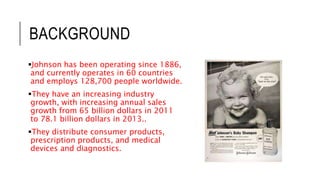
Johnson has been operating since 1886,
and currently operates in 60 countries
and employs 128,700 people worldwide.
They have an increasing industry
growth, with increasing annual sales
growth from 65 billion dollars in 2011
to 78.1 billion dollars in 2013..
They distribute consumer products,
prescription products, and medical
devices and diagnostics.
INTRODUCTION
This analysis focuses in on their
consumer product segment.
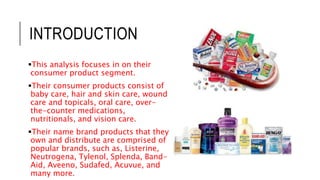
Their consumer products consist of
baby care, hair and skin care, wound
care and topicals, oral care, over-
the-counter medications,
nutritionals, and vision care.
Their name brand products that they
own and distribute are comprised of
popular brands, such as, Listerine,
Neutrogena, Tylenol, Splenda, Band-
Aid, Aveeno, Sudafed, Acuvue, and
many more.
EXTERNAL ANALYSIS
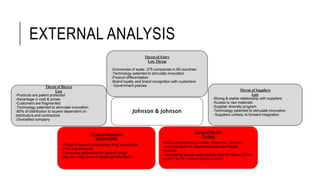
Johnson & Johnson
Threat of Substitutes
Medium/High
-Threat of generic prescription drug substitutes
-FDA requirements
-Consumer preference for generic drugs
-Big box retail stores (Target and Wal-Mart)
Threat of Rivalry
Medium
-Many competitors (Unilever, Pfizer Inc., Novartis,
-Industry leader in pharmaceuticals and health
products
- increasing annual sales growth from 65 billion dollars
in 2011 to 78.1 billion dollars in 2013.
Threat of Suppliers
Low
-Strong & stable relationship with suppliers
-Access to raw materials
-Supplier diversity program
-Technology patented to stimulate innovation
- Suppliers unlikely to forward integration
Threat of Buyers
Low
-Products are patent protected
-Advantage in cost & prices
-Customers are fragmented
-Technology patented to stimulate innovation
-80% of distribution to buyers dependent on
distributors and contractors.
-Diversified company
Threat of Entry
Low Threat
-Economies of scale- 275 companies in 60 countries
-Technology patented to stimulate innovation
-Product differentiation
-Brand loyalty and brand recognition with customers
- Government policies
EXTERNAL ANALYSIS:
PORTERS FIVE FORCES
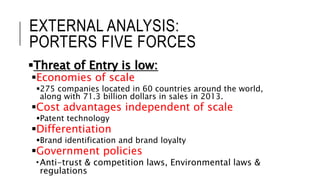
Threat of Entry is low:
Economies of scale
275 companies located in 60 countries around the world,
along with 71.3 billion dollars in sales in 2013.
Cost advantages independent of scale
Patent technology
Differentiation
Brand identification and brand loyalty
Government policies
Anti-trust & competition laws, Environmental laws &
regulations
EXTERNAL ANALYSIS:
PORTERS FIVE FORCES
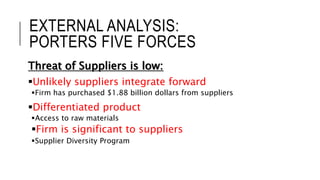
Threat of Suppliers is low:
Unlikely suppliers integrate forward
Firm has purchased $1.88 billion dollars from suppliers
Differentiated product
Access to raw materials
Firm is significant to suppliers
Supplier Diversity Program
EXTERNAL ANALYSIS:
PORTERS FIVE FORCES
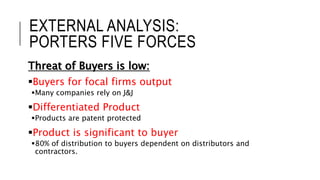
Threat of Buyers is low:
Buyers for focal firms output
Many companies rely on J&J
Differentiated Product
Products are patent protected
Product is significant to buyer
80% of distribution to buyers dependent on distributors and
contractors.
EXTERNAL ANALYSIS:
PORTERS FIVE FORCES
Threat of Rivalry is medium:
Large number of competitors
Unilever, Abbott Laboratories, Pfizer
Increasing growth
Annual sales growth
Fastest growing pharmaceuticals company
EXTERNAL ANALYSIS:
PORTERS FIVE FORCES
Threat of Substitutes
is medium to high:
Pharmaceuticals
Generic prescription drugs
Store brand drugs
EXTERNAL ANALYSIS:
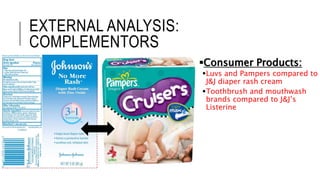
COMPLEMENTORS
Consumer Products:
Luvs and Pampers compared to
J&J diaper rash cream
Toothbrush and mouthwash
brands compared to J&J’s
Listerine
EXTERNAL ANALYSIS:
GENERAL SEGMENTS
 Demographic trends
 Baby boomer generation
 Political/legal conditions
 FDA regulations
 Cultural trends
 All-natural products
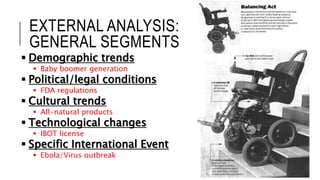
 Technological changes
 IBOT license
 Specific International Event
 Ebola/Virus outbreak
EXTERNAL ANALYSIS:
MATURE INDUSTRY STRUCTURE
Industry characteristics:
Technology stands exist
FDA regulations
Increasing international competition
Outsourcing to small low-cost producers overseas
Industry exit is beginning
Healthcare reform
Antibiotic research and development
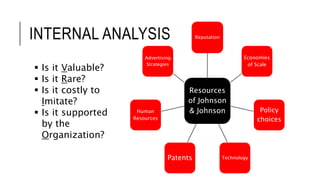
INTERNAL ANALYSIS
Resources
of Johnson
& Johnson
Reputation
Economies
of Scale
Policy
choices
TechnologyPatents
Human
Resources
Advertising
Strategies
 Is it Valuable?
 Is it Rare?
 Is it costly to
Imitate?
 Is it supported
by the
Organization?
INTERNAL ANALYSIS: RESOURCES
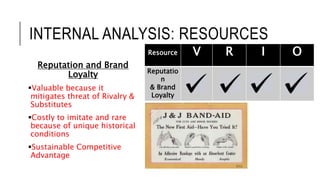
Reputation and Brand
Loyalty
Valuable because it
mitigates threat of Rivalry &
Substitutes
Costly to imitate and rare
because of unique historical
conditions
Sustainable Competitive
Advantage
Resource V R I O
Reputatio
n
& Brand
Loyalty
INTERNAL ANALYSIS: RESOURCES
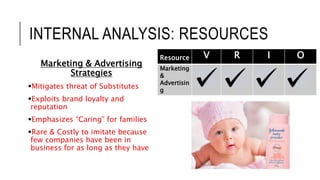
Marketing & Advertising
Strategies
Mitigates threat of Substitutes
Exploits brand loyalty and
reputation
Emphasizes “Caring” for families
Rare & Costly to imitate because
few companies have been in
business for as long as they have
Resource V R I O
Marketing
&
Advertisin
g
INTERNAL ANALYSIS: RESOURCES
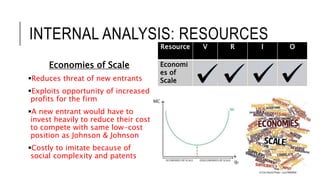
Economies of Scale
Reduces threat of new entrants
Exploits opportunity of increased
profits for the firm
A new entrant would have to
invest heavily to reduce their cost
to compete with same low-cost
position as Johnson & Johnson
Costly to imitate because of
social complexity and patents
Resource V R I O
Economi
es of
Scale
INTERNAL ANALYSIS: RESOURCES
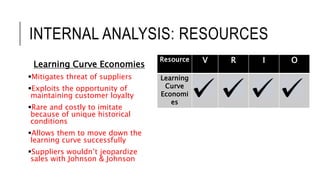
Learning Curve Economies
Mitigates threat of suppliers
Exploits the opportunity of
maintaining customer loyalty
Rare and costly to imitate
because of unique historical
conditions
Allows them to move down the
learning curve successfully
Suppliers wouldn’t jeopardize
sales with Johnson & Johnson
Resource V R I O
Learning
Curve
Economi
es
INTERNAL ANALYSIS: RESOURCES
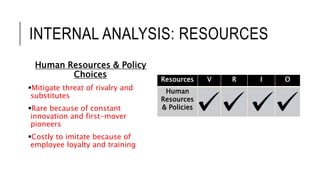
Human Resources & Policy
Choices
Mitigate threat of rivalry and
substitutes
Rare because of constant
innovation and first-mover
pioneers
Costly to imitate because of
employee loyalty and training
Resources V R I O
Human
Resources
& Policies
INTERNAL ANALYSIS: RESOURCES
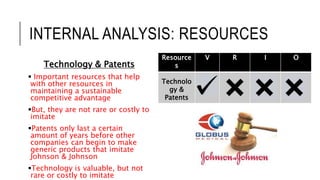
Technology & Patents
 Important resources that help
with other resources in
maintaining a sustainable
competitive advantage
But, they are not rare or costly to
imitate
Patents only last a certain
amount of years before other
companies can begin to make
generic products that imitate
Johnson & Johnson
Technology is valuable, but not
rare or costly to imitate
Resource
s
V R I O
Technolo
gy &
Patents
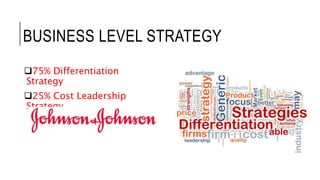
BUSINESS LEVEL STRATEGY
75% Differentiation
Strategy
25% Cost Leadership
Strategy
BUSINESS LEVEL STRATEGY
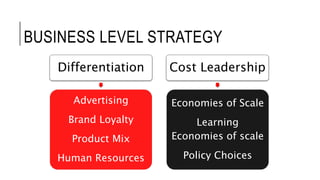
Differentiation
Advertising
Brand Loyalty
Product Mix
Human Resources
Cost Leadership
Economies of Scale
Learning
Economies of scale
Policy Choices
BUSINESS LEVEL STRATEGY
Economic value achieved through advertising
Consumer marketing strategies. “Johnson & Johnson: More than a
century of caring”.
 Emphasize highest care and quality products.
BUSINESS LEVEL STRATEGY
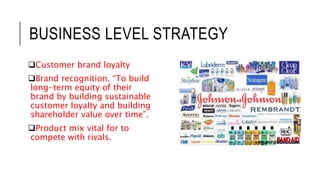
Customer brand loyalty
Brand recognition. “To build
long-term equity of their
brand by building sustainable
customer loyalty and building
shareholder value over time”.
Product mix vital for to
compete with rivals.
BUSINESS LEVEL STRATEGY
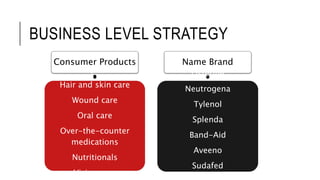
Consumer Products
Baby care
Hair and skin care
Wound care
Oral care
Over-the-counter
medications
Nutritionals
Vision care
Name Brand
Listerine
Neutrogena
Tylenol
Splenda
Band-Aid
Aveeno
Sudafed
BUSINESS LEVEL STRATEGY:
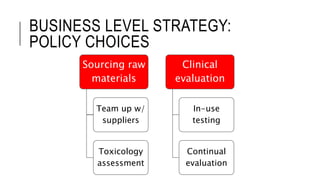
POLICY CHOICES
Sourcing raw
materials
Team up w/
suppliers
Toxicology
assessment
Clinical
evaluation
In-use
testing
Continual
evaluation
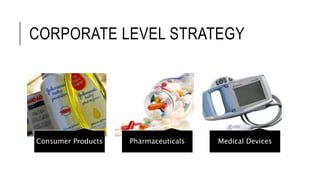
CORPORATE LEVEL STRATEGY
Consumer Products Pharmaceuticals Medical Devices
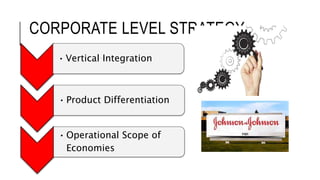
CORPORATE LEVEL STRATEGY
Vertical Integration
• Vertical Integration
• Product Differentiation
• Operational Scope of
Economies
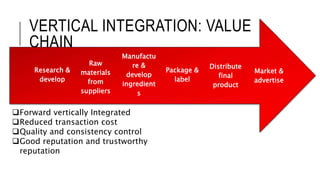
VERTICAL INTEGRATION: VALUE
CHAIN
Market &
advertise
Distribute
final
product
Package &
label
Manufactu
re &
develop
ingredient
s
Raw
materials
from
suppliers
Research &
develop
Forward vertically Integrated
Reduced transaction cost
Quality and consistency control
Good reputation and trustworthy
reputation
PRODUCT DIFFERENTIATION
 Related Corporate Diversification
Related-Constrained: less than 70% of firm revenues comes from a
single business, and different businesses share numerous links and
common attributes.
 The three markets share similar inputs, production technologies,
distribution channels and similar customers.
Innovation
Continuous innovation with technologies in all aspects of product
manufacturing
Hiring successful managers that committed to producing these results
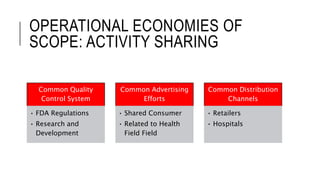
OPERATIONAL ECONOMIES OF
SCOPE: ACTIVITY SHARING
Common Quality
Control System
• FDA Regulations
• Research and
Development
Common Advertising
Efforts
• Shared Consumer
• Related to Health
Field Field
Common Distribution
Channels
• Retailers
• Hospitals
OPERATIONAL ECONOMIES OF
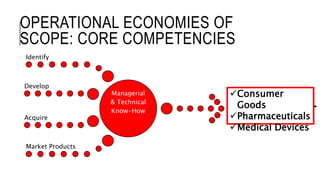
SCOPE: CORE COMPETENCIES
Managerial
& Technical
Know-How
Identify
Develop
Acquire
Market Products
Consumer
Goods
Pharmaceuticals
Medical Devices
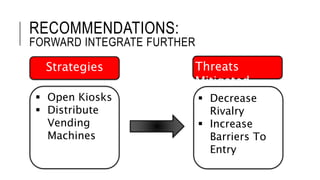
Strategies Threats
Mitigated
RECOMMENDATIONS:
FORWARD INTEGRATE FURTHER
 Open Kiosks
 Distribute
Vending
Machines
 Decrease
Rivalry
 Increase
Barriers To
Entry
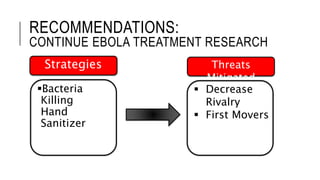
RECOMMENDATIONS:
CONTINUE EBOLA TREATMENT RESEARCH
Bacteria
Killing
Hand
Sanitizer
Strategies Threats
Mitigated
 Decrease
Rivalry
 First Movers
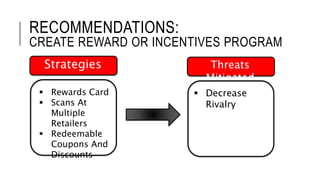
RECOMMENDATIONS:
CREATE REWARD OR INCENTIVES PROGRAM
Strategies Threats
Mitigated
 Rewards Card
 Scans At
Multiple
Retailers
 Redeemable
Coupons And
Discounts
 Decrease
Rivalry

Johnson & Johnson pp

  • 1.
    JOHNSON & JOHNSON: STRATEGICANALYSIS Presented by: Thea Lindquist, Delaney Begin, Kylie Hoffman, Miguel Perez, & Kelly Young
  • 2.
    OBJECTIVES Analyze the externalopportunities and threats of Johnson & Johnson. Analyze the internal strengths and weaknesses of J & J. Identify the Business- Level Strategy. Identify the Corporate- Level Strategy. Make recommendations for Johnson & Johnson’s future.
  • 3.
    BACKGROUND Johnson has beenoperating since 1886, and currently operates in 60 countries and employs 128,700 people worldwide. They have an increasing industry growth, with increasing annual sales growth from 65 billion dollars in 2011 to 78.1 billion dollars in 2013.. They distribute consumer products, prescription products, and medical devices and diagnostics.
  • 4.
    INTRODUCTION This analysis focusesin on their consumer product segment. Their consumer products consist of baby care, hair and skin care, wound care and topicals, oral care, over- the-counter medications, nutritionals, and vision care. Their name brand products that they own and distribute are comprised of popular brands, such as, Listerine, Neutrogena, Tylenol, Splenda, Band- Aid, Aveeno, Sudafed, Acuvue, and many more.
  • 5.
    EXTERNAL ANALYSIS Johnson &Johnson Threat of Substitutes Medium/High -Threat of generic prescription drug substitutes -FDA requirements -Consumer preference for generic drugs -Big box retail stores (Target and Wal-Mart) Threat of Rivalry Medium -Many competitors (Unilever, Pfizer Inc., Novartis, -Industry leader in pharmaceuticals and health products - increasing annual sales growth from 65 billion dollars in 2011 to 78.1 billion dollars in 2013. Threat of Suppliers Low -Strong & stable relationship with suppliers -Access to raw materials -Supplier diversity program -Technology patented to stimulate innovation - Suppliers unlikely to forward integration Threat of Buyers Low -Products are patent protected -Advantage in cost & prices -Customers are fragmented -Technology patented to stimulate innovation -80% of distribution to buyers dependent on distributors and contractors. -Diversified company Threat of Entry Low Threat -Economies of scale- 275 companies in 60 countries -Technology patented to stimulate innovation -Product differentiation -Brand loyalty and brand recognition with customers - Government policies
  • 6.
    EXTERNAL ANALYSIS: PORTERS FIVEFORCES Threat of Entry is low: Economies of scale 275 companies located in 60 countries around the world, along with 71.3 billion dollars in sales in 2013. Cost advantages independent of scale Patent technology Differentiation Brand identification and brand loyalty Government policies Anti-trust & competition laws, Environmental laws & regulations
  • 7.
    EXTERNAL ANALYSIS: PORTERS FIVEFORCES Threat of Suppliers is low: Unlikely suppliers integrate forward Firm has purchased $1.88 billion dollars from suppliers Differentiated product Access to raw materials Firm is significant to suppliers Supplier Diversity Program
  • 8.
    EXTERNAL ANALYSIS: PORTERS FIVEFORCES Threat of Buyers is low: Buyers for focal firms output Many companies rely on J&J Differentiated Product Products are patent protected Product is significant to buyer 80% of distribution to buyers dependent on distributors and contractors.
  • 9.
    EXTERNAL ANALYSIS: PORTERS FIVEFORCES Threat of Rivalry is medium: Large number of competitors Unilever, Abbott Laboratories, Pfizer Increasing growth Annual sales growth Fastest growing pharmaceuticals company
  • 10.
    EXTERNAL ANALYSIS: PORTERS FIVEFORCES Threat of Substitutes is medium to high: Pharmaceuticals Generic prescription drugs Store brand drugs
  • 11.
    EXTERNAL ANALYSIS: COMPLEMENTORS Consumer Products: Luvsand Pampers compared to J&J diaper rash cream Toothbrush and mouthwash brands compared to J&J’s Listerine
  • 12.
    EXTERNAL ANALYSIS: GENERAL SEGMENTS Demographic trends  Baby boomer generation  Political/legal conditions  FDA regulations  Cultural trends  All-natural products  Technological changes  IBOT license  Specific International Event  Ebola/Virus outbreak
  • 13.
    EXTERNAL ANALYSIS: MATURE INDUSTRYSTRUCTURE Industry characteristics: Technology stands exist FDA regulations Increasing international competition Outsourcing to small low-cost producers overseas Industry exit is beginning Healthcare reform Antibiotic research and development
  • 14.
    INTERNAL ANALYSIS Resources of Johnson &Johnson Reputation Economies of Scale Policy choices TechnologyPatents Human Resources Advertising Strategies  Is it Valuable?  Is it Rare?  Is it costly to Imitate?  Is it supported by the Organization?
  • 15.
    INTERNAL ANALYSIS: RESOURCES Reputationand Brand Loyalty Valuable because it mitigates threat of Rivalry & Substitutes Costly to imitate and rare because of unique historical conditions Sustainable Competitive Advantage Resource V R I O Reputatio n & Brand Loyalty
  • 16.
    INTERNAL ANALYSIS: RESOURCES Marketing& Advertising Strategies Mitigates threat of Substitutes Exploits brand loyalty and reputation Emphasizes “Caring” for families Rare & Costly to imitate because few companies have been in business for as long as they have Resource V R I O Marketing & Advertisin g
  • 17.
    INTERNAL ANALYSIS: RESOURCES Economiesof Scale Reduces threat of new entrants Exploits opportunity of increased profits for the firm A new entrant would have to invest heavily to reduce their cost to compete with same low-cost position as Johnson & Johnson Costly to imitate because of social complexity and patents Resource V R I O Economi es of Scale
  • 18.
    INTERNAL ANALYSIS: RESOURCES LearningCurve Economies Mitigates threat of suppliers Exploits the opportunity of maintaining customer loyalty Rare and costly to imitate because of unique historical conditions Allows them to move down the learning curve successfully Suppliers wouldn’t jeopardize sales with Johnson & Johnson Resource V R I O Learning Curve Economi es
  • 19.
    INTERNAL ANALYSIS: RESOURCES HumanResources & Policy Choices Mitigate threat of rivalry and substitutes Rare because of constant innovation and first-mover pioneers Costly to imitate because of employee loyalty and training Resources V R I O Human Resources & Policies
  • 20.
    INTERNAL ANALYSIS: RESOURCES Technology& Patents  Important resources that help with other resources in maintaining a sustainable competitive advantage But, they are not rare or costly to imitate Patents only last a certain amount of years before other companies can begin to make generic products that imitate Johnson & Johnson Technology is valuable, but not rare or costly to imitate Resource s V R I O Technolo gy & Patents
  • 21.
    BUSINESS LEVEL STRATEGY 75%Differentiation Strategy 25% Cost Leadership Strategy
  • 22.
    BUSINESS LEVEL STRATEGY Differentiation Advertising BrandLoyalty Product Mix Human Resources Cost Leadership Economies of Scale Learning Economies of scale Policy Choices
  • 23.
    BUSINESS LEVEL STRATEGY Economicvalue achieved through advertising Consumer marketing strategies. “Johnson & Johnson: More than a century of caring”.  Emphasize highest care and quality products.
  • 24.
    BUSINESS LEVEL STRATEGY Customerbrand loyalty Brand recognition. “To build long-term equity of their brand by building sustainable customer loyalty and building shareholder value over time”. Product mix vital for to compete with rivals.
  • 25.
    BUSINESS LEVEL STRATEGY ConsumerProducts Baby care Hair and skin care Wound care Oral care Over-the-counter medications Nutritionals Vision care Name Brand Listerine Neutrogena Tylenol Splenda Band-Aid Aveeno Sudafed
  • 26.
    BUSINESS LEVEL STRATEGY: POLICYCHOICES Sourcing raw materials Team up w/ suppliers Toxicology assessment Clinical evaluation In-use testing Continual evaluation
  • 27.
    CORPORATE LEVEL STRATEGY ConsumerProducts Pharmaceuticals Medical Devices
  • 28.
    CORPORATE LEVEL STRATEGY VerticalIntegration Vertical Integration • Vertical Integration • Product Differentiation • Operational Scope of Economies
  • 29.
    VERTICAL INTEGRATION: VALUE CHAIN Market& advertise Distribute final product Package & label Manufactu re & develop ingredient s Raw materials from suppliers Research & develop Forward vertically Integrated Reduced transaction cost Quality and consistency control Good reputation and trustworthy reputation
  • 30.
    PRODUCT DIFFERENTIATION  RelatedCorporate Diversification Related-Constrained: less than 70% of firm revenues comes from a single business, and different businesses share numerous links and common attributes.  The three markets share similar inputs, production technologies, distribution channels and similar customers. Innovation Continuous innovation with technologies in all aspects of product manufacturing Hiring successful managers that committed to producing these results
  • 31.
    OPERATIONAL ECONOMIES OF SCOPE:ACTIVITY SHARING Common Quality Control System • FDA Regulations • Research and Development Common Advertising Efforts • Shared Consumer • Related to Health Field Field Common Distribution Channels • Retailers • Hospitals
  • 32.
    OPERATIONAL ECONOMIES OF SCOPE:CORE COMPETENCIES Managerial & Technical Know-How Identify Develop Acquire Market Products Consumer Goods Pharmaceuticals Medical Devices
  • 33.
    Strategies Threats Mitigated RECOMMENDATIONS: FORWARD INTEGRATEFURTHER  Open Kiosks  Distribute Vending Machines  Decrease Rivalry  Increase Barriers To Entry
  • 34.
    RECOMMENDATIONS: CONTINUE EBOLA TREATMENTRESEARCH Bacteria Killing Hand Sanitizer Strategies Threats Mitigated  Decrease Rivalry  First Movers
  • 35.
    RECOMMENDATIONS: CREATE REWARD ORINCENTIVES PROGRAM Strategies Threats Mitigated  Rewards Card  Scans At Multiple Retailers  Redeemable Coupons And Discounts  Decrease Rivalry