Production Optimization
January 21, 2016
Win Nyunt Aung
Production Engineer
Operation and Maintenance Team 1
Petroleum Operations Division
Categories:
 What is Optimization?
 Well Performance and System Analysis
 Production System
 Reservoir Fluid
How do we get hydrocarbons to surface?
Tubing Performance (Vertical Lift)
Tubing Size Selection
 System Analysis (Using Nodal Analysis)
 Understand the components of Inflow Performance
 Understand the components of vertical lift Performance
 Understand combination of Inflow & vertical lift
performance
Objectives
Production Optimization
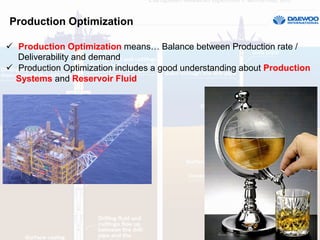
 Production Optimization means… Balance between Production rate /
Deliverability and demand
 Production Optimization includes a good understanding about Production
Systems and Reservoir Fluid
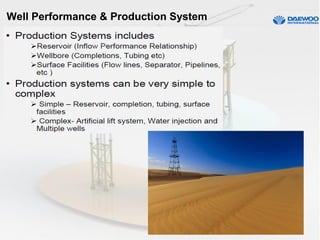
Well Performance & Production System
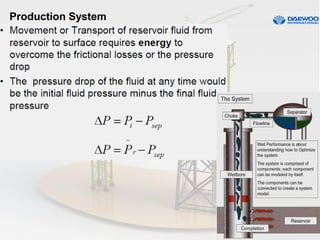
Production System
Production System
Reservoir Fluid
 Phase Behavior
 Dry gas / Wet Gas, Condensate, Oil, Water
 Fluid Properties
 Gas Properties
 Liquid Properties
 Laboratory Measurements
 Composition
 Constant Volume Depletion
Reservoir Fluid Properties
Phase Behavior
 The reservoir fluid can be classified into basically three types
i.e., single phase, two phases, or a combination.
 Such information is used to determine the type of IPR equation
to be used.
 From a technical point of
view, the various types of
reservoirs can be
defined by the location
of the initial reservoir
temperature and pressure
as commonly shown on
pressure-temperature …
(PT) phase diagrams.
Segments
 Rock Properties & Reservoir character
 Reservoir Fluid qualities
 Reservoir flow paths
 The effect of pressure drop and back pressure on fluid flow in the Reservoir
 Fluid behavior in approach / entry to the wellbore
 Lift type and Optimization of flow from bottom hole through the tubing
 Operations effect on the flow rate…
 Choke setting
 Restrictions
 Separator operations
 Pipeline
 Start up/ shut down operations, stabilizing
System AnalysisSystem Analysis
 Well deliverability is
determined by a well’s inflow
performance.
 The Inflow Performance
Relationship (IPR) is defined as
the functional relationship
between the production rate
and the bottom hole flowing
pressure.
 Productivity Index (PI or J)
expresses the ability of a
reservoir to deliver fluids to the
wellbore.
 Productivity Ratio (PR) is the
ratio of actual productivity
index to the ideal productivity
index where skin, s=0.
Reservoir Deliverability System
Inflow Performance & Productivity Index
 A commonly used measure of the ability of the well to produce
…is Productivity Index
 Defined by the symbol “J”, it is ratio of the total fluid flow rate to
the pressure drawdown….
 Drawdown (∆P) = (Pr- Pwf)
In generally,
 PI = J = Q/ ∆P
 PI = Productivity Index
 Q = Flow rate,
 ∆P = Pressure drawdown,
 Pr = Average drainage pressure (static),
 Pwf = bottom hole flowing pressure,
System Analysis
In Flow Performance Relationship - IPR Curves
 The Inflow Performance Relationship (IPR) for a well is the
relationship between the flow rate of the well q and the flowing
pressure of the well Pwf.
 In single phase flow this is a straight line but when gas is moving in
the reservoir, at a pressure below the bubble point, this in not a linear
relationship.
Tubing Performance (Outflow Performance)
 Picture yourself at the bottom of the flowing well ……
Now this time …… Look up into the tubing ……
 What would prevent flow from the well?
 What would make this well produce more?
Tubing Performance (Outflow Performance)
 The outflow system takes energy from the inflow system and
use that energy to get the total fluid rate to surface
 For the outflow system, the higher the pressure at the bottom
of the well, the more fluid can be pushed from the well
( In order to overcome friction)
Tubing Performance (Outflow Performance)
 Another convenient view of the Outflow is on a Depth Vs. Pressure
graph (These are pressure in the tubing)
Factor Affecting Vertical Lift
 Flowing Tubing Pressure
 Length of Tubing (Depth)
 Friction factors
 Tubing Diameter (ID)
 Fluid Composition (Liquid / Gas)
Line Size Criteria
Erosional Velocity
Inflow Performance Relationship (IPR) & Tubing Performance Curves
System Analysis (Combination of Inflow Vs. Outflow)
 IPR & TPR curves can be combined to find the
Stabilized Flow Rate (Point of Natural Flow)
 Tubing shoe reaches the perforation depth****
 Wellbore flowing pressure and tubing intake pressure
are considered at the same depth
 At a specific rate when these two pressures are
equal, the flow system is in equilibrium and
flow is Stable
System Analysis (Combination of Inflow Vs. Outflow)
 Flowing bottom hole pressure (Pwf) = Tubing intake pressure(Pwf e)
… the stable flow rate***
Production Rate & Tubing Sizing
Production Rate & Wellhead Pressures
Production Optimization using Nodal Analysis
Production Optimization Using Nodal Analysis
Well deliverability is determined by the combination of well inflow
performance and wellbore flow performance.
This work focuses on prediction of achievable fluid production rates from
reservoirs with specified production string characteristics.
The technique of analysis is called ‘‘Nodal analysis’’.
 Its application to well producing systems was first proposed by Gilbert
(1954).
Applications
Typical Applications include:
 Estimation of flow rates
 Selection of Tubing size
 Selection of Flowline size
 Selection of Wellhead pressure & surface choke
 Artificial Lift Design
 Estimation of the effects of reservoir pressure depletion
 Identification of flow restrictions
Optimization Procedure
 Identify the components in the system
 Select one component to be optimized
 Select the node location that will best emphasize the effect of change
 Develop expression for inflow and outflow
 Calculate pressure drop versus rate for all components
 Determine the effect of changing the characteristics of the selecting
component
 Repeat the procedure for each component
 Optimize the production system
Start Select Model
Options
Set up and Match
PVT Model
Input System
Equipment & IPR
Yes
Match IPR &
VLP
Calculate System
Sensitivities
Performance
Acceptable?
Review
Design
Finish
Production
Optimization
Production
Optimization
Nodal Analysis
 To simulate the fluid flow in the system, it is
necessary to ‘‘break’’ the system into discrete
nodes that separate system elements (equipment
sections). Fluid properties at the elements are
evaluated locally.
 Nodal analysis is performed on the principle of
pressure continuity, that is, there is only one
unique pressure value at a given node regardless
of whether the pressure is evaluated from the
performance of upstream equipment or
downstream equipment.
 The performance curve (pressure–rate
relation) of upstream equipment is called ‘‘inflow
performance curve’’;
the performance curve of downstream equipment
is called ‘‘outflow performance curve.’’
 The intersection of the two performance curves
defines the operating point, that is, operating flow
rate and pressure, at the specified node.
Production
Optimization
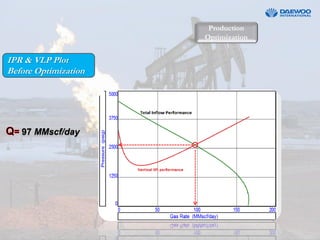
IPR & VLP Plot
Before Optimization
97 MMscf/day
Production
Optimization
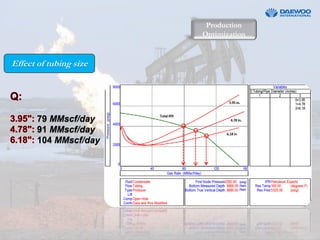
Effect of tubing size
79 MMscf/day
91 MMscf/day
104 MMscf/day
Production
Optimization
Effect of Wellhead pressure
76
MMscf/day
94
MMscf/day
101
MMscf/day
Production
Optimization
Effect of water cut
97 MMscf/day
80 MMscf/day
Production
Optimization
Skin Effect
114 MMscf/day
84 MMscf/day
Production
Optimization
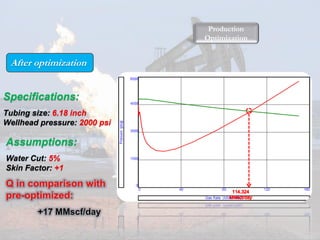
After optimization
Specifications:
Tubing size: 6.18 inch
Wellhead pressure: 2000 psi
Assumptions:
Water Cut: 5%
Skin Factor: +1
Results
 During the production, chosen well with tubing Size of 3.95" and 4.78" causes
restriction because of tubing. But the production rate increases at the production with
tubing Size of 6.18".
 According to production potential of the well and reservoir and Capacity of surface
equipment Wellhead Pressure 2000 psi for the well is appropriate.
 If the creation restriction in bottom hole completion or Formation damage, inflow
performance can be Improve using the Work Over Such as Hydraulic Fracturing or
Acidizing.
 According to formation stability (type and structure of reservoir rock), completion by
the method of open hole is appropriate and there’s no need to mechanical integrity in
the junction.
Commonly Accepted Correlations
Correlation Recommendations
Computer Programs for System Analysis
Thanks for your attention !

Production optimization

  • 1.
    Production Optimization January 21,2016 Win Nyunt Aung Production Engineer Operation and Maintenance Team 1 Petroleum Operations Division
  • 2.
    Categories:  What isOptimization?  Well Performance and System Analysis  Production System  Reservoir Fluid How do we get hydrocarbons to surface? Tubing Performance (Vertical Lift) Tubing Size Selection  System Analysis (Using Nodal Analysis)
  • 3.
     Understand thecomponents of Inflow Performance  Understand the components of vertical lift Performance  Understand combination of Inflow & vertical lift performance Objectives
  • 4.
    Production Optimization  ProductionOptimization means… Balance between Production rate / Deliverability and demand  Production Optimization includes a good understanding about Production Systems and Reservoir Fluid
  • 5.
    Well Performance &Production System
  • 6.
  • 7.
  • 8.
    Reservoir Fluid  PhaseBehavior  Dry gas / Wet Gas, Condensate, Oil, Water  Fluid Properties  Gas Properties  Liquid Properties  Laboratory Measurements  Composition  Constant Volume Depletion
  • 9.
  • 10.
    Phase Behavior  Thereservoir fluid can be classified into basically three types i.e., single phase, two phases, or a combination.  Such information is used to determine the type of IPR equation to be used.  From a technical point of view, the various types of reservoirs can be defined by the location of the initial reservoir temperature and pressure as commonly shown on pressure-temperature … (PT) phase diagrams.
  • 11.
    Segments  Rock Properties& Reservoir character  Reservoir Fluid qualities  Reservoir flow paths  The effect of pressure drop and back pressure on fluid flow in the Reservoir  Fluid behavior in approach / entry to the wellbore  Lift type and Optimization of flow from bottom hole through the tubing  Operations effect on the flow rate…  Choke setting  Restrictions  Separator operations  Pipeline  Start up/ shut down operations, stabilizing
  • 12.
    System AnalysisSystem Analysis Well deliverability is determined by a well’s inflow performance.  The Inflow Performance Relationship (IPR) is defined as the functional relationship between the production rate and the bottom hole flowing pressure.  Productivity Index (PI or J) expresses the ability of a reservoir to deliver fluids to the wellbore.  Productivity Ratio (PR) is the ratio of actual productivity index to the ideal productivity index where skin, s=0. Reservoir Deliverability System
  • 13.
    Inflow Performance &Productivity Index  A commonly used measure of the ability of the well to produce …is Productivity Index  Defined by the symbol “J”, it is ratio of the total fluid flow rate to the pressure drawdown….  Drawdown (∆P) = (Pr- Pwf) In generally,  PI = J = Q/ ∆P  PI = Productivity Index  Q = Flow rate,  ∆P = Pressure drawdown,  Pr = Average drainage pressure (static),  Pwf = bottom hole flowing pressure, System Analysis
  • 14.
    In Flow PerformanceRelationship - IPR Curves  The Inflow Performance Relationship (IPR) for a well is the relationship between the flow rate of the well q and the flowing pressure of the well Pwf.  In single phase flow this is a straight line but when gas is moving in the reservoir, at a pressure below the bubble point, this in not a linear relationship.
  • 15.
  • 16.
  • 17.
    Tubing Performance (OutflowPerformance)  Picture yourself at the bottom of the flowing well …… Now this time …… Look up into the tubing ……  What would prevent flow from the well?  What would make this well produce more?
  • 18.
    Tubing Performance (OutflowPerformance)  The outflow system takes energy from the inflow system and use that energy to get the total fluid rate to surface  For the outflow system, the higher the pressure at the bottom of the well, the more fluid can be pushed from the well ( In order to overcome friction)
  • 19.
    Tubing Performance (OutflowPerformance)  Another convenient view of the Outflow is on a Depth Vs. Pressure graph (These are pressure in the tubing)
  • 20.
    Factor Affecting VerticalLift  Flowing Tubing Pressure  Length of Tubing (Depth)  Friction factors  Tubing Diameter (ID)  Fluid Composition (Liquid / Gas)
  • 21.
  • 22.
  • 23.
    Inflow Performance Relationship(IPR) & Tubing Performance Curves System Analysis (Combination of Inflow Vs. Outflow)
  • 24.
     IPR &TPR curves can be combined to find the Stabilized Flow Rate (Point of Natural Flow)  Tubing shoe reaches the perforation depth****  Wellbore flowing pressure and tubing intake pressure are considered at the same depth  At a specific rate when these two pressures are equal, the flow system is in equilibrium and flow is Stable System Analysis (Combination of Inflow Vs. Outflow)
  • 25.
    System Analysis (Combinationof Inflow Vs. Outflow)  Flowing bottom hole pressure (Pwf) = Tubing intake pressure(Pwf e) … the stable flow rate***
  • 26.
    Production Rate &Tubing Sizing
  • 27.
    Production Rate &Wellhead Pressures
  • 28.
  • 29.
    Production Optimization UsingNodal Analysis Well deliverability is determined by the combination of well inflow performance and wellbore flow performance. This work focuses on prediction of achievable fluid production rates from reservoirs with specified production string characteristics. The technique of analysis is called ‘‘Nodal analysis’’.  Its application to well producing systems was first proposed by Gilbert (1954).
  • 30.
    Applications Typical Applications include: Estimation of flow rates  Selection of Tubing size  Selection of Flowline size  Selection of Wellhead pressure & surface choke  Artificial Lift Design  Estimation of the effects of reservoir pressure depletion  Identification of flow restrictions
  • 31.
    Optimization Procedure  Identifythe components in the system  Select one component to be optimized  Select the node location that will best emphasize the effect of change  Develop expression for inflow and outflow  Calculate pressure drop versus rate for all components  Determine the effect of changing the characteristics of the selecting component  Repeat the procedure for each component  Optimize the production system
  • 32.
    Start Select Model Options Setup and Match PVT Model Input System Equipment & IPR Yes Match IPR & VLP Calculate System Sensitivities Performance Acceptable? Review Design Finish
  • 33.
    Production Optimization Production Optimization Nodal Analysis  Tosimulate the fluid flow in the system, it is necessary to ‘‘break’’ the system into discrete nodes that separate system elements (equipment sections). Fluid properties at the elements are evaluated locally.  Nodal analysis is performed on the principle of pressure continuity, that is, there is only one unique pressure value at a given node regardless of whether the pressure is evaluated from the performance of upstream equipment or downstream equipment.  The performance curve (pressure–rate relation) of upstream equipment is called ‘‘inflow performance curve’’; the performance curve of downstream equipment is called ‘‘outflow performance curve.’’  The intersection of the two performance curves defines the operating point, that is, operating flow rate and pressure, at the specified node.
  • 34.
    Production Optimization IPR & VLPPlot Before Optimization 97 MMscf/day
  • 35.
    Production Optimization Effect of tubingsize 79 MMscf/day 91 MMscf/day 104 MMscf/day
  • 36.
    Production Optimization Effect of Wellheadpressure 76 MMscf/day 94 MMscf/day 101 MMscf/day
  • 37.
    Production Optimization Effect of watercut 97 MMscf/day 80 MMscf/day
  • 38.
  • 39.
    Production Optimization After optimization Specifications: Tubing size:6.18 inch Wellhead pressure: 2000 psi Assumptions: Water Cut: 5% Skin Factor: +1
  • 40.
    Results  During theproduction, chosen well with tubing Size of 3.95" and 4.78" causes restriction because of tubing. But the production rate increases at the production with tubing Size of 6.18".  According to production potential of the well and reservoir and Capacity of surface equipment Wellhead Pressure 2000 psi for the well is appropriate.  If the creation restriction in bottom hole completion or Formation damage, inflow performance can be Improve using the Work Over Such as Hydraulic Fracturing or Acidizing.  According to formation stability (type and structure of reservoir rock), completion by the method of open hole is appropriate and there’s no need to mechanical integrity in the junction.
  • 41.
  • 42.
  • 43.
    Computer Programs forSystem Analysis
  • 45.
    Thanks for yourattention !