
Understanding of sensory physiology.
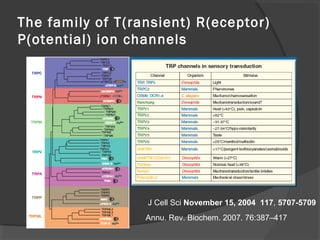
The family of T(ransient) R(eceptor)
P(otential) ion channels
J Cell Sci November 15, 2004 117, 5707-5709
Annu. Rev. Biochem. 2007. 76:387–417
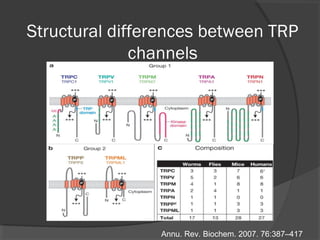
Structural differences between TRP
channels
Annu. Rev. Biochem. 2007. 76:387–417
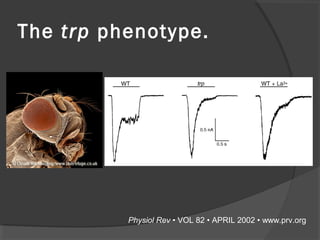
The trp phenotype.
Physiol Rev • VOL 82 • APRIL 2002 • www.prv.org
…but we still considered the
possibility that TRP was a channel
or transporter.
(1) The prior indirect evidence from other laboratories thatintracellular
Ca2+ levels were decreased in the trp mutant.
(2) That TRP was situated in the plasma membrane.
(3) Was structurally related to known channels and transporters; and
(4) Raised the possibility that TRP might be a channel that promotes
Ca2+ entry.
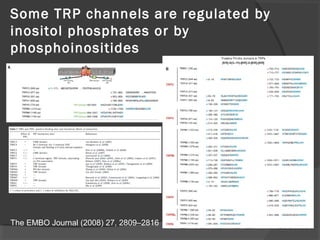
Some TRP channels are regulated by
inositol phosphates or by
phosphoinositides
The EMBO Journal (2008) 27, 2809–2816
The TRP protein in Drosophila: an Ion
Channel?
They don’t has conclusive evidence that TRP was a channel, however. A second
key observationwas a patch-clamp analysis by Roger Hardie and Baruch Minke
that demonstrated that light-dependent Ca2+ influx was reduced significantly in
the trp mutant.
The whole-cell recording analysis demonstrated that a moderately Ca2+ selective
influx pathway was eliminated in the trp mutant
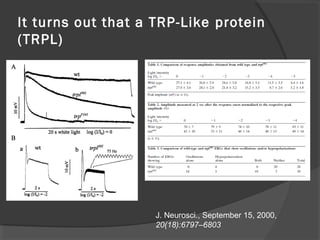
It turns out that a TRP-Like protein
(TRPL)
J. Neurosci., September 15, 2000,
20(18):6797–6803
The direct evidence that Drosophila
TRP comprises a subunit of a Ca2+
permeable channel in vivo
The results of the
analyses demonstrated
that this mutation
dramatically reduced
Ca2+ selectivity in
Drosophila photo
receptor cells.
J. Neurosci., January 17, 2007 • 27(3):604 –615
The first mammalian TRPs
Proc. Natl. Acad. Sci. USA 92 (1995)
“That TRP is conserved from nematodes
to humans,”
Biochem. J. (1995) 311, 41-44
IonIon
channelchannel
A New functionA New function ReferencesReferences
TRPC2,
TRPC7,
TRPP1
The first examples of ion channels fused to
enzyme domains.
• NATURE | VOL 411 | 31 MAY 2001 pp. 590-
595.
• NATURE | VOL 411 | 31 MAY 2001 pp. 595-
599.
• SCIENCE VOL 291 9 FEBRUARY 2001, pp.
1043-1047.
• SCIENCE VOL 293 17 AUGUST 2001, pp.
1327-1330.
TRPM6,
TRPM7.
A “chanzyme” related shown to underlie a
hypomagnesemia and hypocalcemia
NATURE GENETICS VOLUME 31 JUNE 2002,
PP. 166-170.
NATURE GENETICS VOLUME 31 JUNE 2002,
PP. 171-174.
TRPC3 Reported an in vivo conductance in the
mammalian brain resulting from activation
of a TRP channel.
NEURON, VOL. 24, SEPTEMBER, 1999, pp.
261–273.
TRPC1,
TRPC3
Activation by neurotrophins functioned in
growth cone guidance
NATURE | VOL 434 | 14 APRIL 2005 , pp. 894-
898.
NATURE | VOL 434 | 14 APRIL 2005 , pp. 898-
904.
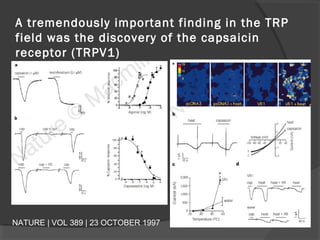
A tremendously important finding in the TRP
field was the discovery of the capsaicin
receptor (TRPV1)
NATURE | VOL 389 | 23 OCTOBER 1997
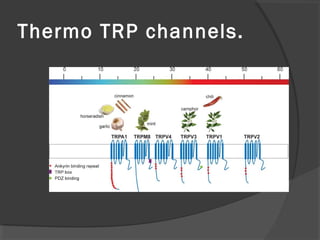
Thermo TRP channels.
The Thermo-TRP
channels.
Current Opinion in Neurobiology 2007, 17:490–497
TRP Channels And Thermosensitivity
Am J Physiol Regul Integr Comp Physiol
292:R64-R76, 2007.
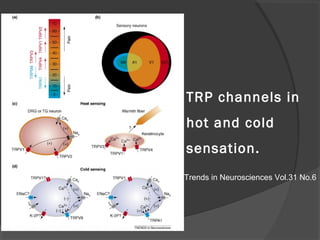
TRP channels in
hot and cold
sensation.
Trends in Neurosciences Vol.31 No.6
The mechanism of direct activation
of thermoTRPs.
NATURE |VOL 430 | 12 AUGUST 2004 | pp. 748-754
Cooling activates TRPM8 by shifting
the voltage dependence of
activation.
NATURE |VOL 430 | 12 AUGUST 2004 | pp. 748-754
Heating activates TRPV1 by shifting the
voltage dependence of activation.
NATURE |VOL 430 | 12 AUGUST 2004 | pp. 748-754
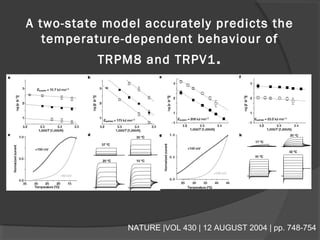
A two-state model accurately predicts the
temperature-dependent behaviour of
TRPM8 and TRPV1.
NATURE |VOL 430 | 12 AUGUST 2004 | pp. 748-754
Requirement for TRPA1 for sensing
comfortably cool temperatures in
Drosophila.
NATURE NEUROSCIENCE VOLUME 11 NUMBER 8
AUGUST 2008 pp. 871-873.
Requirement for phosphoinositide
signaling cascade for discriminating
comfortably cool temperatures (18
versus 24 1C).
NATURE NEUROSCIENCE VOLUME 11 NUMBER 8
AUGUST 2008 pp. 871-873.
Two modes for thermal activation of
TRP channels.
Eur J Physiol (2011) 461:499–506
Gq/NORPA/TRP signaling cascade is
also used in Drosophila for sensing
odorants
Current Biology 20, 1672–1678,
September 28, 2010
Detecting a small subset of
tastants
| PNAS | May 4, 2010 | vol. 107
| no. 18 pp. 8440–8445
TRP channel (TRPM5) functions in
the response to all bitter and sweet
tastants
Cell,Vol.112,293–301,February7,2003
OSM-9, A Novel Protein, Is Required for Olfaction,
Mechanosensation, and Olfactory Adaptation in
Caenorhabditis elegans
The Journal of Neuroscience, November 1,
1997, 17(21):8259–8269
painless, a Drosophila
Gene Essential for
Nociception
Cell2003113:261–273
A Drosophila Mechanosensory
Transduction Channel
SCIENCE VOL 287 24 MARCH
2000 pp. 2229-2234
Two interdependent TRPV channel
subunits, Inactive and Nanchung,
mediate hearing in Drosophila.
A TRPV family ion channel required for
hearing in Drosophila.
NATURE | VOL 424 | 3 JULY 2003 | pp. 81-84
Mechanotransduction in vertebrate hair
cells.
Nat Rev Neurosci 2008. no. 8: pp. 510–521
TRPN channel (NOMPC) is activated by
mechanical stimulation on a microsecond
time scale (~650 μs)
Neuron 67, 381–391, August 12, 2010
TRP channels and diseases.
Eur J Physiol (2011) 461:499–506
Eur J Physiol (2010) 460:437–450
The neurodegeneration resulted from
impaired clearance of early apoptotic
neurons
Cell 135, 838–851, November 28, 2008
Concluding remarks
 Drosophila trp mutant remained obscure during 20 years.
 In wich time there was no especific predicition of a function for the trp
gene product
 Then this changed with amino acid sequence analys, wich showed the trp
gene product is a ion channel.
 The whole cell recording demostrated a reduction in a light dependent Ca+
+ influx in trp mutant cells.
 The analysis of a TRP isoform with mutation in the ion selectivity filter
solidified the concept that TRP was a Ca++ permeable channel.
 The TRP proteins they finded in humans in 1995.
 The TRP are golblar sensors of sensory input.
 The TRP human subfamilies are underlie disease.
 The TRP channels are sensory detectors in insect vectors.

Trp channels

  • 1.
  • 2.
    The family ofT(ransient) R(eceptor) P(otential) ion channels J Cell Sci November 15, 2004 117, 5707-5709 Annu. Rev. Biochem. 2007. 76:387–417
  • 3.
    Structural differences betweenTRP channels Annu. Rev. Biochem. 2007. 76:387–417
  • 4.
    The trp phenotype. PhysiolRev • VOL 82 • APRIL 2002 • www.prv.org
  • 5.
    …but we stillconsidered the possibility that TRP was a channel or transporter. (1) The prior indirect evidence from other laboratories thatintracellular Ca2+ levels were decreased in the trp mutant. (2) That TRP was situated in the plasma membrane. (3) Was structurally related to known channels and transporters; and (4) Raised the possibility that TRP might be a channel that promotes Ca2+ entry.
  • 6.
    Some TRP channelsare regulated by inositol phosphates or by phosphoinositides The EMBO Journal (2008) 27, 2809–2816
  • 7.
    The TRP proteinin Drosophila: an Ion Channel? They don’t has conclusive evidence that TRP was a channel, however. A second key observationwas a patch-clamp analysis by Roger Hardie and Baruch Minke that demonstrated that light-dependent Ca2+ influx was reduced significantly in the trp mutant. The whole-cell recording analysis demonstrated that a moderately Ca2+ selective influx pathway was eliminated in the trp mutant
  • 8.
    It turns outthat a TRP-Like protein (TRPL) J. Neurosci., September 15, 2000, 20(18):6797–6803
  • 9.
    The direct evidencethat Drosophila TRP comprises a subunit of a Ca2+ permeable channel in vivo The results of the analyses demonstrated that this mutation dramatically reduced Ca2+ selectivity in Drosophila photo receptor cells. J. Neurosci., January 17, 2007 • 27(3):604 –615
  • 10.
    The first mammalianTRPs Proc. Natl. Acad. Sci. USA 92 (1995)
  • 11.
    “That TRP isconserved from nematodes to humans,” Biochem. J. (1995) 311, 41-44
  • 12.
    IonIon channelchannel A New functionANew function ReferencesReferences TRPC2, TRPC7, TRPP1 The first examples of ion channels fused to enzyme domains. • NATURE | VOL 411 | 31 MAY 2001 pp. 590- 595. • NATURE | VOL 411 | 31 MAY 2001 pp. 595- 599. • SCIENCE VOL 291 9 FEBRUARY 2001, pp. 1043-1047. • SCIENCE VOL 293 17 AUGUST 2001, pp. 1327-1330. TRPM6, TRPM7. A “chanzyme” related shown to underlie a hypomagnesemia and hypocalcemia NATURE GENETICS VOLUME 31 JUNE 2002, PP. 166-170. NATURE GENETICS VOLUME 31 JUNE 2002, PP. 171-174. TRPC3 Reported an in vivo conductance in the mammalian brain resulting from activation of a TRP channel. NEURON, VOL. 24, SEPTEMBER, 1999, pp. 261–273. TRPC1, TRPC3 Activation by neurotrophins functioned in growth cone guidance NATURE | VOL 434 | 14 APRIL 2005 , pp. 894- 898. NATURE | VOL 434 | 14 APRIL 2005 , pp. 898- 904.
  • 13.
    A tremendously importantfinding in the TRP field was the discovery of the capsaicin receptor (TRPV1) NATURE | VOL 389 | 23 OCTOBER 1997
  • 14.
  • 15.
    The Thermo-TRP channels. Current Opinionin Neurobiology 2007, 17:490–497
  • 16.
    TRP Channels AndThermosensitivity Am J Physiol Regul Integr Comp Physiol 292:R64-R76, 2007.
  • 17.
    TRP channels in hotand cold sensation. Trends in Neurosciences Vol.31 No.6
  • 18.
    The mechanism ofdirect activation of thermoTRPs. NATURE |VOL 430 | 12 AUGUST 2004 | pp. 748-754
  • 19.
    Cooling activates TRPM8by shifting the voltage dependence of activation. NATURE |VOL 430 | 12 AUGUST 2004 | pp. 748-754
  • 20.
    Heating activates TRPV1by shifting the voltage dependence of activation. NATURE |VOL 430 | 12 AUGUST 2004 | pp. 748-754
  • 21.
    A two-state modelaccurately predicts the temperature-dependent behaviour of TRPM8 and TRPV1. NATURE |VOL 430 | 12 AUGUST 2004 | pp. 748-754
  • 22.
    Requirement for TRPA1for sensing comfortably cool temperatures in Drosophila. NATURE NEUROSCIENCE VOLUME 11 NUMBER 8 AUGUST 2008 pp. 871-873.
  • 23.
    Requirement for phosphoinositide signalingcascade for discriminating comfortably cool temperatures (18 versus 24 1C). NATURE NEUROSCIENCE VOLUME 11 NUMBER 8 AUGUST 2008 pp. 871-873.
  • 24.
    Two modes forthermal activation of TRP channels. Eur J Physiol (2011) 461:499–506
  • 25.
    Gq/NORPA/TRP signaling cascadeis also used in Drosophila for sensing odorants Current Biology 20, 1672–1678, September 28, 2010
  • 26.
    Detecting a smallsubset of tastants | PNAS | May 4, 2010 | vol. 107 | no. 18 pp. 8440–8445
  • 27.
    TRP channel (TRPM5)functions in the response to all bitter and sweet tastants Cell,Vol.112,293–301,February7,2003
  • 28.
    OSM-9, A NovelProtein, Is Required for Olfaction, Mechanosensation, and Olfactory Adaptation in Caenorhabditis elegans The Journal of Neuroscience, November 1, 1997, 17(21):8259–8269
  • 29.
    painless, a Drosophila GeneEssential for Nociception Cell2003113:261–273
  • 30.
    A Drosophila Mechanosensory TransductionChannel SCIENCE VOL 287 24 MARCH 2000 pp. 2229-2234
  • 31.
    Two interdependent TRPVchannel subunits, Inactive and Nanchung, mediate hearing in Drosophila.
  • 32.
    A TRPV familyion channel required for hearing in Drosophila. NATURE | VOL 424 | 3 JULY 2003 | pp. 81-84
  • 33.
    Mechanotransduction in vertebratehair cells. Nat Rev Neurosci 2008. no. 8: pp. 510–521
  • 34.
    TRPN channel (NOMPC)is activated by mechanical stimulation on a microsecond time scale (~650 μs) Neuron 67, 381–391, August 12, 2010
  • 35.
    TRP channels anddiseases. Eur J Physiol (2011) 461:499–506 Eur J Physiol (2010) 460:437–450
  • 36.
    The neurodegeneration resultedfrom impaired clearance of early apoptotic neurons Cell 135, 838–851, November 28, 2008
  • 37.
    Concluding remarks  Drosophilatrp mutant remained obscure during 20 years.  In wich time there was no especific predicition of a function for the trp gene product  Then this changed with amino acid sequence analys, wich showed the trp gene product is a ion channel.  The whole cell recording demostrated a reduction in a light dependent Ca+ + influx in trp mutant cells.  The analysis of a TRP isoform with mutation in the ion selectivity filter solidified the concept that TRP was a Ca++ permeable channel.  The TRP proteins they finded in humans in 1995.  The TRP are golblar sensors of sensory input.  The TRP human subfamilies are underlie disease.  The TRP channels are sensory detectors in insect vectors.