









JAPEA
Course Instructor: Miss Hina Jaffery
Group A
Tahmeena Batool
Anum Zafar
Adnan Saddique
H. M. Nouman Riaz Job Analysis and
Performance Evaluation
for teams
Overview
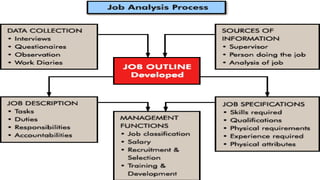
 Job Analysis is a process to identify and determine in
detail the particular job duties and requirements and the
relative importance of these duties for a given job
 The purpose of Job Analysis is to establish and document
the 'job relatedness' of employment procedures such as
training, selection, compensation, and performance
appraisal
 Job Analysis collect information on the such areas like
duties and tasks, environment, tools and equipment
relationships and requirements
Job Requirements Matrix
The job requirements matrix shows the
key components of job requirements job
analysis.
a) Tasks Statements
b) Task Dimensions
c) KSAOs
d) Job Context
Task Statements
Identification of job related tasks:
Task statement will show several things:
What the employees do, using a specific action verb at
the start of the task statement
What is produced, indicating the expected output of
team
 What equipment, materials, tools, or produces, are used
Task Dimensions
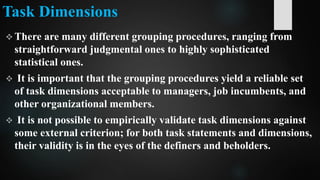
 There are many different grouping procedures, ranging from
straightforward judgmental ones to highly sophisticated
statistical ones.
 It is important that the grouping procedures yield a reliable set
of task dimensions acceptable to managers, job incumbents, and
other organizational members.
 It is not possible to empirically validate task dimensions against
some external criterion; for both task statements and dimensions,
their validity is in the eyes of the definers and beholders.
KSAOs (knowledge, skill, ability,
and other characteristics)
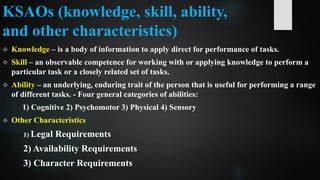
 Knowledge – is a body of information to apply direct for performance of tasks.
 Skill – an observable competence for working with or applying knowledge to perform a
particular task or a closely related set of tasks.
 Ability – an underlying, enduring trait of the person that is useful for performing a range
of different tasks. - Four general categories of abilities:
1) Cognitive 2) Psychomotor 3) Physical 4) Sensory
 Other Characteristics
1) Legal Requirements
2) Availability Requirements
3) Character Requirements
Nouman Riaz
Job Context
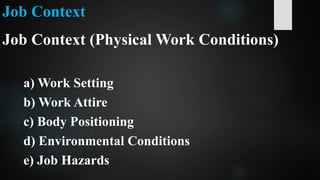
Job Context (Physical Work Conditions)
a) Work Setting
b) Work Attire
c) Body Positioning
d) Environmental Conditions
e) Job Hazards
Job Descriptions and Job
Specifications
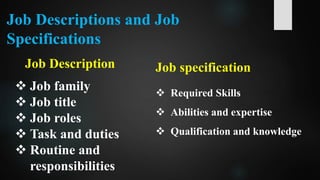
Job Description
 Job family
 Job title
 Job roles
 Task and duties
 Routine and
responsibilities
Job specification
 Required Skills
 Abilities and expertise
 Qualification and knowledge
Team task analysis (TTA)
TTA is a process of analyzing and describing the tasks of teams
and the jobs of team members. Some of the goals that they might
be trying to achieve are:
 solving a problem
 designing a plan
 defining a process
 building a product
 executing a process
Team Task difficult to be analyzed
Teamwork becomes more difficult to analyze as:
It is performed collectively by the team.
Most of the team tasks include soft skills.
How to analyze team tasks
Team tasks can best be analyzed by
extracting task information from the
team as a whole.
Performance evaluation for teams
Fully comprehensive performance evaluations must
consider the multiple "levels" of performance, organized
into four categories
 Top-Down Analysis
 Bottom-Up Analysis
 Peer to Peer Analysis
 Customer Analysis
Adnan Saddique
Top-Down Analysis:
Objectives:
The top-down analysis examines team performance from a management
perspective, evaluating the team as a whole and on a individual member
basis.
Participants:
Project managers and team leaders.
Primary Questions:
Did the team perform as expected and required, both as a cooperative unit
and on an individual basis? Were skills properly exercised and combined?
Did everyone participate actively and positively? Were there any internal
conflicts that damaged team performance?
Bottom-Up Analysis:
Objectives:
The bottom-up analysis examines management performance from a team
"participant" perspective. The goal is to measure team satisfaction with
management.
Participants:
Project team members.
Primary Questions:
Did the project management hierarchy create an environment for success
considering planning strategies, work assignments, information, motivation,
empowerment and support?
Peer to Peer Analysis:
Objectives:
The peer to peer analysis provides the opportunity for a ground
level team assessment, allowing the individual team members to
evaluate each other.
Participants:
Project team members.
Primary Questions:
Did each team member carry out his/her responsibilities as required? Did each team
member support the "unit", by sharing information and following procedures?Did each
team member show sufficient courtesy and respect to fellow team members? Did team
members work to resolve internal conflicts?
Customer Analysis:
Objectives:
The customer analysis provides the opportunity for "customer"
evaluation of team performance.
Participants:
Project customers.
Primary Questions:
Was the project team responsive to customer needs? Were
customers sufficiently included in team deliberations and
activities? Did the team actively seek customer input and
feedback as needed?
Now, We have an act for you.
Anum Zafar
Team Member Performance
Evaluation Techniques
Graphic Rating Scales
Narrative Essay
Forced Distribution
Peer Evaluations
Graphic Rating Scales
 One of the simplest ways to evaluate team members is by using graphic
rating scales.
 Graphic rating scales are useful for fast-paced, production-oriented
work environments.
 Team members receive ratings based on a scale that describes
competency, ability and productivity.
 On a graphic rating scale evaluation, you evaluate team members in
specified areas on a scale of 1 to 5, tally the numbers for each section
and calculate an average.
Narrative Essay
 Most time-consuming
 Produce a wealth of information for employees, supervisors and human
resource practitioners.
 Supervisors and managers responsible for evaluating team members and
employees review personnel files, disciplinary records, recommendations
and work logs for a comprehensive look at the team member's
performance.
 They then write essay responses to evaluation questions. The key to this
evaluation technique is setting aside enough time for preparation and
engaging the team member in two-way feedback during the actual
performance evaluation meeting.
Forced Distribution
 Managers and supervisors evaluate team members according to a
20-70-10 philosophy, which predicts 20 percent of the workforce
consists of high-performing team members.
 Seventy percent of the workforce are deemed average performers
 10 percent of team members are in the lowest-ranking group in
terms of performance.
 Supervisors evaluate team members in a number of work areas;
however, the result is some make the cut to the highest-ranking
employees and many more don't.
Peer Evaluations
Peer evaluations give team members an opportunity to
assess the performance of their co-workers, usually from
a perspective supervisors can't always observe
Employees usually are honest about their assessment of
team member performance, especially as it relates to
interpersonal relationships with other team members and
with the employer's customers and clients.
Job analysis and performance evaluation- JAPEA

Job analysis and performance evaluation- JAPEA

  • 2.
  • 3.
    Group A Tahmeena Batool AnumZafar Adnan Saddique H. M. Nouman Riaz Job Analysis and Performance Evaluation for teams
  • 5.
    Overview  Job Analysisis a process to identify and determine in detail the particular job duties and requirements and the relative importance of these duties for a given job  The purpose of Job Analysis is to establish and document the 'job relatedness' of employment procedures such as training, selection, compensation, and performance appraisal  Job Analysis collect information on the such areas like duties and tasks, environment, tools and equipment relationships and requirements
  • 6.
    Job Requirements Matrix Thejob requirements matrix shows the key components of job requirements job analysis. a) Tasks Statements b) Task Dimensions c) KSAOs d) Job Context
  • 7.
    Task Statements Identification ofjob related tasks: Task statement will show several things: What the employees do, using a specific action verb at the start of the task statement What is produced, indicating the expected output of team  What equipment, materials, tools, or produces, are used
  • 8.
    Task Dimensions  Thereare many different grouping procedures, ranging from straightforward judgmental ones to highly sophisticated statistical ones.  It is important that the grouping procedures yield a reliable set of task dimensions acceptable to managers, job incumbents, and other organizational members.  It is not possible to empirically validate task dimensions against some external criterion; for both task statements and dimensions, their validity is in the eyes of the definers and beholders.
  • 9.
    KSAOs (knowledge, skill,ability, and other characteristics)  Knowledge – is a body of information to apply direct for performance of tasks.  Skill – an observable competence for working with or applying knowledge to perform a particular task or a closely related set of tasks.  Ability – an underlying, enduring trait of the person that is useful for performing a range of different tasks. - Four general categories of abilities: 1) Cognitive 2) Psychomotor 3) Physical 4) Sensory  Other Characteristics 1) Legal Requirements 2) Availability Requirements 3) Character Requirements
  • 10.
  • 11.
    Job Context Job Context(Physical Work Conditions) a) Work Setting b) Work Attire c) Body Positioning d) Environmental Conditions e) Job Hazards
  • 12.
    Job Descriptions andJob Specifications Job Description  Job family  Job title  Job roles  Task and duties  Routine and responsibilities Job specification  Required Skills  Abilities and expertise  Qualification and knowledge
  • 14.
    Team task analysis(TTA) TTA is a process of analyzing and describing the tasks of teams and the jobs of team members. Some of the goals that they might be trying to achieve are:  solving a problem  designing a plan  defining a process  building a product  executing a process
  • 16.
    Team Task difficultto be analyzed Teamwork becomes more difficult to analyze as: It is performed collectively by the team. Most of the team tasks include soft skills.
  • 17.
    How to analyzeteam tasks Team tasks can best be analyzed by extracting task information from the team as a whole.
  • 18.
    Performance evaluation forteams Fully comprehensive performance evaluations must consider the multiple "levels" of performance, organized into four categories  Top-Down Analysis  Bottom-Up Analysis  Peer to Peer Analysis  Customer Analysis
  • 19.
  • 20.
    Top-Down Analysis: Objectives: The top-downanalysis examines team performance from a management perspective, evaluating the team as a whole and on a individual member basis. Participants: Project managers and team leaders. Primary Questions: Did the team perform as expected and required, both as a cooperative unit and on an individual basis? Were skills properly exercised and combined? Did everyone participate actively and positively? Were there any internal conflicts that damaged team performance?
  • 21.
    Bottom-Up Analysis: Objectives: The bottom-upanalysis examines management performance from a team "participant" perspective. The goal is to measure team satisfaction with management. Participants: Project team members. Primary Questions: Did the project management hierarchy create an environment for success considering planning strategies, work assignments, information, motivation, empowerment and support?
  • 22.
    Peer to PeerAnalysis: Objectives: The peer to peer analysis provides the opportunity for a ground level team assessment, allowing the individual team members to evaluate each other. Participants: Project team members. Primary Questions: Did each team member carry out his/her responsibilities as required? Did each team member support the "unit", by sharing information and following procedures?Did each team member show sufficient courtesy and respect to fellow team members? Did team members work to resolve internal conflicts?
  • 23.
    Customer Analysis: Objectives: The customeranalysis provides the opportunity for "customer" evaluation of team performance. Participants: Project customers. Primary Questions: Was the project team responsive to customer needs? Were customers sufficiently included in team deliberations and activities? Did the team actively seek customer input and feedback as needed?
  • 24.
    Now, We havean act for you.
  • 25.
  • 26.
    Team Member Performance EvaluationTechniques Graphic Rating Scales Narrative Essay Forced Distribution Peer Evaluations
  • 27.
    Graphic Rating Scales One of the simplest ways to evaluate team members is by using graphic rating scales.  Graphic rating scales are useful for fast-paced, production-oriented work environments.  Team members receive ratings based on a scale that describes competency, ability and productivity.  On a graphic rating scale evaluation, you evaluate team members in specified areas on a scale of 1 to 5, tally the numbers for each section and calculate an average.
  • 28.
    Narrative Essay  Mosttime-consuming  Produce a wealth of information for employees, supervisors and human resource practitioners.  Supervisors and managers responsible for evaluating team members and employees review personnel files, disciplinary records, recommendations and work logs for a comprehensive look at the team member's performance.  They then write essay responses to evaluation questions. The key to this evaluation technique is setting aside enough time for preparation and engaging the team member in two-way feedback during the actual performance evaluation meeting.
  • 29.
    Forced Distribution  Managersand supervisors evaluate team members according to a 20-70-10 philosophy, which predicts 20 percent of the workforce consists of high-performing team members.  Seventy percent of the workforce are deemed average performers  10 percent of team members are in the lowest-ranking group in terms of performance.  Supervisors evaluate team members in a number of work areas; however, the result is some make the cut to the highest-ranking employees and many more don't.
  • 30.
    Peer Evaluations Peer evaluationsgive team members an opportunity to assess the performance of their co-workers, usually from a perspective supervisors can't always observe Employees usually are honest about their assessment of team member performance, especially as it relates to interpersonal relationships with other team members and with the employer's customers and clients.

Editor's Notes

  • #8 The objective of task statements is to identify and record a set of tasks that includes all of the job’s major tasks and excludes non-relevant or trivial tasks.
  • #12 As you have seen in job requirement matrix, that KSAO’s and tasks come within the boundaries of job context so a job analysis must include considerations of job context and other contents that are important in defining it.
  • #15 TTA is basically a process of identifying and then explaining the tasks and duties of team members, it can b also used to determine the required skill, knowledge and relevant attitude requirements. A team can be defined as a group of people working together for attainment of a common goal.
  • #17 Why? What is the problem in it? Actually teams often perform collectively so it becomes difficult to find ratios, for example how can u determine the amount of participation from each individual in attainment of goal? B- simply , a hard skill can be easily measured such as painting a door or doing anything that is explicitly visible while a soft skill is difficult to be measured such as share in decision making process.
  • #18 for example, if a project requires different tasks for accomplishment of goal, then each of multiple tasks can be identified individually and in this way the performance evaluation will also become easy.