“Retos de la economía circular en el embalaje para 
apelar a la responsabilidad de los productores” 
Joachim Quoden 
Managing Director EXPRA 
November 13, 2014
«XXII Jornadas Técnicas ANEPMA» 
Pamplona, Espagna 
12 - 14 noviembre2014 
“Retos de la economía circular en el embalaje para 
apelar a la responsabilidad de los productores” 
Joachim Quoden 
Managing Director EXPRA
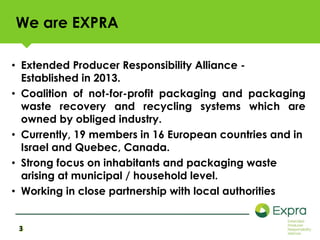
We are EXPRA 
• Extended Producer Responsibility Alliance - 
Established in 2013. 
• Coalition of not-for-profit packaging and packaging 
waste recovery and recycling systems which are 
owned by obliged industry. 
• Currently, 19 members in 16 European countries and in 
Israel and Quebec, Canada. 
• Strong focus on inhabitants and packaging waste 
arising at municipal / household level. 
• Working in close partnership with local authorities 
3
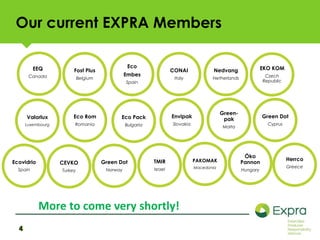
Our current EXPRA Members 
4 
EEQ 
Canada 
Fost Plus 
Belgium 
Eco 
Embes 
Spain 
CONAI 
Italy 
Nedvang 
Netherlands 
EKO KOM 
Czech 
Republic 
Valorlux 
Luxembourg 
Eco Rom 
Romania 
Eco Pack 
Bulgaria 
Envipak 
Slovakia 
Green-pak 
Malta 
Green Dot 
Cyprus 
CEVKO 
Turkey 
Green Dot 
Norway 
TMIR 
Israel 
PAKOMAK 
Macedonia 
Öko 
Pannon 
Hungary 
Ecovidrio 
Spain 
Herrco 
Greece 
More to come very shortly!
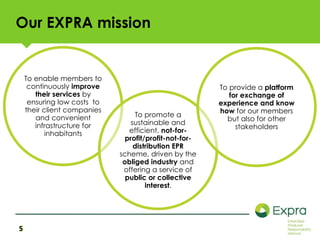
Our EXPRA mission 
5 
To enable members to 
continuously improve 
their services by 
ensuring low costs to 
their client companies 
and convenient 
infrastructure for 
inhabitants 
To promote a 
sustainable and 
efficient, not-for-profit/ 
profit-not-for-distribution 
EPR 
scheme, driven by the 
obliged industry and 
offering a service of 
public or collective 
interest. 
To provide a platform 
for exchange of 
experience and know 
how for our members 
but also for other 
stakeholders
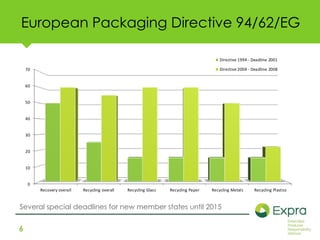
European Packaging Directive 94/62/EG 
6 
70 
60 
50 
40 
30 
20 
10 
0 
Directive 1994 - Deadline 2001 
Directive 2004 - Deadline 2008 
Recovery overall Recycling overall Recycling Glass Recycling Paper Recycling Metals Recycling Plastics 
Several special deadlines for new member states until 2015
90,00% 
80,00% 
70,00% 
7 
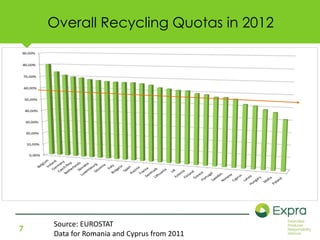
Overall Recycling Quotas in 2012 
60,00% 
50,00% 
40,00% 
30,00% 
20,00% 
10,00% 
0,00% 
Source: EUROSTAT 
Data for Romania and Cyprus from 2011
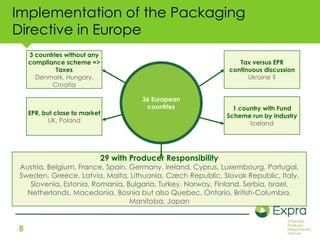
Implementation of the Packaging 
Directive in Europe 
8 
3 countries without any 
compliance scheme => 
Taxes 
Denmark, Hungary, 
Croatia 
Tax versus EPR 
continuous discussion 
Ukraine ? 
EPR, but close to market 
UK, Poland 
29 with Producer Responsibility 
Austria, Belgium, France, Spain, Germany, Ireland, Cyprus, Luxembourg, Portugal, 
Sweden, Greece, Latvia, Malta, Lithuania, Czech Republic, Slovak Republic, Italy, 
Slovenia, Estonia, Romania, Bulgaria, Turkey, Norway, Finland, Serbia, Israel, 
Netherlands, Macedonia, Bosnia but also Quebec, Ontario, British-Columbia, 
Manitoba, Japan 
1 country with Fund 
Scheme run by industry 
Iceland 
36 European 
countries
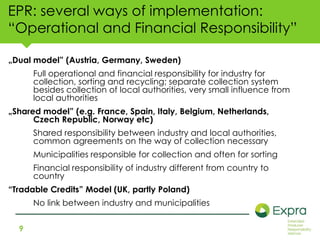
EPR: several ways of implementation: 
“Operational and Financial Responsibility” 
„Dual model” (Austria, Germany, Sweden) 
9 
Full operational and financial responsibility for industry for 
collection, sorting and recycling; separate collection system 
besides collection of local authorities, very small influence from 
local authorities 
„Shared model” (e.g. France, Spain, Italy, Belgium, Netherlands, 
Czech Republic, Norway etc) 
Shared responsibility between industry and local authorities, 
common agreements on the way of collection necessary 
Municipalities responsible for collection and often for sorting 
Financial responsibility of industry different from country to 
country 
“Tradable Credits” Model (UK, partly Poland) 
No link between industry and municipalities
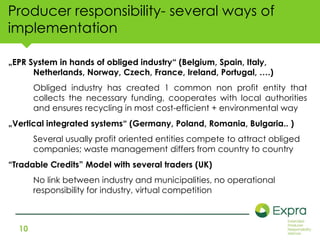
Producer responsibility- several ways of 
implementation 
„EPR System in hands of obliged industry“ (Belgium, Spain, Italy, 
10 
Netherlands, Norway, Czech, France, Ireland, Portugal, ….) 
Obliged industry has created 1 common non profit entity that 
collects the necessary funding, cooperates with local authorities 
and ensures recycling in most cost-efficient + environmental way 
„Vertical integrated systems“ (Germany, Poland, Romania, Bulgaria.. ) 
Several usually profit oriented entities compete to attract obliged 
companies; waste management differs from country to country 
“Tradable Credits” Model with several traders (UK) 
No link between industry and municipalities, no operational 
responsibility for industry, virtual competition
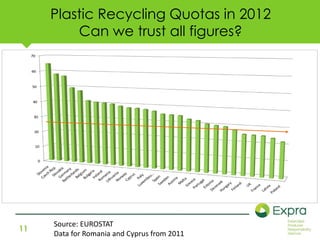
11 
Plastic Recycling Quotas in 2012 
Can we trust all figures? 
70 
60 
50 
30 
20 
10 
0 
40 
Source: EUROSTAT 
Data for Romania and Cyprus from 2011
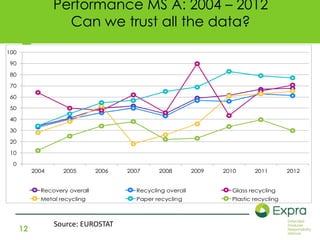
12 
Performance MS A: 2004 – 2012 
Can we trust all the data? 
100 
90 
80 
70 
60 
50 
40 
30 
20 
10 
0 
2004 2005 2006 2007 2008 2009 2010 2011 2012 
Recovery overall Recycling overall Glass recycling 
Metal recycling Paper recycling Plastic recycling 
Source: EUROSTAT
100 
90 
80 
70 
60 
50 
40 
30 
20 
10 
13 
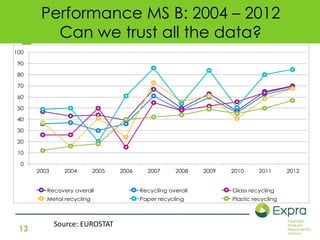
Performance MS B: 2004 – 2012 
Can we trust all the data? 
0 
2003 2004 2005 2006 2007 2008 2009 2010 2011 2012 
Recovery overall Recycling overall Glass recycling 
Metal recycling Paper recycling Plastic recycling 
Source: EUROSTAT
14 
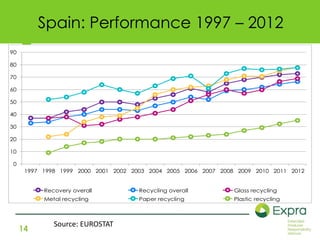
Spain: Performance 1997 – 2012 
90 
80 
70 
60 
50 
40 
30 
20 
10 
0 
1997 1998 1999 2000 2001 2002 2003 2004 2005 2006 2007 2008 2009 2010 2011 2012 
Recovery overall Recycling overall Glass recycling 
Metal recycling Paper recycling Plastic recycling 
Source: EUROSTAT
EPR Data Verification Study 
Presentation for the European Commission 
December 11, 2013
Examples from the findings of the study - 
Spain 
1. Packaging placed on the market (P.O.M.) 
16 
Methodologies used 
The reported weight is provided by the Industrial Trade Associations 
based on two types of measurement: 
• Verified declarations by the licensed organisations (household and 
voluntary commercial packaging) 
• Estimations of non-household packaging, based on studies and 
surveys, carried out for Industrial Trade Associations 
The percentage from verified declarations (weight from EPR Schemes) is 
about 45.5% and the remainder from estimates or surveys (54.5%). 
Strong points 
• The methodology covers the entire economy, including the free riders. 
• Long implementation period, with improvement processes.
Examples from the findings of the study - 
Spain 
2. Recycling 
Methodologies used 
Nearly 100% of the reported weight is based on estimates, surveys and studies carried out by the 
Industrial Trade Associations. Regions have the legal obligation of gathering the information from 
municipalities and waste management companies. However, the information from the Regions source is 
incomplete. 
The remainder is based on: 
• Specific estimate schemes for metals, plastic and wood, 
• Estimate based on a mass balance calculation for paper and glass 
• Amount of metal packaging that is separated from incineration ashes and made available for 
17 
recycling. 
• Data based on Declarations provided by EPR schemes. 
Strong points 
• Nearly 42% of the packaging waste weight reported as sent to recycling is supported by verified 
declarations and audited. 
• Materials Entities coordinate the monitoring of all recycled packaging and have verification schemes; 
• All collection and recycling from households and businesses that have adhered voluntarily is based 
on verified declarations of packaging waste streams and data is verified annually by accountants;
Examples from the findings of the study - 
Spain 
RECOMMENDATIONS 
1. The monitoring system in Spain mainly relies on data provided through EPR 
Schemes. A protocol should be set up to prepare the reports and the verifications to 
ensure the data quality and identify and address all the summands involved in the 
numerator and denominator of the recycling rate 
2. The amounts of reusable packaging placed on the market could be clarified. 
3. Better identify the export and import of waste packaging flows. 
4. Explore the possibilities to make it mandatory for exporters to report if the recycling 
facilities where they export the waste comply with the conditions of article 6.2 
(Directive 94/62/EC). 
5. Explore the possibilities to calculate the private import and export of packed products 
(problem all over Europe!). 
6. Explore the possibilities to control Internet commerce by collaborating with the tax 
authorities 
18
Results: Assessment of data collection methods 1 2 3 4 
• The information Member States provide to EUROSTAT on the methods they apply is 
very limited and does not allow for a proper evaluation of the quality of the data they 
submit. 
• Only occasionally, amounts due to imports or exports of packed goods by private 
householders are included in the data for packaging placed on the market. For certain 
countries the impact can be considerable. Amount imported or exported via internet 
sales are never included in the data. The impact on the data is unknown but the 
amounts are growing. 
• Different methods for data collection are applied. These have different levels of 
accuracy. However, the study did not do any audits and therefore cannot provide strong 
conclusions on the accuracy of the data as reported. 
• The activities for verification of the data differ considerably between the Member 
States. This has impact on the reliability of the data. 
• There are differences in the application of the definition of packaging for certain items 
(coffee cups, wooden barrels, gas cylinders) but these are expected to have limited 
impact on the accuracy of the data as reported. 
Page  19
New Proposals for PPWD+ WFD 
Key topics of concern: 
1. Targets 
2. Measurement Point 
3. EPR Criteria 
20
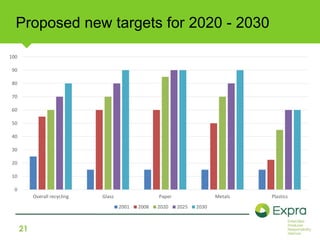
Proposed new targets for 2020 - 2030 
21 
100 
90 
80 
70 
60 
50 
40 
30 
20 
10 
0 
Overall recycling Glass Paper Metals Plastics 
2001 2008 2020 2025 2030
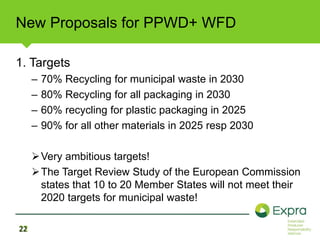
New Proposals for PPWD+ WFD 
1. Targets 
22 
– 70% Recycling for municipal waste in 2030 
– 80% Recycling for all packaging in 2030 
– 60% recycling for plastic packaging in 2025 
– 90% for all other materials in 2025 resp 2030 
Very ambitious targets! 
The Target Review Study of the European Commission 
states that 10 to 20 Member States will not meet their 
2020 targets for municipal waste!
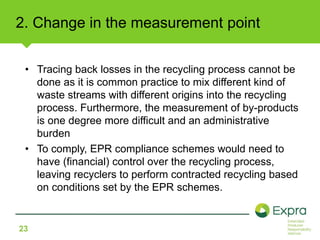
2. Change in the measurement point 
• Tracing back losses in the recycling process cannot be 
23 
done as it is common practice to mix different kind of 
waste streams with different origins into the recycling 
process. Furthermore, the measurement of by-products 
is one degree more difficult and an administrative 
burden 
• To comply, EPR compliance schemes would need to 
have (financial) control over the recycling process, 
leaving recyclers to perform contracted recycling based 
on conditions set by the EPR schemes.
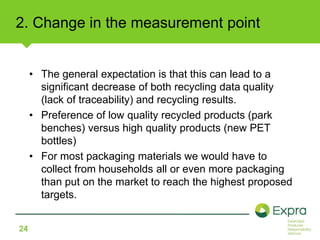
2. Change in the measurement point 
24 
• The general expectation is that this can lead to a 
significant decrease of both recycling data quality 
(lack of traceability) and recycling results. 
• Preference of low quality recycled products (park 
benches) versus high quality products (new PET 
bottles) 
• For most packaging materials we would have to 
collect from households all or even more packaging 
than put on the market to reach the highest proposed 
targets.
3. EPR Criteria 
25 
– Not taking the findings of the BIOIS study ordered and 
paid by the EC into account 
– Very vague and not touching the crucial topics 
– No measures to avoid conflict of interests when 
allocating roles and responsibilities amongst the 
stakeholders 
– No clear criteria for the authorization of compliance 
schemes 
– Using terms without defining them
BIOIS EPR Guidelines Study commissioned 
by the European Commission 
26 
Follows 2012 study on the use of Economic Instruments and Waste 
Management Performances, according to which: 
EPR is an effective tool to shift waste 
streams to more sustainable paths 
Commission develops guidelines on EPR 
http://epr.eu-smr.eu/ 
Commissioned a 15 months study about best 
practices in EPR and guidelines 
36 national case studies: http://epr.eu-smr.eu/documents
Our EXPRA Beliefs for EPR Best Practices -1- 
• EPR organisations should be run by obliged companies on 
a not-for-profit basis 
• Focus on Separate collection and collection infrastructure 
for inhabitants that covers also out of home consumption 
is key for the success of the system! 
• In order to ensure that the right legislation is in place and 
implemented, different stakeholders have clear roles to 
play, ensuring no conflict of interests! 
• Close cooperation with municipalities key to understand 
the needs of inhabitants and to provide the right 
collection systems 
27
Our EXPRA Beliefs for EPR Best Practices -2- 
• Transparency of operations and data is crucial 
• The fees for all materials covered should be calculated in 
a fair manner 
• EPR organisations should control the use of the fees collected, 
and influence infrastructure design if necessary 
• EPR is not a stand-alone solution but needs a 
comprehensive + integrated waste management 
approach and system 
• Packaging optimisation, design-for-recycling, clear 
communication and education of inhabitants and 
company representatives are essential parts of successful 
EPR systems 
28
Contact 
Joachim Quoden 
Managing Director 
EXPRA aisbl 
2 Avenue des Olympiades 
1140 Brussels – Evere 
Belgium 
joachim.quoden@expra.eu 
www.expra.eu
Joachim Quoden – www.quoden.com 
• Profession: Independent Lawyer since 1995 
• 10/92 – 01/93: German Ministry of Environment 
• 02/93 – 06/06: German Green Dot scheme DSD in 
various capacities, i.e. Head of 
International Affairs 
• 10/00 – 02/13: Secretary General respective 
Managing Director of PRO EUROPE 
• 05/13 - …: Managing Director of EXPRA 
• 10/13 - …. Chair of ISWA Legal WG 
• 04/14 - …. Member of the GPSC Advisory Council
PARTNERSHIP IS KEY TO SUCCESS

“Retos de la economía circular en el embalaje para apelar a la responsabilidad de los productores”. Joachim Quoden, EXPRA

  • 1.
    “Retos de laeconomía circular en el embalaje para apelar a la responsabilidad de los productores” Joachim Quoden Managing Director EXPRA November 13, 2014
  • 2.
    «XXII Jornadas TécnicasANEPMA» Pamplona, Espagna 12 - 14 noviembre2014 “Retos de la economía circular en el embalaje para apelar a la responsabilidad de los productores” Joachim Quoden Managing Director EXPRA
  • 3.
    We are EXPRA • Extended Producer Responsibility Alliance - Established in 2013. • Coalition of not-for-profit packaging and packaging waste recovery and recycling systems which are owned by obliged industry. • Currently, 19 members in 16 European countries and in Israel and Quebec, Canada. • Strong focus on inhabitants and packaging waste arising at municipal / household level. • Working in close partnership with local authorities 3
  • 4.
    Our current EXPRAMembers 4 EEQ Canada Fost Plus Belgium Eco Embes Spain CONAI Italy Nedvang Netherlands EKO KOM Czech Republic Valorlux Luxembourg Eco Rom Romania Eco Pack Bulgaria Envipak Slovakia Green-pak Malta Green Dot Cyprus CEVKO Turkey Green Dot Norway TMIR Israel PAKOMAK Macedonia Öko Pannon Hungary Ecovidrio Spain Herrco Greece More to come very shortly!
  • 5.
    Our EXPRA mission 5 To enable members to continuously improve their services by ensuring low costs to their client companies and convenient infrastructure for inhabitants To promote a sustainable and efficient, not-for-profit/ profit-not-for-distribution EPR scheme, driven by the obliged industry and offering a service of public or collective interest. To provide a platform for exchange of experience and know how for our members but also for other stakeholders
  • 6.
    European Packaging Directive94/62/EG 6 70 60 50 40 30 20 10 0 Directive 1994 - Deadline 2001 Directive 2004 - Deadline 2008 Recovery overall Recycling overall Recycling Glass Recycling Paper Recycling Metals Recycling Plastics Several special deadlines for new member states until 2015
  • 7.
    90,00% 80,00% 70,00% 7 Overall Recycling Quotas in 2012 60,00% 50,00% 40,00% 30,00% 20,00% 10,00% 0,00% Source: EUROSTAT Data for Romania and Cyprus from 2011
  • 8.
    Implementation of thePackaging Directive in Europe 8 3 countries without any compliance scheme => Taxes Denmark, Hungary, Croatia Tax versus EPR continuous discussion Ukraine ? EPR, but close to market UK, Poland 29 with Producer Responsibility Austria, Belgium, France, Spain, Germany, Ireland, Cyprus, Luxembourg, Portugal, Sweden, Greece, Latvia, Malta, Lithuania, Czech Republic, Slovak Republic, Italy, Slovenia, Estonia, Romania, Bulgaria, Turkey, Norway, Finland, Serbia, Israel, Netherlands, Macedonia, Bosnia but also Quebec, Ontario, British-Columbia, Manitoba, Japan 1 country with Fund Scheme run by industry Iceland 36 European countries
  • 9.
    EPR: several waysof implementation: “Operational and Financial Responsibility” „Dual model” (Austria, Germany, Sweden) 9 Full operational and financial responsibility for industry for collection, sorting and recycling; separate collection system besides collection of local authorities, very small influence from local authorities „Shared model” (e.g. France, Spain, Italy, Belgium, Netherlands, Czech Republic, Norway etc) Shared responsibility between industry and local authorities, common agreements on the way of collection necessary Municipalities responsible for collection and often for sorting Financial responsibility of industry different from country to country “Tradable Credits” Model (UK, partly Poland) No link between industry and municipalities
  • 10.
    Producer responsibility- severalways of implementation „EPR System in hands of obliged industry“ (Belgium, Spain, Italy, 10 Netherlands, Norway, Czech, France, Ireland, Portugal, ….) Obliged industry has created 1 common non profit entity that collects the necessary funding, cooperates with local authorities and ensures recycling in most cost-efficient + environmental way „Vertical integrated systems“ (Germany, Poland, Romania, Bulgaria.. ) Several usually profit oriented entities compete to attract obliged companies; waste management differs from country to country “Tradable Credits” Model with several traders (UK) No link between industry and municipalities, no operational responsibility for industry, virtual competition
  • 11.
    11 Plastic RecyclingQuotas in 2012 Can we trust all figures? 70 60 50 30 20 10 0 40 Source: EUROSTAT Data for Romania and Cyprus from 2011
  • 12.
    12 Performance MSA: 2004 – 2012 Can we trust all the data? 100 90 80 70 60 50 40 30 20 10 0 2004 2005 2006 2007 2008 2009 2010 2011 2012 Recovery overall Recycling overall Glass recycling Metal recycling Paper recycling Plastic recycling Source: EUROSTAT
  • 13.
    100 90 80 70 60 50 40 30 20 10 13 Performance MS B: 2004 – 2012 Can we trust all the data? 0 2003 2004 2005 2006 2007 2008 2009 2010 2011 2012 Recovery overall Recycling overall Glass recycling Metal recycling Paper recycling Plastic recycling Source: EUROSTAT
  • 14.
    14 Spain: Performance1997 – 2012 90 80 70 60 50 40 30 20 10 0 1997 1998 1999 2000 2001 2002 2003 2004 2005 2006 2007 2008 2009 2010 2011 2012 Recovery overall Recycling overall Glass recycling Metal recycling Paper recycling Plastic recycling Source: EUROSTAT
  • 15.
    EPR Data VerificationStudy Presentation for the European Commission December 11, 2013
  • 16.
    Examples from thefindings of the study - Spain 1. Packaging placed on the market (P.O.M.) 16 Methodologies used The reported weight is provided by the Industrial Trade Associations based on two types of measurement: • Verified declarations by the licensed organisations (household and voluntary commercial packaging) • Estimations of non-household packaging, based on studies and surveys, carried out for Industrial Trade Associations The percentage from verified declarations (weight from EPR Schemes) is about 45.5% and the remainder from estimates or surveys (54.5%). Strong points • The methodology covers the entire economy, including the free riders. • Long implementation period, with improvement processes.
  • 17.
    Examples from thefindings of the study - Spain 2. Recycling Methodologies used Nearly 100% of the reported weight is based on estimates, surveys and studies carried out by the Industrial Trade Associations. Regions have the legal obligation of gathering the information from municipalities and waste management companies. However, the information from the Regions source is incomplete. The remainder is based on: • Specific estimate schemes for metals, plastic and wood, • Estimate based on a mass balance calculation for paper and glass • Amount of metal packaging that is separated from incineration ashes and made available for 17 recycling. • Data based on Declarations provided by EPR schemes. Strong points • Nearly 42% of the packaging waste weight reported as sent to recycling is supported by verified declarations and audited. • Materials Entities coordinate the monitoring of all recycled packaging and have verification schemes; • All collection and recycling from households and businesses that have adhered voluntarily is based on verified declarations of packaging waste streams and data is verified annually by accountants;
  • 18.
    Examples from thefindings of the study - Spain RECOMMENDATIONS 1. The monitoring system in Spain mainly relies on data provided through EPR Schemes. A protocol should be set up to prepare the reports and the verifications to ensure the data quality and identify and address all the summands involved in the numerator and denominator of the recycling rate 2. The amounts of reusable packaging placed on the market could be clarified. 3. Better identify the export and import of waste packaging flows. 4. Explore the possibilities to make it mandatory for exporters to report if the recycling facilities where they export the waste comply with the conditions of article 6.2 (Directive 94/62/EC). 5. Explore the possibilities to calculate the private import and export of packed products (problem all over Europe!). 6. Explore the possibilities to control Internet commerce by collaborating with the tax authorities 18
  • 19.
    Results: Assessment ofdata collection methods 1 2 3 4 • The information Member States provide to EUROSTAT on the methods they apply is very limited and does not allow for a proper evaluation of the quality of the data they submit. • Only occasionally, amounts due to imports or exports of packed goods by private householders are included in the data for packaging placed on the market. For certain countries the impact can be considerable. Amount imported or exported via internet sales are never included in the data. The impact on the data is unknown but the amounts are growing. • Different methods for data collection are applied. These have different levels of accuracy. However, the study did not do any audits and therefore cannot provide strong conclusions on the accuracy of the data as reported. • The activities for verification of the data differ considerably between the Member States. This has impact on the reliability of the data. • There are differences in the application of the definition of packaging for certain items (coffee cups, wooden barrels, gas cylinders) but these are expected to have limited impact on the accuracy of the data as reported. Page  19
  • 20.
    New Proposals forPPWD+ WFD Key topics of concern: 1. Targets 2. Measurement Point 3. EPR Criteria 20
  • 21.
    Proposed new targetsfor 2020 - 2030 21 100 90 80 70 60 50 40 30 20 10 0 Overall recycling Glass Paper Metals Plastics 2001 2008 2020 2025 2030
  • 22.
    New Proposals forPPWD+ WFD 1. Targets 22 – 70% Recycling for municipal waste in 2030 – 80% Recycling for all packaging in 2030 – 60% recycling for plastic packaging in 2025 – 90% for all other materials in 2025 resp 2030 Very ambitious targets! The Target Review Study of the European Commission states that 10 to 20 Member States will not meet their 2020 targets for municipal waste!
  • 23.
    2. Change inthe measurement point • Tracing back losses in the recycling process cannot be 23 done as it is common practice to mix different kind of waste streams with different origins into the recycling process. Furthermore, the measurement of by-products is one degree more difficult and an administrative burden • To comply, EPR compliance schemes would need to have (financial) control over the recycling process, leaving recyclers to perform contracted recycling based on conditions set by the EPR schemes.
  • 24.
    2. Change inthe measurement point 24 • The general expectation is that this can lead to a significant decrease of both recycling data quality (lack of traceability) and recycling results. • Preference of low quality recycled products (park benches) versus high quality products (new PET bottles) • For most packaging materials we would have to collect from households all or even more packaging than put on the market to reach the highest proposed targets.
  • 25.
    3. EPR Criteria 25 – Not taking the findings of the BIOIS study ordered and paid by the EC into account – Very vague and not touching the crucial topics – No measures to avoid conflict of interests when allocating roles and responsibilities amongst the stakeholders – No clear criteria for the authorization of compliance schemes – Using terms without defining them
  • 26.
    BIOIS EPR GuidelinesStudy commissioned by the European Commission 26 Follows 2012 study on the use of Economic Instruments and Waste Management Performances, according to which: EPR is an effective tool to shift waste streams to more sustainable paths Commission develops guidelines on EPR http://epr.eu-smr.eu/ Commissioned a 15 months study about best practices in EPR and guidelines 36 national case studies: http://epr.eu-smr.eu/documents
  • 27.
    Our EXPRA Beliefsfor EPR Best Practices -1- • EPR organisations should be run by obliged companies on a not-for-profit basis • Focus on Separate collection and collection infrastructure for inhabitants that covers also out of home consumption is key for the success of the system! • In order to ensure that the right legislation is in place and implemented, different stakeholders have clear roles to play, ensuring no conflict of interests! • Close cooperation with municipalities key to understand the needs of inhabitants and to provide the right collection systems 27
  • 28.
    Our EXPRA Beliefsfor EPR Best Practices -2- • Transparency of operations and data is crucial • The fees for all materials covered should be calculated in a fair manner • EPR organisations should control the use of the fees collected, and influence infrastructure design if necessary • EPR is not a stand-alone solution but needs a comprehensive + integrated waste management approach and system • Packaging optimisation, design-for-recycling, clear communication and education of inhabitants and company representatives are essential parts of successful EPR systems 28
  • 29.
    Contact Joachim Quoden Managing Director EXPRA aisbl 2 Avenue des Olympiades 1140 Brussels – Evere Belgium joachim.quoden@expra.eu www.expra.eu
  • 30.
    Joachim Quoden –www.quoden.com • Profession: Independent Lawyer since 1995 • 10/92 – 01/93: German Ministry of Environment • 02/93 – 06/06: German Green Dot scheme DSD in various capacities, i.e. Head of International Affairs • 10/00 – 02/13: Secretary General respective Managing Director of PRO EUROPE • 05/13 - …: Managing Director of EXPRA • 10/13 - …. Chair of ISWA Legal WG • 04/14 - …. Member of the GPSC Advisory Council
  • 31.
  • 32.