New European Union 
Policy and Legal Framework for 
Public Procurement 
Niels Schuster 
DG Internal Market and Services 
1
Outline 
1.Overview of the Reform 
2.Classical Directive 
3.Utilities Directive (Water, Energy, Transport, Postal) 
4.New Concessions Directive 
5.Directive on e-invoiocing in public procurement 
6.Government Procurement Agreement (GPA) 
7.International Procurement Instrument (IPI) 
2
Overview of the Reform 
3
Current Rules 
Classical Directive (2004/18/EC) 
•Public works, public supplies and public services Utilities Directive (2004/17/EC) 
•Water, energy, transport and postal services sectors Directive on Defence procurement (2009/81/EC) Remedies Directives (89/665/EEC and 92/13/EC) 
4
New Rules: Preparatory works 
Greenpaper on modernisation (January 2011) Evaluation of existing rules Results of public consultation (June 2011) 
623 replies (Business, public authorities, civil society, academics & legal experts, citizens…) Public procurement conference (June 2011) European Commission proposal (December 2011) 
5
New Rules: Legislative process 
July 2013: political agreement February 2014: Adoption Directive – needs to be transposed by EU Member States 2 years for transposition 4.5 years for e-procurement (at the latest) 
6
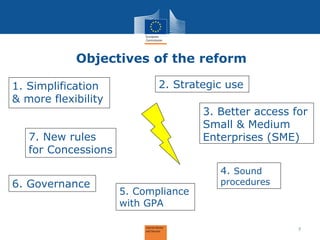
Objectives of the reform 
1. Simplification & more flexibility 
7. New rules for Concessions 
3. Better access for Small & Medium Enterprises (SME) 
2. Strategic use 
6. Governance 
4. Sound procedures 
5. Compliance with GPA 
7
Classical Directive 
8
Simplification & more flexibility 
Increased use of negotiated procedures Reduction of administrative burden Reduced time limits Simplified rules for sub-central authorities Light regime for social, health, cultural and other services e-Procurement 
9
Strategic procurement I 
(1)Strategic policies may be considered in award decision 
(2)Technical specifications may refer to production process 
(3)Integration of disabled & disadvantaged workers 
(4)Innovation Partnership 
(5)Use of labels 
10
Strategic procurement II 
Sole Award Criterion: Most economically advantageous tender (MEAT) 
to be assessed on the basis of 
1.price, or 
2.cost, using cost-effectiveness approach (e.g. "life cycle"), or 
3.the best price-quality ratio using criteria such as 
•Production process 
•Social & environmental criteria 
•Innovative characteristics NB: Criteria must be linked to the subject matter of the contract ! 
11
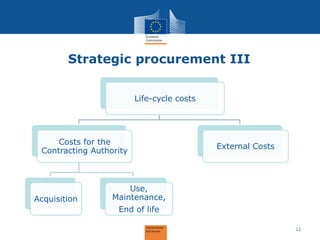
Strategic procurement III 
Life-cycle costs 
Costs for the Contracting Authority 
Acquisition 
Use, Maintenance, End of life 
External Costs 
12
SME-friendly measures 
Division into lots 
"apply or explain" principle; Proportionate criteria for financial standing 
limited to twice contract value Reduced documentary requirements 
"European Single Procurement Document" 
13
Sound procedures I 
•Conflicts of interests clarified 
•Exclusion grounds strengthened and extended 
•Compulsory exclusion in case of abnormally low tender 
•Modifications of contracts simplified 
14
Sound procedures II 
Principles of procurement – Horizontal clause 
Appropriate measures to ensure that economic operators comply with applicable obligations in the field of environmental, social and labour law 
Referred to under: 
Non award 
Exclusion grounds 
Abnormally low tenders 
Subcontracting 
15
Sound procedures III 
Main changes: Competitive procedures with negotiation 
Replaces current negotiated procedure with publication Competitive dialogue 
slightly broader scope for negotiations in the final stages Innovation partnership 
Research services for the development of an innovative product by one or more providers plus supply contract Negotiations without publication 
no substantial changes 
16
Utilities Directive 
17
Utilities Directive 
•Procurement for services, supplies or works 
•By utilities (public or private) 
•Utilitiy activity (water, energy, transport, postal) 
Private entities subject to procurement rules if "operating on the basis of special and exclusive rights" 
More flexible regime for utilities 
18
Utilities Directive 
Essentially same changes for the Utilities as for the Classic Directive Differences 
Framework contracts: 
max 8 years (classic 5 years) 
Contract modifications 
Unforseen circumstances: unlimited (classic: max 50%) 
Definition of special or exclusive rights 
19
New Concessions Directive 
20
New Directive on Concessions 
Works & service concessions ≥ € 5 million 
Classical & utilities sector 
Not: 
Drinking Water (supply or distribution) 
Exclusive rights 
Lotteries 
Public passenger transport services No closed list of procedures Basic rules for selection and exclusion criteria 
21
Distinction contracts – concessions 
Right to exploit the work or services (sometimes with payment) 
transfer of operating risk 
no guarantee to recoup the investments and costs. 
risk can be limited by regulation, but always real exposure to possible loss, not merely nominal or negligible 
demand or supply risk or both 
Clear delimitation from situations such as licenses, authorizations
Duration of Concessions 
The duration of concessions shall be limited 
General principle for concessions lasting more than 5 years: 
Shall not exceed time necessary to recoup investments made for operating works/services with return on invested capital 
Possibility to take into account investments at beginning and during life of concession and those necessary to achieve specific contractual objectives.
Directive on e-invoicing in public 
procurement 
24
Directive on e-invoicing in public procurement 
Key elements: 
•Scope: PP invoices only 
•Mandates standardisation bodies to draw up a new European e-invoicing standard 
•Buyers obliged to accept electronic invoices compliant with the new standard 
•Transposition: 1,5 years after standard (possibility to postpone for regional & local for extra 1 year). Standard to be ready in 3 years.
Government Procurement 
Agreement (GPA) 
26
Government Procurement Agreement 
Structure 
•Text: General principles 
•Annexes: coverage (schedules by parties) 
Principle of non-discrimination (subject to coverage) 
National treatment 
Most favoured nation clause 
Treatment of other Parties’ goods, services and suppliers that is “no less favorable than” that accorded to domestic/other parties' products, services and suppliers
Revised GPA 
Revised GPA: more user friendly, closer to EU Directives 
•Easier access to procurement - Better use of electronic means 
•Improved rights of developing countries to accede 
•Rules to avoid conflicts of interest and prevent corrupt practices 
•Introduces more flexibility for entities 
•Use technical specifications aimed at protection of environment 
•Technical specification relate to production process and methods 
•Award: lowest price or most advantageous tender
Revised GPA : Future 
Seeking accession: 
China, New Zealand, Albania, Georgia, Jordan, the Kyrgyz Republic, Moldova, Montenegro, Oman, Panama and Ukraine 
WTO commitments to accede: 
the Former Yugoslav Republic of Macedonia, Mongolia, the Russian Federation and Saudi Arabia 
The revised GPA came into force on 6 April 2014!
International Procurement 
Instrument (IPI) 
30
Objectives 
•Increase EU exports in public markets outside the EU; 
•Increase the leverage of the EU in international negotiations; 
•Ensure a level playing field; 
•Strengthen legal certainty regarding access of third countries to EU markets. 
31
Main proposals 
1.Possibility for contracting authorities to exclude a tender that is not covered by agreements (Article 6); 
2.External Commission investigation into alleged restrictive measures and possibility to adopt proportionate restrictive measures (Article 8-10). State of Play 
•Broad support from the European Parliament. 
•The amendments of the Parliament are currently under examination in the Council. 
22/09/2014 
32
Thank you! 
33

Presentation, Niels Schuster, 7th Regional Public Procurement Conference, Vlora, 9-10 Sept 2014

  • 1.
    New European Union Policy and Legal Framework for Public Procurement Niels Schuster DG Internal Market and Services 1
  • 2.
    Outline 1.Overview ofthe Reform 2.Classical Directive 3.Utilities Directive (Water, Energy, Transport, Postal) 4.New Concessions Directive 5.Directive on e-invoiocing in public procurement 6.Government Procurement Agreement (GPA) 7.International Procurement Instrument (IPI) 2
  • 3.
  • 4.
    Current Rules ClassicalDirective (2004/18/EC) •Public works, public supplies and public services Utilities Directive (2004/17/EC) •Water, energy, transport and postal services sectors Directive on Defence procurement (2009/81/EC) Remedies Directives (89/665/EEC and 92/13/EC) 4
  • 5.
    New Rules: Preparatoryworks Greenpaper on modernisation (January 2011) Evaluation of existing rules Results of public consultation (June 2011) 623 replies (Business, public authorities, civil society, academics & legal experts, citizens…) Public procurement conference (June 2011) European Commission proposal (December 2011) 5
  • 6.
    New Rules: Legislativeprocess July 2013: political agreement February 2014: Adoption Directive – needs to be transposed by EU Member States 2 years for transposition 4.5 years for e-procurement (at the latest) 6
  • 7.
    Objectives of thereform 1. Simplification & more flexibility 7. New rules for Concessions 3. Better access for Small & Medium Enterprises (SME) 2. Strategic use 6. Governance 4. Sound procedures 5. Compliance with GPA 7
  • 8.
  • 9.
    Simplification & moreflexibility Increased use of negotiated procedures Reduction of administrative burden Reduced time limits Simplified rules for sub-central authorities Light regime for social, health, cultural and other services e-Procurement 9
  • 10.
    Strategic procurement I (1)Strategic policies may be considered in award decision (2)Technical specifications may refer to production process (3)Integration of disabled & disadvantaged workers (4)Innovation Partnership (5)Use of labels 10
  • 11.
    Strategic procurement II Sole Award Criterion: Most economically advantageous tender (MEAT) to be assessed on the basis of 1.price, or 2.cost, using cost-effectiveness approach (e.g. "life cycle"), or 3.the best price-quality ratio using criteria such as •Production process •Social & environmental criteria •Innovative characteristics NB: Criteria must be linked to the subject matter of the contract ! 11
  • 12.
    Strategic procurement III Life-cycle costs Costs for the Contracting Authority Acquisition Use, Maintenance, End of life External Costs 12
  • 13.
    SME-friendly measures Divisioninto lots "apply or explain" principle; Proportionate criteria for financial standing limited to twice contract value Reduced documentary requirements "European Single Procurement Document" 13
  • 14.
    Sound procedures I •Conflicts of interests clarified •Exclusion grounds strengthened and extended •Compulsory exclusion in case of abnormally low tender •Modifications of contracts simplified 14
  • 15.
    Sound procedures II Principles of procurement – Horizontal clause Appropriate measures to ensure that economic operators comply with applicable obligations in the field of environmental, social and labour law Referred to under: Non award Exclusion grounds Abnormally low tenders Subcontracting 15
  • 16.
    Sound procedures III Main changes: Competitive procedures with negotiation Replaces current negotiated procedure with publication Competitive dialogue slightly broader scope for negotiations in the final stages Innovation partnership Research services for the development of an innovative product by one or more providers plus supply contract Negotiations without publication no substantial changes 16
  • 17.
  • 18.
    Utilities Directive •Procurementfor services, supplies or works •By utilities (public or private) •Utilitiy activity (water, energy, transport, postal) Private entities subject to procurement rules if "operating on the basis of special and exclusive rights" More flexible regime for utilities 18
  • 19.
    Utilities Directive Essentiallysame changes for the Utilities as for the Classic Directive Differences Framework contracts: max 8 years (classic 5 years) Contract modifications Unforseen circumstances: unlimited (classic: max 50%) Definition of special or exclusive rights 19
  • 20.
  • 21.
    New Directive onConcessions Works & service concessions ≥ € 5 million Classical & utilities sector Not: Drinking Water (supply or distribution) Exclusive rights Lotteries Public passenger transport services No closed list of procedures Basic rules for selection and exclusion criteria 21
  • 22.
    Distinction contracts –concessions Right to exploit the work or services (sometimes with payment) transfer of operating risk no guarantee to recoup the investments and costs. risk can be limited by regulation, but always real exposure to possible loss, not merely nominal or negligible demand or supply risk or both Clear delimitation from situations such as licenses, authorizations
  • 23.
    Duration of Concessions The duration of concessions shall be limited General principle for concessions lasting more than 5 years: Shall not exceed time necessary to recoup investments made for operating works/services with return on invested capital Possibility to take into account investments at beginning and during life of concession and those necessary to achieve specific contractual objectives.
  • 24.
    Directive on e-invoicingin public procurement 24
  • 25.
    Directive on e-invoicingin public procurement Key elements: •Scope: PP invoices only •Mandates standardisation bodies to draw up a new European e-invoicing standard •Buyers obliged to accept electronic invoices compliant with the new standard •Transposition: 1,5 years after standard (possibility to postpone for regional & local for extra 1 year). Standard to be ready in 3 years.
  • 26.
  • 27.
    Government Procurement Agreement Structure •Text: General principles •Annexes: coverage (schedules by parties) Principle of non-discrimination (subject to coverage) National treatment Most favoured nation clause Treatment of other Parties’ goods, services and suppliers that is “no less favorable than” that accorded to domestic/other parties' products, services and suppliers
  • 28.
    Revised GPA RevisedGPA: more user friendly, closer to EU Directives •Easier access to procurement - Better use of electronic means •Improved rights of developing countries to accede •Rules to avoid conflicts of interest and prevent corrupt practices •Introduces more flexibility for entities •Use technical specifications aimed at protection of environment •Technical specification relate to production process and methods •Award: lowest price or most advantageous tender
  • 29.
    Revised GPA :Future Seeking accession: China, New Zealand, Albania, Georgia, Jordan, the Kyrgyz Republic, Moldova, Montenegro, Oman, Panama and Ukraine WTO commitments to accede: the Former Yugoslav Republic of Macedonia, Mongolia, the Russian Federation and Saudi Arabia The revised GPA came into force on 6 April 2014!
  • 30.
  • 31.
    Objectives •Increase EUexports in public markets outside the EU; •Increase the leverage of the EU in international negotiations; •Ensure a level playing field; •Strengthen legal certainty regarding access of third countries to EU markets. 31
  • 32.
    Main proposals 1.Possibilityfor contracting authorities to exclude a tender that is not covered by agreements (Article 6); 2.External Commission investigation into alleged restrictive measures and possibility to adopt proportionate restrictive measures (Article 8-10). State of Play •Broad support from the European Parliament. •The amendments of the Parliament are currently under examination in the Council. 22/09/2014 32
  • 33.