© Assent Compliance 2021
SCIP Reporting on
Complex Products
Presented by: Raj Takhar, Senior Subject Matter Expert,
Materials Management & Chemical Reporting (Europe)
Email: raj.takhar@assentcompliance.com
Presented at: Product Substance Management &
Compliance Conference, April 23, 2021
© Assent Compliance 2021
FIRST NAME, LAST NAME
COMPANY NAME
TITLE/POSITION
INSERT HEADSHOT IMAGE
OVER THIS IMAGE
2
Raj Takhar
Assent Compliance
Senior Subject Matter Expert, Materials Management
& Chemical Reporting
Today’s Presenter
© Assent Compliance 2021
© Assent Compliance 2021 3
Agenda
1. Background on SCIP Reporting Obligations
2. EU REACH Reporting vs. ECHA SCIP Reporting
3. SCIP Database State of Play
4. Common Industry Concerns
5. Conclusion
6. Q&A
© Assent Compliance 2021 4
Background on SCIP
Reporting Obligations
1
© Assent Compliance 2021 5
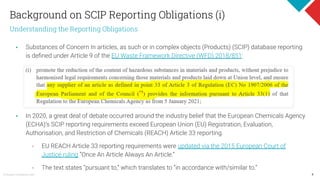
▪ Substances of Concern In articles, as such or in complex objects (Products) (SCIP) database reporting
is defined under Article 9 of the EU Waste Framework Directive (WFD) 2018/851:
▪ In 2020, a great deal of debate occurred around the industry belief that the European Chemicals Agency
(ECHA)’s SCIP reporting requirements exceed European Union (EU) Registration, Evaluation,
Authorisation, and Restriction of Chemicals (REACH) Article 33 reporting.
▫ EU REACH Article 33 reporting requirements were updated via the 2015 European Court of
Justice ruling “Once An Article Always An Article.”
▫ The text states “pursuant to,” which translates to “in accordance with/similar to.”
Background on SCIP Reporting Obligations (i)
Understanding the Reporting Obligations
© Assent Compliance 2021 6
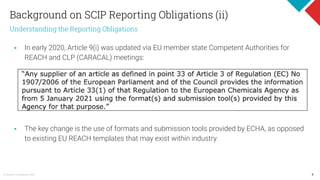
▪ In early 2020, Article 9(i) was updated via EU member state Competent Authorities for
REACH and CLP (CARACAL) meetings:
▪ The key change is the use of formats and submission tools provided by ECHA, as opposed
to existing EU REACH templates that may exist within industry.
Background on SCIP Reporting Obligations (ii)
Understanding the Reporting Obligations
© Assent Compliance 2021 7
▪ As part of the original SCIP stakeholder workshops in 2018, a non-paper was issued by
the commission that outlined the need to collect data and established the conceptual
“duty holders” that ECHA defined SCIP reporting obligations for:
▫ EU importers (importing articles that contain SVHCs from non-EU countries).
▫ EU producers and assemblers.
▫ EU distributors.
Background on SCIP Reporting Obligations (iii)
Understanding the Reporting Obligations
© Assent Compliance 2021
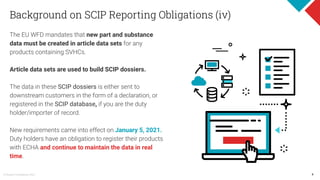
The EU WFD mandates that new part and substance
data must be created in article data sets for any
products containing SVHCs.
Article data sets are used to build SCIP dossiers.
The data in these SCIP dossiers is either sent to
downstream customers in the form of a declaration, or
registered in the SCIP database, if you are the duty
holder/importer of record.
New requirements came into effect on January 5, 2021.
Duty holders have an obligation to register their products
with ECHA and continue to maintain the data in real
time.
8
Background on SCIP Reporting Obligations (iv)
© Assent Compliance 2021 9
EU REACH Reporting vs.
ECHA SCIP Reporting
2
© Assent Compliance 2021 10
EU REACH 1907/2006 (New Article Context)
▪ Manufacturers and importers of articles have
to adhere to the three substance lists
(Candidate/Authorisation/Restricted).
▪ Under Article 33, when a Candidate List
substance is identified, companies are
required to report to downstream users when
it is present above the 0.1 percent threshold at
the article level (the lowest article level within
a complex article).
▫ Current practice is to list the SVHCs at
the article-as-sold level, at minimum.
Additional safe-use information is
optional.
Comparing EU REACH With the EU WFD (SCIP)
Different Use Cases
EU WFD 2018/851 (Recycling & Recovery)
▪ Focus on Candidate List SVHCs.
▪ Follows “Once an Article, Always an Article.”
▪ Additional data points:
▫ Clear identification of where the SVHC is
located in a product structure.
▫ Article category (tariff codes).
▫ Safe use: Updated in October 2020 to
cover normal use and whole life cycle use
(broader than EU REACH – not released in
normal use context).
▫ Clear identification of how the SVHC
arrived in the article (mixture/material
form).
© Assent Compliance 2021 11
SCIP Database State of Play
3
© Assent Compliance 2021 12
Registered Legal Entities in REACH-IT for SCIP
▪ 2,984 legal entities registered at the end of January 2021.
▪ 3,600 legal entities registered on March 15, 2021.
Number of SCIP Article Notifications Submitted
▪ Seven million SCIP Article Notifications by the end January 2021.
▪ Nearly 10 million SCIP Article Notifications on March 15, 2021.
Methods of Data Transmission
▪ One percent of records created via IUCLID Cloud Services (online).
▪ Sixteen percent of records created via uploading of documents into the SCIP Submission Portal.
▪ Eighty-three percent of records submitted via S2S.
SCIP Database State of Play (i)
Extracted From SCIP IT User Group Meeting on March 25, 2021
© Assent Compliance 2021 13
Initial SCIP Article Notifications & Updated SCIP Article Notifications
▪ ECHA is investigating the number of updated SCIP notifications for the same articles; there
was concern over repeat submissions.
Types of SCIP Article Notifications Submitted
▪ Approximately 5 million (53.69%) successful SCIP article notifications submitted without
any form of referencing.
▪ Approximately 4 million (45.69%) successful simplified SCIP notifications (SSNs) submitted.
▪ Approximately 55,500 (0.61%) successful SCIP article notifications submitted with
referencing.
This statistic shows that companies are either:
▪ Submitting on behalf their non-EU supply chains.
▪ Submitting ahead of their EU supply chain making their applicable SCIP notifications and
referencing supplier SCIP article notification numbers.
SCIP Database State of Play (ii)
Extracted From SCIP IT User Group Meeting on March 25, 2021
© Assent Compliance 2021 14
Common Errors (Validation Errors; See SCIP Validation Document)
▪ [BR731] Non-EU companies are not permitted to submit SCIP notifications.
▫ Approximately 79,300 attributed incidents.
▫ A large number of these were identified as coming from legal entities registering ECHA
REACH-IT accounts from locations in Switzerland and Norway, both of which are part of the
European Economic Area (EEA) and not one of the 27 EU member states.
▪ [BR729] SSN: Same notification cannot be submitted multiple times.
▫ Approximately 30,700 attributed incidents.
▫ Repeated submission attempts.
▪ [BR718] If a SCIP notification is updated, then the updated dossier creation date must be newer
than the previously accepted dossier creation date.
▫ Approximately 11,900 attributed incidents.
▫ Dossiers need to be generated after each update to the applicable article.
SCIP Database State of Play (iii)
Extracted From SCIP IT User Group Meeting on March 25, 2021
© Assent Compliance 2021 15
Common Industry Concerns
4
© Assent Compliance 2021 16
▪ The process of collecting supply chain data for EU REACH should be well established.
▪ Companies need to regularly review Candidate List updates and request data from their
supply chains.
▪ Areas where a lack of understanding is still commonplace:
▫ Citing Article 7(2), many companies believe EU REACH is about chemicals and that
they do not have reporting obligations.
◆ This covers the “RE” aspects of EU REACH, not the “ACH” aspects, following
updates to the lists.
▫ Companies often request EU REACH Article 33 data from suppliers at the
article-as-sold” level.
◆ This is where the confusion over the legal text of EU REACH occurs. The
original text merely states “article”, while the updated "Once an Article, Always
an Article" ruling clearly defines the need to collect data at the lowest level
article level and report accordingly.
Common Industry Concerns (i)
Begin With EU REACH 1907/2006 as the Starting Point
© Assent Compliance 2021 17
▪ The ECHA SCIP database prototype was available for use from October 28, 2020. As of January
5, 2021, companies are required to make submissions to the database.
▪ The SCIP database requires EU REACH reporting data at the lowest article level, which in turn
requires the correct verbiage in contracts in order to get the right data.
▫ The need to report SCIP information may require a review of existing contract terms.
▪ Strong supplier training and guidance is required to cover both EU REACH and SCIP
database reporting requirements.
Common Industry Concerns (ii)
EU Waste Framework Directive 2018/85 (SCIP) Reporting
© Assent Compliance 2021 18
▪ The EU WFD requires member state national transpositions. A number of national
transpositions have allowed exemptions for defense.
▫ Some transpositions named ECHA as the agency to report to.
▫ Germany transposed the obligation to report to the agency, but:
◆ An allowance was made for regulators to allow additional powers for
company-specific exemptions:
◇ In order to perform such action, the national MSCA*
would need to adopt
a PPORD**
-type approval process — not anticipated.
◇ Being granted an exemption in one member state transposition does NOT
negate the need to report data into the SCIP database where products
flow into other EU member states that adopt full reporting. If granted =
double reporting + costs of doing so.
*
Member States and Competent Authorities
**
Process Orientated Research and Development
Common Industry Concerns (iii)
Implementations & Exemptions
© Assent Compliance 2021 19
▪ Some trade associations have raised issues and threatened to launch legal actions against SCIP
article reporting, using the legal text of EU REACH Article 33 as justification. However:
▫ The European Court of Justice is likely to maintain its original “Once an Article, Always an
Article” decision.
▫ Approximately 7 million SCIP article notifications have already been transmitted into the
ECHA SCIP database.
▪ Data transmitted into the IUCLID system (ECHA Cloud Services) by design is only meant to be
shared between a manufacturer and a regulator. In order to share data, it needs to be exported
and imported in the standard IUCLID .i6z format.
▫ ECHA is expected to release a public portal in May/June of 2021.
Common Industry Concerns (iv)
Implementations, Exemptions, Public Portal
© Assent Compliance 2021 20
▪ Collecting and reporting information into the ECHA SCIP database should be considered as
two distinct steps:
▫ Collect relevant SCIP information from the supply chain (data collection).
◆ If your supply chain is located in the EU, then the expectation is that they should
have performed relevant SCIP article notifications.
◆ If your supply chain is not located in the EU and you are importing into the EU,
then the burden of data collection and reporting falls on you.
◇ Issues arise over:
▪ Identification of article categories: Navigate to Access2Markets to
define the country of origin as non-EU and the destination as EU.
The EU TARIC system uses shorter digits than North America.
▪ Do not rely on automated approaches, as the same component may
be used in several context = several EU TARIC codes.
Common Industry Concerns (v)
Data Collection vs. Data Submission
© Assent Compliance 2021 21
▪ Data submission with the relevant SCIP data on-hand:
▫ Review the ECHA SCIP dissemination document and understand the possibility of
masking data in SCIP article datasets and dossiers.
▫ SCIP article notifications can be made against (i) individual articles; (ii) articles contained
within complex articles; and (iii) product families.
◆ Take care when generating any product family groups (individual/complex). Follow
the quasi-identical criteria – sameness in chemistry, function, and article
categories.
◆ Work from the bottom up – group articles, complex objects.
Common Industry Concerns (vi)
Data Collection vs. Data Submission
© Assent Compliance 2021 22
Conclusion
5
© Assent Compliance 2021 23
▪ SCIP article notification reporting is here to stay. It forms a strong source of data to support
the EU Green Deal and the EU Chemical Sustainability Strategy for Toxic-Free Environment.
▫ The number of SVHC substances to be added to the Candidate List are likely to rise
sharply as part of the green agenda.
▫ The January 2021 Candidate List update saw the addition of 89 substances.
▪ The SCIP database is here to stay. Maintaining a compliant process requires continual
revalidation of data.
Conclusion (i)
Summary
© Assent Compliance 2021 24
▪ Understand the flow of articles within an organisation. Identify source supplier
regions (EU/non-EU) to determine potential duty holder obligations.
▪ Establish dynamic supplier contract terms as opposed to specific regulations in
scope of reporting.
▪ Rebaseline existing EU REACH reporting to ensure suppliers identify SVHC
information at the level defined by “Once an Article, Always an Article.”
▪ With EU REACH data available:
▫ Identify the articles against which additional SCIP information will be required
(as opposed to combining REACH and SCIP).
▫ Collate the additional SCIP information from the subset of suppliers
identifying SVHCs in articles (estimated at 5–7 percent of all articles).
Conclusions (ii)
Suggested Actions
© Assent Compliance 2021 25
▪ With the required SCIP data available:
▫ Create article datasets and dossiers (follow ECHA SCIP Dissemination document).
◆ Individual articles.
◆ Complex articles.
◆ Product family grouping, if applicable (follow quasi-identical rules); submit as
single article dataset.
◆ Determine your downstream user types, as guidance will be required to
ensure that customers who install supplied articles into other products
(reference) and customers who merely distribute without making changes to
articles (SSN) understand the required SCIP article notifications they need to
make (reference/SSN).
Conclusions (iii)
Suggested Actions
© Assent Compliance 2021 26
▪ Update data as new information arises:
▫ New information from EU REACH and EU SCIP data collection processes.
▫ New products containing articles with newly identified SVHCs.
▫ Removal of articles with SVHC content.
▪ The key is to maintain static SCIP article notifications. DO NOT CHANGE the
article name, primary article identifier type, and primary article identifier type
value data within a article dataset.
Conclusions (iv)
Suggested Actions
© Assent Compliance 2021 27
Subscribe to our newsletter and get webinar invitations,
news, and content delivered to your inbox.
As a subscriber, you’ll be the first to hear about the
latest in regulatory and supply chain data
management, including product compliance,
corporate social responsibility, vendor management,
and more. Never miss an update again!
Subscribe at info.assentcompliance.com/subscribe.
Stay Updated on Supply Chain
Data Management News
© Assent Compliance 2021
Questions/
Discussion
Conclusion

SCIP Reporting on Complex Products

  • 1.
    © Assent Compliance2021 SCIP Reporting on Complex Products Presented by: Raj Takhar, Senior Subject Matter Expert, Materials Management & Chemical Reporting (Europe) Email: raj.takhar@assentcompliance.com Presented at: Product Substance Management & Compliance Conference, April 23, 2021
  • 2.
    © Assent Compliance2021 FIRST NAME, LAST NAME COMPANY NAME TITLE/POSITION INSERT HEADSHOT IMAGE OVER THIS IMAGE 2 Raj Takhar Assent Compliance Senior Subject Matter Expert, Materials Management & Chemical Reporting Today’s Presenter
  • 3.
    © Assent Compliance2021 © Assent Compliance 2021 3 Agenda 1. Background on SCIP Reporting Obligations 2. EU REACH Reporting vs. ECHA SCIP Reporting 3. SCIP Database State of Play 4. Common Industry Concerns 5. Conclusion 6. Q&A
  • 4.
    © Assent Compliance2021 4 Background on SCIP Reporting Obligations 1
  • 5.
    © Assent Compliance2021 5 ▪ Substances of Concern In articles, as such or in complex objects (Products) (SCIP) database reporting is defined under Article 9 of the EU Waste Framework Directive (WFD) 2018/851: ▪ In 2020, a great deal of debate occurred around the industry belief that the European Chemicals Agency (ECHA)’s SCIP reporting requirements exceed European Union (EU) Registration, Evaluation, Authorisation, and Restriction of Chemicals (REACH) Article 33 reporting. ▫ EU REACH Article 33 reporting requirements were updated via the 2015 European Court of Justice ruling “Once An Article Always An Article.” ▫ The text states “pursuant to,” which translates to “in accordance with/similar to.” Background on SCIP Reporting Obligations (i) Understanding the Reporting Obligations
  • 6.
    © Assent Compliance2021 6 ▪ In early 2020, Article 9(i) was updated via EU member state Competent Authorities for REACH and CLP (CARACAL) meetings: ▪ The key change is the use of formats and submission tools provided by ECHA, as opposed to existing EU REACH templates that may exist within industry. Background on SCIP Reporting Obligations (ii) Understanding the Reporting Obligations
  • 7.
    © Assent Compliance2021 7 ▪ As part of the original SCIP stakeholder workshops in 2018, a non-paper was issued by the commission that outlined the need to collect data and established the conceptual “duty holders” that ECHA defined SCIP reporting obligations for: ▫ EU importers (importing articles that contain SVHCs from non-EU countries). ▫ EU producers and assemblers. ▫ EU distributors. Background on SCIP Reporting Obligations (iii) Understanding the Reporting Obligations
  • 8.
    © Assent Compliance2021 The EU WFD mandates that new part and substance data must be created in article data sets for any products containing SVHCs. Article data sets are used to build SCIP dossiers. The data in these SCIP dossiers is either sent to downstream customers in the form of a declaration, or registered in the SCIP database, if you are the duty holder/importer of record. New requirements came into effect on January 5, 2021. Duty holders have an obligation to register their products with ECHA and continue to maintain the data in real time. 8 Background on SCIP Reporting Obligations (iv)
  • 9.
    © Assent Compliance2021 9 EU REACH Reporting vs. ECHA SCIP Reporting 2
  • 10.
    © Assent Compliance2021 10 EU REACH 1907/2006 (New Article Context) ▪ Manufacturers and importers of articles have to adhere to the three substance lists (Candidate/Authorisation/Restricted). ▪ Under Article 33, when a Candidate List substance is identified, companies are required to report to downstream users when it is present above the 0.1 percent threshold at the article level (the lowest article level within a complex article). ▫ Current practice is to list the SVHCs at the article-as-sold level, at minimum. Additional safe-use information is optional. Comparing EU REACH With the EU WFD (SCIP) Different Use Cases EU WFD 2018/851 (Recycling & Recovery) ▪ Focus on Candidate List SVHCs. ▪ Follows “Once an Article, Always an Article.” ▪ Additional data points: ▫ Clear identification of where the SVHC is located in a product structure. ▫ Article category (tariff codes). ▫ Safe use: Updated in October 2020 to cover normal use and whole life cycle use (broader than EU REACH – not released in normal use context). ▫ Clear identification of how the SVHC arrived in the article (mixture/material form).
  • 11.
    © Assent Compliance2021 11 SCIP Database State of Play 3
  • 12.
    © Assent Compliance2021 12 Registered Legal Entities in REACH-IT for SCIP ▪ 2,984 legal entities registered at the end of January 2021. ▪ 3,600 legal entities registered on March 15, 2021. Number of SCIP Article Notifications Submitted ▪ Seven million SCIP Article Notifications by the end January 2021. ▪ Nearly 10 million SCIP Article Notifications on March 15, 2021. Methods of Data Transmission ▪ One percent of records created via IUCLID Cloud Services (online). ▪ Sixteen percent of records created via uploading of documents into the SCIP Submission Portal. ▪ Eighty-three percent of records submitted via S2S. SCIP Database State of Play (i) Extracted From SCIP IT User Group Meeting on March 25, 2021
  • 13.
    © Assent Compliance2021 13 Initial SCIP Article Notifications & Updated SCIP Article Notifications ▪ ECHA is investigating the number of updated SCIP notifications for the same articles; there was concern over repeat submissions. Types of SCIP Article Notifications Submitted ▪ Approximately 5 million (53.69%) successful SCIP article notifications submitted without any form of referencing. ▪ Approximately 4 million (45.69%) successful simplified SCIP notifications (SSNs) submitted. ▪ Approximately 55,500 (0.61%) successful SCIP article notifications submitted with referencing. This statistic shows that companies are either: ▪ Submitting on behalf their non-EU supply chains. ▪ Submitting ahead of their EU supply chain making their applicable SCIP notifications and referencing supplier SCIP article notification numbers. SCIP Database State of Play (ii) Extracted From SCIP IT User Group Meeting on March 25, 2021
  • 14.
    © Assent Compliance2021 14 Common Errors (Validation Errors; See SCIP Validation Document) ▪ [BR731] Non-EU companies are not permitted to submit SCIP notifications. ▫ Approximately 79,300 attributed incidents. ▫ A large number of these were identified as coming from legal entities registering ECHA REACH-IT accounts from locations in Switzerland and Norway, both of which are part of the European Economic Area (EEA) and not one of the 27 EU member states. ▪ [BR729] SSN: Same notification cannot be submitted multiple times. ▫ Approximately 30,700 attributed incidents. ▫ Repeated submission attempts. ▪ [BR718] If a SCIP notification is updated, then the updated dossier creation date must be newer than the previously accepted dossier creation date. ▫ Approximately 11,900 attributed incidents. ▫ Dossiers need to be generated after each update to the applicable article. SCIP Database State of Play (iii) Extracted From SCIP IT User Group Meeting on March 25, 2021
  • 15.
    © Assent Compliance2021 15 Common Industry Concerns 4
  • 16.
    © Assent Compliance2021 16 ▪ The process of collecting supply chain data for EU REACH should be well established. ▪ Companies need to regularly review Candidate List updates and request data from their supply chains. ▪ Areas where a lack of understanding is still commonplace: ▫ Citing Article 7(2), many companies believe EU REACH is about chemicals and that they do not have reporting obligations. ◆ This covers the “RE” aspects of EU REACH, not the “ACH” aspects, following updates to the lists. ▫ Companies often request EU REACH Article 33 data from suppliers at the article-as-sold” level. ◆ This is where the confusion over the legal text of EU REACH occurs. The original text merely states “article”, while the updated "Once an Article, Always an Article" ruling clearly defines the need to collect data at the lowest level article level and report accordingly. Common Industry Concerns (i) Begin With EU REACH 1907/2006 as the Starting Point
  • 17.
    © Assent Compliance2021 17 ▪ The ECHA SCIP database prototype was available for use from October 28, 2020. As of January 5, 2021, companies are required to make submissions to the database. ▪ The SCIP database requires EU REACH reporting data at the lowest article level, which in turn requires the correct verbiage in contracts in order to get the right data. ▫ The need to report SCIP information may require a review of existing contract terms. ▪ Strong supplier training and guidance is required to cover both EU REACH and SCIP database reporting requirements. Common Industry Concerns (ii) EU Waste Framework Directive 2018/85 (SCIP) Reporting
  • 18.
    © Assent Compliance2021 18 ▪ The EU WFD requires member state national transpositions. A number of national transpositions have allowed exemptions for defense. ▫ Some transpositions named ECHA as the agency to report to. ▫ Germany transposed the obligation to report to the agency, but: ◆ An allowance was made for regulators to allow additional powers for company-specific exemptions: ◇ In order to perform such action, the national MSCA* would need to adopt a PPORD** -type approval process — not anticipated. ◇ Being granted an exemption in one member state transposition does NOT negate the need to report data into the SCIP database where products flow into other EU member states that adopt full reporting. If granted = double reporting + costs of doing so. * Member States and Competent Authorities ** Process Orientated Research and Development Common Industry Concerns (iii) Implementations & Exemptions
  • 19.
    © Assent Compliance2021 19 ▪ Some trade associations have raised issues and threatened to launch legal actions against SCIP article reporting, using the legal text of EU REACH Article 33 as justification. However: ▫ The European Court of Justice is likely to maintain its original “Once an Article, Always an Article” decision. ▫ Approximately 7 million SCIP article notifications have already been transmitted into the ECHA SCIP database. ▪ Data transmitted into the IUCLID system (ECHA Cloud Services) by design is only meant to be shared between a manufacturer and a regulator. In order to share data, it needs to be exported and imported in the standard IUCLID .i6z format. ▫ ECHA is expected to release a public portal in May/June of 2021. Common Industry Concerns (iv) Implementations, Exemptions, Public Portal
  • 20.
    © Assent Compliance2021 20 ▪ Collecting and reporting information into the ECHA SCIP database should be considered as two distinct steps: ▫ Collect relevant SCIP information from the supply chain (data collection). ◆ If your supply chain is located in the EU, then the expectation is that they should have performed relevant SCIP article notifications. ◆ If your supply chain is not located in the EU and you are importing into the EU, then the burden of data collection and reporting falls on you. ◇ Issues arise over: ▪ Identification of article categories: Navigate to Access2Markets to define the country of origin as non-EU and the destination as EU. The EU TARIC system uses shorter digits than North America. ▪ Do not rely on automated approaches, as the same component may be used in several context = several EU TARIC codes. Common Industry Concerns (v) Data Collection vs. Data Submission
  • 21.
    © Assent Compliance2021 21 ▪ Data submission with the relevant SCIP data on-hand: ▫ Review the ECHA SCIP dissemination document and understand the possibility of masking data in SCIP article datasets and dossiers. ▫ SCIP article notifications can be made against (i) individual articles; (ii) articles contained within complex articles; and (iii) product families. ◆ Take care when generating any product family groups (individual/complex). Follow the quasi-identical criteria – sameness in chemistry, function, and article categories. ◆ Work from the bottom up – group articles, complex objects. Common Industry Concerns (vi) Data Collection vs. Data Submission
  • 22.
    © Assent Compliance2021 22 Conclusion 5
  • 23.
    © Assent Compliance2021 23 ▪ SCIP article notification reporting is here to stay. It forms a strong source of data to support the EU Green Deal and the EU Chemical Sustainability Strategy for Toxic-Free Environment. ▫ The number of SVHC substances to be added to the Candidate List are likely to rise sharply as part of the green agenda. ▫ The January 2021 Candidate List update saw the addition of 89 substances. ▪ The SCIP database is here to stay. Maintaining a compliant process requires continual revalidation of data. Conclusion (i) Summary
  • 24.
    © Assent Compliance2021 24 ▪ Understand the flow of articles within an organisation. Identify source supplier regions (EU/non-EU) to determine potential duty holder obligations. ▪ Establish dynamic supplier contract terms as opposed to specific regulations in scope of reporting. ▪ Rebaseline existing EU REACH reporting to ensure suppliers identify SVHC information at the level defined by “Once an Article, Always an Article.” ▪ With EU REACH data available: ▫ Identify the articles against which additional SCIP information will be required (as opposed to combining REACH and SCIP). ▫ Collate the additional SCIP information from the subset of suppliers identifying SVHCs in articles (estimated at 5–7 percent of all articles). Conclusions (ii) Suggested Actions
  • 25.
    © Assent Compliance2021 25 ▪ With the required SCIP data available: ▫ Create article datasets and dossiers (follow ECHA SCIP Dissemination document). ◆ Individual articles. ◆ Complex articles. ◆ Product family grouping, if applicable (follow quasi-identical rules); submit as single article dataset. ◆ Determine your downstream user types, as guidance will be required to ensure that customers who install supplied articles into other products (reference) and customers who merely distribute without making changes to articles (SSN) understand the required SCIP article notifications they need to make (reference/SSN). Conclusions (iii) Suggested Actions
  • 26.
    © Assent Compliance2021 26 ▪ Update data as new information arises: ▫ New information from EU REACH and EU SCIP data collection processes. ▫ New products containing articles with newly identified SVHCs. ▫ Removal of articles with SVHC content. ▪ The key is to maintain static SCIP article notifications. DO NOT CHANGE the article name, primary article identifier type, and primary article identifier type value data within a article dataset. Conclusions (iv) Suggested Actions
  • 27.
    © Assent Compliance2021 27 Subscribe to our newsletter and get webinar invitations, news, and content delivered to your inbox. As a subscriber, you’ll be the first to hear about the latest in regulatory and supply chain data management, including product compliance, corporate social responsibility, vendor management, and more. Never miss an update again! Subscribe at info.assentcompliance.com/subscribe. Stay Updated on Supply Chain Data Management News
  • 28.
    © Assent Compliance2021 Questions/ Discussion Conclusion