Dr. PARTH MAKWANA
ASSISTANT PROFESSOR-ENT
DEPARTMENT
DR. M.K. SHAH MEDICAL COLLEGE
AND RESEARCH CENTRE,AHMEDABAD.
JUVENILE
NASOPHARYNGEAL
ANGIOFIBROMA
Introduction:
• Nasopharynx is an embryologic confluence of end of nasal
structures and beginning of pharynx
• Symptoms generally arise late because of capacity for tumor
growth and expansion
• Diagnostic inaccessibility of nasopharyngeal (NP) area,
tumors can be difficult to detect
DIAGNOSTIC APPROACH FOR
NASOPHARYNGEAL MASSES
• Presentation of an NP tumor is variable and ranges from ear,
nose, and throat symptoms to neck masses and cranial nerve
palsies
• Age and gender are important in D/D
• Usually due to adenoidal hypertrophy in pediatric but JNA
should be strongly considered in teenage boys
• In adults, NP malignancy should be default diagnosis
• In several Asian regions it is common and usually of epstein-
barr virus (EBV)–related, undifferentiated carcinoma
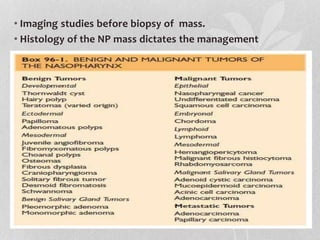
• Imaging studies before biopsy of mass.
• Histology of the NP mass dictates the management
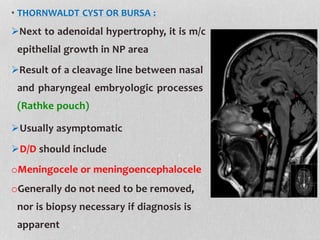
• THORNWALDT CYST OR BURSA :
Next to adenoidal hypertrophy, it is m/c
epithelial growth in NP area
Result of a cleavage line between nasal
and pharyngeal embryologic processes
(Rathke pouch)
Usually asymptomatic
D/D should include
oMeningocele or meningoencephalocele
oGenerally do not need to be removed,
nor is biopsy necessary if diagnosis is
apparent
JUVENILE
NASOPHARYNGEAL
ANGIOFIBROMA
•Introduction :
Usually occurs in adolescent boys, thus commonly called
juvenile nasal angiofibroma (JNA)
<1% of all head and neck tumors
Benign but Locally infiltrative
Sarcomatous, malignant transformation is extremely rare
and attributable to prior radiotherapy
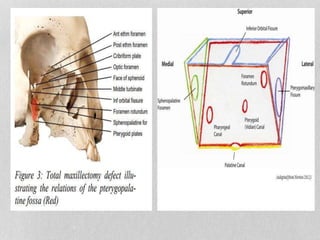
Slow-growing vascular tumor, arises in area of
Sphenopalatine foramen at root of pterygoid process on
lateral nasal wall
Maxillary sinus is m/c site for extra-NP angiofibroma, occur
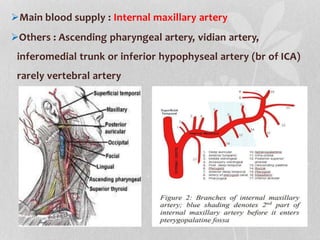
Main blood supply : Internal maxillary artery
Others : Ascending pharyngeal artery, vidian artery,
inferomedial trunk or inferior hypophyseal artery (br of ICA)
rarely vertebral artery
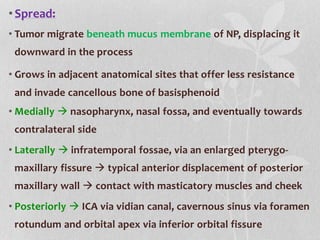
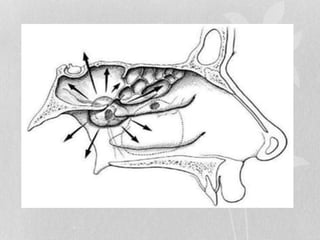
•Spread:
• Tumor migrate beneath mucus membrane of NP, displacing it
downward in the process
• Grows in adjacent anatomical sites that offer less resistance
and invade cancellous bone of basisphenoid
• Medially  nasopharynx, nasal fossa, and eventually towards
contralateral side
• Laterally  infratemporal fossae, via an enlarged pterygo-
maxillary fissure  typical anterior displacement of posterior
maxillary wall  contact with masticatory muscles and cheek
• Posteriorly  ICA via vidian canal, cavernous sinus via foramen
rotundum and orbital apex via inferior orbital fissure
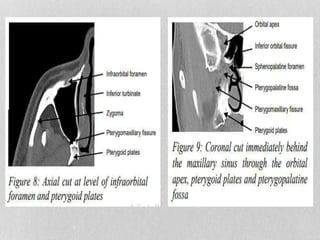
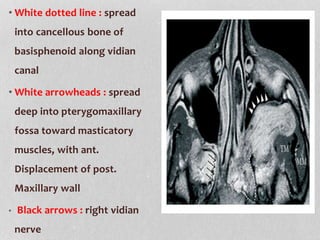
• White dotted line : spread
into cancellous bone of
basisphenoid along vidian
canal
• White arrowheads : spread
deep into pterygomaxillary
fossa toward masticatory
muscles, with ant.
Displacement of post.
Maxillary wall
• Black arrows : right vidian
nerve
• Bone involvement occurs via two main mechanisms:
1. Resorption by direct pressure of preexisting bony structures
with osteoclastic activation
2. Direct spread along perforating arteries into cancellous root
of pterygoid process
• In advanced cases
Extends posteriorly towards upper-middle of clivus
Laterally within greater wing of sphenoid
Erosion of the inner table of middle cranial fossa
Infiltration of dura is very rare
•Pathologic features:
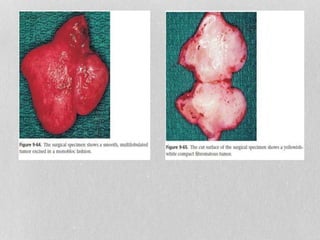
Gross pathology usually shows a sessile, lobulated, rubbery,
dark red to tan gray mass that can be large
Color varies from pink to white
On section  reticulated, whorled or spongy appearance,
lacks true capsule but sharply demarcated edges
Microscopically, Composed of an admixture of vascular
tissue and fibrous stroma
Vessel walls lack elastic fibers and have incomplete or
absent smooth muscle -- tendency to bleed
•Factors that play a role in the growth :
• Chromosomal abnormalities: gains at chromosomes 4, 6, 8,
and X and losses on chromosomes 17, 22, and Y are most
frequent
• Increased prevalence of JA (25 times) in patients with
familial adenomatous polyposis (FAP), condition that is
associated with mutations of adenomatous polyposis coli
(APC) gene
This gene regulates beta-catenin pathway which
influences cell to cell adhesion. Mutations of beta-catenin
have been found in sporadic and recurrent JAs.
• Angiogenic growth factor, vascular endothelial growth
factor (VEGF) has been found localized on both endothelial
and stromal cells
• Overexpression of insulin-like growth factor II (IGFII)
• Hormonal factors: controversial
•Theories associated with its aetiopathogenesis:
Ringertz theory (1938) – JNA arose from the periosteum of
NP vault
Som & Neffson (1940) – inequalities in the growth of bones
forming skull base resulted in hypertrophy of the underlying
periosteum in response to hormonal influence.
Bensch & Ewing (1941) – tumour probably arose from
embryonic fibro cartilage between basi-occiput and basi-
sphenoid.
Brunner (1942) – suggested origin from conjoined
pharyngobasilar and buccopharyngeal fascia.
Sternberg (1954) – proposed that JNA could be a type of
hemangioma like a cutaneous hemangioma seen in children
which regresses with age
Osborn (1959) – it could be due to either a hamartoma or
residual fetal erectile tissue which were subjected to
hormonal influence
Girgis & fahmy (1973) – observed cell nests of
undifferentiated epitheloid cells or “zellballen” at the
growing edge of angiofibromas and so considered it as a
paraganglioma
‘Branchial arch artery’ theory:
• Tumour origin is based on an incomplete regression of the first
branchial arch artery
• Able to explain different aspects of JNA:
1. During embryological development, it finally recedes close
to pterygoid base and sphenopalatine foramen regions
2. Vascular remnants of this artery are incorporated into
sphenopalatine and maxillary arteries themselves
Its connection to c4-segment of ICA accounts for vascular
supply from ICA, despite an anatomical distance between
this vessel and the JA
Elucidates common finding of residual tumour at pterygoid
base and clivus
•Clinical features:
Ages : 10 and 25 in males
Cardinal symptoms : nasal obstruction and intermittent
epistaxis
Others:
Chronic anaemia
Hyposmia or anosmia
Nasal intonation of voice
Deafness and otalgia
Headache
• In extensive lesions 
Nasal bones become splayed out
Swelling in temple and cheek
• Intraoral palpation between ascending ramus of mandible
and side of maxilla may reveal thickening of disease which
has crept around back of the antrum
• Trismus and bulging of parotid if Impaction of bulky mass in
infratemporal fossa
• Proptosis if orbital fissures are penetrated
• Frog face appearance if massive escape of diseases
• Diagnosis:
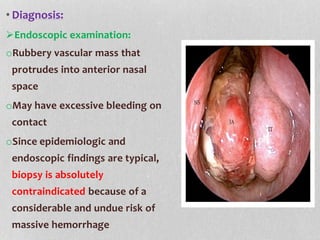
Endoscopic examination:
oRubbery vascular mass that
protrudes into anterior nasal
space
oMay have excessive bleeding on
contact
oSince epidemiologic and
endoscopic findings are typical,
biopsy is absolutely
contraindicated because of a
considerable and undue risk of
massive hemorrhage
Diagnosis on imaging is based on three factors
1. Site of origin
2. Hypervascularization after contrast enhancement
3. Patterns of growth
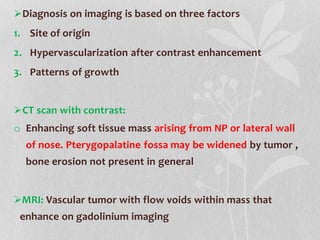
CT scan with contrast:
o Enhancing soft tissue mass arising from NP or lateral wall
of nose. Pterygopalatine fossa may be widened by tumor ,
bone erosion not present in general
MRI: Vascular tumor with flow voids within mass that
enhance on gadolinium imaging
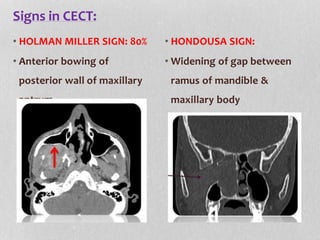
Signs in CECT:
• HOLMAN MILLER SIGN: 80%
• Anterior bowing of
posterior wall of maxillary
antrum
• HONDOUSA SIGN:
• Widening of gap between
ramus of mandible &
maxillary body
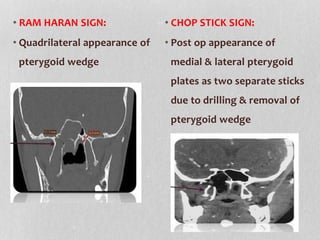
• RAM HARAN SIGN:
• Quadrilateral appearance of
pterygoid wedge
• CHOP STICK SIGN:
• Post op appearance of
medial & lateral pterygoid
plates as two separate sticks
due to drilling & removal of
pterygoid wedge
• Pathognomonic sign : erosion of upper medial pterygoid
plate which is found in 98%
• Differential diagnosis includes other hypervascularized
lesions:
Hemangiopericytoma
Lobular capillary hemangioma
Paraganglioma
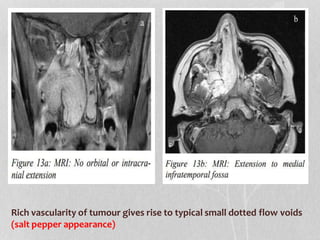
Rich vascularity of tumour gives rise to typical small dotted flow voids
(salt pepper appearance)
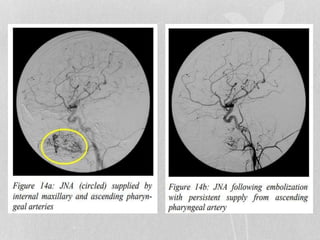
•Angiography:
b/l vascular supply is around 36% hence both carotid systems
require angiographic evaluation
1. Assess vascular supply of JA
2. Allow embolization of feeding vessels prior to surgery
More as a surgical treatment adjuvant via possibility of
embolization rather than diagnostic tool
MR angiography is least invasive form of vascular imaging
that will show size feeding vessels
Vascular blush seen in postnasal space and adjacent areas is
diagnostic
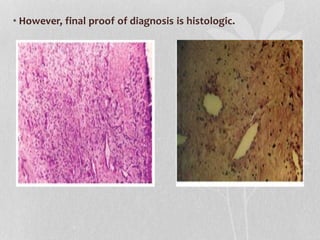
• However, final proof of diagnosis is histologic.
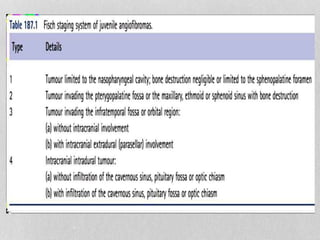
•Staging:
Several staging systems have been proposed –
Fisch
Chandlers
Andrews
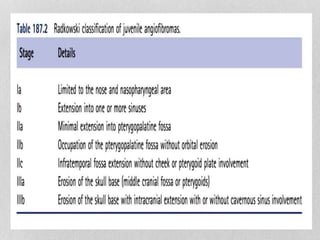
Radkowski
• Fisch  most robust and practical. Defines clearly which
surgical approach is required
• Radkowski  appeals to those involved with management of
smaller tumours as there are more subdivisions
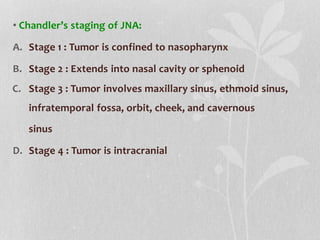
• Chandler’s staging of JNA:
A. Stage 1 : Tumor is confined to nasopharynx
B. Stage 2 : Extends into nasal cavity or sphenoid
C. Stage 3 : Tumor involves maxillary sinus, ethmoid sinus,
infratemporal fossa, orbit, cheek, and cavernous
sinus
D. Stage 4 : Tumor is intracranial
•General surgical principles:
• The surgical approach is dependent on
1. Tumour location and extent
2. Pattern of vascular supply
3. Effectiveness of embolisation
4. Facial skeletal maturity
5. Experience of the surgical team
• JNAs may be resected by endoscopic, open or combined
(endoscopic & open) techniques
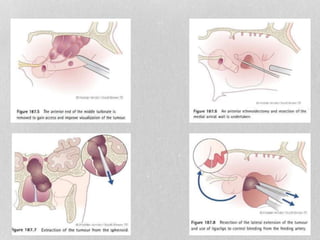
•Endoscopic sinus surgery techniques
Mainstay of surgical resection in present era
• Advantages:
Magnified view of lesion and related anatomical structures
from multiple angles  better identification of interface
between lesion and soft tissues or adjacent bone strs
Allows more accurate and complete dissection and better
control of bleeding
•Indications:
Tumours involving nasal
cavity, paranasal sinuses,
and nasopharynx
Tumours with only medial
infratemporal fossa
involvement or extradural
parasellar involvement with
limited intracranial
extension
Facilitation of open
approaches
•Relative
contraindications:
Lateral infratemporal fossa
involvement,
Extensive parasellar
extension,
Encasementof the optic
nerve,
Intradural spread, or
cavernous sinus involvement
•Complications:
Pain
Bleeding
Infection
Hyposmia
Synechiae
Orbital Injury, loss of vision
Cerebrospinal fluid leak
Intracranial injury
Tumour recidivism if margins are not cleared
•Open approaches:
Tumours that extend to infra-temporal fossa
Tumours with intradural extension
In centres that lack endo-scopic expertise
In conjunction with endo-scopic resection e.g. Anterior
antrostomy (caldwell-luc) may be employed to gain access to,
and clip, internal maxillary artery
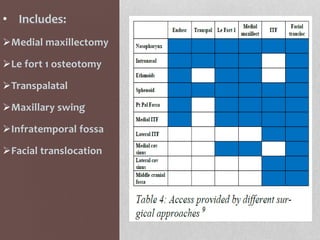
• Includes:
Medial maxillectomy
Le fort 1 osteotomy
Transpalatal
Maxillary swing
Infratemporal fossa
Facial translocation
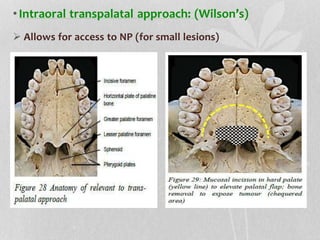
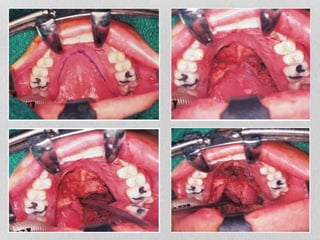
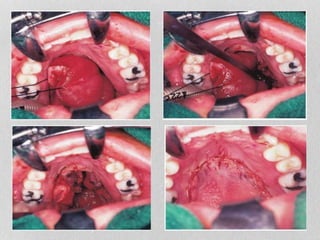
•Intraoral transpalatal approach: (Wilson’s)
 Allows for access to NP (for small lesions)
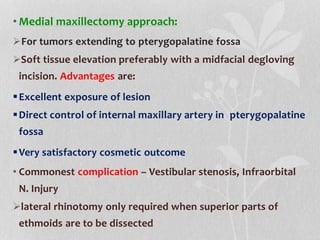
• Medial maxillectomy approach:
For tumors extending to pterygopalatine fossa
Soft tissue elevation preferably with a midfacial degloving
incision. Advantages are:
Excellent exposure of lesion
Direct control of internal maxillary artery in pterygopalatine
fossa
Very satisfactory cosmetic outcome
• Commonest complication – Vestibular stenosis, Infraorbital
N. Injury
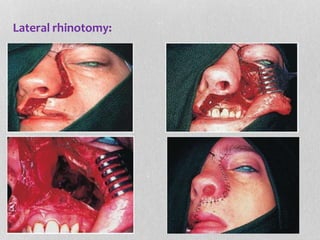
lateral rhinotomy only required when superior parts of
ethmoids are to be dissected
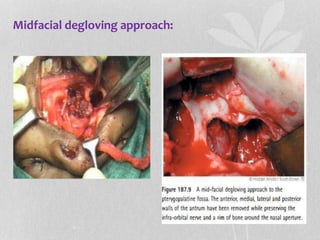
Midfacial degloving approach:
Lateral rhinotomy:
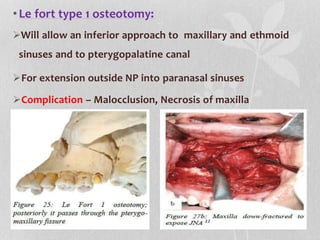
•Le fort type 1 osteotomy:
Will allow an inferior approach to maxillary and ethmoid
sinuses and to pterygopalatine canal
For extension outside NP into paranasal sinuses
Complication – Malocclusion, Necrosis of maxilla
• Facial translocation approach:
Affords a large window of access
For lesions that involve infratemporal fossa or large lesions
that involve majority of sinuses
Adjuvant Therapies:
• Preoperative embolization:
• Reduces intra-operative bleeding
• May shrink the tumor
• Enables better visualization of surgical field (endoscopic
setting), facilitates dissection
However, risk of recurrence increased
Tumour shrinkage makes borders ill-defined leads to
inadequate resection
Done 24–72 hours pre-operatively
Stroke, visual loss, facial paralysis, or carotid dissection may
occur if feeders from ICA embolized
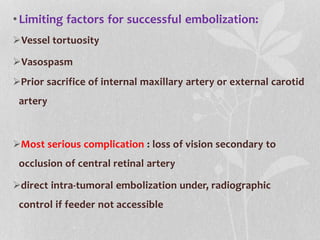
Gelfoam
Polyvinyl alcohol foam
Coils
Micro-particles or
Liquid glue
Ethylene–vinyl alcohol co-polymer (Onyx®):
1. shows deep penetration into tumor
2. more extensive tumor necrosis
3. embolization of large portions of tumor via fewer
catheterizations
4. safe withdrawal of catheter
•Limiting factors for successful embolization:
Vessel tortuosity
Vasospasm
Prior sacrifice of internal maxillary artery or external carotid
artery
Most serious complication : loss of vision secondary to
occlusion of central retinal artery
direct intra-tumoral embolization under, radiographic
control if feeder not accessible
•Hormonal Therapy:
Tumor enlargement with administration of testosterone and
shrinkage with estrogen therapy
Flutamide (2-methyl-n-[4-nitro-3{trifluoromethyl}phenyl]
propanamide), orally active non-steroidal androgen
antagonist
Gates et al.  tumor reduction of 44% in 4 of 5 cases
receiving 6 week treatment course
Labra et al.  tumor reduction of only 11.1% in 6 cases
receiving 3 week treatment course
Current recommendation  6 week course of flutamide as
adjuvant therapy in post-pubertal patient
•Radiation:
For tumors that recur after surgery and those with intracranial
extension, where clearance of margins may be difficult
3000 – 5500 cGy in 15 -18# over 3 - 3.5 wks
Tumour regression is very slow (over 2-3 year) and is by
radiation vasculitis and occlusion of vessels by perivascular
fibrosis
• Intensity-modulated radiotherapy:
Creates conformal dose distribution to minimize dose to
adjacent tissues
Has been used to deliver 3,400–4,500 cGy to patients with
extensive disease involving cavernous sinus and skull base
• Proton RT 
Creates even tighter dose distribution
Further reduce risk of late effects
• Stereotactic radiosurgery 
For minimal, well-defined residual tumor following
incomplete resection
• Disadvantages :
Risk of marginal miss because of necessarily tight dose
distribution
Higher risk of late complications
•Complications of radiotherapy:
Up to 33%
Growth retardation
Panhypopituitarism
Temporal lobe necrosis
Cataracts
Radiation keratopathy
Thyroid and nasopharyngeal malignancies
•Hypotensive Anesthesia:
Provide a relative bloodless field  tumor removal is easier,
quicker and satisfactory
Complications:
• Recurrence 
Most common complication (25 %)
More likely in patients with advanced disease and in those
treated by inexperienced surgeons
Younger patient
Usu. Develop as a consequence of invasion of basisphenoid
Disease-free status five years after primary surgery probably
represents cure
• Infraorbital nerve sensory deficits and nasal vestibular
stenosis  complication of mid-facial degloving,.
• Prolonged nasal crusting  may develop into ozaena
(regular nasal douching with saline and the use of glucose in
glycerine drops can alleviate)
• Ocular problems with more extensive resections
1. Displacement of globe caused by loss of bony support,
2. Ophthalmoplegia
3. Visual loss
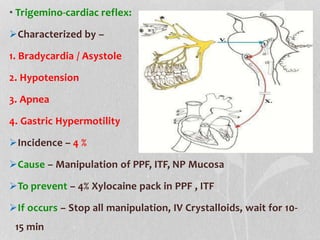
• Trigemino-cardiac reflex:
Characterized by –
1. Bradycardia / Asystole
2. Hypotension
3. Apnea
4. Gastric Hypermotility
Incidence – 4 %
Cause – Manipulation of PPF, ITF, NP Mucosa
To prevent – 4% Xylocaine pack in PPF , ITF
If occurs – Stop all manipulation, IV Crystalloids, wait for 10-
15 min
• Management of ICA injury:
Don’t panic Don’t pack
Use 2 suctions
1 – 2 cm3 muscle harvested from thigh or abdomen
Crushed & placed over bleeding point for at least 3-5 min →
activates platelet fibrin plug
Reinforce with surgicel
If still not controlled → Endovascular intervention by
angiography team
References:
1. Scott browns ORL & HNS 6th, 7th and 8th edition.
2. Cummings ORL & HNS 6TH edition.
3. López, Fernando, et al. "Nasal juvenile angiofibroma: Current
perspectives with emphasis on management." 2017
4. Nicolai P, Schreiber A, Bolzoni Villaret A. “Juvenile
angiofibroma: evolution of management.” 2011
5. Open atlas. JUVENILE NASOPHARYNGEAL ANGIOFIBROMA
SURGERY.

JNA.pptx

  • 1.
    Dr. PARTH MAKWANA ASSISTANTPROFESSOR-ENT DEPARTMENT DR. M.K. SHAH MEDICAL COLLEGE AND RESEARCH CENTRE,AHMEDABAD. JUVENILE NASOPHARYNGEAL ANGIOFIBROMA
  • 2.
    Introduction: • Nasopharynx isan embryologic confluence of end of nasal structures and beginning of pharynx • Symptoms generally arise late because of capacity for tumor growth and expansion • Diagnostic inaccessibility of nasopharyngeal (NP) area, tumors can be difficult to detect
  • 3.
    DIAGNOSTIC APPROACH FOR NASOPHARYNGEALMASSES • Presentation of an NP tumor is variable and ranges from ear, nose, and throat symptoms to neck masses and cranial nerve palsies • Age and gender are important in D/D • Usually due to adenoidal hypertrophy in pediatric but JNA should be strongly considered in teenage boys • In adults, NP malignancy should be default diagnosis • In several Asian regions it is common and usually of epstein- barr virus (EBV)–related, undifferentiated carcinoma
  • 4.
    • Imaging studiesbefore biopsy of mass. • Histology of the NP mass dictates the management
  • 5.
    • THORNWALDT CYSTOR BURSA : Next to adenoidal hypertrophy, it is m/c epithelial growth in NP area Result of a cleavage line between nasal and pharyngeal embryologic processes (Rathke pouch) Usually asymptomatic D/D should include oMeningocele or meningoencephalocele oGenerally do not need to be removed, nor is biopsy necessary if diagnosis is apparent
  • 6.
  • 7.
    •Introduction : Usually occursin adolescent boys, thus commonly called juvenile nasal angiofibroma (JNA) <1% of all head and neck tumors Benign but Locally infiltrative Sarcomatous, malignant transformation is extremely rare and attributable to prior radiotherapy Slow-growing vascular tumor, arises in area of Sphenopalatine foramen at root of pterygoid process on lateral nasal wall Maxillary sinus is m/c site for extra-NP angiofibroma, occur
  • 8.
    Main blood supply: Internal maxillary artery Others : Ascending pharyngeal artery, vidian artery, inferomedial trunk or inferior hypophyseal artery (br of ICA) rarely vertebral artery
  • 9.
    •Spread: • Tumor migratebeneath mucus membrane of NP, displacing it downward in the process • Grows in adjacent anatomical sites that offer less resistance and invade cancellous bone of basisphenoid • Medially  nasopharynx, nasal fossa, and eventually towards contralateral side • Laterally  infratemporal fossae, via an enlarged pterygo- maxillary fissure  typical anterior displacement of posterior maxillary wall  contact with masticatory muscles and cheek • Posteriorly  ICA via vidian canal, cavernous sinus via foramen rotundum and orbital apex via inferior orbital fissure
  • 13.
    • White dottedline : spread into cancellous bone of basisphenoid along vidian canal • White arrowheads : spread deep into pterygomaxillary fossa toward masticatory muscles, with ant. Displacement of post. Maxillary wall • Black arrows : right vidian nerve
  • 14.
    • Bone involvementoccurs via two main mechanisms: 1. Resorption by direct pressure of preexisting bony structures with osteoclastic activation 2. Direct spread along perforating arteries into cancellous root of pterygoid process • In advanced cases Extends posteriorly towards upper-middle of clivus Laterally within greater wing of sphenoid Erosion of the inner table of middle cranial fossa Infiltration of dura is very rare
  • 15.
    •Pathologic features: Gross pathologyusually shows a sessile, lobulated, rubbery, dark red to tan gray mass that can be large Color varies from pink to white On section  reticulated, whorled or spongy appearance, lacks true capsule but sharply demarcated edges Microscopically, Composed of an admixture of vascular tissue and fibrous stroma Vessel walls lack elastic fibers and have incomplete or absent smooth muscle -- tendency to bleed
  • 16.
    •Factors that playa role in the growth : • Chromosomal abnormalities: gains at chromosomes 4, 6, 8, and X and losses on chromosomes 17, 22, and Y are most frequent • Increased prevalence of JA (25 times) in patients with familial adenomatous polyposis (FAP), condition that is associated with mutations of adenomatous polyposis coli (APC) gene This gene regulates beta-catenin pathway which influences cell to cell adhesion. Mutations of beta-catenin have been found in sporadic and recurrent JAs.
  • 17.
    • Angiogenic growthfactor, vascular endothelial growth factor (VEGF) has been found localized on both endothelial and stromal cells • Overexpression of insulin-like growth factor II (IGFII) • Hormonal factors: controversial
  • 18.
    •Theories associated withits aetiopathogenesis: Ringertz theory (1938) – JNA arose from the periosteum of NP vault Som & Neffson (1940) – inequalities in the growth of bones forming skull base resulted in hypertrophy of the underlying periosteum in response to hormonal influence. Bensch & Ewing (1941) – tumour probably arose from embryonic fibro cartilage between basi-occiput and basi- sphenoid. Brunner (1942) – suggested origin from conjoined pharyngobasilar and buccopharyngeal fascia.
  • 19.
    Sternberg (1954) –proposed that JNA could be a type of hemangioma like a cutaneous hemangioma seen in children which regresses with age Osborn (1959) – it could be due to either a hamartoma or residual fetal erectile tissue which were subjected to hormonal influence Girgis & fahmy (1973) – observed cell nests of undifferentiated epitheloid cells or “zellballen” at the growing edge of angiofibromas and so considered it as a paraganglioma
  • 20.
    ‘Branchial arch artery’theory: • Tumour origin is based on an incomplete regression of the first branchial arch artery • Able to explain different aspects of JNA: 1. During embryological development, it finally recedes close to pterygoid base and sphenopalatine foramen regions 2. Vascular remnants of this artery are incorporated into sphenopalatine and maxillary arteries themselves
  • 21.
    Its connection toc4-segment of ICA accounts for vascular supply from ICA, despite an anatomical distance between this vessel and the JA Elucidates common finding of residual tumour at pterygoid base and clivus
  • 22.
    •Clinical features: Ages :10 and 25 in males Cardinal symptoms : nasal obstruction and intermittent epistaxis Others: Chronic anaemia Hyposmia or anosmia Nasal intonation of voice Deafness and otalgia Headache
  • 23.
    • In extensivelesions  Nasal bones become splayed out Swelling in temple and cheek • Intraoral palpation between ascending ramus of mandible and side of maxilla may reveal thickening of disease which has crept around back of the antrum • Trismus and bulging of parotid if Impaction of bulky mass in infratemporal fossa • Proptosis if orbital fissures are penetrated • Frog face appearance if massive escape of diseases
  • 24.
    • Diagnosis: Endoscopic examination: oRubberyvascular mass that protrudes into anterior nasal space oMay have excessive bleeding on contact oSince epidemiologic and endoscopic findings are typical, biopsy is absolutely contraindicated because of a considerable and undue risk of massive hemorrhage
  • 25.
    Diagnosis on imagingis based on three factors 1. Site of origin 2. Hypervascularization after contrast enhancement 3. Patterns of growth CT scan with contrast: o Enhancing soft tissue mass arising from NP or lateral wall of nose. Pterygopalatine fossa may be widened by tumor , bone erosion not present in general MRI: Vascular tumor with flow voids within mass that enhance on gadolinium imaging
  • 26.
    Signs in CECT: •HOLMAN MILLER SIGN: 80% • Anterior bowing of posterior wall of maxillary antrum • HONDOUSA SIGN: • Widening of gap between ramus of mandible & maxillary body
  • 27.
    • RAM HARANSIGN: • Quadrilateral appearance of pterygoid wedge • CHOP STICK SIGN: • Post op appearance of medial & lateral pterygoid plates as two separate sticks due to drilling & removal of pterygoid wedge
  • 28.
    • Pathognomonic sign: erosion of upper medial pterygoid plate which is found in 98% • Differential diagnosis includes other hypervascularized lesions: Hemangiopericytoma Lobular capillary hemangioma Paraganglioma
  • 29.
    Rich vascularity oftumour gives rise to typical small dotted flow voids (salt pepper appearance)
  • 30.
    •Angiography: b/l vascular supplyis around 36% hence both carotid systems require angiographic evaluation 1. Assess vascular supply of JA 2. Allow embolization of feeding vessels prior to surgery More as a surgical treatment adjuvant via possibility of embolization rather than diagnostic tool MR angiography is least invasive form of vascular imaging that will show size feeding vessels Vascular blush seen in postnasal space and adjacent areas is diagnostic
  • 31.
    • However, finalproof of diagnosis is histologic.
  • 32.
    •Staging: Several staging systemshave been proposed – Fisch Chandlers Andrews Radkowski • Fisch  most robust and practical. Defines clearly which surgical approach is required • Radkowski  appeals to those involved with management of smaller tumours as there are more subdivisions
  • 35.
    • Chandler’s stagingof JNA: A. Stage 1 : Tumor is confined to nasopharynx B. Stage 2 : Extends into nasal cavity or sphenoid C. Stage 3 : Tumor involves maxillary sinus, ethmoid sinus, infratemporal fossa, orbit, cheek, and cavernous sinus D. Stage 4 : Tumor is intracranial
  • 36.
    •General surgical principles: •The surgical approach is dependent on 1. Tumour location and extent 2. Pattern of vascular supply 3. Effectiveness of embolisation 4. Facial skeletal maturity 5. Experience of the surgical team • JNAs may be resected by endoscopic, open or combined (endoscopic & open) techniques
  • 37.
    •Endoscopic sinus surgerytechniques Mainstay of surgical resection in present era • Advantages: Magnified view of lesion and related anatomical structures from multiple angles  better identification of interface between lesion and soft tissues or adjacent bone strs Allows more accurate and complete dissection and better control of bleeding
  • 38.
    •Indications: Tumours involving nasal cavity,paranasal sinuses, and nasopharynx Tumours with only medial infratemporal fossa involvement or extradural parasellar involvement with limited intracranial extension Facilitation of open approaches •Relative contraindications: Lateral infratemporal fossa involvement, Extensive parasellar extension, Encasementof the optic nerve, Intradural spread, or cavernous sinus involvement
  • 40.
    •Complications: Pain Bleeding Infection Hyposmia Synechiae Orbital Injury, lossof vision Cerebrospinal fluid leak Intracranial injury Tumour recidivism if margins are not cleared
  • 41.
    •Open approaches: Tumours thatextend to infra-temporal fossa Tumours with intradural extension In centres that lack endo-scopic expertise In conjunction with endo-scopic resection e.g. Anterior antrostomy (caldwell-luc) may be employed to gain access to, and clip, internal maxillary artery
  • 42.
    • Includes: Medial maxillectomy Lefort 1 osteotomy Transpalatal Maxillary swing Infratemporal fossa Facial translocation
  • 43.
    •Intraoral transpalatal approach:(Wilson’s)  Allows for access to NP (for small lesions)
  • 47.
    • Medial maxillectomyapproach: For tumors extending to pterygopalatine fossa Soft tissue elevation preferably with a midfacial degloving incision. Advantages are: Excellent exposure of lesion Direct control of internal maxillary artery in pterygopalatine fossa Very satisfactory cosmetic outcome • Commonest complication – Vestibular stenosis, Infraorbital N. Injury lateral rhinotomy only required when superior parts of ethmoids are to be dissected
  • 48.
  • 49.
  • 50.
    •Le fort type1 osteotomy: Will allow an inferior approach to maxillary and ethmoid sinuses and to pterygopalatine canal For extension outside NP into paranasal sinuses Complication – Malocclusion, Necrosis of maxilla
  • 51.
    • Facial translocationapproach: Affords a large window of access For lesions that involve infratemporal fossa or large lesions that involve majority of sinuses
  • 52.
  • 53.
    • Preoperative embolization: •Reduces intra-operative bleeding • May shrink the tumor • Enables better visualization of surgical field (endoscopic setting), facilitates dissection However, risk of recurrence increased Tumour shrinkage makes borders ill-defined leads to inadequate resection Done 24–72 hours pre-operatively Stroke, visual loss, facial paralysis, or carotid dissection may occur if feeders from ICA embolized
  • 54.
    Gelfoam Polyvinyl alcohol foam Coils Micro-particlesor Liquid glue Ethylene–vinyl alcohol co-polymer (Onyx®): 1. shows deep penetration into tumor 2. more extensive tumor necrosis 3. embolization of large portions of tumor via fewer catheterizations 4. safe withdrawal of catheter
  • 56.
    •Limiting factors forsuccessful embolization: Vessel tortuosity Vasospasm Prior sacrifice of internal maxillary artery or external carotid artery Most serious complication : loss of vision secondary to occlusion of central retinal artery direct intra-tumoral embolization under, radiographic control if feeder not accessible
  • 57.
    •Hormonal Therapy: Tumor enlargementwith administration of testosterone and shrinkage with estrogen therapy Flutamide (2-methyl-n-[4-nitro-3{trifluoromethyl}phenyl] propanamide), orally active non-steroidal androgen antagonist Gates et al.  tumor reduction of 44% in 4 of 5 cases receiving 6 week treatment course Labra et al.  tumor reduction of only 11.1% in 6 cases receiving 3 week treatment course Current recommendation  6 week course of flutamide as adjuvant therapy in post-pubertal patient
  • 58.
    •Radiation: For tumors thatrecur after surgery and those with intracranial extension, where clearance of margins may be difficult 3000 – 5500 cGy in 15 -18# over 3 - 3.5 wks Tumour regression is very slow (over 2-3 year) and is by radiation vasculitis and occlusion of vessels by perivascular fibrosis • Intensity-modulated radiotherapy: Creates conformal dose distribution to minimize dose to adjacent tissues Has been used to deliver 3,400–4,500 cGy to patients with extensive disease involving cavernous sinus and skull base
  • 59.
    • Proton RT Creates even tighter dose distribution Further reduce risk of late effects • Stereotactic radiosurgery  For minimal, well-defined residual tumor following incomplete resection • Disadvantages : Risk of marginal miss because of necessarily tight dose distribution Higher risk of late complications
  • 60.
    •Complications of radiotherapy: Upto 33% Growth retardation Panhypopituitarism Temporal lobe necrosis Cataracts Radiation keratopathy Thyroid and nasopharyngeal malignancies
  • 61.
    •Hypotensive Anesthesia: Provide arelative bloodless field  tumor removal is easier, quicker and satisfactory
  • 62.
    Complications: • Recurrence  Mostcommon complication (25 %) More likely in patients with advanced disease and in those treated by inexperienced surgeons Younger patient Usu. Develop as a consequence of invasion of basisphenoid Disease-free status five years after primary surgery probably represents cure
  • 63.
    • Infraorbital nervesensory deficits and nasal vestibular stenosis  complication of mid-facial degloving,. • Prolonged nasal crusting  may develop into ozaena (regular nasal douching with saline and the use of glucose in glycerine drops can alleviate) • Ocular problems with more extensive resections 1. Displacement of globe caused by loss of bony support, 2. Ophthalmoplegia 3. Visual loss
  • 64.
    • Trigemino-cardiac reflex: Characterizedby – 1. Bradycardia / Asystole 2. Hypotension 3. Apnea 4. Gastric Hypermotility Incidence – 4 % Cause – Manipulation of PPF, ITF, NP Mucosa To prevent – 4% Xylocaine pack in PPF , ITF If occurs – Stop all manipulation, IV Crystalloids, wait for 10- 15 min
  • 65.
    • Management ofICA injury: Don’t panic Don’t pack Use 2 suctions 1 – 2 cm3 muscle harvested from thigh or abdomen Crushed & placed over bleeding point for at least 3-5 min → activates platelet fibrin plug Reinforce with surgicel If still not controlled → Endovascular intervention by angiography team
  • 66.
    References: 1. Scott brownsORL & HNS 6th, 7th and 8th edition. 2. Cummings ORL & HNS 6TH edition. 3. López, Fernando, et al. "Nasal juvenile angiofibroma: Current perspectives with emphasis on management." 2017 4. Nicolai P, Schreiber A, Bolzoni Villaret A. “Juvenile angiofibroma: evolution of management.” 2011 5. Open atlas. JUVENILE NASOPHARYNGEAL ANGIOFIBROMA SURGERY.