JellyFish By: Stardust Burwell
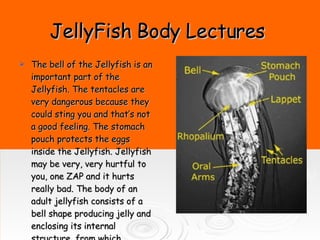
JellyFish Body Lectures   The bell of the Jellyfish is an important part of the Jellyfish. The tentacles are very dangerous because they could sting you and that’s not a good feeling. The stomach pouch protects the eggs inside the Jellyfish. Jellyfish may be very, very hurtful to you, one ZAP and it hurts really bad. The body of an adult jellyfish consists of a bell shape producing jelly and enclosing its internal structure, from which tentacles are suspended.
Defense Of The JellyFish Most jellyfish have tendrils or oral arms coated with thousands of microscopic nematocysts. Generally, each nematocyst has a "trigger" (cnidocil) paired with a capsule containing a coiled stinging filament armed with exterior barbs. Upon contact, the filament rapidly unwinds, launches into the target, and injects toxins. The animal can then pull its prey into its mouth, if appropriate.
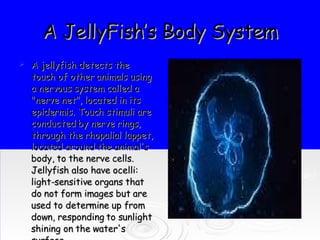
A JellyFish’s Body System A jellyfish detects the touch of other animals using a nervous system called a "nerve net", located in its epidermis. Touch stimuli are conducted by nerve rings, through the rhopalial lappet, located around the animal's body, to the nerve cells. Jellyfish also have ocelli: light-sensitive organs that do not form images but are used to determine up from down, responding to sunlight shining on the water's surface.
Life History Of A JellyFish Most jellyfish pass through two distinct life history phases (body forms) during their life cycle. The first is the  polypoid  stage, when the jellyfish takes the form of either a sessile stalk which catches passing food, or a similar free-floating configuration. The polyp's mouth and tentacles face upwards, reminiscent of the hydroid stage of the somewhat closely related anthozoan polyps, also of the phylum Cnidaria.

Jellyfish

  • 1.
  • 2.
    JellyFish Body Lectures The bell of the Jellyfish is an important part of the Jellyfish. The tentacles are very dangerous because they could sting you and that’s not a good feeling. The stomach pouch protects the eggs inside the Jellyfish. Jellyfish may be very, very hurtful to you, one ZAP and it hurts really bad. The body of an adult jellyfish consists of a bell shape producing jelly and enclosing its internal structure, from which tentacles are suspended.
  • 3.
    Defense Of TheJellyFish Most jellyfish have tendrils or oral arms coated with thousands of microscopic nematocysts. Generally, each nematocyst has a "trigger" (cnidocil) paired with a capsule containing a coiled stinging filament armed with exterior barbs. Upon contact, the filament rapidly unwinds, launches into the target, and injects toxins. The animal can then pull its prey into its mouth, if appropriate.
  • 4.
    A JellyFish’s BodySystem A jellyfish detects the touch of other animals using a nervous system called a "nerve net", located in its epidermis. Touch stimuli are conducted by nerve rings, through the rhopalial lappet, located around the animal's body, to the nerve cells. Jellyfish also have ocelli: light-sensitive organs that do not form images but are used to determine up from down, responding to sunlight shining on the water's surface.
  • 5.
    Life History OfA JellyFish Most jellyfish pass through two distinct life history phases (body forms) during their life cycle. The first is the polypoid stage, when the jellyfish takes the form of either a sessile stalk which catches passing food, or a similar free-floating configuration. The polyp's mouth and tentacles face upwards, reminiscent of the hydroid stage of the somewhat closely related anthozoan polyps, also of the phylum Cnidaria.