
Module 02 – The JEE Containers
Danairat T.
Line ID: Danairat
FB: Danairat Thanabodithammachari
+668-1559-1446
JEE and Web Application Development
The Course Outline
Module 01 - Introduction to JEE
Module 02 - The JEE Containers
Module 03 - The Model-View-Controller Design Pattern
Module04 - Java Servlets
Module 05 - Java Server Pages in MVC
Module 06 - JEE Web Application Deployment
Module 07 - Enterprise Java Bean
Module08 - JEE Enterprise Application Deployment
JEE Containers
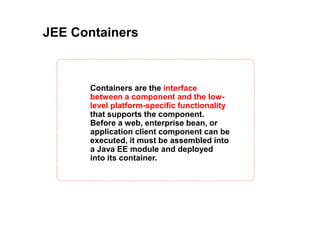
Containers are the interface
between a component and the low-
level platform-specific functionality
that supports the component.
Before a web, enterprise bean, or
application client component can be
executed, it must be assembled into
a Java EE module and deployed
into its container.
JEE Containers Features
Java EE security model lets you configure a web component or
enterprise bean so that system resources are accessed only by
authorized users.
Java EE transaction model lets you specify relationships among
methods that make up a single transaction so that all methods
in one transaction are treated as a single unit.
JNDI lookup services provide a unified interface to multiple
naming and directory services in the enterprise so that
application components can access these services.
Java EE remote connectivity model manages low-level
communications between clients and enterprise beans. After an
enterprise bean is created, a client invokes methods on it as if it
were in the same virtual machine.
JEE Server and Containers
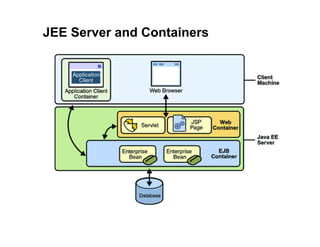
Java EE server: The runtime portion of a Java EE product. A Java EE
server provides EJB and web containers.
Enterprise JavaBeans (EJB) container: Manages the execution of
enterprise beans for Java EE applications. Enterprise beans and their
container run on the Java EE server.
Web container: Manages the execution of JSP page and servlet
components for Java EE applications. Web components and their
container run on the Java EE server.
Application client container: Manages the execution of application
client components. Application clients and their container run on the
client.
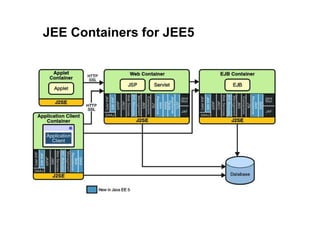
JEE Containers for JEE5
Danairat T.
Line ID: Danairat
FB: Danairat Thanabodithammachari
+668-1559-1446
Thank you

JEE Programming - 02 The Containers

  • 1.
    Module 02 –The JEE Containers Danairat T. Line ID: Danairat FB: Danairat Thanabodithammachari +668-1559-1446
  • 2.
    JEE and WebApplication Development The Course Outline Module 01 - Introduction to JEE Module 02 - The JEE Containers Module 03 - The Model-View-Controller Design Pattern Module04 - Java Servlets Module 05 - Java Server Pages in MVC Module 06 - JEE Web Application Deployment Module 07 - Enterprise Java Bean Module08 - JEE Enterprise Application Deployment
  • 3.
    JEE Containers Containers arethe interface between a component and the low- level platform-specific functionality that supports the component. Before a web, enterprise bean, or application client component can be executed, it must be assembled into a Java EE module and deployed into its container.
  • 4.
    JEE Containers Features JavaEE security model lets you configure a web component or enterprise bean so that system resources are accessed only by authorized users. Java EE transaction model lets you specify relationships among methods that make up a single transaction so that all methods in one transaction are treated as a single unit. JNDI lookup services provide a unified interface to multiple naming and directory services in the enterprise so that application components can access these services. Java EE remote connectivity model manages low-level communications between clients and enterprise beans. After an enterprise bean is created, a client invokes methods on it as if it were in the same virtual machine.
  • 5.
    JEE Server andContainers
  • 6.
    JEE Server andContainers Java EE server: The runtime portion of a Java EE product. A Java EE server provides EJB and web containers. Enterprise JavaBeans (EJB) container: Manages the execution of enterprise beans for Java EE applications. Enterprise beans and their container run on the Java EE server. Web container: Manages the execution of JSP page and servlet components for Java EE applications. Web components and their container run on the Java EE server. Application client container: Manages the execution of application client components. Application clients and their container run on the client.
  • 7.
  • 8.
    Danairat T. Line ID:Danairat FB: Danairat Thanabodithammachari +668-1559-1446 Thank you