On-heap cache vs Off-heap cache
Radek Grębski
@RadekGrebski
https://github.com/rgrebski
PRESENTATION PLAN
1. Heap vs off-heap
2. Heap memory
3. Off-heap memory
3.1 Memory mapped file
3.2 Unsafe and ByteBuffers
3.3 Off-heap memory advantages
4. Cache:
4.1 Chronicle
4.2 Hazelcast
4.3 Redis
5. Comparison
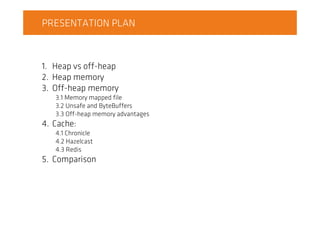
1. HEAP VS OFF-HEAP
vs
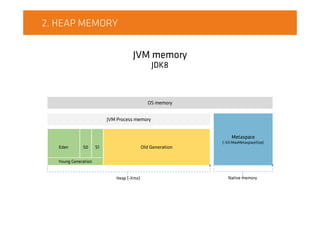
2. HEAP MEMORY
JVM memory
JDK8
S1Eden S0 Old Generation
Heap (-Xmx)
Metaspace
(-XX:MaxMetaspaceSize)
Native memory
JVM Process memory
OS memory
Young Generation
Objects on heap
Source: http://www.ibm.com/developerworks/library/j-codetoheap/
Integer (64-bit JVM): 7:1 (28 bytes)
9:1 (36 bytes)
Integer (32-bit JVM):
3:1 overhead ratio
16 bytes
String (32-bit JVM):
3.75:1
60 bytes
int[1]
2. HEAP MEMORY
3. OFF-HEAP MEMORY
Off-heap (native) memoryJVM Process
OS memory
Other processes /
unallocated
byte[]
byte[]
3.1. MEMORY MAPPED FILE
Off-heap memoryJVM Process
OS memory
JVM Process
/tmp/myFile.dat
byte[]
byte[] byte[]
byte[]
3.2. UNSAFE AND BYTEBUFFERS
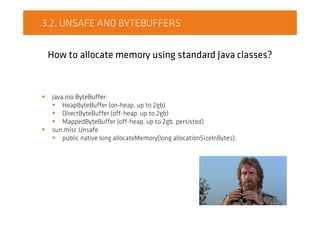
How to allocate memory using standard Java classes?
java.nio.ByteBuffer:
HeapByteBuffer (on-heap, up to 2gb)
DirectByteBuffer (off-heap, up to 2gb)
MappedByteBuffer (off-heap, up to 2gb, persisted)
sun.misc.Unsafe
public native long allocateMemory(long allocationSizeInBytes);
3.2. UNSAFE AND BYTEBUFFERS
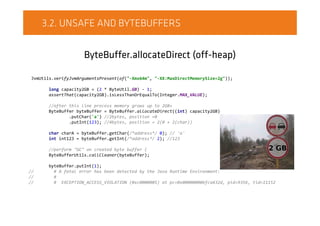
ByteBuffer.allocate ( <2GB )
JvmUtils.verifyJvmArgumentsPresent("-Xmx2g");
ByteBuffer byteBuffer = ByteBuffer.allocate((int) ByteUtil.GB);
byteBuffer.putChar('a') //2bytes, position =0
.putInt(123) //4bytes, position = 2(0 + 2(char))
.put("test".getBytes("UTF-8")); //6 => 2(char) + 4(integer)
byte[] bytesToBeReadInto = new byte["test".getBytes("UTF-8").length];
char charA = byteBuffer.getChar(/*address*/ 0); // 'a'
int int123 = byteBuffer.getInt(/*address*/ 2); //123
byteBuffer.position(6); //set cursor position
byteBuffer.get(bytesToBeReadInto); //"test" as byte[] read into "bytesToBeReadIntoRead"
1. HEAP VS OFF-HEAP
vs
3.2. UNSAFE AND BYTEBUFFERS
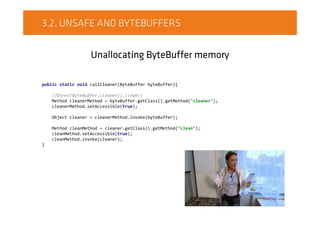
Unallocating ByteBuffer memory
public static void callCleaner(ByteBuffer byteBuffer){
//DirectByteBuffer.cleaner().clean()
Method cleanerMethod = byteBuffer.getClass().getMethod("cleaner");
cleanerMethod.setAccessible(true);
Object cleaner = cleanerMethod.invoke(byteBuffer);
Method cleanMethod = cleaner.getClass().getMethod("clean");
cleanMethod.setAccessible(true);
cleanMethod.invoke(cleaner);
}
3.2. UNSAFE AND BYTEBUFFERS
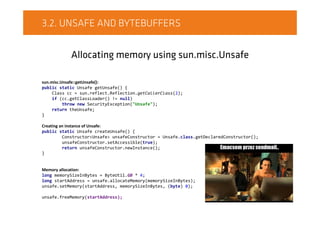
Allocating memory using sun.misc.Unsafe
sun.misc.Unsafe::getUnsafe():
public static Unsafe getUnsafe() {
Class cc = sun.reflect.Reflection.getCallerClass(2);
if (cc.getClassLoader() != null)
throw new SecurityException("Unsafe");
return theUnsafe;
}
Creating an instance of Unsafe:
public static Unsafe createUnsafe() {
Constructor<Unsafe> unsafeConstructor = Unsafe.class.getDeclaredConstructor();
unsafeConstructor.setAccessible(true);
return unsafeConstructor.newInstance();
}
Memory allocation:
long memorySizeInBytes = ByteUtil.GB * 4;
long startAddress = unsafe.allocateMemory(memorySizeInBytes);
unsafe.setMemory(startAddress, memorySizeInBytes, (byte) 0);
unsafe.freeMemory(startAddress);
3.2. UNSAFE AND BYTEBUFFERS
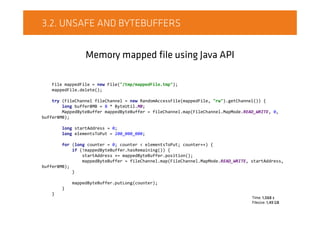
Memory mapped file using Java API
File mappedFile = new File("/tmp/mappedFile.tmp");
mappedFile.delete();
try (FileChannel fileChannel = new RandomAccessFile(mappedFile, "rw").getChannel()) {
long buffer8MB = 8 * ByteUtil.MB;
MappedByteBuffer mappedByteBuffer = fileChannel.map(FileChannel.MapMode.READ_WRITE, 0,
buffer8MB);
long startAddress = 0;
long elementsToPut = 200_000_000;
for (long counter = 0; counter < elementsToPut; counter++) {
if (!mappedByteBuffer.hasRemaining()) {
startAddress += mappedByteBuffer.position();
mappedByteBuffer = fileChannel.map(FileChannel.MapMode.READ_WRITE, startAddress,
buffer8MB);
}
mappedByteBuffer.putLong(counter);
}
}
Time: 1,068 s
Filesize: 1,49 GB
3.2. UNSAFE AND BYTEBUFFERS
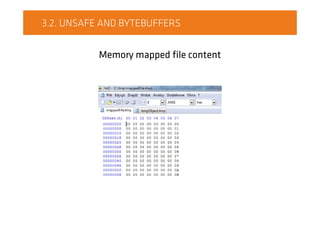
Memory mapped file content
3.2. UNSAFE AND BYTEBUFFERS
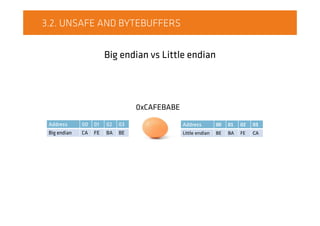
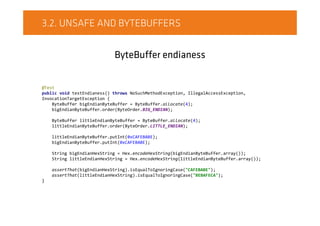
Big endian vs Little endian
0xCAFEBABE
Address 00 01 02 03
Big endian CA FE BA BE
Address 00 01 02 03
Little endian BE BA FE CA
3.2. UNSAFE AND BYTEBUFFERS
ByteBuffer endianess
@Test
public void testEndianess() throws NoSuchMethodException, IllegalAccessException,
InvocationTargetException {
ByteBuffer bigEndianByteBuffer = ByteBuffer.allocate(4);
bigEndianByteBuffer.order(ByteOrder.BIG_ENDIAN);
ByteBuffer littleEndianByteBuffer = ByteBuffer.allocate(4);
littleEndianByteBuffer.order(ByteOrder.LITTLE_ENDIAN);
littleEndianByteBuffer.putInt(0xCAFEBABE);
bigEndianByteBuffer.putInt(0xCAFEBABE);
String bigEndianHexString = Hex.encodeHexString(bigEndianByteBuffer.array());
String littleEndianHexString = Hex.encodeHexString(littleEndianByteBuffer.array());
assertThat(bigEndianHexString).isEqualToIgnoringCase("CAFEBABE");
assertThat(littleEndianHexString).isEqualToIgnoringCase("BEBAFECA");
}
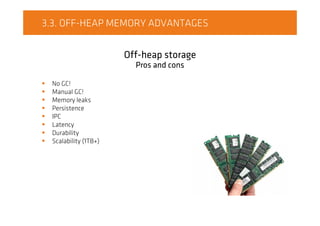
3.3. OFF-HEAP MEMORY ADVANTAGES
Off-heap storage
Pros and cons
No GC!
Manual GC!
Memory leaks
Persistence
IPC
Latency
Durability
Scalability (1TB+)
4. CACHE
HashMap
Collections.synchronizedMap(..)
ConcurrentHashMap
4.1. CHRONICLE
http://chronicle.software
Chronicle Map Chronicle Set Chronicle Queue
Chronicle Logger Java Thread Affinity
2. HEAP MEMORY
JVM memory
JDK8
S1Eden S0 Old Generation
Heap (-Xmx)
Metaspace
(-XX:MaxMetaspaceSize)
Native memory
JVM Process memory
OS memory
Young Generation
4.1. CHRONICLE MAP
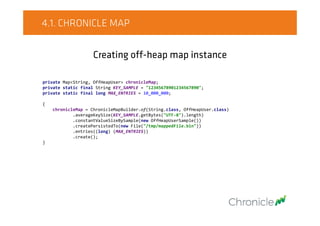
Creating off-heap map instance
private Map<String, OffHeapUser> chronicleMap;
private static final String KEY_SAMPLE = "12345678901234567890";
private static final long MAX_ENTRIES = 10_000_000;
{
chronicleMap = ChronicleMapBuilder.of(String.class, OffHeapUser.class)
.averageKeySize(KEY_SAMPLE.getBytes("UTF-8").length)
.constantValueSizeBySample(new OffHeapUserSample())
.createPersistedTo(new File("/tmp/mappedFile.bin"))
.entries((long) (MAX_ENTRIES))
.create();
}
4.1. CHRONICLE MAP
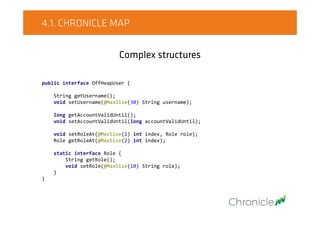
Complex structures
public interface OffHeapUser {
String getUsername();
void setUsername(@MaxSize(30) String username);
long getAccountValidUntil();
void setAccountValidUntil(long accountValidUntil);
void setRoleAt(@MaxSize(2) int index, Role role);
Role getRoleAt(@MaxSize(2) int index);
static interface Role {
String getRole();
void setRole(@MaxSize(10) String role);
}
}
4.1. CHRONICLE MAP
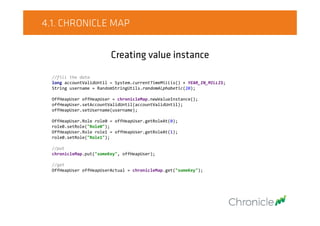
Creating value instance
//fill the data
long accountValidUntil = System.currentTimeMillis() + YEAR_IN_MILLIS;
String username = RandomStringUtils.randomAlphabetic(20);
OffHeapUser offHeapUser = chronicleMap.newValueInstance();
offHeapUser.setAccountValidUntil(accountValidUntil);
offHeapUser.setUsername(username);
OffHeapUser.Role role0 = offHeapUser.getRoleAt(0);
role0.setRole("Role0");
OffHeapUser.Role role1 = offHeapUser.getRoleAt(1);
role0.setRole("Role1");
//put
chronicleMap.put("someKey", offHeapUser);
//get
OffHeapUser offHeapUserActual = chronicleMap.get("someKey");
4.1. CHRONICLE MAP
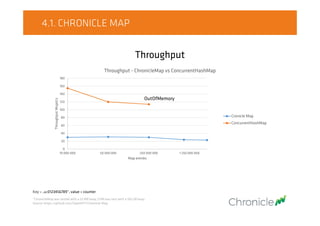
Throughput
Key = „u:0123456789”, value = counter
*ChronicleMap was tested with a 32 MB heap, CHM was test with a 100 GB heap.
Source: https://github.com/OpenHFT/Chronicle-Map
0
20
40
60
80
100
120
140
160
180
10 000 000 50 000 000 250 000 000 1 250 000 000
ThroughputMupd/s
Map entries
Throughput - ChronicleMap vs ConcurrentHashMap
Cronicle Map
ConcurrentHashMap
OutOfMemory
4.1. CHRONICLE MAP
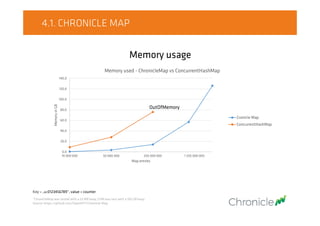
Memory usage
OutOfMemory
0,0
20,0
40,0
60,0
80,0
100,0
120,0
140,0
10 000 000 50 000 000 250 000 000 1 250 000 000
MemoryinGB
Map entries
Memory used - ChronicleMap vs ConcurrentHashMap
Cronicle Map
ConcurrentHashMap
Key = „u:0123456789”, value = counter
*ChronicleMap was tested with a 32 MB heap, CHM was test with a 100 GB heap.
Source: https://github.com/OpenHFT/Chronicle-Map
4.1. CHRONICLE MAP
GC pauses
0,0
5,0
10,0
15,0
20,0
25,0
30,0
35,0
40,0
45,0
50,0
10 000 000 50 000 000 250 000 000 1 250 000 000
WorstGCpauseinseconds
Map entries
Worst GC pause [s] - ChronicleMap vs ConcurrentHashMap
Cronicle Map
ConcurrentHashMap
OutOfMemory
Key = „u:0123456789”, value = counter
*ChronicleMap was tested with a 32 MB heap, CHM was test with a 100 GB heap.
Source: https://github.com/OpenHFT/Chronicle-Map
Objects on heap
Source: http://www.ibm.com/developerworks/library/j-codetoheap/
Integer (64-bit JVM): 7:1 (28 bytes)
9:1 (36 bytes)
Integer (32-bit JVM):
3:1 overhead ratio
16 bytes
String (32-bit JVM):
3.75:1
60 bytes
int[1]
2. HEAP MEMORY
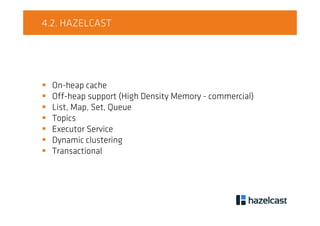
4.2. HAZELCAST
On-heap cache
Off-heap support (High Density Memory - commercial)
List, Map, Set, Queue
Topics
Executor Service
Dynamic clustering
Transactional
4.2. HAZELCAST
Example
@Test
public void hazelcastClusterTest(){
Config hazelcastConfig = new Config();
HazelcastInstance hazelcastInstance1 = Hazelcast.newHazelcastInstance(hazelcastConfig);
HazelcastInstance hazelcastInstance2 = Hazelcast.newHazelcastInstance(hazelcastConfig);
Map<String, String> node1Map = hazelcastInstance1.getMap("someMapName");
Map<String, String> node2Map = hazelcastInstance2.getMap("someMapName");
node1Map.put("key", "value");
Assertions.assertThat(node2Map.get("key")).isEqualTo("value");
}
Output:
Members [2] {
Member [192.168.1.23]:5701 this
Member [192.168.1.23]:5702
}
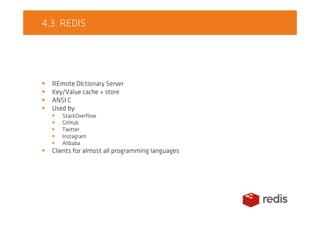
4.3. REDIS
REmote DIctionary Server
Key/Value cache + store
ANSI C
Used by:
StackOverflow
GitHub
Twitter
Instagram
Alibaba
Clients for almost all programming languages
4.3. REDIS
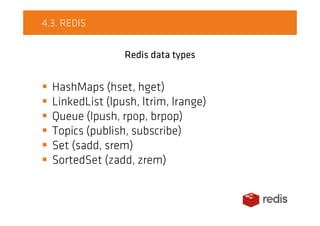
Redis data types
HashMaps (hset, hget)
LinkedList (lpush, ltrim, lrange)
Queue (lpush, rpop, brpop)
Topics (publish, subscribe)
Set (sadd, srem)
SortedSet (zadd, zrem)
4.3. REDIS
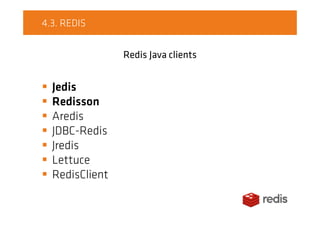
Redis Java clients
Jedis
Redisson
Aredis
JDBC-Redis
Jredis
Lettuce
RedisClient
4.3. REDIS
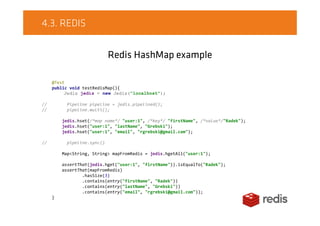
Redis HashMap example
@Test
public void testRedisMap(){
Jedis jedis = new Jedis("localhost");
// Pipeline pipeline = jedis.pipelined();
// pipeline.multi();
jedis.hset(/*map name*/ "user:1", /*key*/ "firstName", /*value*/"Radek");
jedis.hset("user:1", "lastName", "Grebski");
jedis.hset("user:1", "email", "rgrebski@gmail.com");
// pipeline.sync()
Map<String, String> mapFromRedis = jedis.hgetAll("user:1");
assertThat(jedis.hget("user:1", "firstName")).isEqualTo("Radek");
assertThat(mapFromRedis)
.hasSize(3)
.contains(entry("firstName", "Radek"))
.contains(entry("lastName", "Grebski"))
.contains(entry("email", "rgrebski@gmail.com"));
}
5. COMPARISON
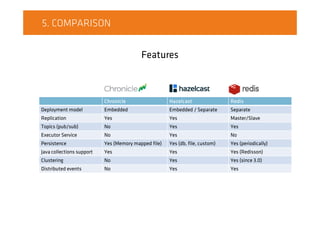
Chronicle Hazelcast Redis
Deployment model Embedded Embedded / Separate Separate
Replication Yes Yes Master/Slave
Topics (pub/sub) No Yes Yes
Executor Service No Yes No
Persistence Yes (Memory mapped file) Yes (db, file, custom) Yes (periodically)
Java collections support Yes Yes Yes (Redisson)
Clustering No Yes Yes (since 3.0)
Distributed events No Yes Yes
Features
5. COMPARISON
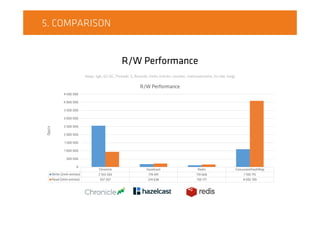
R/W Performance
Chronicle Hazelcast Redis ConcurrentHashMap
Write (2mln entries) 2 555 583 178 491 110 668 1 100 715
Read (2mln entries) 937 207 214 638 156 177 4 092 769
0
500 000
1 000 000
1 500 000
2 000 000
2 500 000
3 000 000
3 500 000
4 000 000
4 500 000
Ops/s
R/W Performance
Heap: 1gb, G1 GC, Threads: 2, Records: 2mln, Entries: counter, User(username, 2x role, long)
5. PERFORMANCE COMPARISON
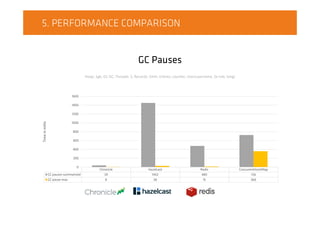
GC Pauses
Heap: 1gb, G1 GC, Threads: 2, Records: 2mln, Entries: counter, User(username, 2x role, long)
Chronicle Hazelcast Redis ConcurrentHashMap
GC pauses summarized 39 1452 480 726
GC pause max 8 28 15 360
0
200
400
600
800
1000
1200
1400
1600
Timeinmillis
Which cache should I use in my app ?
Questions?
3. OFF-HEAP MEMORY
Off-heap (native) memoryJVM Process
OS memory
Other processes /
unallocated
byte[]
byte[]

JDD2015: On-heap cache vs Off-heap cache - Radek Grębski

  • 1.
    On-heap cache vsOff-heap cache Radek Grębski @RadekGrebski https://github.com/rgrebski
  • 2.
    PRESENTATION PLAN 1. Heapvs off-heap 2. Heap memory 3. Off-heap memory 3.1 Memory mapped file 3.2 Unsafe and ByteBuffers 3.3 Off-heap memory advantages 4. Cache: 4.1 Chronicle 4.2 Hazelcast 4.3 Redis 5. Comparison
  • 3.
    1. HEAP VSOFF-HEAP vs
  • 4.
    2. HEAP MEMORY JVMmemory JDK8 S1Eden S0 Old Generation Heap (-Xmx) Metaspace (-XX:MaxMetaspaceSize) Native memory JVM Process memory OS memory Young Generation
  • 5.
    Objects on heap Source:http://www.ibm.com/developerworks/library/j-codetoheap/ Integer (64-bit JVM): 7:1 (28 bytes) 9:1 (36 bytes) Integer (32-bit JVM): 3:1 overhead ratio 16 bytes String (32-bit JVM): 3.75:1 60 bytes int[1] 2. HEAP MEMORY
  • 6.
    3. OFF-HEAP MEMORY Off-heap(native) memoryJVM Process OS memory Other processes / unallocated byte[] byte[]
  • 7.
    3.1. MEMORY MAPPEDFILE Off-heap memoryJVM Process OS memory JVM Process /tmp/myFile.dat byte[] byte[] byte[] byte[]
  • 8.
    3.2. UNSAFE ANDBYTEBUFFERS How to allocate memory using standard Java classes? java.nio.ByteBuffer: HeapByteBuffer (on-heap, up to 2gb) DirectByteBuffer (off-heap, up to 2gb) MappedByteBuffer (off-heap, up to 2gb, persisted) sun.misc.Unsafe public native long allocateMemory(long allocationSizeInBytes);
  • 9.
    3.2. UNSAFE ANDBYTEBUFFERS ByteBuffer.allocate ( <2GB ) JvmUtils.verifyJvmArgumentsPresent("-Xmx2g"); ByteBuffer byteBuffer = ByteBuffer.allocate((int) ByteUtil.GB); byteBuffer.putChar('a') //2bytes, position =0 .putInt(123) //4bytes, position = 2(0 + 2(char)) .put("test".getBytes("UTF-8")); //6 => 2(char) + 4(integer) byte[] bytesToBeReadInto = new byte["test".getBytes("UTF-8").length]; char charA = byteBuffer.getChar(/*address*/ 0); // 'a' int int123 = byteBuffer.getInt(/*address*/ 2); //123 byteBuffer.position(6); //set cursor position byteBuffer.get(bytesToBeReadInto); //"test" as byte[] read into "bytesToBeReadIntoRead"
  • 10.
    1. HEAP VSOFF-HEAP vs
  • 11.
    3.2. UNSAFE ANDBYTEBUFFERS Unallocating ByteBuffer memory public static void callCleaner(ByteBuffer byteBuffer){ //DirectByteBuffer.cleaner().clean() Method cleanerMethod = byteBuffer.getClass().getMethod("cleaner"); cleanerMethod.setAccessible(true); Object cleaner = cleanerMethod.invoke(byteBuffer); Method cleanMethod = cleaner.getClass().getMethod("clean"); cleanMethod.setAccessible(true); cleanMethod.invoke(cleaner); }
  • 12.
    3.2. UNSAFE ANDBYTEBUFFERS Allocating memory using sun.misc.Unsafe sun.misc.Unsafe::getUnsafe(): public static Unsafe getUnsafe() { Class cc = sun.reflect.Reflection.getCallerClass(2); if (cc.getClassLoader() != null) throw new SecurityException("Unsafe"); return theUnsafe; } Creating an instance of Unsafe: public static Unsafe createUnsafe() { Constructor<Unsafe> unsafeConstructor = Unsafe.class.getDeclaredConstructor(); unsafeConstructor.setAccessible(true); return unsafeConstructor.newInstance(); } Memory allocation: long memorySizeInBytes = ByteUtil.GB * 4; long startAddress = unsafe.allocateMemory(memorySizeInBytes); unsafe.setMemory(startAddress, memorySizeInBytes, (byte) 0); unsafe.freeMemory(startAddress);
  • 13.
    3.2. UNSAFE ANDBYTEBUFFERS Memory mapped file using Java API File mappedFile = new File("/tmp/mappedFile.tmp"); mappedFile.delete(); try (FileChannel fileChannel = new RandomAccessFile(mappedFile, "rw").getChannel()) { long buffer8MB = 8 * ByteUtil.MB; MappedByteBuffer mappedByteBuffer = fileChannel.map(FileChannel.MapMode.READ_WRITE, 0, buffer8MB); long startAddress = 0; long elementsToPut = 200_000_000; for (long counter = 0; counter < elementsToPut; counter++) { if (!mappedByteBuffer.hasRemaining()) { startAddress += mappedByteBuffer.position(); mappedByteBuffer = fileChannel.map(FileChannel.MapMode.READ_WRITE, startAddress, buffer8MB); } mappedByteBuffer.putLong(counter); } } Time: 1,068 s Filesize: 1,49 GB
  • 14.
    3.2. UNSAFE ANDBYTEBUFFERS Memory mapped file content
  • 15.
    3.2. UNSAFE ANDBYTEBUFFERS Big endian vs Little endian 0xCAFEBABE Address 00 01 02 03 Big endian CA FE BA BE Address 00 01 02 03 Little endian BE BA FE CA
  • 16.
    3.2. UNSAFE ANDBYTEBUFFERS ByteBuffer endianess @Test public void testEndianess() throws NoSuchMethodException, IllegalAccessException, InvocationTargetException { ByteBuffer bigEndianByteBuffer = ByteBuffer.allocate(4); bigEndianByteBuffer.order(ByteOrder.BIG_ENDIAN); ByteBuffer littleEndianByteBuffer = ByteBuffer.allocate(4); littleEndianByteBuffer.order(ByteOrder.LITTLE_ENDIAN); littleEndianByteBuffer.putInt(0xCAFEBABE); bigEndianByteBuffer.putInt(0xCAFEBABE); String bigEndianHexString = Hex.encodeHexString(bigEndianByteBuffer.array()); String littleEndianHexString = Hex.encodeHexString(littleEndianByteBuffer.array()); assertThat(bigEndianHexString).isEqualToIgnoringCase("CAFEBABE"); assertThat(littleEndianHexString).isEqualToIgnoringCase("BEBAFECA"); }
  • 17.
    3.3. OFF-HEAP MEMORYADVANTAGES Off-heap storage Pros and cons No GC! Manual GC! Memory leaks Persistence IPC Latency Durability Scalability (1TB+)
  • 18.
  • 19.
    4.1. CHRONICLE http://chronicle.software Chronicle MapChronicle Set Chronicle Queue Chronicle Logger Java Thread Affinity
  • 20.
    2. HEAP MEMORY JVMmemory JDK8 S1Eden S0 Old Generation Heap (-Xmx) Metaspace (-XX:MaxMetaspaceSize) Native memory JVM Process memory OS memory Young Generation
  • 21.
    4.1. CHRONICLE MAP Creatingoff-heap map instance private Map<String, OffHeapUser> chronicleMap; private static final String KEY_SAMPLE = "12345678901234567890"; private static final long MAX_ENTRIES = 10_000_000; { chronicleMap = ChronicleMapBuilder.of(String.class, OffHeapUser.class) .averageKeySize(KEY_SAMPLE.getBytes("UTF-8").length) .constantValueSizeBySample(new OffHeapUserSample()) .createPersistedTo(new File("/tmp/mappedFile.bin")) .entries((long) (MAX_ENTRIES)) .create(); }
  • 22.
    4.1. CHRONICLE MAP Complexstructures public interface OffHeapUser { String getUsername(); void setUsername(@MaxSize(30) String username); long getAccountValidUntil(); void setAccountValidUntil(long accountValidUntil); void setRoleAt(@MaxSize(2) int index, Role role); Role getRoleAt(@MaxSize(2) int index); static interface Role { String getRole(); void setRole(@MaxSize(10) String role); } }
  • 23.
    4.1. CHRONICLE MAP Creatingvalue instance //fill the data long accountValidUntil = System.currentTimeMillis() + YEAR_IN_MILLIS; String username = RandomStringUtils.randomAlphabetic(20); OffHeapUser offHeapUser = chronicleMap.newValueInstance(); offHeapUser.setAccountValidUntil(accountValidUntil); offHeapUser.setUsername(username); OffHeapUser.Role role0 = offHeapUser.getRoleAt(0); role0.setRole("Role0"); OffHeapUser.Role role1 = offHeapUser.getRoleAt(1); role0.setRole("Role1"); //put chronicleMap.put("someKey", offHeapUser); //get OffHeapUser offHeapUserActual = chronicleMap.get("someKey");
  • 24.
    4.1. CHRONICLE MAP Throughput Key= „u:0123456789”, value = counter *ChronicleMap was tested with a 32 MB heap, CHM was test with a 100 GB heap. Source: https://github.com/OpenHFT/Chronicle-Map 0 20 40 60 80 100 120 140 160 180 10 000 000 50 000 000 250 000 000 1 250 000 000 ThroughputMupd/s Map entries Throughput - ChronicleMap vs ConcurrentHashMap Cronicle Map ConcurrentHashMap OutOfMemory
  • 25.
    4.1. CHRONICLE MAP Memoryusage OutOfMemory 0,0 20,0 40,0 60,0 80,0 100,0 120,0 140,0 10 000 000 50 000 000 250 000 000 1 250 000 000 MemoryinGB Map entries Memory used - ChronicleMap vs ConcurrentHashMap Cronicle Map ConcurrentHashMap Key = „u:0123456789”, value = counter *ChronicleMap was tested with a 32 MB heap, CHM was test with a 100 GB heap. Source: https://github.com/OpenHFT/Chronicle-Map
  • 26.
    4.1. CHRONICLE MAP GCpauses 0,0 5,0 10,0 15,0 20,0 25,0 30,0 35,0 40,0 45,0 50,0 10 000 000 50 000 000 250 000 000 1 250 000 000 WorstGCpauseinseconds Map entries Worst GC pause [s] - ChronicleMap vs ConcurrentHashMap Cronicle Map ConcurrentHashMap OutOfMemory Key = „u:0123456789”, value = counter *ChronicleMap was tested with a 32 MB heap, CHM was test with a 100 GB heap. Source: https://github.com/OpenHFT/Chronicle-Map
  • 27.
    Objects on heap Source:http://www.ibm.com/developerworks/library/j-codetoheap/ Integer (64-bit JVM): 7:1 (28 bytes) 9:1 (36 bytes) Integer (32-bit JVM): 3:1 overhead ratio 16 bytes String (32-bit JVM): 3.75:1 60 bytes int[1] 2. HEAP MEMORY
  • 28.
    4.2. HAZELCAST On-heap cache Off-heapsupport (High Density Memory - commercial) List, Map, Set, Queue Topics Executor Service Dynamic clustering Transactional
  • 29.
    4.2. HAZELCAST Example @Test public voidhazelcastClusterTest(){ Config hazelcastConfig = new Config(); HazelcastInstance hazelcastInstance1 = Hazelcast.newHazelcastInstance(hazelcastConfig); HazelcastInstance hazelcastInstance2 = Hazelcast.newHazelcastInstance(hazelcastConfig); Map<String, String> node1Map = hazelcastInstance1.getMap("someMapName"); Map<String, String> node2Map = hazelcastInstance2.getMap("someMapName"); node1Map.put("key", "value"); Assertions.assertThat(node2Map.get("key")).isEqualTo("value"); } Output: Members [2] { Member [192.168.1.23]:5701 this Member [192.168.1.23]:5702 }
  • 30.
    4.3. REDIS REmote DIctionaryServer Key/Value cache + store ANSI C Used by: StackOverflow GitHub Twitter Instagram Alibaba Clients for almost all programming languages
  • 31.
    4.3. REDIS Redis datatypes HashMaps (hset, hget) LinkedList (lpush, ltrim, lrange) Queue (lpush, rpop, brpop) Topics (publish, subscribe) Set (sadd, srem) SortedSet (zadd, zrem)
  • 32.
    4.3. REDIS Redis Javaclients Jedis Redisson Aredis JDBC-Redis Jredis Lettuce RedisClient
  • 33.
    4.3. REDIS Redis HashMapexample @Test public void testRedisMap(){ Jedis jedis = new Jedis("localhost"); // Pipeline pipeline = jedis.pipelined(); // pipeline.multi(); jedis.hset(/*map name*/ "user:1", /*key*/ "firstName", /*value*/"Radek"); jedis.hset("user:1", "lastName", "Grebski"); jedis.hset("user:1", "email", "rgrebski@gmail.com"); // pipeline.sync() Map<String, String> mapFromRedis = jedis.hgetAll("user:1"); assertThat(jedis.hget("user:1", "firstName")).isEqualTo("Radek"); assertThat(mapFromRedis) .hasSize(3) .contains(entry("firstName", "Radek")) .contains(entry("lastName", "Grebski")) .contains(entry("email", "rgrebski@gmail.com")); }
  • 34.
    5. COMPARISON Chronicle HazelcastRedis Deployment model Embedded Embedded / Separate Separate Replication Yes Yes Master/Slave Topics (pub/sub) No Yes Yes Executor Service No Yes No Persistence Yes (Memory mapped file) Yes (db, file, custom) Yes (periodically) Java collections support Yes Yes Yes (Redisson) Clustering No Yes Yes (since 3.0) Distributed events No Yes Yes Features
  • 35.
    5. COMPARISON R/W Performance ChronicleHazelcast Redis ConcurrentHashMap Write (2mln entries) 2 555 583 178 491 110 668 1 100 715 Read (2mln entries) 937 207 214 638 156 177 4 092 769 0 500 000 1 000 000 1 500 000 2 000 000 2 500 000 3 000 000 3 500 000 4 000 000 4 500 000 Ops/s R/W Performance Heap: 1gb, G1 GC, Threads: 2, Records: 2mln, Entries: counter, User(username, 2x role, long)
  • 36.
    5. PERFORMANCE COMPARISON GCPauses Heap: 1gb, G1 GC, Threads: 2, Records: 2mln, Entries: counter, User(username, 2x role, long) Chronicle Hazelcast Redis ConcurrentHashMap GC pauses summarized 39 1452 480 726 GC pause max 8 28 15 360 0 200 400 600 800 1000 1200 1400 1600 Timeinmillis
  • 37.
    Which cache shouldI use in my app ?
  • 38.
  • 39.
    3. OFF-HEAP MEMORY Off-heap(native) memoryJVM Process OS memory Other processes / unallocated byte[] byte[]