Improving go-git performance
Javi Fontán
What’s go-git
What’s go-git
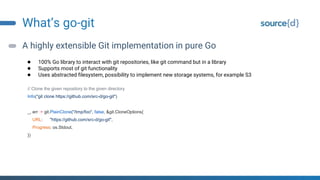
A highly extensible Git implementation in pure Go
● 100% Go library to interact with git repositories, like git command but in a library
● Supports most of git functionality
● Uses abstracted filesystem, possibility to implement new storage systems, for example S3
// Clone the given repository to the given directory
Info("git clone https://github.com/src-d/go-git")
_, err := git.PlainClone("/tmp/foo", false, &git.CloneOptions{
URL: "https://github.com/src-d/go-git",
Progress: os.Stdout,
})
What’s go-git
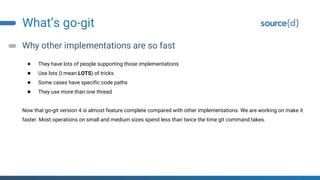
Why other implementations are so fast
● They have lots of people supporting those implementations
● Use lots (I mean LOTS) of tricks
● Some cases have specific code paths
● They use more than one thread
Now that go-git version 4 is almost feature complete compared with other implementations. We are working on make it
faster. Most operations on small and medium sizes spend less than twice the time git command takes.
What’s go-git
How git stores data
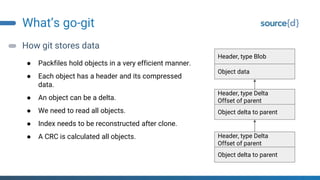
● Packfiles hold objects in a very efficient manner.
● Each object has a header and its compressed
data.
● An object can be a delta.
● We need to read all objects.
● Index needs to be reconstructed after clone.
● A CRC is calculated all objects.
Header, type Blob
Object data
Header, type Delta
Offset of parent
Object delta to parent
Header, type Delta
Offset of parent
Object delta to parent
What’s go-git
Recent performance improvements
● Modify an LRU cache to be able to evict more than one object in case there’s
no space in it. This change decreased disk access and decompression quite
heavily. Index creation speed was increased 2x.
● Freed memory more aggressively when packing objects. This change
decreased memory consumption between 3 and 5 times less. It also made
some speed improvements as also decreased GC pressure.
● Modified delta packing algorithm to make better use of delta reuse. It
doubled the speed of this process and decreased packfile size.
Improving index generation speed
Generating the index
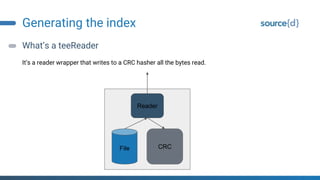
What’s a teeReader
It’s a reader wrapper that writes to a CRC hasher all the bytes read.
File CRC
Reader
Generating the index
Generating CRC - Original Code
func (r *teeReader) ReadByte() (b byte, err error) {
b, err = r.reader.ReadByte()
if err == nil {
slice := []byte{b}
_, err := r.w.Write(slice)
if err != nil {
return 0, err
}
}
return
}
Generating the index
Generating CRC - Original Profile
70ms 70ms 416:func (r *teeReader) ReadByte() (b byte, err error) {
170ms 550ms 417: b, err = r.reader.ReadByte()
. . 418: if err == nil {
150ms 870ms 419: slice := []byte{b}
90ms 1.01s 420: _, err := r.w.Write(slice)
40ms 40ms 421: if err != nil {
. . 422: return 0, err
. . 423: }
. . 424: }
. . 425:
20ms 20ms 426: return
. . 427:}
Generating the index
Generating CRC - Precreate Slice Code
func (r *teeReader) ReadByte() (b byte, err error) {
if r.byteBuf == nil {
r.byteBuf = make([]byte, 1)
}
b, err = r.reader.ReadByte()
if err == nil {
r.byteBuf[0] = b
_, err := r.w.Write(r.byteBuf)
if err != nil {
return 0, err
}
}
return
}
Generating the index
Generating CRC - Precreate Slice Profile
40ms 40ms 418:func (r *teeReader) ReadByte() (b byte, err error) {
40ms 40ms 419: if r.byteBuf == nil {
. . 420: r.byteBuf = make([]byte, 1)
. . 421: }
60ms 470ms 422: b, err = r.reader.ReadByte()
. . 423: if err == nil {
20ms 20ms 424: r.byteBuf[0] = b
70ms 880ms 425: _, err := r.w.Write(r.byteBuf)
20ms 20ms 426: if err != nil {
. . 427: return 0, err
. . 428: }
. . 429: }
. . 430:
40ms 40ms 431: return
. . 432:}
Generating the index
Generating CRC - Library Code
func slicingUpdate(crc uint32, tab *slicing8Table, p []byte) uint32 {
if len(p) >= slicing8Cutoff {
crc = ^crc
for len(p) > 8 {
// here calculates CRC
[...]
p = p[8:]
}
crc = ^crc
}
if len(p) == 0 {
return crc
}
return simpleUpdate(crc, &tab[0], p)
}
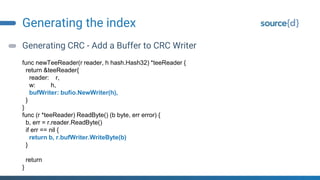
Generating the index
Generating CRC - Add a Buffer to CRC Writer
func newTeeReader(r reader, h hash.Hash32) *teeReader {
return &teeReader{
reader: r,
w: h,
bufWriter: bufio.NewWriter(h),
}
}
func (r *teeReader) ReadByte() (b byte, err error) {
b, err = r.reader.ReadByte()
if err == nil {
return b, r.bufWriter.WriteByte(b)
}
return
}
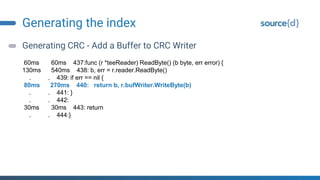
Generating the index
Generating CRC - Add a Buffer to CRC Writer
60ms 60ms 437:func (r *teeReader) ReadByte() (b byte, err error) {
130ms 540ms 438: b, err = r.reader.ReadByte()
. . 439: if err == nil {
80ms 270ms 440: return b, r.bufWriter.WriteByte(b)
. . 441: }
. . 442:
30ms 30ms 443: return
. . 444:}
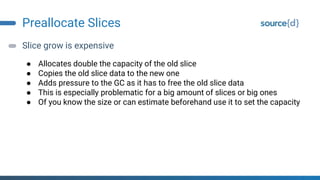
Preallocate Slices
Slice grow is expensive
● Allocates double the capacity of the old slice
● Copies the old slice data to the new one
● Adds pressure to the GC as it has to free the old slice data
● This is especially problematic for a big amount of slices or big ones
● Of you know the size or can estimate beforehand use it to set the capacity
Preallocate Slices
Code example
targetSz, delta := decodeLEB128(delta)
var dest []byte
for {
[...]
dest = append(dest, src[o:o+sz]...)
targetSz, delta := decodeLEB128(delta)
dest := make([]byte, 0, targetSz)
for {
[...]
dest = append(dest, src[o:o+sz]...)
Preallocate Slices
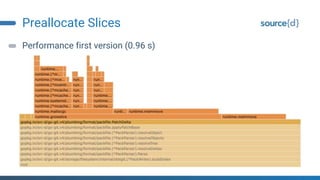
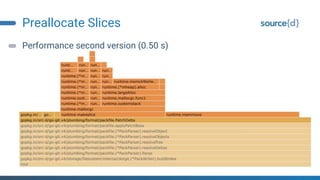
Performance first version (0.96 s)
Preallocate Slices
Performance second version (0.50 s)
Inspecting Syscalls
Inspecting Syscalls
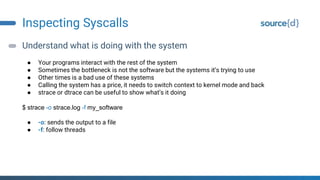
Understand what is doing with the system
● Your programs interact with the rest of the system
● Sometimes the bottleneck is not the software but the systems it’s trying to use
● Other times is a bad use of these systems
● Calling the system has a price, it needs to switch context to kernel mode and back
● strace or dtrace can be useful to show what’s it doing
$ strace -o strace.log -f my_software
● -o: sends the output to a file
● -f: follow threads
Inspecting Syscalls
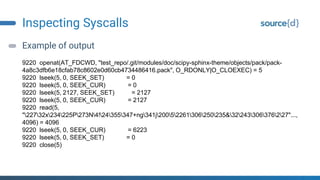
Example of output
9220 openat(AT_FDCWD, "test_repo/.git/modules/doc/scipy-sphinx-theme/objects/pack/pack-
4a8c3dfb6e18cfab78c8602e0d60cb4734486416.pack", O_RDONLY|O_CLOEXEC) = 5
9220 lseek(5, 0, SEEK_SET) = 0
9220 lseek(5, 0, SEEK_CUR) = 0
9220 lseek(5, 2127, SEEK_SET) = 2127
9220 lseek(5, 0, SEEK_CUR) = 2127
9220 read(5,
"22732x234225P273N4!24355347+ng341j20052261306250235&32243306376227"...,
4096) = 4096
9220 lseek(5, 0, SEEK_CUR) = 6223
9220 lseek(5, 0, SEEK_SET) = 0
9220 close(5)
Inspecting Syscalls
Find bad uses of SEEK_CUR
$ grep -E '(open|read|seek)' strace.log
[...]
11209 lseek(6, 0, SEEK_CUR) = 224543
11209 read(6, "327261360"..., 4096) = 4096
11209 lseek(6, 0, SEEK_CUR) = 228639
Inspecting Syscalls
Find seek direction and jump size
$ grep SEEK_SET master.strace | grep -v -E '(= 0$|unfinished)' | awk 'BEGIN {pos=0}
{new=$6;print pos-new;pos=new}'
[...]
-19608
19843
-19843
19843
-423
188
-319
-19289
19843
-19843
19843
Conclusions
● Biggest improvements are done changing the algorithm
● The profiler is your friend, learn to use it
● Check if you’re doing the same thing multiple times, this happens very often
● Try not to do one byte writes, use buffers is you really need to do it
● Preallocate slices when possible
● Your software does not work alone, check the use of the rest of the system
● When in doubt check library implementations
Thanks!

Improving go-git performance

  • 1.
  • 2.
  • 3.
    What’s go-git A highlyextensible Git implementation in pure Go ● 100% Go library to interact with git repositories, like git command but in a library ● Supports most of git functionality ● Uses abstracted filesystem, possibility to implement new storage systems, for example S3 // Clone the given repository to the given directory Info("git clone https://github.com/src-d/go-git") _, err := git.PlainClone("/tmp/foo", false, &git.CloneOptions{ URL: "https://github.com/src-d/go-git", Progress: os.Stdout, })
  • 4.
    What’s go-git Why otherimplementations are so fast ● They have lots of people supporting those implementations ● Use lots (I mean LOTS) of tricks ● Some cases have specific code paths ● They use more than one thread Now that go-git version 4 is almost feature complete compared with other implementations. We are working on make it faster. Most operations on small and medium sizes spend less than twice the time git command takes.
  • 5.
    What’s go-git How gitstores data ● Packfiles hold objects in a very efficient manner. ● Each object has a header and its compressed data. ● An object can be a delta. ● We need to read all objects. ● Index needs to be reconstructed after clone. ● A CRC is calculated all objects. Header, type Blob Object data Header, type Delta Offset of parent Object delta to parent Header, type Delta Offset of parent Object delta to parent
  • 6.
    What’s go-git Recent performanceimprovements ● Modify an LRU cache to be able to evict more than one object in case there’s no space in it. This change decreased disk access and decompression quite heavily. Index creation speed was increased 2x. ● Freed memory more aggressively when packing objects. This change decreased memory consumption between 3 and 5 times less. It also made some speed improvements as also decreased GC pressure. ● Modified delta packing algorithm to make better use of delta reuse. It doubled the speed of this process and decreased packfile size.
  • 7.
  • 8.
    Generating the index What’sa teeReader It’s a reader wrapper that writes to a CRC hasher all the bytes read. File CRC Reader
  • 9.
    Generating the index GeneratingCRC - Original Code func (r *teeReader) ReadByte() (b byte, err error) { b, err = r.reader.ReadByte() if err == nil { slice := []byte{b} _, err := r.w.Write(slice) if err != nil { return 0, err } } return }
  • 10.
    Generating the index GeneratingCRC - Original Profile 70ms 70ms 416:func (r *teeReader) ReadByte() (b byte, err error) { 170ms 550ms 417: b, err = r.reader.ReadByte() . . 418: if err == nil { 150ms 870ms 419: slice := []byte{b} 90ms 1.01s 420: _, err := r.w.Write(slice) 40ms 40ms 421: if err != nil { . . 422: return 0, err . . 423: } . . 424: } . . 425: 20ms 20ms 426: return . . 427:}
  • 11.
    Generating the index GeneratingCRC - Precreate Slice Code func (r *teeReader) ReadByte() (b byte, err error) { if r.byteBuf == nil { r.byteBuf = make([]byte, 1) } b, err = r.reader.ReadByte() if err == nil { r.byteBuf[0] = b _, err := r.w.Write(r.byteBuf) if err != nil { return 0, err } } return }
  • 12.
    Generating the index GeneratingCRC - Precreate Slice Profile 40ms 40ms 418:func (r *teeReader) ReadByte() (b byte, err error) { 40ms 40ms 419: if r.byteBuf == nil { . . 420: r.byteBuf = make([]byte, 1) . . 421: } 60ms 470ms 422: b, err = r.reader.ReadByte() . . 423: if err == nil { 20ms 20ms 424: r.byteBuf[0] = b 70ms 880ms 425: _, err := r.w.Write(r.byteBuf) 20ms 20ms 426: if err != nil { . . 427: return 0, err . . 428: } . . 429: } . . 430: 40ms 40ms 431: return . . 432:}
  • 13.
    Generating the index GeneratingCRC - Library Code func slicingUpdate(crc uint32, tab *slicing8Table, p []byte) uint32 { if len(p) >= slicing8Cutoff { crc = ^crc for len(p) > 8 { // here calculates CRC [...] p = p[8:] } crc = ^crc } if len(p) == 0 { return crc } return simpleUpdate(crc, &tab[0], p) }
  • 14.
    Generating the index GeneratingCRC - Add a Buffer to CRC Writer func newTeeReader(r reader, h hash.Hash32) *teeReader { return &teeReader{ reader: r, w: h, bufWriter: bufio.NewWriter(h), } } func (r *teeReader) ReadByte() (b byte, err error) { b, err = r.reader.ReadByte() if err == nil { return b, r.bufWriter.WriteByte(b) } return }
  • 15.
    Generating the index GeneratingCRC - Add a Buffer to CRC Writer 60ms 60ms 437:func (r *teeReader) ReadByte() (b byte, err error) { 130ms 540ms 438: b, err = r.reader.ReadByte() . . 439: if err == nil { 80ms 270ms 440: return b, r.bufWriter.WriteByte(b) . . 441: } . . 442: 30ms 30ms 443: return . . 444:}
  • 16.
    Preallocate Slices Slice growis expensive ● Allocates double the capacity of the old slice ● Copies the old slice data to the new one ● Adds pressure to the GC as it has to free the old slice data ● This is especially problematic for a big amount of slices or big ones ● Of you know the size or can estimate beforehand use it to set the capacity
  • 17.
    Preallocate Slices Code example targetSz,delta := decodeLEB128(delta) var dest []byte for { [...] dest = append(dest, src[o:o+sz]...) targetSz, delta := decodeLEB128(delta) dest := make([]byte, 0, targetSz) for { [...] dest = append(dest, src[o:o+sz]...)
  • 18.
  • 19.
  • 20.
  • 21.
    Inspecting Syscalls Understand whatis doing with the system ● Your programs interact with the rest of the system ● Sometimes the bottleneck is not the software but the systems it’s trying to use ● Other times is a bad use of these systems ● Calling the system has a price, it needs to switch context to kernel mode and back ● strace or dtrace can be useful to show what’s it doing $ strace -o strace.log -f my_software ● -o: sends the output to a file ● -f: follow threads
  • 22.
    Inspecting Syscalls Example ofoutput 9220 openat(AT_FDCWD, "test_repo/.git/modules/doc/scipy-sphinx-theme/objects/pack/pack- 4a8c3dfb6e18cfab78c8602e0d60cb4734486416.pack", O_RDONLY|O_CLOEXEC) = 5 9220 lseek(5, 0, SEEK_SET) = 0 9220 lseek(5, 0, SEEK_CUR) = 0 9220 lseek(5, 2127, SEEK_SET) = 2127 9220 lseek(5, 0, SEEK_CUR) = 2127 9220 read(5, "22732x234225P273N4!24355347+ng341j20052261306250235&32243306376227"..., 4096) = 4096 9220 lseek(5, 0, SEEK_CUR) = 6223 9220 lseek(5, 0, SEEK_SET) = 0 9220 close(5)
  • 23.
    Inspecting Syscalls Find baduses of SEEK_CUR $ grep -E '(open|read|seek)' strace.log [...] 11209 lseek(6, 0, SEEK_CUR) = 224543 11209 lseek(6, 0, SEEK_CUR) = 224543 11209 lseek(6, 0, SEEK_CUR) = 224543 11209 lseek(6, 0, SEEK_CUR) = 224543 11209 lseek(6, 0, SEEK_CUR) = 224543 11209 lseek(6, 0, SEEK_CUR) = 224543 11209 lseek(6, 0, SEEK_CUR) = 224543 11209 lseek(6, 0, SEEK_CUR) = 224543 11209 read(6, "327261360"..., 4096) = 4096 11209 lseek(6, 0, SEEK_CUR) = 228639 11209 lseek(6, 0, SEEK_CUR) = 228639 11209 lseek(6, 0, SEEK_CUR) = 228639 11209 lseek(6, 0, SEEK_CUR) = 228639
  • 24.
    Inspecting Syscalls Find seekdirection and jump size $ grep SEEK_SET master.strace | grep -v -E '(= 0$|unfinished)' | awk 'BEGIN {pos=0} {new=$6;print pos-new;pos=new}' [...] -19608 19843 -19843 19843 -423 188 -319 -19289 19843 -19843 19843
  • 25.
    Conclusions ● Biggest improvementsare done changing the algorithm ● The profiler is your friend, learn to use it ● Check if you’re doing the same thing multiple times, this happens very often ● Try not to do one byte writes, use buffers is you really need to do it ● Preallocate slices when possible ● Your software does not work alone, check the use of the rest of the system ● When in doubt check library implementations
  • 26.