www.SunilOS.com 1
www.sunilos.com
www.raystec.com
Object Oriented Programming
OOP……. Not OOPS!!
2
Object-Oriented Programming Concepts
What is an Object?
What is a Class?
What is a Message?
Encapsulation?
Inheritance?
Polymorphism/Dynamic Binding?
Data Hiding?
Data Abstraction?
www.SunilOS.com
3
Java Primitive Data Types
Primitive Data Types:
o boolean true or false
o char unicode (16 bits)
o byte signed 8 bit integer
o short signed 16 bit integer
o int signed 32 bit integer
o long signed 64 bit integer
o float,double floating point values
www.SunilOS.com
4
Other Data Types
Reference types (composite)
o objects
o arrays
strings are supported by a built-in class
named String (java.lang.String).
string literals are supported by the language
(as a special case).
www.SunilOS.com
www.SunilOS.com 5
Attributes
String color = “Red” ;
int borderWidth = 5 ;
//……
System.out.println(borderWidth) ;
www.SunilOS.com 6
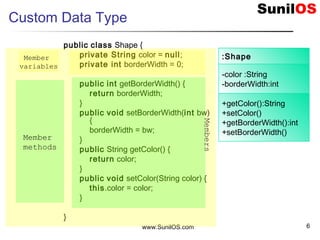
Custom Data Type
public class Shape {
private String color = null;
private int borderWidth = 0;
public int getBorderWidth() {
return borderWidth;
}
public void setBorderWidth(int bw)
{
borderWidth = bw;
}
public String getColor() {
return color;
}
public void setColor(String color) {
this.color = color;
}
}
:Shape
-color :String
-borderWidth:int
+getColor():String
+setColor()
+getBorderWidth():int
+setBorderWidth()
Members
Member
variables
Member
methods
www.SunilOS.com 7
Method Definition
public class Shape {
..
public void setBorderWidth(int bw)
{
borderWidth = bw;
}
}
Method
www.SunilOS.com 8
Define attribute/variable
 public class TestShape {
o public static void main(String[] args){
 Shape s; //Declaration
 s = new Shape(); //Instantiation
 s.setColor(“Red”);
 s.setBorderWidth(3);
 ….
 int borderW =s.getBorderWidth();
 System.out.println(borderW) ;
o }
 }
S is an object here
S is an instance
here
Real World Entities – More Classes
www.SunilOS.com 9
:Automobile
-color :String
-speed:int
-make:String
+$NO_OF_GEARS
+getColor():String
+setColor()
+getMake():String
+setMake()
+break()
+changeGear()
+accelerator()
+getSpeed():int
:Person
-name:String
-dob : Date
-address:String
+$AVG_AGE
+getName():String
+setName()
+getAdress():String
+setAddress()
+getDob (): Date
+setDob ()
+getAge() : int
:Account
-number:String
-accountType : String
-balance:double
+getNumber():String
+setNumber()
+getAccountType():String
+setAccountType()
+deposit ()
+withdrawal ()
+getBalance():double
+fundTransfer()
+payBill()
www.SunilOS.com 10
Define A Class - Shape
public class Shape {
private string color = null;
private int borderWidth = 0;
public static final float PI = 3.14;
public int getBorderWidth() {
return borderWidth;
}
public void setBorderWidth(int bw) {
borderWidth = bw;
}
public String getColor() {
return color;
}
public void setColor(String color) {
this.color = color;
}
}
:Shape
-color :String
-borderWidth:int
+$PI=3.14
+getColor():String
+setColor()
+getBorderWidth():int
+setBorderWidth()
Shape s1 = new Shape();
Shape s2 = new Shape();
S.o.p( s1.PI );
S.o.p( s2.PI );
S.o.p( Shape.PI );
www.SunilOS.com 11
Constructor
public class Shape {
private String color = null;
private int borderWidth = 0;
public Shape(){
System.out.println(
“This is default constructor”);
}
……………
Shape s = new Shape();
 Constructor is just like a method.
 It does not have return type.
 Its name is same as Class name.
 It is called at the time of object
instantiation (new Shape()).
 Constructors are used to initialize
instance/class variables.
 A class may have multiple
constructors with different number
of parameters.
www.SunilOS.com 12
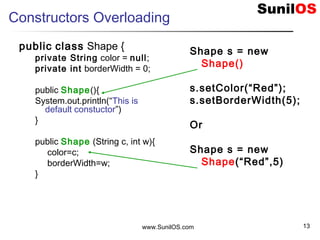
Multiple Constructors
One class may have more than one constructors.
Multiple constructors are used to initialize different
sets of class attributes.
When a class has more than one constructors, it is
called Constructor Overloading.
Constructors those receive parameters are called
Parameterized Constructors.
www.SunilOS.com 13
Constructors Overloading
public class Shape {
private String color = null;
private int borderWidth = 0;
public Shape(){
System.out.println(“This is
default constuctor”)
}
public Shape (String c, int w){
color=c;
borderWidth=w;
}
Shape s = new
Shape()
s.setColor(“Red”);
s.setBorderWidth(5);
Or
Shape s = new
Shape(“Red”,5)
Default Constructor
 Default constructor does not receive any parameter.
o public Shape(){ .. }
 If User does not define any constructor then Default
Constructor will be created by Java Compiler.
 But if user defines single or multiple constructors then
default constructor will not be generated by Java Compiler.
www.SunilOS.com 14
www.SunilOS.com 15
Declare an Instance/Object
Declare Primitive
Type
int i;
i=5;
Declare Object
Shape s1,s2;
s1 = new Shape();
s2 = new Shape();
5
4 Bytes
s1
2 Bytes
s2
2 Bytes
getColor()
setColor()
getBorderWidth()
setBorderWidth()
Color
borderWidth
Color
borderWidth
www.SunilOS.com 16
Instance vs static attributes
instance
static
instance
static
Attributes Methods
+getColor()
+setColor()
+getBorderWidth()
+setBorderWiidth()
PI = 3.14
Shape s1, s2
s1 = new Shape()
s2 = new Shape()
color = Red
borderWidth= 5
color = White
borderWidth= 10
s1
s2s1.getColor()
s2.getBorderWidth()
s1.PI
Shape.PI
Class
1011
1010
1010
1011
2B
2B
:Shape
-color :String
-borderWidth:int
+$PI =3.14
+getColor():String
+setColor()
+getBorderWidth():int
+setBorderWidth()
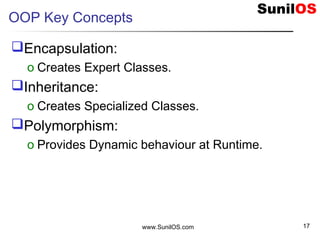
OOP Key Concepts
Encapsulation:
o Creates Expert Classes.
Inheritance:
o Creates Specialized Classes.
Polymorphism:
o Provides Dynamic behaviour at Runtime.
www.SunilOS.com 17
www.SunilOS.com 18
Encapsulation
Gathering all related methods and attributes in a
Class is called encapsulation.
Often, for practical reasons, an object may wish
to expose some of its variables or hide some of
its methods.
Access Levels:
Modifier Class Subclass Packag
e
World
private X
protected X X X
public X X X X
www.SunilOS.com 19
Inheritance
:Shape
color :String
borderWidth:int
getColor():String
setColor()
getBorderWidth():int
setBorderWidth()
:Rectangle
length :int
width:int
area()
getLength()
setLength()
:Circle
radius : int
area()
getRadius()
setRadius()
:Triangle
base:int
hight:int
area()
getBase()
setBase()
Circle c =new Circle();
c.getColor();
c.getBorderWidth();
c.area();
:Object
UML Notation
www.SunilOS.com 20
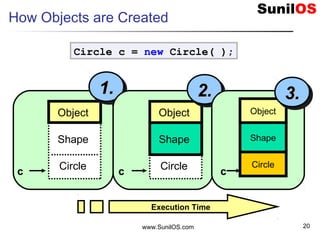
How Objects are Created
Circle c = new Circle( );
Execution Time
c
Shape
Circle
Object
1.1.1.1.
c
Shape
Circle
Object
2.2.2.2.
Object
c
3.3.3.3.
Shape
Circle
www.SunilOS.com 21
Parents Can Keep Child’s Reference
 Circle c = new Circle();
o c.getColor()
o c.getBorderBidth()
o c.area()
 Shape s = new Circle();
o s.getColor()
o s.getBorderBidth()
o s.area()
 Circle c1 = (Circle) s;
o c1.getColor()
o c1.getBorderBidth()
o c1.area()
www.SunilOS.com 22
Parents Can Keep Child’s Reference
Shape s = new Circle( );
Execution Time
s
Shape
Circle
Object
1.1.1.1.
s
Shape
Circle
Object
2.2.2.2.
Object
s
3.3.3.3.
Shape
Circle
Accessible
Window
www.SunilOS.com 23
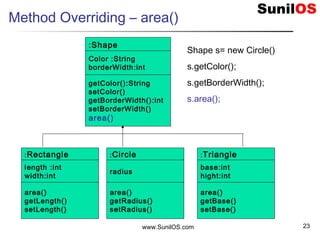
Method Overriding – area()
:Shape
Color :String
borderWidth:int
getColor():String
setColor()
getBorderWidth():int
setBorderWidth()
area()
:Rectangle
length :int
width:int
area()
getLength()
setLength()
:Circle
radius
area()
getRadius()
setRadius()
:Triangle
base:int
hight:int
area()
getBase()
setBase()
Shape s= new Circle()
s.getColor();
s.getBorderWidth();
s.area();
www.SunilOS.com 24
Polymorphism
 Three Common Uses of Polymorphism:
o Using Polymorphism in Arrays.
o Using Polymorphism for Method Arguments.
o Using Polymorphism for Method Return Type.
 Ways to Provide polymorphism:
o Through Interfaces.
o Method Overriding.
o Method Overloading.
www.SunilOS.com 25
1) Using Polymorphism in Arrays
Shape s[] = new Shape[3];
s[0] = new Rectangle()
s[1] = new Circle()
s[2] = new Triangle()
s[0]:Rectangle
color
borderWidth
length = 17
Width = 35
s[1]:Circle
color
borderWidth
radius = 11
s[2]:Triangle
color
borderWidth
base:15
hight:7
www.SunilOS.com 26
1) Using Polymorphism in Arrays
 Shape[] s;
 s = new Shape[3];
 s[0] = new Rectangle()
 s[1] = new Circle()
 s[2] = new Triangle()
2B
3
[0]
[1]
[2]
length
color
borderWidth
length
width
color
borderWidth
radius
color
borderWidth
Base
hight
1010
1111
1011
1010
1011
1111
1000
1000
www.SunilOS.com 27
2) Using Polymorphism for Method Arguments
public static void main(String[] args) {
Shape[] s = new Shape[3];
s[0] = new Rectangle();
s[1] = new Circle();
s[2] = new Triangle();
double totalArea = calcArea(s);
System.out.println(totalArea);
}
public static double calcArea(Shape[] s) {
double totalArea = 0;
for(int i =0;i<s.length; i++){
totalArea += s[i].area();
}
return totalArea;
}
*The method overriding is an example of runtime polymorphism.
www.SunilOS.com 28
3) Polymorphism using Return Type
public static Shape getShape(int i) {
if (i == 1) return new Rectangle();
if (i == 2) return new Circle();
if (i == 3) return new Triangle();
}
www.SunilOS.com 29
Method Overloading
PrintWriter
o println(String)
o println(int)
o println(double)
o println(boolean)
o println()
www.SunilOS.com 30
The Final modifier
Class :
o Final classes can not have Children.
o public final class Math
Method:
o Final Methods can not be overridden.
o public final double sqrt(int i);
Attribute:
o Final attributes can be assigned a value once in a life.
o public final float PI = 3.14;
www.SunilOS.com 31
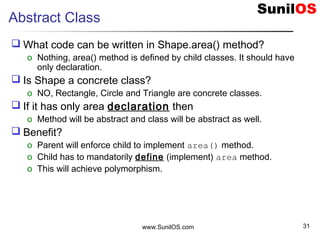
Abstract Class
 What code can be written in Shape.area() method?
o Nothing, area() method is defined by child classes. It should have
only declaration.
 Is Shape a concrete class?
o NO, Rectangle, Circle and Triangle are concrete classes.
 If it has only area declaration then
o Method will be abstract and class will be abstract as well.
 Benefit?
o Parent will enforce child to implement area() method.
o Child has to mandatorily define (implement) area method.
o This will achieve polymorphism.
www.SunilOS.com 32
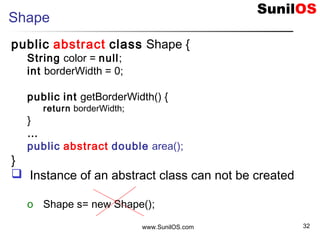
Shape
public abstract class Shape {
String color = null;
int borderWidth = 0;
public int getBorderWidth() {
return borderWidth;
}
…
public abstract double area();
}
 Instance of an abstract class can not be created
o Shape s= new Shape();
www.SunilOS.com 33
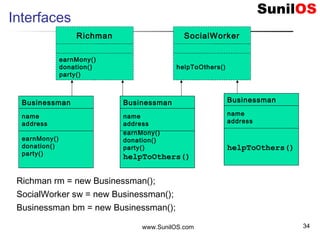
Interface
When all methods are abstract then interface is
created.
It has abstract methods and constants.
It represents a role (abstract view) for a class.
One interface can extend another interface using
extends keyword.
One Class can implement multiple interfaces using
implements keyword.
www.SunilOS.com 34
Interfaces
Richman
earnMony()
donation()
party()
Businessman
name
address
earnMony()
donation()
party()
Richman rm = new Businessman();
SocialWorker sw = new Businessman();
Businessman bm = new Businessman();
SocialWorker
helpToOthers()
Businessman
name
address
earnMony()
donation()
party()
helpToOthers()
Businessman
name
address
helpToOthers()
www.SunilOS.com 35
interface Richman
public interface Richman {
o public void earnMoney();
o public void donation();
o public void party();
}
www.SunilOS.com 36
interface SocialWorker
public interface SocialWorker{
o public void helpToOthers();
}
www.SunilOS.com 37
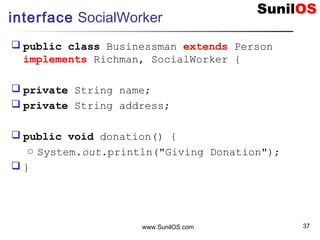
interface SocialWorker
 public class Businessman extends Person
implements Richman, SocialWorker {
 private String name;
 private String address;
 public void donation() {
o System.out.println("Giving Donation");
 }
www.SunilOS.com 38
Interface
It declares APIs.
Specifications are defined as interfaces.
o JDBC
o Collection
o EJB
o JNI
o etc.
Data Abstraction
www.SunilOS.com 39
Data Abstraction ( Cont. )
Data abstraction is the way to create complex data
types and exposing only meaningful operations to
interact with data type, whereas hiding all the
implementation details from outside world.
Data Abstraction is a process of hiding the
implementation details and showing only the
functionality.
Data Abstraction in java is achieved by interfaces
and abstract classes.
www.SunilOS.com 40
Data Hiding
www.SunilOS.com 41
Data Hiding ( Cont. )
Data Hiding is an aspect of Object Oriented
Programming (OOP) that allows developers
to protect private data and hide
implementation details.
Developers can hide class members from
other classes. Access of class members
can be restricted or hide with the help of
access modifiers.
www.SunilOS.com 42
www.SunilOS.com 43
How a constructor can call another constructor ?
 public class Person {
 protected String firstName = null;
 protected String lastName = null;
 protected String address = null;
 public Person() {
 System.out.println("Person Default Con");
 }
 public Person(String fn, String ln) {
o firstName = fn;
o lastName = ln;
o System.out.println(“2 params constructor is called");
 }
www.SunilOS.com 44
How a constructor can call another constructor ?
 public Person(String fn, String ln, String address) {
o firstName = fn;
o lastName = ln;
o this.address = address;
o System.out.println(“3 params constructor is called");
 }
www.SunilOS.com 45
How a constructor can call another constructor ?
 public Person() {
 System.out.println("Person Default Con");
 }
 public Person(String fn, String ln) {
o firstName = fn;
o lastName = ln;
o System.out.println("2 params constructor is called");
 }
 public Person(String fn, String ln, String address) {
1. this(fn,ln) ;
2. this.address = address;
3. System.out.println(“3 params constructor is called");
 }
www.SunilOS.com 46
How to Call Parent Constructor
 public class Employee extends Person {
 private String designation = null;
 public Employee() {
 System.out.println("Default Constructor");
 }
 public Employee(String fn, String ln, String des) {
 super(fn, ln);
 designation = des;
 System.out.println(“3 params constructor is called");
 }
www.SunilOS.com 47
Super default constructor
 If Child constructor does not call parent’s constructor then Parent’s
default constructor is automatically called.
 public Employee() {
 System.out.println("Default Constructor");
 }
 Is Equal to
 public Employee() {
 super();
 System.out.println("Default Constructor");
 }
www.SunilOS.com 48
Super default constructor (cont.)
 public Employee(String fn, String ln, String des) {
o designation = des;
o System.out.println(“3 params constructor is called ");
 }
 Is Equal to
 public Employee(String fn, String ln, String des) {
o super();
o designation = des;
o System.out.println(“3 params constructor is called");
 }
www.SunilOS.com 49
How to call Parent’s overridden method?
 public class Person {
 public void changeAddress() {
o System.out.println("Person change Address");
 }
 …
 public class Employee extends Person {
 public void changeAddress() {
o System.out.println("*****");
o super.changeAddress();
o System.out.println("Employee change Address");
 }
 …
www.SunilOS.com 50
Interesting facts - Overriding
 public class Account{
o public int getAmount() {
o return 5;
o }
 }
 public class SavingAccount extends Account {
o public int getAmount() {
 return 10;
o }
 }
www.SunilOS.com 51
What is Output Of
 public class Test {
 public static void main(String[] args) {
o SavingAccount s = new SavingAccount ();
o Account a = new Account ();
o Account sa = new SavingAccount ();
o System.out.println(s.getAmount());
o System.out.println(a.getAmount());
o System.out.println(sa.getAmount());
o }
 }
Interesting facts - Overriding
 public class Account{
o public int getAmount() {
o return 5;
o }
 }
 public class SavingAccount extends Account{
o public int getAmount() {
 int i = super.getAmount() + 10;
 return i;
o }
 }
www.SunilOS.com 52
www.SunilOS.com 53
Constructor and Inheritance
class A {
...
}
class B extends A {
public B(int x){}
}
B b = new B(3);
OK
-default constr. A()
-B(int x)
Implicit call of base class constructor
class A {
public A() {...}
}
class B extends A {
public B(int x) {...}
}
B b = new B(3);
OK
-A()
-B(int x)
class A {
public A(int x) {...}
}
class B extends A {
public B(int x) {...}
}
B b = new B(3);
Error!
-no explicit call of
the A() constructor
-default constr. A()
does not exist
class A {
public A(int x) {...}
}
class B extends A {
public B(int x){
super(x) ...}
}
B b = new B(3);
OK
-A(int x)
-B(int x)
Explicit call
Disclaimer
This is an educational presentation to enhance the
skill of computer science students.
This presentation is available for free to computer
science students.
Some internet images from different URLs are
used in this presentation to simplify technical
examples and correlate examples with the real
world.
We are grateful to owners of these URLs and
pictures.
www.SunilOS.com 54
Thank You!
www.SunilOS.com 55
www.SunilOS.com

JAVA OOP

  • 1.
  • 2.
    2 Object-Oriented Programming Concepts Whatis an Object? What is a Class? What is a Message? Encapsulation? Inheritance? Polymorphism/Dynamic Binding? Data Hiding? Data Abstraction? www.SunilOS.com
  • 3.
    3 Java Primitive DataTypes Primitive Data Types: o boolean true or false o char unicode (16 bits) o byte signed 8 bit integer o short signed 16 bit integer o int signed 32 bit integer o long signed 64 bit integer o float,double floating point values www.SunilOS.com
  • 4.
    4 Other Data Types Referencetypes (composite) o objects o arrays strings are supported by a built-in class named String (java.lang.String). string literals are supported by the language (as a special case). www.SunilOS.com
  • 5.
    www.SunilOS.com 5 Attributes String color= “Red” ; int borderWidth = 5 ; //…… System.out.println(borderWidth) ;
  • 6.
    www.SunilOS.com 6 Custom DataType public class Shape { private String color = null; private int borderWidth = 0; public int getBorderWidth() { return borderWidth; } public void setBorderWidth(int bw) { borderWidth = bw; } public String getColor() { return color; } public void setColor(String color) { this.color = color; } } :Shape -color :String -borderWidth:int +getColor():String +setColor() +getBorderWidth():int +setBorderWidth() Members Member variables Member methods
  • 7.
    www.SunilOS.com 7 Method Definition publicclass Shape { .. public void setBorderWidth(int bw) { borderWidth = bw; } } Method
  • 8.
    www.SunilOS.com 8 Define attribute/variable public class TestShape { o public static void main(String[] args){  Shape s; //Declaration  s = new Shape(); //Instantiation  s.setColor(“Red”);  s.setBorderWidth(3);  ….  int borderW =s.getBorderWidth();  System.out.println(borderW) ; o }  } S is an object here S is an instance here
  • 9.
    Real World Entities– More Classes www.SunilOS.com 9 :Automobile -color :String -speed:int -make:String +$NO_OF_GEARS +getColor():String +setColor() +getMake():String +setMake() +break() +changeGear() +accelerator() +getSpeed():int :Person -name:String -dob : Date -address:String +$AVG_AGE +getName():String +setName() +getAdress():String +setAddress() +getDob (): Date +setDob () +getAge() : int :Account -number:String -accountType : String -balance:double +getNumber():String +setNumber() +getAccountType():String +setAccountType() +deposit () +withdrawal () +getBalance():double +fundTransfer() +payBill()
  • 10.
    www.SunilOS.com 10 Define AClass - Shape public class Shape { private string color = null; private int borderWidth = 0; public static final float PI = 3.14; public int getBorderWidth() { return borderWidth; } public void setBorderWidth(int bw) { borderWidth = bw; } public String getColor() { return color; } public void setColor(String color) { this.color = color; } } :Shape -color :String -borderWidth:int +$PI=3.14 +getColor():String +setColor() +getBorderWidth():int +setBorderWidth() Shape s1 = new Shape(); Shape s2 = new Shape(); S.o.p( s1.PI ); S.o.p( s2.PI ); S.o.p( Shape.PI );
  • 11.
    www.SunilOS.com 11 Constructor public classShape { private String color = null; private int borderWidth = 0; public Shape(){ System.out.println( “This is default constructor”); } …………… Shape s = new Shape();  Constructor is just like a method.  It does not have return type.  Its name is same as Class name.  It is called at the time of object instantiation (new Shape()).  Constructors are used to initialize instance/class variables.  A class may have multiple constructors with different number of parameters.
  • 12.
    www.SunilOS.com 12 Multiple Constructors Oneclass may have more than one constructors. Multiple constructors are used to initialize different sets of class attributes. When a class has more than one constructors, it is called Constructor Overloading. Constructors those receive parameters are called Parameterized Constructors.
  • 13.
    www.SunilOS.com 13 Constructors Overloading publicclass Shape { private String color = null; private int borderWidth = 0; public Shape(){ System.out.println(“This is default constuctor”) } public Shape (String c, int w){ color=c; borderWidth=w; } Shape s = new Shape() s.setColor(“Red”); s.setBorderWidth(5); Or Shape s = new Shape(“Red”,5)
  • 14.
    Default Constructor  Defaultconstructor does not receive any parameter. o public Shape(){ .. }  If User does not define any constructor then Default Constructor will be created by Java Compiler.  But if user defines single or multiple constructors then default constructor will not be generated by Java Compiler. www.SunilOS.com 14
  • 15.
    www.SunilOS.com 15 Declare anInstance/Object Declare Primitive Type int i; i=5; Declare Object Shape s1,s2; s1 = new Shape(); s2 = new Shape(); 5 4 Bytes s1 2 Bytes s2 2 Bytes getColor() setColor() getBorderWidth() setBorderWidth() Color borderWidth Color borderWidth
  • 16.
    www.SunilOS.com 16 Instance vsstatic attributes instance static instance static Attributes Methods +getColor() +setColor() +getBorderWidth() +setBorderWiidth() PI = 3.14 Shape s1, s2 s1 = new Shape() s2 = new Shape() color = Red borderWidth= 5 color = White borderWidth= 10 s1 s2s1.getColor() s2.getBorderWidth() s1.PI Shape.PI Class 1011 1010 1010 1011 2B 2B :Shape -color :String -borderWidth:int +$PI =3.14 +getColor():String +setColor() +getBorderWidth():int +setBorderWidth()
  • 17.
    OOP Key Concepts Encapsulation: oCreates Expert Classes. Inheritance: o Creates Specialized Classes. Polymorphism: o Provides Dynamic behaviour at Runtime. www.SunilOS.com 17
  • 18.
    www.SunilOS.com 18 Encapsulation Gathering allrelated methods and attributes in a Class is called encapsulation. Often, for practical reasons, an object may wish to expose some of its variables or hide some of its methods. Access Levels: Modifier Class Subclass Packag e World private X protected X X X public X X X X
  • 19.
    www.SunilOS.com 19 Inheritance :Shape color :String borderWidth:int getColor():String setColor() getBorderWidth():int setBorderWidth() :Rectangle length:int width:int area() getLength() setLength() :Circle radius : int area() getRadius() setRadius() :Triangle base:int hight:int area() getBase() setBase() Circle c =new Circle(); c.getColor(); c.getBorderWidth(); c.area(); :Object UML Notation
  • 20.
    www.SunilOS.com 20 How Objectsare Created Circle c = new Circle( ); Execution Time c Shape Circle Object 1.1.1.1. c Shape Circle Object 2.2.2.2. Object c 3.3.3.3. Shape Circle
  • 21.
    www.SunilOS.com 21 Parents CanKeep Child’s Reference  Circle c = new Circle(); o c.getColor() o c.getBorderBidth() o c.area()  Shape s = new Circle(); o s.getColor() o s.getBorderBidth() o s.area()  Circle c1 = (Circle) s; o c1.getColor() o c1.getBorderBidth() o c1.area()
  • 22.
    www.SunilOS.com 22 Parents CanKeep Child’s Reference Shape s = new Circle( ); Execution Time s Shape Circle Object 1.1.1.1. s Shape Circle Object 2.2.2.2. Object s 3.3.3.3. Shape Circle Accessible Window
  • 23.
    www.SunilOS.com 23 Method Overriding– area() :Shape Color :String borderWidth:int getColor():String setColor() getBorderWidth():int setBorderWidth() area() :Rectangle length :int width:int area() getLength() setLength() :Circle radius area() getRadius() setRadius() :Triangle base:int hight:int area() getBase() setBase() Shape s= new Circle() s.getColor(); s.getBorderWidth(); s.area();
  • 24.
    www.SunilOS.com 24 Polymorphism  ThreeCommon Uses of Polymorphism: o Using Polymorphism in Arrays. o Using Polymorphism for Method Arguments. o Using Polymorphism for Method Return Type.  Ways to Provide polymorphism: o Through Interfaces. o Method Overriding. o Method Overloading.
  • 25.
    www.SunilOS.com 25 1) UsingPolymorphism in Arrays Shape s[] = new Shape[3]; s[0] = new Rectangle() s[1] = new Circle() s[2] = new Triangle() s[0]:Rectangle color borderWidth length = 17 Width = 35 s[1]:Circle color borderWidth radius = 11 s[2]:Triangle color borderWidth base:15 hight:7
  • 26.
    www.SunilOS.com 26 1) UsingPolymorphism in Arrays  Shape[] s;  s = new Shape[3];  s[0] = new Rectangle()  s[1] = new Circle()  s[2] = new Triangle() 2B 3 [0] [1] [2] length color borderWidth length width color borderWidth radius color borderWidth Base hight 1010 1111 1011 1010 1011 1111 1000 1000
  • 27.
    www.SunilOS.com 27 2) UsingPolymorphism for Method Arguments public static void main(String[] args) { Shape[] s = new Shape[3]; s[0] = new Rectangle(); s[1] = new Circle(); s[2] = new Triangle(); double totalArea = calcArea(s); System.out.println(totalArea); } public static double calcArea(Shape[] s) { double totalArea = 0; for(int i =0;i<s.length; i++){ totalArea += s[i].area(); } return totalArea; } *The method overriding is an example of runtime polymorphism.
  • 28.
    www.SunilOS.com 28 3) Polymorphismusing Return Type public static Shape getShape(int i) { if (i == 1) return new Rectangle(); if (i == 2) return new Circle(); if (i == 3) return new Triangle(); }
  • 29.
    www.SunilOS.com 29 Method Overloading PrintWriter oprintln(String) o println(int) o println(double) o println(boolean) o println()
  • 30.
    www.SunilOS.com 30 The Finalmodifier Class : o Final classes can not have Children. o public final class Math Method: o Final Methods can not be overridden. o public final double sqrt(int i); Attribute: o Final attributes can be assigned a value once in a life. o public final float PI = 3.14;
  • 31.
    www.SunilOS.com 31 Abstract Class What code can be written in Shape.area() method? o Nothing, area() method is defined by child classes. It should have only declaration.  Is Shape a concrete class? o NO, Rectangle, Circle and Triangle are concrete classes.  If it has only area declaration then o Method will be abstract and class will be abstract as well.  Benefit? o Parent will enforce child to implement area() method. o Child has to mandatorily define (implement) area method. o This will achieve polymorphism.
  • 32.
    www.SunilOS.com 32 Shape public abstractclass Shape { String color = null; int borderWidth = 0; public int getBorderWidth() { return borderWidth; } … public abstract double area(); }  Instance of an abstract class can not be created o Shape s= new Shape();
  • 33.
    www.SunilOS.com 33 Interface When allmethods are abstract then interface is created. It has abstract methods and constants. It represents a role (abstract view) for a class. One interface can extend another interface using extends keyword. One Class can implement multiple interfaces using implements keyword.
  • 34.
    www.SunilOS.com 34 Interfaces Richman earnMony() donation() party() Businessman name address earnMony() donation() party() Richman rm= new Businessman(); SocialWorker sw = new Businessman(); Businessman bm = new Businessman(); SocialWorker helpToOthers() Businessman name address earnMony() donation() party() helpToOthers() Businessman name address helpToOthers()
  • 35.
    www.SunilOS.com 35 interface Richman publicinterface Richman { o public void earnMoney(); o public void donation(); o public void party(); }
  • 36.
    www.SunilOS.com 36 interface SocialWorker publicinterface SocialWorker{ o public void helpToOthers(); }
  • 37.
    www.SunilOS.com 37 interface SocialWorker public class Businessman extends Person implements Richman, SocialWorker {  private String name;  private String address;  public void donation() { o System.out.println("Giving Donation");  }
  • 38.
    www.SunilOS.com 38 Interface It declaresAPIs. Specifications are defined as interfaces. o JDBC o Collection o EJB o JNI o etc.
  • 39.
  • 40.
    Data Abstraction (Cont. ) Data abstraction is the way to create complex data types and exposing only meaningful operations to interact with data type, whereas hiding all the implementation details from outside world. Data Abstraction is a process of hiding the implementation details and showing only the functionality. Data Abstraction in java is achieved by interfaces and abstract classes. www.SunilOS.com 40
  • 41.
  • 42.
    Data Hiding (Cont. ) Data Hiding is an aspect of Object Oriented Programming (OOP) that allows developers to protect private data and hide implementation details. Developers can hide class members from other classes. Access of class members can be restricted or hide with the help of access modifiers. www.SunilOS.com 42
  • 43.
    www.SunilOS.com 43 How aconstructor can call another constructor ?  public class Person {  protected String firstName = null;  protected String lastName = null;  protected String address = null;  public Person() {  System.out.println("Person Default Con");  }  public Person(String fn, String ln) { o firstName = fn; o lastName = ln; o System.out.println(“2 params constructor is called");  }
  • 44.
    www.SunilOS.com 44 How aconstructor can call another constructor ?  public Person(String fn, String ln, String address) { o firstName = fn; o lastName = ln; o this.address = address; o System.out.println(“3 params constructor is called");  }
  • 45.
    www.SunilOS.com 45 How aconstructor can call another constructor ?  public Person() {  System.out.println("Person Default Con");  }  public Person(String fn, String ln) { o firstName = fn; o lastName = ln; o System.out.println("2 params constructor is called");  }  public Person(String fn, String ln, String address) { 1. this(fn,ln) ; 2. this.address = address; 3. System.out.println(“3 params constructor is called");  }
  • 46.
    www.SunilOS.com 46 How toCall Parent Constructor  public class Employee extends Person {  private String designation = null;  public Employee() {  System.out.println("Default Constructor");  }  public Employee(String fn, String ln, String des) {  super(fn, ln);  designation = des;  System.out.println(“3 params constructor is called");  }
  • 47.
    www.SunilOS.com 47 Super defaultconstructor  If Child constructor does not call parent’s constructor then Parent’s default constructor is automatically called.  public Employee() {  System.out.println("Default Constructor");  }  Is Equal to  public Employee() {  super();  System.out.println("Default Constructor");  }
  • 48.
    www.SunilOS.com 48 Super defaultconstructor (cont.)  public Employee(String fn, String ln, String des) { o designation = des; o System.out.println(“3 params constructor is called ");  }  Is Equal to  public Employee(String fn, String ln, String des) { o super(); o designation = des; o System.out.println(“3 params constructor is called");  }
  • 49.
    www.SunilOS.com 49 How tocall Parent’s overridden method?  public class Person {  public void changeAddress() { o System.out.println("Person change Address");  }  …  public class Employee extends Person {  public void changeAddress() { o System.out.println("*****"); o super.changeAddress(); o System.out.println("Employee change Address");  }  …
  • 50.
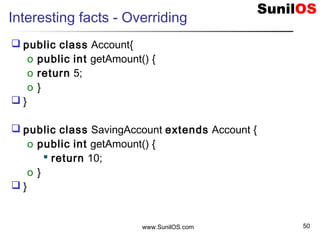
    www.SunilOS.com 50 Interesting facts- Overriding  public class Account{ o public int getAmount() { o return 5; o }  }  public class SavingAccount extends Account { o public int getAmount() {  return 10; o }  }
  • 51.
    www.SunilOS.com 51 What isOutput Of  public class Test {  public static void main(String[] args) { o SavingAccount s = new SavingAccount (); o Account a = new Account (); o Account sa = new SavingAccount (); o System.out.println(s.getAmount()); o System.out.println(a.getAmount()); o System.out.println(sa.getAmount()); o }  }
  • 52.
    Interesting facts -Overriding  public class Account{ o public int getAmount() { o return 5; o }  }  public class SavingAccount extends Account{ o public int getAmount() {  int i = super.getAmount() + 10;  return i; o }  } www.SunilOS.com 52
  • 53.
    www.SunilOS.com 53 Constructor andInheritance class A { ... } class B extends A { public B(int x){} } B b = new B(3); OK -default constr. A() -B(int x) Implicit call of base class constructor class A { public A() {...} } class B extends A { public B(int x) {...} } B b = new B(3); OK -A() -B(int x) class A { public A(int x) {...} } class B extends A { public B(int x) {...} } B b = new B(3); Error! -no explicit call of the A() constructor -default constr. A() does not exist class A { public A(int x) {...} } class B extends A { public B(int x){ super(x) ...} } B b = new B(3); OK -A(int x) -B(int x) Explicit call
  • 54.
    Disclaimer This is aneducational presentation to enhance the skill of computer science students. This presentation is available for free to computer science students. Some internet images from different URLs are used in this presentation to simplify technical examples and correlate examples with the real world. We are grateful to owners of these URLs and pictures. www.SunilOS.com 54
  • 55.