INTRODUCTION TO
OBJECT- ORIENTED
PROGRAMMIMG
Malathi P
Dept. Computer Science
1
"Oops in Java" by Malathi is in the Public Domain, CC0
PROCEDURAL PROGRAMMING
• Traditional programming languages were procedural.
– C, Pascal, BASIC, Ada and COBOL.
• Programming in procedural languages involves choosing data
structures (appropriate ways to store data), designing algorithms,
and translating algorithm into code.
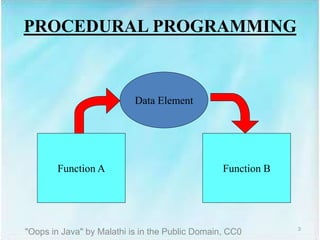
• In procedural programming, data and operations on the data are
separated.2
• This methodology requires sending data to procedure/functions.
"Oops in Java" by Malathi is in the Public Domain, CC0
2
Function A
Data Element
Function B
PROCEDURAL PROGRAMMING
"Oops in Java" by Malathi is in the Public Domain, CC0 3
OBJECT ORIENTED
PROGRAMMING
• Object-oriented programming is
centered on creating objects
rather than procedures/
functions.
• Objects are a melding of data
and procedures that manipulate
that data.
• Data in an object are known as
attributes.
• Procedures/functions in an
object are known as methods.
Object
Attributes (data)
Methods
(behaviors / procedures)
"Oops in Java" by Malathi is in the Public Domain, CC0
4
• Object-oriented programming combines data and behavior
via encapsulation.
• Data hiding is the ability of an object to hide data from other
objects in the program.
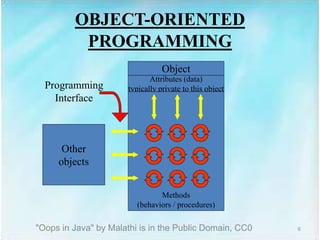
• Only an objects methods should be able to directly
manipulate its attributes.
• Other objects are allowed to manipulate an object’s attributes
via the object’s methods.
• This indirect access is known as a programming interface.
OBJECT ORIENTED
PROGRAMMING
"Oops in Java" by Malathi is in the Public Domain, CC0 5
Object
Attributes (data)
typically private to this object
Methods
(behaviors / procedures)
Other
objects
Programming
Interface
OBJECT-ORIENTED
PROGRAMMING
"Oops in Java" by Malathi is in the Public Domain, CC0 6
• Pure OO Languages
Smalltalk, Eiffel, Actor, Java
• Hybrid OO Languages
C++, Objective-C, Object-Pascal
OBJECT ORIENTED
PROGRAMMING - LANGUAGES
"Oops in Java" by Malathi is in the Public Domain, CC0
7
VOCABULARY OF OOP
• CLASS
• OBJECT
• ENCAPSULATION implement DATA
HIDING
• INHERITANCE
• POLYMORPHISM
• MESSAGE PASSING
"Oops in Java" by Malathi is in the
Public Domain, CC0
8
CLASS
The most important term.
– A class is the template or blueprint from which
objects are actually made.
– Class is a logical entity, It can't be physical.
– All code that we write in Java is inside a class.
– The standard Java library supplies several thousand
classes.
 A class encapsulates the attributes and actions that
characterizes a certain type of object.
"Oops in Java" by Malathi is in the
Public Domain, CC0
9
OBJECTS
• Classes can be used to instantiate as many objects as
are needed.
• Each object that is created from a class is called an
instance of the class.
• A program is simply a collection of objects that
interact with each other to accomplish a goal.
"Oops in Java" by Malathi is in the
Public Domain, CC0
10
CLASSES AND OBJECTS
"Oops in Java" by Malathi is in the
Public Domain, CC0
11
ENCAPSULATION
key concept in working with objects.
– Combining data and behavior in
one package and hiding the
implementation of the data from
the user of the object.
– The data in an object are called
its instance fields, and the
procedures that operate on the
data are called its methods.
– The key to making
encapsulation work is to have
methods never directly access
instance fields in a class other
than their own.
– Programs should interact with
object data only through the
object's methods.
– By encapsulating object data,
you maximize reusability,
reduce data dependency, and
minimize debugging time.
"Oops in Java" by Malathi is in the Public Domain, CC0 12
DATA HIDING IMPLEMENTED
THROUGH ENCAPSULATION
Data Hiding is important for several reasons.
– It protects of attributes from accidental corruption
by outside objects.
– It hides the details of how an object works, so the
programmer can concentrate on using it.
– It allows the maintainer of the object to have the
ability to modify the internal functioning of the
object without “breaking” someone else's code.
"Oops in Java" by Malathi is in the
Public Domain, CC0
13
ALLOW CODE RESUABILITY
• Object-Oriented Programming (OOP) has encouraged component
reusability.
• A component is a software object contains data and methods that
represents a specific concept or service.
• Components typically are not stand-alone programs.
• Components can be used by programs that need the component’s
service.
• Reuse of code promotes the rapid development of larger software
projects. "Oops in Java" by Malathi is in the
Public Domain, CC0
14
INHERITANCE
• Inheritance is the ability of one class to extend the capabilities
of another.
– it allows code defined in one class to be reused in other
classes
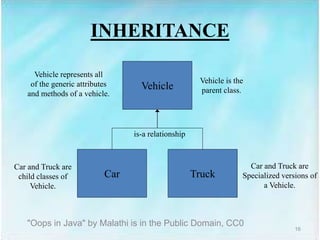
• Consider the class Car. A Car is a specialized form of the
Vehicle class.
– So, is said that the Vehicle class is the base or parent class
of the Car class.
– The Car class is the derived or child class of the Vehicle
class.
"Oops in Java" by Malathi is in the Public Domain, CC0 15
INHERITANCE
Vehicle
Vehicle is the
parent class.
TruckCar
is-a relationship
Car and Truck are
child classes of
Vehicle.
Car and Truck are
Specialized versions of
a Vehicle.
Vehicle represents all
of the generic attributes
and methods of a vehicle.
"Oops in Java" by Malathi is in the Public Domain, CC0
16
POLYMORPHISM
• Polymorphism means "many forms."
– A reference variable is always of a single,
unchangeable type, but it can refer to a subtype object.
– A single object can be referred to by reference
variables of many different types—as long as they are
the same type or a supertype of the object.q The
reference variable's type (not the object's type),
determines which methods can be called!
• Polymorphism allows extensibility.
"Oops in Java" by Malathi is in the Public Domain, CC0
17
BENEFITS OF OBJECT-ORIENTED
PROGRAMMING
• Save development time (and cost) by reusing code
– once an object class is created it can be used in
other applications
• Easier debugging
– classes can be tested independently
– reused objects have already been tested
"Oops in Java" by Malathi is in the Public Domain, CC0
18
THANK YOU
"Oops in Java" by Malathi is in the Public Domain, CC0 19

Oops in Java

  • 1.
    INTRODUCTION TO OBJECT- ORIENTED PROGRAMMIMG MalathiP Dept. Computer Science 1 "Oops in Java" by Malathi is in the Public Domain, CC0
  • 2.
    PROCEDURAL PROGRAMMING • Traditionalprogramming languages were procedural. – C, Pascal, BASIC, Ada and COBOL. • Programming in procedural languages involves choosing data structures (appropriate ways to store data), designing algorithms, and translating algorithm into code. • In procedural programming, data and operations on the data are separated.2 • This methodology requires sending data to procedure/functions. "Oops in Java" by Malathi is in the Public Domain, CC0 2
  • 3.
    Function A Data Element FunctionB PROCEDURAL PROGRAMMING "Oops in Java" by Malathi is in the Public Domain, CC0 3
  • 4.
    OBJECT ORIENTED PROGRAMMING • Object-orientedprogramming is centered on creating objects rather than procedures/ functions. • Objects are a melding of data and procedures that manipulate that data. • Data in an object are known as attributes. • Procedures/functions in an object are known as methods. Object Attributes (data) Methods (behaviors / procedures) "Oops in Java" by Malathi is in the Public Domain, CC0 4
  • 5.
    • Object-oriented programmingcombines data and behavior via encapsulation. • Data hiding is the ability of an object to hide data from other objects in the program. • Only an objects methods should be able to directly manipulate its attributes. • Other objects are allowed to manipulate an object’s attributes via the object’s methods. • This indirect access is known as a programming interface. OBJECT ORIENTED PROGRAMMING "Oops in Java" by Malathi is in the Public Domain, CC0 5
  • 6.
    Object Attributes (data) typically privateto this object Methods (behaviors / procedures) Other objects Programming Interface OBJECT-ORIENTED PROGRAMMING "Oops in Java" by Malathi is in the Public Domain, CC0 6
  • 7.
    • Pure OOLanguages Smalltalk, Eiffel, Actor, Java • Hybrid OO Languages C++, Objective-C, Object-Pascal OBJECT ORIENTED PROGRAMMING - LANGUAGES "Oops in Java" by Malathi is in the Public Domain, CC0 7
  • 8.
    VOCABULARY OF OOP •CLASS • OBJECT • ENCAPSULATION implement DATA HIDING • INHERITANCE • POLYMORPHISM • MESSAGE PASSING "Oops in Java" by Malathi is in the Public Domain, CC0 8
  • 9.
    CLASS The most importantterm. – A class is the template or blueprint from which objects are actually made. – Class is a logical entity, It can't be physical. – All code that we write in Java is inside a class. – The standard Java library supplies several thousand classes.  A class encapsulates the attributes and actions that characterizes a certain type of object. "Oops in Java" by Malathi is in the Public Domain, CC0 9
  • 10.
    OBJECTS • Classes canbe used to instantiate as many objects as are needed. • Each object that is created from a class is called an instance of the class. • A program is simply a collection of objects that interact with each other to accomplish a goal. "Oops in Java" by Malathi is in the Public Domain, CC0 10
  • 11.
    CLASSES AND OBJECTS "Oopsin Java" by Malathi is in the Public Domain, CC0 11
  • 12.
    ENCAPSULATION key concept inworking with objects. – Combining data and behavior in one package and hiding the implementation of the data from the user of the object. – The data in an object are called its instance fields, and the procedures that operate on the data are called its methods. – The key to making encapsulation work is to have methods never directly access instance fields in a class other than their own. – Programs should interact with object data only through the object's methods. – By encapsulating object data, you maximize reusability, reduce data dependency, and minimize debugging time. "Oops in Java" by Malathi is in the Public Domain, CC0 12
  • 13.
    DATA HIDING IMPLEMENTED THROUGHENCAPSULATION Data Hiding is important for several reasons. – It protects of attributes from accidental corruption by outside objects. – It hides the details of how an object works, so the programmer can concentrate on using it. – It allows the maintainer of the object to have the ability to modify the internal functioning of the object without “breaking” someone else's code. "Oops in Java" by Malathi is in the Public Domain, CC0 13
  • 14.
    ALLOW CODE RESUABILITY •Object-Oriented Programming (OOP) has encouraged component reusability. • A component is a software object contains data and methods that represents a specific concept or service. • Components typically are not stand-alone programs. • Components can be used by programs that need the component’s service. • Reuse of code promotes the rapid development of larger software projects. "Oops in Java" by Malathi is in the Public Domain, CC0 14
  • 15.
    INHERITANCE • Inheritance isthe ability of one class to extend the capabilities of another. – it allows code defined in one class to be reused in other classes • Consider the class Car. A Car is a specialized form of the Vehicle class. – So, is said that the Vehicle class is the base or parent class of the Car class. – The Car class is the derived or child class of the Vehicle class. "Oops in Java" by Malathi is in the Public Domain, CC0 15
  • 16.
    INHERITANCE Vehicle Vehicle is the parentclass. TruckCar is-a relationship Car and Truck are child classes of Vehicle. Car and Truck are Specialized versions of a Vehicle. Vehicle represents all of the generic attributes and methods of a vehicle. "Oops in Java" by Malathi is in the Public Domain, CC0 16
  • 17.
    POLYMORPHISM • Polymorphism means"many forms." – A reference variable is always of a single, unchangeable type, but it can refer to a subtype object. – A single object can be referred to by reference variables of many different types—as long as they are the same type or a supertype of the object.q The reference variable's type (not the object's type), determines which methods can be called! • Polymorphism allows extensibility. "Oops in Java" by Malathi is in the Public Domain, CC0 17
  • 18.
    BENEFITS OF OBJECT-ORIENTED PROGRAMMING •Save development time (and cost) by reusing code – once an object class is created it can be used in other applications • Easier debugging – classes can be tested independently – reused objects have already been tested "Oops in Java" by Malathi is in the Public Domain, CC0 18
  • 19.
    THANK YOU "Oops inJava" by Malathi is in the Public Domain, CC0 19