Mobile Information Device
          Profile


            Cornelius Koo - 2005
Hardware Requirements
• Screen dimension at least 96x54 pixels
• At least one type of user input available,
  eg. one handed keyboard
• 128 kb non-volatile memory to run Mobile
  Information Device (MID) components
• At least 8 kb of non-volatile memory for
  applications to store persistent data
• 32 kb of volatile memory to run Java
• Wireless network connectivity
Software Requirements
• OS running on device must provide minimal
  scheduling, exception handling and processing
  of interrupts.
• Able to run JVM
• Must support writing of bitmapped graphics to
  the display
• The software must accept input and pass the
  information to the JVM
• able to read and write to/from non-volatile
  memory
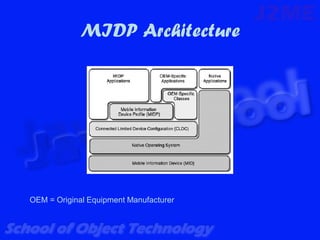
MIDP Architecture


OEM = Original Equipment Manufacturer
MIDlet & MIDlet Suite
• MIDlet : Java App. Designed to be run on
  mobile application
• MIDlet Suite : Consists of on or more
  MIDlet packaged on .jar file
Application Manager
• Software on a mobile device that is
  responsible for installing, running and
  removing MIDlets
• This software is device-dependent
Application Manager
• When Application Manager runs it will
  make these available :
• Access to CLDC & JVM
• Access to MIDP defined class
• Access to JAR file
• Access to Java Application Descriptor File
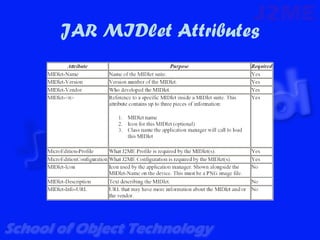
MIDlet Java Archive (JAR)
Six Must-Exist Entry
•   MIDlet-Name
•   MIDlet-Version
•   MIDlet-Vendor
•   MIDlet-<n>
•   MicroEdition-Profile
•   MicroEdition-Configuration

Must exist in the Manifest file
JAR MIDlet Attributes
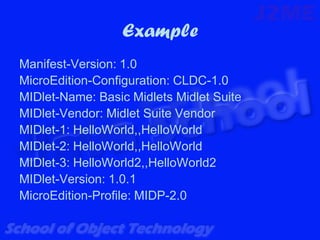
Example
Manifest-Version: 1.0
MicroEdition-Configuration: CLDC-1.0
MIDlet-Name: Basic Midlets Midlet Suite
MIDlet-Vendor: Midlet Suite Vendor
MIDlet-1: HelloWorld,,HelloWorld
MIDlet-2: HelloWorld,,HelloWorld
MIDlet-3: HelloWorld2,,HelloWorld2
MIDlet-Version: 1.0.1
MicroEdition-Profile: MIDP-2.0
Java Application Descriptor
           (JAD)
Why JAD ?
• Provide the application manager with
  information about the contents of a JAR,
  so that it can decide whether a MIDlet
  suitable to run on the device or not.

• Provide a means for parameters to be
  passed to a MIDlet without changing the
  JAR file.
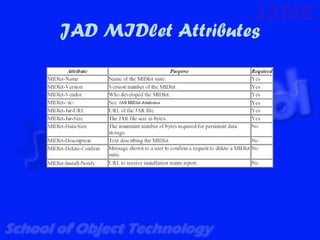
Must-Exist Entry
•   MIDlet-Name
•   MIDlet-Version
•   MIDlet-Vendor
•   MIDlet-<n>
•   MIDlet-Jar-URL
•   MIDlet-Jar-Size
JAD MIDlet Attributes
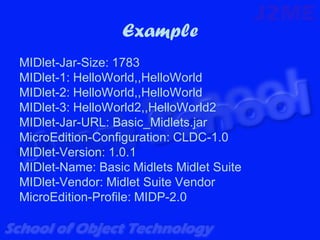
Example
MIDlet-Jar-Size: 1783
MIDlet-1: HelloWorld,,HelloWorld
MIDlet-2: HelloWorld,,HelloWorld
MIDlet-3: HelloWorld2,,HelloWorld2
MIDlet-Jar-URL: Basic_Midlets.jar
MicroEdition-Configuration: CLDC-1.0
MIDlet-Version: 1.0.1
MIDlet-Name: Basic Midlets Midlet Suite
MIDlet-Vendor: Midlet Suite Vendor
MicroEdition-Profile: MIDP-2.0
Reference
• Core J2ME Technology and MIDP. John
  W. Muchow. Prentice Hall PTR, 2002.

03 midp

  • 1.
    Mobile Information Device Profile Cornelius Koo - 2005
  • 2.
    Hardware Requirements • Screendimension at least 96x54 pixels • At least one type of user input available, eg. one handed keyboard • 128 kb non-volatile memory to run Mobile Information Device (MID) components • At least 8 kb of non-volatile memory for applications to store persistent data • 32 kb of volatile memory to run Java • Wireless network connectivity
  • 3.
    Software Requirements • OSrunning on device must provide minimal scheduling, exception handling and processing of interrupts. • Able to run JVM • Must support writing of bitmapped graphics to the display • The software must accept input and pass the information to the JVM • able to read and write to/from non-volatile memory
  • 4.
    MIDP Architecture OEM =Original Equipment Manufacturer
  • 5.
    MIDlet & MIDletSuite • MIDlet : Java App. Designed to be run on mobile application • MIDlet Suite : Consists of on or more MIDlet packaged on .jar file
  • 6.
    Application Manager • Softwareon a mobile device that is responsible for installing, running and removing MIDlets • This software is device-dependent
  • 7.
    Application Manager • WhenApplication Manager runs it will make these available : • Access to CLDC & JVM • Access to MIDP defined class • Access to JAR file • Access to Java Application Descriptor File
  • 8.
  • 9.
    Six Must-Exist Entry • MIDlet-Name • MIDlet-Version • MIDlet-Vendor • MIDlet-<n> • MicroEdition-Profile • MicroEdition-Configuration Must exist in the Manifest file
  • 10.
  • 11.
    Example Manifest-Version: 1.0 MicroEdition-Configuration: CLDC-1.0 MIDlet-Name:Basic Midlets Midlet Suite MIDlet-Vendor: Midlet Suite Vendor MIDlet-1: HelloWorld,,HelloWorld MIDlet-2: HelloWorld,,HelloWorld MIDlet-3: HelloWorld2,,HelloWorld2 MIDlet-Version: 1.0.1 MicroEdition-Profile: MIDP-2.0
  • 12.
  • 13.
    Why JAD ? •Provide the application manager with information about the contents of a JAR, so that it can decide whether a MIDlet suitable to run on the device or not. • Provide a means for parameters to be passed to a MIDlet without changing the JAR file.
  • 14.
    Must-Exist Entry • MIDlet-Name • MIDlet-Version • MIDlet-Vendor • MIDlet-<n> • MIDlet-Jar-URL • MIDlet-Jar-Size
  • 15.
  • 16.
    Example MIDlet-Jar-Size: 1783 MIDlet-1: HelloWorld,,HelloWorld MIDlet-2:HelloWorld,,HelloWorld MIDlet-3: HelloWorld2,,HelloWorld2 MIDlet-Jar-URL: Basic_Midlets.jar MicroEdition-Configuration: CLDC-1.0 MIDlet-Version: 1.0.1 MIDlet-Name: Basic Midlets Midlet Suite MIDlet-Vendor: Midlet Suite Vendor MicroEdition-Profile: MIDP-2.0
  • 17.
    Reference • Core J2METechnology and MIDP. John W. Muchow. Prentice Hall PTR, 2002.