Java - Basic Datatypes
P NAGARAJU
Assistant Professor
Department of CSE
INTRODUCTION
 Variables are nothing but reserved memory locations to store values.
 Based on the data type of a variable, the operating system allocates memory and
decides what can be stored in the reserved memory.
There are two data types available in Java:
1. Primitive Data Types
2. Reference/Object Data Types
Primitive Data Types:
 Primitive data types are predefined by the language and named by a keyword.
 There are eight primitive data types supported by Java.
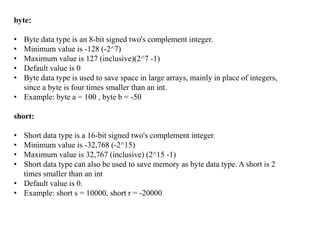
byte:
• Byte data type is an 8-bit signed two's complement integer.
• Minimum value is -128 (-2^7)
• Maximum value is 127 (inclusive)(2^7 -1)
• Default value is 0
• Byte data type is used to save space in large arrays, mainly in place of integers,
since a byte is four times smaller than an int.
• Example: byte a = 100 , byte b = -50
short:
• Short data type is a 16-bit signed two's complement integer.
• Minimum value is -32,768 (-2^15)
• Maximum value is 32,767 (inclusive) (2^15 -1)
• Short data type can also be used to save memory as byte data type. A short is 2
times smaller than an int
• Default value is 0.
• Example: short s = 10000, short r = -20000
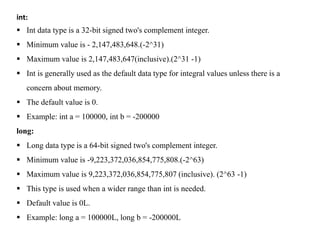
int:
 Int data type is a 32-bit signed two's complement integer.
 Minimum value is - 2,147,483,648.(-2^31)
 Maximum value is 2,147,483,647(inclusive).(2^31 -1)
 Int is generally used as the default data type for integral values unless there is a
concern about memory.
 The default value is 0.
 Example: int a = 100000, int b = -200000
long:
 Long data type is a 64-bit signed two's complement integer.
 Minimum value is -9,223,372,036,854,775,808.(-2^63)
 Maximum value is 9,223,372,036,854,775,807 (inclusive). (2^63 -1)
 This type is used when a wider range than int is needed.
 Default value is 0L.
 Example: long a = 100000L, long b = -200000L
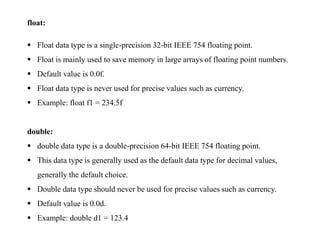
float:
 Float data type is a single-precision 32-bit IEEE 754 floating point.
 Float is mainly used to save memory in large arrays of floating point numbers.
 Default value is 0.0f.
 Float data type is never used for precise values such as currency.
 Example: float f1 = 234.5f
double:
 double data type is a double-precision 64-bit IEEE 754 floating point.
 This data type is generally used as the default data type for decimal values,
generally the default choice.
 Double data type should never be used for precise values such as currency.
 Default value is 0.0d.
 Example: double d1 = 123.4
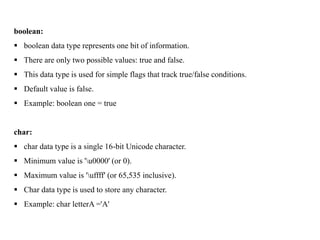
boolean:
 boolean data type represents one bit of information.
 There are only two possible values: true and false.
 This data type is used for simple flags that track true/false conditions.
 Default value is false.
 Example: boolean one = true
char:
 char data type is a single 16-bit Unicode character.
 Minimum value is 'u0000' (or 0).
 Maximum value is 'uffff' (or 65,535 inclusive).
 Char data type is used to store any character.
 Example: char letterA ='A'
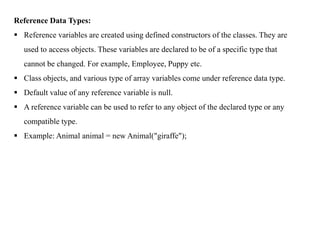
Reference Data Types:
 Reference variables are created using defined constructors of the classes. They are
used to access objects. These variables are declared to be of a specific type that
cannot be changed. For example, Employee, Puppy etc.
 Class objects, and various type of array variables come under reference data type.
 Default value of any reference variable is null.
 A reference variable can be used to refer to any object of the declared type or any
compatible type.
 Example: Animal animal = new Animal("giraffe");
Java Scanner class
 There are various ways to read input from the keyboard, the java.util.Scanner
class is one of them.
 The Java Scanner class breaks the input into tokens using a delimiter that is
whitespace by default. It provides many methods to read and parse various
primitive values.
 Java Scanner class is widely used to parse text for string and primitive types using
regular expression.
 Java Scanner class extends Object class and implements Iterator and Closeable
interfaces.
Cont….
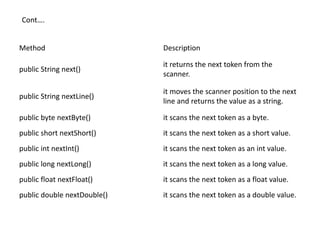
Method Description
public String next()
it returns the next token from the
scanner.
public String nextLine()
it moves the scanner position to the next
line and returns the value as a string.
public byte nextByte() it scans the next token as a byte.
public short nextShort() it scans the next token as a short value.
public int nextInt() it scans the next token as an int value.
public long nextLong() it scans the next token as a long value.
public float nextFloat() it scans the next token as a float value.
public double nextDouble() it scans the next token as a double value.
Java Scanner Example to get input from console
import java.util.Scanner;
class ScannerTest{
public static void main(String args[]){
Scanner sc=new Scanner(System.in);
System.out.println("Enter your rollno");
int rollno=sc.nextInt();
System.out.println("Enter your name");
String name=sc.next();
System.out.println("Enter your fee");
double fee=sc.nextDouble();
System.out.println("Rollno:"+rollno+" name:"+name+" fee:"+fee);
sc.close();
}
}

Java - Basic Datatypes.pptx

  • 1.
    Java - BasicDatatypes P NAGARAJU Assistant Professor Department of CSE
  • 2.
    INTRODUCTION  Variables arenothing but reserved memory locations to store values.  Based on the data type of a variable, the operating system allocates memory and decides what can be stored in the reserved memory. There are two data types available in Java: 1. Primitive Data Types 2. Reference/Object Data Types Primitive Data Types:  Primitive data types are predefined by the language and named by a keyword.  There are eight primitive data types supported by Java.
  • 3.
    byte: • Byte datatype is an 8-bit signed two's complement integer. • Minimum value is -128 (-2^7) • Maximum value is 127 (inclusive)(2^7 -1) • Default value is 0 • Byte data type is used to save space in large arrays, mainly in place of integers, since a byte is four times smaller than an int. • Example: byte a = 100 , byte b = -50 short: • Short data type is a 16-bit signed two's complement integer. • Minimum value is -32,768 (-2^15) • Maximum value is 32,767 (inclusive) (2^15 -1) • Short data type can also be used to save memory as byte data type. A short is 2 times smaller than an int • Default value is 0. • Example: short s = 10000, short r = -20000
  • 4.
    int:  Int datatype is a 32-bit signed two's complement integer.  Minimum value is - 2,147,483,648.(-2^31)  Maximum value is 2,147,483,647(inclusive).(2^31 -1)  Int is generally used as the default data type for integral values unless there is a concern about memory.  The default value is 0.  Example: int a = 100000, int b = -200000 long:  Long data type is a 64-bit signed two's complement integer.  Minimum value is -9,223,372,036,854,775,808.(-2^63)  Maximum value is 9,223,372,036,854,775,807 (inclusive). (2^63 -1)  This type is used when a wider range than int is needed.  Default value is 0L.  Example: long a = 100000L, long b = -200000L
  • 5.
    float:  Float datatype is a single-precision 32-bit IEEE 754 floating point.  Float is mainly used to save memory in large arrays of floating point numbers.  Default value is 0.0f.  Float data type is never used for precise values such as currency.  Example: float f1 = 234.5f double:  double data type is a double-precision 64-bit IEEE 754 floating point.  This data type is generally used as the default data type for decimal values, generally the default choice.  Double data type should never be used for precise values such as currency.  Default value is 0.0d.  Example: double d1 = 123.4
  • 6.
    boolean:  boolean datatype represents one bit of information.  There are only two possible values: true and false.  This data type is used for simple flags that track true/false conditions.  Default value is false.  Example: boolean one = true char:  char data type is a single 16-bit Unicode character.  Minimum value is 'u0000' (or 0).  Maximum value is 'uffff' (or 65,535 inclusive).  Char data type is used to store any character.  Example: char letterA ='A'
  • 7.
    Reference Data Types: Reference variables are created using defined constructors of the classes. They are used to access objects. These variables are declared to be of a specific type that cannot be changed. For example, Employee, Puppy etc.  Class objects, and various type of array variables come under reference data type.  Default value of any reference variable is null.  A reference variable can be used to refer to any object of the declared type or any compatible type.  Example: Animal animal = new Animal("giraffe");
  • 8.
    Java Scanner class There are various ways to read input from the keyboard, the java.util.Scanner class is one of them.  The Java Scanner class breaks the input into tokens using a delimiter that is whitespace by default. It provides many methods to read and parse various primitive values.  Java Scanner class is widely used to parse text for string and primitive types using regular expression.  Java Scanner class extends Object class and implements Iterator and Closeable interfaces.
  • 9.
    Cont…. Method Description public Stringnext() it returns the next token from the scanner. public String nextLine() it moves the scanner position to the next line and returns the value as a string. public byte nextByte() it scans the next token as a byte. public short nextShort() it scans the next token as a short value. public int nextInt() it scans the next token as an int value. public long nextLong() it scans the next token as a long value. public float nextFloat() it scans the next token as a float value. public double nextDouble() it scans the next token as a double value.
  • 10.
    Java Scanner Exampleto get input from console import java.util.Scanner; class ScannerTest{ public static void main(String args[]){ Scanner sc=new Scanner(System.in); System.out.println("Enter your rollno"); int rollno=sc.nextInt(); System.out.println("Enter your name"); String name=sc.next(); System.out.println("Enter your fee"); double fee=sc.nextDouble(); System.out.println("Rollno:"+rollno+" name:"+name+" fee:"+fee); sc.close(); } }