The	
  Features	
  of	
  “Workless	
  Society”	
  
in	
  Japan	
  
19,Nov.,	
  2016	
  
@Tsinghua	
  University
Ryosuke	
  NISHIDA	
  
西田	
  亮介
from	
  Tokyo	
  Tech
ryosukenishida@gmail.com
Introduce	
  of	
  myself
• Ryosuke	
  NISHIDA	
  (西田	
  亮介),	
  Assoc.	
  Prof	
  at	
  Institute	
  for	
  Liberal	
  Arts,	
  
Tokyo	
  Tech
• Ph.D(Media	
   and	
  Governance),	
   Master	
  Degree	
   of	
  Media	
  and	
  Governance,	
  
each	
  from	
  Keio	
  University,	
   Japan
• After	
  working	
  at	
  some	
  universities	
   and	
  a	
  research	
  center,	
   joining	
  Tokyo	
  
Tech,	
  2015.	
  
• Majoring:	
  Sociology
– …and	
  radio	
  navigator,	
  TV	
  commentator,	
  author	
  of	
  articles	
  …etc
• Three	
  Research	
   Domains:	
  
– Information	
  Technology	
  and	
  Politics
– Education	
  for	
  Improving	
  Democracy
– “Workless	
  Society”	
  in	
  Japan	
  (today’s	
  main	
  issue)
2
3
My	
  Books	
  
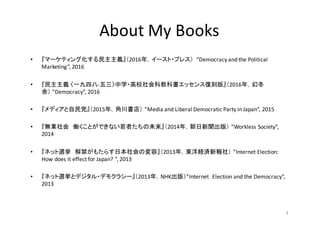
• 『マーケティング化する民主主義』(2016年,イースト・プレス)	
   “Democracy	
  and	
  the	
  Political	
  
Marketing”,	
  2016	
  
• 『民主主義 〈一九四八-­‐五三〉中学・高校社会科教科書エッセンス復刻版』(2016年,幻冬
舎) ”Democracy”,	
  2016
• 『メディアと自民党』(2015年,角川書店) ”Media	
  and	
  Liberal	
  Democratic	
  Party	
  in	
  Japan”,	
  2015
• 『無業社会 働くことができない若者たちの未来』(2014年,朝日新聞出版) ”Workless	
  Society”,	
  
2014
• 『ネット選挙 解禁がもたらす日本社会の変容』(2013年,東洋経済新報社) ”Internet	
  Election:	
  
How	
  does	
  it	
  effect	
  for	
  Japan?	
  ”,	
  2013
• 『ネット選挙とデジタル・デモクラシー』(2013年,NHK出版)”Internet	
   Election	
  and	
  the	
  Democracy”,	
  
2013
4
About	
  My	
  Books	
  
“Workless	
  Society”	
  in	
  Japan	
  
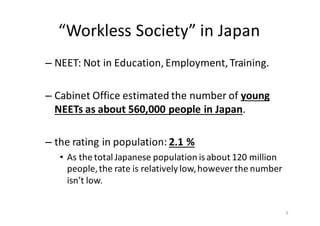
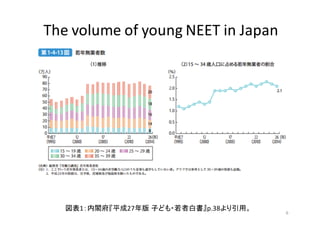
– NEET:	
  Not	
  in	
  Education,	
  Employment,	
  Training.
– Cabinet	
  Office	
  estimated	
  the	
  number	
  of	
  young	
  
NEETs	
  as	
  about	
  560,000	
  people	
  in	
  Japan.	
  	
  
– the	
  rating	
  in	
  population:	
  2.1	
  %
• As	
  the	
  total	
  Japanese	
  population	
  is	
  about	
  120	
  million	
  
people,	
  the	
  rate	
  is	
  relatively	
  low,	
  however	
  the	
  number	
  
isn’t	
  low.
5
 The	
  volume	
  of	
  young	
  NEET	
  in	
  Japan
6
図表1:内閣府『平成27年版 子ども・若者白書』p.38より引用。
What	
  is	
  “Workless	
  Society”	
  ?
• Jobless	
  /	
  Workless
– “Works”	
  are	
  not	
  only	
  income	
  problem,	
  but	
  also	
  connecting	
  to	
  each	
  
other,	
  social	
  welfare,	
  some	
  pride	
  to	
  live,	
  respect	
  by	
  the	
  other	
  people	
  
and	
  social	
  reputation…etc
– Workless	
  would	
  be	
  the	
  lost	
  of	
  social	
  capital,	
  a	
  connecting	
  the	
  people	
  
and	
  communities.
– Many	
  types	
  of	
  “jobs”,	
  however	
   “works”	
  are	
  about	
  to	
  be	
  lost	
  in	
  Japan.
– Big	
  difference	
   between	
   Irregular	
  works	
  and	
  regular	
  works	
  in	
  Japan.
• The	
  definition	
  of	
  “Workless	
  Society”:	
  
– Society	
  which	
  every	
  person	
  has	
  a	
  possibility	
  to	
  be	
  workless,	
  however	
  
most	
  of	
  them	
  not	
  to	
   recognize,	
  to	
  be	
  difficult	
  to	
  survive	
   the	
  situation
– We	
  think	
  that	
  Japanese	
   society	
  is	
  “workless	
  society”	
  and	
  it	
  is	
  a	
  social	
  
problem.
7
The	
  meanings	
  of	
  “Workless	
  Society”	
  in	
  
Japan	
  
• The	
  unemployment	
  rate	
  of	
  Japan	
  is	
  relatively	
  low	
  level	
  in	
  the	
  world.
– 4.3%(2012)、4.0%(2013)、3.6%(2014)
– The	
  rate	
  of	
  younger	
  generation	
  is	
  relatively	
  high.
• 15-­‐24years:8.1%(2012)、6.9%(2013)、6.3%(2014)
• 25-­‐34years:5.5%(2012)、5.3%(2013)、4.6%(2014)
• The	
  Features	
  of	
  Japanese	
  “Workless	
  Society”…
– have	
  a	
  generation	
  gap.
– have	
  gaps	
  of	
  work	
  style	
  between	
  regular	
  workers	
  and	
  irregular	
  workers.	
  
– rely	
  from	
  changing	
  social	
  system.
8
Misunderstandings	
  about	
  “Workless	
  
Society”	
  in	
  Japan
• Misunderstandings	
  
– NEETs	
  have	
  no	
  motivation	
  to	
  work.	
  
– The	
  reason	
  of	
  becoming	
  to	
  NEET	
  is	
  a	
  laziness.	
  
– Nothing	
  to	
  relate	
  with	
  university	
  students.	
  
↓
• Actualities	
  
– Many	
  NEETs	
  hope	
  to	
  work,	
  but	
  can’t	
  find	
  the	
  work	
  and	
  the	
  companies	
  
receiving	
  them.	
  	
  
– The	
  main	
  reason	
  of	
  NEETs	
  is	
  injury	
  and	
  sick	
  including	
  mental	
  problem.	
  
– Our	
  case	
  studies	
  shows	
  that	
  university	
  students	
  have	
  also	
  possibilities	
  
to	
  be	
  NEETs.	


• These	
  are	
  reasons	
  of	
  our	
  challenge	
  to	
  do	
  some	
  researches	
  and	
  
projects	
  for	
  “Workless	
  Society”.	
  
	
   9
Our	
  Researches	
  and	
  Projects	
  for	
  
“Workless	
  Society”	
  
• 『若年無業者白書』 ”Research	
  Paper	
  of	
  “Workless	
  Society””
– Sodateage Net,	
  a	
  famous	
  NPO,	
  and	
  I	
  try	
  to	
  analyze	
  the	
  lifestyle	
  of	
  NEET,	
  to	
  know	
  what	
  factors	
  effect	
  the	
  NEET.	
  
– Translated	
  in	
  South	
  Korea.
• 『無業社会』 ”Workless	
  Society”
– This	
  book	
  shows	
  the	
  lifestyles	
  of	
  NEET	
  and	
  policy	
  failures,	
  the	
  some	
  data.
– Translated	
  in	
  South	
  Korea.
• 政策提言『若者と仕事』:	
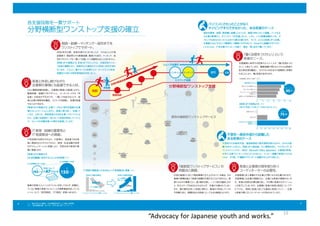
  “Advocacy	
  for	
  Japanese	
  youth	
  and	
  works.”
– With	
  Sodateage Net	
  and	
  MS,	
  I	
  advocated	
  improving	
  the	
  policy	
  for	
  	
  (Jan,	
  2015)。
– (PDF)( http://go.microsoft.com/?linkid=9875960)
• 西田亮介,2015,「ニートとひきこもり」『日本労働研究雑誌』 657:	
  72-­‐3.Short	
  paper	
  of	
  Japan	
  NEET.
– (PDF)( http://www.jil.go.jp/institute/zassi/backnumber/2015/04/pdf/072-­‐073.pdf)。
• 『若年無業者白書2014-­‐2015-­‐個々の属性と進路決定における多面的分析』 ”Research	
  Paper	
  of	
  “Workless	
  
Society””	
  2014-­‐2015
– Second	
  ver.	
  of	
  ”Research	
  Paper	
  of	
  “Workless	
  Society””	
  
10
11
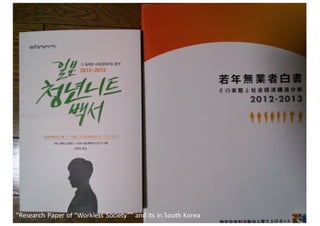
”Research	
  Paper	
  of	
  “Workless	
  Society””	
  and	
  its	
  in	
  South	
  Korea
12
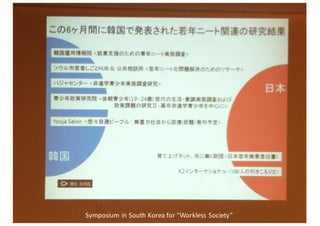
Symposium	
  in	
  South	
  Korea	
  for	
  “Workless	
  Society”
13
”Workless	
  Society”	
  
translated	
  in	
  South	
  
Korea
14
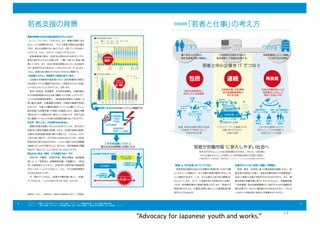
“Advocacy	
  for	
  Japanese	
  youth	
  and	
  works.”
15
“Advocacy	
  for	
  Japanese	
  youth	
  and	
  works.”
“Workless	
  Society”	
  and	
  
social	
  system	
  in	
  Japan
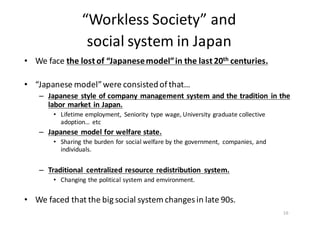
• We	
  face	
  the	
  lost	
  of	
  “Japanese	
  model”	
  in	
  the	
  last	
  20th	
  centuries.	


• “Japanese	
  model”	
  were	
  consisted	
  of	
  that…
– Japanese	
  style	
  of	
  company	
  management	
  system	
  and	
  the	
  tradition	
   in	
  the	
  
labor	
  market	
  in	
  Japan.
• Lifetime	
  employment,	
   Seniority	
   type	
  wage,	
  University	
  graduate	
  collective	
  
adoption…	
   etc
– Japanese	
  model	
  for	
  welfare	
  state.
• Sharing	
  the	
  burden	
  for	
  social	
  welfare	
  by	
  the	
  government,	
   companies,	
  and	
  
individuals.	
  
– Traditional	
   centralized	
  resource	
  redistribution	
   system.
• Changing	
  the	
  political	
  system	
  and	
  emvironment.
• We	
  faced	
  that	
  the	
  big	
  social	
  system	
  changes	
  in	
  late	
  90s.
16
Discovering	
  “Youth	
  as	
  the	
  Week”	
  in	
  
Japan	
  in	
  2000s	
  
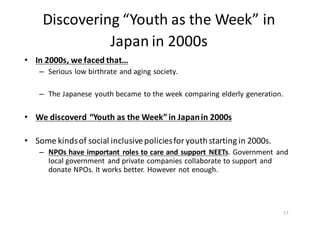
• In	
  2000s,	
  we	
  faced	
  that…
– Serious	
  low	
  birthrate	
  and	
  aging	
  society.	
  
– The	
  Japanese	
   youth	
  became	
  to	
  the	
  week	
  comparing	
  elderly	
  generation.
• We	
  discoverd “Youth	
  as	
  the	
  Week”	
  in	
  Japan	
  in	
  2000s	
  
• Some	
  kinds	
  of	
  social	
  inclusive	
  policies	
  for	
  youth	
  starting	
  in	
  2000s.	
  
– NPOs	
  have	
  important	
   roles	
  to	
  care	
  and	
  support	
   NEETs.	
  Government	
   and	
  
local	
  government	
   and	
  private	
  companies	
  collaborate	
  to	
  support	
  and	
  
donate	
  NPOs.	
  It	
  works	
  better.	
  However	
  not	
  enough.
17
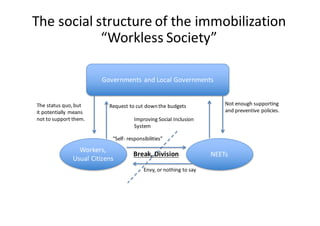
Break,	
  Division
The	
  status	
  quo,	
  but	
  
it	
  potentially	
  means	
  
not	
  to	
  support	
  them.
Workers,	
  
Usual	
  Citizens	
  
NEETs
Governments	
  and	
  Local	
  Governments
“Self-­‐	
  responsibilities”
Envy,	
  or	
  nothing	
  to	
  say
Request	
  to	
  cut	
  down	
  the	
  budgets
Improving	
  Social	
  Inclusion	
  
System
Not	
  enough	
  supporting	
  
and	
  preventive	
  policies.
The	
  social	
  structure	
  of	
  the	
  immobilization	
  
“Workless	
  Society”
“Workless	
  Society”	
  to
“Tolerant	
  Society”
• “Tolerant	
  Society”	
  is…
– Inclusive	
  for	
  everyone.
– Seriously	
  for	
  every	
  life	
  stage	
  or	
  age.
– Supporting	
  their	
  own	
  Re-­‐ challenge	
  for	
  working
• From	
  “Workless	
  Society”	
  to	
  “Tolerant	
  Society”,	
  
– To	
  know	
  how	
  NEETs	
  get	
  to	
  the	
  work,	
  what	
  factors	
  effects	
   the	
  revival.
– The	
  analysis	
  the	
  data	
  gathering	
  from	
  the	
  programs	
  and	
  facilities	
  for	
  policy	
  
making.	
  
– Connecting	
  the	
  data	
  and	
  human	
  support	
  skill,	
  for	
  more	
  effective	
   and	
  
improving	
  support	
  programs	
  and	
  policies.	
  
– Comparing	
   global	
  policies	
  and	
  programs	
   and	
  exchange	
  them	
  each	
  other,	
  
because	
  of	
  many	
  countries	
  facing	
  similar	
  problem	
  in	
  particular	
  of	
  east	
  Asia	
  
countries. 19
Thank	
  you	
  for	
  your	
  listening!!
The	
  Features	
  of	
  “Workless	
  Society”	
  
in	
  Japan	
  
19,Nov.,	
  2016	
  
@Tsinghua	
  University
Ryosuke	
  NISHIDA	
  
西田	
  亮介
from	
  Tokyo	
  Tech
ryosukenishida@gmail.com

20161119_the_features_of_“workless society”_in_japan

  • 1.
    The  Features  of  “Workless  Society”   in  Japan   19,Nov.,  2016   @Tsinghua  University Ryosuke  NISHIDA   西田  亮介 from  Tokyo  Tech ryosukenishida@gmail.com
  • 2.
    Introduce  of  myself •Ryosuke  NISHIDA  (西田  亮介),  Assoc.  Prof  at  Institute  for  Liberal  Arts,   Tokyo  Tech • Ph.D(Media   and  Governance),   Master  Degree   of  Media  and  Governance,   each  from  Keio  University,   Japan • After  working  at  some  universities   and  a  research  center,   joining  Tokyo   Tech,  2015.   • Majoring:  Sociology – …and  radio  navigator,  TV  commentator,  author  of  articles  …etc • Three  Research   Domains:   – Information  Technology  and  Politics – Education  for  Improving  Democracy – “Workless  Society”  in  Japan  (today’s  main  issue) 2
  • 3.
  • 4.
    • 『マーケティング化する民主主義』(2016年,イースト・プレス)  “Democracy  and  the  Political   Marketing”,  2016   • 『民主主義 〈一九四八-­‐五三〉中学・高校社会科教科書エッセンス復刻版』(2016年,幻冬 舎) ”Democracy”,  2016 • 『メディアと自民党』(2015年,角川書店) ”Media  and  Liberal  Democratic  Party  in  Japan”,  2015 • 『無業社会 働くことができない若者たちの未来』(2014年,朝日新聞出版) ”Workless  Society”,   2014 • 『ネット選挙 解禁がもたらす日本社会の変容』(2013年,東洋経済新報社) ”Internet  Election:   How  does  it  effect  for  Japan?  ”,  2013 • 『ネット選挙とデジタル・デモクラシー』(2013年,NHK出版)”Internet   Election  and  the  Democracy”,   2013 4 About  My  Books  
  • 5.
    “Workless  Society”  in  Japan   – NEET:  Not  in  Education,  Employment,  Training. – Cabinet  Office  estimated  the  number  of  young   NEETs  as  about  560,000  people  in  Japan.     – the  rating  in  population:  2.1  % • As  the  total  Japanese  population  is  about  120  million   people,  the  rate  is  relatively  low,  however  the  number   isn’t  low. 5
  • 6.
     The  volume  of  young  NEET  in  Japan 6 図表1:内閣府『平成27年版 子ども・若者白書』p.38より引用。
  • 7.
    What  is  “Workless  Society”  ? • Jobless  /  Workless – “Works”  are  not  only  income  problem,  but  also  connecting  to  each   other,  social  welfare,  some  pride  to  live,  respect  by  the  other  people   and  social  reputation…etc – Workless  would  be  the  lost  of  social  capital,  a  connecting  the  people   and  communities. – Many  types  of  “jobs”,  however   “works”  are  about  to  be  lost  in  Japan. – Big  difference   between   Irregular  works  and  regular  works  in  Japan. • The  definition  of  “Workless  Society”:   – Society  which  every  person  has  a  possibility  to  be  workless,  however   most  of  them  not  to   recognize,  to  be  difficult  to  survive   the  situation – We  think  that  Japanese   society  is  “workless  society”  and  it  is  a  social   problem. 7
  • 8.
    The  meanings  of  “Workless  Society”  in   Japan   • The  unemployment  rate  of  Japan  is  relatively  low  level  in  the  world. – 4.3%(2012)、4.0%(2013)、3.6%(2014) – The  rate  of  younger  generation  is  relatively  high. • 15-­‐24years:8.1%(2012)、6.9%(2013)、6.3%(2014) • 25-­‐34years:5.5%(2012)、5.3%(2013)、4.6%(2014) • The  Features  of  Japanese  “Workless  Society”… – have  a  generation  gap. – have  gaps  of  work  style  between  regular  workers  and  irregular  workers.   – rely  from  changing  social  system. 8
  • 9.
    Misunderstandings  about  “Workless   Society”  in  Japan • Misunderstandings   – NEETs  have  no  motivation  to  work.   – The  reason  of  becoming  to  NEET  is  a  laziness.   – Nothing  to  relate  with  university  students.   ↓ • Actualities   – Many  NEETs  hope  to  work,  but  can’t  find  the  work  and  the  companies   receiving  them.     – The  main  reason  of  NEETs  is  injury  and  sick  including  mental  problem.   – Our  case  studies  shows  that  university  students  have  also  possibilities   to  be  NEETs.       • These  are  reasons  of  our  challenge  to  do  some  researches  and   projects  for  “Workless  Society”.     9
  • 10.
    Our  Researches  and  Projects  for   “Workless  Society”   • 『若年無業者白書』 ”Research  Paper  of  “Workless  Society”” – Sodateage Net,  a  famous  NPO,  and  I  try  to  analyze  the  lifestyle  of  NEET,  to  know  what  factors  effect  the  NEET.   – Translated  in  South  Korea. • 『無業社会』 ”Workless  Society” – This  book  shows  the  lifestyles  of  NEET  and  policy  failures,  the  some  data. – Translated  in  South  Korea. • 政策提言『若者と仕事』:  “Advocacy  for  Japanese  youth  and  works.” – With  Sodateage Net  and  MS,  I  advocated  improving  the  policy  for    (Jan,  2015)。 – (PDF)( http://go.microsoft.com/?linkid=9875960) • 西田亮介,2015,「ニートとひきこもり」『日本労働研究雑誌』 657:  72-­‐3.Short  paper  of  Japan  NEET. – (PDF)( http://www.jil.go.jp/institute/zassi/backnumber/2015/04/pdf/072-­‐073.pdf)。 • 『若年無業者白書2014-­‐2015-­‐個々の属性と進路決定における多面的分析』 ”Research  Paper  of  “Workless   Society””  2014-­‐2015 – Second  ver.  of  ”Research  Paper  of  “Workless  Society””   10
  • 11.
    11 ”Research  Paper  of  “Workless  Society””  and  its  in  South  Korea
  • 12.
    12 Symposium  in  South  Korea  for  “Workless  Society”
  • 13.
  • 14.
    14 “Advocacy  for  Japanese  youth  and  works.”
  • 15.
    15 “Advocacy  for  Japanese  youth  and  works.”
  • 16.
    “Workless  Society”  and   social  system  in  Japan • We  face  the  lost  of  “Japanese  model”  in  the  last  20th  centuries.     • “Japanese  model”  were  consisted  of  that… – Japanese  style  of  company  management  system  and  the  tradition   in  the   labor  market  in  Japan. • Lifetime  employment,   Seniority   type  wage,  University  graduate  collective   adoption…   etc – Japanese  model  for  welfare  state. • Sharing  the  burden  for  social  welfare  by  the  government,   companies,  and   individuals.   – Traditional   centralized  resource  redistribution   system. • Changing  the  political  system  and  emvironment. • We  faced  that  the  big  social  system  changes  in  late  90s. 16
  • 17.
    Discovering  “Youth  as  the  Week”  in   Japan  in  2000s   • In  2000s,  we  faced  that… – Serious  low  birthrate  and  aging  society.   – The  Japanese   youth  became  to  the  week  comparing  elderly  generation. • We  discoverd “Youth  as  the  Week”  in  Japan  in  2000s   • Some  kinds  of  social  inclusive  policies  for  youth  starting  in  2000s.   – NPOs  have  important   roles  to  care  and  support   NEETs.  Government   and   local  government   and  private  companies  collaborate  to  support  and   donate  NPOs.  It  works  better.  However  not  enough. 17
  • 18.
    Break,  Division The  status  quo,  but   it  potentially  means   not  to  support  them. Workers,   Usual  Citizens   NEETs Governments  and  Local  Governments “Self-­‐  responsibilities” Envy,  or  nothing  to  say Request  to  cut  down  the  budgets Improving  Social  Inclusion   System Not  enough  supporting   and  preventive  policies. The  social  structure  of  the  immobilization   “Workless  Society”
  • 19.
    “Workless  Society”  to “Tolerant  Society” • “Tolerant  Society”  is… – Inclusive  for  everyone. – Seriously  for  every  life  stage  or  age. – Supporting  their  own  Re-­‐ challenge  for  working • From  “Workless  Society”  to  “Tolerant  Society”,   – To  know  how  NEETs  get  to  the  work,  what  factors  effects   the  revival. – The  analysis  the  data  gathering  from  the  programs  and  facilities  for  policy   making.   – Connecting  the  data  and  human  support  skill,  for  more  effective   and   improving  support  programs  and  policies.   – Comparing   global  policies  and  programs   and  exchange  them  each  other,   because  of  many  countries  facing  similar  problem  in  particular  of  east  Asia   countries. 19
  • 20.
    Thank  you  for  your  listening!! The  Features  of  “Workless  Society”   in  Japan   19,Nov.,  2016   @Tsinghua  University Ryosuke  NISHIDA   西田  亮介 from  Tokyo  Tech ryosukenishida@gmail.com