The Ancient Civilizations
VIEWING AND ANALYSIS OF VIDEO
• Watch the short video clip from Japan. Be able to define some of the characteristics of
Japanese based on this.
ANALYSIS OF VIDEO
• What are your perceptions about the Japanese after watching the short video clip?

• The Ring ( リ ン グ Ringu?) is a 1998
Japanese horror film by Hideo Nakata,
adapted from the novel Ring by Koji
Suzuki, which in turn draws on the
Japanese folk tale Banchi Sarayashiki.
• In a way, it gives us ideas about the
Japanese culture.
• The movie shows that the Japanese have
various superstitious beliefs.
JAPAN: SUPERSTITIOUS BELIEFS
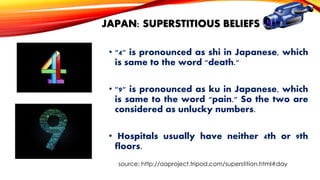
• "4" is pronounced as shi in Japanese, which
is same to the word "death."
• "9" is pronounced as ku in Japanese, which
is same to the word "pain." So the two are
considered as unlucky numbers.
• Hospitals usually have neither 4th or 9th
floors.
source: http://oaproject.tripod.com/superstition.html#day
JAPAN: SUPERSTITIOUS BELIEFS
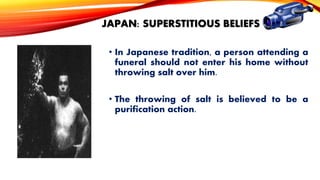
• In Japanese tradition, a person attending a
funeral should not enter his home without
throwing salt over him.
• The throwing of salt is believed to be a
purification action.
JAPAN: SUPERSTITIOUS BELIEFS
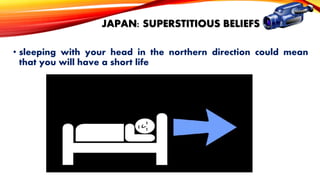
• sleeping with your head in the northern direction could mean
that you will have a short life
JAPAN: SUPERSTITIOUS BELIEFS
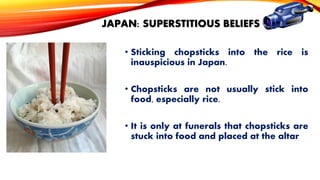
• Sticking chopsticks into the rice is
inauspicious in Japan.
• Chopsticks are not usually stick into
food, especially rice.
• It is only at funerals that chopsticks are
stuck into food and placed at the altar
THE JAPANESE CULTURE
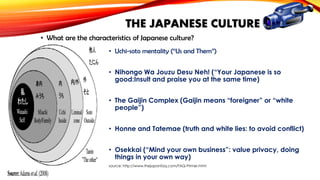
• What are the characteristics of Japanese culture?
• Uchi-soto mentality (“Us and Them”)
• Nihongo Wa Jouzu Desu Neh! (“Your Japanese is so
good:Insult and praise you at the same time)
• The Gaijin Complex (Gaijin means “foreigner” or “white
people”)
• Honne and Tatemae (truth and white lies: to avoid conflict)

• Osekkai (“Mind your own business”: value privacy, doing
things in your own way)
source: http://www.thejapanfaq.com/FAQ-Primer.html
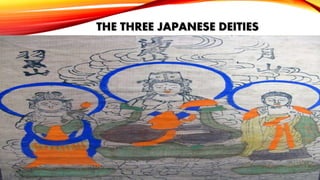
THE THREE JAPANESE DEITIES
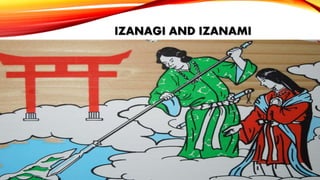
IZANAGI AND IZANAMI
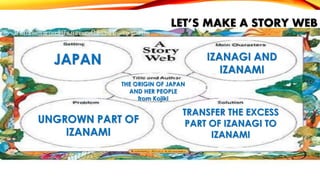
LET’S MAKE A STORY WEB

JAPAN

IZANAGI AND
IZANAMI
THE ORIGIN OF JAPAN
AND HER PEOPLE
from Kojiki

UNGROWN PART OF
IZANAMI

TRANSFER THE EXCESS
PART OF IZANAGI TO
IZANAMI
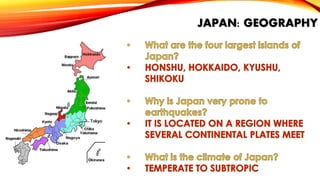
JAPAN: GEOGRAPHY
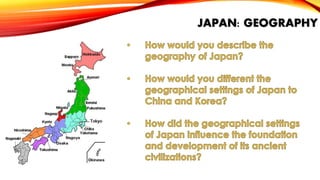
JAPAN: GEOGRAPHY
JAPAN: GEOGRAPHY
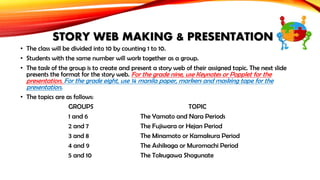
STORY WEB MAKING & PRESENTATION
• The class will be divided into 10 by counting 1 to 10.
• Students with the same number will work together as a group.
• The task of the group is to create and present a story web of their assigned topic. The next slide
presents the format for the story web. For the grade nine, use Keynotes or Popplet for the

presentation. For the grade eight, use ¼ manila paper, markers and masking tape for the
presentation.

• The topics are as follows:
GROUPS
1 and 6
2 and 7
3 and 8
4 and 9
5 and 10

TOPIC
The Yamato and Nara Periods
The Fujiwara or Hejan Period
The Minamoto or Kamakura Period
The Ashikaga or Muromachi Period
The Tokugawa Shogunate
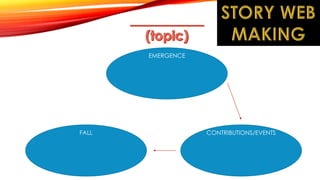
EMERGENCE

FALL

CONTRIBUTIONS/EVENTS
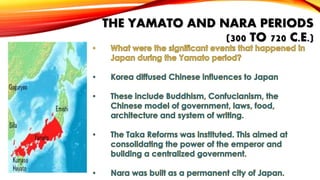
THE YAMATO AND NARA PERIODS
(300 TO 720 C.E.)
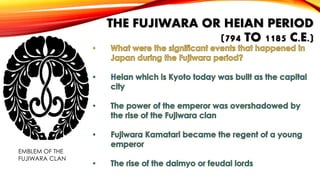
THE FUJIWARA OR HEIAN PERIOD
(794 TO 1185 C.E.)

EMBLEM OF THE
FUJIWARA CLAN
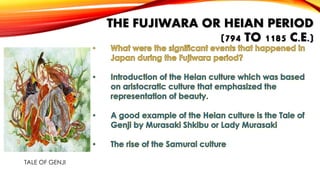
THE FUJIWARA OR HEIAN PERIOD
(794 TO 1185 C.E.)

TALE OF GENJI
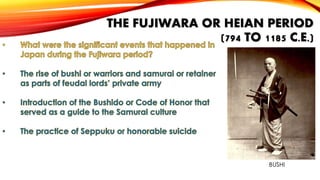
THE FUJIWARA OR HEIAN PERIOD
(794 TO 1185 C.E.)

BUSHI
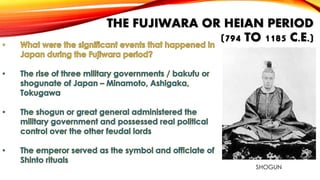
THE FUJIWARA OR HEIAN PERIOD
(794 TO 1185 C.E.)

SHOGUN
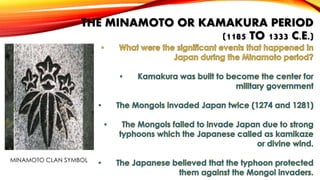
THE MINAMOTO OR KAMAKURA PERIOD
(1185 TO 1333 C.E.)

MINAMOTO CLAN SYMBOL
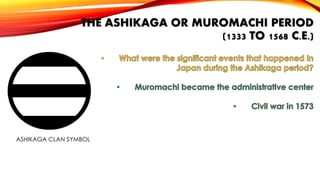
THE ASHIKAGA OR MUROMACHI PERIOD
(1333 TO 1568 C.E.)

ASHIKAGA CLAN SYMBOL
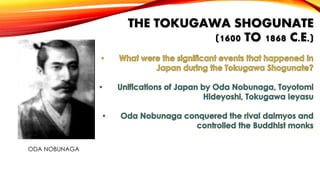
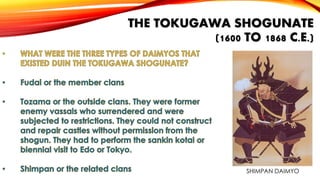
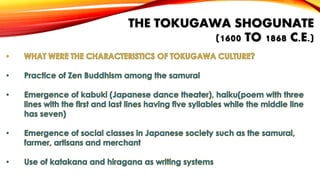
THE TOKUGAWA SHOGUNATE
(1600 TO 1868 C.E.)

ODA NOBUNAGA
THE TOKUGAWA SHOGUNATE
(1600 TO 1868 C.E.)

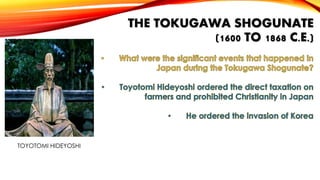
TOYOTOMI HIDEYOSHI
THE TOKUGAWA SHOGUNATE
(1600 TO 1868 C.E.)

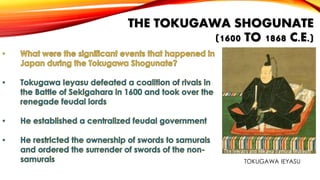
TOKUGAWA IEYASU
THE TOKUGAWA SHOGUNATE
(1600 TO 1868 C.E.)

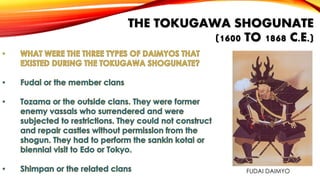
FUDAI DAIMYO
THE TOKUGAWA SHOGUNATE
(1600 TO 1868 C.E.)

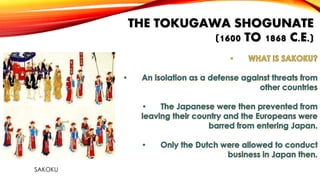
SAKOKU
THE TOKUGAWA SHOGUNATE
(1600 TO 1868 C.E.)

SHIMPAN DAIMYO
THE TOKUGAWA SHOGUNATE
(1600 TO 1868 C.E.)
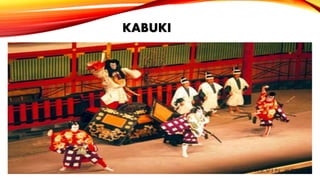
KABUKI
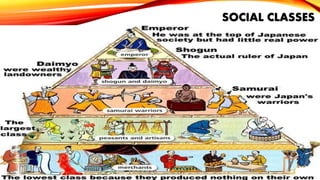
SOCIAL CLASSES
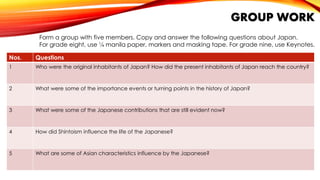
GROUP WORK
Form a group with five members. Copy and answer the following questions about Japan.
For grade eight, use ¼ manila paper, markers and masking tape. For grade nine, use Keynotes.

Nos.
Questions

1

Who were the original inhabitants of Japan? How did the present inhabitants of Japan reach the country?

2

What were some of the importance events or turning points in the history of Japan?

3

What were some of the Japanese contributions that are still evident now?

4

How did Shintoism influence the life of the Japanese?

5

What are some of Asian characteristics influence by the Japanese?
GROUP WORK
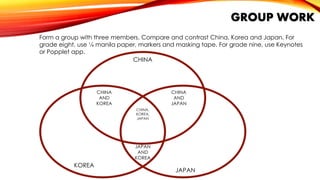
Form a group with three members. Compare and contrast China, Korea and Japan. For
grade eight, use ¼ manila paper, markers and masking tape. For grade nine, use Keynotes
or Popplet app.
CHINA

CHINA
AND
KOREA

CHINA
AND
JAPAN
CHINA,
KOREA,
JAPAN

JAPAN
AND
KOREA

KOREA

JAPAN
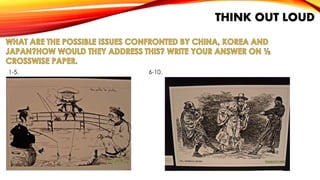
THINK OUT LOUD

1-5.

6-10.
Japan - Ancient Civilizations

Japan - Ancient Civilizations

  • 1.
  • 2.
    VIEWING AND ANALYSISOF VIDEO • Watch the short video clip from Japan. Be able to define some of the characteristics of Japanese based on this.
  • 3.
    ANALYSIS OF VIDEO •What are your perceptions about the Japanese after watching the short video clip? • The Ring ( リ ン グ Ringu?) is a 1998 Japanese horror film by Hideo Nakata, adapted from the novel Ring by Koji Suzuki, which in turn draws on the Japanese folk tale Banchi Sarayashiki. • In a way, it gives us ideas about the Japanese culture. • The movie shows that the Japanese have various superstitious beliefs.
  • 4.
    JAPAN: SUPERSTITIOUS BELIEFS •"4" is pronounced as shi in Japanese, which is same to the word "death." • "9" is pronounced as ku in Japanese, which is same to the word "pain." So the two are considered as unlucky numbers. • Hospitals usually have neither 4th or 9th floors. source: http://oaproject.tripod.com/superstition.html#day
  • 5.
    JAPAN: SUPERSTITIOUS BELIEFS •In Japanese tradition, a person attending a funeral should not enter his home without throwing salt over him. • The throwing of salt is believed to be a purification action.
  • 6.
    JAPAN: SUPERSTITIOUS BELIEFS •sleeping with your head in the northern direction could mean that you will have a short life
  • 7.
    JAPAN: SUPERSTITIOUS BELIEFS •Sticking chopsticks into the rice is inauspicious in Japan. • Chopsticks are not usually stick into food, especially rice. • It is only at funerals that chopsticks are stuck into food and placed at the altar
  • 8.
    THE JAPANESE CULTURE •What are the characteristics of Japanese culture? • Uchi-soto mentality (“Us and Them”) • Nihongo Wa Jouzu Desu Neh! (“Your Japanese is so good:Insult and praise you at the same time) • The Gaijin Complex (Gaijin means “foreigner” or “white people”) • Honne and Tatemae (truth and white lies: to avoid conflict) • Osekkai (“Mind your own business”: value privacy, doing things in your own way) source: http://www.thejapanfaq.com/FAQ-Primer.html
  • 11.
  • 12.
  • 13.
    LET’S MAKE ASTORY WEB JAPAN IZANAGI AND IZANAMI THE ORIGIN OF JAPAN AND HER PEOPLE from Kojiki UNGROWN PART OF IZANAMI TRANSFER THE EXCESS PART OF IZANAGI TO IZANAMI
  • 15.
  • 16.
  • 17.
  • 19.
    STORY WEB MAKING& PRESENTATION • The class will be divided into 10 by counting 1 to 10. • Students with the same number will work together as a group. • The task of the group is to create and present a story web of their assigned topic. The next slide presents the format for the story web. For the grade nine, use Keynotes or Popplet for the presentation. For the grade eight, use ¼ manila paper, markers and masking tape for the presentation. • The topics are as follows: GROUPS 1 and 6 2 and 7 3 and 8 4 and 9 5 and 10 TOPIC The Yamato and Nara Periods The Fujiwara or Hejan Period The Minamoto or Kamakura Period The Ashikaga or Muromachi Period The Tokugawa Shogunate
  • 20.
  • 21.
    THE YAMATO ANDNARA PERIODS (300 TO 720 C.E.)
  • 22.
    THE FUJIWARA ORHEIAN PERIOD (794 TO 1185 C.E.) EMBLEM OF THE FUJIWARA CLAN
  • 23.
    THE FUJIWARA ORHEIAN PERIOD (794 TO 1185 C.E.) TALE OF GENJI
  • 24.
    THE FUJIWARA ORHEIAN PERIOD (794 TO 1185 C.E.) BUSHI
  • 25.
    THE FUJIWARA ORHEIAN PERIOD (794 TO 1185 C.E.) SHOGUN
  • 26.
    THE MINAMOTO ORKAMAKURA PERIOD (1185 TO 1333 C.E.) MINAMOTO CLAN SYMBOL
  • 27.
    THE ASHIKAGA ORMUROMACHI PERIOD (1333 TO 1568 C.E.) ASHIKAGA CLAN SYMBOL
  • 28.
    THE TOKUGAWA SHOGUNATE (1600TO 1868 C.E.) ODA NOBUNAGA
  • 29.
    THE TOKUGAWA SHOGUNATE (1600TO 1868 C.E.) TOYOTOMI HIDEYOSHI
  • 30.
    THE TOKUGAWA SHOGUNATE (1600TO 1868 C.E.) TOKUGAWA IEYASU
  • 31.
    THE TOKUGAWA SHOGUNATE (1600TO 1868 C.E.) FUDAI DAIMYO
  • 32.
    THE TOKUGAWA SHOGUNATE (1600TO 1868 C.E.) SAKOKU
  • 33.
    THE TOKUGAWA SHOGUNATE (1600TO 1868 C.E.) SHIMPAN DAIMYO
  • 34.
  • 35.
  • 37.
  • 40.
    GROUP WORK Form agroup with five members. Copy and answer the following questions about Japan. For grade eight, use ¼ manila paper, markers and masking tape. For grade nine, use Keynotes. Nos. Questions 1 Who were the original inhabitants of Japan? How did the present inhabitants of Japan reach the country? 2 What were some of the importance events or turning points in the history of Japan? 3 What were some of the Japanese contributions that are still evident now? 4 How did Shintoism influence the life of the Japanese? 5 What are some of Asian characteristics influence by the Japanese?
  • 41.
    GROUP WORK Form agroup with three members. Compare and contrast China, Korea and Japan. For grade eight, use ¼ manila paper, markers and masking tape. For grade nine, use Keynotes or Popplet app. CHINA CHINA AND KOREA CHINA AND JAPAN CHINA, KOREA, JAPAN JAPAN AND KOREA KOREA JAPAN
  • 42.