An Emerging CivilizationNadira Aisha Mulyandari
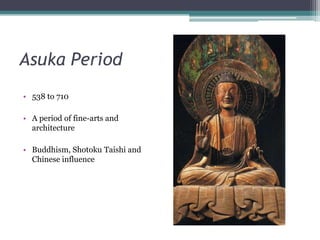
Asuka Period538 to 710A period of fine-arts and architectureBuddhism, Shotoku Taishi and Chinese influence
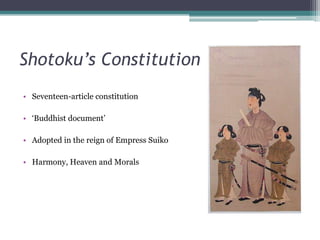
Shotoku’s ConstitutionSeventeen-article constitution‘Buddhist document’Adopted in the reign of Empress SuikoHarmony, Heaven and Morals
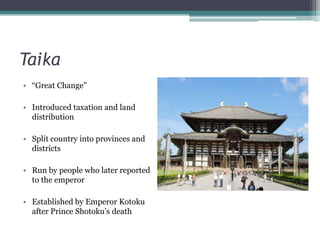
Taika“Great Change”Introduced taxation and land distributionSplit country into provinces and districtsRun by people who later reported to the emperorEstablished by Emperor Kotoku after Prince Shotoku’s death
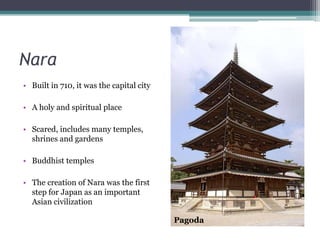
NaraBuilt in 710, it was the capital cityA holy and spiritual placeScared, includes many temples, shrines and gardensBuddhist templesThe creation of Nara was the first step for Japan as an important Asian civilizationPagoda
Resourceshttp://www.fascinating-travel-destinations.com/ancient-nara.htmlhttp://afe.easia.columbia.edu/japan/japanworkbook/traditional/shotoku.htmGlobal Insights, copyright 1994 by the Glencoe Division of Macmillan/McGraw-Hill School Publishing Company, ISBN 0-02-822690-9 (Teacher’s Edition),  Chapter 16, Traditional Japan. Page 255, section 1, Emerging Civilizationhttp://en.wikipedia.org/wiki/Asuka_period

Japan - An Emerging Civilization

Editor's Notes

  • #3 The Asuka period is set from 538 to 710, it was known as the period of fine-art and architecture. This period of history was greatly effected by Prince Shotoku Taishi who was the adviser of Empress Suiko, he was devouted Buddhist which effected his work as it was his inspiration. He was known to be very intelligent and learnt a lot from the Chinese, even using their system of imperial rule to make the Japanese dynasty even more powerful.