Introductions
• Jim Stenerson
• Joan Walker
• Ally Kimmel
• APW Mentors
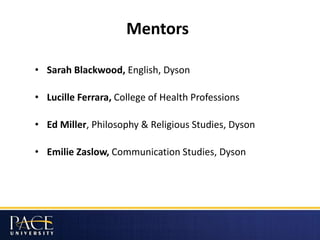
Mentors
• Sarah Blackwood, English, Dyson
• Lucille Ferrara, College of Health Professions
• Ed Miller, Philosophy & Religious Studies, Dyson
• Emilie Zaslow, Communication Studies, Dyson
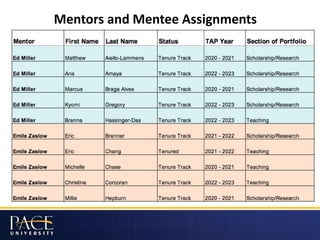
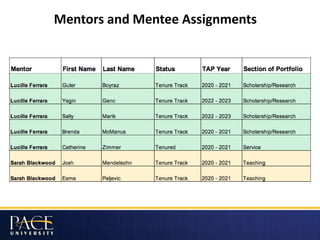
Mentors and Mentee Assignments
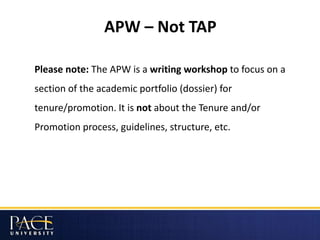
APW – Not TAP
Please note: The APW is a writing workshop to focus on a
section of the academic portfolio (dossier) for
tenure/promotion. It is not about the Tenure and/or
Promotion process, guidelines, structure, etc.
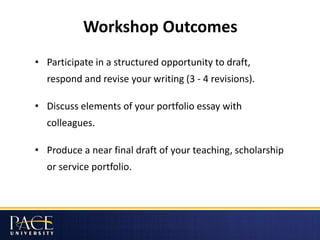
Workshop Outcomes
• Participate in a structured opportunity to draft,
respond and revise your writing (3 - 4 revisions).
• Discuss elements of your portfolio essay with
colleagues.
• Produce a near final draft of your teaching, scholarship
or service portfolio.
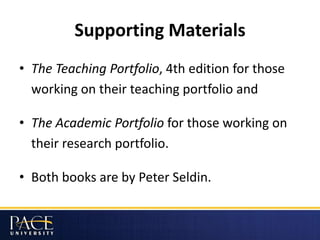
Supporting Materials
• The Teaching Portfolio, 4th edition for those
working on their teaching portfolio and
• The Academic Portfolio for those working on
their research portfolio.
• Both books are by Peter Seldin.
• First draft due to mentor by January 2nd
• January 13, 10 am: (3 – 4 hours meeting time)
• Introductions and workshop overview
• Meet with mentor and discuss feedback on first draft
• January 14 and 15: Daily work with mentor on revisions
• January 16, 12pm: (2 – 3 hours meeting time)
• Celebratory lunch
• Review process and provide feedback
• Library citation analysis review
January 2020 Academic Portfolio Workshop
551 5th Ave, Midtown - Room 819
2020 CDFPT Dossier Guidelines
• Curriculum Vitae (CV) ≤ 15 pages
• Executive Summary ≤ 2 pages
• Teaching Statement ≤ 10 pages
• Scholarship/Research Statement ≤ 10 pages
• Service Statement ≤ 10 pages
• Professional/Practicum (Optional) ≤ 10 pages
Teaching Portfolio
This section should include objective and subjective evidence of your
abilities and effectiveness as a teacher. Some suggested sub-headings for this
section include:
• Teaching Philosophy
• Teaching Responsibilities - include any courses you developed
• General Classroom Strategies
• Teaching Assessments and Evaluations
• Collaborative Opportunities with Students
• Future Teaching Goals
Scholarship/Research Portfolio
Should include objective evidence of your abilities and effectiveness as a scholar/researcher.
Some suggested sub-headings for this section include:
• Introduction – Your scholarship/research philosophy. A description of your area(s) of
research.
• Scholarship/Research
• A description of your scholarship/research and its impact, influence, importance in
your discipline.
• Work(s) in progress with anticipated completion dates and grants, applied for and
received, or approved and not funded (substantiated by documents).
• Other means used to share research findings, knowledge, and thinking, such as
presentations at academic or professional meetings or in seminars or forums for
students, peers, or the public. You may present this by specifying dates, sponsoring
organizations, locations, and nature of participation (e.g., coordinator, presenter, or
panelist; titles of sessions/papers, etc.).
• Future Scholarship/Research Goals - Where you see your scholarship/research moving.
Service Portfolio
Highlights your contribution to your Department, School/College, and University
(internal service) and community (external service). Specify organizations, groups, and
events in which you have actively participated, citing particular accomplishments. You
may wish to submit letters from knowledgeable and qualified individuals attesting to
your involvement. Some suggested sub-headings for this section include:
• Introduction – A description of your internal and external service.
• Internal Service – A list of your internal service at the Departmental,
College/School, and/or University levels; this list can be bulleted.
• External Service – A list of your external service that is relevant at the community,
local, national, and/or international, professional levels; this list can be bulleted.
• Professional Development – A list of conferences, courses, symposiums, continuing
education courses that you participated and/or attended; this list can be bulleted.
Dossier Appendices
There is no limit to the length; however, not all Departmental Tap and CDFPT members
devote the same amount importance or time to this section. Suggested subheadings:
• Course Syllabi. Rather than providing a syllabus for each class you may want to provide
two from the same course; one early in your teaching and one later to show growth or
change. Include courses developed.
• Examples of Assessments and Evaluations. Examples include rubrics and assessment
matrices, assignments, projects, review guides and exams.
• Assignments and Exams: Examples include use of portfolios, projects, papers,
summaries, abstracts, presentations, and exams.
• Student Evaluations.
• Teaching Evaluations by Peers and/or Other Professionals. Strongly encouraged and may
be either formal classroom evaluations or letters attesting to effective teaching,
conducted by tenured, senior colleagues at Pace and/or other universities. Can also
include professional colleague evaluations of teaching performance in non-academic
settings, e.g., professional groups or public seminars.
Dossier Appendices
• Teaching Strategies.
• Publications. The manuscript or links to your work is recommended.
• Presentations. Provide a list in bulleted form that includes the date of the presentation,
the title of your work, name of conference or organization, and location.
• Grants and Awards.
• Impact Factor and Citation Reports. Include citation of your work, (e.g. by other authors
or speakers), impact factor and acceptance rate of journals your work appears.
• Letters of Support. The majority of the letters of support regarding your teaching,
scholarship/research, and service are mailed directly to your Dean’s Office. You may
have, however, some letters attesting to your abilities that were unsolicited (e.g. an
email from an appreciative student) that you wish to include.
• Internal Service.
• External Service.
• Professional Development.
Formatting Guidelines
Below are formatting guidelines for:
1. Executive Summary
2. Teaching Statement
3. Research/Scholarship Statement
4. Service Statement
5. Practicum
Heading on each page: Last name, First initial top right corner
Font: Times New Roman
Font size: 11 PT
Spacing: 1.5 lines
Page margins: 1 inch all around
APW Questions on Discussion Board
Please answer these questions in the discussion
board by January 10th
• What are you hoping to achieve during the APW?
• How can your mentor help you achieve your aims?
• Is there anything else you'd like to ask or share
before the workshop begins?
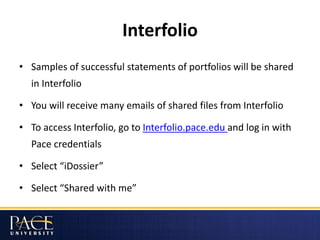
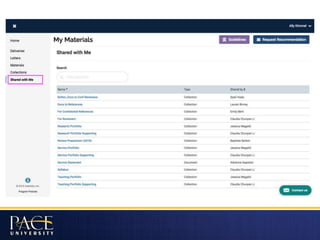
Interfolio
• Samples of successful statements of portfolios will be shared
in Interfolio
• You will receive many emails of shared files from Interfolio
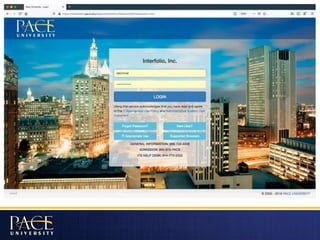
• To access Interfolio, go to Interfolio.pace.edu and log in with
Pace credentials
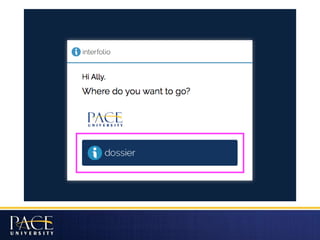
• Select “iDossier”
• Select “Shared with me”
Questions or Comments
Mentor Advice?
Thank you! See you in January.

January 2020 APW Pre Meeting Presentation

  • 1.
    Introductions • Jim Stenerson •Joan Walker • Ally Kimmel • APW Mentors
  • 2.
    Mentors • Sarah Blackwood,English, Dyson • Lucille Ferrara, College of Health Professions • Ed Miller, Philosophy & Religious Studies, Dyson • Emilie Zaslow, Communication Studies, Dyson
  • 3.
    Mentors and MenteeAssignments
  • 4.
    Mentors and MenteeAssignments
  • 5.
    APW – NotTAP Please note: The APW is a writing workshop to focus on a section of the academic portfolio (dossier) for tenure/promotion. It is not about the Tenure and/or Promotion process, guidelines, structure, etc.
  • 6.
    Workshop Outcomes • Participatein a structured opportunity to draft, respond and revise your writing (3 - 4 revisions). • Discuss elements of your portfolio essay with colleagues. • Produce a near final draft of your teaching, scholarship or service portfolio.
  • 7.
    Supporting Materials • TheTeaching Portfolio, 4th edition for those working on their teaching portfolio and • The Academic Portfolio for those working on their research portfolio. • Both books are by Peter Seldin.
  • 8.
    • First draftdue to mentor by January 2nd • January 13, 10 am: (3 – 4 hours meeting time) • Introductions and workshop overview • Meet with mentor and discuss feedback on first draft • January 14 and 15: Daily work with mentor on revisions • January 16, 12pm: (2 – 3 hours meeting time) • Celebratory lunch • Review process and provide feedback • Library citation analysis review January 2020 Academic Portfolio Workshop 551 5th Ave, Midtown - Room 819
  • 9.
    2020 CDFPT DossierGuidelines • Curriculum Vitae (CV) ≤ 15 pages • Executive Summary ≤ 2 pages • Teaching Statement ≤ 10 pages • Scholarship/Research Statement ≤ 10 pages • Service Statement ≤ 10 pages • Professional/Practicum (Optional) ≤ 10 pages
  • 10.
    Teaching Portfolio This sectionshould include objective and subjective evidence of your abilities and effectiveness as a teacher. Some suggested sub-headings for this section include: • Teaching Philosophy • Teaching Responsibilities - include any courses you developed • General Classroom Strategies • Teaching Assessments and Evaluations • Collaborative Opportunities with Students • Future Teaching Goals
  • 11.
    Scholarship/Research Portfolio Should includeobjective evidence of your abilities and effectiveness as a scholar/researcher. Some suggested sub-headings for this section include: • Introduction – Your scholarship/research philosophy. A description of your area(s) of research. • Scholarship/Research • A description of your scholarship/research and its impact, influence, importance in your discipline. • Work(s) in progress with anticipated completion dates and grants, applied for and received, or approved and not funded (substantiated by documents). • Other means used to share research findings, knowledge, and thinking, such as presentations at academic or professional meetings or in seminars or forums for students, peers, or the public. You may present this by specifying dates, sponsoring organizations, locations, and nature of participation (e.g., coordinator, presenter, or panelist; titles of sessions/papers, etc.). • Future Scholarship/Research Goals - Where you see your scholarship/research moving.
  • 12.
    Service Portfolio Highlights yourcontribution to your Department, School/College, and University (internal service) and community (external service). Specify organizations, groups, and events in which you have actively participated, citing particular accomplishments. You may wish to submit letters from knowledgeable and qualified individuals attesting to your involvement. Some suggested sub-headings for this section include: • Introduction – A description of your internal and external service. • Internal Service – A list of your internal service at the Departmental, College/School, and/or University levels; this list can be bulleted. • External Service – A list of your external service that is relevant at the community, local, national, and/or international, professional levels; this list can be bulleted. • Professional Development – A list of conferences, courses, symposiums, continuing education courses that you participated and/or attended; this list can be bulleted.
  • 13.
    Dossier Appendices There isno limit to the length; however, not all Departmental Tap and CDFPT members devote the same amount importance or time to this section. Suggested subheadings: • Course Syllabi. Rather than providing a syllabus for each class you may want to provide two from the same course; one early in your teaching and one later to show growth or change. Include courses developed. • Examples of Assessments and Evaluations. Examples include rubrics and assessment matrices, assignments, projects, review guides and exams. • Assignments and Exams: Examples include use of portfolios, projects, papers, summaries, abstracts, presentations, and exams. • Student Evaluations. • Teaching Evaluations by Peers and/or Other Professionals. Strongly encouraged and may be either formal classroom evaluations or letters attesting to effective teaching, conducted by tenured, senior colleagues at Pace and/or other universities. Can also include professional colleague evaluations of teaching performance in non-academic settings, e.g., professional groups or public seminars.
  • 14.
    Dossier Appendices • TeachingStrategies. • Publications. The manuscript or links to your work is recommended. • Presentations. Provide a list in bulleted form that includes the date of the presentation, the title of your work, name of conference or organization, and location. • Grants and Awards. • Impact Factor and Citation Reports. Include citation of your work, (e.g. by other authors or speakers), impact factor and acceptance rate of journals your work appears. • Letters of Support. The majority of the letters of support regarding your teaching, scholarship/research, and service are mailed directly to your Dean’s Office. You may have, however, some letters attesting to your abilities that were unsolicited (e.g. an email from an appreciative student) that you wish to include. • Internal Service. • External Service. • Professional Development.
  • 15.
    Formatting Guidelines Below areformatting guidelines for: 1. Executive Summary 2. Teaching Statement 3. Research/Scholarship Statement 4. Service Statement 5. Practicum Heading on each page: Last name, First initial top right corner Font: Times New Roman Font size: 11 PT Spacing: 1.5 lines Page margins: 1 inch all around
  • 16.
    APW Questions onDiscussion Board Please answer these questions in the discussion board by January 10th • What are you hoping to achieve during the APW? • How can your mentor help you achieve your aims? • Is there anything else you'd like to ask or share before the workshop begins?
  • 17.
    Interfolio • Samples ofsuccessful statements of portfolios will be shared in Interfolio • You will receive many emails of shared files from Interfolio • To access Interfolio, go to Interfolio.pace.edu and log in with Pace credentials • Select “iDossier” • Select “Shared with me”
  • 21.
    Questions or Comments MentorAdvice? Thank you! See you in January.