





Building Your  Academic Portfolio New Faculty Scholars May 11 & 12, 2009
Overview & Introduction Retreat Schedule Us Our Approach Your Goals Our Goals http://bit.ly/ExMKY Do we have your picture?
Retreat Schedule See Handout
Our Retreat Approach--RIPP Reflective Integrative Participative Productive
Our Workshop Approach Work-Shop You Work — We Shop So, let’s let it RIPP!
Your Goals Please Take a Few Minutes to Write Down  Your Goals for the Retreat  —What to you Want to Get Out of This Experience? Share
Our Goals Create a  SANCTUARY  for Reflection and Work Facilitate  EMPOWERMENT Provide  GUIDELINES  and  ORGANIZATION Provide  FOUNDATIONAL INFORMATION Facilitate  COLLEGIALITY   Facilitate  COLLABORATION
Our Goals To Support  FEEDBACK  and SHARING To Create an  ENGAGED LEARNING  EXPERIENCE To Encourage  NETWORKING  and FUTURE SUPPORT MECHANISMS To Provide a  TEMPLATE  for FUTURE GROWTH
Our Goals MOST IMPORTANT GOAL To PRODUCE A  PRODUCT  —A Partial First Draft of Your Academic Portfolio
The only way I see changing the old guard is by educating them. And how do we educate them? We have to educate them by putting together good portfolios." Associate Professor Large Research University
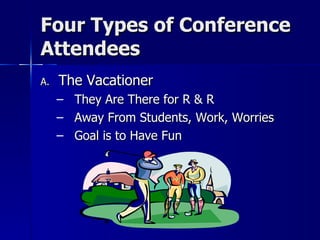
Four Types of Conference Attendees The Vacationer They Are There for R & R Away From Students, Work, Worries Goal is to Have Fun
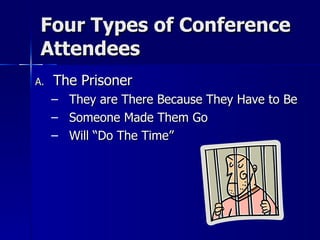
Four Types of Conference Attendees The Prisoner They are There Because They Have to Be Someone Made Them Go Will “Do The Time”
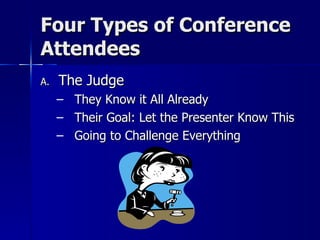
Four Types of Conference Attendees The Judge They Know it All Already  Their Goal: Let the Presenter Know This Going to Challenge Everything
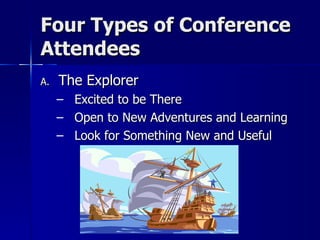
Four Types of Conference Attendees The Explorer Excited to be There Open to New Adventures and Learning Look for Something New and Useful
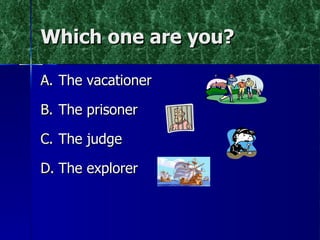
Which one are you? The vacationer The prisoner The judge The explorer
I HOPE WE HAVE A ROOM FULL OF EXPLORERS!!
General Writing Suggestions Write:  Get Something Down NOW Collaborate & Share Be Inclusive Rather than Exclusive Save Early & Save Often Order Not Important Now Edit & Revise Later
Ch. 2:  What is an Academic Portfolio? A Description of  WHAT  You do,  WHY  You do it,  HOW  you do it, to  WHOM  You do it to,  WHERE   and  WHEN  You do it, and What  IMPACT  Your Actions Have on You, Your Students, Your Department, Your College, Your University, Society,  & Universe
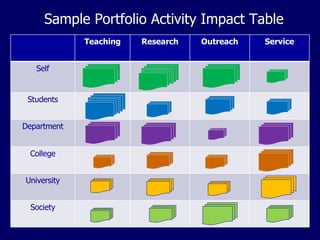
Sample Portfolio Activity Impact Table Teaching Research Outreach Service Self Students Department College University Society
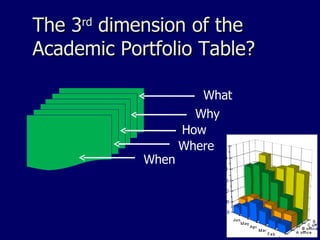
The 3 rd  dimension of the Academic Portfolio Table? What Why How When Where
Ch. 2: What is an Academic Portfolio? 8-15  Written Pages Followed by Appendices and Supporting Data Organized into Sections That Reflect the Various Aspects of Your Academic Life
Ch. 2: A Good Academic Portfolio Introduces You  Is a Focused Guide Revealing Who You Are and Why You Do What You Do Provides Evidence of Your Abilities Is Integrated and Aligned  Provides Evidence of Growth Describes Plans for Future
Ch. 2: Reasons to Create an Academic Portfolio Take Control  — Proactive not Reactive THE EVALUATION OF YOUR PERFORMANCE IS TOO IMPORTANT TO BE LEFT UP TO OTHERS Help Others  to Understand the Full Range of Your Academic Accomplishments Stimulates  Reflection Can Create Template for  Future Growth
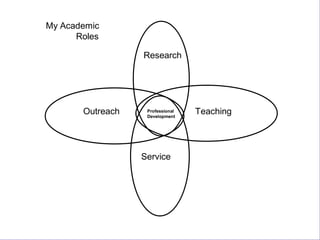
Ch. 2: What Does an Academic Portfolio Look Like?
 
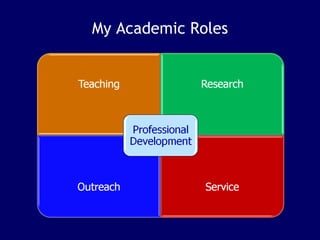
My Academic Roles
Ch. 2: Draw/Describe Your Academic Roles Page 10
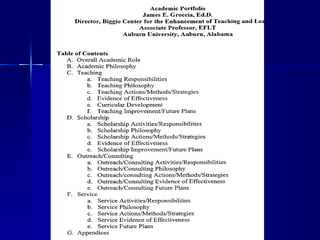
Ch. 2: Plan Your Table of Contents Pages 12 & 13 Complete Brainstorming Activities
 
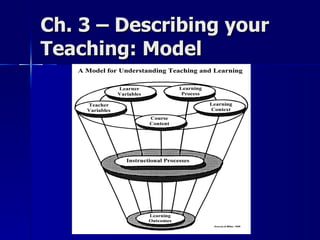
Ch. 3 – Describing your Teaching: Model
Ch. 3 – Describing your Teaching Step 1 List Courses Step 2 Organize / Group Step 3 Writing Steps 4, 5, & 6 Other Teaching Activities
“ The whole art of teaching is only the art of awakening the natural curiosity of young minds for the purpose of satisfying it afterwards.” Anatole France
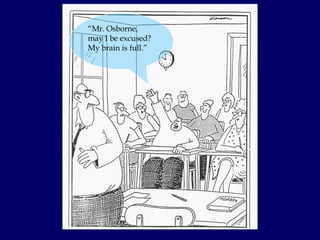
“ Mr. Osborne, may I be excused?  My brain is full.”
Ch. 3: Philosophy of Teaching – Pages 21-31 Step 1 Thinking / Metaphors Step 2 Role of Teacher Step 3 Describe what you do Step 4 Discuss Step 5 Role of Students – Read: “Student as Customer vs. Student as Learner”
 
 
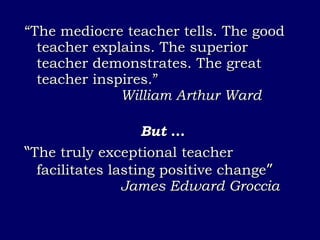
“ The mediocre teacher tells. The good teacher explains. The superior teacher demonstrates. The great teacher inspires.”  William Arthur Ward But  … “ The truly exceptional teacher facilitates lasting positive change ” James Edward Groccia
Ch. 3: Philosophy of Teaching Step 6 Organizing and Writing Step 7 Discuss and Share Step 8 Foundational Knowledge: Background Reading – What We Know About Learning Step 9 Reflecting, Editing, Rewriting Reflection : http://bit.ly/zPgfk
Ch. 3: Documenting Evidence of Good Teaching Refer to any evaluation data you brought with you
 
Ch. 3: Broadening Our View of Teaching Evaluation Need to Use Multiple Strategies For Evaluating Teaching  Don’t Just Rely on Student Ratings  Teaching Involves More Than Presenting (Remember Model)
What  is the Purpose?  Data for Promotion and Tenure Data for Professional Development Data for Research (SoTL)
Who  will do Evaluation? Self Students Colleagues Administrator—Chair / Dean Alumni Biggio Center
When  will Evaluation be Done? Before  Teaching During  Teaching  After  Teaching
What  Can Be Evaluated? Organization of Course Content Instructional Materials / Syllabus Communication Skills Knowledge Concern / Caring / Empathy
What  Can Be Evaluated? Fairness and Equity Reliability / Validity of Tests & Exams Teaching Methods Learning Outcomes
How ? Evaluation Approaches End of Semester Student Evaluations “ Compared to What I was Told About You, You are Better Than I Expected” “… He Made the Best Out of an Unbearable Situation” “ You’re a Great Teacher, but I Hate This Class” “ Maybe an Eraser Fight is in Your Future”
How ? Evaluation Approaches End of Semester Student Evaluations Quiz
How ? Evaluation Approaches Class Observation Videotaping Peer Review – Caveat  Review of Instructional Material Review of Student Records Graduate on Time? GPA
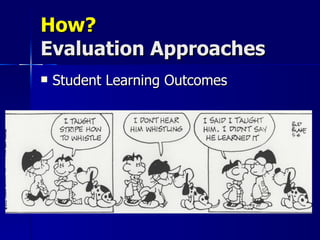
How?   Evaluation Approaches Student Learning Outcomes
How ? Evaluation Approaches Self-Assessment Early Feedback SGIF CATs Evaluation Forms On-Going Assessment—”Clickers”
Ch. 3: Documenting Effective Teaching (P. 37) Step 1: Student Evaluation Step 2: Other Evidence Step 3: Student Comments Step 4: Organizing and Writing Step 5: Additional Evidence Step 6: Sharing and Editing
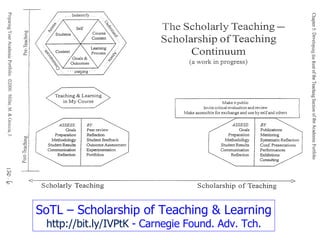
SoTL – Scholarship of Teaching & Learning http://bit.ly/IVPtK  - Carnegie Found. Adv. Tch.
“  Scholars of teaching and learning … are not prepared to be drive-by educators.  They insist on stopping at the scene to see what more they can do.” — Lee S. Shulman, 2002 President, Carnegie Foundation
… Cars…Sports…Military…Construction… Typical male bias in choice of analogy?
Ch. 4: My Research Role Step 1 Brainstorming Step 2 Pre-Writing / Metaphor / Discussion Step 3 Writing Describe “What”


Ch. 4: My Research Philosophy Step 1 Brainstorming Step 2 Writing Step 3 Share and Provide Feedback Describe “Why” Demonstrate Alignment
How would you describe your research area? An emerging field with not very many people working in it A well-established field but not very popular A well-established field that is very popular right now A field that might be stagnating What? I am supposed to do research?
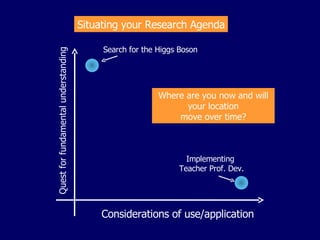
Considerations of use/application Quest for fundamental understanding Search for the Higgs Boson Implementing  Teacher Prof. Dev. Situating your Research Agenda Where are you now and will your location move over time?
How much research are you supposed to do in your appointment? <20% 20-40% 40-60% >60% I am supposed to do research?
How many people do you regularly interact with to conduct your research? No one else – just books and databases Just one or two people (rest are plants or animals) A few to several (lab research assistants) Dozens (e.g. in K-12 classrooms) Hundreds (e.g. survey research; audiences)
Not including your time, how expensive is your research? Not very – just need books and databases Moderately so (~$10K/year) Reasonably so (~10K-50K/year) Pretty expensive (~$100K/year) Really expensive (> ~$100K/year)
Ch. 4: Evidence of Research Success Step 1 List Accomplishments Step 2 Discuss how to Organize Step 3 & 4 Write — 3 to 5 Paragraphs
How much progress have you made this year on your research? Not very much Some, but not as much as I would like I am satisfied with the progress Its been great! I was nominated for the Nobel Prize!!
Ch. 4: Impact & Future Plans  Describe how your Research has meaning to profession, department, institution, students, etc. Describe Future Plans
How much progress have you made this year on your research? Not very much Some, but not as much as I would like I am satisfied with the progress Its been great! I was nominated for the Nobel Prize!!
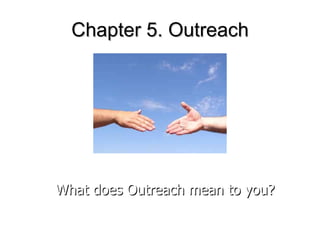
Chapter 5. Outreach What does Outreach mean to you?
The  Faculty Handbook  says… Today, Auburn University serves as a comprehensive, multi-disciplinary source of information, expertise, and programs of lifelong learning. Through .., university outreach, … Auburn faculty contribute to an educational network that extends research-generated knowledge and services to the people and communities of Alabama and subsequently to national and international audiences.
Outreach Role Outreach:  “ Instruction, or Research, or Instruction and Research that is Applied to the Direct Benefit of External Audiences and that is Directly Relevant to the Mission of the Units in which the Contributing Faculty and Staff Members Work” (Muse, 2000)
Keep brainstorming – who could potentially benefit from your outreach activities?
High school teachers Health services and hospitals Prisons Underserved population General public Auburn citizens Kids  Minority groups Communities Non-profit organizations Elderly   Museums Cities Students Small businesses Inventors  Animal shelters Parks
Activities Educational programs Informational publications Technical assistance Locally, nationally and internationally
…  who has time for that…? How can you get credit for it?
How could you tie  Outreach  to your  Research  or  Teaching
Documentation -  Creating a Framework
I. Situation - Problem  Identify a need and the benefitting target group How is this problem connected to your discipline and expertise? Community activities National and international
II. Objectives What would you like to achieve? For direct beneficiaries (e.g., high school teachers) For indirect beneficiaries (e.g., high school students through their teachers)
III. Approach - Methodology What would be ways to best achieve your goals? Develop a workshop Set-up small group discussions Create electronic message board …
III. Approach – Resources Do you need any resources to achieve your objectives (student help, space)? Do you need funding? Where could you apply for funding? Consider AU funding opportunities, organizations, public agencies, private sector, ...
VI. Outcomes - Impact What is the impact of your outreach project? On the direct and indirect beneficiaries Qualitatively and quantitatively
V. Deliverables Consider Workshop Report Non-technical publication …
VI. Outreach Effectiveness How could you evaluate the success of your outreach activity? Consider Evaluation by participants Development of an Outreach Portfolio Outreach philosophy Documentation of evidence
How could your outreach activity benefit  you  in terms of research and/or teaching and morph into something larger?
Outreach Philosophy Write one paragraph and share with your group Expand later to approximately 1 page
Ideas and Goals for the Future?
Ch. 7: Pulling it all Together: My Academic Role  Who Are You as an Academic Professional? What is the “Gestalt” of What You do? What is the Meaning of What You do?
Ch. 7: Academic Role & Responsibilities Describing your Academic Responsibilities Review What you Have Written in Previous Sections Respond to Brainstorming Qusetions Write Discuss and Edit
Ch. 7: Academic Philosophy – Sources  AAUP Code of Professional Ethics Seek and State Truth Support Free Pursuit of Learning Support Community of Scholars Effective Teachers & Scholars Good Citizens
Ch. 7: Academic Philosophy – Sources  AU Mission Statement and Strategic Plan
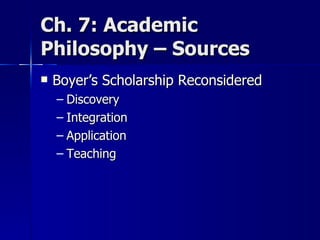
Ch. 7: Academic  Philosophy – Sources Boyer’s Scholarship Reconsidered Discovery Integration Application Teaching
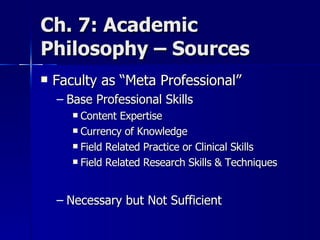
Ch. 7: Academic Philosophy – Sources Faculty as “Meta Professional” Base Professional Skills Content Expertise Currency of Knowledge Field Related Practice or Clinical Skills Field Related Research Skills & Techniques Necessary but Not Sufficient
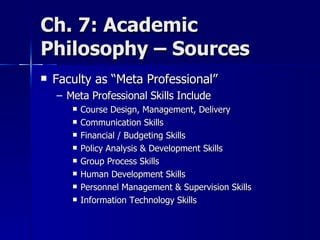
Ch. 7: Academic  Philosophy – Sources Faculty as “Meta Professional” Meta Professional Skills Include Course Design, Management, Delivery Communication Skills Financial / Budgeting Skills Policy Analysis & Development Skills Group Process Skills Human Development Skills Personnel Management & Supervision Skills Information Technology Skills
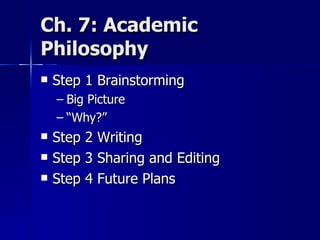
Ch. 7: Academic  Philosophy Step 1 Brainstorming Big Picture “ Why?” Step 2 Writing Step 3 Sharing and Editing Step 4 Future Plans
“ Spoon–feeding in the long run teaches us nothing but the shape of the spoon.” E.M. Forster
“ I am teaching…it’s kind of like having a love affair with a rhinoceros.” Anne Sexton
Ch. 8: Finishing  Check for Alignment Organize Appendices Review and Edit Self Evaluation and Other’s Feedback
Ch. 8: Plans for Continuation Commit to Working with Others to Continue Process Schedule Future Meeting Work with Campus Directors
Ch. 8: Plans for Continuation Remember:  Academic Portfolio is NEVER finished (Unless you Retire or Die)!
Summary / Wrap Up
We Hope We Accomplished Our Goals Created a  SANTUARY  for Reflection and Work Facilitated  EMPOWERMENT Provided  GUIDELINES  &  ORGANIZATION Provided  FOUNDATIONAL INFORMATION Facilitated  COLLEGIALITY   Facilitated  COLLABORATION
We Hope We Accomplished Our Goals Supported  FEEBACK  and SHARING Created an  ENGAGED LEARNING  EXPERIENCE Encouraged  NETWORKING  and FUTURE SUPPORT MECHANISMS HELPED YOU PRODUCE A PRODUCT —A Partial First Draft of Your Academic Portfolio
 

Academic Portfolio May 2009

  • 1.
    Building Your Academic Portfolio New Faculty Scholars May 11 & 12, 2009
  • 2.
    Overview & IntroductionRetreat Schedule Us Our Approach Your Goals Our Goals http://bit.ly/ExMKY Do we have your picture?
  • 3.
  • 4.
    Our Retreat Approach--RIPPReflective Integrative Participative Productive
  • 5.
    Our Workshop ApproachWork-Shop You Work — We Shop So, let’s let it RIPP!
  • 6.
    Your Goals PleaseTake a Few Minutes to Write Down Your Goals for the Retreat —What to you Want to Get Out of This Experience? Share
  • 7.
    Our Goals Createa SANCTUARY for Reflection and Work Facilitate EMPOWERMENT Provide GUIDELINES and ORGANIZATION Provide FOUNDATIONAL INFORMATION Facilitate COLLEGIALITY Facilitate COLLABORATION
  • 8.
    Our Goals ToSupport FEEDBACK and SHARING To Create an ENGAGED LEARNING EXPERIENCE To Encourage NETWORKING and FUTURE SUPPORT MECHANISMS To Provide a TEMPLATE for FUTURE GROWTH
  • 9.
    Our Goals MOSTIMPORTANT GOAL To PRODUCE A PRODUCT —A Partial First Draft of Your Academic Portfolio
  • 10.
    The only wayI see changing the old guard is by educating them. And how do we educate them? We have to educate them by putting together good portfolios.&quot; Associate Professor Large Research University
  • 11.
    Four Types ofConference Attendees The Vacationer They Are There for R & R Away From Students, Work, Worries Goal is to Have Fun
  • 12.
    Four Types ofConference Attendees The Prisoner They are There Because They Have to Be Someone Made Them Go Will “Do The Time”
  • 13.
    Four Types ofConference Attendees The Judge They Know it All Already Their Goal: Let the Presenter Know This Going to Challenge Everything
  • 14.
    Four Types ofConference Attendees The Explorer Excited to be There Open to New Adventures and Learning Look for Something New and Useful
  • 15.
    Which one areyou? The vacationer The prisoner The judge The explorer
  • 16.
    I HOPE WEHAVE A ROOM FULL OF EXPLORERS!!
  • 17.
    General Writing SuggestionsWrite: Get Something Down NOW Collaborate & Share Be Inclusive Rather than Exclusive Save Early & Save Often Order Not Important Now Edit & Revise Later
  • 18.
    Ch. 2: What is an Academic Portfolio? A Description of WHAT You do, WHY You do it, HOW you do it, to WHOM You do it to, WHERE and WHEN You do it, and What IMPACT Your Actions Have on You, Your Students, Your Department, Your College, Your University, Society, & Universe
  • 19.
    Sample Portfolio ActivityImpact Table Teaching Research Outreach Service Self Students Department College University Society
  • 20.
    The 3 rd dimension of the Academic Portfolio Table? What Why How When Where
  • 21.
    Ch. 2: Whatis an Academic Portfolio? 8-15 Written Pages Followed by Appendices and Supporting Data Organized into Sections That Reflect the Various Aspects of Your Academic Life
  • 22.
    Ch. 2: AGood Academic Portfolio Introduces You Is a Focused Guide Revealing Who You Are and Why You Do What You Do Provides Evidence of Your Abilities Is Integrated and Aligned Provides Evidence of Growth Describes Plans for Future
  • 23.
    Ch. 2: Reasonsto Create an Academic Portfolio Take Control — Proactive not Reactive THE EVALUATION OF YOUR PERFORMANCE IS TOO IMPORTANT TO BE LEFT UP TO OTHERS Help Others to Understand the Full Range of Your Academic Accomplishments Stimulates Reflection Can Create Template for Future Growth
  • 24.
    Ch. 2: WhatDoes an Academic Portfolio Look Like?
  • 25.
  • 26.
  • 27.
    Ch. 2: Draw/DescribeYour Academic Roles Page 10
  • 28.
    Ch. 2: PlanYour Table of Contents Pages 12 & 13 Complete Brainstorming Activities
  • 29.
  • 30.
    Ch. 3 –Describing your Teaching: Model
  • 31.
    Ch. 3 –Describing your Teaching Step 1 List Courses Step 2 Organize / Group Step 3 Writing Steps 4, 5, & 6 Other Teaching Activities
  • 32.
    “ The wholeart of teaching is only the art of awakening the natural curiosity of young minds for the purpose of satisfying it afterwards.” Anatole France
  • 33.
    “ Mr. Osborne,may I be excused? My brain is full.”
  • 34.
    Ch. 3: Philosophyof Teaching – Pages 21-31 Step 1 Thinking / Metaphors Step 2 Role of Teacher Step 3 Describe what you do Step 4 Discuss Step 5 Role of Students – Read: “Student as Customer vs. Student as Learner”
  • 35.
  • 36.
  • 37.
    “ The mediocreteacher tells. The good teacher explains. The superior teacher demonstrates. The great teacher inspires.” William Arthur Ward But … “ The truly exceptional teacher facilitates lasting positive change ” James Edward Groccia
  • 38.
    Ch. 3: Philosophyof Teaching Step 6 Organizing and Writing Step 7 Discuss and Share Step 8 Foundational Knowledge: Background Reading – What We Know About Learning Step 9 Reflecting, Editing, Rewriting Reflection : http://bit.ly/zPgfk
  • 39.
    Ch. 3: DocumentingEvidence of Good Teaching Refer to any evaluation data you brought with you
  • 40.
  • 41.
    Ch. 3: BroadeningOur View of Teaching Evaluation Need to Use Multiple Strategies For Evaluating Teaching Don’t Just Rely on Student Ratings Teaching Involves More Than Presenting (Remember Model)
  • 42.
    What isthe Purpose? Data for Promotion and Tenure Data for Professional Development Data for Research (SoTL)
  • 43.
    Who willdo Evaluation? Self Students Colleagues Administrator—Chair / Dean Alumni Biggio Center
  • 44.
    When willEvaluation be Done? Before Teaching During Teaching After Teaching
  • 45.
    What CanBe Evaluated? Organization of Course Content Instructional Materials / Syllabus Communication Skills Knowledge Concern / Caring / Empathy
  • 46.
    What CanBe Evaluated? Fairness and Equity Reliability / Validity of Tests & Exams Teaching Methods Learning Outcomes
  • 47.
    How ? EvaluationApproaches End of Semester Student Evaluations “ Compared to What I was Told About You, You are Better Than I Expected” “… He Made the Best Out of an Unbearable Situation” “ You’re a Great Teacher, but I Hate This Class” “ Maybe an Eraser Fight is in Your Future”
  • 48.
    How ? EvaluationApproaches End of Semester Student Evaluations Quiz
  • 49.
    How ? EvaluationApproaches Class Observation Videotaping Peer Review – Caveat Review of Instructional Material Review of Student Records Graduate on Time? GPA
  • 50.
    How? Evaluation Approaches Student Learning Outcomes
  • 51.
    How ? EvaluationApproaches Self-Assessment Early Feedback SGIF CATs Evaluation Forms On-Going Assessment—”Clickers”
  • 52.
    Ch. 3: DocumentingEffective Teaching (P. 37) Step 1: Student Evaluation Step 2: Other Evidence Step 3: Student Comments Step 4: Organizing and Writing Step 5: Additional Evidence Step 6: Sharing and Editing
  • 53.
    SoTL – Scholarshipof Teaching & Learning http://bit.ly/IVPtK - Carnegie Found. Adv. Tch.
  • 54.
    “ Scholarsof teaching and learning … are not prepared to be drive-by educators. They insist on stopping at the scene to see what more they can do.” — Lee S. Shulman, 2002 President, Carnegie Foundation
  • 55.
  • 56.
    Ch. 4: MyResearch Role Step 1 Brainstorming Step 2 Pre-Writing / Metaphor / Discussion Step 3 Writing Describe “What”
  • 57.
  • 58.
  • 59.
  • 60.
    Ch. 4: MyResearch Philosophy Step 1 Brainstorming Step 2 Writing Step 3 Share and Provide Feedback Describe “Why” Demonstrate Alignment
  • 61.
    How would youdescribe your research area? An emerging field with not very many people working in it A well-established field but not very popular A well-established field that is very popular right now A field that might be stagnating What? I am supposed to do research?
  • 62.
    Considerations of use/applicationQuest for fundamental understanding Search for the Higgs Boson Implementing Teacher Prof. Dev. Situating your Research Agenda Where are you now and will your location move over time?
  • 63.
    How much researchare you supposed to do in your appointment? <20% 20-40% 40-60% >60% I am supposed to do research?
  • 64.
    How many peopledo you regularly interact with to conduct your research? No one else – just books and databases Just one or two people (rest are plants or animals) A few to several (lab research assistants) Dozens (e.g. in K-12 classrooms) Hundreds (e.g. survey research; audiences)
  • 65.
    Not including yourtime, how expensive is your research? Not very – just need books and databases Moderately so (~$10K/year) Reasonably so (~10K-50K/year) Pretty expensive (~$100K/year) Really expensive (> ~$100K/year)
  • 66.
    Ch. 4: Evidenceof Research Success Step 1 List Accomplishments Step 2 Discuss how to Organize Step 3 & 4 Write — 3 to 5 Paragraphs
  • 67.
    How much progresshave you made this year on your research? Not very much Some, but not as much as I would like I am satisfied with the progress Its been great! I was nominated for the Nobel Prize!!
  • 68.
    Ch. 4: Impact& Future Plans Describe how your Research has meaning to profession, department, institution, students, etc. Describe Future Plans
  • 69.
    How much progresshave you made this year on your research? Not very much Some, but not as much as I would like I am satisfied with the progress Its been great! I was nominated for the Nobel Prize!!
  • 70.
    Chapter 5. OutreachWhat does Outreach mean to you?
  • 71.
    The FacultyHandbook says… Today, Auburn University serves as a comprehensive, multi-disciplinary source of information, expertise, and programs of lifelong learning. Through .., university outreach, … Auburn faculty contribute to an educational network that extends research-generated knowledge and services to the people and communities of Alabama and subsequently to national and international audiences.
  • 72.
    Outreach Role Outreach: “ Instruction, or Research, or Instruction and Research that is Applied to the Direct Benefit of External Audiences and that is Directly Relevant to the Mission of the Units in which the Contributing Faculty and Staff Members Work” (Muse, 2000)
  • 73.
    Keep brainstorming –who could potentially benefit from your outreach activities?
  • 74.
    High school teachersHealth services and hospitals Prisons Underserved population General public Auburn citizens Kids Minority groups Communities Non-profit organizations Elderly Museums Cities Students Small businesses Inventors Animal shelters Parks
  • 75.
    Activities Educational programsInformational publications Technical assistance Locally, nationally and internationally
  • 76.
    … whohas time for that…? How can you get credit for it?
  • 77.
    How could youtie Outreach to your Research or Teaching
  • 78.
    Documentation - Creating a Framework
  • 79.
    I. Situation -Problem Identify a need and the benefitting target group How is this problem connected to your discipline and expertise? Community activities National and international
  • 80.
    II. Objectives Whatwould you like to achieve? For direct beneficiaries (e.g., high school teachers) For indirect beneficiaries (e.g., high school students through their teachers)
  • 81.
    III. Approach -Methodology What would be ways to best achieve your goals? Develop a workshop Set-up small group discussions Create electronic message board …
  • 82.
    III. Approach –Resources Do you need any resources to achieve your objectives (student help, space)? Do you need funding? Where could you apply for funding? Consider AU funding opportunities, organizations, public agencies, private sector, ...
  • 83.
    VI. Outcomes -Impact What is the impact of your outreach project? On the direct and indirect beneficiaries Qualitatively and quantitatively
  • 84.
    V. Deliverables ConsiderWorkshop Report Non-technical publication …
  • 85.
    VI. Outreach EffectivenessHow could you evaluate the success of your outreach activity? Consider Evaluation by participants Development of an Outreach Portfolio Outreach philosophy Documentation of evidence
  • 86.
    How could youroutreach activity benefit you in terms of research and/or teaching and morph into something larger?
  • 87.
    Outreach Philosophy Writeone paragraph and share with your group Expand later to approximately 1 page
  • 88.
    Ideas and Goalsfor the Future?
  • 89.
    Ch. 7: Pullingit all Together: My Academic Role Who Are You as an Academic Professional? What is the “Gestalt” of What You do? What is the Meaning of What You do?
  • 90.
    Ch. 7: AcademicRole & Responsibilities Describing your Academic Responsibilities Review What you Have Written in Previous Sections Respond to Brainstorming Qusetions Write Discuss and Edit
  • 91.
    Ch. 7: AcademicPhilosophy – Sources AAUP Code of Professional Ethics Seek and State Truth Support Free Pursuit of Learning Support Community of Scholars Effective Teachers & Scholars Good Citizens
  • 92.
    Ch. 7: AcademicPhilosophy – Sources AU Mission Statement and Strategic Plan
  • 93.
    Ch. 7: Academic Philosophy – Sources Boyer’s Scholarship Reconsidered Discovery Integration Application Teaching
  • 94.
    Ch. 7: AcademicPhilosophy – Sources Faculty as “Meta Professional” Base Professional Skills Content Expertise Currency of Knowledge Field Related Practice or Clinical Skills Field Related Research Skills & Techniques Necessary but Not Sufficient
  • 95.
    Ch. 7: Academic Philosophy – Sources Faculty as “Meta Professional” Meta Professional Skills Include Course Design, Management, Delivery Communication Skills Financial / Budgeting Skills Policy Analysis & Development Skills Group Process Skills Human Development Skills Personnel Management & Supervision Skills Information Technology Skills
  • 96.
    Ch. 7: Academic Philosophy Step 1 Brainstorming Big Picture “ Why?” Step 2 Writing Step 3 Sharing and Editing Step 4 Future Plans
  • 97.
    “ Spoon–feeding inthe long run teaches us nothing but the shape of the spoon.” E.M. Forster
  • 98.
    “ I amteaching…it’s kind of like having a love affair with a rhinoceros.” Anne Sexton
  • 99.
    Ch. 8: Finishing Check for Alignment Organize Appendices Review and Edit Self Evaluation and Other’s Feedback
  • 100.
    Ch. 8: Plansfor Continuation Commit to Working with Others to Continue Process Schedule Future Meeting Work with Campus Directors
  • 101.
    Ch. 8: Plansfor Continuation Remember: Academic Portfolio is NEVER finished (Unless you Retire or Die)!
  • 102.
  • 103.
    We Hope WeAccomplished Our Goals Created a SANTUARY for Reflection and Work Facilitated EMPOWERMENT Provided GUIDELINES & ORGANIZATION Provided FOUNDATIONAL INFORMATION Facilitated COLLEGIALITY Facilitated COLLABORATION
  • 104.
    We Hope WeAccomplished Our Goals Supported FEEBACK and SHARING Created an ENGAGED LEARNING EXPERIENCE Encouraged NETWORKING and FUTURE SUPPORT MECHANISMS HELPED YOU PRODUCE A PRODUCT —A Partial First Draft of Your Academic Portfolio
  • 105.