Strategies for a Successful
Academic Interview
Erin N. Haynes, DrPH, MS
Professor and Chair
Department of Epidemiology, College of Public Health
Erin.Haynes@uky.edu
22nd NIEHS Annual Career Symposium
April 26, 2019
Objectives
• Interview process – how it operates from
the inside
• Preparing your application package
• Preparing for the Interview
• Interview Day
• After the Interview
What do you want?
• List your priorities
• Why do you want an academic job?
• List your needs
– Space, equipment, travel funds, etc
What do you need?
Be selective
• Don’t apply to all postings
• Consider each one and decide – Is this
really a place I’d want to live and work?
University Perspective
• We want to grow our research portfolio
• We need good educators
• We need colleagues
Search Committee and Timeline
• Appointed by the Department Chair
• Search Committee has a Chair
• Initial review
• Rank candidates
• Invite top candidates for online interview
• Invite a few for on site interviews
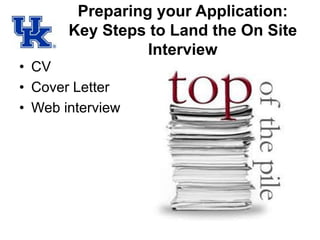
Preparing your Application:
Key Steps to Land the On Site
Interview
• CV
• Cover Letter
• Web interview
Preparing Your Curriculum
Vitae (CV)
• professional qualifications
• education
• experience
• accomplishments
• activities
• special qualifications
Cover Letter
• Purpose: to introduce yourself in a
narrative format.
• It demonstrates your writing skills –
proofread and spell check
• Articulate your fit
• Show enthusiasm
• Demonstrate your abilities in teaching,
research, and service
• 1 page, 3-4 paragraphs
• Single-spaced
• 10-12 point font, 1” margins
• Use same font as CV for unified
application
• Edit/proofread carefully
• Use active voice – keeping the tone
positive and profession.
Introduction
• “Dear Members of the Search Committee” (or
if a name is given for the Search Committee
Chair – address it to them)
• Refer to the specific position/announcement
• How did you learn about the position?
• Why you are a good fit/excellent candidate
• If you spoke with someone or know someone
at the University, include that person’s name
Body of Letter
• Demonstrate your ability in research, teaching,
and service
• Provide brief specific examples
– Use verbs: “led,” “developed,” “innovated” – actual
contribution
• Express your motivation and how your skills and
experiences prepared you for the job.
• Name Centers, Labs, resources at that institution
that you could work with
• Organize by relevance – not chronology.
• Do identify potential collaborators from the
institution
Last paragraph/Conclusion
• Reemphasis your enthusiasm
– “I look forward to speaking with the search
committee.”
• Thank them for their time and
consideration
• End with “Kind Regards” or “Sincerely”
• Sign with your full name
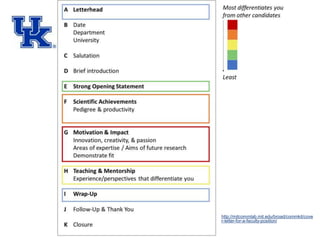
http://mitcommlab.mit.edu/broad/commkit/cove
r-letter-for-a-faculty-position/
Skype or Zoom Interviews
• Choose a professional location
• Do practice – view the space you’ve selected,
as they see it
• Make notes – they will only see you, not your
notes
• Highlight your research experience
• Be prepared to elaborate on your research –
and where you see it going/next steps
• Convey your interest in their institution
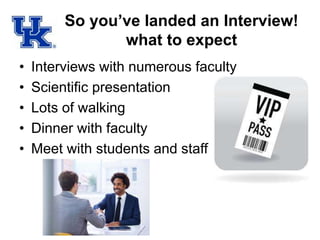
So you’ve landed an Interview!
what to expect
• Interviews with numerous faculty
• Scientific presentation
• Lots of walking
• Dinner with faculty
• Meet with students and staff
Prepare for the Interview
• Know who you are meeting
• Know the school/department
• Be able to discuss your research skills –
and future ideas
• What classes could you teach?
• You are also interviewing them – what
questions do you have?
Be prepared to answer these
questions:
• Tell me about yourself?
• Why do you want this position?
• Why are you interested in our institution?
• Tell us about your research – where is it
going/next steps?
• Tell us about your teaching experience?
• What classes could you teach for us?
• What can you contribute to the work we do?
• Do you have any questions for us?
Beyond the Bench
• Dinner or meals are social.
• Be prepared to talk about topics beyond
the Bench
– Sports, news, world events
Presentation
• Consider the time allotted – do not run
over!
• Practice your presentation: emphasis,
volume, and clarity.
• Be positive. Share your passion.
Questions you should ask:
• Tell me about the research infrastructure support
that is available to faculty?
• Describe the support mechanisms for junior faculty
– does the Department have a mentorship plan?
• What are sources of pilot data?
• What are the roles of the faculty in governance of
the Department/College?
• Tell me about you the courses your Department
offers and current teaching needs.
• Timeline for the interview process
What to wear
• Be professional
• Represent your best professional self
• Wear comfortable shoes – you will be
walking a lot
• Be prepared for a long day
After the interview
• Write (hand written) thank you notes
• OK to email and follow-up with each
interviewer.
• Each interviewer will complete an
evaluation of you within the next few days
– so don’t wait!
Resources
• https://www.training.nih.gov/assets/Prepari
ng_for_Academic_Interviews_Handout.pdf
• https://www.careereducation.columbia.edu
/resources/how-and-why-write-great-
cover-letter

Strategies for a successful academic interview

  • 1.
    Strategies for aSuccessful Academic Interview Erin N. Haynes, DrPH, MS Professor and Chair Department of Epidemiology, College of Public Health Erin.Haynes@uky.edu 22nd NIEHS Annual Career Symposium April 26, 2019
  • 2.
    Objectives • Interview process– how it operates from the inside • Preparing your application package • Preparing for the Interview • Interview Day • After the Interview
  • 3.
    What do youwant? • List your priorities • Why do you want an academic job? • List your needs – Space, equipment, travel funds, etc What do you need?
  • 4.
    Be selective • Don’tapply to all postings • Consider each one and decide – Is this really a place I’d want to live and work?
  • 5.
    University Perspective • Wewant to grow our research portfolio • We need good educators • We need colleagues
  • 6.
    Search Committee andTimeline • Appointed by the Department Chair • Search Committee has a Chair • Initial review • Rank candidates • Invite top candidates for online interview • Invite a few for on site interviews
  • 7.
    Preparing your Application: KeySteps to Land the On Site Interview • CV • Cover Letter • Web interview
  • 8.
    Preparing Your Curriculum Vitae(CV) • professional qualifications • education • experience • accomplishments • activities • special qualifications
  • 9.
    Cover Letter • Purpose:to introduce yourself in a narrative format. • It demonstrates your writing skills – proofread and spell check • Articulate your fit • Show enthusiasm • Demonstrate your abilities in teaching, research, and service
  • 10.
    • 1 page,3-4 paragraphs • Single-spaced • 10-12 point font, 1” margins • Use same font as CV for unified application • Edit/proofread carefully • Use active voice – keeping the tone positive and profession.
  • 11.
    Introduction • “Dear Membersof the Search Committee” (or if a name is given for the Search Committee Chair – address it to them) • Refer to the specific position/announcement • How did you learn about the position? • Why you are a good fit/excellent candidate • If you spoke with someone or know someone at the University, include that person’s name
  • 12.
    Body of Letter •Demonstrate your ability in research, teaching, and service • Provide brief specific examples – Use verbs: “led,” “developed,” “innovated” – actual contribution • Express your motivation and how your skills and experiences prepared you for the job. • Name Centers, Labs, resources at that institution that you could work with • Organize by relevance – not chronology. • Do identify potential collaborators from the institution
  • 13.
    Last paragraph/Conclusion • Reemphasisyour enthusiasm – “I look forward to speaking with the search committee.” • Thank them for their time and consideration • End with “Kind Regards” or “Sincerely” • Sign with your full name
  • 14.
  • 15.
    Skype or ZoomInterviews • Choose a professional location • Do practice – view the space you’ve selected, as they see it • Make notes – they will only see you, not your notes • Highlight your research experience • Be prepared to elaborate on your research – and where you see it going/next steps • Convey your interest in their institution
  • 16.
    So you’ve landedan Interview! what to expect • Interviews with numerous faculty • Scientific presentation • Lots of walking • Dinner with faculty • Meet with students and staff
  • 17.
    Prepare for theInterview • Know who you are meeting • Know the school/department • Be able to discuss your research skills – and future ideas • What classes could you teach? • You are also interviewing them – what questions do you have?
  • 18.
    Be prepared toanswer these questions: • Tell me about yourself? • Why do you want this position? • Why are you interested in our institution? • Tell us about your research – where is it going/next steps? • Tell us about your teaching experience? • What classes could you teach for us? • What can you contribute to the work we do? • Do you have any questions for us?
  • 19.
    Beyond the Bench •Dinner or meals are social. • Be prepared to talk about topics beyond the Bench – Sports, news, world events
  • 21.
    Presentation • Consider thetime allotted – do not run over! • Practice your presentation: emphasis, volume, and clarity. • Be positive. Share your passion.
  • 22.
    Questions you shouldask: • Tell me about the research infrastructure support that is available to faculty? • Describe the support mechanisms for junior faculty – does the Department have a mentorship plan? • What are sources of pilot data? • What are the roles of the faculty in governance of the Department/College? • Tell me about you the courses your Department offers and current teaching needs. • Timeline for the interview process
  • 23.
    What to wear •Be professional • Represent your best professional self • Wear comfortable shoes – you will be walking a lot • Be prepared for a long day
  • 24.
    After the interview •Write (hand written) thank you notes • OK to email and follow-up with each interviewer. • Each interviewer will complete an evaluation of you within the next few days – so don’t wait!
  • 25.