


Annie
G. Estacio
Charmaine
Escolano
Lea
Javier
Sir Andy
Bonifacio
 1965

to 1972 witnessed the holding of massive rallies
transport-strikes, different people demonstrations, as well as
protest marches by:
 Student rallies, Transport-strikes, Farmers, Workers, Urban
poor demonstration, Teachers, Doctors, Lawyers,
Professionals.
 The political, economic, social, educational, military, and
moral conditions in the country have reached their critical
level.
 Philippines society at this time that was a “social volcano”
that was ready to erupt.
 The

unprecedented government overspending during
Marco’s reelection campaign. The infusion of so much
money into an-unproductive electoral activity caused
inflation. Rice importation in the hands of cartels
enriched government cronies and even their relatives.
Farmers suffered and remain poor. They had no enough
gain that can be used to reduce the tenancy under the
Marcos land reform program. Prices of commodities
increase like in the student tuition fees. Slow
industrialization had caused low wages received by
workers unemployment reached to million in the 60s and
early 70s.
Business

is in the hand of the foreigners like
Americans and Japanese and “Parity Rights”
favored them. The radical leftists New People`s
Army (NPA) claimed its biggest number of
recruits from the countryside. Due to the
increasing poverty in many provinces, people, by
the families, flocked to the cities (mainly metro
manila) to eke out a living in sub-human
conditions. Urban poor demolitions to give way
to beautification projects and massive
infrastructure building pushed those in “squatter
colonies” to join the protest movement.
Abuse from Americans

fueled nationwide
protests. -Sexual abuse, brawls involving
U.S servicemen, the shooting of scavengers
of mistaken identity.
Marco’s was called as:
-Hitler
-Diktador
-Tuta!
-protector of U.S imperialist interest and
its local allies.
was a period

of leftist unrest in the Philippines,
composed of a series of heavy demonstrations,
protests, and marches against the government
from January to March 1970, or the first
quarter of 1970. It was one of the factors
leading to the declaration of Martial Law in
1972.
These were the causes behind the violent and
chaotic situation and the grim and bloody
events that followed.
 popularly known

as the 1987 Constitution, is the constitution or
the supreme law of the Republic of the Philippines. It was
enacted in 1987, during the administration of President Corazon
C. Aquino.
 Philippine constitutional law experts recognize three other
previous constitutions as having effectively governed the country
the 1935 Commonwealth Constitution, the 1973 Constitution,
and the 1986 Freedom Constitution.
 Two further constitutions were drafted and adopted during two
short-lived war-time governments, by the revolutionary forces
during the Philippine Revolution with Emilio Aguinaldo as
President and by the occupation forces during the Japanese
Occupation of the Philippines during World War II with José P.
Laurel as President.
 President

Jose P. Laurel issued Proclamation No. 29 on
September 21, 1944 placing the Philippines under martial law,
effective September 22, 1944.
 The propaganda effort was so successful that up to the present,
many Filipinos, particularly those who did not live through the
events of September 23, 1972, labor under the misapprehension
that martial law was proclaimed on September 21, 1972. It was
not.
 The facts are clear. A week before the actual declaration of
Martial Law, a number of people had already received
information that Marcos had drawn up a plan to completely take
over the government and gain absolute rule. Senator Benigno S.
Aquino Jr., during a September 13, 1972 privilege speech, thus
exposed what was known as “Operation Sagittarius”.
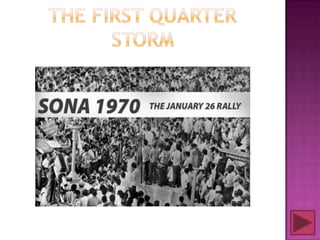
 The First

Quarter Storm was a period of leftist unrest in the
Philippines, composed of a series of heavy demonstrations,
protests, and marches against the government from January
to March 1970, or the first quarter of 1970.
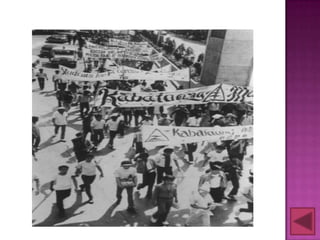
 It began in January 1970, when students welcomed Marcos
with demonstrations after his speech in the Congress. The
movement was led by the student leaders of the University of
the Philippines, echoing recent student demonstrations all
around the world before 1970. But then, the Moderate
demonstration turned into a Radical one, led by the
Kabataang Makabayan founder Jose Maria Sison as well as
the leader of the New People's Army Bernabe "Kuya Dante"
Buscayno.
 Laborers

also took part, protesting against graft and
corruption in the government, and the decline in the economy
caused by high oil prices and the overkill electoral victory of
Marcos for his second term. Some sources stated that the
unrest is the plan to overthrow the government through
communist as well as socialist support to the masses, as well
as students and workers who facilitated the storm. Most of
the activists carried Molotov cocktails and pillbox bombs to
counter the policemen attacks at Malacañang Palace.
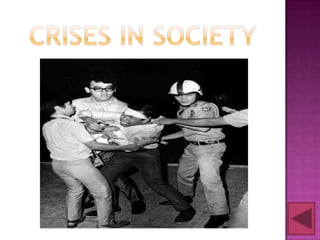
 The storm ended violently when the police used tear gas and
arms to quell the demonstrators. Students tried to counter
using Molotov cocktails and pillbox bombs while retreating.
Those who were slow enough were beaten with rifle butts
and fists of the police. The storm extended to Divisoria
district in Tondo, Manila.
After

the failed protest, some of the surviving
radical students, mostly from the University of
the Philippines, Lyceum of the Philippines,
Polytechnic University of the Philippines, and
the University of the East, became avowed
Marxists, and took up arms, engaging in
guerrilla and urban warfare. The First Quarter
Storm was one of the factors that led President
Ferdinand Marcos to declare Martial Law two
years later in 1972.
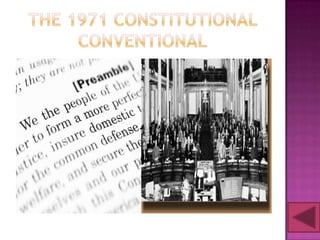
Headed by

Diosdado Macapagal
Was called to change the existing Philippine
Constitution which made during the
commonwealth of the Philippines special
elections for the CON-CON delegates who will
represent the various provinces of the country .
It was Macapagal who head on of former
President Marcos mannered to control the CONCON by bribing and influencing its delegates
who were supposed to be independent of
Malacañang.
Ratified

by the citizen assembles on
Jan.17,1973, provides for a shift from a
Presidential form of government to a
Parliamentary system. The president serves as a
symbolic head of state, executive power to
exercise by the prime minister of the assistance of
the cabinet and the legislative power.
Unicameral National assembly in 1976, The
national Assembly was replaced by BATASAN
PAMBANSA.
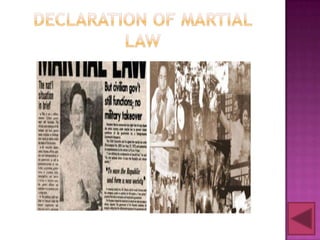
Proclamation

№ 1081 was the declaration
of Martial Law in the Philippines by
President Ferdinand E. Marcos. It became
effective throughout the entire country on
21 September 1972, and was announced to
the public two days later. It was formally
lifted on 17 January 1981, six months
before the first presidential election in the
Philippines in twelve years.
project
project
project
project
project
project
project
project
project

project

  • 2.
  • 3.
  • 4.
  • 5.
  • 6.
     1965 to 1972witnessed the holding of massive rallies transport-strikes, different people demonstrations, as well as protest marches by:  Student rallies, Transport-strikes, Farmers, Workers, Urban poor demonstration, Teachers, Doctors, Lawyers, Professionals.  The political, economic, social, educational, military, and moral conditions in the country have reached their critical level.  Philippines society at this time that was a “social volcano” that was ready to erupt.
  • 7.
     The unprecedented governmentoverspending during Marco’s reelection campaign. The infusion of so much money into an-unproductive electoral activity caused inflation. Rice importation in the hands of cartels enriched government cronies and even their relatives. Farmers suffered and remain poor. They had no enough gain that can be used to reduce the tenancy under the Marcos land reform program. Prices of commodities increase like in the student tuition fees. Slow industrialization had caused low wages received by workers unemployment reached to million in the 60s and early 70s.
  • 8.
    Business is in thehand of the foreigners like Americans and Japanese and “Parity Rights” favored them. The radical leftists New People`s Army (NPA) claimed its biggest number of recruits from the countryside. Due to the increasing poverty in many provinces, people, by the families, flocked to the cities (mainly metro manila) to eke out a living in sub-human conditions. Urban poor demolitions to give way to beautification projects and massive infrastructure building pushed those in “squatter colonies” to join the protest movement.
  • 9.
    Abuse from Americans fuelednationwide protests. -Sexual abuse, brawls involving U.S servicemen, the shooting of scavengers of mistaken identity. Marco’s was called as: -Hitler -Diktador -Tuta! -protector of U.S imperialist interest and its local allies.
  • 10.
    was a period ofleftist unrest in the Philippines, composed of a series of heavy demonstrations, protests, and marches against the government from January to March 1970, or the first quarter of 1970. It was one of the factors leading to the declaration of Martial Law in 1972. These were the causes behind the violent and chaotic situation and the grim and bloody events that followed.
  • 11.
     popularly known asthe 1987 Constitution, is the constitution or the supreme law of the Republic of the Philippines. It was enacted in 1987, during the administration of President Corazon C. Aquino.  Philippine constitutional law experts recognize three other previous constitutions as having effectively governed the country the 1935 Commonwealth Constitution, the 1973 Constitution, and the 1986 Freedom Constitution.  Two further constitutions were drafted and adopted during two short-lived war-time governments, by the revolutionary forces during the Philippine Revolution with Emilio Aguinaldo as President and by the occupation forces during the Japanese Occupation of the Philippines during World War II with José P. Laurel as President.
  • 12.
     President Jose P.Laurel issued Proclamation No. 29 on September 21, 1944 placing the Philippines under martial law, effective September 22, 1944.  The propaganda effort was so successful that up to the present, many Filipinos, particularly those who did not live through the events of September 23, 1972, labor under the misapprehension that martial law was proclaimed on September 21, 1972. It was not.  The facts are clear. A week before the actual declaration of Martial Law, a number of people had already received information that Marcos had drawn up a plan to completely take over the government and gain absolute rule. Senator Benigno S. Aquino Jr., during a September 13, 1972 privilege speech, thus exposed what was known as “Operation Sagittarius”.
  • 13.
     The First QuarterStorm was a period of leftist unrest in the Philippines, composed of a series of heavy demonstrations, protests, and marches against the government from January to March 1970, or the first quarter of 1970.  It began in January 1970, when students welcomed Marcos with demonstrations after his speech in the Congress. The movement was led by the student leaders of the University of the Philippines, echoing recent student demonstrations all around the world before 1970. But then, the Moderate demonstration turned into a Radical one, led by the Kabataang Makabayan founder Jose Maria Sison as well as the leader of the New People's Army Bernabe "Kuya Dante" Buscayno.
  • 14.
     Laborers also tookpart, protesting against graft and corruption in the government, and the decline in the economy caused by high oil prices and the overkill electoral victory of Marcos for his second term. Some sources stated that the unrest is the plan to overthrow the government through communist as well as socialist support to the masses, as well as students and workers who facilitated the storm. Most of the activists carried Molotov cocktails and pillbox bombs to counter the policemen attacks at Malacañang Palace.  The storm ended violently when the police used tear gas and arms to quell the demonstrators. Students tried to counter using Molotov cocktails and pillbox bombs while retreating. Those who were slow enough were beaten with rifle butts and fists of the police. The storm extended to Divisoria district in Tondo, Manila.
  • 15.
    After the failed protest,some of the surviving radical students, mostly from the University of the Philippines, Lyceum of the Philippines, Polytechnic University of the Philippines, and the University of the East, became avowed Marxists, and took up arms, engaging in guerrilla and urban warfare. The First Quarter Storm was one of the factors that led President Ferdinand Marcos to declare Martial Law two years later in 1972.
  • 16.
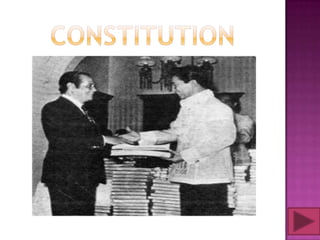
    Headed by Diosdado Macapagal Wascalled to change the existing Philippine Constitution which made during the commonwealth of the Philippines special elections for the CON-CON delegates who will represent the various provinces of the country . It was Macapagal who head on of former President Marcos mannered to control the CONCON by bribing and influencing its delegates who were supposed to be independent of Malacañang.
  • 17.
    Ratified by the citizenassembles on Jan.17,1973, provides for a shift from a Presidential form of government to a Parliamentary system. The president serves as a symbolic head of state, executive power to exercise by the prime minister of the assistance of the cabinet and the legislative power. Unicameral National assembly in 1976, The national Assembly was replaced by BATASAN PAMBANSA.
  • 18.
    Proclamation № 1081 wasthe declaration of Martial Law in the Philippines by President Ferdinand E. Marcos. It became effective throughout the entire country on 21 September 1972, and was announced to the public two days later. It was formally lifted on 17 January 1981, six months before the first presidential election in the Philippines in twelve years.