DIOSDADO
MACAPAGAL
(1910-1997)
9th
President of the Philippines
5th
President of the Third Republic
2nd
President of the 1971 Philippine
Constitutional Convention
6th
Vice-President of the Philippines
Diosdado Macapagal was born on September 28, 1910, in
Lubao, Pampanga, the third of four children in a poor family.
His father, Urbano Macapagal, was a poet who wrote in the
local Pampangan language, and his mother, Romana Pangan
Macapagal, was a schoolteacher who taught catechism.
He is a distant descendant of Don Juan Macapagal, a
prince of Tondo, who was a great-grandson of the last reigning Rajah
of Selurong, Rajah Lakandula.
The family earned extra income by raising pigs and
accommodating boarders in their home. Due to his roots in poverty,
Macapagal would later become affectionately known as the "Poor
boy from Lubao”. Diosdado Macapagal was also a reputed poet in
the Spanish language although his poet work was eclipsed by his
political biography.
Diosdado Macapagal excelled in his studies at local public
schools, graduating valedictorian at Lubao Elementary School, and
salutatorian at Pampanga High School.
He finished his pre-law course at the University of the
Philippines, then enrolled at Philippine Law School in 1932,
studying on a scholarship and supporting himself with a part-time
job as an accountant. While in law school, he gained prominence
as an orator and debater. However, he was forced to quit schooling
after two years due to poor health and a lack of money.
His brother-in-law Rogelio de la Rosa, with whom he
acted in and produced Tagalog operettas, helped him continue his
education. Macapagal raised enough money to continue his studies
at the University of Santo Tomas
He also gained the
assistance of philanthropist
Honorio Ventura, the
Secretary of the Interior at the
time, who financed his
education. After receiving his
Bachelor of Laws degree in
1936, he was admitted to the
bar, topping the 1936 bar
examination with a score of
89.95%. He later returned to
his alma mater to take up
graduate studies and earn a
Master of Laws degree in
1941, a Doctor of Civil Law
degree in 1947, and a PhD in
Economics in 1957. 1957, Diosdado Macapagal was conferred Doctor of Civil
Laws and Doctor of Economics. (Taken at UST)
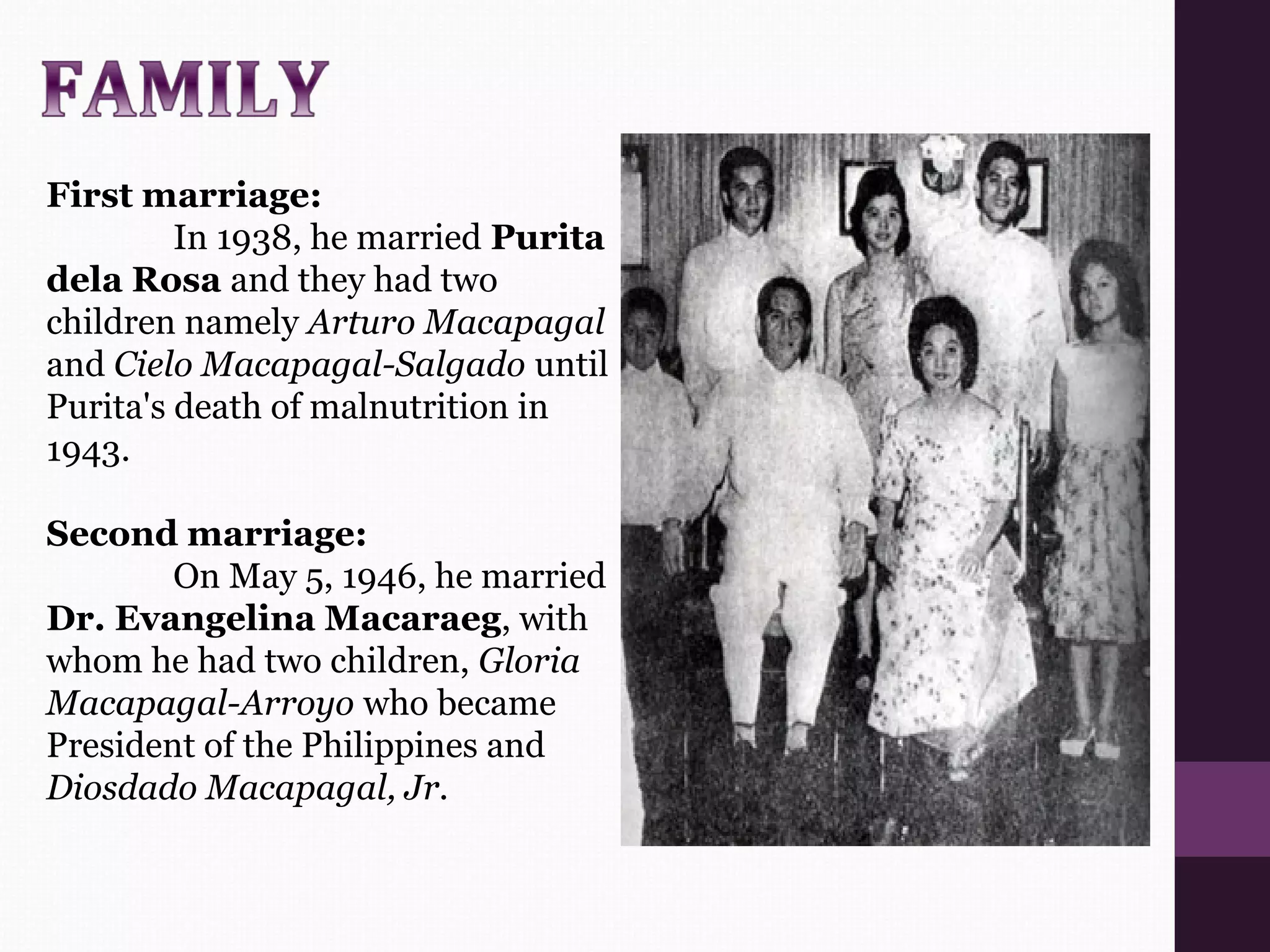
First marriage:
In 1938, he married Purita
dela Rosa and they had two
children namely Arturo Macapagal
and Cielo Macapagal-Salgado until
Purita's death of malnutrition in
1943.
Second marriage:
On May 5, 1946, he married
Dr. Evangelina Macaraeg, with
whom he had two children, Gloria
Macapagal-Arroyo who became
President of the Philippines and
Diosdado Macapagal, Jr.
President Diosdado Macapagal,
sharing a light moment with
daughter Gloria—who’d then
become the fourteenth President of
the Philippines, and is now the
Representative of the Second
District of Pampanga.
President Macapagal enjoying a well-
cooked meal of sinigang by his wife Eva at
home.
President Diosdado Macapagal and the
First Family with Pope John XXIII
“Let not the noble race of men of
freedom and dignity, which the Filipino
people are, ever be traduced and made
to kneel before any dictator, foreign or
native. Because as a tradition nurtured
in their history, freedom is deathless
and irrepressible in the soul of the
Filipino people.
In the Filipino heart, freedom is an
eternal flame that may be dimmed by
brutal might but not extinguished, for
hope will ever glow for the resurgence
of freedom. In the same manner that no
matter how long and dark the night
may be and how fearful the nightmare,
there will surely come the dawn that
will change the night into day.”
(Dec. 30, 1961 – Dec. 30, 1965)
Diosdado Macapagal
- From Democracy in the Philippines by Pres.
Diosdado Macapagal
• Agricultural Land Reform Code
- One of Diosdado Macapagal’s greatest achievements.
 He instituted a public land clearance program to make new farmlands
available for immediate use.
 Goal: To establish owner – cultivator ship and the economic family –
size farm as the basis of Philippine agriculture, and as a consequence,
divert landlord capital in agriculture to industrial development;
 To create a truly viable social and economic structure in agriculture
conducive to greater productivity and higher farm incomes;
 To provide a more vigorous and systematic land resettlement program
and public land distribution;
 Change the traditional share tenancy to lease hold system.
 The tenant would give 25% of their harvest as payment
The historic signing of the Agricultural Land Reform Code
on August 8, 1963
The historic signing of the Agricultural Land Reform Code on August 8, 1963 at
the Agrifina Circle in Luneta Manila. Together with the President were Senator Ferdinand
Marcos (left) and Speaker Cornelio Villareal (right). The said Code finally abolished the
centuries-old institution of tenancy.
• Emergency Employment Administration
 It was patterned after a similar employment program of United
States President Franklin D. Roosevelt during America’s great
depression in the 1930’s.
 Purpose: stated on Section 2 which says “It is hereby declared to
be the continuing policy and responsibility of the State to utilize
every possible means to create maximum employment
opportunities for all who are able, willing and seeking to work
but cannot find employment, thus increasing mass purchasing
power, developing income in rural areas, and stimulating
economic activity in general.”
 What this law basically does is to create and offer job
opportunities to Filipinos who are seeking or in need of
employment.
• Philippine Industry
 The law abolished share tenancy on rice and corn farmlands, and
established a leasehold system in which farmers paid fixed
rentals to landlords, rather than a percentage of the harvest.
• SABAH
 During President Diosdado Macapagal’s administration, the
Philippines formally claimed Sabah based on the Sultanate of
Sulu heirs’ claim on the territory.
• MAPHILINDO
 An organization composed of Southeast Asian countries
particularly the Malaysia, Philippines, and Indonesia.
 Purpose: To boost our country’s trade with our neighbors.
 The organization also have way to the making of the Association
of Southeast Asian Nations or better known as ASEAN.
• Independence Day
 From 1946 to 1962, Philippine
independence was celebrated on
July 4. It was President
Diosdado Macapagal who issued
Proclamation No. 28, s. 1962,
moving the commemoration of
Independence Day to June 12
— the date independence from
Spain was proclaimed in Emilio
Aguinaldo’s home in Kawit,
Cavite.
 July 4 is now the Philippine-
American Friendship Day.
President Macapagal was
particularly proud of restoring
Philippine Independence Day to
June 12, and was congratulated
for it at the Palace by President
Aguinaldo.
President Macapagal during
the Independence Day
celebration of 1963.
First State of the Nation Address of President Diosdado Macapagal
Second State of the Nation Address of President Diosdado
Macapagal delivered on January 28, 1963.
President Macapagal being carried by
female supporters during one of his
presidential campaigns.
President Macapagal enjoying the experience of planting palay.
Vice President Macapagal stopped in a Negros Occidental barrio
to swear in Nationalist Party defectionists into the Liberal Party.
President Macapagal waves as he rides
a carabao-drawn sled through shallow
waters in Linapacan, an island town of
Palawan.
Vice President Macapagal alights
from a banca in Binaungan,
Bulacan.
- President Macapagal stretches a long
arm to shake the hands of members of
the family of a farmer during his visit in
Roxas, Mindoro Oriental where he held
his "Common Man's Day" reception.
Outgoing President Diosdado P.
Macapagal and President-elect
Ferdinand E. Marcos
The elderly Diosdado Macapagal
pensively writing in his study room
during the years of struggle against the
dictatorship.
Diosdado and Evangelina Macapagal in a
more recent picture with their children.
(from left) Gloria Macapagal-Arroyo, Diosdado
Macapagal, Jr., Cielo Macapagal-Salgado and
Arturo Macapagal.
 In his retirement, Macapagal
devoted much of his time to
reading and writing. He
published his presidential
memoir, authored several books
about government and
economics, and wrote a weekly
column for the Manila Bulletin
newspaper.
 Diosdado Macapagal died of
heart failure, pneumonia and
renal complications at the Makati
Medical Center on April 21, 1997.
He is buried at the Libingan ng
mga Bayani.
Grave of Diosdado Macapagal at the
Libingan ng mga Bayani.
BS BIOLOGY 1A2-1
Prepared by:
 Ballesteros, Sharmine
 Natividad, Mica
 Beoncio, Catrina Charmaine
 Nabablit, Francis Marvien
 Sanggalang, Syrel

Diosdado Macapagal's Biography - PPT

  • 1.
    DIOSDADO MACAPAGAL (1910-1997) 9th President of thePhilippines 5th President of the Third Republic 2nd President of the 1971 Philippine Constitutional Convention 6th Vice-President of the Philippines
  • 2.
    Diosdado Macapagal wasborn on September 28, 1910, in Lubao, Pampanga, the third of four children in a poor family. His father, Urbano Macapagal, was a poet who wrote in the local Pampangan language, and his mother, Romana Pangan Macapagal, was a schoolteacher who taught catechism. He is a distant descendant of Don Juan Macapagal, a prince of Tondo, who was a great-grandson of the last reigning Rajah of Selurong, Rajah Lakandula. The family earned extra income by raising pigs and accommodating boarders in their home. Due to his roots in poverty, Macapagal would later become affectionately known as the "Poor boy from Lubao”. Diosdado Macapagal was also a reputed poet in the Spanish language although his poet work was eclipsed by his political biography.
  • 3.
    Diosdado Macapagal excelledin his studies at local public schools, graduating valedictorian at Lubao Elementary School, and salutatorian at Pampanga High School. He finished his pre-law course at the University of the Philippines, then enrolled at Philippine Law School in 1932, studying on a scholarship and supporting himself with a part-time job as an accountant. While in law school, he gained prominence as an orator and debater. However, he was forced to quit schooling after two years due to poor health and a lack of money. His brother-in-law Rogelio de la Rosa, with whom he acted in and produced Tagalog operettas, helped him continue his education. Macapagal raised enough money to continue his studies at the University of Santo Tomas
  • 4.
    He also gainedthe assistance of philanthropist Honorio Ventura, the Secretary of the Interior at the time, who financed his education. After receiving his Bachelor of Laws degree in 1936, he was admitted to the bar, topping the 1936 bar examination with a score of 89.95%. He later returned to his alma mater to take up graduate studies and earn a Master of Laws degree in 1941, a Doctor of Civil Law degree in 1947, and a PhD in Economics in 1957. 1957, Diosdado Macapagal was conferred Doctor of Civil Laws and Doctor of Economics. (Taken at UST)
  • 5.
    First marriage: In 1938,he married Purita dela Rosa and they had two children namely Arturo Macapagal and Cielo Macapagal-Salgado until Purita's death of malnutrition in 1943. Second marriage: On May 5, 1946, he married Dr. Evangelina Macaraeg, with whom he had two children, Gloria Macapagal-Arroyo who became President of the Philippines and Diosdado Macapagal, Jr.
  • 6.
    President Diosdado Macapagal, sharinga light moment with daughter Gloria—who’d then become the fourteenth President of the Philippines, and is now the Representative of the Second District of Pampanga. President Macapagal enjoying a well- cooked meal of sinigang by his wife Eva at home. President Diosdado Macapagal and the First Family with Pope John XXIII
  • 7.
    “Let not thenoble race of men of freedom and dignity, which the Filipino people are, ever be traduced and made to kneel before any dictator, foreign or native. Because as a tradition nurtured in their history, freedom is deathless and irrepressible in the soul of the Filipino people. In the Filipino heart, freedom is an eternal flame that may be dimmed by brutal might but not extinguished, for hope will ever glow for the resurgence of freedom. In the same manner that no matter how long and dark the night may be and how fearful the nightmare, there will surely come the dawn that will change the night into day.” (Dec. 30, 1961 – Dec. 30, 1965) Diosdado Macapagal - From Democracy in the Philippines by Pres. Diosdado Macapagal
  • 8.
    • Agricultural LandReform Code - One of Diosdado Macapagal’s greatest achievements.  He instituted a public land clearance program to make new farmlands available for immediate use.  Goal: To establish owner – cultivator ship and the economic family – size farm as the basis of Philippine agriculture, and as a consequence, divert landlord capital in agriculture to industrial development;  To create a truly viable social and economic structure in agriculture conducive to greater productivity and higher farm incomes;  To provide a more vigorous and systematic land resettlement program and public land distribution;  Change the traditional share tenancy to lease hold system.  The tenant would give 25% of their harvest as payment
  • 9.
    The historic signingof the Agricultural Land Reform Code on August 8, 1963 The historic signing of the Agricultural Land Reform Code on August 8, 1963 at the Agrifina Circle in Luneta Manila. Together with the President were Senator Ferdinand Marcos (left) and Speaker Cornelio Villareal (right). The said Code finally abolished the centuries-old institution of tenancy.
  • 10.
    • Emergency EmploymentAdministration  It was patterned after a similar employment program of United States President Franklin D. Roosevelt during America’s great depression in the 1930’s.  Purpose: stated on Section 2 which says “It is hereby declared to be the continuing policy and responsibility of the State to utilize every possible means to create maximum employment opportunities for all who are able, willing and seeking to work but cannot find employment, thus increasing mass purchasing power, developing income in rural areas, and stimulating economic activity in general.”  What this law basically does is to create and offer job opportunities to Filipinos who are seeking or in need of employment.
  • 11.
    • Philippine Industry The law abolished share tenancy on rice and corn farmlands, and established a leasehold system in which farmers paid fixed rentals to landlords, rather than a percentage of the harvest. • SABAH  During President Diosdado Macapagal’s administration, the Philippines formally claimed Sabah based on the Sultanate of Sulu heirs’ claim on the territory. • MAPHILINDO  An organization composed of Southeast Asian countries particularly the Malaysia, Philippines, and Indonesia.  Purpose: To boost our country’s trade with our neighbors.  The organization also have way to the making of the Association of Southeast Asian Nations or better known as ASEAN.
  • 12.
    • Independence Day From 1946 to 1962, Philippine independence was celebrated on July 4. It was President Diosdado Macapagal who issued Proclamation No. 28, s. 1962, moving the commemoration of Independence Day to June 12 — the date independence from Spain was proclaimed in Emilio Aguinaldo’s home in Kawit, Cavite.  July 4 is now the Philippine- American Friendship Day.
  • 13.
    President Macapagal was particularlyproud of restoring Philippine Independence Day to June 12, and was congratulated for it at the Palace by President Aguinaldo. President Macapagal during the Independence Day celebration of 1963.
  • 14.
    First State ofthe Nation Address of President Diosdado Macapagal
  • 15.
    Second State ofthe Nation Address of President Diosdado Macapagal delivered on January 28, 1963.
  • 16.
    President Macapagal beingcarried by female supporters during one of his presidential campaigns. President Macapagal enjoying the experience of planting palay. Vice President Macapagal stopped in a Negros Occidental barrio to swear in Nationalist Party defectionists into the Liberal Party.
  • 17.
    President Macapagal wavesas he rides a carabao-drawn sled through shallow waters in Linapacan, an island town of Palawan. Vice President Macapagal alights from a banca in Binaungan, Bulacan.
  • 18.
    - President Macapagalstretches a long arm to shake the hands of members of the family of a farmer during his visit in Roxas, Mindoro Oriental where he held his "Common Man's Day" reception. Outgoing President Diosdado P. Macapagal and President-elect Ferdinand E. Marcos
  • 19.
    The elderly DiosdadoMacapagal pensively writing in his study room during the years of struggle against the dictatorship. Diosdado and Evangelina Macapagal in a more recent picture with their children. (from left) Gloria Macapagal-Arroyo, Diosdado Macapagal, Jr., Cielo Macapagal-Salgado and Arturo Macapagal.
  • 20.
     In hisretirement, Macapagal devoted much of his time to reading and writing. He published his presidential memoir, authored several books about government and economics, and wrote a weekly column for the Manila Bulletin newspaper.  Diosdado Macapagal died of heart failure, pneumonia and renal complications at the Makati Medical Center on April 21, 1997. He is buried at the Libingan ng mga Bayani. Grave of Diosdado Macapagal at the Libingan ng mga Bayani.
  • 21.
    BS BIOLOGY 1A2-1 Preparedby:  Ballesteros, Sharmine  Natividad, Mica  Beoncio, Catrina Charmaine  Nabablit, Francis Marvien  Sanggalang, Syrel