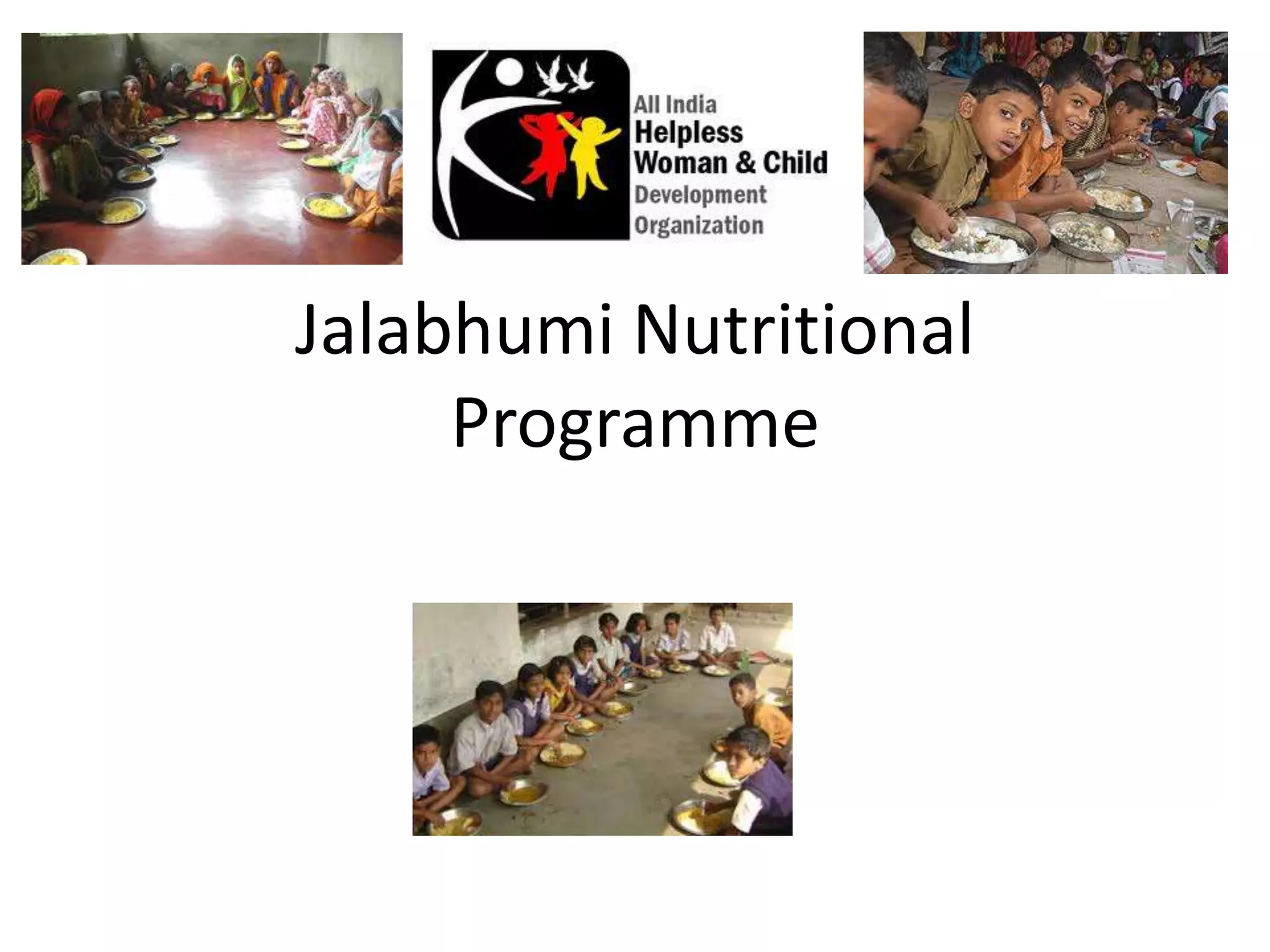
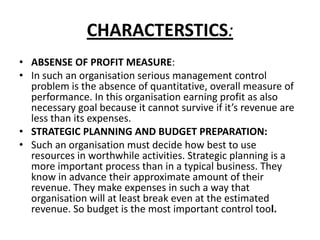
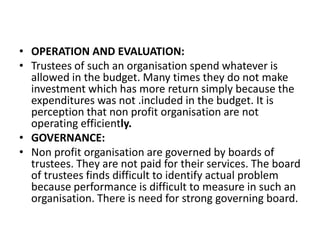

Jalabhumi Nutritional
Programme
NON PROFIT ORGANISATION
• The main objective of non profit organisation
is not to make profit. Their goal is welfare of
society.
• Non profit organisation has to earn modest
profit to provide funds for working capital and
day to day activities.
• Non profit organisation which meets the
criteria of section 501 (c) of Internal Revenue
Code are exempted from income taxes.
CHARACTERSTICS:
• ABSENSE OF PROFIT MEASURE:
• In such an organisation serious management control
problem is the absence of quantitative, overall measure of
performance. In this organisation earning profit as also
necessary goal because it cannot survive if it’s revenue are
less than its expenses.
• STRATEGIC PLANNING AND BUDGET PREPARATION:
• Such an organisation must decide how best to use
resources in worthwhile activities. Strategic planning is a
more important process than in a typical business. They
know in advance their approximate amount of their
revenue. They make expenses in such a way that
organisation will at least break even at the estimated
revenue. So budget is the most important control tool.
• OPERATION AND EVALUATION:
• Trustees of such an organisation spend whatever is
allowed in the budget. Many times they do not make
investment which has more return simply because the
expenditures was not .included in the budget. It is
perception that non profit organisation are not
operating efficiently.
• GOVERNANCE:
• Non profit organisation are governed by boards of
trustees. They are not paid for their services. The board
of trustees finds difficult to identify actual problem
because performance is difficult to measure in such an
organisation. There is need for strong governing board.
Malnutrition in India
• Malnutrition refers to the situation where there is an unbalanced diet in
which some nutrients are in lacking or wrong proportion.
• The World Bank estimates that India is one of the highest ranking
countries in the world for the number of children suffering from
malnutrition. The prevalence of underweight children in India is among
the highest in the world.
• Since Independence in 1947, its economic status has been classified as a
low-income country with majority of the population at or below the
poverty line.
• One of the major causes for malnutrition in India is gender inequality. Due
to the low social status of Indian women, their diet often lacks in both
quality and quantity. Women who suffer malnutrition are less likely to
have healthy babies. In India, mothers generally lack proper knowledge in
feeding children. Consequently, new born infants are unable to get
adequate amount of nutrition from their mothers.
• Deficiencies in nutrition inflict long-term damage to both individuals and
society.
• In addition, nutrition-deficient individuals are less productive at work. Low
productivity not only gives them low pay that traps them in a vicious circle
of under-nutrition, but also brings inefficiency to the society, especially in
India where labor is a major input factor for economic production.
Programs to address the causes of
malnutrition in India
•
•
•
•
•

Midday meal scheme in Indian schools
Integrated child development scheme
National Children's Fund
National Plan of Action for Children
United Nations Children's Fund
Jalabhumi Nutritional Programme (A)
•

•
•

•

The International Relief Organization(IRO) was planning a feeding scheme
to mitigate the nutritional deficiencies of the population of Jalabhumi
state in 1974.
Households spending less than Rs. 300 per month on household
expenditures were likely to experience deficiencies in calorie intake.
In spite of other nutritional problems, Deficiencies in calorie intake was
selected as a measure of the nutritional problem and also a sophisticated
yardstick.
Most vulnerable segments of population were:
 Infants up to 3 years
 Pregnant women and nursing mothers
 Pre-school children between 3 and 5.5 years
• Mid-Day Meal Programme
• Expanding balwadies is not so practicable. So
expanding mid day meal programme to cover
pre-schools was the best option
• For pregnant and nursing women also mid-day
meal programme was used
• Each IRO meal should provide at least 500
Calories of energy
• A framework for systematic evaluation of the
programme was developed through special
study team
International Relief Organization
• International Relief Organization is a nonprofit organization also
called not for profit or non profit & non-commercial organization
which is an organization that uses surplus revenues to achieve its
goals rather than distributing them as profit or dividends.
• It is permitted to generate surplus revenues, however it must retain
them for its self-preservation, expansion, or plans. It has
controlling members or boards. it has paid staff including
management as well as unpaid volunteers and even executives who
work with or without compensation (occasionally nominal). When
there is a token fee, it is used to meet legal requirements for
establishing a contract between the executive and the organization.
• Its goal is not to be successful in terms of wealth, but in terms of
giving value to the groups of people they administer to.
• In India, NPOs are known commonly as Non-Governmental
Organizations (NGOs).
• They can be registered in four ways:
–
–
–
–

Trust
Society
Section-25 Company
Special Licensing

• Registration can be done with the Registrar of
Companies(RoC).
• The following laws or Constitutional Articles of the Republic
of India are relevant to the NGOs:
–
–
–
–
–
–

Articles 19(1)(c) and 30 of the Constitution of India
Income Tax Act, 1961
Public Trusts Acts of various states
Societies Registration Act, 1860
Section 25 of the Indian Companies Act, 1956
Foreign Contribution (Regulation) Act, 1976
Question:1:
• What additional data would you, as the IRO
official concerned with the programme, have
requested at the planning stage?
1. Resource Management:
• Resource mismanagement is a particular problem with
NPOs because the employees are not accountable to
anybody with a direct stake in the organization. For
example, an employee may start a new program
without disclosing its complete liabilities or may be
rewarded for improving the NPO's reputation, making
other employees happy, and attracting new donors.
• Liabilities promised on the full faith and credit of the
organization but not recorded anywhere constitute
accounting fraud. But even indirect liabilities negatively
affect the financial sustainability of the NPO, and the
NPO will have financial problems unless strict controls
are instated.
2. Sources of External Funding:
• Most NPOs rely on external funding (government
funds, grants from charitable foundations, direct
donations) to maintain their operations and changes in
these sources of revenue may influence the reliability
or predictability with which the organization can hire
and retain staff, sustain facilities, create programs.
• The loss of funding created a huge resource problem
for the NPOs. More NPOs compete for fewer
money. Funders and donors question their own
decisions on why they should give to a particular NPO.
It has become more crucial for an NPO to
state why they acquire their funds and how they use
those money. This new environment is pushing NPOs
to be more accountable.
3. Corporate Structure:
NPOs that use a for-profit business model to
help solve social and environmental problems
showed no signs of financial crisis. Several
NPOs created new corporate structure that
allow to incorporate social purpose effectively
and efficiently. These NPOs have a bold, new
way to pursue their missions.
4. Leadership Succession
Research studies on NPOs suggest that there is a
leadership capacity deficit in the NPOs. They
need to build their leadership capacity and
improve their succession planning. Some NPOs
have wonderful leaders and these leaders have
passionately participated in their growth over the
years. While some of the leaders find it difficult
to guide the organization’s strategic plan and may
not have a succession plan in place.
5. Change Management
• NPO leaders are tasked with managing change;
being creative with their resources, using
volunteers, selecting board members who can
contribute in multiple ways, retaining and hiring
the appropriate staff, all while facing multiple
changes at the same time. A change in mindset
and a change in behavior are the keys to meeting
the demands of a NPO’s constituency.
• NPOs must find new ways to operate – their
mission may not change, but how they go about
it probably needs to change.
Question:2:
• Would you accept the “Illustrative goal
statement” diagrammed in Exhibit 1? What
modifications, if any, would you suggest so as
to facilitate the development of a framework
of evaluation?
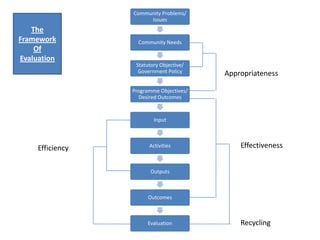
Community Problems/
Issues

The
Framework
Of
Evaluation

Community Needs

Statutory Objective/
Government Policy

Appropriateness

Programme Objectives/
Desired Outcomes

Input

Efficiency

Activities

Effectiveness

Outputs

Outcomes

Evaluation

Recycling
Question:3:
• On the basis of the “Goal statement” given in
Exhibit 1, modified as desired by you, identify
the data requirements needed in order to
comprehensively evaluate the Jalabhumi
Nutritional Programme.
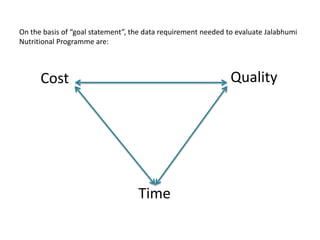
On the basis of “goal statement”, the data requirement needed to evaluate Jalabhumi
Nutritional Programme are:

Quality

Cost

Time
1. Strategic planning and Budgeting:

- Through establishing responsibility center
- Standard cost is required
- Collecting fund from donations : either
Specific or General
- Preparing the financial position

2. Control of Operation:

- Scheduling of time
- Milestone (Quality) must be maintained
- Controlling the operating cost

3. Fund Accounting:

- Collecting fund from donations : either
Specific or General

4. Governance:

-governed by boards of trustees.

5. Proper utilization of logistics of the
Mid-day Meal programme.
REVOLUTIONARY PART:
 Bringing profit centre cocept
 Increase volunteers
 Fund raising
 Increasing more calories meal
Jalabhumi nutritional programme

Jalabhumi nutritional programme

  • 1.
  • 2.
    NON PROFIT ORGANISATION •The main objective of non profit organisation is not to make profit. Their goal is welfare of society. • Non profit organisation has to earn modest profit to provide funds for working capital and day to day activities. • Non profit organisation which meets the criteria of section 501 (c) of Internal Revenue Code are exempted from income taxes.
  • 3.
    CHARACTERSTICS: • ABSENSE OFPROFIT MEASURE: • In such an organisation serious management control problem is the absence of quantitative, overall measure of performance. In this organisation earning profit as also necessary goal because it cannot survive if it’s revenue are less than its expenses. • STRATEGIC PLANNING AND BUDGET PREPARATION: • Such an organisation must decide how best to use resources in worthwhile activities. Strategic planning is a more important process than in a typical business. They know in advance their approximate amount of their revenue. They make expenses in such a way that organisation will at least break even at the estimated revenue. So budget is the most important control tool.
  • 4.
    • OPERATION ANDEVALUATION: • Trustees of such an organisation spend whatever is allowed in the budget. Many times they do not make investment which has more return simply because the expenditures was not .included in the budget. It is perception that non profit organisation are not operating efficiently. • GOVERNANCE: • Non profit organisation are governed by boards of trustees. They are not paid for their services. The board of trustees finds difficult to identify actual problem because performance is difficult to measure in such an organisation. There is need for strong governing board.
  • 5.
    Malnutrition in India •Malnutrition refers to the situation where there is an unbalanced diet in which some nutrients are in lacking or wrong proportion. • The World Bank estimates that India is one of the highest ranking countries in the world for the number of children suffering from malnutrition. The prevalence of underweight children in India is among the highest in the world. • Since Independence in 1947, its economic status has been classified as a low-income country with majority of the population at or below the poverty line. • One of the major causes for malnutrition in India is gender inequality. Due to the low social status of Indian women, their diet often lacks in both quality and quantity. Women who suffer malnutrition are less likely to have healthy babies. In India, mothers generally lack proper knowledge in feeding children. Consequently, new born infants are unable to get adequate amount of nutrition from their mothers. • Deficiencies in nutrition inflict long-term damage to both individuals and society. • In addition, nutrition-deficient individuals are less productive at work. Low productivity not only gives them low pay that traps them in a vicious circle of under-nutrition, but also brings inefficiency to the society, especially in India where labor is a major input factor for economic production.
  • 6.
    Programs to addressthe causes of malnutrition in India • • • • • Midday meal scheme in Indian schools Integrated child development scheme National Children's Fund National Plan of Action for Children United Nations Children's Fund
  • 7.
    Jalabhumi Nutritional Programme(A) • • • • The International Relief Organization(IRO) was planning a feeding scheme to mitigate the nutritional deficiencies of the population of Jalabhumi state in 1974. Households spending less than Rs. 300 per month on household expenditures were likely to experience deficiencies in calorie intake. In spite of other nutritional problems, Deficiencies in calorie intake was selected as a measure of the nutritional problem and also a sophisticated yardstick. Most vulnerable segments of population were:  Infants up to 3 years  Pregnant women and nursing mothers  Pre-school children between 3 and 5.5 years
  • 8.
    • Mid-Day MealProgramme • Expanding balwadies is not so practicable. So expanding mid day meal programme to cover pre-schools was the best option • For pregnant and nursing women also mid-day meal programme was used • Each IRO meal should provide at least 500 Calories of energy • A framework for systematic evaluation of the programme was developed through special study team
  • 9.
    International Relief Organization •International Relief Organization is a nonprofit organization also called not for profit or non profit & non-commercial organization which is an organization that uses surplus revenues to achieve its goals rather than distributing them as profit or dividends. • It is permitted to generate surplus revenues, however it must retain them for its self-preservation, expansion, or plans. It has controlling members or boards. it has paid staff including management as well as unpaid volunteers and even executives who work with or without compensation (occasionally nominal). When there is a token fee, it is used to meet legal requirements for establishing a contract between the executive and the organization. • Its goal is not to be successful in terms of wealth, but in terms of giving value to the groups of people they administer to.
  • 10.
    • In India,NPOs are known commonly as Non-Governmental Organizations (NGOs). • They can be registered in four ways: – – – – Trust Society Section-25 Company Special Licensing • Registration can be done with the Registrar of Companies(RoC). • The following laws or Constitutional Articles of the Republic of India are relevant to the NGOs: – – – – – – Articles 19(1)(c) and 30 of the Constitution of India Income Tax Act, 1961 Public Trusts Acts of various states Societies Registration Act, 1860 Section 25 of the Indian Companies Act, 1956 Foreign Contribution (Regulation) Act, 1976
  • 11.
    Question:1: • What additionaldata would you, as the IRO official concerned with the programme, have requested at the planning stage?
  • 12.
    1. Resource Management: •Resource mismanagement is a particular problem with NPOs because the employees are not accountable to anybody with a direct stake in the organization. For example, an employee may start a new program without disclosing its complete liabilities or may be rewarded for improving the NPO's reputation, making other employees happy, and attracting new donors. • Liabilities promised on the full faith and credit of the organization but not recorded anywhere constitute accounting fraud. But even indirect liabilities negatively affect the financial sustainability of the NPO, and the NPO will have financial problems unless strict controls are instated.
  • 13.
    2. Sources ofExternal Funding: • Most NPOs rely on external funding (government funds, grants from charitable foundations, direct donations) to maintain their operations and changes in these sources of revenue may influence the reliability or predictability with which the organization can hire and retain staff, sustain facilities, create programs. • The loss of funding created a huge resource problem for the NPOs. More NPOs compete for fewer money. Funders and donors question their own decisions on why they should give to a particular NPO. It has become more crucial for an NPO to state why they acquire their funds and how they use those money. This new environment is pushing NPOs to be more accountable.
  • 14.
    3. Corporate Structure: NPOsthat use a for-profit business model to help solve social and environmental problems showed no signs of financial crisis. Several NPOs created new corporate structure that allow to incorporate social purpose effectively and efficiently. These NPOs have a bold, new way to pursue their missions.
  • 15.
    4. Leadership Succession Researchstudies on NPOs suggest that there is a leadership capacity deficit in the NPOs. They need to build their leadership capacity and improve their succession planning. Some NPOs have wonderful leaders and these leaders have passionately participated in their growth over the years. While some of the leaders find it difficult to guide the organization’s strategic plan and may not have a succession plan in place.
  • 16.
    5. Change Management •NPO leaders are tasked with managing change; being creative with their resources, using volunteers, selecting board members who can contribute in multiple ways, retaining and hiring the appropriate staff, all while facing multiple changes at the same time. A change in mindset and a change in behavior are the keys to meeting the demands of a NPO’s constituency. • NPOs must find new ways to operate – their mission may not change, but how they go about it probably needs to change.
  • 17.
    Question:2: • Would youaccept the “Illustrative goal statement” diagrammed in Exhibit 1? What modifications, if any, would you suggest so as to facilitate the development of a framework of evaluation?
  • 18.
    Community Problems/ Issues The Framework Of Evaluation Community Needs StatutoryObjective/ Government Policy Appropriateness Programme Objectives/ Desired Outcomes Input Efficiency Activities Effectiveness Outputs Outcomes Evaluation Recycling
  • 19.
    Question:3: • On thebasis of the “Goal statement” given in Exhibit 1, modified as desired by you, identify the data requirements needed in order to comprehensively evaluate the Jalabhumi Nutritional Programme.
  • 20.
    On the basisof “goal statement”, the data requirement needed to evaluate Jalabhumi Nutritional Programme are: Quality Cost Time
  • 21.
    1. Strategic planningand Budgeting: - Through establishing responsibility center - Standard cost is required - Collecting fund from donations : either Specific or General - Preparing the financial position 2. Control of Operation: - Scheduling of time - Milestone (Quality) must be maintained - Controlling the operating cost 3. Fund Accounting: - Collecting fund from donations : either Specific or General 4. Governance: -governed by boards of trustees. 5. Proper utilization of logistics of the Mid-day Meal programme.
  • 22.
    REVOLUTIONARY PART:  Bringingprofit centre cocept  Increase volunteers  Fund raising  Increasing more calories meal