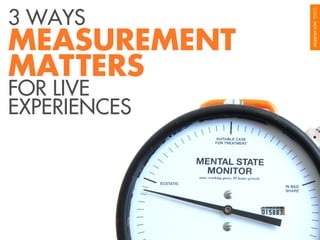
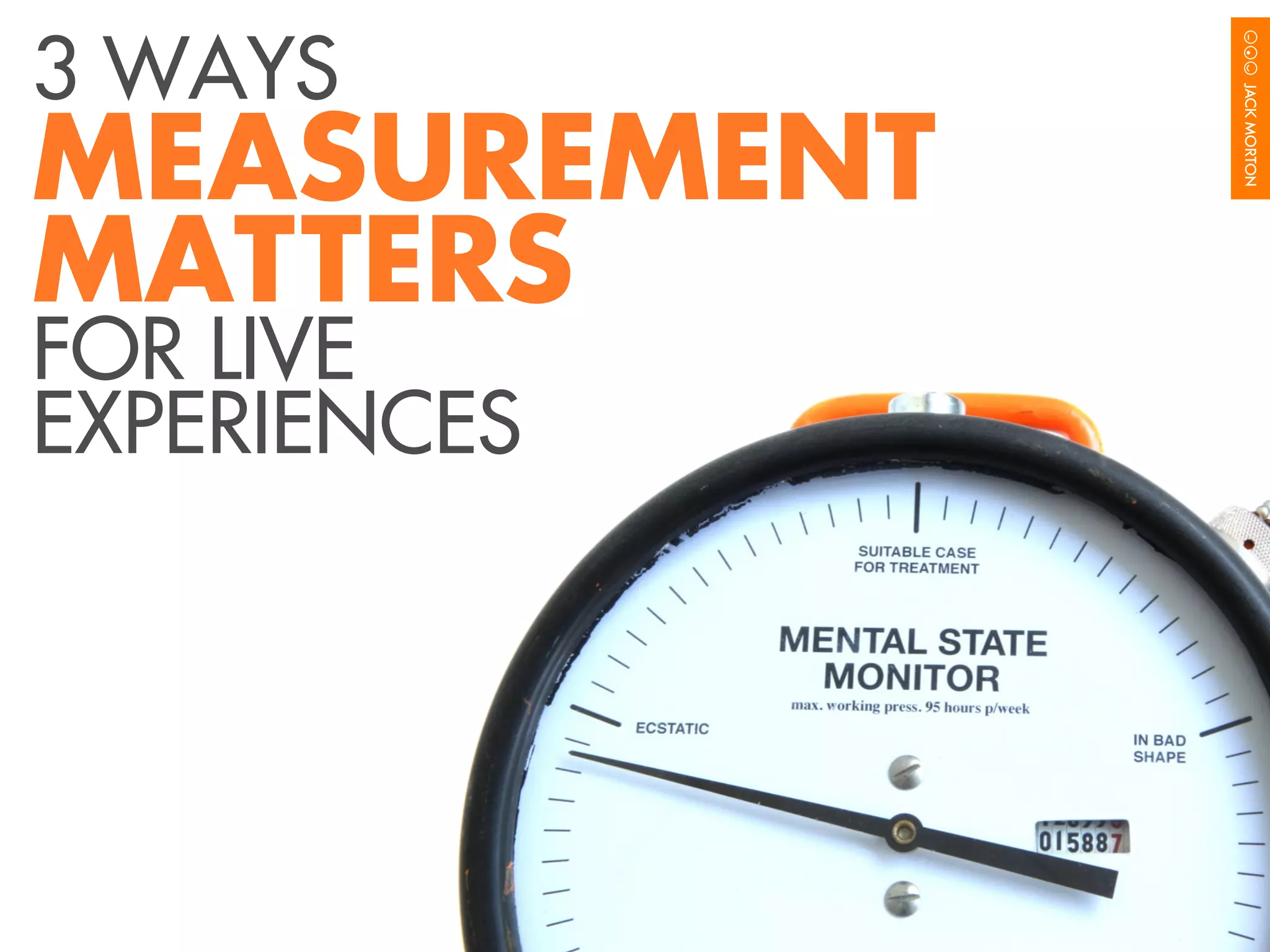
3 WAYS

MEASUREMENT
MATTERS
FOR LIVE
EXPERIENCES
How did we measure up?
Continue the conversation!

BEN GROSSMAN
SENIOR STRATEGIST
JACK MORTON WORLDWIDE
e: ben_grossman@jackmorton.com
m: + 1.617.752.1171
t: @BenGrossman
w: www.ben-grossman.com

Read our blog: blog.jackmorton.com
Follow us on twitter: @JackMorton
Visit us online: www.jackmorton.com
THE LANDSCAPE
3 WAYS IT MATTERS
DEVELOPING PLANS
TRENDS

MEASUREMENT
AGENDA
THE LANDSCAPE
3 TYPES THAT MATTER
DEVELOPING PLANS
TRENDS

MEASUREMENT
AGENDA
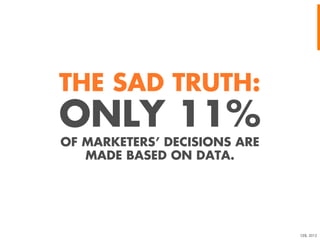
THE SAD TRUTH:

ONLY 11%
OF MARKETERS’ DECISIONS ARE
MADE BASED ON DATA.

CEB, 2012
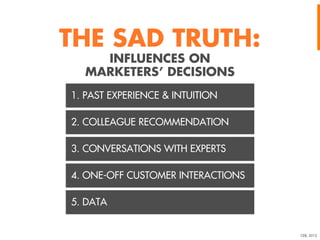
THE SAD TRUTH:
INFLUENCES ON
MARKETERS’ DECISIONS
1. PAST EXPERIENCE & INTUITION
2. COLLEAGUE RECOMMENDATION
3. CONVERSATIONS WITH EXPERTS
4. ONE-OFF CUSTOMER INTERACTIONS
5. DATA

CEB, 2012
A LITTLE SECRET...
When marketers’ statistical aptitude
was tested with 5 questions, almost
half (44%) got 4+ questions wrong.
A mere 6% got all five right.

CEB, 2012
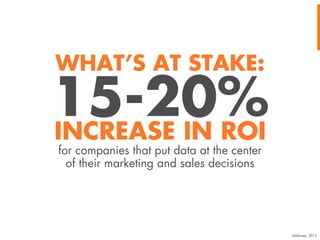
WHAT’S AT STAKE:

15-20%
INCREASE IN ROI
for companies that put data at the center
of their marketing and sales decisions

McKinsey, 2013
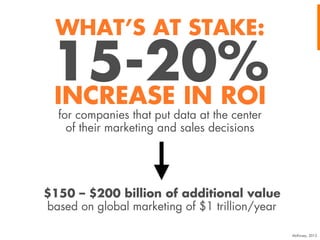
WHAT’S AT STAKE:

15-20%
INCREASE IN ROI
for companies that put data at the center
of their marketing and sales decisions

$150 – $200 billion of additional value
based on global marketing of $1 trillion/year
McKinsey, 2013
THE LANDSCAPE
3 TYPES THAT MATTER
DEVELOPING PLANS
TRENDS

MEASUREMENT
AGENDA
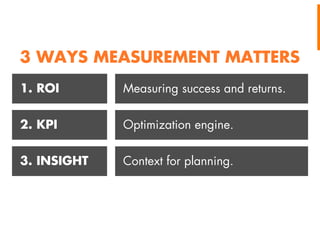
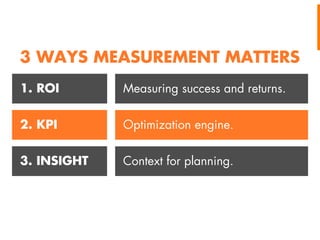
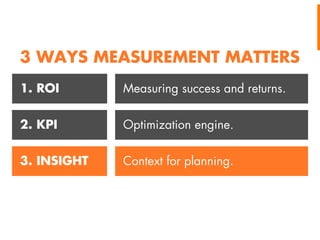
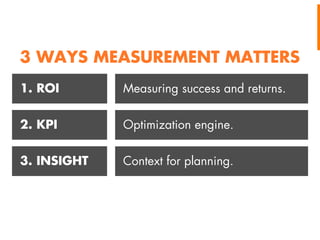
3 WAYS MEASUREMENT MATTERS
1. ROI

Measuring success and returns.

2. KPI

Optimization engine.

3. INSIGHT

Context for planning.
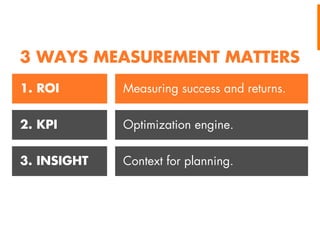
3 WAYS MEASUREMENT MATTERS
1. ROI

Measuring success and returns.

2. KPI

Optimization engine.

3. INSIGHT

Context for planning.
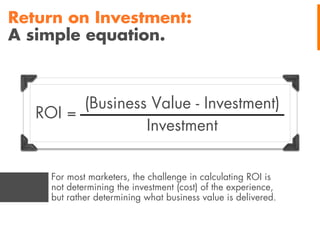
Return on Investment:
A simple equation.

(Business Value - Investment)
ROI =
Investment
For most marketers, the challenge in calculating ROI is
not determining the investment (cost) of the experience,
but rather determining what business value is delivered.
TWEET-ABLE TIP:

“

Measurement shouldn’t be an intellectually
bankrupt exercise. It can't cost more than
the value you get out of it.”
- @BenGrossman
Return on Investment:
Defining business value.
Customer Lifetime Value (CLTV) -- not immediate sales -sets the standard for terming value (and thus, lift in value).
Harvard Business School offers a useful tool to help
organizations calculate CLTV: http://bit.ly/HBSCLTV.
Return on Investment:
Defining business value.
Customer Lifetime Value (CLTV) -- not immediate sales -sets the standard for terming value (and thus, lift in value).
Harvard Business School offers a useful tool to help
organizations calculate CLTV: http://bit.ly/HBSCLTV.
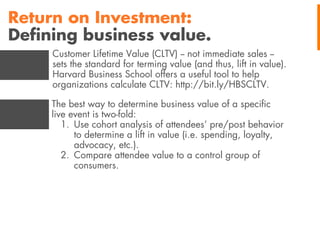
The best way to determine business value of a specific
live event is two-fold:
1. Use cohort analysis of attendees’ pre/post behavior
to determine a lift in value (i.e. spending, loyalty,
advocacy, etc.).
2. Compare attendee value to a control group of
consumers.
Return on Investment:
Defining business value.
Customer Lifetime Value (CLTV) -- not immediate sales -sets the standard for terming value (and thus, lift in value).
Harvard Business School offers a useful tool to help
organizations calculate CLTV: http://bit.ly/HBSCLTV.
The best way to determine business value of a specific
live event is two-fold:
1. Use cohort analysis of attendees’ pre/post behavior
to determine a lift in value (i.e. spending, loyalty,
advocacy, etc.).
2. Compare attendee value to a control group of
consumers.
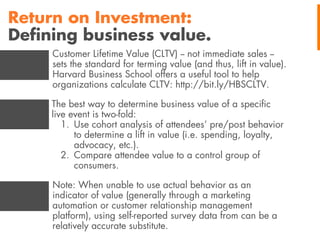
Note: When unable to use actual behavior as an
indicator of value (generally through a marketing
automation or customer relationship management
platform), using self-reported survey data from can be a
relatively accurate substitute.
3 WAYS MEASUREMENT MATTERS
1. ROI

Measuring success and returns.

2. KPI

Optimization engine.

3. INSIGHT

Context for planning.
TWEET-ABLE TIP:

“

Experiences must be agile. If you’re not
changing something, you’re not listening
closely enough.”
- @BenGrossman
Key Performance Indicators:
An optimization engine.
Key performance indicators (KPIs) are a set of initiativespecific metrics that are the key drivers of ultimate success
and returns.
Key Performance Indicators:
An optimization engine.
Key performance indicators (KPIs) are a set of initiativespecific metrics that are the key drivers of ultimate success
and returns.
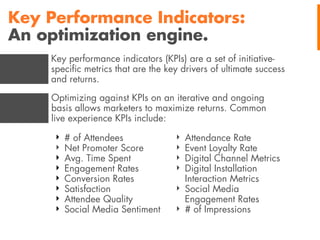
Optimizing against KPIs on an iterative and ongoing
basis allows marketers to maximize returns. Common
live experience KPIs include:
‣
‣
‣
‣
‣
‣
‣
‣

# of Attendees
Net Promoter Score
Avg. Time Spent
Engagement Rates
Conversion Rates
Satisfaction
Attendee Quality
Social Media Sentiment

‣
‣
‣
‣

Attendance Rate
Event Loyalty Rate
Digital Channel Metrics
Digital Installation
Interaction Metrics
‣ Social Media
Engagement Rates
‣ # of Impressions
3 WAYS MEASUREMENT MATTERS
1. ROI

Measuring success and returns.

2. KPI

Optimization engine.

3. INSIGHT

Context for planning.
TWEET-ABLE TIP:

“

Your brand experiences should get
smarter every time they happen.”
- @BenGrossman
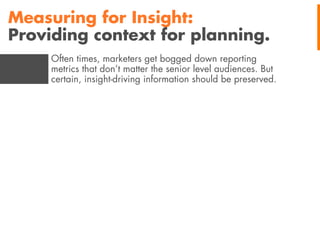
Measuring for Insight:
Providing context for planning.
Often times, marketers get bogged down reporting
metrics that don’t matter the senior level audiences. But
certain, insight-driving information should be preserved.
Measuring for Insight:
Providing context for planning.
Often times, marketers get bogged down reporting
metrics that don’t matter the senior level audiences. But
certain, insight-driving information should be preserved.
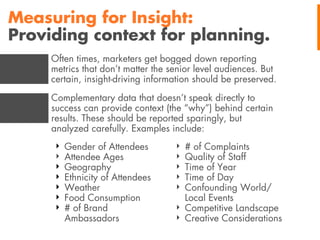
Complementary data that doesn’t speak directly to
success can provide context (the “why”) behind certain
results. These should be reported sparingly, but
analyzed carefully. Examples include:
‣
‣
‣
‣
‣
‣
‣

Gender of Attendees
Attendee Ages
Geography
Ethnicity of Attendees
Weather
Food Consumption
# of Brand
Ambassadors

‣
‣
‣
‣
‣

# of Complaints
Quality of Staff
Time of Year
Time of Day
Confounding World/
Local Events
‣ Competitive Landscape
‣ Creative Considerations
3 WAYS MEASUREMENT MATTERS
1. ROI

Measuring success and returns.

2. KPI

Optimization engine.

3. INSIGHT

Context for planning.
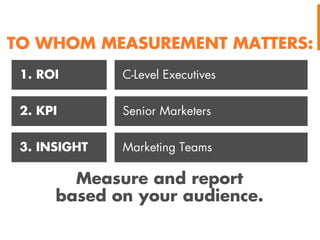
TO WHOM MEASUREMENT MATTERS:
1. ROI

C-Level Executives

2. KPI

Senior Marketers

3. INSIGHT

Marketing Teams

Measure and report
based on your audience.
THE LANDSCAPE
3 TYPES THAT MATTER
DEVELOPING PLANS
TRENDS

MEASUREMENT
AGENDA
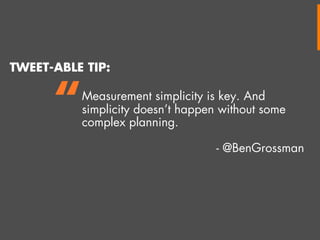
TWEET-ABLE TIP:

“

Measurement simplicity is key. And
simplicity doesn’t happen without some
complex planning.
- @BenGrossman
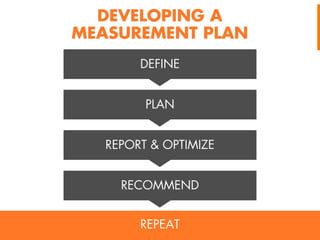
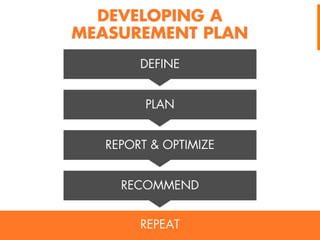
DEVELOPING A
MEASUREMENT PLAN
DEFINE
PLAN
REPORT & OPTIMIZE
RECOMMEND
REPEAT
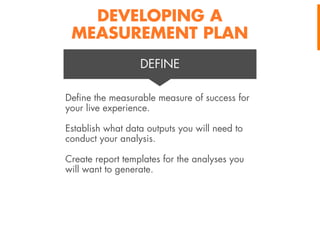
DEVELOPING A
MEASUREMENT PLAN
DEFINE
Define the measurable measure of success for
your live experience.
Establish what data outputs you will need to
conduct your analysis.
Create report templates for the analyses you
will want to generate.
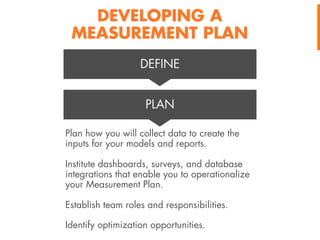
DEVELOPING A
MEASUREMENT PLAN
DEFINE
PLAN
Plan how you will collect data to create the
inputs for your models and reports.
Institute dashboards, surveys, and database
integrations that enable you to operationalize
your Measurement Plan.
Establish team roles and responsibilities.
Identify optimization opportunities.
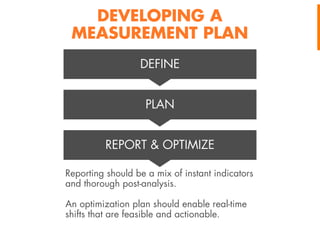
DEVELOPING A
MEASUREMENT PLAN
DEFINE
PLAN
REPORT & OPTIMIZE
Reporting should be a mix of instant indicators
and thorough post-analysis.
An optimization plan should enable real-time
shifts that are feasible and actionable.
DEVELOPING A
MEASUREMENT PLAN
DEFINE
PLAN
REPORT & OPTIMIZE
RECOMMEND
Final results should be reported to relevant
stakeholders (sometimes requires multiple
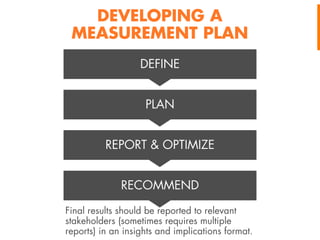
reports) in an insights and implications format.
DEVELOPING A
MEASUREMENT PLAN
DEFINE
PLAN
REPORT & OPTIMIZE
RECOMMEND
REPEAT
THE LANDSCAPE
3 TYPES THAT MATTER
DEVELOPING PLANS
TRENDS

MEASUREMENT
AGENDA
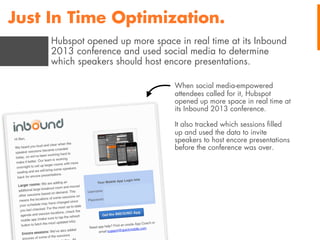
Just In Time Optimization.
Hubspot opened up more space in real time at its Inbound
2013 conference and used social media to determine
which speakers should host encore presentations.
When social media-empowered
attendees called for it, Hubspot
opened up more space in real time at
its Inbound 2013 conference.
It also tracked which sessions filled
up and used the data to invite
speakers to host encore presentations
before the conference was over.
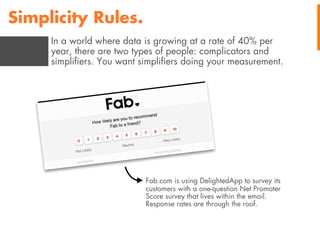
Simplicity Rules.
In a world where data is growing at a rate of 40% per
year, there are two types of people: complicators and
simplifiers. You want simplifiers doing your measurement.

Fab.com is using DelightedApp to survey its
customers with a one-question Net Promoter
Score survey that lives within the email.
Response rates are through the roof.
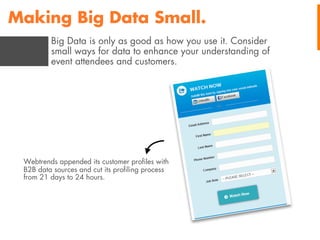
Making Big Data Small.
Big Data is only as good as how you use it. Consider
small ways for data to enhance your understanding of
event attendees and customers.

Webtrends appended its customer profiles with
B2B data sources and cut its profiling process
from 21 days to 24 hours.
THE LANDSCAPE
3 WAYS IT MATTERS
DEVELOPING PLANS
TRENDS

MEASUREMENT
AGENDA
How did we measure up?
Continue the conversation!

BEN GROSSMAN
SENIOR STRATEGIST
JACK MORTON WORLDWIDE
e: ben_grossman@jackmorton.com
m: + 1.617.752.1171
t: @BenGrossman
w: www.ben-grossman.com

Read our blog: blog.jackmorton.com
Follow us on twitter: @JackMorton
Visit us online: www.jackmorton.com
3 WAYS

MEASUREMENT
MATTERS
FOR LIVE
EXPERIENCES

3 best practices for measuring the ROI of live experiences

  • 1.
  • 2.
    How did wemeasure up? Continue the conversation! BEN GROSSMAN SENIOR STRATEGIST JACK MORTON WORLDWIDE e: ben_grossman@jackmorton.com m: + 1.617.752.1171 t: @BenGrossman w: www.ben-grossman.com Read our blog: blog.jackmorton.com Follow us on twitter: @JackMorton Visit us online: www.jackmorton.com
  • 3.
    THE LANDSCAPE 3 WAYSIT MATTERS DEVELOPING PLANS TRENDS MEASUREMENT AGENDA
  • 4.
    THE LANDSCAPE 3 TYPESTHAT MATTER DEVELOPING PLANS TRENDS MEASUREMENT AGENDA
  • 5.
    THE SAD TRUTH: ONLY11% OF MARKETERS’ DECISIONS ARE MADE BASED ON DATA. CEB, 2012
  • 6.
    THE SAD TRUTH: INFLUENCESON MARKETERS’ DECISIONS 1. PAST EXPERIENCE & INTUITION 2. COLLEAGUE RECOMMENDATION 3. CONVERSATIONS WITH EXPERTS 4. ONE-OFF CUSTOMER INTERACTIONS 5. DATA CEB, 2012
  • 7.
    A LITTLE SECRET... Whenmarketers’ statistical aptitude was tested with 5 questions, almost half (44%) got 4+ questions wrong. A mere 6% got all five right. CEB, 2012
  • 8.
    WHAT’S AT STAKE: 15-20% INCREASEIN ROI for companies that put data at the center of their marketing and sales decisions McKinsey, 2013
  • 9.
    WHAT’S AT STAKE: 15-20% INCREASEIN ROI for companies that put data at the center of their marketing and sales decisions $150 – $200 billion of additional value based on global marketing of $1 trillion/year McKinsey, 2013
  • 10.
    THE LANDSCAPE 3 TYPESTHAT MATTER DEVELOPING PLANS TRENDS MEASUREMENT AGENDA
  • 11.
    3 WAYS MEASUREMENTMATTERS 1. ROI Measuring success and returns. 2. KPI Optimization engine. 3. INSIGHT Context for planning.
  • 12.
    3 WAYS MEASUREMENTMATTERS 1. ROI Measuring success and returns. 2. KPI Optimization engine. 3. INSIGHT Context for planning.
  • 13.
    Return on Investment: Asimple equation. (Business Value - Investment) ROI = Investment For most marketers, the challenge in calculating ROI is not determining the investment (cost) of the experience, but rather determining what business value is delivered.
  • 14.
    TWEET-ABLE TIP: “ Measurement shouldn’tbe an intellectually bankrupt exercise. It can't cost more than the value you get out of it.” - @BenGrossman
  • 15.
    Return on Investment: Definingbusiness value. Customer Lifetime Value (CLTV) -- not immediate sales -sets the standard for terming value (and thus, lift in value). Harvard Business School offers a useful tool to help organizations calculate CLTV: http://bit.ly/HBSCLTV.
  • 16.
    Return on Investment: Definingbusiness value. Customer Lifetime Value (CLTV) -- not immediate sales -sets the standard for terming value (and thus, lift in value). Harvard Business School offers a useful tool to help organizations calculate CLTV: http://bit.ly/HBSCLTV. The best way to determine business value of a specific live event is two-fold: 1. Use cohort analysis of attendees’ pre/post behavior to determine a lift in value (i.e. spending, loyalty, advocacy, etc.). 2. Compare attendee value to a control group of consumers.
  • 17.
    Return on Investment: Definingbusiness value. Customer Lifetime Value (CLTV) -- not immediate sales -sets the standard for terming value (and thus, lift in value). Harvard Business School offers a useful tool to help organizations calculate CLTV: http://bit.ly/HBSCLTV. The best way to determine business value of a specific live event is two-fold: 1. Use cohort analysis of attendees’ pre/post behavior to determine a lift in value (i.e. spending, loyalty, advocacy, etc.). 2. Compare attendee value to a control group of consumers. Note: When unable to use actual behavior as an indicator of value (generally through a marketing automation or customer relationship management platform), using self-reported survey data from can be a relatively accurate substitute.
  • 18.
    3 WAYS MEASUREMENTMATTERS 1. ROI Measuring success and returns. 2. KPI Optimization engine. 3. INSIGHT Context for planning.
  • 19.
    TWEET-ABLE TIP: “ Experiences mustbe agile. If you’re not changing something, you’re not listening closely enough.” - @BenGrossman
  • 20.
    Key Performance Indicators: Anoptimization engine. Key performance indicators (KPIs) are a set of initiativespecific metrics that are the key drivers of ultimate success and returns.
  • 21.
    Key Performance Indicators: Anoptimization engine. Key performance indicators (KPIs) are a set of initiativespecific metrics that are the key drivers of ultimate success and returns. Optimizing against KPIs on an iterative and ongoing basis allows marketers to maximize returns. Common live experience KPIs include: ‣ ‣ ‣ ‣ ‣ ‣ ‣ ‣ # of Attendees Net Promoter Score Avg. Time Spent Engagement Rates Conversion Rates Satisfaction Attendee Quality Social Media Sentiment ‣ ‣ ‣ ‣ Attendance Rate Event Loyalty Rate Digital Channel Metrics Digital Installation Interaction Metrics ‣ Social Media Engagement Rates ‣ # of Impressions
  • 22.
    3 WAYS MEASUREMENTMATTERS 1. ROI Measuring success and returns. 2. KPI Optimization engine. 3. INSIGHT Context for planning.
  • 23.
    TWEET-ABLE TIP: “ Your brandexperiences should get smarter every time they happen.” - @BenGrossman
  • 24.
    Measuring for Insight: Providingcontext for planning. Often times, marketers get bogged down reporting metrics that don’t matter the senior level audiences. But certain, insight-driving information should be preserved.
  • 25.
    Measuring for Insight: Providingcontext for planning. Often times, marketers get bogged down reporting metrics that don’t matter the senior level audiences. But certain, insight-driving information should be preserved. Complementary data that doesn’t speak directly to success can provide context (the “why”) behind certain results. These should be reported sparingly, but analyzed carefully. Examples include: ‣ ‣ ‣ ‣ ‣ ‣ ‣ Gender of Attendees Attendee Ages Geography Ethnicity of Attendees Weather Food Consumption # of Brand Ambassadors ‣ ‣ ‣ ‣ ‣ # of Complaints Quality of Staff Time of Year Time of Day Confounding World/ Local Events ‣ Competitive Landscape ‣ Creative Considerations
  • 26.
    3 WAYS MEASUREMENTMATTERS 1. ROI Measuring success and returns. 2. KPI Optimization engine. 3. INSIGHT Context for planning.
  • 27.
    TO WHOM MEASUREMENTMATTERS: 1. ROI C-Level Executives 2. KPI Senior Marketers 3. INSIGHT Marketing Teams Measure and report based on your audience.
  • 28.
    THE LANDSCAPE 3 TYPESTHAT MATTER DEVELOPING PLANS TRENDS MEASUREMENT AGENDA
  • 29.
    TWEET-ABLE TIP: “ Measurement simplicityis key. And simplicity doesn’t happen without some complex planning. - @BenGrossman
  • 30.
  • 31.
    DEVELOPING A MEASUREMENT PLAN DEFINE Definethe measurable measure of success for your live experience. Establish what data outputs you will need to conduct your analysis. Create report templates for the analyses you will want to generate.
  • 32.
    DEVELOPING A MEASUREMENT PLAN DEFINE PLAN Planhow you will collect data to create the inputs for your models and reports. Institute dashboards, surveys, and database integrations that enable you to operationalize your Measurement Plan. Establish team roles and responsibilities. Identify optimization opportunities.
  • 33.
    DEVELOPING A MEASUREMENT PLAN DEFINE PLAN REPORT& OPTIMIZE Reporting should be a mix of instant indicators and thorough post-analysis. An optimization plan should enable real-time shifts that are feasible and actionable.
  • 34.
    DEVELOPING A MEASUREMENT PLAN DEFINE PLAN REPORT& OPTIMIZE RECOMMEND Final results should be reported to relevant stakeholders (sometimes requires multiple reports) in an insights and implications format.
  • 35.
  • 36.
    THE LANDSCAPE 3 TYPESTHAT MATTER DEVELOPING PLANS TRENDS MEASUREMENT AGENDA
  • 37.
    Just In TimeOptimization. Hubspot opened up more space in real time at its Inbound 2013 conference and used social media to determine which speakers should host encore presentations. When social media-empowered attendees called for it, Hubspot opened up more space in real time at its Inbound 2013 conference. It also tracked which sessions filled up and used the data to invite speakers to host encore presentations before the conference was over.
  • 38.
    Simplicity Rules. In aworld where data is growing at a rate of 40% per year, there are two types of people: complicators and simplifiers. You want simplifiers doing your measurement. Fab.com is using DelightedApp to survey its customers with a one-question Net Promoter Score survey that lives within the email. Response rates are through the roof.
  • 39.
    Making Big DataSmall. Big Data is only as good as how you use it. Consider small ways for data to enhance your understanding of event attendees and customers. Webtrends appended its customer profiles with B2B data sources and cut its profiling process from 21 days to 24 hours.
  • 40.
    THE LANDSCAPE 3 WAYSIT MATTERS DEVELOPING PLANS TRENDS MEASUREMENT AGENDA
  • 41.
    How did wemeasure up? Continue the conversation! BEN GROSSMAN SENIOR STRATEGIST JACK MORTON WORLDWIDE e: ben_grossman@jackmorton.com m: + 1.617.752.1171 t: @BenGrossman w: www.ben-grossman.com Read our blog: blog.jackmorton.com Follow us on twitter: @JackMorton Visit us online: www.jackmorton.com
  • 42.