







Why, what, and how of
marketing measurement
March 2013
Why?
Proactive, integrated measurement leads
to insights that:
• Assess the value, focus and precision
of campaign and overall progress.
• Benchmark performance.
• Gauge market trends.
• Evaluate target audience
information.
Insights then allow for
optimal alignment
of marketing activities with
corporate objectives and
strategic goals, not just
those for marketing..
Gains include:
• Defining better strategies.
• Optimizing spend.
• Making better decisions.
What?
Measurement is only the starting point.
The real goal isn’t collecting data. It’s gaining
.
That is, that will drive making better
business decisions and improving marketing
effectiveness.
The best analysts
have
bolstered with
horizontal
business
expertise.
They show the
story behind the
numbers.
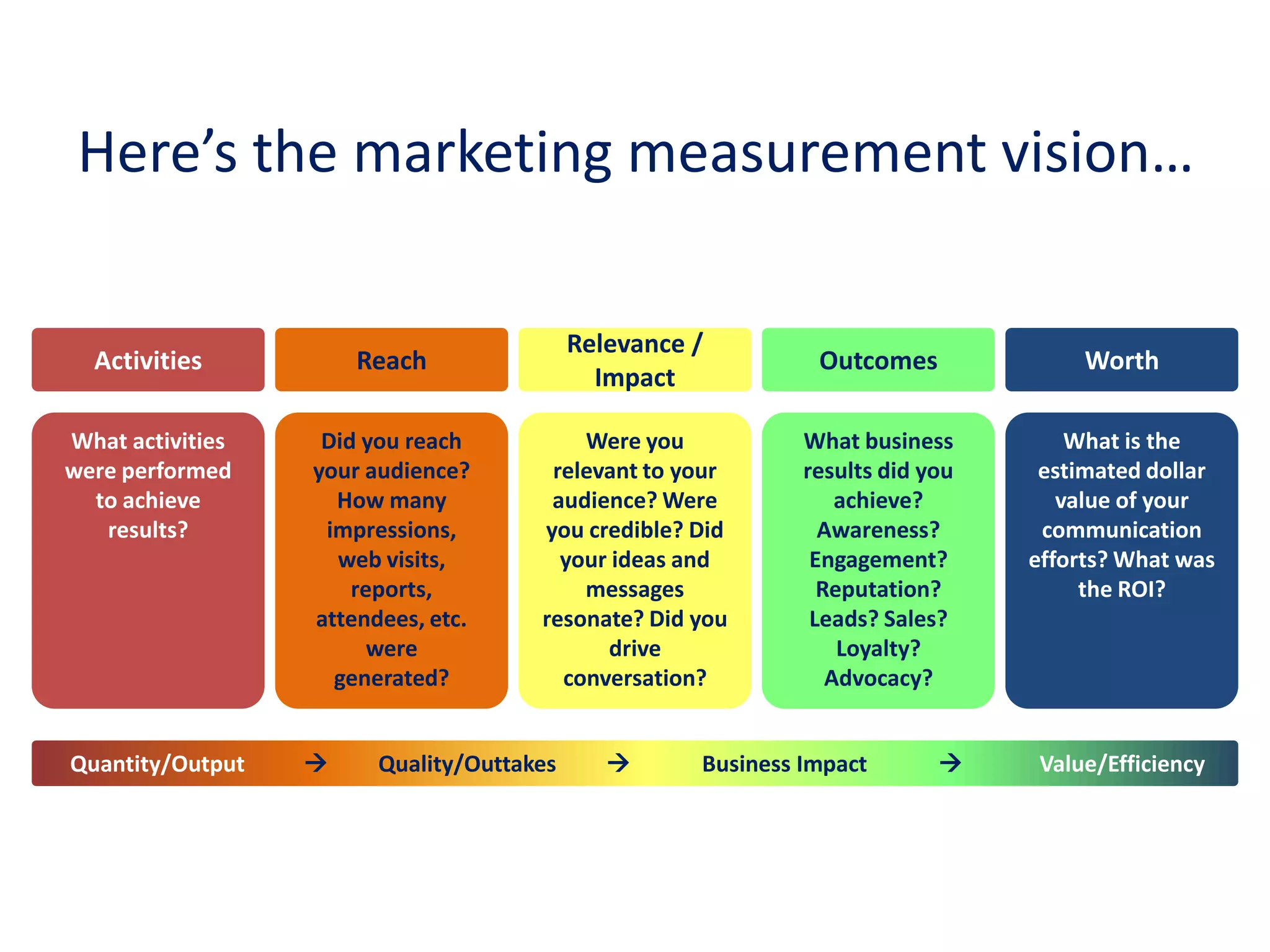
Activities Reach
Relevance /
Impact
Outcomes Worth
What activities
were performed
to achieve
results?
Did you reach
your audience?
How many
impressions,
web visits,
reports,
attendees, etc.
were
generated?
Were you
relevant to your
audience? Were
you credible? Did
your ideas and
messages
resonate? Did you
drive
conversation?
What business
results did you
achieve?
Awareness?
Engagement?
Reputation?
Leads? Sales?
Loyalty?
Advocacy?
What is the
estimated dollar
value of your
communication
efforts? What was
the ROI?
Quantity/Output  Quality/Outtakes  Business Impact  Value/Efficiency
Here’s the marketing measurement vision…
How?
9
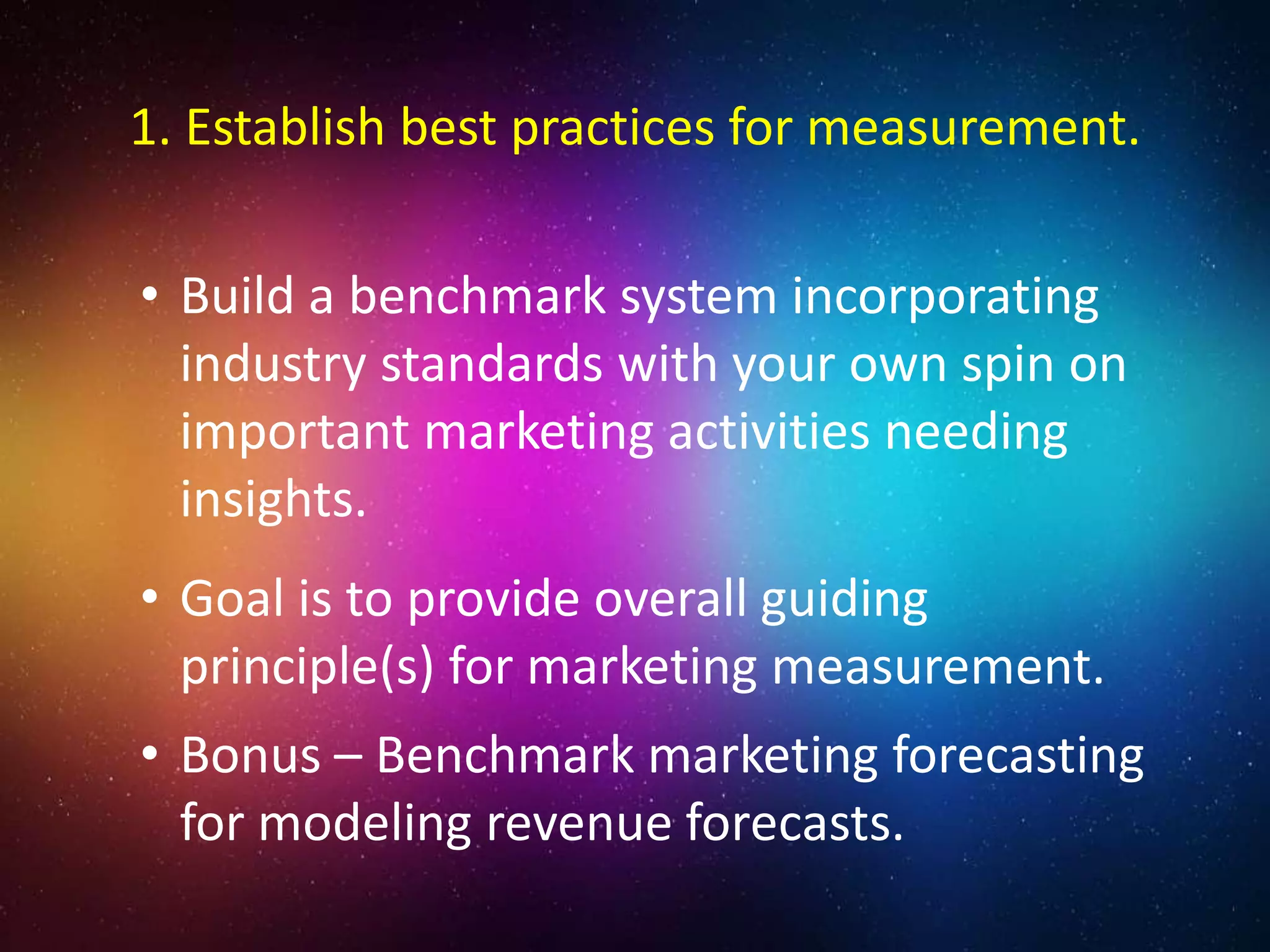
• Build a benchmark system incorporating
industry standards with your own spin on
important marketing activities needing
insights.
• Goal is to provide overall guiding
principle(s) for marketing measurement.
• Bonus – Benchmark marketing forecasting
for modeling revenue forecasts.
1. Establish best practices for measurement.
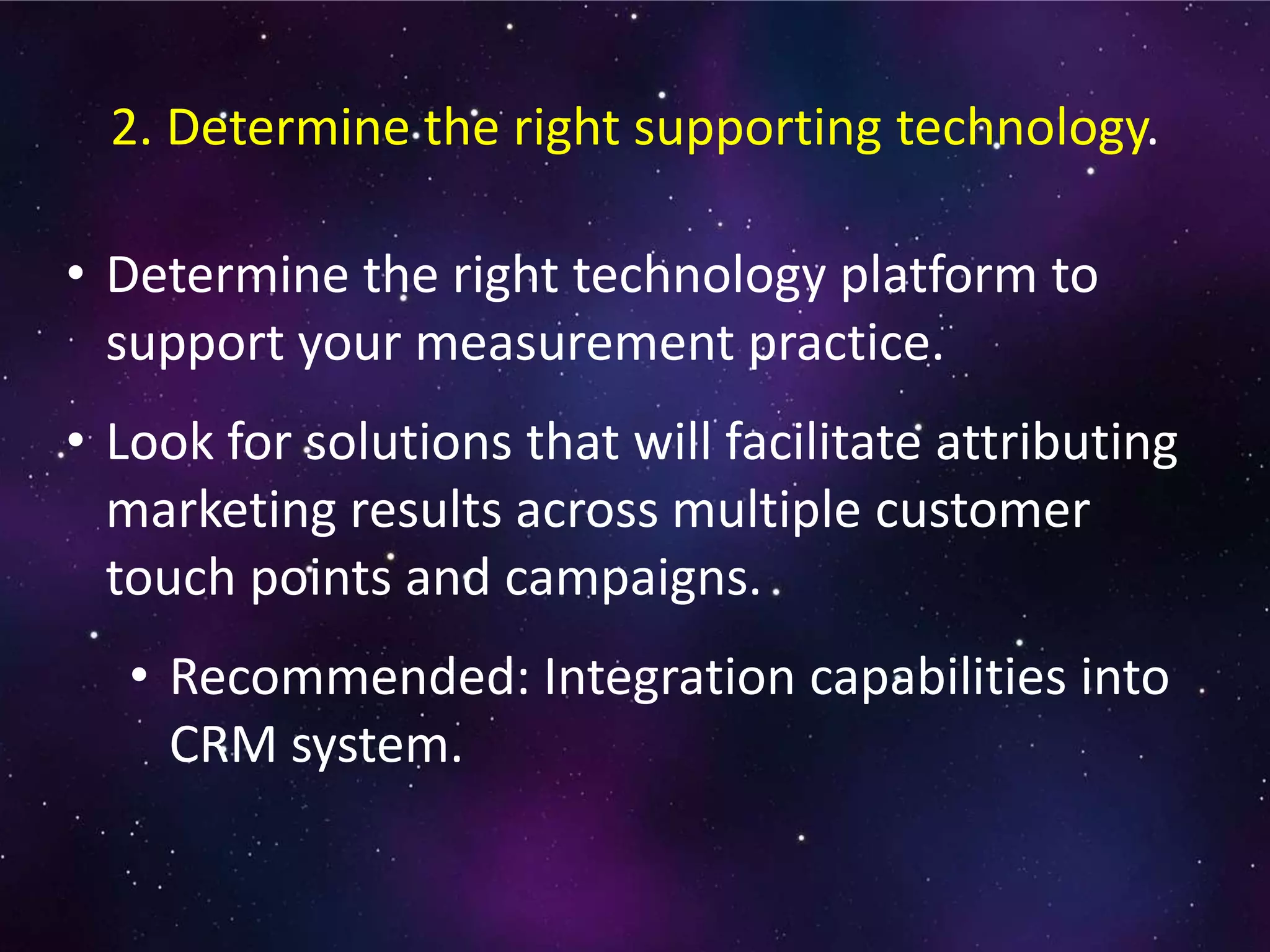
• Determine the right technology platform to
support your measurement practice.
• Look for solutions that will facilitate attributing
marketing results across multiple customer
touch points and campaigns.
• Recommended: Integration capabilities into
CRM system.
2. Determine the right supporting technology.
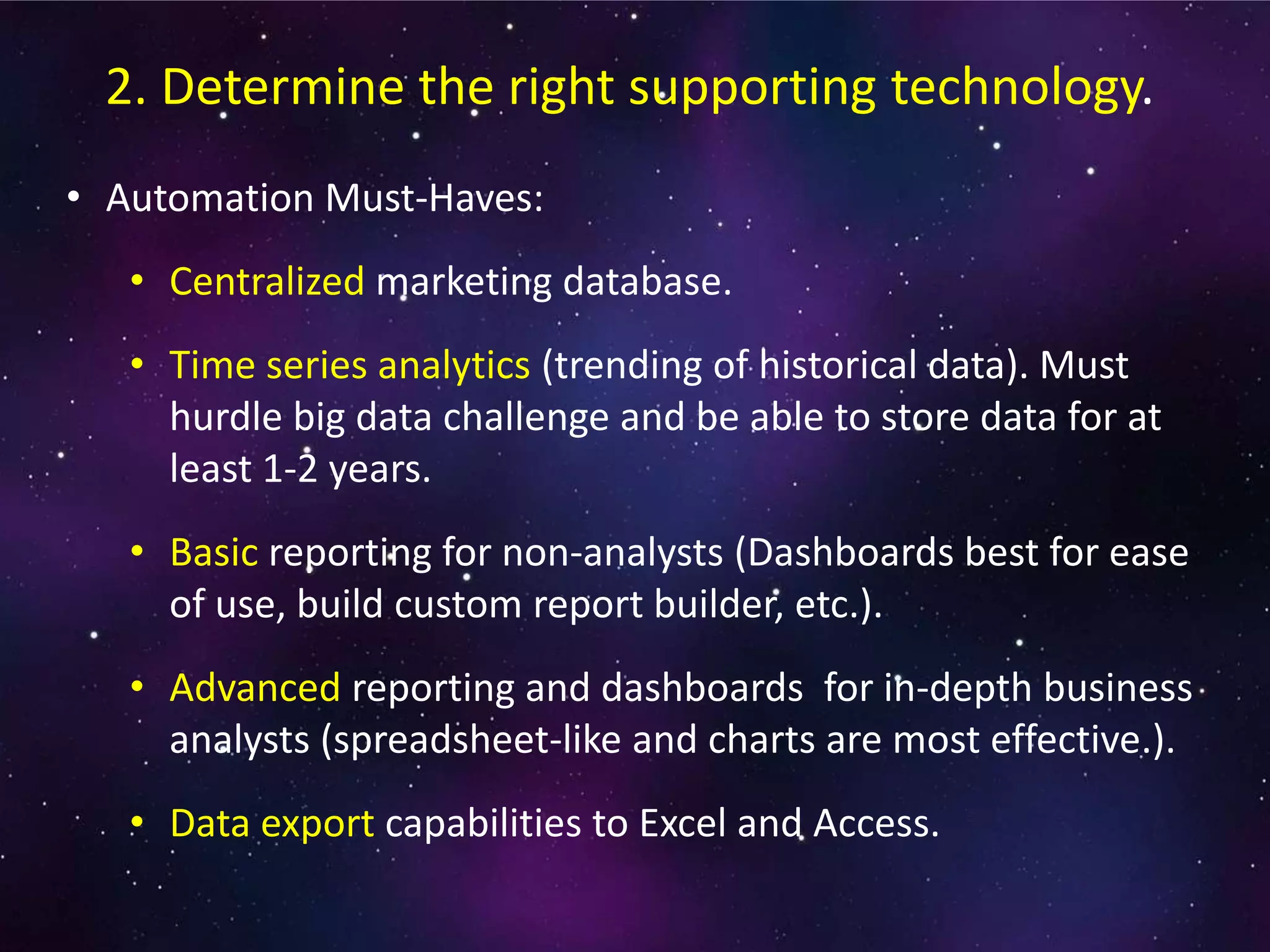
• Automation Must-Haves:
• Centralized marketing database.
• Time series analytics (trending of historical data). Must
hurdle big data challenge and be able to store data for at
least 1-2 years.
• Basic reporting for non-analysts (Dashboards best for ease
of use, build custom report builder, etc.).
• Advanced reporting and dashboards for in-depth business
analysts (spreadsheet-like and charts are most effective.).
• Data export capabilities to Excel and Access.
2. Determine the right supporting technology.
• Visualize the right metrics mix of:
• Traditional marketing metrics (ad metrics,
PR metrics, direct mail/email, etc.).
• Web metrics.
• SEO metrics.
• Social monitoring and metrics.
2. Determine the right supporting technology.
• Goal is to link marketing outcomes to business
results to assesses the value, focus and precision
of marketing campaigns and activities.
• Must understand business objectives so you
know what the relevant business outcomes are.
3. Define campaign-specific measurement plans
• Design marketing campaigns to be
measureable.
• Define marketing activities/processes along
entire marketing activity life cycle for
campaign. Plan for measurement
throughout.
3. Define campaign-specific measurement plans
• Plan for determining ROI:
• Define Key Performance Indicators that
support campaign success based on
• Marketing operations,
• Social analytics, and
• Business results.
3. Define campaign-specific measurement plans
• Determine how you will measure marketing
results and how you will convert those into
business results.
• Ex. of marketing results: Increased awareness,
higher web visitations.
• Ex. of business results: Increased sales
revenues, lower customer acquisition costs.
4. Determine measurement framework
• Avoid measurement pitfalls:
• Vanity metrics (“Feel good” metrics with no ties
to business results).
• Quantity without consideration to quality.
• Efficiency without consideration for
effectiveness.
4. Determine measurement framework
• Take active role in revenue forecasting.
• Design measurement to forecast your
company’s revenue by modeling how
marketing leads will convert to sales over
time.
5. Bonus – Marketing forecasting
Measurement challenges
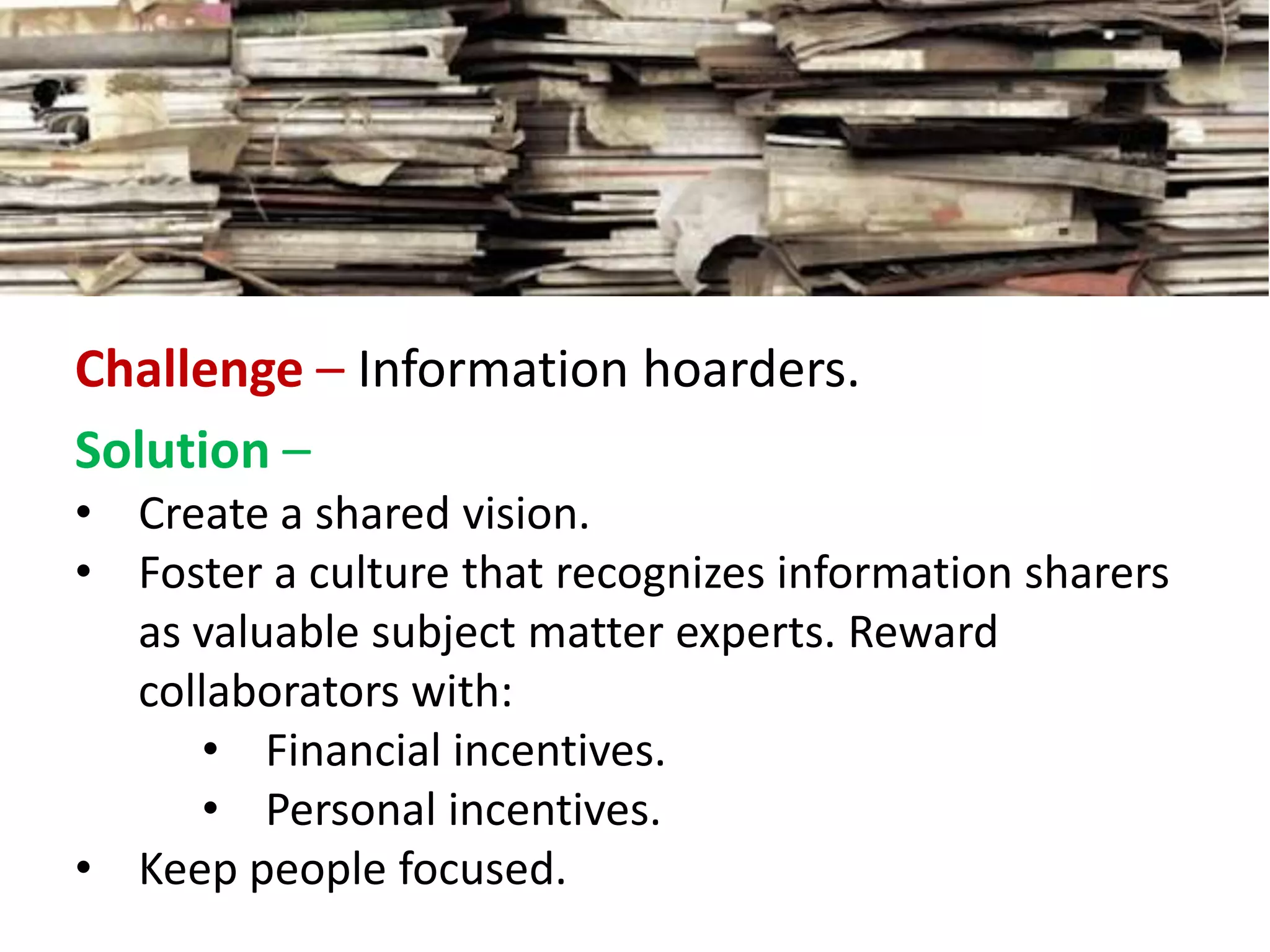
Challenge – Information hoarders.
Solution –
• Create a shared vision.
• Foster a culture that recognizes information sharers
as valuable subject matter experts. Reward
collaborators with:
• Financial incentives.
• Personal incentives.
• Keep people focused.
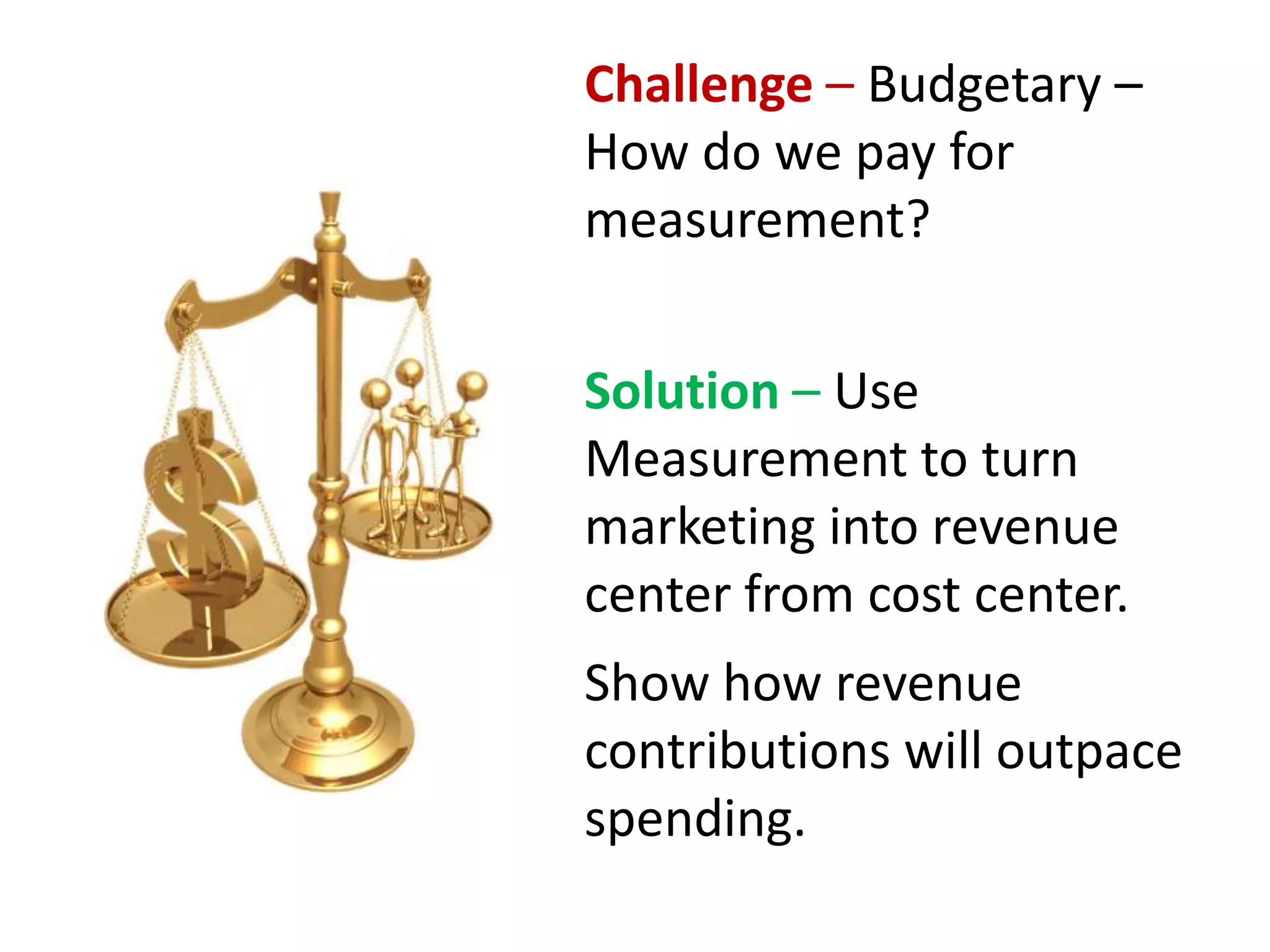
Solution – Use
Measurement to turn
marketing into revenue
center from cost center.
Show how revenue
contributions will outpace
spending.
Challenge – Budgetary –
How do we pay for
measurement?
Closing thoughts
If you want to:
 Define better
marketing strategies
that align with
corporate objectives.
 Design more
effective marketing
tactics.
 Optimize spending.
 Make better
decisions….
…then it’s time to build
marketing
measurement into your
activities…
…or use an agency with
a strong measurement
practice.
Who?
For other clients, she defines technology requirements that
will heighten business effectiveness.
Kathy Herrmann
builds better businesses.
She propels businesses as a T-shaped pro with vertical
penetration in diverse types of data analysis and horizontal
experience in marketing, sales, customer service, and
operations.
For some clients, she improves business
performance by providing results-focused
data insights into customer activity and
behaviors, or into operational activities.
Kathy
Herrmann
571-236-7929
info@kathyherrmann.com
www.kathyherrmann.com
LinkedIn

Why, What, and of How Marketing Measurement

  • 1.
    Why, what, andhow of marketing measurement March 2013
  • 2.
  • 3.
    Proactive, integrated measurementleads to insights that: • Assess the value, focus and precision of campaign and overall progress. • Benchmark performance. • Gauge market trends. • Evaluate target audience information.
  • 4.
    Insights then allowfor optimal alignment of marketing activities with corporate objectives and strategic goals, not just those for marketing.. Gains include: • Defining better strategies. • Optimizing spend. • Making better decisions.
  • 5.
  • 6.
    Measurement is onlythe starting point. The real goal isn’t collecting data. It’s gaining . That is, that will drive making better business decisions and improving marketing effectiveness.
  • 7.
    The best analysts have bolsteredwith horizontal business expertise. They show the story behind the numbers.
  • 8.
    Activities Reach Relevance / Impact OutcomesWorth What activities were performed to achieve results? Did you reach your audience? How many impressions, web visits, reports, attendees, etc. were generated? Were you relevant to your audience? Were you credible? Did your ideas and messages resonate? Did you drive conversation? What business results did you achieve? Awareness? Engagement? Reputation? Leads? Sales? Loyalty? Advocacy? What is the estimated dollar value of your communication efforts? What was the ROI? Quantity/Output  Quality/Outtakes  Business Impact  Value/Efficiency Here’s the marketing measurement vision…
  • 9.
  • 10.
    • Build abenchmark system incorporating industry standards with your own spin on important marketing activities needing insights. • Goal is to provide overall guiding principle(s) for marketing measurement. • Bonus – Benchmark marketing forecasting for modeling revenue forecasts. 1. Establish best practices for measurement.
  • 11.
    • Determine theright technology platform to support your measurement practice. • Look for solutions that will facilitate attributing marketing results across multiple customer touch points and campaigns. • Recommended: Integration capabilities into CRM system. 2. Determine the right supporting technology.
  • 12.
    • Automation Must-Haves: •Centralized marketing database. • Time series analytics (trending of historical data). Must hurdle big data challenge and be able to store data for at least 1-2 years. • Basic reporting for non-analysts (Dashboards best for ease of use, build custom report builder, etc.). • Advanced reporting and dashboards for in-depth business analysts (spreadsheet-like and charts are most effective.). • Data export capabilities to Excel and Access. 2. Determine the right supporting technology.
  • 13.
    • Visualize theright metrics mix of: • Traditional marketing metrics (ad metrics, PR metrics, direct mail/email, etc.). • Web metrics. • SEO metrics. • Social monitoring and metrics. 2. Determine the right supporting technology.
  • 14.
    • Goal isto link marketing outcomes to business results to assesses the value, focus and precision of marketing campaigns and activities. • Must understand business objectives so you know what the relevant business outcomes are. 3. Define campaign-specific measurement plans
  • 15.
    • Design marketingcampaigns to be measureable. • Define marketing activities/processes along entire marketing activity life cycle for campaign. Plan for measurement throughout. 3. Define campaign-specific measurement plans
  • 16.
    • Plan fordetermining ROI: • Define Key Performance Indicators that support campaign success based on • Marketing operations, • Social analytics, and • Business results. 3. Define campaign-specific measurement plans
  • 17.
    • Determine howyou will measure marketing results and how you will convert those into business results. • Ex. of marketing results: Increased awareness, higher web visitations. • Ex. of business results: Increased sales revenues, lower customer acquisition costs. 4. Determine measurement framework
  • 18.
    • Avoid measurementpitfalls: • Vanity metrics (“Feel good” metrics with no ties to business results). • Quantity without consideration to quality. • Efficiency without consideration for effectiveness. 4. Determine measurement framework
  • 19.
    • Take activerole in revenue forecasting. • Design measurement to forecast your company’s revenue by modeling how marketing leads will convert to sales over time. 5. Bonus – Marketing forecasting
  • 20.
  • 21.
    Challenge – Informationhoarders. Solution – • Create a shared vision. • Foster a culture that recognizes information sharers as valuable subject matter experts. Reward collaborators with: • Financial incentives. • Personal incentives. • Keep people focused.
  • 22.
    Solution – Use Measurementto turn marketing into revenue center from cost center. Show how revenue contributions will outpace spending. Challenge – Budgetary – How do we pay for measurement?
  • 23.
  • 24.
    If you wantto:  Define better marketing strategies that align with corporate objectives.  Design more effective marketing tactics.  Optimize spending.  Make better decisions….
  • 25.
    …then it’s timeto build marketing measurement into your activities… …or use an agency with a strong measurement practice.
  • 26.
  • 27.
    For other clients,she defines technology requirements that will heighten business effectiveness. Kathy Herrmann builds better businesses. She propels businesses as a T-shaped pro with vertical penetration in diverse types of data analysis and horizontal experience in marketing, sales, customer service, and operations. For some clients, she improves business performance by providing results-focused data insights into customer activity and behaviors, or into operational activities.
  • 28.