Lean LaunchPad Workshop:
Defining an Analytics Strategy
Ryan Jung
Haas MBA 2014
ryan_jung@haas.berkeley.edu
Why Are Analytics Important?
• Failure to define an
analytics strategy can be
a fatal error for a startup
in 2015.
• Analytics has changed
the landscape
• A great analytics
strategy is tightly
integrated with the
overall business strategy
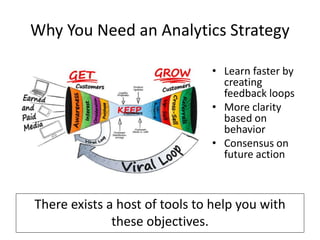
Why You Need an Analytics Strategy
• Learn faster by
creating
feedback loops
• More clarity
based on
behavior
• Consensus on
future action
There exists a host of tools to help you with
these objectives.
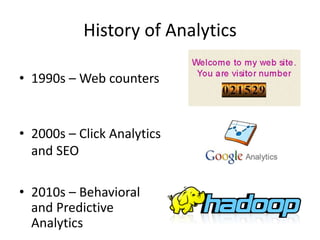
History of Analytics
• 1990s – Web counters
• 2000s – Click Analytics
and SEO
• 2010s – Behavioral
and Predictive
Analytics
Keys to a Great Analytics Strategy
1. Tightly integrated
with overall
business strategy
2. Iterative process
3. Measurable set of
hypotheses,
results, and
revisions
The Modern Data-Driven Lean Startup
Goal is to optimize a set of
business objectives in a logical
progression leveraging quantitative
and qualitative facts in order to
delight customers in a scalable,
repeatable fashion
Most Important Reports
• Segmentation (Cohorting)
• Retention
• Funnels
• Revenue Tracking
• Marketing Campaign Effectiveness
• Path Analysis
• Notifications
Segmentation / Cohorting
What segments are getting what
value out of your product?
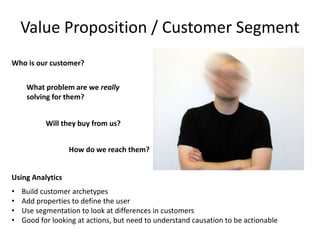
Value Proposition / Customer Segment
Who is our customer?
What problem are we really
solving for them?
Will they buy from us?
How do we reach them?
• Build customer archetypes
• Add properties to define the user
• Use segmentation to look at differences in customers
• Good for looking at actions, but need to understand causation to be actionable
Using Analytics
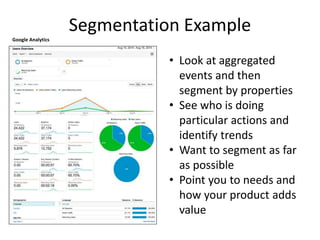
Segmentation Example
• Look at aggregated
events and then
segment by properties
• See who is doing
particular actions and
identify trends
• Want to segment as far
as possible
• Point you to needs and
how your product adds
value
Google Analytics
Retention
Who gets the most value out of your
solution?
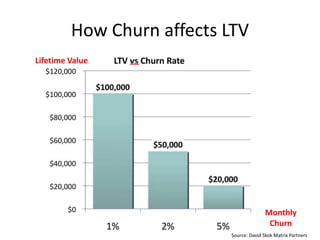
How Churn affects LTV
Lifetime Value
Monthly
Churn
Source: David Skok Matrix Partners
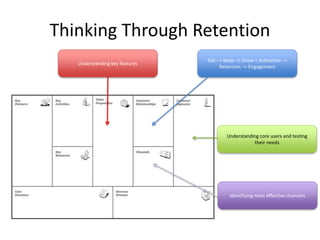
Thinking Through Retention
Get –> Keep –> Grow = Activation –>
Retention –> Engagement
Understanding key features
Understanding core users and testing
their needs
Identifying most effective channels
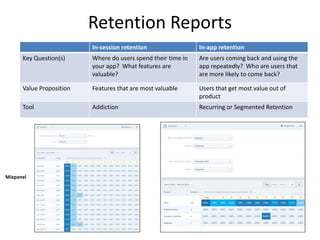
Retention Reports
In-session retention In-app retention
Key Question(s) Where do users spend their time in
your app? What features are
valuable?
Are users coming back and using the
app repeatedly? Who are users that
are more likely to come back?
Value Proposition Features that are most valuable Users that get most value out of
product
Tool Addiction Recurring or Segmented Retention
Mixpanel
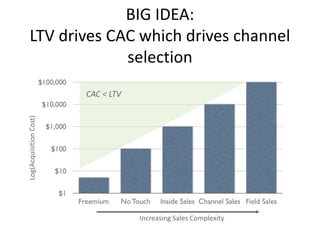
BIG IDEA:
LTV drives CAC which drives channel
selection
Increasing Sales Complexity
Log(AcquisitionCost)
CAC < LTV
Funnels
How are users interacting with your
solution?
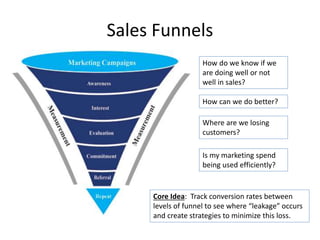
Sales Funnels
Where are we losing
customers?
How do we know if we
are doing well or not
well in sales?
How can we do better?
Core Idea: Track conversion rates between
levels of funnel to see where “leakage” occurs
and create strategies to minimize this loss.
Is my marketing spend
being used efficiently?
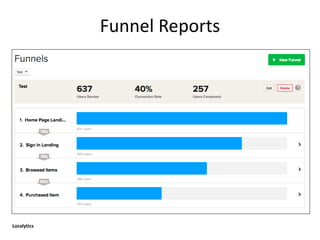
Funnel Reports
Localytics
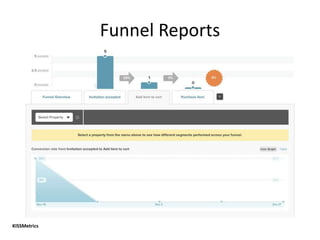
Funnel Reports
KISSMetrics
Tying funnels to revenues
Revenue = installs x [signups / installs] x [purchases / signups ] x [revenue / purchase]
Back-end tells
you this
Analytics tells
you this
Analytics can
tell you this
You control this
The main point here is that you can break revenue into measureable
components
• Tie how you earn revenue to what you measure
• Then understand where you are doing well and not well
• Then use your analytics solution to design tests to figure out how to drive
more lifetime value
Mathematically:
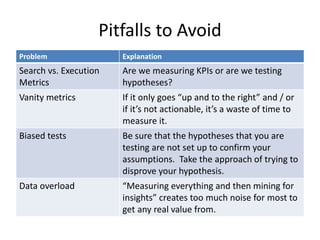
Pitfalls to Avoid
Problem Explanation
Search vs. Execution
Metrics
Are we measuring KPIs or are we testing
hypotheses?
Vanity metrics If it only goes “up and to the right” and / or
if it’s not actionable, it’s a waste of time to
measure it.
Biased tests Be sure that the hypotheses that you are
testing are not set up to confirm your
assumptions. Take the approach of trying to
disprove your hypothesis.
Data overload “Measuring everything and then mining for
insights” creates too much noise for most to
get any real value from.
Summary
• You need to be thinking about analytics
because your competition probably already is
• Analytics is evolving, so keeping up is
imperative
• Analytics needs to be tied to your overall
business strategy, should be hypothesis-
driven, and is an iterative process
Case Studies
Airbnb
• Challenge: Initially wanted to optimize booking flow
• Allowed them to identify to distinct classes of users
• Can better target users and their needs
More info: https://mixpanel.com/case-study/airbnb/
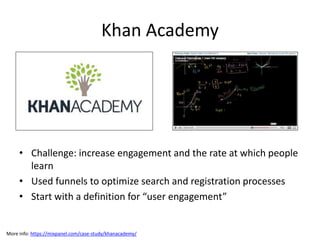
Khan Academy
• Challenge: increase engagement and the rate at which people
learn
• Used funnels to optimize search and registration processes
• Start with a definition for “user engagement”
More info: https://mixpanel.com/case-study/khanacademy/
Jawbone
• Challenge: Assess the viability of Jawbone UP
• Used Segmentation reporting to better understand their users
• Helps to build customer archetypes
• Faster iterations and faster time to product-market fit
More info: https://mixpanel.com/case-study/jawbone/
Cohort analysis
Renewal and upsell rates
Return on marketing investment
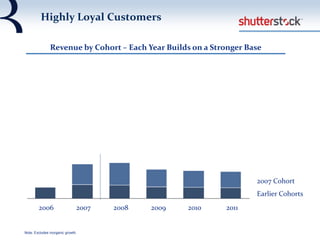
Revenue by Cohort – Each Year Builds on a Stronger Base
Note: Excludes inorganic growth.
201120102009200820072006
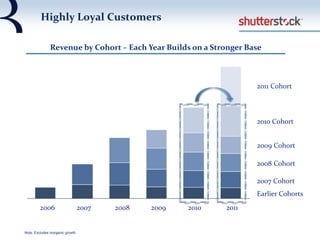
Highly Loyal Customers
2007 Cohort
Earlier Cohorts
Revenue by Cohort – Each Year Builds on a Stronger Base
2006
2008 Cohort
2009 Cohort
2010 Cohort
2011 Cohort
20112010200920082007
Highly Loyal Customers
Note: Excludes inorganic growth.
2007 Cohort
Earlier Cohorts

Lean LaunchPad: Analytics Workshop

  • 1.
    Lean LaunchPad Workshop: Definingan Analytics Strategy Ryan Jung Haas MBA 2014 ryan_jung@haas.berkeley.edu
  • 2.
    Why Are AnalyticsImportant? • Failure to define an analytics strategy can be a fatal error for a startup in 2015. • Analytics has changed the landscape • A great analytics strategy is tightly integrated with the overall business strategy
  • 3.
    Why You Needan Analytics Strategy • Learn faster by creating feedback loops • More clarity based on behavior • Consensus on future action There exists a host of tools to help you with these objectives.
  • 4.
    History of Analytics •1990s – Web counters • 2000s – Click Analytics and SEO • 2010s – Behavioral and Predictive Analytics
  • 5.
    Keys to aGreat Analytics Strategy 1. Tightly integrated with overall business strategy 2. Iterative process 3. Measurable set of hypotheses, results, and revisions
  • 6.
    The Modern Data-DrivenLean Startup Goal is to optimize a set of business objectives in a logical progression leveraging quantitative and qualitative facts in order to delight customers in a scalable, repeatable fashion
  • 7.
    Most Important Reports •Segmentation (Cohorting) • Retention • Funnels • Revenue Tracking • Marketing Campaign Effectiveness • Path Analysis • Notifications
  • 8.
    Segmentation / Cohorting Whatsegments are getting what value out of your product?
  • 9.
    Value Proposition /Customer Segment Who is our customer? What problem are we really solving for them? Will they buy from us? How do we reach them? • Build customer archetypes • Add properties to define the user • Use segmentation to look at differences in customers • Good for looking at actions, but need to understand causation to be actionable Using Analytics
  • 10.
    Segmentation Example • Lookat aggregated events and then segment by properties • See who is doing particular actions and identify trends • Want to segment as far as possible • Point you to needs and how your product adds value Google Analytics
  • 11.
    Retention Who gets themost value out of your solution?
  • 12.
    How Churn affectsLTV Lifetime Value Monthly Churn Source: David Skok Matrix Partners
  • 13.
    Thinking Through Retention Get–> Keep –> Grow = Activation –> Retention –> Engagement Understanding key features Understanding core users and testing their needs Identifying most effective channels
  • 14.
    Retention Reports In-session retentionIn-app retention Key Question(s) Where do users spend their time in your app? What features are valuable? Are users coming back and using the app repeatedly? Who are users that are more likely to come back? Value Proposition Features that are most valuable Users that get most value out of product Tool Addiction Recurring or Segmented Retention Mixpanel
  • 15.
    BIG IDEA: LTV drivesCAC which drives channel selection Increasing Sales Complexity Log(AcquisitionCost) CAC < LTV
  • 16.
    Funnels How are usersinteracting with your solution?
  • 17.
    Sales Funnels Where arewe losing customers? How do we know if we are doing well or not well in sales? How can we do better? Core Idea: Track conversion rates between levels of funnel to see where “leakage” occurs and create strategies to minimize this loss. Is my marketing spend being used efficiently?
  • 18.
  • 19.
  • 20.
    Tying funnels torevenues Revenue = installs x [signups / installs] x [purchases / signups ] x [revenue / purchase] Back-end tells you this Analytics tells you this Analytics can tell you this You control this The main point here is that you can break revenue into measureable components • Tie how you earn revenue to what you measure • Then understand where you are doing well and not well • Then use your analytics solution to design tests to figure out how to drive more lifetime value Mathematically:
  • 21.
    Pitfalls to Avoid ProblemExplanation Search vs. Execution Metrics Are we measuring KPIs or are we testing hypotheses? Vanity metrics If it only goes “up and to the right” and / or if it’s not actionable, it’s a waste of time to measure it. Biased tests Be sure that the hypotheses that you are testing are not set up to confirm your assumptions. Take the approach of trying to disprove your hypothesis. Data overload “Measuring everything and then mining for insights” creates too much noise for most to get any real value from.
  • 22.
    Summary • You needto be thinking about analytics because your competition probably already is • Analytics is evolving, so keeping up is imperative • Analytics needs to be tied to your overall business strategy, should be hypothesis- driven, and is an iterative process
  • 23.
  • 24.
    Airbnb • Challenge: Initiallywanted to optimize booking flow • Allowed them to identify to distinct classes of users • Can better target users and their needs More info: https://mixpanel.com/case-study/airbnb/
  • 25.
    Khan Academy • Challenge:increase engagement and the rate at which people learn • Used funnels to optimize search and registration processes • Start with a definition for “user engagement” More info: https://mixpanel.com/case-study/khanacademy/
  • 26.
    Jawbone • Challenge: Assessthe viability of Jawbone UP • Used Segmentation reporting to better understand their users • Helps to build customer archetypes • Faster iterations and faster time to product-market fit More info: https://mixpanel.com/case-study/jawbone/
  • 27.
    Cohort analysis Renewal andupsell rates Return on marketing investment
  • 28.
    Revenue by Cohort– Each Year Builds on a Stronger Base Note: Excludes inorganic growth. 201120102009200820072006 Highly Loyal Customers 2007 Cohort Earlier Cohorts
  • 29.
    Revenue by Cohort– Each Year Builds on a Stronger Base 2006 2008 Cohort 2009 Cohort 2010 Cohort 2011 Cohort 20112010200920082007 Highly Loyal Customers Note: Excludes inorganic growth. 2007 Cohort Earlier Cohorts

Editor's Notes

  • #6 Starter: Most companies report not getting enough insights from their data. Why?
  • #10 Cut text in half in “Using Analytics”
  • #11 About 1/3rd of text here, and pick 2-3 points
  • #22 Move to back of deck
  • #29 We meet our customers needs so well that
  • #30 We meet our customers needs so well that