April 13-14, 2018
Toronto
“The growth of reading skills
fits a deficit, not a lag model.”
Fletcher & al 1994
Foorman, Francis, Fletcher &Lyon 1996
Liberman & al,1989
Stanovich & Seigel,1994
Wagner, Torgesen & Rashotte 1994
Dr. Julian Elliott
“What we need instead is for
teachers to look at each
child`s educational needs &
spot problems early
on(without pursuing a
diagnosis)”.
Heated discussion…
Dr. Linea Ehri
“Grapheme phoneme
knowledge is essential to read
words in English”.
Dr. Stanislas Dehane
“Graphemes map onto
phonemes”.
“Phonological awareness is
the greatest
breakthrough in reading
research of the 21st century.”
Dr. Reid Lyon, Chief of the N.I.C.H.D.
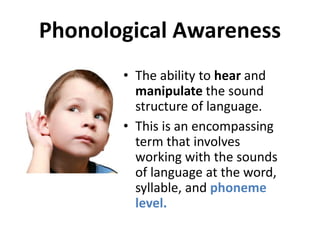
Phonological Awareness
• The ability to hear and
manipulate the sound
structure of language.
• This is an encompassing
term that involves
working with the sounds
of language at the word,
syllable, and phoneme
level.
This is why we MUST learn to
clearly articulate the sounds of
our language!
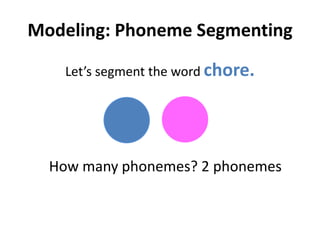
Modeling: Phoneme Segmenting
Let’s segment the word chore.
How many phonemes? 2 phonemes
Modeling: Phoneme Segmenting
Let’s segment the word dodge.
How many phonemes? 3 phonemes
dc ĕ fb
ă
k
i
l
jhg
ŏ q rp
m
n
x
v wu
z
y
t
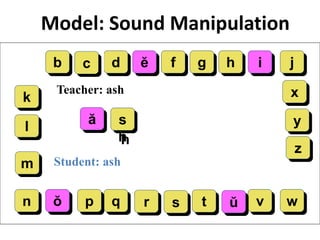
Teacher: ash
Student: ash
s
Model: Sound Manipulation
s
h
c
r s t ŭ
dc ĕ fb
ă
k
ĭ
l
jhg
ŏ q rp
m
n
x
v wu
z
y
t
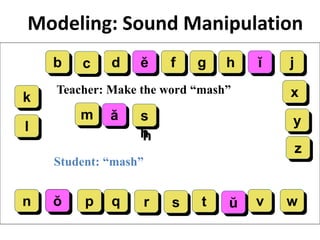
Teacher: Make the word “mash”
Student: “mash”
s
Modeling: Sound Manipulation
s
h
c
r s t ŭ
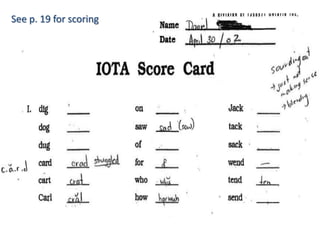
See p. 19 for scoring
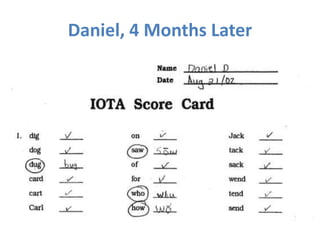
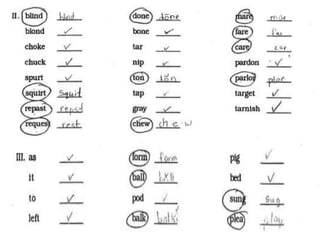
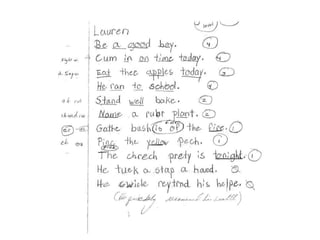
Daniel, 4 Months Later
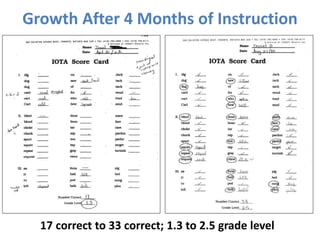
Growth After 4 Months of Instruction
17 correct to 33 correct; 1.3 to 2.5 grade level
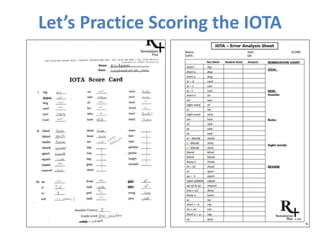
Let’s Practice Scoring the IOTA
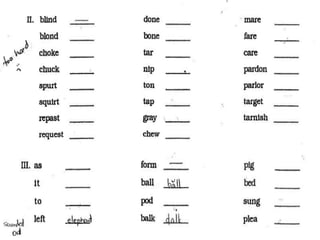
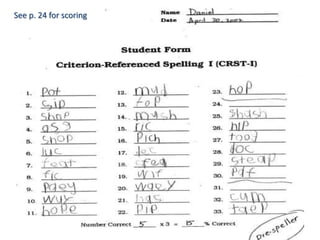
See p. 24 for scoring
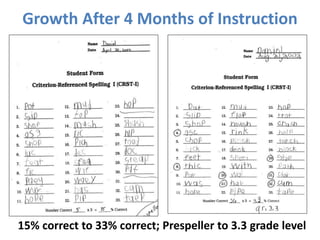
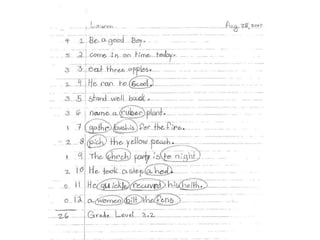
Growth After 4 Months of Instruction
15% correct to 33% correct; Prespeller to 3.3 grade level
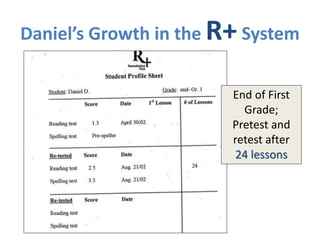
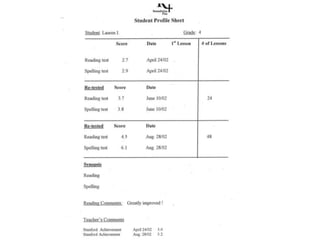
Daniel’s Growth in the R+ System
End of First
Grade;
Pretest and
retest after
24 lessons
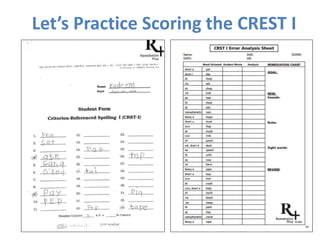
Let’s Practice Scoring the CREST I
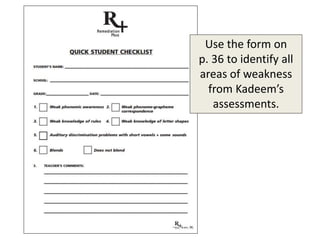
Use the form on
p. 36 to identify all
areas of weakness
from Kadeem’s
assessments.
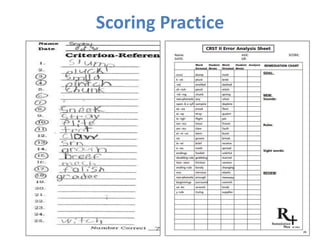
Scoring Practice
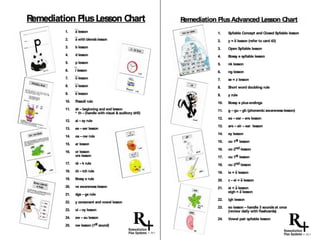
1. a lesson
2. a with blendslesson
3. b lesson
4. d lesson
5. p lesson
6. i lesson
7. o lesson
8. u lesson
9. e lesson
10. ffsszzll rule
11. sh – beginning and end lesson
* th – (handle with visual & auditory drill)
12. ai – ay rule
13. ee – eer lesson
14. oa – ow rule
15. ar lesson
16. or lesson
ore lesson
17. ck – k rule
18. ch – tch rule
19. Bossy e rule
20. ve awarenesslesson
21. dge – ge rule
22. y consonant and vowel lesson
23. oi – oy lesson
24. aw – au lesson
25. ow lesson (1st sound)
Remediation PlusLesson Chart
© 2013
1. Syllable Concept and Closed Syllable lesson
2. y = e lesson (refer to card 43)
3. Open Syllable lesson
4. Bossy e syllable lesson
5. nk lesson
6. ng lesson
7. se = z lesson
8. Short word doubling rule
9. y rule
10. Bossy e plusendings
11. g – gu – gh (phonemicawarenesslesson)
12. ea – ear – ere lesson
13. are – air – ear lesson
14. ey lesson
15. oo 1st lesson
16. oo 2nd lesson
17. ou 1st lesson
18. ou 2nd lesson
19. ie = e lesson
20. c– ei = e lesson
21. ei = a lesson
eigh = a lesson
22. igh lesson
23. eo lesson – handle 3 soundsat once
(review daily with flashcards)
24. Vowel pair syllable lesson
Remediation PlusAdvanced Lesson Chart
© 2013
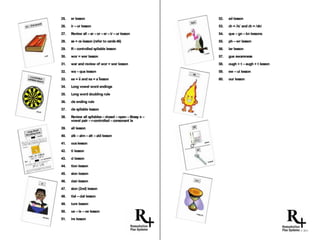
25. er lesson
26. ir – ur lesson
27. Review all –ar –or – er –ir – ur lesson
28. se = ce lesson (refer to cards46)
29. R– controlled syllable lesson
30. wor = wer lesson
31. war and review of wor = wer lesson
32. wa – qua lesson
33. ea = e and ea = a lesson
34. Long vowel word endings
35. Long word doubling rule
36. cle ending rule
37. cle syllable lesson
38. Review all syllables– closed – open – Bossy e –
vowel pair – r-controlled – consonant le
39. all lesson
40. alk – alm – alt – ald lesson
41. ouslesson
42. ti lesson
43. ci lesson
44. tion lesson
45. sion lesson
46. cian lesson
47. sion (2nd) lesson
48. tial – cial lesson
49. ture lesson
50. ue – ie – oe lesson
51. ire lesson
52. ed lesson
53. ch = /k/ and ch = /sh/
54. que – gn – kn lessons
55. ph – wr lesson
56. ier lesson
57. gue awareness
58. ough + t – augh + t lesson
59. ew – ui lesson
60. our lesson
© 2013
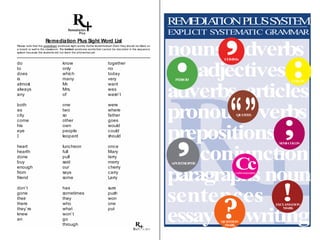
Remediation Plus Sight Word List
Please note that the underlined wordsare sight words. Asthe studentslearn them they should be listed on
a board or wall in the classroom. The bolded wordsare words that cannot be decoded in the sequence
system because the students did not learn the phonemes yet.
do
to
does
is
almost
always
any
both
as
city
come
his
eye
I
heart
hearth
done
buy
enough
from
friend
don’t
gone
their
there
they’re
knew
an
know
only
which
many
Mr.
Mrs.
of
one
two
so
other
own
people
leopard
luncheon
full
pull
said
our
says
some
has
sometimes
they
who
what
won’t
go
through
together
no
today
very
want
was
wasn’t
were
where
father
goes
would
could
should
once
Mary
terry
merry
cherry
carry
Larry
sure
push
won
one
put
© 2013
nouns adverbs
adjectives
adverbs articles
pronouns verbs
prepositions
conjunction
paragraphs noun
sentences
essay writing
REMEDIATIONPLUSSYSTEM
EXPLICIT SYSTEMATIC GRAMMAR
COMMA
CAPITALIZATION
QUOTES
PERIOD
APOSTROPHE
COLON
QUESTION
MARK
EXCLAMATION
MARK
SEMI-COLON
Cc
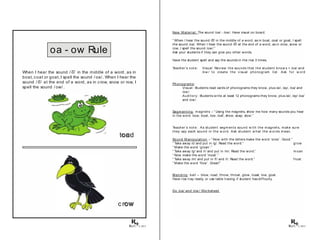
oa - ow Rule
When I hear the sound / o/ in the middle of a word, as in
boat, coat or goat, I spell the sound / oa/ . When I hear the
sound / o/ at the end of a word, as in crow, snow or row, I
spell the sound / ow/ .
toad
crow
© 2013
New M at erial: The sound /oa/ - /ow/. Have visual on board.
“ When I hear the sound /o/ in the middle of a word, as in boat, coat or goat, I spell
the sound /oa/. When I hear the sound /o/ at the end of a word, as in crow, snow or
row, I spell the sound /ow/.”
Ask your students if they can give you other words.
Have the student spell and say the sounds in the rice 3 times.
Teacher’s not e: Visual: Review t he sounds t hat t he st udent know s + /oa/ and
/ow / t o creat e t he visual phonogram list . Ask f or w ord
Phonogram s:
Visual: Students read cards of phonograms they know, plus /ai/, /ay/, /oa/ and
/ow/.
Audit ory: Students write at least 12 phonograms they know, plus /ai/, /ay/ /oa/
and /ow/.
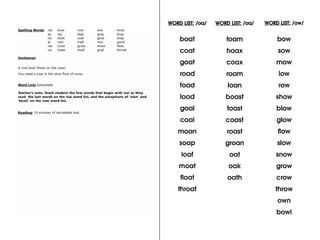
Segm ent ing : m agnet s – “ Using the magnets, show me how many sounds you hear
in the word: bow, boat, low, loaf, show, soap, slow.”
Teacher’s not e: As st udent segm ent s sound w it h t he m agnet s, m ake sure
t hey say each sound in t he w ord. Ask st udent w hat t he w ords m ean.
Sound M anipulat ion – “ Now with the letters make the word ‘crow’. Good.”
“ Take away /c/ and put in /g/. Read the word.” grow
“ Make the word ‘groan’.”
“ Take away /g/ and /r/ and put in /m/. Read the word.” m oan
“ Now make the word ‘moat’.”
“ Take away /m/ and put in /f/ and /l/. Read the word.” f loat
“ Make the word ‘flow’. Great!”
Blending: ball – blow, road, throw, throat, glow, toast, low, goat.
Have rice tray ready, or use table tracing if student has difficulty.
Do /oa/ and /ow / Worksheet
© 2013
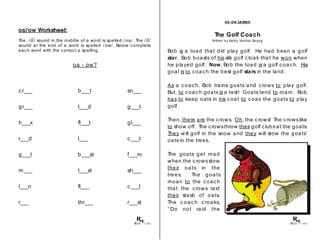
oa/ ow Worksheet:
The / o/ sound in the middle of a word is spelled / oa/ . The / o/
sound at the end of a word is spelled / ow/ . Below complete
each word with the correct a spelling.
oa - ow?
cr___ b___t sn___
gr___ t___d g___t
h___x fl___t gl___
r___d l___ c___t
g___l b___st f___m
m___ t___st sh___
l___n fl___ c___l
r___ thr___ r___st
© 2013
oa-ow Lesson
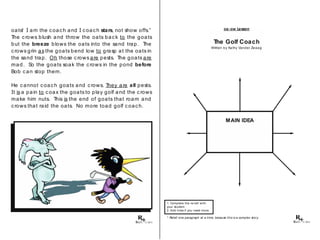
The Golf Coach
Written by Kathy Vander Zwaag
Bob is a toad that did play golf. He had been a golf
star. Bob boasts of his silk golf cloak that he won when
he played golf. Now, Bob the toad is a golf coach. His
goal is to coach the best golf stars in the land.
As a coach, Bob trains goats and crows to play golf.
But, to coach goats is a test! Goats tend to roam. Bob
has to keep oats in his coat to coax the goats to play
golf.
Then, there are the crows. Oh, the c rows! The c rowslike
to show off. The crowsthrow their golf clubsat the goats.
They will golf in the snow and they will stow the goats’
oats in the trees.
The goats get mad
when the c rowsstow
their oa ts in the
trees. The goa ts
moan to the coach
that the c rows raid
their stash of oats.
The c oac h c roaks,
“ Do not raid the
© 2013
oats! I am the coach and I coach stars, not show offs.”
The c rows blush and throw the oats back to the goats
but the breeze blows the oats into the sand trap. The
crows grin as the goats bend low to grasp at the oats in
the sand trap. Oh those crows are pests. The goats are
mad. So the goats soak the crows in the pond before
Bob can stop them.
He cannot coach goats and c rows. They are all pests.
It is a pain to coax the goats to play golf and the crows
make him nuts. This is the end of goats that roam and
crows that raid the oats. No more toad golf coach.
© 2013
MAIN IDEA
oa-ow Lesson
The Golf Coach
Written by Kathy Vander Zwaag
1. Complete the re-tell with
your student.
2. Add lines if you need more.
* Retell one paragraph at a time, because this is a complex story.
© 2013
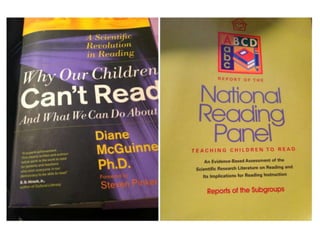
Orthographic mapping – “Holy Grail”
Dr. Linea Ehri
It involves the formation of letter sound connections to bond
the spellings, pronunciations and meanings of specific words in
memory.
Recommended reading:
Essentials of Assessing, Preventing & Overcoming Reading
Difficulties
Dr. David Kilpatrick
TESTIMONIAL
I am the Learning for All Teacher at a northern Ontario school. Many of our students are First Nations,
transient or simply do not come to school on a regular basis. I received the Remediation Plus Program in
December. It was bought for a Grade 8 student in our school who was reading at a grade 1 level. He was
unwilling to try conventional programs as they were “babyish”, and spent most of his day out of the
classroom and causing trouble. I received the program and I immediately went to work, watching the
videos and training myself on how to deliver the program. The videos showed me everything I needed to
know. I continue to use them, as they model many of the individual lessons.
I began by doing the assessments that came with the program. Jo-Anne Gross and I then spent an hour
on the phone, going over the results, and planning where to start and answering any questions I had. My
grade 8 boy and I started the program at the beginning of January. I promised him, he would be reading
very soon! I don’t think he really believed me, but thank goodness he was willing to give it a try. The
lessons were fast paced and incorporated a multi-sensory approach that made it fun. By the middle of
January, I could tell his confidence was growing, and his behavior had improved! He was staying in his
class all day! One day at the end of February, we were playing a math game. He grabbed one of the cards
out of my hand and with a giant grin on his face, he read it to me and his class!! He was so proud and so
was I!! The program works! It is easy to follow, quick paced and fun.
Once you have watched the videos and practiced on a fellow teacher once or twice, you are ready to go! It
is amazing to see the progress happen so quickly. I am now using the program on other students in our
school from as young as grade 3. I am seeing similar results, and they love it! I would definitely
recommend it to others who have students who are not experiencing success with their reading programs.
--
Dana Allen
Our Lady of Fatima
Learning For All

Research ed canada april 13 14-

  • 1.
  • 2.
    “The growth ofreading skills fits a deficit, not a lag model.” Fletcher & al 1994 Foorman, Francis, Fletcher &Lyon 1996 Liberman & al,1989 Stanovich & Seigel,1994 Wagner, Torgesen & Rashotte 1994
  • 3.
    Dr. Julian Elliott “Whatwe need instead is for teachers to look at each child`s educational needs & spot problems early on(without pursuing a diagnosis)”. Heated discussion…
  • 4.
    Dr. Linea Ehri “Graphemephoneme knowledge is essential to read words in English”. Dr. Stanislas Dehane “Graphemes map onto phonemes”.
  • 6.
    “Phonological awareness is thegreatest breakthrough in reading research of the 21st century.” Dr. Reid Lyon, Chief of the N.I.C.H.D.
  • 7.
    Phonological Awareness • Theability to hear and manipulate the sound structure of language. • This is an encompassing term that involves working with the sounds of language at the word, syllable, and phoneme level.
  • 8.
    This is whywe MUST learn to clearly articulate the sounds of our language!
  • 9.
    Modeling: Phoneme Segmenting Let’ssegment the word chore. How many phonemes? 2 phonemes
  • 10.
    Modeling: Phoneme Segmenting Let’ssegment the word dodge. How many phonemes? 3 phonemes
  • 11.
    dc ĕ fb ă k i l jhg ŏq rp m n x v wu z y t Teacher: ash Student: ash s Model: Sound Manipulation s h c r s t ŭ
  • 12.
    dc ĕ fb ă k ĭ l jhg ŏq rp m n x v wu z y t Teacher: Make the word “mash” Student: “mash” s Modeling: Sound Manipulation s h c r s t ŭ
  • 13.
    See p. 19for scoring
  • 15.
  • 17.
    Growth After 4Months of Instruction 17 correct to 33 correct; 1.3 to 2.5 grade level
  • 18.
  • 19.
    See p. 24for scoring
  • 20.
    Growth After 4Months of Instruction 15% correct to 33% correct; Prespeller to 3.3 grade level
  • 21.
    Daniel’s Growth inthe R+ System End of First Grade; Pretest and retest after 24 lessons
  • 22.
  • 23.
    Use the formon p. 36 to identify all areas of weakness from Kadeem’s assessments.
  • 24.
  • 25.
    1. a lesson 2.a with blendslesson 3. b lesson 4. d lesson 5. p lesson 6. i lesson 7. o lesson 8. u lesson 9. e lesson 10. ffsszzll rule 11. sh – beginning and end lesson * th – (handle with visual & auditory drill) 12. ai – ay rule 13. ee – eer lesson 14. oa – ow rule 15. ar lesson 16. or lesson ore lesson 17. ck – k rule 18. ch – tch rule 19. Bossy e rule 20. ve awarenesslesson 21. dge – ge rule 22. y consonant and vowel lesson 23. oi – oy lesson 24. aw – au lesson 25. ow lesson (1st sound) Remediation PlusLesson Chart © 2013 1. Syllable Concept and Closed Syllable lesson 2. y = e lesson (refer to card 43) 3. Open Syllable lesson 4. Bossy e syllable lesson 5. nk lesson 6. ng lesson 7. se = z lesson 8. Short word doubling rule 9. y rule 10. Bossy e plusendings 11. g – gu – gh (phonemicawarenesslesson) 12. ea – ear – ere lesson 13. are – air – ear lesson 14. ey lesson 15. oo 1st lesson 16. oo 2nd lesson 17. ou 1st lesson 18. ou 2nd lesson 19. ie = e lesson 20. c– ei = e lesson 21. ei = a lesson eigh = a lesson 22. igh lesson 23. eo lesson – handle 3 soundsat once (review daily with flashcards) 24. Vowel pair syllable lesson Remediation PlusAdvanced Lesson Chart © 2013
  • 26.
    25. er lesson 26.ir – ur lesson 27. Review all –ar –or – er –ir – ur lesson 28. se = ce lesson (refer to cards46) 29. R– controlled syllable lesson 30. wor = wer lesson 31. war and review of wor = wer lesson 32. wa – qua lesson 33. ea = e and ea = a lesson 34. Long vowel word endings 35. Long word doubling rule 36. cle ending rule 37. cle syllable lesson 38. Review all syllables– closed – open – Bossy e – vowel pair – r-controlled – consonant le 39. all lesson 40. alk – alm – alt – ald lesson 41. ouslesson 42. ti lesson 43. ci lesson 44. tion lesson 45. sion lesson 46. cian lesson 47. sion (2nd) lesson 48. tial – cial lesson 49. ture lesson 50. ue – ie – oe lesson 51. ire lesson 52. ed lesson 53. ch = /k/ and ch = /sh/ 54. que – gn – kn lessons 55. ph – wr lesson 56. ier lesson 57. gue awareness 58. ough + t – augh + t lesson 59. ew – ui lesson 60. our lesson © 2013
  • 27.
    Remediation Plus SightWord List Please note that the underlined wordsare sight words. Asthe studentslearn them they should be listed on a board or wall in the classroom. The bolded wordsare words that cannot be decoded in the sequence system because the students did not learn the phonemes yet. do to does is almost always any both as city come his eye I heart hearth done buy enough from friend don’t gone their there they’re knew an know only which many Mr. Mrs. of one two so other own people leopard luncheon full pull said our says some has sometimes they who what won’t go through together no today very want was wasn’t were where father goes would could should once Mary terry merry cherry carry Larry sure push won one put © 2013 nouns adverbs adjectives adverbs articles pronouns verbs prepositions conjunction paragraphs noun sentences essay writing REMEDIATIONPLUSSYSTEM EXPLICIT SYSTEMATIC GRAMMAR COMMA CAPITALIZATION QUOTES PERIOD APOSTROPHE COLON QUESTION MARK EXCLAMATION MARK SEMI-COLON Cc
  • 28.
    oa - owRule When I hear the sound / o/ in the middle of a word, as in boat, coat or goat, I spell the sound / oa/ . When I hear the sound / o/ at the end of a word, as in crow, snow or row, I spell the sound / ow/ . toad crow © 2013 New M at erial: The sound /oa/ - /ow/. Have visual on board. “ When I hear the sound /o/ in the middle of a word, as in boat, coat or goat, I spell the sound /oa/. When I hear the sound /o/ at the end of a word, as in crow, snow or row, I spell the sound /ow/.” Ask your students if they can give you other words. Have the student spell and say the sounds in the rice 3 times. Teacher’s not e: Visual: Review t he sounds t hat t he st udent know s + /oa/ and /ow / t o creat e t he visual phonogram list . Ask f or w ord Phonogram s: Visual: Students read cards of phonograms they know, plus /ai/, /ay/, /oa/ and /ow/. Audit ory: Students write at least 12 phonograms they know, plus /ai/, /ay/ /oa/ and /ow/. Segm ent ing : m agnet s – “ Using the magnets, show me how many sounds you hear in the word: bow, boat, low, loaf, show, soap, slow.” Teacher’s not e: As st udent segm ent s sound w it h t he m agnet s, m ake sure t hey say each sound in t he w ord. Ask st udent w hat t he w ords m ean. Sound M anipulat ion – “ Now with the letters make the word ‘crow’. Good.” “ Take away /c/ and put in /g/. Read the word.” grow “ Make the word ‘groan’.” “ Take away /g/ and /r/ and put in /m/. Read the word.” m oan “ Now make the word ‘moat’.” “ Take away /m/ and put in /f/ and /l/. Read the word.” f loat “ Make the word ‘flow’. Great!” Blending: ball – blow, road, throw, throat, glow, toast, low, goat. Have rice tray ready, or use table tracing if student has difficulty. Do /oa/ and /ow / Worksheet © 2013
  • 30.
    oa/ ow Worksheet: The/ o/ sound in the middle of a word is spelled / oa/ . The / o/ sound at the end of a word is spelled / ow/ . Below complete each word with the correct a spelling. oa - ow? cr___ b___t sn___ gr___ t___d g___t h___x fl___t gl___ r___d l___ c___t g___l b___st f___m m___ t___st sh___ l___n fl___ c___l r___ thr___ r___st © 2013 oa-ow Lesson The Golf Coach Written by Kathy Vander Zwaag Bob is a toad that did play golf. He had been a golf star. Bob boasts of his silk golf cloak that he won when he played golf. Now, Bob the toad is a golf coach. His goal is to coach the best golf stars in the land. As a coach, Bob trains goats and crows to play golf. But, to coach goats is a test! Goats tend to roam. Bob has to keep oats in his coat to coax the goats to play golf. Then, there are the crows. Oh, the c rows! The c rowslike to show off. The crowsthrow their golf clubsat the goats. They will golf in the snow and they will stow the goats’ oats in the trees. The goats get mad when the c rowsstow their oa ts in the trees. The goa ts moan to the coach that the c rows raid their stash of oats. The c oac h c roaks, “ Do not raid the © 2013
  • 31.
    oats! I amthe coach and I coach stars, not show offs.” The c rows blush and throw the oats back to the goats but the breeze blows the oats into the sand trap. The crows grin as the goats bend low to grasp at the oats in the sand trap. Oh those crows are pests. The goats are mad. So the goats soak the crows in the pond before Bob can stop them. He cannot coach goats and c rows. They are all pests. It is a pain to coax the goats to play golf and the crows make him nuts. This is the end of goats that roam and crows that raid the oats. No more toad golf coach. © 2013 MAIN IDEA oa-ow Lesson The Golf Coach Written by Kathy Vander Zwaag 1. Complete the re-tell with your student. 2. Add lines if you need more. * Retell one paragraph at a time, because this is a complex story. © 2013
  • 42.
    Orthographic mapping –“Holy Grail” Dr. Linea Ehri It involves the formation of letter sound connections to bond the spellings, pronunciations and meanings of specific words in memory. Recommended reading: Essentials of Assessing, Preventing & Overcoming Reading Difficulties Dr. David Kilpatrick
  • 44.
    TESTIMONIAL I am theLearning for All Teacher at a northern Ontario school. Many of our students are First Nations, transient or simply do not come to school on a regular basis. I received the Remediation Plus Program in December. It was bought for a Grade 8 student in our school who was reading at a grade 1 level. He was unwilling to try conventional programs as they were “babyish”, and spent most of his day out of the classroom and causing trouble. I received the program and I immediately went to work, watching the videos and training myself on how to deliver the program. The videos showed me everything I needed to know. I continue to use them, as they model many of the individual lessons. I began by doing the assessments that came with the program. Jo-Anne Gross and I then spent an hour on the phone, going over the results, and planning where to start and answering any questions I had. My grade 8 boy and I started the program at the beginning of January. I promised him, he would be reading very soon! I don’t think he really believed me, but thank goodness he was willing to give it a try. The lessons were fast paced and incorporated a multi-sensory approach that made it fun. By the middle of January, I could tell his confidence was growing, and his behavior had improved! He was staying in his class all day! One day at the end of February, we were playing a math game. He grabbed one of the cards out of my hand and with a giant grin on his face, he read it to me and his class!! He was so proud and so was I!! The program works! It is easy to follow, quick paced and fun. Once you have watched the videos and practiced on a fellow teacher once or twice, you are ready to go! It is amazing to see the progress happen so quickly. I am now using the program on other students in our school from as young as grade 3. I am seeing similar results, and they love it! I would definitely recommend it to others who have students who are not experiencing success with their reading programs. -- Dana Allen Our Lady of Fatima Learning For All