DIAGNOSTIC IMAGING PATHWAYS
                             www.imagingpathways.health.wa.gov.au


INTRAUTERINE GROWTH RESTRICTION (IUGR)
  •   Intrauterine growth restriction (IUGR) refers to a fetus with an estimated fetal weight below the 10th
      percentile corrected for sex and ethnicity which has features of chronic hypoxia and/or malnutrition.
      However, a consensus does not exist for the definition of IUGR. 1
  •   It is associated with adverse fetal outcomes including acidosis, stillbirth, oligohydramnios, low-birth
      weight, and adverse events during labour including fetal distress in labour. 1,2
  •   IUGR is often suspected by poor maternal weight gain, and a fundal height that is less than expected
      for the gestational age and is an indication for ultrasound at presentation. Additionally, it may be
      detected during the routine 18-20 week scan that is recommended as best practice within Australia.
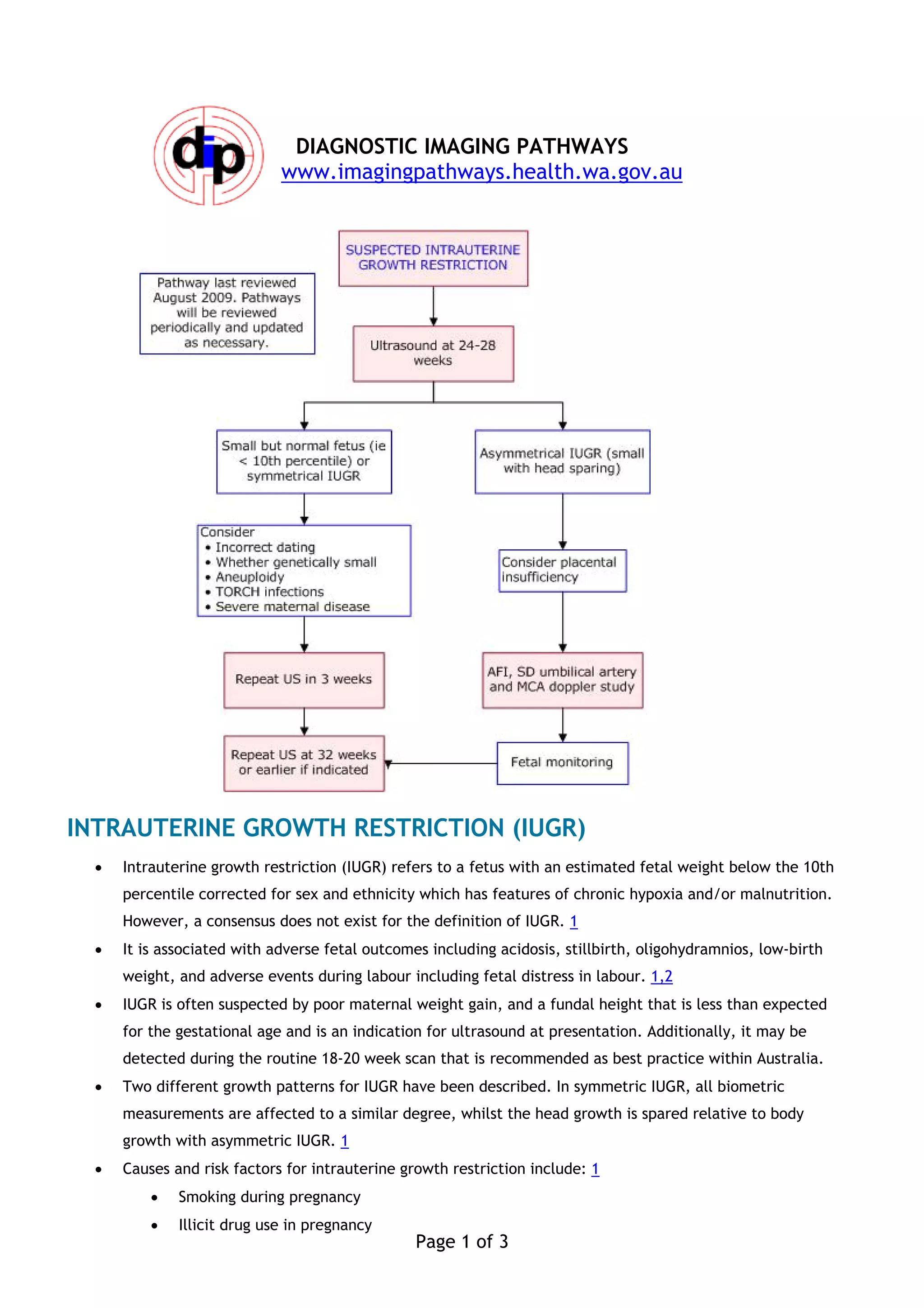
  •   Two different growth patterns for IUGR have been described. In symmetric IUGR, all biometric
      measurements are affected to a similar degree, whilst the head growth is spared relative to body
      growth with asymmetric IUGR. 1
  •   Causes and risk factors for intrauterine growth restriction include: 1
          •   Smoking during pregnancy
          •   Illicit drug use in pregnancy
                                                 Page 1 of 3
•   Low maternal body mass index
          •   Deficient antenatal care
          •   Fetal abnormalities: chromosomal abnormalities, malformations
          •   Maternal infections: toxoplasmosis, rubella, CMV, herpes
          •   Chronic maternal disease: diabetes mellitus, hypertension, renal disease


ULTRASOUND
  •   Conventional and Doppler ultrasonography are used to assess fetal wellbeing through the
      following parameters: 3,4,5,6
          •   Fetal anatomy: measurements include biparietal diameter, head circumference,
              abdominal circumference, femur length, and estimation of fetal weight. Abdominal
              circumference is the most sensitive measurement for assessing fetal wellbeing.
          •   Biophysical profile: includes fetal heart rate, breathing, movements, tone, amniotic
              fluid and duplex Doppler waveform of the umbilical artery, including a calculation of
              the systolic to diastolic (S/D) ratio.
  •   Percentile charts are used to assess the estimated fetal weight for age. Normal values are
      arbitrarily chosen as between the 10th and 90th percentiles.
  •   During early pregnancy, the placental vascular resistance is normally high, and in normal
      pregnancies vascular resistance falls so that by 20 weeks of gestation, there is continuous
      diastolic flow toward the maternal system through the umbilical arteries. 4,5
  •   Changes in the Doppler characteristics of the umbilical artery may reflect IUGR and placental
      dysfunction. Changes in the end-diastolic velocity of the umbilical artery range from reduced,
      to absent or reversed and may indicate progressive abnormal increases in the placental
      circulatory resistance. The normal S/D ratio is less than 3.5, and varies with gestational age. 4,5
  •   Doppler studies of the umbilical artery alone are not diagnostic of intrauterine growth
      restriction as the sensitivity is low. A combination of conventional and Doppler ultrasound has a
      sensitivity, specificity, positive predictive value and negative predictive value of 31%, 99%, 77%,
      and 93% respectively. 7
  •   Increasingly, middle cerebral artery, ductus venosus, and umbilical vein doppler studies are
      being used to aid assessment. 8
  •   In diagnosed IUGR, the degree of umbilical artery abnormality directly correlates with adverse
      fetal outcomes and adverse events during labour and the immediate post-partum period. It can
      be used to guide management and has been shown to significantly reduce the risk of perinatal
      mortality by 38%, but without a significant effect on neonatal morbidity. 4,5,7,9
  •   If IUGR is diagnosed and there are no indications for immediate delivery, fetal monitoring is
      appropriate. This usually consists of serial cardiotocography and ultrasound (biophysical profile,
      S/D ratios, and assessment of fetal growth). One randomised control trial has shown that
      compared to serial cardiotocography, serial Doppler ultrasound of the umbilical arteries


                                                  Page 2 of 3
significantly reduces the need for emergency cesarean deliveries for fetal distress in-utero.
        1,3,10


REFERENCES
   1. Nyberg DA, Abuhamad A, Ville Y. Ultrasound Assessment of Abnormal Fetal Growth. Seminars
        in Perinatology 2004;28:3-22. (Review article)
   2. Smith-Bindman R, Chu PW, Ecker JL, Feldstein VA, Filly RA, Bacchetti P. US Evaluation of Fetal
        Growth: Predictors of Neonatal Outcomes. Radiology 2002;223:153-61. (Level III evidence)
   3. Cragio SD. The Role of Ultrasound in the Diagnosis and Management of Intrauterine Growth
        Retardation. Seminars in Perinatology 1994;18:292-304. (Review article)
   4. Harman CR, Baschat AA. Comprehensive assessment of fetal wellbeing: which Doppler tests
        should be performed. Curr Opin Obstet Gynecol 2003;15:147-57. (Review article)
   5. Dudiak CM, Salomon CG, Posniak HV, Olson MC, Flisak ME. Sonography of the Umbilical Cord.
        Radiographics 1995;15:1035-50. (Review article)
   6. Australasian Society for Ultrasound in Medicine (ASUM). Guidelines for the Performance of
        Third Trimester Ultrasound. ASUM Guidelines revised 1999. (Position Statement)
   7. Ott WJ. Diagnosis of Intrauterine Growth Restriction: Comparison of Ultrasound Parameters.
        Am J Perinatology 2002;19:133-7. (Level III evidence)
   8. Harman CR, Baschat AA. Arterial and Venous Dopplers in IUGR. Clin Obstet Gynaecol
        2003;46:931-46. (Review article)
   9. Alfirevic Z, Neilson JP. Doppler ultrasonography in high-risk pregnancies: Systematic review
        with meta-analysis. Am J Obstetrics and Gynaecology 1995;172: 1379-87. (Level II evidence).
        Click here to view reference
   10. Williams KP, Farquharson DF, Bebbington M, et al. Screening for fetal well-being in a high-risk
        pregnant population comparing the nonstress test with umbilical artery Doppler
        velocimetry: a randomised controlled clinical trial. Am J Obstet Gynecol 2003;188:1366-71.
        (Level II evidence). Click here to view reference

                                                            Website
                              For more information go to www.imagingpathways.health.wa.gov.au


                                                           Copyright
                        © Copyright 2009, Department of Health Western Australia. All Rights Reserved.
This web site and its content has been prepared by The Department of Health, Western Australia. The information contained on
                                             this web site is protected by copyright.


                                                          Legal Notice
 Please remember that this leaflet is intended as general information only. It is not definitive and The Department of Health,
 Western Australia can not accept any legal liability arising from its use. The information is kept as up to date and accurate as
                               possible, but please be warned that it is always subject to change.


                                                             Page 3 of 3

Iugr

  • 1.
    DIAGNOSTIC IMAGING PATHWAYS www.imagingpathways.health.wa.gov.au INTRAUTERINE GROWTH RESTRICTION (IUGR) • Intrauterine growth restriction (IUGR) refers to a fetus with an estimated fetal weight below the 10th percentile corrected for sex and ethnicity which has features of chronic hypoxia and/or malnutrition. However, a consensus does not exist for the definition of IUGR. 1 • It is associated with adverse fetal outcomes including acidosis, stillbirth, oligohydramnios, low-birth weight, and adverse events during labour including fetal distress in labour. 1,2 • IUGR is often suspected by poor maternal weight gain, and a fundal height that is less than expected for the gestational age and is an indication for ultrasound at presentation. Additionally, it may be detected during the routine 18-20 week scan that is recommended as best practice within Australia. • Two different growth patterns for IUGR have been described. In symmetric IUGR, all biometric measurements are affected to a similar degree, whilst the head growth is spared relative to body growth with asymmetric IUGR. 1 • Causes and risk factors for intrauterine growth restriction include: 1 • Smoking during pregnancy • Illicit drug use in pregnancy Page 1 of 3
  • 2.
    Low maternal body mass index • Deficient antenatal care • Fetal abnormalities: chromosomal abnormalities, malformations • Maternal infections: toxoplasmosis, rubella, CMV, herpes • Chronic maternal disease: diabetes mellitus, hypertension, renal disease ULTRASOUND • Conventional and Doppler ultrasonography are used to assess fetal wellbeing through the following parameters: 3,4,5,6 • Fetal anatomy: measurements include biparietal diameter, head circumference, abdominal circumference, femur length, and estimation of fetal weight. Abdominal circumference is the most sensitive measurement for assessing fetal wellbeing. • Biophysical profile: includes fetal heart rate, breathing, movements, tone, amniotic fluid and duplex Doppler waveform of the umbilical artery, including a calculation of the systolic to diastolic (S/D) ratio. • Percentile charts are used to assess the estimated fetal weight for age. Normal values are arbitrarily chosen as between the 10th and 90th percentiles. • During early pregnancy, the placental vascular resistance is normally high, and in normal pregnancies vascular resistance falls so that by 20 weeks of gestation, there is continuous diastolic flow toward the maternal system through the umbilical arteries. 4,5 • Changes in the Doppler characteristics of the umbilical artery may reflect IUGR and placental dysfunction. Changes in the end-diastolic velocity of the umbilical artery range from reduced, to absent or reversed and may indicate progressive abnormal increases in the placental circulatory resistance. The normal S/D ratio is less than 3.5, and varies with gestational age. 4,5 • Doppler studies of the umbilical artery alone are not diagnostic of intrauterine growth restriction as the sensitivity is low. A combination of conventional and Doppler ultrasound has a sensitivity, specificity, positive predictive value and negative predictive value of 31%, 99%, 77%, and 93% respectively. 7 • Increasingly, middle cerebral artery, ductus venosus, and umbilical vein doppler studies are being used to aid assessment. 8 • In diagnosed IUGR, the degree of umbilical artery abnormality directly correlates with adverse fetal outcomes and adverse events during labour and the immediate post-partum period. It can be used to guide management and has been shown to significantly reduce the risk of perinatal mortality by 38%, but without a significant effect on neonatal morbidity. 4,5,7,9 • If IUGR is diagnosed and there are no indications for immediate delivery, fetal monitoring is appropriate. This usually consists of serial cardiotocography and ultrasound (biophysical profile, S/D ratios, and assessment of fetal growth). One randomised control trial has shown that compared to serial cardiotocography, serial Doppler ultrasound of the umbilical arteries Page 2 of 3
  • 3.
    significantly reduces theneed for emergency cesarean deliveries for fetal distress in-utero. 1,3,10 REFERENCES 1. Nyberg DA, Abuhamad A, Ville Y. Ultrasound Assessment of Abnormal Fetal Growth. Seminars in Perinatology 2004;28:3-22. (Review article) 2. Smith-Bindman R, Chu PW, Ecker JL, Feldstein VA, Filly RA, Bacchetti P. US Evaluation of Fetal Growth: Predictors of Neonatal Outcomes. Radiology 2002;223:153-61. (Level III evidence) 3. Cragio SD. The Role of Ultrasound in the Diagnosis and Management of Intrauterine Growth Retardation. Seminars in Perinatology 1994;18:292-304. (Review article) 4. Harman CR, Baschat AA. Comprehensive assessment of fetal wellbeing: which Doppler tests should be performed. Curr Opin Obstet Gynecol 2003;15:147-57. (Review article) 5. Dudiak CM, Salomon CG, Posniak HV, Olson MC, Flisak ME. Sonography of the Umbilical Cord. Radiographics 1995;15:1035-50. (Review article) 6. Australasian Society for Ultrasound in Medicine (ASUM). Guidelines for the Performance of Third Trimester Ultrasound. ASUM Guidelines revised 1999. (Position Statement) 7. Ott WJ. Diagnosis of Intrauterine Growth Restriction: Comparison of Ultrasound Parameters. Am J Perinatology 2002;19:133-7. (Level III evidence) 8. Harman CR, Baschat AA. Arterial and Venous Dopplers in IUGR. Clin Obstet Gynaecol 2003;46:931-46. (Review article) 9. Alfirevic Z, Neilson JP. Doppler ultrasonography in high-risk pregnancies: Systematic review with meta-analysis. Am J Obstetrics and Gynaecology 1995;172: 1379-87. (Level II evidence). Click here to view reference 10. Williams KP, Farquharson DF, Bebbington M, et al. Screening for fetal well-being in a high-risk pregnant population comparing the nonstress test with umbilical artery Doppler velocimetry: a randomised controlled clinical trial. Am J Obstet Gynecol 2003;188:1366-71. (Level II evidence). Click here to view reference Website For more information go to www.imagingpathways.health.wa.gov.au Copyright © Copyright 2009, Department of Health Western Australia. All Rights Reserved. This web site and its content has been prepared by The Department of Health, Western Australia. The information contained on this web site is protected by copyright. Legal Notice Please remember that this leaflet is intended as general information only. It is not definitive and The Department of Health, Western Australia can not accept any legal liability arising from its use. The information is kept as up to date and accurate as possible, but please be warned that it is always subject to change. Page 3 of 3