






Decreased fetal movements (DFM)
Alarm before fetal death
Ahmad S Soliman
Lecturer of Obstetrics and gynecology Department
Benha University Hospital
Objectives
• Normal FETAL MOVEMENTS
• DFMC
• Factors affecting FM
• Optimal management
“ I AM A FETUS IN THE
WOMB
I FEAR IT MAY BECOME
MY TOMB
IF ONLY I COULD GIVE
A SHOUT
TO MAKE MY DOCTOR
GET ME OUT.
I have no
energy to
move; I am
struggling
to keep my
mom
smiling
I am moving
; I am alive
Why we try to put a title decreased
perception of fetal movement ???
In their 8th annual report (London 2001) The Confidential Enquiry into
Stillbirths and Deaths in Infancy (CESDI) under the umbrella of NICE
reviewed 422 stillbirths and found that 69 cases (16.4%) were
related to altered or reducedfetalmovements.
Over 55% of women experiencing a stillbirth perceive a reduction in
fetal movements prior to diagnosis (Efkarpidis et al., 2004).
Early recognition of (DFM) makes it possible for the clinician to
intervene at a stage when the fetus is still compensated, and thus
prevent progression to fetal or neonatal injury or death.(Heazell et al;
2008).
PREVALENCE
40 % of pregnant women experience DFM one or more times during
pregnancy most of them are transient.(Saastad et al; 2012).
Types of Fetal movements
• Limb movement.
(short duration-variable amplitude)
• Rolling movement : Due to changing position.
(long duration-high amplitude).
• Respiratory movement
• Hiccough like movement.
• OTHER activities like suckling the thumb or blinking.
Start around 20 weeks gestation
peak at 28- 34 weeks gestation
(Mangesi & Hofmeyr, 2007).
N.B: Multiparous may notice movements earlier (16-20 wks) than
primi (20-22 wks gestation) (Grant et al., 1989).
 Fetal movements tend to plateau at 32 weeks of gestation
 No reduction in the frequency of fetal movements in the late third
trimester.
Maternal perception of fetal movement
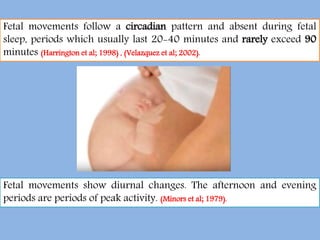
Fetal movements follow a circadian pattern and absent during fetal
sleep, periods which usually last 20-40 minutes and rarely exceed 90
minutes (Harrington et al; 1998) , (Velazquez et al; 2002).
Fetal movements show diurnal changes. The afternoon and evening
periods are periods of peak activity. (Minors et al; 1979).
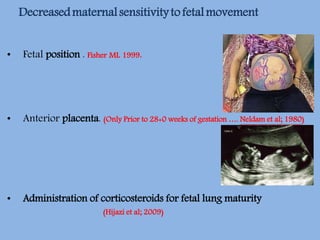
• Fetal position . Fisher ML 1999.
• Anterior placenta. (Only Prior to 28+0 weeks of gestation …. Neldam et al; 1980)
• Administration of corticosteroids for fetal lung maturity
(Hijazi et al; 2009)
Decreasedmaternalsensitivitytofetalmovement
Unlike betamethasone, dexamethasone does not induce a decrease
in fetal movements. Dexamethasone might, therefore, be preferred
for enhancement of lung maturation in imminent preterm labor.
Mushkat et al; 2001
Both betamethasone and dexamethasone induce a profound,
transient, suppression of fetal heart rate characteristics and
biophysical activities in the preterm fetus. However, the effect of
betamethasone is more pronounced. Awareness of these phenomena
might prevent unwarranted iatrogenic delivery of preterm fetuses.
Rotmensch et al; 1999
In women with Persistent DFM, maternal glucose administration
has no effect on perceived fetal movement Michaan et al; 2016
Increased with elevation of glucose concentration in
maternal blood . (Zisser et al; 2006)
Increased fetal movements
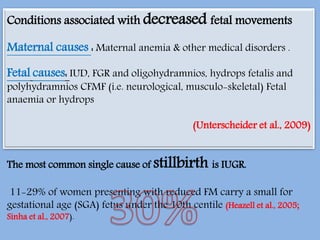
The most common single cause of stillbirth is IUGR.
11-29% of women presenting with reduced FM carry a small for
gestational age (SGA) fetus under the 10th centile (Heazell et al., 2005;
Sinha et al., 2007).
Conditions associated with decreased fetal movements
Maternal causes : Maternal anemia & other medical disorders .
Fetal causes: IUD, FGR and oligohydramnios, hydrops fetalis and
polyhydramnios CFMF (i.e. neurological, musculo-skeletal) Fetal
anaemia or hydrops
(Unterscheider et al., 2009)
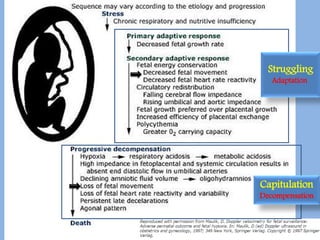
If placental insufficiency is a cause of DFM
Did you have time to save your baby ??!!
Struggling
Adaptation
Capitulation
Decompensation
Pearl:
55% of cases of still birth are
associated with DFM and 30% of
IUGRs are associated with DFM
Fetal movements and CFMF
Fetuses with major malformations are generally more likely
to demonstrate reduced fetal activity. (Christensen et al; 1999)
A lack of vigorous motion may relate to abnormalities of
the central nervous system, muscular dysfunction or
skeletal abnormalities. (Tveit et al; 2009)
Assessment of fetal movements
Subjective maternal perception VS Objective assessment by US.
Can we depend only on the US detected movements ?????
Duration of recording is restricted to 20–30 minutes with the
mother in a semi-recumbent position but results not correlate
strongly to perinatal outcome. (Lowery et al; 1997)
No studies evaluated the use of longer periods of fetal movement
counting by ultrasound .
When correlated sonographically,
• 50% with isolated limb movements
• 80% of movements involving both the trunk and limb
(de Vries et al; 2006).
Mothers perceived 33 to 88 percent of visualized fetal
movements by US (Hijazi et al; 2009).
Fetal Movements in a healthy fetus vary from 4 to 100 per hour
(Mangesi & Hofmeyr, 2007).
Definition of DFM
Dilemma
No universally agreed definition of RFM. RCOG 2014
Also, level of fetal movement that distinguishes a healthy fetus from a
fetus at risk has not been determined (Flenady et al; 2009).
NICE and ACOG guidelines do not provide a definition of reduced
fetal movements, which reflects the dilemma and controversy of the
definition and management of reduced FM.
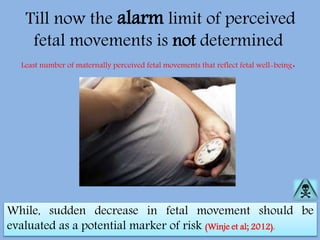
Till now the alarm limit of perceived
fetal movements is not determined
Least number of maternally perceived fetal movements that reflect fetal well-being.
While, sudden decrease in fetal movement should be
evaluated as a potential marker of risk (Winje et al; 2012).
Perception of at least
• 10 FMs during 12 hours of normal maternal activity.
•10 FMs over two hours when the mother is at rest and focused on
counting.
•4 FMs in one hour when the mother is at rest and focused on
counting.
•10FMs within 25 minutes in pregnancies 22 to 36 weeks and 35
minutes in pregnancies 37 or more weeks of gestation.
Adapted from Australian guidelines, four examples of criteria for
reassurance of fetal well-being (Kuwata et al; 2008)
A recent prospective cohort study showed that the mean time to perceive
10 movements is approximately 10 minutes in normal 3rd trimester
pregnancies (Winje et al., 2011).
If women are unsure of RFM after 28+0 wks,
RCOG 2011
Patient on left side and focus on fetal movements for 2 hours.
If they do not feel 10 or more discrete movements in 2 hours, they
should contact their doctor immediately. level C
ACOG 2014
perception of 10 distinct movements in a period of up to 2
continuous or interrupted hours is considered reassuring.
The only numerical limit that has been derived from a total
population, and subsequently evaluated as a screening test in the
same population, is the perception of 10 distinct movements during
focused counting over a period of two hours, which is reassuring
("count to 10" method) ( Moore et al; 1989).
qualitative vs quantitative !!
There is no evidence that any quantitative limit is more effective
than qualitative maternal perception of DFM for identifying
pregnancies at risk of adverse outcome.
EVALUATION of a case of DFM
• Rationale
• Goal
• Methods
Rationale :
 Fetal heart rate, fetal movements are impacted by uteroplacental
blood flow alterations and are thereby sensitive to fetal hypoxemia
and acidemia. ACOG 2014
 Any diminution in fetal activity requires fetal reevaluation ,
regardless of the amount of time that has elapsed since the last test.
level B ACOG 2014
 Fetal movements decrease as the fetus attempts to conserve energy
. The loss of fetal movement can be a sign of ongoing central
nervous system hypoxia and injury. (Olesen and Svare JA. 2004)
Goals:
1. rule out imminent fetal demise.
2. Assessment for common risk factors, such as fetal growth
restriction and decreasing placental function.
1st
History taking
(FGR, placental insufficiency and congenital malformations).
• Confirm RFM if not present reassure and discharge.
If confirmed :
comprehensive stillbirth risk evaluation
• multiple consultations for RFM, known FGR,
• HTN, DM,
• extremes of maternal age,
• smoking,
• placental insufficiency,
• CFM,
• obesity,
• poor past obstetric history (e.g.FGR and stillbirth)
• genetic factors.
Clinical approaches described in observational studies include:
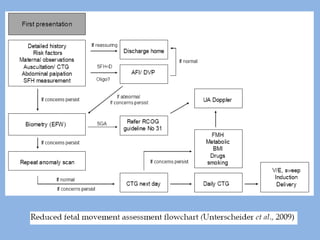
1. physical examination including SFH
2. non-stress and contraction stress tests.
3. ultrasound examination (biophysical profile [BPP])
4. umbilical artery Doppler.
5. testing for fetomaternal hemorrhage (eg, Kleihauer-Betke test).
6. Amnioscopy.
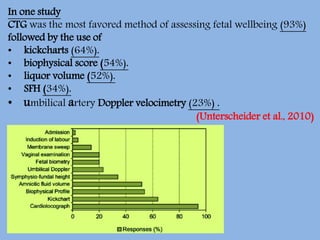
In one study
CTG was the most favored method of assessing fetal wellbeing (93%)
followed by the use of
• kickcharts (64%).
• biophysical score (54%).
• liquor volume (52%).
• SFH (34%).
• umbilical artery Doppler velocimetry (23%) .
(Unterscheider et al., 2010)
Fetal movement counting (count-to-ten kickcharts)
The use of kickcharts is easy, simple and can be done at home.
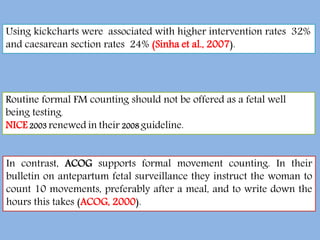
Using kickcharts were associated with higher intervention rates 32%
and caesarean section rates 24% (Sinha et al., 2007).
Routine formal FM counting should not be offered as a fetal well
being testing.
NICE 2003 renewed in their 2008 guideline.
In contrast, ACOG supports formal movement counting. In their
bulletin on antepartum fetal surveillance they instruct the woman to
count 10 movements, preferably after a meal, and to write down the
hours this takes (ACOG, 2000).
systematic review of 5 trials involving 71,458 women Not enough
evidence on counting the baby's movements in the womb to check for
wellbeing. (Mangesi et al; 2015) .
Fetal movement counting for assessment of fetal wellbeing
Role of CTG
For how long CTG should be done?
Even without movements if the term fetus does not experience a fetal
heart rate acceleration for more than 80 minutes, fetal compromise is
likely to be present (Leveno et al; 1983).
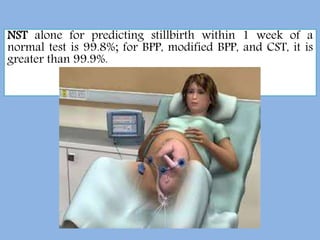
The negative predictive value of NST alone for predicting stillbirth
within 1 week of a normal test is 99.8%; for BPP, modified BPP,
and CST, it is greater than 99.9%. ACOG 2014
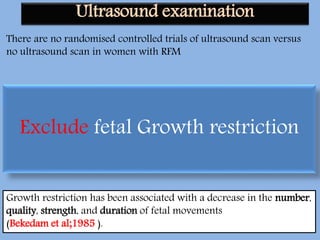
There are no randomised controlled trials of ultrasound scan versus
no ultrasound scan in women with RFM
US examination in cases complicated by persistent DFM despite a
reactive NST is a valuable assessment tool.
• Fetal activity
• Fetal growth velocity
• Amniotic fluid volume
• Fetal anatomic survey (CFMF)
• EFW if there is a size-dates discrepancy (Heazell et al; 2005).
Growth restriction has been associated with a decrease in the number,
quality, strength, and duration of fetal movements
(Bekedam et al;1985 ).
Exclude fetal Growth restriction
Ultrasound examination
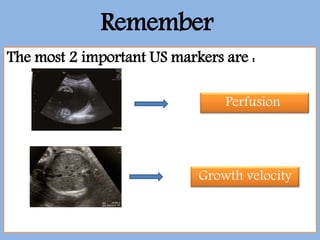
Remember
The most 2 important US markers are :
Perfusion
Growth velocity
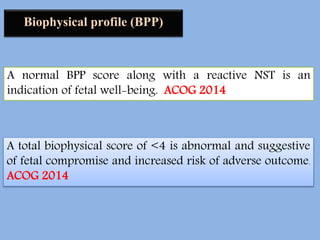
Biophysical profile (BPP)
A normal BPP score along with a reactive NST is an
indication of fetal well-being. ACOG 2014
A total biophysical score of <4 is abnormal and suggestive
of fetal compromise and increased risk of adverse outcome.
ACOG 2014
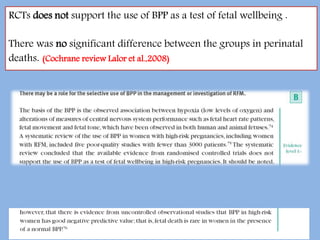
RCTs does not support the use of BPP as a test of fetal wellbeing .
There was no significant difference between the groups in perinatal
deaths. (Cochrane review Lalor et al.,2008)
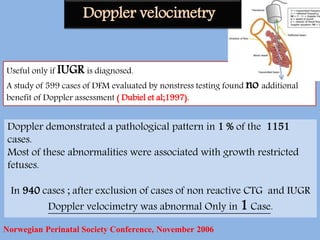
Useful only if IUGR is diagnosed.
A study of 599 cases of DFM evaluated by nonstress testing found no additional
benefit of Doppler assessment ( Dubiel et al;1997).
Doppler demonstrated a pathological pattern in 1 % of the 1151
cases.
Most of these abnormalities were associated with growth restricted
fetuses.
In 940 cases ; after exclusion of cases of non reactive CTG and IUGR
Doppler velocimetry was abnormal Only in 1 Case.
Norwegian Perinatal Society Conference, November 2006
Doppler velocimetry
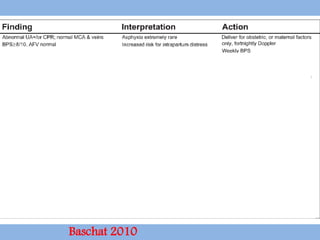
Baschat 2010
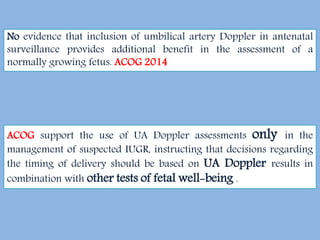
ACOG support the use of UA Doppler assessments only in the
management of suspected IUGR, instructing that decisions regarding
the timing of delivery should be based on UA Doppler results in
combination with other tests of fetal well-being .
No evidence that inclusion of umbilical artery Doppler in antenatal
surveillance provides additional benefit in the assessment of a
normally growing fetus. ACOG 2014
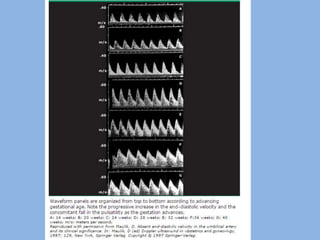
Abnormal elevation of Doppler indices precedes loss of fetal heart rate
variability and reactivity, eventually leading to decline and loss of
fetal breathing and body movements (Williams et al; 2003).
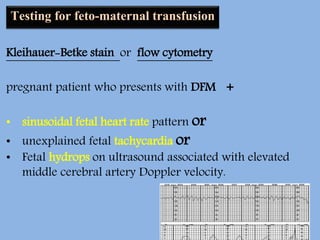
Testing for feto-maternal transfusion
Kleihauer-Betke stain or flow cytometry
pregnant patient who presents with DFM +
• sinusoidal fetal heart rate pattern or
• unexplained fetal tachycardia or
• Fetal hydrops on ultrasound associated with elevated
middle cerebral artery Doppler velocity.
A large fetomaternal transfusion (FMT) is estimated to
occur in 0.3 % of pregnancies, and is a significant
contributor to stillbirth. (Sebring et al;1990)
FOLLOW-UP AND DELIVERY
There are no studies to determine whether intervention
(e.g. delivery or further investigation) alters perinatal
morbidity or mortality in women presenting with
recurrent or persistent RFM remote from term .
No randomized trials have evaluated any aspect of the management
of DFM. (Frøen et al; 2005)
Abnormal findings :
• Non-reactive non-stress test
• low biophysical profile score
• fetal growth restriction
managed according to usual clinical standards
Persistent DFM and normal evaluation
There are no studies evaluating the optimal frequency and method of
follow-up of pregnancies complicated by persistent DFM in which the
antepartum evaluations are all normal.
no data from randomized trials to guide practice recommendations
for management of DFM (Cochrane Database Syst Rev 2012 ).
Adapted recommendations of managing a woman reported
decreased perception of fetal movements from Stillbirth
Foundation , The Perinatal Society Of Australia and New
Zealand and the international stillbirth Alliance
Management of patients with persistently decreased fetal
movement depends on:
1. gestational age
2. presence of other identifiable risk factors for stillbirth.
If no cause for decreased fetal movement is determined, we
suggest pregnancies under 37 weeks of gestation be
monitored with nonstress testing and ultrasound
examination twice weekly.
After 37 wks >> labor induction of these pregnancies
when the cervix is favorable ( Grade 2C ).
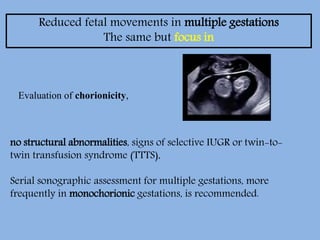
Reduced fetal movements in multiple gestations
The same but focus in
Evaluation of chorionicity,
no structural abnormalities, signs of selective IUGR or twin-to-
twin transfusion syndrome (TTTS),
Serial sonographic assessment for multiple gestations, more
frequently in monochorionic gestations, is recommended.
Postdates
UA Doppler would not be expected to be helpful since elevated fetal
risk in postdates pregnancy is related to impaired placental gas
exchange rather than impaired blood flow
Amniotic fluid assessment should be added in postdates
pregnancies.
•Every mother who presents with the concern of reduced or altered
fetal movements should. be taken seriously .
•The initial assessment should include a detailed history +DVP + AC to
rule out IUGR + CTG. ( if all normal discharge !!!!)
Summary and recommendation
Kickcharts are of no value and should therefore not be
given out to pregnant women.
UA Doppler velocimetry and vibroacoustic stimulation are
of limited use in the assessment of reduced FM.
BPP scoring has not been shown to be of benefit.
NST alone for predicting stillbirth within 1 week of a
normal test is 99.8%; for BPP, modified BPP, and CST, it is
greater than 99.9%.
Thank
you
Women with high risk factors for stillbirth should undergo
antepartum fetal surveillance using NST, modified BPP.
ACOG 2014 level B
Decreased fetal movements 2017

Decreased fetal movements 2017

  • 1.
    Decreased fetal movements(DFM) Alarm before fetal death Ahmad S Soliman Lecturer of Obstetrics and gynecology Department Benha University Hospital
  • 2.
    Objectives • Normal FETALMOVEMENTS • DFMC • Factors affecting FM • Optimal management
  • 3.
    “ I AMA FETUS IN THE WOMB I FEAR IT MAY BECOME MY TOMB IF ONLY I COULD GIVE A SHOUT TO MAKE MY DOCTOR GET ME OUT. I have no energy to move; I am struggling to keep my mom smiling I am moving ; I am alive
  • 4.
    Why we tryto put a title decreased perception of fetal movement ???
  • 5.
    In their 8thannual report (London 2001) The Confidential Enquiry into Stillbirths and Deaths in Infancy (CESDI) under the umbrella of NICE reviewed 422 stillbirths and found that 69 cases (16.4%) were related to altered or reducedfetalmovements. Over 55% of women experiencing a stillbirth perceive a reduction in fetal movements prior to diagnosis (Efkarpidis et al., 2004). Early recognition of (DFM) makes it possible for the clinician to intervene at a stage when the fetus is still compensated, and thus prevent progression to fetal or neonatal injury or death.(Heazell et al; 2008).
  • 6.
    PREVALENCE 40 % ofpregnant women experience DFM one or more times during pregnancy most of them are transient.(Saastad et al; 2012).
  • 7.
    Types of Fetalmovements • Limb movement. (short duration-variable amplitude) • Rolling movement : Due to changing position. (long duration-high amplitude). • Respiratory movement • Hiccough like movement. • OTHER activities like suckling the thumb or blinking.
  • 8.
    Start around 20weeks gestation peak at 28- 34 weeks gestation (Mangesi & Hofmeyr, 2007). N.B: Multiparous may notice movements earlier (16-20 wks) than primi (20-22 wks gestation) (Grant et al., 1989).  Fetal movements tend to plateau at 32 weeks of gestation  No reduction in the frequency of fetal movements in the late third trimester. Maternal perception of fetal movement
  • 9.
    Fetal movements followa circadian pattern and absent during fetal sleep, periods which usually last 20-40 minutes and rarely exceed 90 minutes (Harrington et al; 1998) , (Velazquez et al; 2002). Fetal movements show diurnal changes. The afternoon and evening periods are periods of peak activity. (Minors et al; 1979).
  • 10.
    • Fetal position. Fisher ML 1999. • Anterior placenta. (Only Prior to 28+0 weeks of gestation …. Neldam et al; 1980) • Administration of corticosteroids for fetal lung maturity (Hijazi et al; 2009) Decreasedmaternalsensitivitytofetalmovement
  • 11.
    Unlike betamethasone, dexamethasonedoes not induce a decrease in fetal movements. Dexamethasone might, therefore, be preferred for enhancement of lung maturation in imminent preterm labor. Mushkat et al; 2001 Both betamethasone and dexamethasone induce a profound, transient, suppression of fetal heart rate characteristics and biophysical activities in the preterm fetus. However, the effect of betamethasone is more pronounced. Awareness of these phenomena might prevent unwarranted iatrogenic delivery of preterm fetuses. Rotmensch et al; 1999
  • 12.
    In women withPersistent DFM, maternal glucose administration has no effect on perceived fetal movement Michaan et al; 2016 Increased with elevation of glucose concentration in maternal blood . (Zisser et al; 2006) Increased fetal movements
  • 13.
    The most commonsingle cause of stillbirth is IUGR. 11-29% of women presenting with reduced FM carry a small for gestational age (SGA) fetus under the 10th centile (Heazell et al., 2005; Sinha et al., 2007). Conditions associated with decreased fetal movements Maternal causes : Maternal anemia & other medical disorders . Fetal causes: IUD, FGR and oligohydramnios, hydrops fetalis and polyhydramnios CFMF (i.e. neurological, musculo-skeletal) Fetal anaemia or hydrops (Unterscheider et al., 2009)
  • 14.
    If placental insufficiencyis a cause of DFM Did you have time to save your baby ??!!
  • 15.
  • 16.
    Pearl: 55% of casesof still birth are associated with DFM and 30% of IUGRs are associated with DFM
  • 17.
    Fetal movements andCFMF Fetuses with major malformations are generally more likely to demonstrate reduced fetal activity. (Christensen et al; 1999) A lack of vigorous motion may relate to abnormalities of the central nervous system, muscular dysfunction or skeletal abnormalities. (Tveit et al; 2009)
  • 18.
    Assessment of fetalmovements Subjective maternal perception VS Objective assessment by US. Can we depend only on the US detected movements ????? Duration of recording is restricted to 20–30 minutes with the mother in a semi-recumbent position but results not correlate strongly to perinatal outcome. (Lowery et al; 1997) No studies evaluated the use of longer periods of fetal movement counting by ultrasound .
  • 19.
    When correlated sonographically, •50% with isolated limb movements • 80% of movements involving both the trunk and limb (de Vries et al; 2006). Mothers perceived 33 to 88 percent of visualized fetal movements by US (Hijazi et al; 2009). Fetal Movements in a healthy fetus vary from 4 to 100 per hour (Mangesi & Hofmeyr, 2007).
  • 20.
  • 21.
    No universally agreeddefinition of RFM. RCOG 2014 Also, level of fetal movement that distinguishes a healthy fetus from a fetus at risk has not been determined (Flenady et al; 2009). NICE and ACOG guidelines do not provide a definition of reduced fetal movements, which reflects the dilemma and controversy of the definition and management of reduced FM.
  • 22.
    Till now thealarm limit of perceived fetal movements is not determined Least number of maternally perceived fetal movements that reflect fetal well-being. While, sudden decrease in fetal movement should be evaluated as a potential marker of risk (Winje et al; 2012).
  • 23.
    Perception of atleast • 10 FMs during 12 hours of normal maternal activity. •10 FMs over two hours when the mother is at rest and focused on counting. •4 FMs in one hour when the mother is at rest and focused on counting. •10FMs within 25 minutes in pregnancies 22 to 36 weeks and 35 minutes in pregnancies 37 or more weeks of gestation. Adapted from Australian guidelines, four examples of criteria for reassurance of fetal well-being (Kuwata et al; 2008)
  • 25.
    A recent prospectivecohort study showed that the mean time to perceive 10 movements is approximately 10 minutes in normal 3rd trimester pregnancies (Winje et al., 2011). If women are unsure of RFM after 28+0 wks, RCOG 2011 Patient on left side and focus on fetal movements for 2 hours. If they do not feel 10 or more discrete movements in 2 hours, they should contact their doctor immediately. level C ACOG 2014 perception of 10 distinct movements in a period of up to 2 continuous or interrupted hours is considered reassuring. The only numerical limit that has been derived from a total population, and subsequently evaluated as a screening test in the same population, is the perception of 10 distinct movements during focused counting over a period of two hours, which is reassuring ("count to 10" method) ( Moore et al; 1989).
  • 26.
    qualitative vs quantitative!! There is no evidence that any quantitative limit is more effective than qualitative maternal perception of DFM for identifying pregnancies at risk of adverse outcome.
  • 27.
    EVALUATION of acase of DFM • Rationale • Goal • Methods
  • 28.
    Rationale :  Fetalheart rate, fetal movements are impacted by uteroplacental blood flow alterations and are thereby sensitive to fetal hypoxemia and acidemia. ACOG 2014  Any diminution in fetal activity requires fetal reevaluation , regardless of the amount of time that has elapsed since the last test. level B ACOG 2014  Fetal movements decrease as the fetus attempts to conserve energy . The loss of fetal movement can be a sign of ongoing central nervous system hypoxia and injury. (Olesen and Svare JA. 2004)
  • 29.
    Goals: 1. rule outimminent fetal demise. 2. Assessment for common risk factors, such as fetal growth restriction and decreasing placental function.
  • 30.
    1st History taking (FGR, placentalinsufficiency and congenital malformations). • Confirm RFM if not present reassure and discharge. If confirmed : comprehensive stillbirth risk evaluation • multiple consultations for RFM, known FGR, • HTN, DM, • extremes of maternal age, • smoking, • placental insufficiency, • CFM, • obesity, • poor past obstetric history (e.g.FGR and stillbirth) • genetic factors.
  • 31.
    Clinical approaches describedin observational studies include: 1. physical examination including SFH 2. non-stress and contraction stress tests. 3. ultrasound examination (biophysical profile [BPP]) 4. umbilical artery Doppler. 5. testing for fetomaternal hemorrhage (eg, Kleihauer-Betke test). 6. Amnioscopy.
  • 32.
    In one study CTGwas the most favored method of assessing fetal wellbeing (93%) followed by the use of • kickcharts (64%). • biophysical score (54%). • liquor volume (52%). • SFH (34%). • umbilical artery Doppler velocimetry (23%) . (Unterscheider et al., 2010)
  • 33.
    Fetal movement counting(count-to-ten kickcharts) The use of kickcharts is easy, simple and can be done at home.
  • 34.
    Using kickcharts wereassociated with higher intervention rates 32% and caesarean section rates 24% (Sinha et al., 2007). Routine formal FM counting should not be offered as a fetal well being testing. NICE 2003 renewed in their 2008 guideline. In contrast, ACOG supports formal movement counting. In their bulletin on antepartum fetal surveillance they instruct the woman to count 10 movements, preferably after a meal, and to write down the hours this takes (ACOG, 2000).
  • 35.
    systematic review of5 trials involving 71,458 women Not enough evidence on counting the baby's movements in the womb to check for wellbeing. (Mangesi et al; 2015) . Fetal movement counting for assessment of fetal wellbeing
  • 37.
    Role of CTG Forhow long CTG should be done? Even without movements if the term fetus does not experience a fetal heart rate acceleration for more than 80 minutes, fetal compromise is likely to be present (Leveno et al; 1983). The negative predictive value of NST alone for predicting stillbirth within 1 week of a normal test is 99.8%; for BPP, modified BPP, and CST, it is greater than 99.9%. ACOG 2014
  • 38.
    There are norandomised controlled trials of ultrasound scan versus no ultrasound scan in women with RFM US examination in cases complicated by persistent DFM despite a reactive NST is a valuable assessment tool. • Fetal activity • Fetal growth velocity • Amniotic fluid volume • Fetal anatomic survey (CFMF) • EFW if there is a size-dates discrepancy (Heazell et al; 2005). Growth restriction has been associated with a decrease in the number, quality, strength, and duration of fetal movements (Bekedam et al;1985 ). Exclude fetal Growth restriction Ultrasound examination
  • 39.
    Remember The most 2important US markers are : Perfusion Growth velocity
  • 40.
    Biophysical profile (BPP) Anormal BPP score along with a reactive NST is an indication of fetal well-being. ACOG 2014 A total biophysical score of <4 is abnormal and suggestive of fetal compromise and increased risk of adverse outcome. ACOG 2014
  • 41.
    RCTs does notsupport the use of BPP as a test of fetal wellbeing . There was no significant difference between the groups in perinatal deaths. (Cochrane review Lalor et al.,2008)
  • 42.
    Useful only ifIUGR is diagnosed. A study of 599 cases of DFM evaluated by nonstress testing found no additional benefit of Doppler assessment ( Dubiel et al;1997). Doppler demonstrated a pathological pattern in 1 % of the 1151 cases. Most of these abnormalities were associated with growth restricted fetuses. In 940 cases ; after exclusion of cases of non reactive CTG and IUGR Doppler velocimetry was abnormal Only in 1 Case. Norwegian Perinatal Society Conference, November 2006 Doppler velocimetry
  • 43.
  • 45.
    ACOG support theuse of UA Doppler assessments only in the management of suspected IUGR, instructing that decisions regarding the timing of delivery should be based on UA Doppler results in combination with other tests of fetal well-being . No evidence that inclusion of umbilical artery Doppler in antenatal surveillance provides additional benefit in the assessment of a normally growing fetus. ACOG 2014
  • 46.
    Abnormal elevation ofDoppler indices precedes loss of fetal heart rate variability and reactivity, eventually leading to decline and loss of fetal breathing and body movements (Williams et al; 2003).
  • 47.
    Testing for feto-maternaltransfusion Kleihauer-Betke stain or flow cytometry pregnant patient who presents with DFM + • sinusoidal fetal heart rate pattern or • unexplained fetal tachycardia or • Fetal hydrops on ultrasound associated with elevated middle cerebral artery Doppler velocity.
  • 48.
    A large fetomaternaltransfusion (FMT) is estimated to occur in 0.3 % of pregnancies, and is a significant contributor to stillbirth. (Sebring et al;1990)
  • 49.
    FOLLOW-UP AND DELIVERY Thereare no studies to determine whether intervention (e.g. delivery or further investigation) alters perinatal morbidity or mortality in women presenting with recurrent or persistent RFM remote from term . No randomized trials have evaluated any aspect of the management of DFM. (Frøen et al; 2005)
  • 50.
    Abnormal findings : •Non-reactive non-stress test • low biophysical profile score • fetal growth restriction managed according to usual clinical standards
  • 51.
    Persistent DFM andnormal evaluation There are no studies evaluating the optimal frequency and method of follow-up of pregnancies complicated by persistent DFM in which the antepartum evaluations are all normal. no data from randomized trials to guide practice recommendations for management of DFM (Cochrane Database Syst Rev 2012 ).
  • 52.
    Adapted recommendations ofmanaging a woman reported decreased perception of fetal movements from Stillbirth Foundation , The Perinatal Society Of Australia and New Zealand and the international stillbirth Alliance
  • 53.
    Management of patientswith persistently decreased fetal movement depends on: 1. gestational age 2. presence of other identifiable risk factors for stillbirth. If no cause for decreased fetal movement is determined, we suggest pregnancies under 37 weeks of gestation be monitored with nonstress testing and ultrasound examination twice weekly. After 37 wks >> labor induction of these pregnancies when the cervix is favorable ( Grade 2C ).
  • 54.
    Reduced fetal movementsin multiple gestations The same but focus in Evaluation of chorionicity, no structural abnormalities, signs of selective IUGR or twin-to- twin transfusion syndrome (TTTS), Serial sonographic assessment for multiple gestations, more frequently in monochorionic gestations, is recommended.
  • 55.
    Postdates UA Doppler wouldnot be expected to be helpful since elevated fetal risk in postdates pregnancy is related to impaired placental gas exchange rather than impaired blood flow Amniotic fluid assessment should be added in postdates pregnancies.
  • 56.
    •Every mother whopresents with the concern of reduced or altered fetal movements should. be taken seriously . •The initial assessment should include a detailed history +DVP + AC to rule out IUGR + CTG. ( if all normal discharge !!!!) Summary and recommendation Kickcharts are of no value and should therefore not be given out to pregnant women. UA Doppler velocimetry and vibroacoustic stimulation are of limited use in the assessment of reduced FM. BPP scoring has not been shown to be of benefit.
  • 58.
    NST alone forpredicting stillbirth within 1 week of a normal test is 99.8%; for BPP, modified BPP, and CST, it is greater than 99.9%.
  • 60.
  • 61.
    Women with highrisk factors for stillbirth should undergo antepartum fetal surveillance using NST, modified BPP. ACOG 2014 level B