Alisha Blair, Nurse Consultant Heartland National TB Center December 10 th , 2009 Directly Observed Therapy and Maximizing Adherence
Objectives Define DOT and Explain Why We Use This Method DOT Do’s and Don’t Advantages and Disadvantages of DOT Discuss the Role of the DOT Provider  Responsibilities Expanded Role  Identify Barriers that make Adherence to DOT Difficult Cultural and Social Patient  Adherence Discuss Court Ordered Treatment  Indications Review Cases
Objectives Discuss the Goals of DOT incentives and Enablers Importance of Treatment Adherence Importance and Implications for TB Treatment Adherence Drug Resistance Treatment Failure/Relapse Reduced Public Health Threat Economic Burden Impact of Co-Morbid Conditions
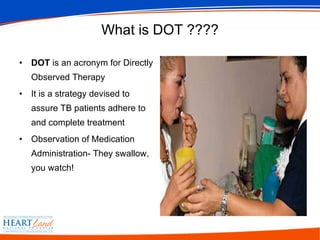
What is DOT ???? DOT  is an acronym for Directly Observed Therapy It is a strategy devised to assure TB patients adhere to and complete treatment Observation of Medication Administration- They swallow, you watch!
Why DOT??? It’s the most Effective Strategy for ensuring TB Treatment completion Reduces risk of developing drug resistance, relapse or reactivation   Patient becomes non-infectious sooner Associated with Better Treatment completion Rates and Outcomes It helps solve problems that might interrupt treatment Allows the health care worker monitor the patient regularly for side effects and response to therapy 2003 CDC/ATS/ISDA Guidelines Standard of Care  
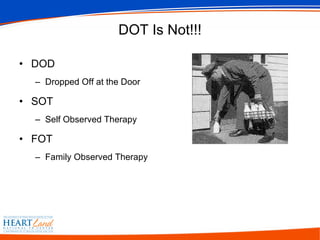
DOT Is Not!!! DOD Dropped Off at the Door SOT Self Observed Therapy FOT Family Observed Therapy
DOT Don’ts leaving TB medications with the patient to self-administer except as prescribed by the physician for weekends or holidays … leaving TB medications at the patient’s home when the patient is not present … dispensing TB medications and “verifying” ingestion/adherence by performing pill counts … permitting medical professionals to self-administer their TB medications
Advantages and Disadvantages of DOT Advantages It ensures that the patient completes an adequate regimen  It lets the health care worker monitor the patient regularly for side effects and response to therapy  It helps the health care worker solve problems that might interrupt treatment  By ensuring the patient takes every dose of medicine, it helps the patient become noninfectious sooner  Disadvantages It is time consuming  It is labor intensive  It can be insulting to some patients  It can imply that the patient is incapable or irresponsible  It can be perceived as demeaning or punitive
Who May Provide Dot Trained TB Clinic or Health Department staff Nurses, outreach workers, other health care providers Trained staff of other health care facilities Just because they are medical professional does not mean they are familiar with the principles and requirements for DOT Other Trained School Nurses, Occupational Health Nurses
DOT Worker Responsibilities Verify prescribed TB Medication Against TB 400 A/B Original Orders Deliver Medication Assess for Drug Toxicity Question, Listen, Observe Observe Patient Swallowing Medications Document Visit Report Possible Drug Toxicity or Other Concerns
The Expanded Role of The DOT Worker Foreign Language Skills Many DOT Workers Serve as Interpreters Patient Advocate Link Between Patient and Other Case Management Team Members
Promoting DOT Adherence  Treatment of Tuberculosis, American Thoracic Society, CDC and Infectious Disease Society of America, 2003 “…  any public health program or private provider ( or both) undertaking to treat a patient with tuberculosis is assuming a public health function that includes not only prescribing an appropriate regimen but also ensuring adherence to the regimen until treatment is completed”
Social Barriers that Affect DOT   Adherence Drug Addictions Competing priority of obtaining drugs vs. being available to receive DOT Employment Patient may work in another city and can’t make it to the clinic for DOT Mental Illness Patient can’t comprehend the disease and the need for medications Denial
Knocking Down Social Barriers Be Familiar with Alcohol and drug treatment Centers in your area Call other HD to ask for assistance with DOT if your patient is in their area Assess for mental health issues early and give appropriate referrals
Cultural Barriers that Affect DOT Adherence Limited or No English Trained interpreters should be available   Ensures patient is receiving the correct information Allows patient to communicate accurately with provider  Immigration Status Non-Residents  Migrant Farm Workers Reluctant to undertake activities that might draw attention to themselves
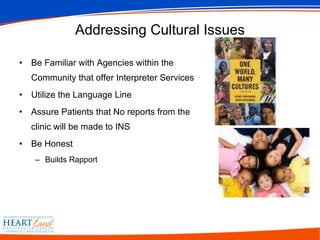
Addressing Cultural Issues Be Familiar with Agencies within the Community that offer Interpreter Services Utilize the Language Line Assure Patients that No reports from the clinic will be made to INS Be Honest  Builds Rapport
Predicting Adherence A Patient’s Adherence with an  anti-TB drug Treatment Regimen is Impossible to Predict Adherence is NOT Associated with Age Sex Race Education Occupation Socioeconomic status
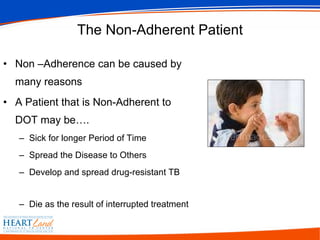
The Non-Adherent Patient Non –Adherence can be caused by many reasons A Patient that is Non-Adherent to DOT may be…. Sick for longer Period of Time Spread the Disease to Others Develop and spread drug-resistant TB  Die as the result of interrupted treatment
Common Causes For Non-Adherence Social and Cultural Beliefs Competing Priorities Education Employment Patient No Longer Feels Sick Mental Capacity Lack of Motivation Poor Relationships with Healthcare Workers Control Issues
Tried Everything Centers for Disease Control and Prevention “ individuals have the right to ignore a doctor's advice or refuse treatment if they wish. However, persons with infectious TB may lose that right if health officials believe these persons risk infecting  others by not taking their prescribed medicine. Patients who are unwilling or unable to adhere to treatment may be  required to do so by law  or may be quarantined or isolated until noninfectious.”  Health care workers should notify the appropriate supervisory clinical and management staff when patients are non-adherent Determine why the patient is non-adherent and begin strategies that will help the patient finish treatment before legal measures are taken
Quarantine When All Else Fails TB control programs should not begin procedures for confining patients to a treatment facility until after the patient has shown that he or she is unable or unwilling to follow a treatment  Involuntary confinement or isolation for inpatient treatment should be viewed as the last resort. Criteria for Determining the Need for Involuntary Confinement  Laboratory results (acid-fast bacilli smears and cultures)  Clinical signs and symptoms of infectious TB  An abnormal chest radiograph, especially if cavities are present  A history of non-adherence (not caused by factors outside patient's control)  The opportunity to infect others
Case Study 1 You are assigned to deliver DOT to Mrs. Wilson, a 76-year-old woman who lives alone in the house she and her husband bought many years ago. Mrs. Wilson was recently released from the hospital. Upon discharge from the hospital, she received education about TB and about the need to take medications until she completes treatment. She was told that she would be started on DOT and a health care worker would visit her at her home to help her take her medication. Mrs. Wilson is elated to have some company. She happily offers you cookies and wants to "talk awhile" before she takes her medication.  What are the tasks you complete when you deliver DOT to Mrs. Wilson?
Observation Check for side effects.   Before the Medications are Given Ask Mrs. Wilson if she is having any problems with the medications.  Educate About Symptoms that may Indicated an Adverse Reaction If Adverse Reaction Symptoms are Present, do not give medications Contact the Supervisor Arrange and Appointment for the Patient Verify the medication . Each time DOT is delivered, Verify that the Correct Drugs and Dosages are delivered to Mrs. Wilson If this cannot be confirmed, the drugs should not be given.  Contac the supervisor
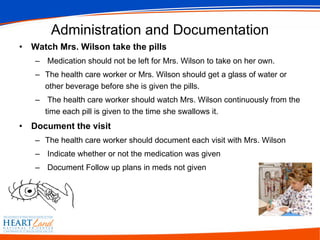
Administration and Documentation Watch Mrs. Wilson take the pills Medication should not be left for Mrs. Wilson to take on her own.  The health care worker or Mrs. Wilson should get a glass of water or other beverage before she is given the pills. The health care worker should watch Mrs. Wilson continuously from the time each pill is given to the time she swallows it.  Document the visit  The health care worker should document each visit with Mrs. Wilson Indicate whether or not the medication was given Document Follow up plans in meds not given
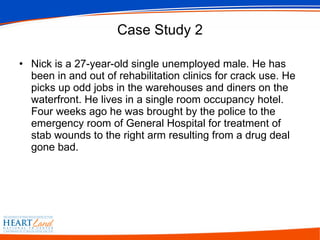
Case Study 2 Nick is a 27-year-old single unemployed male. He has been in and out of rehabilitation clinics for crack use. He picks up odd jobs in the warehouses and diners on the waterfront. He lives in a single room occupancy hotel. Four weeks ago he was brought by the police to the emergency room of General Hospital for treatment of stab wounds to the right arm resulting from a drug deal gone bad.
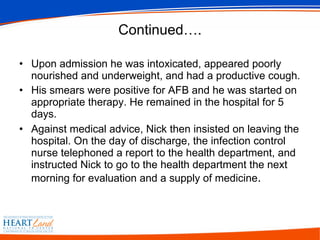
Continued…. Upon admission he was intoxicated, appeared poorly nourished and underweight, and had a productive cough.  His smears were positive for AFB and he was started on appropriate therapy. He remained in the hospital for 5 days.  Against medical advice, Nick then insisted on leaving the hospital. On the day of discharge, the infection control nurse telephoned a report to the health department, and instructed Nick to go to the health department the next morning for evaluation and a supply of medicine .
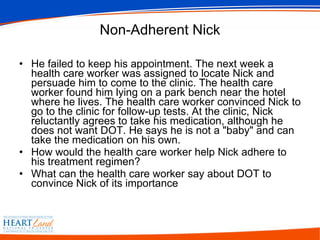
Non-Adherent Nick He failed to keep his appointment. The next week a health care worker was assigned to locate Nick and persuade him to come to the clinic. The health care worker found him lying on a park bench near the hotel where he lives. The health care worker convinced Nick to go to the clinic for follow-up tests. At the clinic, Nick reluctantly agrees to take his medication, although he does not want DOT. He says he is not a "baby" and can take the medication on his own.  How would the health care worker help Nick adhere to his treatment regimen?  What can the health care worker say about DOT to convince Nick of its importance
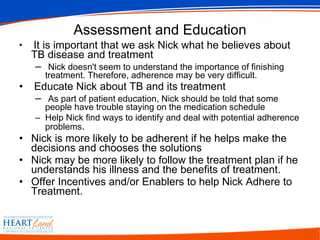
Assessment and Education It is important that we ask Nick what he believes about TB disease and treatment Nick doesn't seem to understand the importance of finishing treatment. Therefore, adherence may be very difficult.  Educate Nick about TB and its treatment As part of patient education, Nick should be told that some people have trouble staying on the medication schedule Help Nick find ways to identify and deal with potential adherence problems .  Nick is more likely to be adherent if he helps make the decisions and chooses the solutions  Nick may be more likely to follow the treatment plan if he understands his illness and the benefits of treatment.  Offer Incentives and/or Enablers to help Nick Adhere to Treatment.
Patient Education and Rapport Building Explain the benefits of DOT to Nick and to stress the fact that DOT is not punitive.  Explain that DOT is more than watching Nick swallow each pill. DOT Will Help him keep appointments  Provide education when needed  Point out that DOT will help the health care worker monitor Nick for any side effects and help him complete an adequate regimen
The Goal of DOT To Ensure that Clients with Active Tuberculosis receive and Adequately Complete their Treatment Minimize the Risk of Spreading the Disease to Others Reduce the Risk of Developing Drug-resistant TB
Ensure Clients Receive and Complete Adequate Treatment Ensure Clients are Receiving the Correct Doses of Medication Monitor weight as doses are calculated according to body weight Incorrect Doses May not be Effective Ensure the Client Swallows the Medication  Follow up on Missed DOT Appointments Early detection of adherence problems  Monitor Adverse Reactions Perform Dose Counts Monthly  Helps Determine Therapy Completion date and gives information about adherence
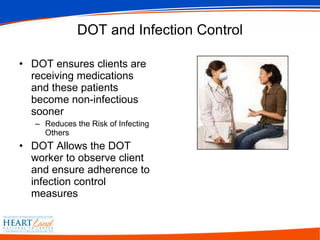
DOT and Infection Control DOT ensures clients are receiving medications and these patients become non-infectious sooner Reduces the Risk of Infecting Others DOT Allows the DOT worker to observe client and ensure adherence to infection control measures
Reduce the Risk for  Acquiring Drug Resistance Provide medications as ordered Do not allow family members to provide medications Encourage Clients to Report Side Effects or Adverse Reactions Immediately Side effects can discourage a client from being compliant with treatment Always Observe the Client Swallowing the Medication Do not leave medication at the client’s door step DOT is not a drop off service
Accomplishing the Goal  with Non-Adherent Patients Incentives Rewards for desired behavior Enablers Remove barriers from willing but unable patients Both  must  be tailored to the individual! BRIBARY DOES WORK!!
Offer Incentives Interventions to motivate the patient, tailored to the patient wishes and needs Incentives work for both young and old Food, Snacks, Gift Cards, Bus Passes, Clothing
Identify Enablers Interventions that Assist the patient complete Therapy Child Care Adjustment of Clinic Hours Appointment Reminders Appropriate Referrals Clinic Personnel who speak the languages of the populations served Remember Both Incentives and Enablers must be Tailored to the Patient in Order to be Effective
Importance and Implications  of Treatment Adherence Reduces the Risk of Developing Drug Resistance Sporadic Treatment coupled with non-compliance fosters Drug Resistant TB Reduces the risk of Treatment Failure and Relapse DOT and proper treatment adherence is associated with fewer rates of relapse and/or reactivation DOT allows the identification of problems early Reduces the threat to Public Health Person adherent to DOT are usually infectious for shorter periods of time
Improved Health and Outcomes and Reduced Economic Impact No Quarantine Adherence daunts the need for Court-Ordered Treatment Management Improves Individual Health Outcomes Patient Health Improves and the patient Feels better earlier Reduces the Economic Impact DOT and the adherence to DOT reduces the cost of treating TB  Drug Sensitive TB can be treated intermittently by DOT which is cost effective
Impact of Co-Morbidities Reduces the impact of co-morbidities i.e. surgical Interventions and Hospitalization DOT benefits the patient not only from a TB  Treatment Standpoint but it also allows the Case Management team to ensure co-morbid conditions are not exacerbated by Tuberculosis DOT ensures patients are receiving medications and these patients tend to feel better sooner, negating the need for ED visits for exacerbation of the disease and possible surgical intervention
Pulling It All Together DOT strategy devised to assure TB patients adhere to and complete treatment Observation of Medication Administration- They swallow, you watch! DOT is not a Milk Man service so medication should not be dropped of at the door step Why DOT  It’s the most Effective Strategy for ensuring TB Treatment completion Reduces risk of developing drug resistance, relapse or reactivation
Pulling It All Together The Role of the DOT Provider The DOT provider should assess the patient, administer and supervise medication swallowing and document  Deliver medications as scheduled and report adverse reactions immediately Dot Providers Trained TB Clinic or Health Department staff Promoting Adherence There are many barriers that patients face that foster Non-adherence to DOT and anti-TB treatment Social  Cultural  Identify these factors and offer incentives and/or enablers to maximize treatment adherence
Pulling It All Together No way to predict adherence However assess patient’s current situation to determine possible problems that may hinder adherence Assessment should be ongoing throughout treatment Court Ordered Treatment After all else fails consideration for court ordered management should be the last resort Criteria for Determining the Need for Court Ordered Confinement Laboratory results (acid-fast bacilli smears and cultures)  Clinical signs and symptoms of infectious TB  An abnormal chest radiograph, especially if cavities are present  A history of non-adherence (not caused by factors outside patient's control)  The opportunity to infect others
Pulling It Together Incentives and Enablers Movie Tickets, Food Coupons, Gift cards, Bus Passes Motivation to complete treatment Tailor to Patient’s Needs Importance of DOT and Adherence to Treatment Reduces the Risk of Treatment Failure Reduces the rate of Relapse/Reactivation Lowers Economic Burden Reduces Complications from Co-Morbid Conditions
“ DOT succeeds for one reason … DOT makes the health care system, not the patient, responsible for achieving a cure ”
Special Thanks Dawn Farrell, RN, San Antonio Jane Moore, RN, Wisconsin

Directly Observed Therapy And Maximizing Adherence

  • 1.
    Alisha Blair, NurseConsultant Heartland National TB Center December 10 th , 2009 Directly Observed Therapy and Maximizing Adherence
  • 2.
    Objectives Define DOTand Explain Why We Use This Method DOT Do’s and Don’t Advantages and Disadvantages of DOT Discuss the Role of the DOT Provider Responsibilities Expanded Role Identify Barriers that make Adherence to DOT Difficult Cultural and Social Patient Adherence Discuss Court Ordered Treatment Indications Review Cases
  • 3.
    Objectives Discuss theGoals of DOT incentives and Enablers Importance of Treatment Adherence Importance and Implications for TB Treatment Adherence Drug Resistance Treatment Failure/Relapse Reduced Public Health Threat Economic Burden Impact of Co-Morbid Conditions
  • 4.
    What is DOT???? DOT is an acronym for Directly Observed Therapy It is a strategy devised to assure TB patients adhere to and complete treatment Observation of Medication Administration- They swallow, you watch!
  • 5.
    Why DOT??? It’sthe most Effective Strategy for ensuring TB Treatment completion Reduces risk of developing drug resistance, relapse or reactivation Patient becomes non-infectious sooner Associated with Better Treatment completion Rates and Outcomes It helps solve problems that might interrupt treatment Allows the health care worker monitor the patient regularly for side effects and response to therapy 2003 CDC/ATS/ISDA Guidelines Standard of Care  
  • 6.
    DOT Is Not!!!DOD Dropped Off at the Door SOT Self Observed Therapy FOT Family Observed Therapy
  • 7.
    DOT Don’ts leavingTB medications with the patient to self-administer except as prescribed by the physician for weekends or holidays … leaving TB medications at the patient’s home when the patient is not present … dispensing TB medications and “verifying” ingestion/adherence by performing pill counts … permitting medical professionals to self-administer their TB medications
  • 8.
    Advantages and Disadvantagesof DOT Advantages It ensures that the patient completes an adequate regimen It lets the health care worker monitor the patient regularly for side effects and response to therapy It helps the health care worker solve problems that might interrupt treatment By ensuring the patient takes every dose of medicine, it helps the patient become noninfectious sooner Disadvantages It is time consuming It is labor intensive It can be insulting to some patients It can imply that the patient is incapable or irresponsible It can be perceived as demeaning or punitive
  • 9.
    Who May ProvideDot Trained TB Clinic or Health Department staff Nurses, outreach workers, other health care providers Trained staff of other health care facilities Just because they are medical professional does not mean they are familiar with the principles and requirements for DOT Other Trained School Nurses, Occupational Health Nurses
  • 10.
    DOT Worker ResponsibilitiesVerify prescribed TB Medication Against TB 400 A/B Original Orders Deliver Medication Assess for Drug Toxicity Question, Listen, Observe Observe Patient Swallowing Medications Document Visit Report Possible Drug Toxicity or Other Concerns
  • 11.
    The Expanded Roleof The DOT Worker Foreign Language Skills Many DOT Workers Serve as Interpreters Patient Advocate Link Between Patient and Other Case Management Team Members
  • 12.
    Promoting DOT Adherence Treatment of Tuberculosis, American Thoracic Society, CDC and Infectious Disease Society of America, 2003 “… any public health program or private provider ( or both) undertaking to treat a patient with tuberculosis is assuming a public health function that includes not only prescribing an appropriate regimen but also ensuring adherence to the regimen until treatment is completed”
  • 13.
    Social Barriers thatAffect DOT Adherence Drug Addictions Competing priority of obtaining drugs vs. being available to receive DOT Employment Patient may work in another city and can’t make it to the clinic for DOT Mental Illness Patient can’t comprehend the disease and the need for medications Denial
  • 14.
    Knocking Down SocialBarriers Be Familiar with Alcohol and drug treatment Centers in your area Call other HD to ask for assistance with DOT if your patient is in their area Assess for mental health issues early and give appropriate referrals
  • 15.
    Cultural Barriers thatAffect DOT Adherence Limited or No English Trained interpreters should be available Ensures patient is receiving the correct information Allows patient to communicate accurately with provider Immigration Status Non-Residents Migrant Farm Workers Reluctant to undertake activities that might draw attention to themselves
  • 16.
    Addressing Cultural IssuesBe Familiar with Agencies within the Community that offer Interpreter Services Utilize the Language Line Assure Patients that No reports from the clinic will be made to INS Be Honest Builds Rapport
  • 17.
    Predicting Adherence APatient’s Adherence with an anti-TB drug Treatment Regimen is Impossible to Predict Adherence is NOT Associated with Age Sex Race Education Occupation Socioeconomic status
  • 18.
    The Non-Adherent PatientNon –Adherence can be caused by many reasons A Patient that is Non-Adherent to DOT may be…. Sick for longer Period of Time Spread the Disease to Others Develop and spread drug-resistant TB Die as the result of interrupted treatment
  • 19.
    Common Causes ForNon-Adherence Social and Cultural Beliefs Competing Priorities Education Employment Patient No Longer Feels Sick Mental Capacity Lack of Motivation Poor Relationships with Healthcare Workers Control Issues
  • 20.
    Tried Everything Centersfor Disease Control and Prevention “ individuals have the right to ignore a doctor's advice or refuse treatment if they wish. However, persons with infectious TB may lose that right if health officials believe these persons risk infecting others by not taking their prescribed medicine. Patients who are unwilling or unable to adhere to treatment may be required to do so by law or may be quarantined or isolated until noninfectious.” Health care workers should notify the appropriate supervisory clinical and management staff when patients are non-adherent Determine why the patient is non-adherent and begin strategies that will help the patient finish treatment before legal measures are taken
  • 21.
    Quarantine When AllElse Fails TB control programs should not begin procedures for confining patients to a treatment facility until after the patient has shown that he or she is unable or unwilling to follow a treatment Involuntary confinement or isolation for inpatient treatment should be viewed as the last resort. Criteria for Determining the Need for Involuntary Confinement Laboratory results (acid-fast bacilli smears and cultures) Clinical signs and symptoms of infectious TB An abnormal chest radiograph, especially if cavities are present A history of non-adherence (not caused by factors outside patient's control) The opportunity to infect others
  • 22.
    Case Study 1You are assigned to deliver DOT to Mrs. Wilson, a 76-year-old woman who lives alone in the house she and her husband bought many years ago. Mrs. Wilson was recently released from the hospital. Upon discharge from the hospital, she received education about TB and about the need to take medications until she completes treatment. She was told that she would be started on DOT and a health care worker would visit her at her home to help her take her medication. Mrs. Wilson is elated to have some company. She happily offers you cookies and wants to "talk awhile" before she takes her medication. What are the tasks you complete when you deliver DOT to Mrs. Wilson?
  • 23.
    Observation Check forside effects. Before the Medications are Given Ask Mrs. Wilson if she is having any problems with the medications. Educate About Symptoms that may Indicated an Adverse Reaction If Adverse Reaction Symptoms are Present, do not give medications Contact the Supervisor Arrange and Appointment for the Patient Verify the medication . Each time DOT is delivered, Verify that the Correct Drugs and Dosages are delivered to Mrs. Wilson If this cannot be confirmed, the drugs should not be given. Contac the supervisor
  • 24.
    Administration and DocumentationWatch Mrs. Wilson take the pills Medication should not be left for Mrs. Wilson to take on her own. The health care worker or Mrs. Wilson should get a glass of water or other beverage before she is given the pills. The health care worker should watch Mrs. Wilson continuously from the time each pill is given to the time she swallows it. Document the visit The health care worker should document each visit with Mrs. Wilson Indicate whether or not the medication was given Document Follow up plans in meds not given
  • 25.
    Case Study 2Nick is a 27-year-old single unemployed male. He has been in and out of rehabilitation clinics for crack use. He picks up odd jobs in the warehouses and diners on the waterfront. He lives in a single room occupancy hotel. Four weeks ago he was brought by the police to the emergency room of General Hospital for treatment of stab wounds to the right arm resulting from a drug deal gone bad.
  • 26.
    Continued…. Upon admissionhe was intoxicated, appeared poorly nourished and underweight, and had a productive cough. His smears were positive for AFB and he was started on appropriate therapy. He remained in the hospital for 5 days. Against medical advice, Nick then insisted on leaving the hospital. On the day of discharge, the infection control nurse telephoned a report to the health department, and instructed Nick to go to the health department the next morning for evaluation and a supply of medicine .
  • 27.
    Non-Adherent Nick Hefailed to keep his appointment. The next week a health care worker was assigned to locate Nick and persuade him to come to the clinic. The health care worker found him lying on a park bench near the hotel where he lives. The health care worker convinced Nick to go to the clinic for follow-up tests. At the clinic, Nick reluctantly agrees to take his medication, although he does not want DOT. He says he is not a "baby" and can take the medication on his own. How would the health care worker help Nick adhere to his treatment regimen? What can the health care worker say about DOT to convince Nick of its importance
  • 28.
    Assessment and EducationIt is important that we ask Nick what he believes about TB disease and treatment Nick doesn't seem to understand the importance of finishing treatment. Therefore, adherence may be very difficult. Educate Nick about TB and its treatment As part of patient education, Nick should be told that some people have trouble staying on the medication schedule Help Nick find ways to identify and deal with potential adherence problems . Nick is more likely to be adherent if he helps make the decisions and chooses the solutions Nick may be more likely to follow the treatment plan if he understands his illness and the benefits of treatment. Offer Incentives and/or Enablers to help Nick Adhere to Treatment.
  • 29.
    Patient Education andRapport Building Explain the benefits of DOT to Nick and to stress the fact that DOT is not punitive. Explain that DOT is more than watching Nick swallow each pill. DOT Will Help him keep appointments Provide education when needed Point out that DOT will help the health care worker monitor Nick for any side effects and help him complete an adequate regimen
  • 30.
    The Goal ofDOT To Ensure that Clients with Active Tuberculosis receive and Adequately Complete their Treatment Minimize the Risk of Spreading the Disease to Others Reduce the Risk of Developing Drug-resistant TB
  • 31.
    Ensure Clients Receiveand Complete Adequate Treatment Ensure Clients are Receiving the Correct Doses of Medication Monitor weight as doses are calculated according to body weight Incorrect Doses May not be Effective Ensure the Client Swallows the Medication Follow up on Missed DOT Appointments Early detection of adherence problems Monitor Adverse Reactions Perform Dose Counts Monthly Helps Determine Therapy Completion date and gives information about adherence
  • 32.
    DOT and InfectionControl DOT ensures clients are receiving medications and these patients become non-infectious sooner Reduces the Risk of Infecting Others DOT Allows the DOT worker to observe client and ensure adherence to infection control measures
  • 33.
    Reduce the Riskfor Acquiring Drug Resistance Provide medications as ordered Do not allow family members to provide medications Encourage Clients to Report Side Effects or Adverse Reactions Immediately Side effects can discourage a client from being compliant with treatment Always Observe the Client Swallowing the Medication Do not leave medication at the client’s door step DOT is not a drop off service
  • 34.
    Accomplishing the Goal with Non-Adherent Patients Incentives Rewards for desired behavior Enablers Remove barriers from willing but unable patients Both must be tailored to the individual! BRIBARY DOES WORK!!
  • 35.
    Offer Incentives Interventionsto motivate the patient, tailored to the patient wishes and needs Incentives work for both young and old Food, Snacks, Gift Cards, Bus Passes, Clothing
  • 36.
    Identify Enablers Interventionsthat Assist the patient complete Therapy Child Care Adjustment of Clinic Hours Appointment Reminders Appropriate Referrals Clinic Personnel who speak the languages of the populations served Remember Both Incentives and Enablers must be Tailored to the Patient in Order to be Effective
  • 37.
    Importance and Implications of Treatment Adherence Reduces the Risk of Developing Drug Resistance Sporadic Treatment coupled with non-compliance fosters Drug Resistant TB Reduces the risk of Treatment Failure and Relapse DOT and proper treatment adherence is associated with fewer rates of relapse and/or reactivation DOT allows the identification of problems early Reduces the threat to Public Health Person adherent to DOT are usually infectious for shorter periods of time
  • 38.
    Improved Health andOutcomes and Reduced Economic Impact No Quarantine Adherence daunts the need for Court-Ordered Treatment Management Improves Individual Health Outcomes Patient Health Improves and the patient Feels better earlier Reduces the Economic Impact DOT and the adherence to DOT reduces the cost of treating TB Drug Sensitive TB can be treated intermittently by DOT which is cost effective
  • 39.
    Impact of Co-MorbiditiesReduces the impact of co-morbidities i.e. surgical Interventions and Hospitalization DOT benefits the patient not only from a TB Treatment Standpoint but it also allows the Case Management team to ensure co-morbid conditions are not exacerbated by Tuberculosis DOT ensures patients are receiving medications and these patients tend to feel better sooner, negating the need for ED visits for exacerbation of the disease and possible surgical intervention
  • 40.
    Pulling It AllTogether DOT strategy devised to assure TB patients adhere to and complete treatment Observation of Medication Administration- They swallow, you watch! DOT is not a Milk Man service so medication should not be dropped of at the door step Why DOT It’s the most Effective Strategy for ensuring TB Treatment completion Reduces risk of developing drug resistance, relapse or reactivation
  • 41.
    Pulling It AllTogether The Role of the DOT Provider The DOT provider should assess the patient, administer and supervise medication swallowing and document Deliver medications as scheduled and report adverse reactions immediately Dot Providers Trained TB Clinic or Health Department staff Promoting Adherence There are many barriers that patients face that foster Non-adherence to DOT and anti-TB treatment Social Cultural Identify these factors and offer incentives and/or enablers to maximize treatment adherence
  • 42.
    Pulling It AllTogether No way to predict adherence However assess patient’s current situation to determine possible problems that may hinder adherence Assessment should be ongoing throughout treatment Court Ordered Treatment After all else fails consideration for court ordered management should be the last resort Criteria for Determining the Need for Court Ordered Confinement Laboratory results (acid-fast bacilli smears and cultures) Clinical signs and symptoms of infectious TB An abnormal chest radiograph, especially if cavities are present A history of non-adherence (not caused by factors outside patient's control) The opportunity to infect others
  • 43.
    Pulling It TogetherIncentives and Enablers Movie Tickets, Food Coupons, Gift cards, Bus Passes Motivation to complete treatment Tailor to Patient’s Needs Importance of DOT and Adherence to Treatment Reduces the Risk of Treatment Failure Reduces the rate of Relapse/Reactivation Lowers Economic Burden Reduces Complications from Co-Morbid Conditions
  • 44.
    “ DOT succeedsfor one reason … DOT makes the health care system, not the patient, responsible for achieving a cure ”
  • 45.
    Special Thanks DawnFarrell, RN, San Antonio Jane Moore, RN, Wisconsin

Editor's Notes

  • #5 DOT is method devised to ensure TB patients are taking their medications as directed and that they essentially complete an adequate course of TB treatment with little to no interruptions
  • #6 This method of medication administration is proven to be effective in treating TB patients and is associated with better treatment outcomes We can ensure patients are getting the recommended doses and can furthermore reduce the frequency of the development of drug resistance and treatment failure or relapse so this explains Why DOT is so important in the treatment of Tuberculosis
  • #7 So when we are giving DOT there are a couple of very important things to remember DOT is not dropping medications off at the patient’s door-step Neither is it allowing patients to self administer medications And we should never entrust a patient’s family member to administer medications in lieu of the DOT worker
  • #8 Again, this is a re-cap of the information presented on the previous slide, however; I would like to touch on the last bullet point Medical professionals should not be allowed to self administer TB medications. They are to patients and a DOT workers must go out and witness the ingestion of those medications
  • #9 Now with DOT there are advantages and disadvantages as noted here Advantages are…..
  • #45 Traditional example of disease treatment: treatment is offered, but it is up to the patient to take it. This is not the case with DOT The treatment of TB is different; responsibility for achieving a cure is placed upon the treating physician and the public health case management team. We are responsible for ensuring the patient is treated appropriately and taking medications as directed In essence, we “ meaning public health” must achieve the cure.