http://informationaction.blogspot.com
Tw: @Alan_D_Duncan
Information Strategy | Data Governance | Analytics | Better Business Outcomes
Example Data Specifications &
Information Requirements Framework
INFORMATION SOLUTION OUTLINE &
HIGH-LEVEL REQUIREMENTS
TEMPLATE (Project Mandate)
Alan D. Duncan
This work is licensed under a Creative Commons Attribution-ShareAlike 4.0 International License.
Information Solution Outline & High-Level Requirements
http://informationaction.blogspot.com
Tw: @Alan_D_Duncan
Information Strategy | Data Governance | Analytics | Better Business Outcomes
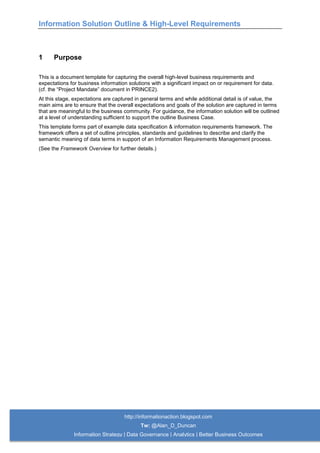
1 Purpose
This is a document template for capturing the overall high-level business requirements and
expectations for business information solutions with a significant impact on or requirement for data.
(cf. the “Project Mandate” document in PRINCE2).
At this stage, expectations are captured in general terms and while additional detail is of value, the
main aims are to ensure that the overall expectations and goals of the solution are captured in terms
that are meaningful to the business community. For guidance, the information solution will be outlined
at a level of understanding sufficient to support the outline Business Case.
This template forms part of example data specification & information requirements framework. The
framework offers a set of outline principles, standards and guidelines to describe and clarify the
semantic meaning of data terms in support of an Information Requirements Management process.
(See the Framework Overview for further details.)
Information Solution Outline & High-Level Requirements
http://informationaction.blogspot.com
Tw: @Alan_D_Duncan
Information Strategy | Data Governance | Analytics | Better Business Outcomes
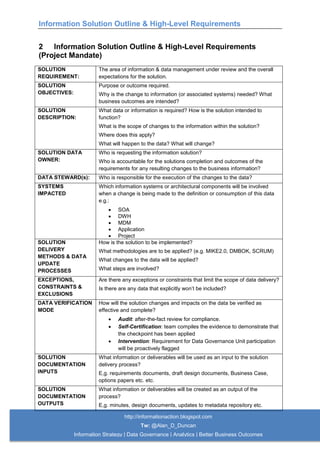
2 Information Solution Outline & High-Level Requirements
(Project Mandate)
SOLUTION
REQUIREMENT:
The area of information & data management under review and the overall
expectations for the solution.
SOLUTION
OBJECTIVES:
Purpose or outcome required.
Why is the change to information (or associated systems) needed? What
business outcomes are intended?
SOLUTION
DESCRIPTION:
What data or information is required? How is the solution intended to
function?
What is the scope of changes to the information within the solution?
Where does this apply?
What will happen to the data? What will change?
SOLUTION DATA
OWNER:
Who is requesting the information solution?
Who is accountable for the solutions completion and outcomes of the
requirements for any resulting changes to the business information?
DATA STEWARD(s): Who is responsible for the execution of the changes to the data?
SYSTEMS
IMPACTED
Which information systems or architectural components will be involved
when a change is being made to the definition or consumption of this data
e.g.:
 SOA
 DWH
 MDM
 Application
 Project
SOLUTION
DELIVERY
METHODS & DATA
UPDATE
PROCESSES
How is the solution to be implemented?
What methodologies are to be applied? (e.g. MIKE2.0, DMBOK, SCRUM)
What changes to the data will be applied?
What steps are involved?
EXCEPTIONS,
CONSTRAINTS &
EXCLUSIONS
Are there any exceptions or constraints that limit the scope of data delivery?
Is there are any data that explicitly won’t be included?
DATA VERIFICATION
MODE
How will the solution changes and impacts on the data be verified as
effective and complete?
 Audit: after-the-fact review for compliance.
 Self-Certification: team compiles the evidence to demonstrate that
the checkpoint has been applied
 Intervention: Requirement for Data Governance Unit participation
will be proactively flagged
SOLUTION
DOCUMENTATION
INPUTS
What information or deliverables will be used as an input to the solution
delivery process?
E,g. requirements documents, draft design documents, Business Case,
options papers etc. etc.
SOLUTION
DOCUMENTATION
OUTPUTS
What information or deliverables will be created as an output of the
process?
E,g. minutes, design documents, updates to metadata repository etc.
Information Solution Outline & High-Level Requirements
http://informationaction.blogspot.com
Tw: @Alan_D_Duncan
Information Strategy | Data Governance | Analytics | Better Business Outcomes
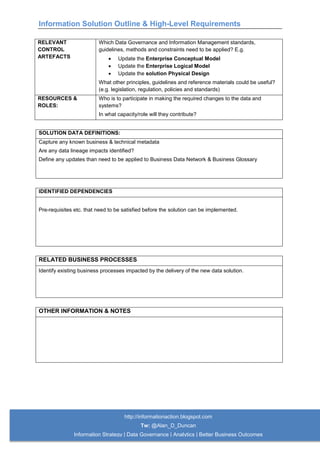
RELEVANT
CONTROL
ARTEFACTS
Which Data Governance and Information Management standards,
guidelines, methods and constraints need to be applied? E.g.
 Update the Enterprise Conceptual Model
 Update the Enterprise Logical Model
 Update the solution Physical Design
What other principles, guidelines and reference materials could be useful?
(e.g. legislation, regulation, policies and standards)
RESOURCES &
ROLES:
Who is to participate in making the required changes to the data and
systems?
In what capacity/role will they contribute?
SOLUTION DATA DEFINITIONS:
Capture any known business & technical metadata
Are any data lineage impacts identified?
Define any updates than need to be applied to Business Data Network & Business Glossary
IDENTIFIED DEPENDENCIES
Pre-requisites etc. that need to be satisfied before the solution can be implemented.
RELATED BUSINESS PROCESSES
Identify existing business processes impacted by the delivery of the new data solution.
OTHER INFORMATION & NOTES
Information Solution Outline & High-Level Requirements
http://informationaction.blogspot.com
Tw: @Alan_D_Duncan
Information Strategy | Data Governance | Analytics | Better Business Outcomes
About the author
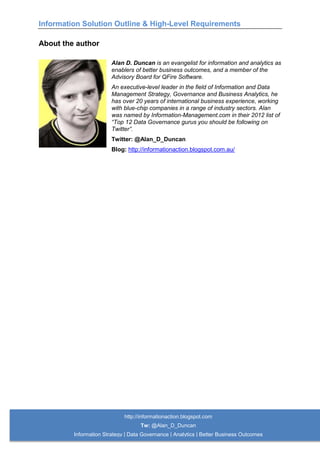
Alan D. Duncan is an evangelist for information and analytics as
enablers of better business outcomes, and a member of the
Advisory Board for QFire Software.
An executive-level leader in the field of Information and Data
Management Strategy, Governance and Business Analytics, he
has over 20 years of international business experience, working
with blue-chip companies in a range of industry sectors. Alan
was named by Information-Management.com in their 2012 list of
“Top 12 Data Governance gurus you should be following on
Twitter”.
Twitter: @Alan_D_Duncan
Blog: http://informationaction.blogspot.com.au/
Information Solution Outline & High-Level Requirements
http://informationaction.blogspot.com
Tw: @Alan_D_Duncan
Information Strategy | Data Governance | Analytics | Better Business Outcomes
Intellectual curiosity
Skeptical scrutiny
Critical thinking
http://www.informationaction.blogspot.com.au/
@Alan_D_Duncan
http://www.linkedin.com/in/alandduncan

02. Information solution outline template

  • 1.
    http://informationaction.blogspot.com Tw: @Alan_D_Duncan Information Strategy| Data Governance | Analytics | Better Business Outcomes Example Data Specifications & Information Requirements Framework INFORMATION SOLUTION OUTLINE & HIGH-LEVEL REQUIREMENTS TEMPLATE (Project Mandate) Alan D. Duncan This work is licensed under a Creative Commons Attribution-ShareAlike 4.0 International License.
  • 2.
    Information Solution Outline& High-Level Requirements http://informationaction.blogspot.com Tw: @Alan_D_Duncan Information Strategy | Data Governance | Analytics | Better Business Outcomes 1 Purpose This is a document template for capturing the overall high-level business requirements and expectations for business information solutions with a significant impact on or requirement for data. (cf. the “Project Mandate” document in PRINCE2). At this stage, expectations are captured in general terms and while additional detail is of value, the main aims are to ensure that the overall expectations and goals of the solution are captured in terms that are meaningful to the business community. For guidance, the information solution will be outlined at a level of understanding sufficient to support the outline Business Case. This template forms part of example data specification & information requirements framework. The framework offers a set of outline principles, standards and guidelines to describe and clarify the semantic meaning of data terms in support of an Information Requirements Management process. (See the Framework Overview for further details.)
  • 3.
    Information Solution Outline& High-Level Requirements http://informationaction.blogspot.com Tw: @Alan_D_Duncan Information Strategy | Data Governance | Analytics | Better Business Outcomes 2 Information Solution Outline & High-Level Requirements (Project Mandate) SOLUTION REQUIREMENT: The area of information & data management under review and the overall expectations for the solution. SOLUTION OBJECTIVES: Purpose or outcome required. Why is the change to information (or associated systems) needed? What business outcomes are intended? SOLUTION DESCRIPTION: What data or information is required? How is the solution intended to function? What is the scope of changes to the information within the solution? Where does this apply? What will happen to the data? What will change? SOLUTION DATA OWNER: Who is requesting the information solution? Who is accountable for the solutions completion and outcomes of the requirements for any resulting changes to the business information? DATA STEWARD(s): Who is responsible for the execution of the changes to the data? SYSTEMS IMPACTED Which information systems or architectural components will be involved when a change is being made to the definition or consumption of this data e.g.:  SOA  DWH  MDM  Application  Project SOLUTION DELIVERY METHODS & DATA UPDATE PROCESSES How is the solution to be implemented? What methodologies are to be applied? (e.g. MIKE2.0, DMBOK, SCRUM) What changes to the data will be applied? What steps are involved? EXCEPTIONS, CONSTRAINTS & EXCLUSIONS Are there any exceptions or constraints that limit the scope of data delivery? Is there are any data that explicitly won’t be included? DATA VERIFICATION MODE How will the solution changes and impacts on the data be verified as effective and complete?  Audit: after-the-fact review for compliance.  Self-Certification: team compiles the evidence to demonstrate that the checkpoint has been applied  Intervention: Requirement for Data Governance Unit participation will be proactively flagged SOLUTION DOCUMENTATION INPUTS What information or deliverables will be used as an input to the solution delivery process? E,g. requirements documents, draft design documents, Business Case, options papers etc. etc. SOLUTION DOCUMENTATION OUTPUTS What information or deliverables will be created as an output of the process? E,g. minutes, design documents, updates to metadata repository etc.
  • 4.
    Information Solution Outline& High-Level Requirements http://informationaction.blogspot.com Tw: @Alan_D_Duncan Information Strategy | Data Governance | Analytics | Better Business Outcomes RELEVANT CONTROL ARTEFACTS Which Data Governance and Information Management standards, guidelines, methods and constraints need to be applied? E.g.  Update the Enterprise Conceptual Model  Update the Enterprise Logical Model  Update the solution Physical Design What other principles, guidelines and reference materials could be useful? (e.g. legislation, regulation, policies and standards) RESOURCES & ROLES: Who is to participate in making the required changes to the data and systems? In what capacity/role will they contribute? SOLUTION DATA DEFINITIONS: Capture any known business & technical metadata Are any data lineage impacts identified? Define any updates than need to be applied to Business Data Network & Business Glossary IDENTIFIED DEPENDENCIES Pre-requisites etc. that need to be satisfied before the solution can be implemented. RELATED BUSINESS PROCESSES Identify existing business processes impacted by the delivery of the new data solution. OTHER INFORMATION & NOTES
  • 5.
    Information Solution Outline& High-Level Requirements http://informationaction.blogspot.com Tw: @Alan_D_Duncan Information Strategy | Data Governance | Analytics | Better Business Outcomes About the author Alan D. Duncan is an evangelist for information and analytics as enablers of better business outcomes, and a member of the Advisory Board for QFire Software. An executive-level leader in the field of Information and Data Management Strategy, Governance and Business Analytics, he has over 20 years of international business experience, working with blue-chip companies in a range of industry sectors. Alan was named by Information-Management.com in their 2012 list of “Top 12 Data Governance gurus you should be following on Twitter”. Twitter: @Alan_D_Duncan Blog: http://informationaction.blogspot.com.au/
  • 6.
    Information Solution Outline& High-Level Requirements http://informationaction.blogspot.com Tw: @Alan_D_Duncan Information Strategy | Data Governance | Analytics | Better Business Outcomes Intellectual curiosity Skeptical scrutiny Critical thinking http://www.informationaction.blogspot.com.au/ @Alan_D_Duncan http://www.linkedin.com/in/alandduncan