Sample Data
and
Data Modules
Why They’re so Important to a Project
Presenter: Mike Cook
Making S1000D Work for You
 There are several steps you must complete in order to
create a successful S1000D implementation
 Success is dependent on a willingness to address the
business rule decisions as defined in the specification
and as they apply to your project
 Addressing all the business rule decisions is important
but not all rules require being acknowledged
 There is an order in what should be addressed to
achieve success
How much S1000D does your project need?
 Business rules are a significant piece of the specification. There are
two important processes for developing business rules:
1. Create business rule design documents
2. Create business rule exchange data module
 Before either of these can be addressed, preliminary work should
be performed to determine whether or not it is feasible to spend
time on creating an S1000D solution.
How much S1000D does your project need?
– cont’d
If S1000D is mandated by the customer, then you should still go through
these steps to see what it’s going to cost, who is involved, etc.
 Initial analysis
• Creation of a problem statement
• Creation of a list of areas within the company affected by the problem
• Identify the owner(s) of the problem
 Proceed or reject project based on the following information
• Feasibility analysis
• Cost analysis
• Submit Request For Procurement (RFP) or Request For Information (RFI) -
if needed.
 If solution includes S1000D
• Review S1000D specification
• Find business rule decisions and address each accordingly
• Create "business rule design documents"
• Create "business rule exchange data module” from design documents
• Create XML sample data "data modules" for each schema and
publication in the project
Stepping Through Business Rule Decisions
 Each business rule decision should be evaluated in an XML file to
validate its use
 The sample file becomes a working prototype of how the data will or
will not be used – based on your business rule decisions
 It allows various groups to identify how systems will react to the data
 It provides a working model for authors, editors, information
architects, and programmers to play “what if” games
 Eventually it can be used as a teaching model to instruct authors
and others how data is stored or used within the XML
Authoring Business Rule Design Documents
 Formally documenting business rule decisions is the key to
successfully generating sample data
 Each decision must have at least one documented entry in a
Business Rule Design Document
 Enumerated values should be fully documented (including a
description for each enumeration)
 XML examples within the Business Rule Design Documents are an
important plus and can be used to help create sample data
Extrapolating Business Rule Decisions from Design
Documents into the BREX Data Module
 If a business rule decision has a QA component or is used by
authoring to create pick lists, the identified values should be entered
into the BREX data module
 Decisions where an element or attribute are used differently within
various publications or schemas require special handling if an entry
is to be put into the BREX data module – attention to how the XPath
expression is created is therefore critical
 Do you really need all business rule decisions to be put into the
BREX DM? No, there are alternatives to using the BREX DM.
 Do you need something more powerful than the BREX DM to
perform the necessary QA for your data?
Structuring your Business Rule Design Documents
 General Business Rule Design Documents
 Commonly used – for example, anything in the <identAndStatusSection>
 Publication specific Business Rule Design Documents
 Maintenance Manual
 Maintenance Planning Data
 Wiring Data Manual
 etc
 Encoding Business Rule Design Documents
 How to use the ipd.xsd
 How to use the wrngdata.xsd
 How to use the schedul.xsd
 etc
 Packaging Business Rules - Distributing Business Rules
 Web site
 PDF
 HTML Help
 Sharepoint
Creating Sample Data
1. Generate an empty data module
2. Populate its elements and attributes using your business rule
decisions – preferably at least one example of each decision
 Some XML editors allow you to create empty data modules using the
schema you select (just remember to use <dmodule> as the root)
3. Create multiple issues of each data module (000 through 003) to
see how change markup is going to work
4. Create Front Matter samples to see how you will structure the XML
for these data module types
5. Identify if you’ll use any automation to create wiring or parts data
modules
• Create samples of what these data modules by hand, so the teams
who will create the automation can see how content maps from their
system to the related schema
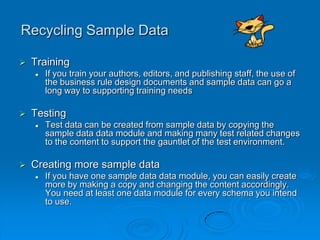
Recycling Sample Data
 Training
 If you train your authors, editors, and publishing staff, the use of
the business rule design documents and sample data can go a
long way to supporting training needs
 Testing
 Test data can be created from sample data by copying the
sample data data module and making many test related changes
to the content to support the gauntlet of the test environment.
 Creating more sample data
 If you have one sample data data module, you can easily create
more by making a copy and changing the content accordingly.
You need at least one data module for every schema you intend
to use.
Measuring Your Success
 Can members of the project easily find and work with sample data?
 Was it easy to communicate ideas regarding the authoring and
editing of data?
 Was it used to help teach authors and transform designers?
 Was it used during design sessions or meetings as a working model
for how to use various elements and attributes of the schemas?
 Was it used as examples within the Business Rule Design
Documents or were the examples in the design documents used to
create the sample data? (either is acceptable)
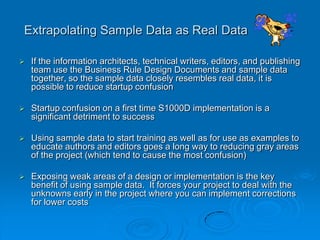
Extrapolating Sample Data as Real Data
 If the information architects, technical writers, editors, and publishing
team use the Business Rule Design Documents and sample data
together, so the sample data closely resembles real data, it is
possible to reduce startup confusion
 Startup confusion on a first time S1000D implementation is a
significant detriment to success
 Using sample data to start training as well as for use as examples to
educate authors and editors goes a long way to reducing gray areas
of the project (which tend to cause the most confusion)
 Exposing weak areas of a design or implementation is the key
benefit of using sample data. It forces your project to deal with the
unknowns early in the project where you can implement corrections
for lower costs
Giving it Context
<dmStatus issueType="new">
<security securityClassification="01"/>
<dataRestrictions>
<restrictionInstructions>
<dataDistribution>Snappy Buggy Corporation PROPRIETARY, CONFIDENTIAL, AND/OR TRADE
SECRET</dataDistribution>
<exportControl exportRegulationType="EAR" governmentAuthority="US">
<exportRegistrationStmt>
<simplePara>Export of this technology is controlled under the United States Export Administration Regulations
(EAR) (15 CFR 730-774). An export license may be required before it is used for development, production or use
by foreign persons from specific countries. The controller of this data has the individual responsibility to abide by
all export laws.</simplePara>
</exportRegistrationStmt>
<exportRegistrationCode exportRegulationCodeType="9E001"/>
</exportControl>
<dataHandling/>
<dataDestruction>Destroy by any means possible to prevent disclosure of contents or reconstruction of the
document.</dataDestruction>
<dataDisclosure>This information is furnished upon the condition that it not be released to another nation without
the specific authority of the Department of the (appropriate Service or agency) of the United States, that it be used
for military purposes only, that individual or corporate rights originating in the information, whether patented or not,
is respected, that the recipient report promptly to the United States, any known or suspected compromise, and the
information be provided substantially the same degree of security afforded it by the Department of Defense of the
United States. Also, regardless of any other markings on the document, it is not downgraded or declassified
without written approval of the originating United States agency.</dataDisclosure>
<supersedure/>
</restrictionInstructions>
What are the allowed values for
“exportRegulationCodeType”? You might
want sample data to explore all the values.
What are the allowed values for “securityClassification”? Should you
have an example indicating the highest security value you intend to use?
Should you use the commercial classification?
Do you need to see how your project will
handle “EAR” as well as “ECCN”?
How about all your boilerplate text for data destruction, data
disclosure, export registration statements, etc? Shouldn’t
you have samples of what those are going to look like?
Identifying Related Data
<qualityAssurance>
<firstVerification verificationType="tabtop"/>
<secondVerification verificationType="onobject"/>
</qualityAssurance>
<systemBreakdownCode>00-40-05</systemBreakdownCode>
<reasonForUpdate id="RFU-001">
<simplePara>Changed high side reading from 160 psi to 180 psi.</simplePara>
</reasonForUpdate>
</dmStatus>
</identAndStatusSection>
How does the reasonForUpdateRefIds attribute relate to the
<reasonForUpdate> element?
How will the changeMark attribute be used?
<faultMessageIndication>F-210000-01</faultMessageIndication>
<faultMessageBody changeMark="1" changeType="add" reasonForUpdateRefIds="RFU-001">T manifold high
side gauge reads less than 180 psi and low side gauge reads higher than 30 psi</faultMessageBody>
<faultCond>Possible low refrigerant charge condition</faultCond>
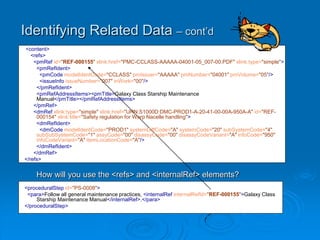
Identifying Related Data – cont’d
<content>
<refs>
<pmRef id="REF-000155" xlink:href="PMC-CCLASS-AAAAA-04001-05_007-00.PDF" xlink:type="simple">
<pmRefIdent>
<pmCode modelIdentCode="CCLASS" pmIssuer="AAAAA" pmNumber="04001" pmVolume="05"/>
<issueInfo issueNumber="007" inWork="00"/>
</pmRefIdent>
<pmRefAddressItems><pmTitle>Galaxy Class Starship Maintenance
Manual</pmTitle></pmRefAddressItems>
</pmRef>
<dmRef xlink:type="simple" xlink:href="URN:S1000D:DMC-PROD1-A-20-41-00-00A-950A-A" id="REF-
000154" xlink:title="Safety regulation for Warp Nacelle handling">
<dmRefIdent>
<dmCode modelIdentCode="PROD1" systemDiffCode="A" systemCode="20" subSystemCode="4"
subSubSystemCode="1" assyCode="00" disassyCode="00" disassyCodeVariant="A" infoCode="950"
infoCodeVariant="A" itemLocationCode="A"/>
</dmRefIdent>
</dmRef>
</refs>
How will you use the <refs> and <internalRef> elements?
<proceduralStep id="PS-0008">
<para>Follow all general maintenance practices, <internalRef internalRefId="REF-000155">Galaxy Class
Starship Maintenance Manual</internalRef>.</para>
</proceduralStep>
Limitations of Business Rule Design Documents
 Business Rule Design Documents are necessary, but are limited to
how much example XML can be provided without bloating the
document
 Business Rule Design Documents cannot indicate the complete
structure of an XML information set for a given file and all its
possible permutations
 Sample data is the only way to see all the relationships of data and
discuss them within the context of various information structure
scenarios before committing to a specific design
 Sample data is the fastest way to achieve success early in the
project and drive out a multitude of scenarios for a proposed
information architecture
The Cost of Not Creating Sample Data
 Slow startup and little progress
 Everyone pointing fingers
 Sliding schedules
 Increased costs
 Far more faults and bug reports
 Added stress on project planners, managers,
and developers
 Less likelihood of a bonus!
 Can’t put it on your résumé!
Thanks for Attending

Sample_Data_and_Data_Modules

  • 1.
    Sample Data and Data Modules WhyThey’re so Important to a Project Presenter: Mike Cook
  • 2.
    Making S1000D Workfor You  There are several steps you must complete in order to create a successful S1000D implementation  Success is dependent on a willingness to address the business rule decisions as defined in the specification and as they apply to your project  Addressing all the business rule decisions is important but not all rules require being acknowledged  There is an order in what should be addressed to achieve success
  • 3.
    How much S1000Ddoes your project need?  Business rules are a significant piece of the specification. There are two important processes for developing business rules: 1. Create business rule design documents 2. Create business rule exchange data module  Before either of these can be addressed, preliminary work should be performed to determine whether or not it is feasible to spend time on creating an S1000D solution.
  • 4.
    How much S1000Ddoes your project need? – cont’d If S1000D is mandated by the customer, then you should still go through these steps to see what it’s going to cost, who is involved, etc.  Initial analysis • Creation of a problem statement • Creation of a list of areas within the company affected by the problem • Identify the owner(s) of the problem  Proceed or reject project based on the following information • Feasibility analysis • Cost analysis • Submit Request For Procurement (RFP) or Request For Information (RFI) - if needed.  If solution includes S1000D • Review S1000D specification • Find business rule decisions and address each accordingly • Create "business rule design documents" • Create "business rule exchange data module” from design documents • Create XML sample data "data modules" for each schema and publication in the project
  • 5.
    Stepping Through BusinessRule Decisions  Each business rule decision should be evaluated in an XML file to validate its use  The sample file becomes a working prototype of how the data will or will not be used – based on your business rule decisions  It allows various groups to identify how systems will react to the data  It provides a working model for authors, editors, information architects, and programmers to play “what if” games  Eventually it can be used as a teaching model to instruct authors and others how data is stored or used within the XML
  • 6.
    Authoring Business RuleDesign Documents  Formally documenting business rule decisions is the key to successfully generating sample data  Each decision must have at least one documented entry in a Business Rule Design Document  Enumerated values should be fully documented (including a description for each enumeration)  XML examples within the Business Rule Design Documents are an important plus and can be used to help create sample data
  • 7.
    Extrapolating Business RuleDecisions from Design Documents into the BREX Data Module  If a business rule decision has a QA component or is used by authoring to create pick lists, the identified values should be entered into the BREX data module  Decisions where an element or attribute are used differently within various publications or schemas require special handling if an entry is to be put into the BREX data module – attention to how the XPath expression is created is therefore critical  Do you really need all business rule decisions to be put into the BREX DM? No, there are alternatives to using the BREX DM.  Do you need something more powerful than the BREX DM to perform the necessary QA for your data?
  • 8.
    Structuring your BusinessRule Design Documents  General Business Rule Design Documents  Commonly used – for example, anything in the <identAndStatusSection>  Publication specific Business Rule Design Documents  Maintenance Manual  Maintenance Planning Data  Wiring Data Manual  etc  Encoding Business Rule Design Documents  How to use the ipd.xsd  How to use the wrngdata.xsd  How to use the schedul.xsd  etc  Packaging Business Rules - Distributing Business Rules  Web site  PDF  HTML Help  Sharepoint
  • 9.
    Creating Sample Data 1.Generate an empty data module 2. Populate its elements and attributes using your business rule decisions – preferably at least one example of each decision  Some XML editors allow you to create empty data modules using the schema you select (just remember to use <dmodule> as the root) 3. Create multiple issues of each data module (000 through 003) to see how change markup is going to work 4. Create Front Matter samples to see how you will structure the XML for these data module types 5. Identify if you’ll use any automation to create wiring or parts data modules • Create samples of what these data modules by hand, so the teams who will create the automation can see how content maps from their system to the related schema
  • 10.
    Recycling Sample Data Training  If you train your authors, editors, and publishing staff, the use of the business rule design documents and sample data can go a long way to supporting training needs  Testing  Test data can be created from sample data by copying the sample data data module and making many test related changes to the content to support the gauntlet of the test environment.  Creating more sample data  If you have one sample data data module, you can easily create more by making a copy and changing the content accordingly. You need at least one data module for every schema you intend to use.
  • 11.
    Measuring Your Success Can members of the project easily find and work with sample data?  Was it easy to communicate ideas regarding the authoring and editing of data?  Was it used to help teach authors and transform designers?  Was it used during design sessions or meetings as a working model for how to use various elements and attributes of the schemas?  Was it used as examples within the Business Rule Design Documents or were the examples in the design documents used to create the sample data? (either is acceptable)
  • 12.
    Extrapolating Sample Dataas Real Data  If the information architects, technical writers, editors, and publishing team use the Business Rule Design Documents and sample data together, so the sample data closely resembles real data, it is possible to reduce startup confusion  Startup confusion on a first time S1000D implementation is a significant detriment to success  Using sample data to start training as well as for use as examples to educate authors and editors goes a long way to reducing gray areas of the project (which tend to cause the most confusion)  Exposing weak areas of a design or implementation is the key benefit of using sample data. It forces your project to deal with the unknowns early in the project where you can implement corrections for lower costs
  • 13.
    Giving it Context <dmStatusissueType="new"> <security securityClassification="01"/> <dataRestrictions> <restrictionInstructions> <dataDistribution>Snappy Buggy Corporation PROPRIETARY, CONFIDENTIAL, AND/OR TRADE SECRET</dataDistribution> <exportControl exportRegulationType="EAR" governmentAuthority="US"> <exportRegistrationStmt> <simplePara>Export of this technology is controlled under the United States Export Administration Regulations (EAR) (15 CFR 730-774). An export license may be required before it is used for development, production or use by foreign persons from specific countries. The controller of this data has the individual responsibility to abide by all export laws.</simplePara> </exportRegistrationStmt> <exportRegistrationCode exportRegulationCodeType="9E001"/> </exportControl> <dataHandling/> <dataDestruction>Destroy by any means possible to prevent disclosure of contents or reconstruction of the document.</dataDestruction> <dataDisclosure>This information is furnished upon the condition that it not be released to another nation without the specific authority of the Department of the (appropriate Service or agency) of the United States, that it be used for military purposes only, that individual or corporate rights originating in the information, whether patented or not, is respected, that the recipient report promptly to the United States, any known or suspected compromise, and the information be provided substantially the same degree of security afforded it by the Department of Defense of the United States. Also, regardless of any other markings on the document, it is not downgraded or declassified without written approval of the originating United States agency.</dataDisclosure> <supersedure/> </restrictionInstructions> What are the allowed values for “exportRegulationCodeType”? You might want sample data to explore all the values. What are the allowed values for “securityClassification”? Should you have an example indicating the highest security value you intend to use? Should you use the commercial classification? Do you need to see how your project will handle “EAR” as well as “ECCN”? How about all your boilerplate text for data destruction, data disclosure, export registration statements, etc? Shouldn’t you have samples of what those are going to look like?
  • 14.
    Identifying Related Data <qualityAssurance> <firstVerificationverificationType="tabtop"/> <secondVerification verificationType="onobject"/> </qualityAssurance> <systemBreakdownCode>00-40-05</systemBreakdownCode> <reasonForUpdate id="RFU-001"> <simplePara>Changed high side reading from 160 psi to 180 psi.</simplePara> </reasonForUpdate> </dmStatus> </identAndStatusSection> How does the reasonForUpdateRefIds attribute relate to the <reasonForUpdate> element? How will the changeMark attribute be used? <faultMessageIndication>F-210000-01</faultMessageIndication> <faultMessageBody changeMark="1" changeType="add" reasonForUpdateRefIds="RFU-001">T manifold high side gauge reads less than 180 psi and low side gauge reads higher than 30 psi</faultMessageBody> <faultCond>Possible low refrigerant charge condition</faultCond>
  • 15.
    Identifying Related Data– cont’d <content> <refs> <pmRef id="REF-000155" xlink:href="PMC-CCLASS-AAAAA-04001-05_007-00.PDF" xlink:type="simple"> <pmRefIdent> <pmCode modelIdentCode="CCLASS" pmIssuer="AAAAA" pmNumber="04001" pmVolume="05"/> <issueInfo issueNumber="007" inWork="00"/> </pmRefIdent> <pmRefAddressItems><pmTitle>Galaxy Class Starship Maintenance Manual</pmTitle></pmRefAddressItems> </pmRef> <dmRef xlink:type="simple" xlink:href="URN:S1000D:DMC-PROD1-A-20-41-00-00A-950A-A" id="REF- 000154" xlink:title="Safety regulation for Warp Nacelle handling"> <dmRefIdent> <dmCode modelIdentCode="PROD1" systemDiffCode="A" systemCode="20" subSystemCode="4" subSubSystemCode="1" assyCode="00" disassyCode="00" disassyCodeVariant="A" infoCode="950" infoCodeVariant="A" itemLocationCode="A"/> </dmRefIdent> </dmRef> </refs> How will you use the <refs> and <internalRef> elements? <proceduralStep id="PS-0008"> <para>Follow all general maintenance practices, <internalRef internalRefId="REF-000155">Galaxy Class Starship Maintenance Manual</internalRef>.</para> </proceduralStep>
  • 16.
    Limitations of BusinessRule Design Documents  Business Rule Design Documents are necessary, but are limited to how much example XML can be provided without bloating the document  Business Rule Design Documents cannot indicate the complete structure of an XML information set for a given file and all its possible permutations  Sample data is the only way to see all the relationships of data and discuss them within the context of various information structure scenarios before committing to a specific design  Sample data is the fastest way to achieve success early in the project and drive out a multitude of scenarios for a proposed information architecture
  • 17.
    The Cost ofNot Creating Sample Data  Slow startup and little progress  Everyone pointing fingers  Sliding schedules  Increased costs  Far more faults and bug reports  Added stress on project planners, managers, and developers  Less likelihood of a bonus!  Can’t put it on your résumé!
  • 18.