ITALY
Italy leaves its mark.
Kate S. Magpoc
BSTM- 3A
so ITALY?
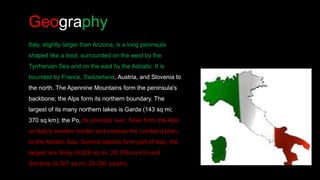
Geography
Italy, slightly larger than Arizona, is a long peninsula
shaped like a boot, surrounded on the west by the
Tyrrhenian Sea and on the east by the Adriatic. It is
bounded by France, Switzerland, Austria, and Slovenia to
the north. The Apennine Mountains form the peninsula's
backbone; the Alps form its northern boundary. The
largest of its many northern lakes is Garda (143 sq mi;
370 sq km); the Po, its principal river, flows from the Alps
on Italy's western border and crosses the Lombard plain
to the Adriatic Sea. Several islands form part of Italy; the
largest are Sicily (9,926 sq mi; 25,708 sq km) and
Sardinia (9,301 sq mi; 24,090 sq km).
Government:
Italy has been a unitary parliamentary republic since 2 June
1946, when the monarchy was abolished by a constitutional
referendum. The President of Italy (Presidente della
Repubblica), currently Sergio Mattarella since 2015, is
Italy's head of state. The President is elected for a single
seven years mandate by the Parliament of Italy in joint
session. 6 formed by the representatives of all the anti-
fascist forces that contributed to the defeat of Nazi and
Fascist forces during the Civil War.
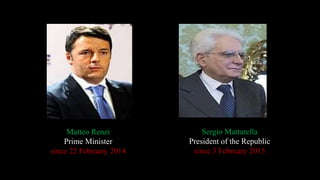
Matteo Renzi
Prime Minister
since 22 February 2014
Sergio Mattarella
President of the Republic
since 3 February 2015
History
The migrations of Indo-European peoples into Italy probably began about 2000 B.C. and continued until 1000 B.C. From
about the 9th century B.C. until it was overthrown by the Romans in the 3rd century B.C. , the Etruscan civilization was
dominant. By 264 B.C. , all Italy south of Cisalpine Gaul was under the leadership of Rome. For the next seven centuries,
until the barbarian invasions destroyed the western Roman Empire in the 4th and 5th centuries A.D. , the history of Italy
is largely the history of Rome. From 800 on, the Holy Roman Emperors, Roman Catholic popes, Normans, and Saracens
all vied for control over various segments of the Italian peninsula. Numerous city-states, such as Venice and Genoa,
whose political and commercial rivalries were intense, and many small principalities flourished in the late Middle Ages.
Although Italy remained politically fragmented for centuries, it became the cultural center of the Western world from the
13th to the 16th century.
Italy Becomes a Unified Peninsula
In 1713, after the War of the Spanish Succession, Milan, Naples, and Sardinia were handed over to the Hapsburgs of
Austria, which lost some of its Italian territories in 1735. After 1800, Italy was unified by Napoléon, who crowned
himself king of Italy in 1805; but with the Congress of Vienna in 1815, Austria once again became the dominant power in
a disunited Italy. Austrian armies crushed Italian uprisings in 1820–1821 and 1831. In the 1830s, Giuseppe Mazzini, a
brilliant liberal nationalist, organized the Risorgimento (Resurrection), which laid the foundation for Italian unity.
Disappointed Italian patriots looked to the House of Savoy for leadership. Count Camille di Cavour (1810–1861), prime
minister of Sardinia in 1852 and the architect of a united Italy, joined England and France in the Crimean War (1853–
1856), and in 1859 helped France in a war against Austria, thereby obtaining Lombardy. By plebiscite in 1860, Modena,
Parma, Tuscany, and the Romagna voted to join Sardinia. In 1860, Giuseppe Garibaldi conquered Sicily and Naples and
turned them over to Sardinia. Victor Emmanuel II, king of Sardinia, was proclaimed king of Italy in 1861. The annexation
of Venetia in 1866 and of papal Rome in 1870 marked the complete unification of peninsular Italy into one nation under a
constitutional monarchy.
The Rise and Fall of Mussolini
Italy declared its neutrality upon the outbreak of World War I on the grounds that Germany had
embarked upon an offensive war. In 1915, Italy entered the war on the side of the Allies but obtained
less territory than it expected in the postwar settlement. Benito (“Il Duce”) Mussolini, a former
Socialist, organized discontented Italians in 1919 into the Fascist Party to “rescue Italy from
Bolshevism.” He led his Black Shirts in a march on Rome and, on Oct. 28, 1922, became prime minister.
He transformed Italy into a dictatorship, embarking on an expansionist foreign policy with the invasion
and annexation of Ethiopia in 1935 and allying himself with Adolf Hitler in the Rome-Berlin Axis in 1936.
When the Allies invaded Italy in 1943, Mussolini's dictatorship collapsed; he was executed by partisans
on April 28, 1945, at Dongo on Lake Como. Following the armistice with the Allies (Sept. 3, 1943), Italy
joined the war against Germany as a cobelligerent. A June 1946 plebiscite rejected monarchy and a
republic was proclaimed. The peace treaty of Sept. 15, 1947, required Italian renunciation of all claims
in Ethiopia and Greece and the cession of the Dodecanese islands to Greece and of five small Alpine
areas to France. The Trieste area west of the new Yugoslav territory was made a free territory (until
1954, when the city and a 90-square-mile zone were transferred to Italy and the rest to Yugoslavia).
Italy Moves to Stabilize Its Economy
Italy became an integral member of NATO and the European Economic
Community (later the EU) as it successfully rebuilt its postwar economy. A
prolonged outbreak of terrorist activities by the left-wing Red Brigades
threatened domestic stability in the 1970s, but by the early 1980s the terrorist
groups had been suppressed. “Revolving door” governments, political instability,
scandal, and corruption characterized Italian politics in the 1980s and 1990s.
Italy adopted the euro as its currency in Jan. 1999. Treasury Secretary Carlo
Ciampi, who is credited with the economic reforms that permitted Italy to enter
the European Monetary Union, was elected president in May 1999. Italy joined
its NATO partners in the Kosovo crisis. Aviano Air Base in northern Italy was a
crucial base for launching air strikes into Kosovo and Yugoslavia.
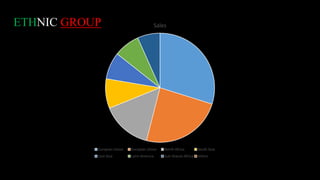
Sales
Europian Union Europian Union North Africa South Asia
East Asia Latin America Sub-Sharan Africa others
ETHNIC GROUP
Italy's official language is Italian It is estimated that there are about 64 million
native Italian speakers while the total number of Italian speakers, including
those who use it as a second language, is about 85 million. Italy has numerous
regional dialects, however, the establishment of a national education system
has led to decrease in variation in the languages spoken across the country
during the 20th century. Standardization was further expanded in the 1950s
and 1960s thanks to economic growth and the rise of mass media and
television (the state broadcaster helped set a standard Italian).
LANGUAGE
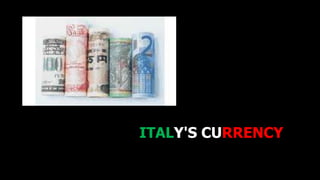
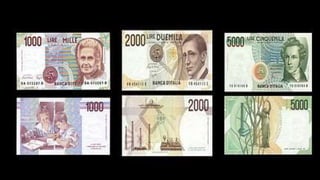
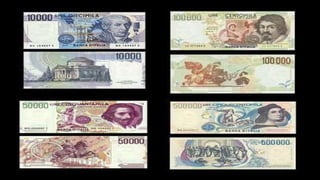
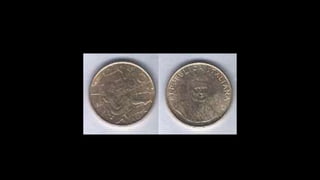
ITALY'S CURRENCY
Currency
Italy is one of the 12 EU countries that joined the EMU
– the Economic and Monetary Union – which
introduced the single currency, the Euro.
Sample Prices
It is always a good idea to budget for a trip so you don’t run out of money. Here are a few
sample prices to help you plan your Italian vacation:
Mozzarella = €1.54
A slice of pizza to take away = €1.70
1 bottle of local Italian wine = €2.50
Museum entry ticket = €10 to €15
Football (soccer) matches = €12 to €70 depending on the seat or teams playing.
Average room prices = anywhere from €20 at the lower end, to €100 mid-range and €200 at the
high end.
Average meal prices = €5 for a cheap meal, around €15 for mid-range and €25 and upwards at a
classy joint!
These prices are in Euros, are correct as of 03/18/09 and are subject to change
Tipping
Italians don't generally tip huge amounts, that's if they tip at
all. Many restaurants will charge a service fee as part of the bill,
but often this will go straight to the owner rather than the staff. If
you’re keen to tip it is customary to leave a 10-15% tip in a sit-
down restaurant, taxi-drivers will get 5-10% depending on the city,
and water taxi in Venice is already so expensive but you could give
them a euro or two extra if you have any money left.
http://www.justlanded.com/english/Italy/Italy-
Guide/Culture/The-Italians
www.euroeducation.net/prof/italco.htm
www.istruzione.it
http://www.giovanisi.it/files/2011/10/The-istitutional-mapping-
of-Italy_s-education-system_Bifulco.pdf

ITALY

  • 1.
    ITALY Italy leaves itsmark. Kate S. Magpoc BSTM- 3A
  • 10.
  • 11.
    Geography Italy, slightly largerthan Arizona, is a long peninsula shaped like a boot, surrounded on the west by the Tyrrhenian Sea and on the east by the Adriatic. It is bounded by France, Switzerland, Austria, and Slovenia to the north. The Apennine Mountains form the peninsula's backbone; the Alps form its northern boundary. The largest of its many northern lakes is Garda (143 sq mi; 370 sq km); the Po, its principal river, flows from the Alps on Italy's western border and crosses the Lombard plain to the Adriatic Sea. Several islands form part of Italy; the largest are Sicily (9,926 sq mi; 25,708 sq km) and Sardinia (9,301 sq mi; 24,090 sq km).
  • 12.
    Government: Italy has beena unitary parliamentary republic since 2 June 1946, when the monarchy was abolished by a constitutional referendum. The President of Italy (Presidente della Repubblica), currently Sergio Mattarella since 2015, is Italy's head of state. The President is elected for a single seven years mandate by the Parliament of Italy in joint session. 6 formed by the representatives of all the anti- fascist forces that contributed to the defeat of Nazi and Fascist forces during the Civil War.
  • 13.
    Matteo Renzi Prime Minister since22 February 2014 Sergio Mattarella President of the Republic since 3 February 2015
  • 14.
    History The migrations ofIndo-European peoples into Italy probably began about 2000 B.C. and continued until 1000 B.C. From about the 9th century B.C. until it was overthrown by the Romans in the 3rd century B.C. , the Etruscan civilization was dominant. By 264 B.C. , all Italy south of Cisalpine Gaul was under the leadership of Rome. For the next seven centuries, until the barbarian invasions destroyed the western Roman Empire in the 4th and 5th centuries A.D. , the history of Italy is largely the history of Rome. From 800 on, the Holy Roman Emperors, Roman Catholic popes, Normans, and Saracens all vied for control over various segments of the Italian peninsula. Numerous city-states, such as Venice and Genoa, whose political and commercial rivalries were intense, and many small principalities flourished in the late Middle Ages. Although Italy remained politically fragmented for centuries, it became the cultural center of the Western world from the 13th to the 16th century.
  • 15.
    Italy Becomes aUnified Peninsula In 1713, after the War of the Spanish Succession, Milan, Naples, and Sardinia were handed over to the Hapsburgs of Austria, which lost some of its Italian territories in 1735. After 1800, Italy was unified by Napoléon, who crowned himself king of Italy in 1805; but with the Congress of Vienna in 1815, Austria once again became the dominant power in a disunited Italy. Austrian armies crushed Italian uprisings in 1820–1821 and 1831. In the 1830s, Giuseppe Mazzini, a brilliant liberal nationalist, organized the Risorgimento (Resurrection), which laid the foundation for Italian unity. Disappointed Italian patriots looked to the House of Savoy for leadership. Count Camille di Cavour (1810–1861), prime minister of Sardinia in 1852 and the architect of a united Italy, joined England and France in the Crimean War (1853– 1856), and in 1859 helped France in a war against Austria, thereby obtaining Lombardy. By plebiscite in 1860, Modena, Parma, Tuscany, and the Romagna voted to join Sardinia. In 1860, Giuseppe Garibaldi conquered Sicily and Naples and turned them over to Sardinia. Victor Emmanuel II, king of Sardinia, was proclaimed king of Italy in 1861. The annexation of Venetia in 1866 and of papal Rome in 1870 marked the complete unification of peninsular Italy into one nation under a constitutional monarchy.
  • 16.
    The Rise andFall of Mussolini Italy declared its neutrality upon the outbreak of World War I on the grounds that Germany had embarked upon an offensive war. In 1915, Italy entered the war on the side of the Allies but obtained less territory than it expected in the postwar settlement. Benito (“Il Duce”) Mussolini, a former Socialist, organized discontented Italians in 1919 into the Fascist Party to “rescue Italy from Bolshevism.” He led his Black Shirts in a march on Rome and, on Oct. 28, 1922, became prime minister. He transformed Italy into a dictatorship, embarking on an expansionist foreign policy with the invasion and annexation of Ethiopia in 1935 and allying himself with Adolf Hitler in the Rome-Berlin Axis in 1936. When the Allies invaded Italy in 1943, Mussolini's dictatorship collapsed; he was executed by partisans on April 28, 1945, at Dongo on Lake Como. Following the armistice with the Allies (Sept. 3, 1943), Italy joined the war against Germany as a cobelligerent. A June 1946 plebiscite rejected monarchy and a republic was proclaimed. The peace treaty of Sept. 15, 1947, required Italian renunciation of all claims in Ethiopia and Greece and the cession of the Dodecanese islands to Greece and of five small Alpine areas to France. The Trieste area west of the new Yugoslav territory was made a free territory (until 1954, when the city and a 90-square-mile zone were transferred to Italy and the rest to Yugoslavia).
  • 17.
    Italy Moves toStabilize Its Economy Italy became an integral member of NATO and the European Economic Community (later the EU) as it successfully rebuilt its postwar economy. A prolonged outbreak of terrorist activities by the left-wing Red Brigades threatened domestic stability in the 1970s, but by the early 1980s the terrorist groups had been suppressed. “Revolving door” governments, political instability, scandal, and corruption characterized Italian politics in the 1980s and 1990s. Italy adopted the euro as its currency in Jan. 1999. Treasury Secretary Carlo Ciampi, who is credited with the economic reforms that permitted Italy to enter the European Monetary Union, was elected president in May 1999. Italy joined its NATO partners in the Kosovo crisis. Aviano Air Base in northern Italy was a crucial base for launching air strikes into Kosovo and Yugoslavia.
  • 18.
    Sales Europian Union EuropianUnion North Africa South Asia East Asia Latin America Sub-Sharan Africa others ETHNIC GROUP
  • 19.
    Italy's official languageis Italian It is estimated that there are about 64 million native Italian speakers while the total number of Italian speakers, including those who use it as a second language, is about 85 million. Italy has numerous regional dialects, however, the establishment of a national education system has led to decrease in variation in the languages spoken across the country during the 20th century. Standardization was further expanded in the 1950s and 1960s thanks to economic growth and the rise of mass media and television (the state broadcaster helped set a standard Italian). LANGUAGE
  • 20.
  • 21.
    Currency Italy is oneof the 12 EU countries that joined the EMU – the Economic and Monetary Union – which introduced the single currency, the Euro.
  • 22.
    Sample Prices It isalways a good idea to budget for a trip so you don’t run out of money. Here are a few sample prices to help you plan your Italian vacation: Mozzarella = €1.54 A slice of pizza to take away = €1.70 1 bottle of local Italian wine = €2.50 Museum entry ticket = €10 to €15 Football (soccer) matches = €12 to €70 depending on the seat or teams playing. Average room prices = anywhere from €20 at the lower end, to €100 mid-range and €200 at the high end. Average meal prices = €5 for a cheap meal, around €15 for mid-range and €25 and upwards at a classy joint! These prices are in Euros, are correct as of 03/18/09 and are subject to change
  • 23.
    Tipping Italians don't generallytip huge amounts, that's if they tip at all. Many restaurants will charge a service fee as part of the bill, but often this will go straight to the owner rather than the staff. If you’re keen to tip it is customary to leave a 10-15% tip in a sit- down restaurant, taxi-drivers will get 5-10% depending on the city, and water taxi in Venice is already so expensive but you could give them a euro or two extra if you have any money left.
  • 27.