Italy
The presentation was prepared
Student OA-51 group
Kulynych Serhiy
- 2015 -
Geographical location
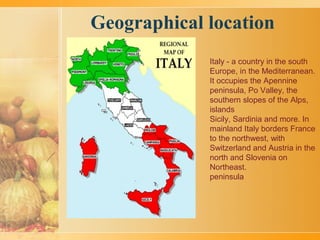
Italy - a country in the south
Europe, in the Mediterranean.
It occupies the Apennine
peninsula, Po Valley, the
southern slopes of the Alps,
islands
Sicily, Sardinia and more. In
mainland Italy borders France
to the northwest, with
Switzerland and Austria in the
north and Slovenia on
Northeast.
peninsula
Political system
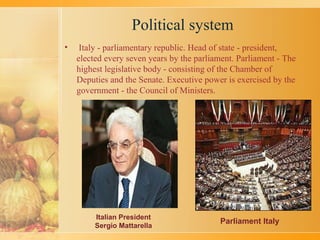
• Italy - parliamentary republic. Head of state - president,
elected every seven years by the parliament. Parliament - The
highest legislative body - consisting of the Chamber of
Deputies and the Senate. Executive power is exercised by the
government - the Council of Ministers.
Italian President
Sergio Mattarella
Parliament Italy
History
• History begins in Italy around 500 BC. E. e., when
laid the foundations of the Roman Empire. In 1861
the King of Sardinia Victor Emanuele II proclaimed
state. By 1870 Italy was already virtually present
boundaries, and in July 1871 Rome became the
capital of united Italy. In June 1946, Italy was
proclaimed a republic.
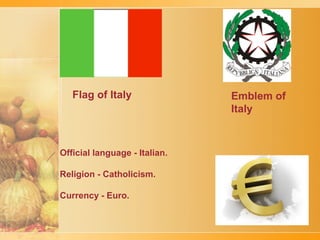
Emblem of
Italy
Flag of Italy
Official language - Italian.
Religion - Catholicism.
Currency - Euro.
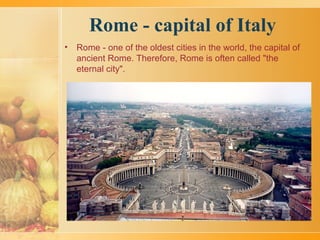
Rome - capital of Italy
• Rome - one of the oldest cities in the world, the capital of
ancient Rome. Therefore, Rome is often called "the
eternal city".
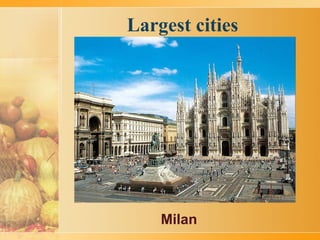
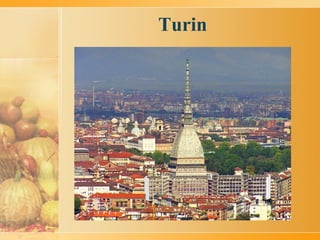
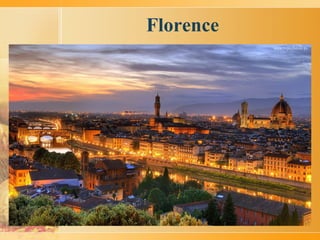
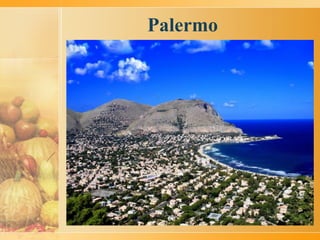
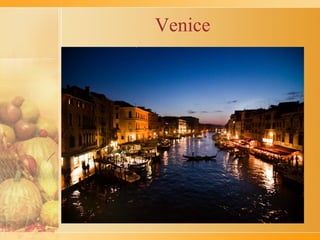
Largest cities
Milan
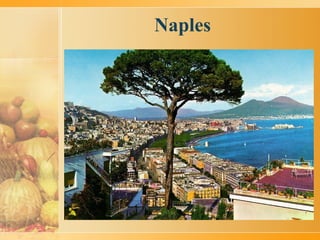
Naples
Turin
Florence
Palermo
Venice
Economy
• A characteristic feature of placing the economy of
Italy - territorial disparity between North and South
of the country. Northern Italy is not inferior in
terms of the largest countries in Europe, while
Southern Italy close to the less developed countries
such as Greece and Portugal. Italy - highly
developed industrial-agrarian country, part of the
volume of industrial production in the 10 most
developed countries.
Industry and agriculture
• The most advanced machinery, petroleum refining,
petrochemical, chemical, cement, textile, clothing,
leather and footwear industry. Well developed food
industry, including wine. The basis of agriculture -
crop. Major crops: wheat, corn, rice, sugar beet.
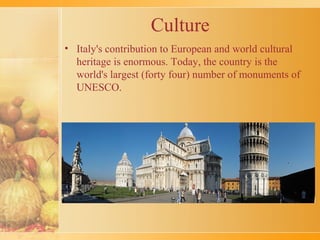
• Italy's contribution to European and world cultural
heritage is enormous. Today, the country is the
world's largest (forty four) number of monuments of
UNESCO.
Culture
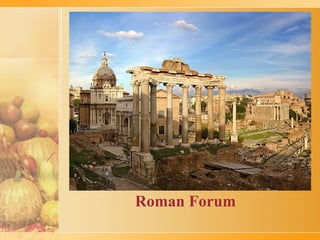
Roman Forum
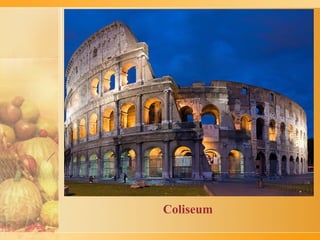
Coliseum
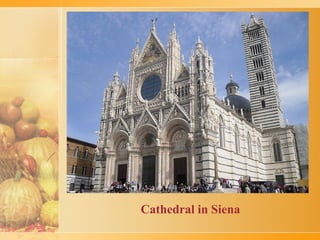
Cathedral in Siena
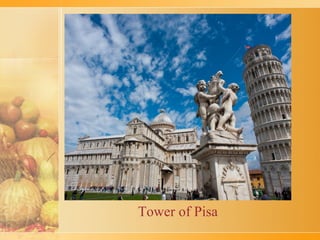
Tower of Pisa
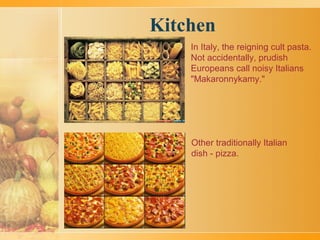
Kitchen
In Italy, the reigning cult pasta.
Not accidentally, prudish
Europeans call noisy Italians
"Makaronnykamy."
Other traditionally Italian
dish - pizza.
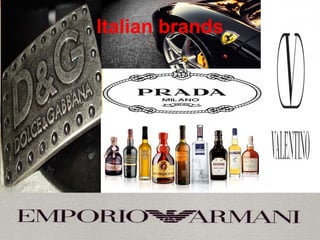
Italian brands
EU membership
• Italy - one of the most important members of the European
Union (EU), the country which initiated its creation. In
1951, with the establishment of the European Coal and
Steel Community (YEOUS) Treaty of Paris was signed with
six Member States: Belgium, France, Germany, Italy,
Luxembourg and the Netherlands.
• With the accession to the EU Italy received significant benefits:
• - Accelerated the concentration of production;
• - Opened a free, not burdened by trade barriers, access to the
European market;
• - Intensified agricultural development of Italy;
• - Expanded technical modernization of production and so on.
• Italy is in fourth place in the EU, but it
• benefited from the integration, effectively using advantages of
international division of labor.
Italy Presentetion

Italy Presentetion

  • 1.
    Italy The presentation wasprepared Student OA-51 group Kulynych Serhiy - 2015 -
  • 2.
    Geographical location Italy -a country in the south Europe, in the Mediterranean. It occupies the Apennine peninsula, Po Valley, the southern slopes of the Alps, islands Sicily, Sardinia and more. In mainland Italy borders France to the northwest, with Switzerland and Austria in the north and Slovenia on Northeast. peninsula
  • 3.
    Political system • Italy- parliamentary republic. Head of state - president, elected every seven years by the parliament. Parliament - The highest legislative body - consisting of the Chamber of Deputies and the Senate. Executive power is exercised by the government - the Council of Ministers. Italian President Sergio Mattarella Parliament Italy
  • 4.
    History • History beginsin Italy around 500 BC. E. e., when laid the foundations of the Roman Empire. In 1861 the King of Sardinia Victor Emanuele II proclaimed state. By 1870 Italy was already virtually present boundaries, and in July 1871 Rome became the capital of united Italy. In June 1946, Italy was proclaimed a republic.
  • 5.
    Emblem of Italy Flag ofItaly Official language - Italian. Religion - Catholicism. Currency - Euro.
  • 6.
    Rome - capitalof Italy • Rome - one of the oldest cities in the world, the capital of ancient Rome. Therefore, Rome is often called "the eternal city".
  • 7.
  • 8.
  • 9.
  • 10.
  • 11.
  • 12.
  • 13.
    Economy • A characteristicfeature of placing the economy of Italy - territorial disparity between North and South of the country. Northern Italy is not inferior in terms of the largest countries in Europe, while Southern Italy close to the less developed countries such as Greece and Portugal. Italy - highly developed industrial-agrarian country, part of the volume of industrial production in the 10 most developed countries.
  • 14.
    Industry and agriculture •The most advanced machinery, petroleum refining, petrochemical, chemical, cement, textile, clothing, leather and footwear industry. Well developed food industry, including wine. The basis of agriculture - crop. Major crops: wheat, corn, rice, sugar beet.
  • 15.
    • Italy's contributionto European and world cultural heritage is enormous. Today, the country is the world's largest (forty four) number of monuments of UNESCO. Culture
  • 16.
  • 17.
  • 18.
  • 19.
  • 20.
    Kitchen In Italy, thereigning cult pasta. Not accidentally, prudish Europeans call noisy Italians "Makaronnykamy." Other traditionally Italian dish - pizza.
  • 21.
  • 22.
    EU membership • Italy- one of the most important members of the European Union (EU), the country which initiated its creation. In 1951, with the establishment of the European Coal and Steel Community (YEOUS) Treaty of Paris was signed with six Member States: Belgium, France, Germany, Italy, Luxembourg and the Netherlands.
  • 23.
    • With theaccession to the EU Italy received significant benefits: • - Accelerated the concentration of production; • - Opened a free, not burdened by trade barriers, access to the European market; • - Intensified agricultural development of Italy; • - Expanded technical modernization of production and so on. • Italy is in fourth place in the EU, but it • benefited from the integration, effectively using advantages of international division of labor.