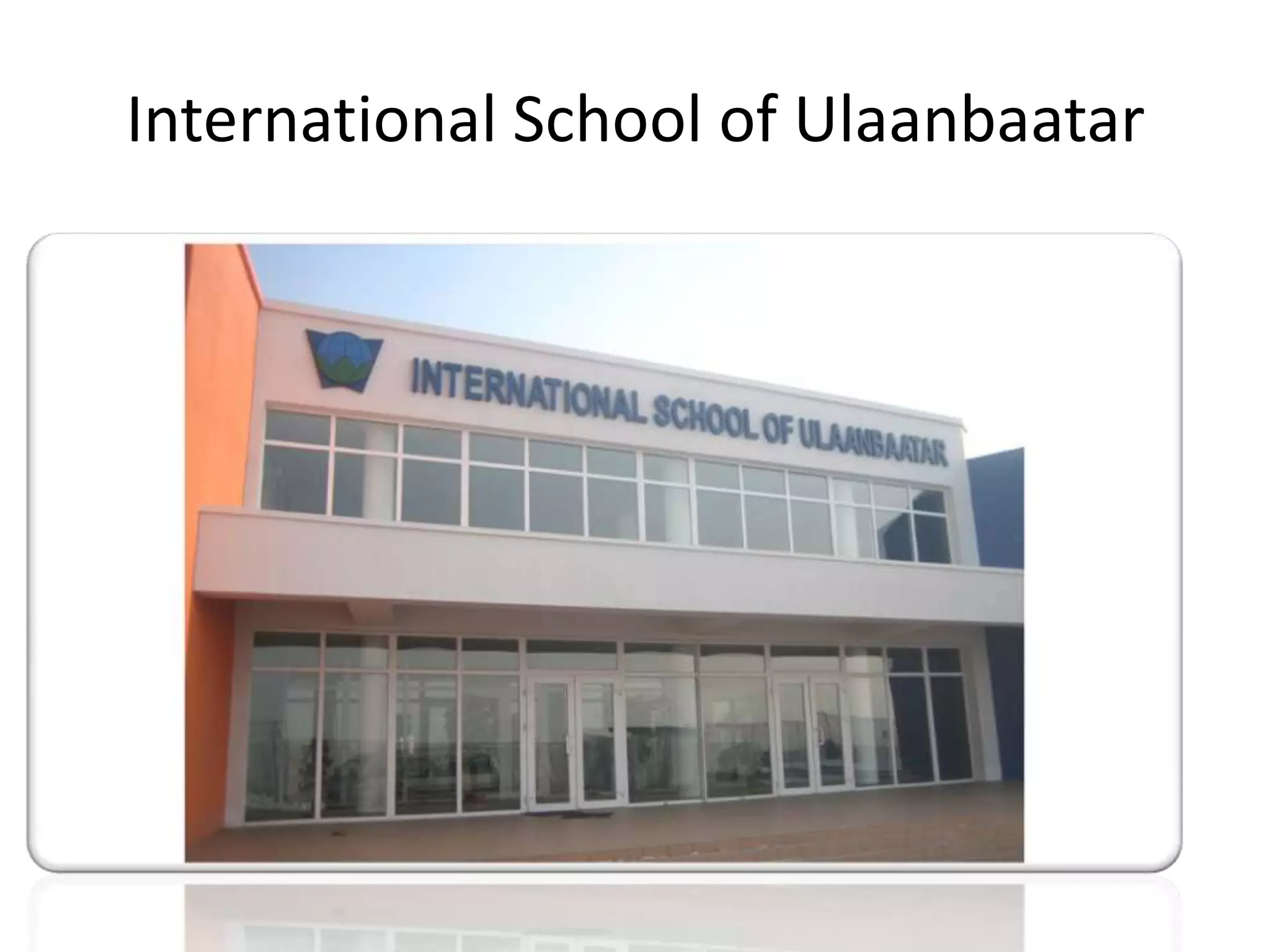
International School of Ulaanbaatar
Please note that
• Information we provide today is only extracts
  from different documents for different areas
  of the school and the full documents are in
  student parent handbook.
School History
• The International School of Ulaanbaatar (ISU)
  is a private, non-profit, secular, co-educational
  school.
• The International School of Ulaanbaatar
  started in 1992.
• We moved into this current building in 2007.
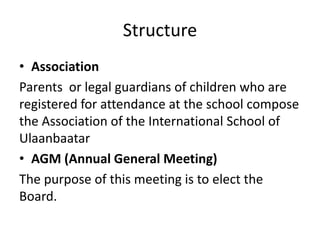
Structure
• Association
Parents or legal guardians of children who are
registered for attendance at the school compose
the Association of the International School of
Ulaanbaatar
• AGM (Annual General Meeting)
The purpose of this meeting is to elect the
Board.
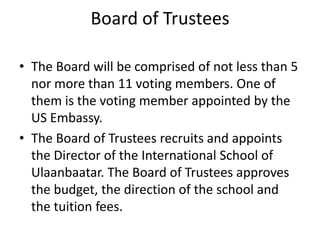
Board of Trustees

• The Board will be comprised of not less than 5
  nor more than 11 voting members. One of
  them is the voting member appointed by the
  US Embassy.
• The Board of Trustees recruits and appoints
  the Director of the International School of
  Ulaanbaatar. The Board of Trustees approves
  the budget, the direction of the school and
  the tuition fees.
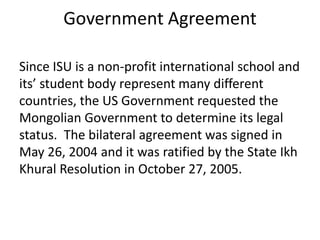
Government Agreement

Since ISU is a non-profit international school and
its’ student body represent many different
countries, the US Government requested the
Mongolian Government to determine its legal
status. The bilateral agreement was signed in
May 26, 2004 and it was ratified by the State Ikh
Khural Resolution in October 27, 2005.
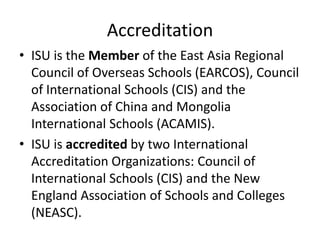
Accreditation
• ISU is the Member of the East Asia Regional
  Council of Overseas Schools (EARCOS), Council
  of International Schools (CIS) and the
  Association of China and Mongolia
  International Schools (ACAMIS).
• ISU is accredited by two International
  Accreditation Organizations: Council of
  International Schools (CIS) and the New
  England Association of Schools and Colleges
  (NEASC).
Accreditation visit this year
• 10 year accreditation visit will take place in
  October along with IB (International
  Baccalaureate) Reauthorization.
Program
• ISU is one of 161 IB World Schools. A school
  can be called "IB World School" if only it has
  all three programs:

• PYP (Primary Years Program) PK-G5
• MYP (Middle Years Program) G6-10
• DP (Diploma Program) G11-12
Assessment & Reporting
• Assessment for academic progress
• Rubrics
• Criteria-based assessments
• Homework (Primary Planner has all
  homeworks written by the teachers and TA-s
  and Secondary students write themselves)
• Assignment is given with the rubrics for
  assessment and deadline for submission
• Reports for Primary
• Reports for Secondary
Report Cards
• Primary will have two reports: Semester 1 and
  Semester 2
• Secondary will have Autumn Mid Semester
  Report and Semester 1, and Spring Mid
  Semester Report and Semester 2 report
• Please note that these Semester reports are
  important documents and you need to keep
  them. School cannot provide duplicates after
  certain number of years.
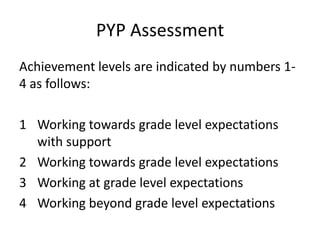
PYP Assessment
Achievement levels are indicated by numbers 1-
4 as follows:

1 Working towards grade level expectations
  with support
2 Working towards grade level expectations
3 Working at grade level expectations
4 Working beyond grade level expectations
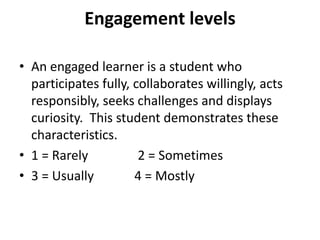
Engagement levels

• An engaged learner is a student who
  participates fully, collaborates willingly, acts
  responsibly, seeks challenges and displays
  curiosity. This student demonstrates these
  characteristics.
• 1 = Rarely           2 = Sometimes
• 3 = Usually         4 = Mostly
MYP Assessment (Grades 6-9)
• Students are judged against a set of criteria
• Each subject has its own set of criteria
• The criteria are modified in grade 6-9 to make
  them age appropriate
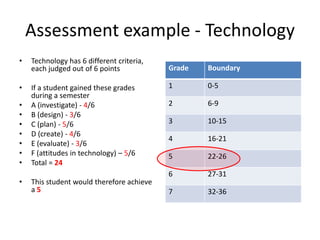
Assessment example - Technology
•   Technology has 6 different criteria,
    each judged out of 6 points            Grade   Boundary

•   If a student gained these grades       1       0-5
    during a semester
•   A (investigate) - 4/6                  2       6-9
•   B (design) - 3/6
•   C (plan) - 5/6                         3       10-15
•   D (create) - 4/6
                                           4       16-21
•   E (evaluate) - 3/6
•   F (attitudes in technology) – 5/6      5       22-26
•   Total = 24
                                           6       27-31
•   This student would therefore achieve
    a5                                     7       32-36
Approaches to learning (ATL) grade
• When awarding the ATL grade the classroom teacher has taken into
  consideration the following student behaviors, where applicable.

•   Punctuality to class
•   Organization of classroom equipment
•   Organization of notes and files
•   Completion of class work and homework
•   Motivation to be successful
•   Contributes positively to class in both group and individual situations
•   Effective use of the student planner
•   Reflection and implementation of teacher feedback
•   Sense of responsibility for own learning
Approaches to learning grade
• Approaches to learning refers to the students study habits and
  attitudes.
• The awarded grades mean the following:

The student is…
• E (Exceeds) - conscientious in all areas all of the time
• M (Meets) - conscientious in all areas most of the time
• B (Below) - noticeable lapses in many areas
DP Assessment
Assessment—a term used to cover all the
various methods by which student achievement
can be evaluated.
Assessment instruments may include:
•tests
•examinations
•extended practical work
•projects
•portfolios and oral work
DP Assessment (continue)
• There are some highly formalized assessment
  tasks, including multiple-choice tests, but
  there are also many more substantial open-
  ended tasks, and a focus on process through
  teacher marking of student projects and
  practical work.
• This range of student performances is reduced
  to a final subject grade (on a scale of 1 to 7)
  according to grade descriptors, which
  represent the standards for each subject.
Tips for understanding your child’s
              report
• Ask your child to explain
• In Primary if your child got 1 or 2, this means
  his/her performance is not at the Grade level
• In Secondary, if your child got 1 or 2 he/she
  performed well below the standard in that
  area and a conference needs to be held with
  the teacher; if it is 3 then his/her future
  progress in this course is at risk
Attendance
ISU has a very strict attendance policy.
Students are required to attend at least 90% of
each school year, or from date of enrolment, to
obtain a pass in that grade level.
This means there is a 10% allowance for
absences that are either explained/unexplained
or unexcused. This means that in any ONE
school year of 180 days, a student can be absent
for up to 18 days.
Attendance (continue)
• Any student who fails to make the required
  90% total school daily attendance will risk not
  being promoted to the next grade or meeting
  graduation requirements.

• LATE STUDENTS – arrival to school after 8.20
  am
• 5 lates = 1 day absence
Sickness/Medication
• Inform the school if your child is sick
• ISU will not give any medication without
  parent consent
• Filling in Medical/Allergy inform forms
  correctly and completely with true
  information on admission, for field trips,
  whenever significant change in students'
  health
Parent Involvement
• Reading Medee and all other correspondences
  regularly and specially on Fridays because we
  send most of the notes on Fridays
• Making follow up clarification if needed
• Checking school calendar on webpage
• Reading the forms and signing them on time
  (For example: Your child will not be taken to
  the trip if you don't sign the permission slip)
Parent Involvement (continue)
• PTG (Parent Teacher Group) meets once a
  month and organizes fundraising activities
  that help school to enrich students learning
  experiences
• Program information night (requirements and
  assessments will be introduced in details)
• AGM (Annual General Meeting)
Parent Involvement (continue)
• Student led conferences (only once during a
  School Year)
• Assemblies (as announced in the Medee)
• School events (International Week, Primary &
  Secondary Plays etc.)
• Student Planner checking every week for the
  whole week in secondary and signing it
• Checking and signing Student Planner
  everyday in Primary is required.
Communication
• Parent student handbook
• Student Planner notes
• Website:            www.isumongolia.edu.mn
• Medee        (Sent electronically to all parents
  on Fridays in both English & Mongolian)
• Facebook (You can access via webpage or
  direct signing in:     www.facebook.com
Communication (continue)
• Please contact the Coordinators and the
  Heads of the schools if you have any
  questions/queries about your children's
  program and performance and we are happy
  to provide a translator if you let us know
  beforehand
• This powerpoint presentation will be on our
  website

ISU - School information slideshow (English version)

  • 1.
  • 2.
    Please note that •Information we provide today is only extracts from different documents for different areas of the school and the full documents are in student parent handbook.
  • 3.
    School History • TheInternational School of Ulaanbaatar (ISU) is a private, non-profit, secular, co-educational school. • The International School of Ulaanbaatar started in 1992. • We moved into this current building in 2007.
  • 4.
    Structure • Association Parents orlegal guardians of children who are registered for attendance at the school compose the Association of the International School of Ulaanbaatar • AGM (Annual General Meeting) The purpose of this meeting is to elect the Board.
  • 5.
    Board of Trustees •The Board will be comprised of not less than 5 nor more than 11 voting members. One of them is the voting member appointed by the US Embassy. • The Board of Trustees recruits and appoints the Director of the International School of Ulaanbaatar. The Board of Trustees approves the budget, the direction of the school and the tuition fees.
  • 6.
    Government Agreement Since ISUis a non-profit international school and its’ student body represent many different countries, the US Government requested the Mongolian Government to determine its legal status. The bilateral agreement was signed in May 26, 2004 and it was ratified by the State Ikh Khural Resolution in October 27, 2005.
  • 7.
    Accreditation • ISU isthe Member of the East Asia Regional Council of Overseas Schools (EARCOS), Council of International Schools (CIS) and the Association of China and Mongolia International Schools (ACAMIS). • ISU is accredited by two International Accreditation Organizations: Council of International Schools (CIS) and the New England Association of Schools and Colleges (NEASC).
  • 8.
    Accreditation visit thisyear • 10 year accreditation visit will take place in October along with IB (International Baccalaureate) Reauthorization.
  • 9.
    Program • ISU isone of 161 IB World Schools. A school can be called "IB World School" if only it has all three programs: • PYP (Primary Years Program) PK-G5 • MYP (Middle Years Program) G6-10 • DP (Diploma Program) G11-12
  • 10.
    Assessment & Reporting •Assessment for academic progress • Rubrics • Criteria-based assessments • Homework (Primary Planner has all homeworks written by the teachers and TA-s and Secondary students write themselves) • Assignment is given with the rubrics for assessment and deadline for submission • Reports for Primary • Reports for Secondary
  • 11.
    Report Cards • Primarywill have two reports: Semester 1 and Semester 2 • Secondary will have Autumn Mid Semester Report and Semester 1, and Spring Mid Semester Report and Semester 2 report • Please note that these Semester reports are important documents and you need to keep them. School cannot provide duplicates after certain number of years.
  • 12.
    PYP Assessment Achievement levelsare indicated by numbers 1- 4 as follows: 1 Working towards grade level expectations with support 2 Working towards grade level expectations 3 Working at grade level expectations 4 Working beyond grade level expectations
  • 13.
    Engagement levels • Anengaged learner is a student who participates fully, collaborates willingly, acts responsibly, seeks challenges and displays curiosity. This student demonstrates these characteristics. • 1 = Rarely 2 = Sometimes • 3 = Usually 4 = Mostly
  • 14.
    MYP Assessment (Grades6-9) • Students are judged against a set of criteria • Each subject has its own set of criteria • The criteria are modified in grade 6-9 to make them age appropriate
  • 15.
    Assessment example -Technology • Technology has 6 different criteria, each judged out of 6 points Grade Boundary • If a student gained these grades 1 0-5 during a semester • A (investigate) - 4/6 2 6-9 • B (design) - 3/6 • C (plan) - 5/6 3 10-15 • D (create) - 4/6 4 16-21 • E (evaluate) - 3/6 • F (attitudes in technology) – 5/6 5 22-26 • Total = 24 6 27-31 • This student would therefore achieve a5 7 32-36
  • 16.
    Approaches to learning(ATL) grade • When awarding the ATL grade the classroom teacher has taken into consideration the following student behaviors, where applicable. • Punctuality to class • Organization of classroom equipment • Organization of notes and files • Completion of class work and homework • Motivation to be successful • Contributes positively to class in both group and individual situations • Effective use of the student planner • Reflection and implementation of teacher feedback • Sense of responsibility for own learning
  • 17.
    Approaches to learninggrade • Approaches to learning refers to the students study habits and attitudes. • The awarded grades mean the following: The student is… • E (Exceeds) - conscientious in all areas all of the time • M (Meets) - conscientious in all areas most of the time • B (Below) - noticeable lapses in many areas
  • 18.
    DP Assessment Assessment—a termused to cover all the various methods by which student achievement can be evaluated. Assessment instruments may include: •tests •examinations •extended practical work •projects •portfolios and oral work
  • 19.
    DP Assessment (continue) •There are some highly formalized assessment tasks, including multiple-choice tests, but there are also many more substantial open- ended tasks, and a focus on process through teacher marking of student projects and practical work. • This range of student performances is reduced to a final subject grade (on a scale of 1 to 7) according to grade descriptors, which represent the standards for each subject.
  • 20.
    Tips for understandingyour child’s report • Ask your child to explain • In Primary if your child got 1 or 2, this means his/her performance is not at the Grade level • In Secondary, if your child got 1 or 2 he/she performed well below the standard in that area and a conference needs to be held with the teacher; if it is 3 then his/her future progress in this course is at risk
  • 21.
    Attendance ISU has avery strict attendance policy. Students are required to attend at least 90% of each school year, or from date of enrolment, to obtain a pass in that grade level. This means there is a 10% allowance for absences that are either explained/unexplained or unexcused. This means that in any ONE school year of 180 days, a student can be absent for up to 18 days.
  • 22.
    Attendance (continue) • Anystudent who fails to make the required 90% total school daily attendance will risk not being promoted to the next grade or meeting graduation requirements. • LATE STUDENTS – arrival to school after 8.20 am • 5 lates = 1 day absence
  • 23.
    Sickness/Medication • Inform theschool if your child is sick • ISU will not give any medication without parent consent • Filling in Medical/Allergy inform forms correctly and completely with true information on admission, for field trips, whenever significant change in students' health
  • 24.
    Parent Involvement • ReadingMedee and all other correspondences regularly and specially on Fridays because we send most of the notes on Fridays • Making follow up clarification if needed • Checking school calendar on webpage • Reading the forms and signing them on time (For example: Your child will not be taken to the trip if you don't sign the permission slip)
  • 25.
    Parent Involvement (continue) •PTG (Parent Teacher Group) meets once a month and organizes fundraising activities that help school to enrich students learning experiences • Program information night (requirements and assessments will be introduced in details) • AGM (Annual General Meeting)
  • 26.
    Parent Involvement (continue) •Student led conferences (only once during a School Year) • Assemblies (as announced in the Medee) • School events (International Week, Primary & Secondary Plays etc.) • Student Planner checking every week for the whole week in secondary and signing it • Checking and signing Student Planner everyday in Primary is required.
  • 27.
    Communication • Parent studenthandbook • Student Planner notes • Website: www.isumongolia.edu.mn • Medee (Sent electronically to all parents on Fridays in both English & Mongolian) • Facebook (You can access via webpage or direct signing in: www.facebook.com
  • 28.
    Communication (continue) • Pleasecontact the Coordinators and the Heads of the schools if you have any questions/queries about your children's program and performance and we are happy to provide a translator if you let us know beforehand • This powerpoint presentation will be on our website