New Students of 2015
Update
A future approach to Admissions:
The time is Now
Board of Trustees
February 25, 2017
Jim Goecker
Vice President of Enrollment Management
May 2013 BOT meeting: Enrollment Management Update – Next Year
3
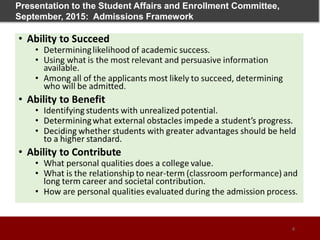
Presentation to the Student Affairs and Enrollment Committee,
September, 2015: Admissions Framework
4
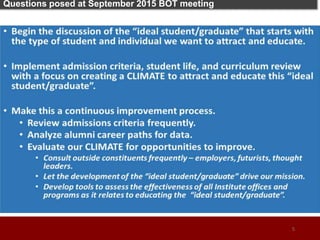
Questions posed at September 2015 BOT meeting
(How a class is formed: “What’s Next? – An Opportunity!)
5
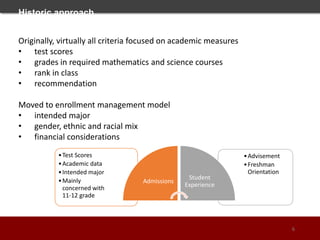
Historic approach
Originally, virtually all criteria focused on academic measures
• test scores
• grades in required mathematics and science courses
• rank in class
• recommendation
Moved to enrollment management model
• intended major
• gender, ethnic and racial mix
• financial considerations
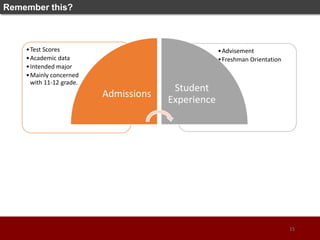
•Advisement
•Freshman
Orientation
•Test Scores
•Academic data
•Intended major
•Mainly
concerned with
11-12 grade
Admissions
Student
Experience
6
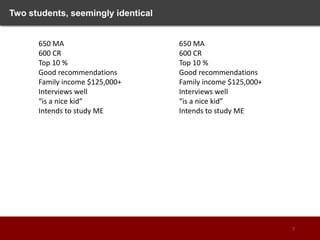
Two students, seemingly identical
650 MA
600 CR
Top 10 %
Good recommendations
Family income $125,000+
Interviews well
“is a nice kid”
Intends to study ME
650 MA
600 CR
Top 10 %
Good recommendations
Family income $125,000+
Interviews well
“is a nice kid”
Intends to study ME
7
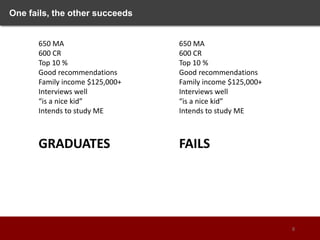
One fails, the other succeeds
650 MA
600 CR
Top 10 %
Good recommendations
Family income $125,000+
Interviews well
“is a nice kid”
Intends to study ME
GRADUATES
650 MA
600 CR
Top 10 %
Good recommendations
Family income $125,000+
Interviews well
“is a nice kid”
Intends to study ME
FAILS
8
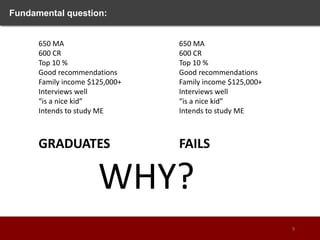
Fundamental question:
650 MA
600 CR
Top 10 %
Good recommendations
Family income $125,000+
Interviews well
“is a nice kid”
Intends to study ME
GRADUATES
650 MA
600 CR
Top 10 %
Good recommendations
Family income $125,000+
Interviews well
“is a nice kid”
Intends to study ME
FAILS
WHY?
9
Other questions
• When do you take a risk in admission?
• What is the decision based on?
• Are there other factors as important as
academic measures that contribute to
success?
10
College Board two years ago presented a framework for their future work
An example of a non-cognitive measurement tool:
Adversity Index – placing a student in the context of what he or
she has faced on their path to success.
Scores in Context – comparing test scores and student
performance in the context of others with similar opportunity.
Academic Curricular Index – comparing the rigor of the
student’s level of preparation relative to the opportunities available.
2 yr. to 4 yr. transfer facilitation – investigating additional
sources of data that can assist colleges in identifying and evaluating
students who have demonstrated post-secondary potential via
community college enrollment.
11
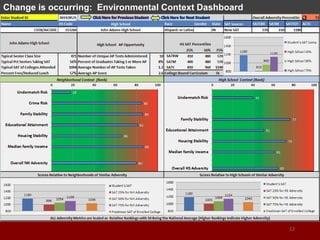
Change is occurring: Environmental Context Dashboard
12
Grit, persistence, maturity, locus of control, …
• The measurement of non-academic or non-
cognitive attributes are being viewed as the
next evolution in admission.
• Rose-Hulman has been a part of this evolution
with the use of the Locus of Control Inventory
and Curiosity Index.
13
A revision of our understanding of admissions
Lifecycle Admissions
• Admission should not be solely based on a student’s ability to be academically
successful at Rose-Hulman.
• We should also consider other aspects of life and the student’s talents in those
areas as well.
• Personality
• Attitude
• View of world
• Persistence
• We should better understand those attributes that lead students to a life of
fulfillment and success.
• We are admitting individuals whose personality, in the long run, will be as
much or more important to their future success as the academic preparation
we offer.
• Such traits should be measureable.
14
Remember this?
15
•Advisement
•Freshman Orientation
•Test Scores
•Academic data
•Intended major
•Mainly concerned
with 11-12 grade.
Admissions
Student
Experience
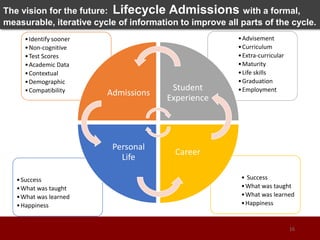
The vision for the future: Lifecycle Admissions with a formal,
measurable, iterative cycle of information to improve all parts of the cycle.
• Success
•What was taught
•What was learned
•Happiness
•Success
•What was taught
•What was learned
•Happiness
•Advisement
•Curriculum
•Extra-curricular
•Maturity
•Life skills
•Graduation
•Employment
•Identify sooner
•Non-cognitive
•Test Scores
•Academic Data
•Contextual
•Demographic
•Compatibility Admissions
Student
Experience
Career
Personal
Life
16
Work to do
17
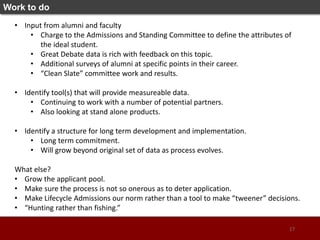
• Input from alumni and faculty
• Charge to the Admissions and Standing Committee to define the attributes of
the ideal student.
• Great Debate data is rich with feedback on this topic.
• Additional surveys of alumni at specific points in their career.
• “Clean Slate” committee work and results.
• Identify tool(s) that will provide measureable data.
• Continuing to work with a number of potential partners.
• Also looking at stand alone products.
• Identify a structure for long term development and implementation.
• Long term commitment.
• Will grow beyond original set of data as process evolves.
What else?
• Grow the applicant pool.
• Make sure the process is not so onerous as to deter application.
• Make Lifecycle Admissions our norm rather than a tool to make “tweener” decisions.
• “Hunting rather than fishing.”

Lifecycle admissions overview

  • 2.
    New Students of2015 Update A future approach to Admissions: The time is Now Board of Trustees February 25, 2017 Jim Goecker Vice President of Enrollment Management
  • 3.
    May 2013 BOTmeeting: Enrollment Management Update – Next Year 3
  • 4.
    Presentation to theStudent Affairs and Enrollment Committee, September, 2015: Admissions Framework 4
  • 5.
    Questions posed atSeptember 2015 BOT meeting (How a class is formed: “What’s Next? – An Opportunity!) 5
  • 6.
    Historic approach Originally, virtuallyall criteria focused on academic measures • test scores • grades in required mathematics and science courses • rank in class • recommendation Moved to enrollment management model • intended major • gender, ethnic and racial mix • financial considerations •Advisement •Freshman Orientation •Test Scores •Academic data •Intended major •Mainly concerned with 11-12 grade Admissions Student Experience 6
  • 7.
    Two students, seeminglyidentical 650 MA 600 CR Top 10 % Good recommendations Family income $125,000+ Interviews well “is a nice kid” Intends to study ME 650 MA 600 CR Top 10 % Good recommendations Family income $125,000+ Interviews well “is a nice kid” Intends to study ME 7
  • 8.
    One fails, theother succeeds 650 MA 600 CR Top 10 % Good recommendations Family income $125,000+ Interviews well “is a nice kid” Intends to study ME GRADUATES 650 MA 600 CR Top 10 % Good recommendations Family income $125,000+ Interviews well “is a nice kid” Intends to study ME FAILS 8
  • 9.
    Fundamental question: 650 MA 600CR Top 10 % Good recommendations Family income $125,000+ Interviews well “is a nice kid” Intends to study ME GRADUATES 650 MA 600 CR Top 10 % Good recommendations Family income $125,000+ Interviews well “is a nice kid” Intends to study ME FAILS WHY? 9
  • 10.
    Other questions • Whendo you take a risk in admission? • What is the decision based on? • Are there other factors as important as academic measures that contribute to success? 10
  • 11.
    College Board twoyears ago presented a framework for their future work An example of a non-cognitive measurement tool: Adversity Index – placing a student in the context of what he or she has faced on their path to success. Scores in Context – comparing test scores and student performance in the context of others with similar opportunity. Academic Curricular Index – comparing the rigor of the student’s level of preparation relative to the opportunities available. 2 yr. to 4 yr. transfer facilitation – investigating additional sources of data that can assist colleges in identifying and evaluating students who have demonstrated post-secondary potential via community college enrollment. 11
  • 12.
    Change is occurring:Environmental Context Dashboard 12
  • 13.
    Grit, persistence, maturity,locus of control, … • The measurement of non-academic or non- cognitive attributes are being viewed as the next evolution in admission. • Rose-Hulman has been a part of this evolution with the use of the Locus of Control Inventory and Curiosity Index. 13
  • 14.
    A revision ofour understanding of admissions Lifecycle Admissions • Admission should not be solely based on a student’s ability to be academically successful at Rose-Hulman. • We should also consider other aspects of life and the student’s talents in those areas as well. • Personality • Attitude • View of world • Persistence • We should better understand those attributes that lead students to a life of fulfillment and success. • We are admitting individuals whose personality, in the long run, will be as much or more important to their future success as the academic preparation we offer. • Such traits should be measureable. 14
  • 15.
    Remember this? 15 •Advisement •Freshman Orientation •TestScores •Academic data •Intended major •Mainly concerned with 11-12 grade. Admissions Student Experience
  • 16.
    The vision forthe future: Lifecycle Admissions with a formal, measurable, iterative cycle of information to improve all parts of the cycle. • Success •What was taught •What was learned •Happiness •Success •What was taught •What was learned •Happiness •Advisement •Curriculum •Extra-curricular •Maturity •Life skills •Graduation •Employment •Identify sooner •Non-cognitive •Test Scores •Academic Data •Contextual •Demographic •Compatibility Admissions Student Experience Career Personal Life 16
  • 17.
    Work to do 17 •Input from alumni and faculty • Charge to the Admissions and Standing Committee to define the attributes of the ideal student. • Great Debate data is rich with feedback on this topic. • Additional surveys of alumni at specific points in their career. • “Clean Slate” committee work and results. • Identify tool(s) that will provide measureable data. • Continuing to work with a number of potential partners. • Also looking at stand alone products. • Identify a structure for long term development and implementation. • Long term commitment. • Will grow beyond original set of data as process evolves. What else? • Grow the applicant pool. • Make sure the process is not so onerous as to deter application. • Make Lifecycle Admissions our norm rather than a tool to make “tweener” decisions. • “Hunting rather than fishing.”